NAVODAYA VIDYALAYA SAMITI, NOIDA
By
Ashish Rana, PGT-Biology
JNV- Dewas M.P
E-content
Class IX
Sub: Science
Chapter: Tissue
LEARNING OUTCOMES
Students will able to:
1. Define tissue and differentiate it from cell.
2. Differentiate between plant and animal tissue.
3. Classify, explain, compare and differentiate
various types of plant tissue like meristematic
simple permanent and complex permanent
tissue on the basis of structure ,location and
function.
4. Identify, explain, classify and describe the
function of different type of animal tissues like
epithelial, connective, muscular, nervous tissue
and draw their diagrams.
5. Expected skill development: Skill developing
scientific vocabulary ,critical thinking and
comprehension of text.
6. Development of creativity, reasoning, analytical
skill and accuracy of diagrams.
LEARNING OUTCOMES
TOPICS TO BE COVERED
• Tissue –Definition
• Are plant and animals made up of same types of tissues?
• Plant tissue
• Meristematic tissue
• Permanent tissue- simple and complex permanent tissue
• Animal tissues
• Epithelial tissue
• Connective tissue
• Muscular tissue And Nervous tissue
INTRODUCTION
•What is a cell?
•What are unicellular organism?
•What are multicellular organisms?
•Does multicellular organisms are made up of
same types of cells?
•What is the organization of multicellular
organisms?
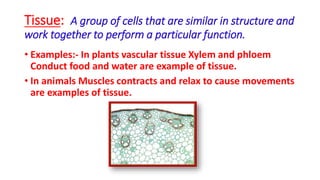
Tissue: A group of cells that are similar in structure and
work together to perform a particular function.
• Examples:- In plants vascular tissue Xylem and phloem
Conduct food and water are example of tissue.
• In animals Muscles contracts and relax to cause movements
are examples of tissue.
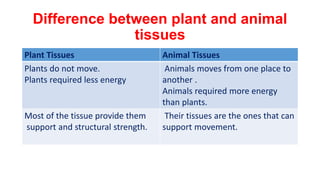
Difference between plant and animal
tissues
Plant Tissues Animal Tissues
Plants do not move.
Plants required less energy
Animals moves from one place to
another .
Animals required more energy
than plants.
Most of the tissue provide them
support and structural strength.
Their tissues are the ones that can
support movement.
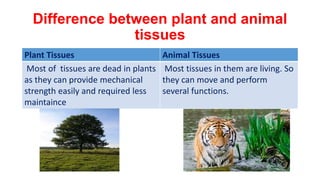
Difference between plant and animal
tissues
Plant Tissues Animal Tissues
Most of tissues are dead in plants
as they can provide mechanical
strength easily and required less
maintaince
Most tissues in them are living. So
they can move and perform
several functions.
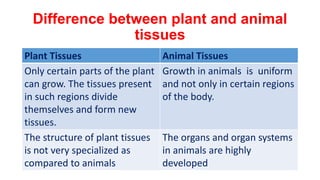
Difference between plant and animal
tissues
Plant Tissues Animal Tissues
Only certain parts of the plant
can grow. The tissues present
in such regions divide
themselves and form new
tissues.
Growth in animals is uniform
and not only in certain regions
of the body.
The structure of plant tissues
is not very specialized as
compared to animals
The organs and organ systems
in animals are highly
developed
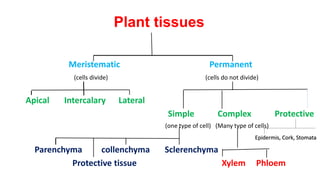
Plant tissues
Meristematic Permanent
(cells divide) (cells do not divide)
Apical Intercalary Lateral
Simple Complex Protective
(one type of cell) (Many type of cells)
Epidermis, Cork, Stomata
Parenchyma collenchyma Sclerenchyma
Protective tissue Xylem Phloem
Meristematic tissue (Meristem)
•Have the ability to divide and form new cells.
Cells of meristems are active having dense
cytoplasm thin cell wall and prominent nucleus.
•They lack vacuoles because it provide rigidity to
cell and prevent quick cell division.
•It increase length and width of plant.
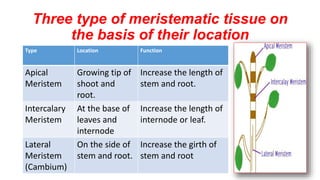
Three type of meristematic tissue on
the basis of their location
Type Location Function
Apical
Meristem
Growing tip of
shoot and
root.
Increase the length of
stem and root.
Intercalary
Meristem
At the base of
leaves and
internode
Increase the length of
internode or leaf.
Lateral
Meristem
(Cambium)
On the side of
stem and root.
Increase the girth of
stem and root
PERMANENT TISSUE
• Arise from meristematic tissue. Loss the ability to
divide.
• Have definite shape, size and function.
• The process by which meristematic tissue form
permanent tissue is called differentiation.
• It is of two types: -
• Simple and complex permanent tissue.
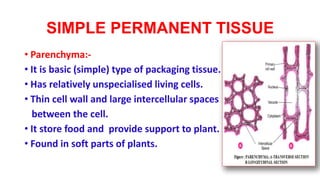
SIMPLE PERMANENT TISSUE
• Parenchyma:-
• It is basic (simple) type of packaging tissue.
• Has relatively unspecialised living cells.
• Thin cell wall and large intercellular spaces
between the cell.
• It store food and provide support to plant.
• Found in soft parts of plants.
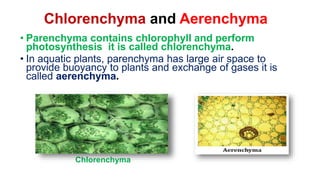
Chlorenchyma and Aerenchyma
• Parenchyma contains chlorophyll and perform
photosynthesis it is called chlorenchyma.
• In aquatic plants, parenchyma has large air space to
provide buoyancy to plants and exchange of gases it is
called aerenchyma.
Chlorenchyma
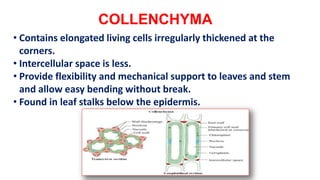
COLLENCHYMA
• Contains elongated living cells irregularly thickened at the
corners.
• Intercellular space is less.
• Provide flexibility and mechanical support to leaves and stem
and allow easy bending without break.
• Found in leaf stalks below the epidermis.
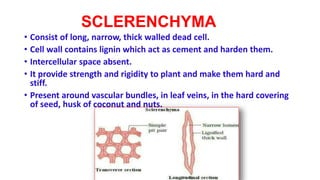
SCLERENCHYMA
• Consist of long, narrow, thick walled dead cell.
• Cell wall contains lignin which act as cement and harden them.
• Intercellular space absent.
• It provide strength and rigidity to plant and make them hard and
stiff.
• Present around vascular bundles, in leaf veins, in the hard covering
of seed, husk of coconut and nuts.
Protective Tissue
It is found on the surface of the roots, stems and leaves.
It consists of cells with thick walls.
It provides protection against mechanical injury or invasion by parasitic fungi.
Types of Protective TissueTYPE
EPIDERMIS
Characteristics :Cells are elongated and flattened with no intercellular spaces
between them.
Location :Present in the outermost layer of leaves, flowers, stem and roots.
Function :Protects the plant from desiccation and infection.
CORK :
Characteristics : Cells are rectangular with vacuolated protoplasts.
Location : It is the outermost layer formed after the epidermis undergoes certain
changes.
Function :Prevents desiccation, infection and mechanical injury.
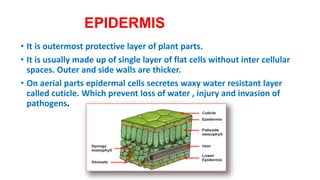
EPIDERMIS
• It is outermost protective layer of plant parts.
• It is usually made up of single layer of flat cells without inter cellular
spaces. Outer and side walls are thicker.
• On aerial parts epidermal cells secretes waxy water resistant layer
called cuticle. Which prevent loss of water , injury and invasion of
pathogens.
EPIDERMIS
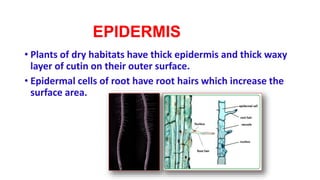
• Plants of dry habitats have thick epidermis and thick waxy
layer of cutin on their outer surface.
• Epidermal cells of root have root hairs which increase the
surface area.
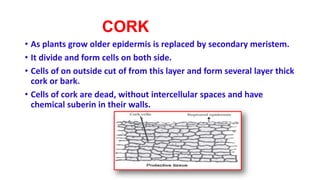
CORK
• As plants grow older epidermis is replaced by secondary meristem.
• It divide and form cells on both side.
• Cells of on outside cut of from this layer and form several layer thick
cork or bark.
• Cells of cork are dead, without intercellular spaces and have
chemical suberin in their walls.
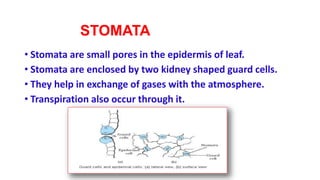
STOMATA
• Stomata are small pores in the epidermis of leaf.
• Stomata are enclosed by two kidney shaped guard cells.
• They help in exchange of gases with the atmosphere.
• Transpiration also occur through it.
COMPLEX PERMANENT TISSUE
•They are made up of more than one type of
cells.
•Xylem and phloem are examples.
•Both are conducting tissue and form vascular
bundles.
•They made possible survival of vascular plant in
terrestrial environment.
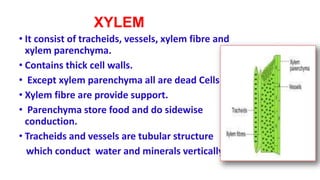
XYLEM
• It consist of tracheids, vessels, xylem fibre and
xylem parenchyma.
• Contains thick cell walls.
• Except xylem parenchyma all are dead Cells.
• Xylem fibre are provide support.
• Parenchyma store food and do sidewise
conduction.
• Tracheids and vessels are tubular structure
which conduct water and minerals vertically.
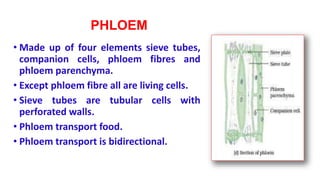
PHLOEM
• Made up of four elements sieve tubes,
companion cells, phloem fibres and
phloem parenchyma.
• Except phloem fibre all are living cells.
• Sieve tubes are tubular cells with
perforated walls.
• Phloem transport food.
• Phloem transport is bidirectional.
RECAPITULATION
•What is the unique feature of meristem?
• What are different types of permanent tissues?
•Name the dead elements of xylem and phloem.
• Name the protective tissue present in plants.
•State the characteristics of cells of epidermis.
•Name the chemical present in cork.
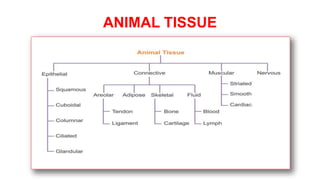
ANIMAL TISSUE
Epithelial tissue (Epithelium)
• It is the covering or protective tissue of animals.
• Made up of tightly packed cell which form
continuous layer with no intercellular spaces .
• Separated from underlying tissue by fibrous
basement membrane.
• The permeability of epithelial cells regulate the
exchange of material between body and
environment.
Types of epithelium
Type of
epithelium
Characteristics Location Function
Squamous
epithelium
Cells are thin and
flat.
Lungs alveoli,
Blood Vessels,
Oesophagus
Lining of mouth
Protection
Exchange of substances
between blood and
cells and at alveoli
Stratified
Squamous
epithelium
Flat cells arranged
in many layers to
prevent wear and
tear.
Skin Protection
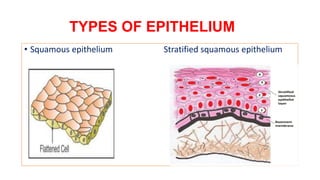
TYPES OF EPITHELIUM
• Squamous epithelium Stratified squamous epithelium
TYPES OF EPITHELIUM
Type of
epithelium
Characteristics Location Function
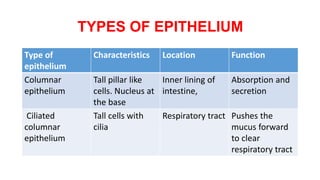
Columnar
epithelium
Tall pillar like
cells. Nucleus at
the base
Inner lining of
intestine,
Absorption and
secretion
Ciliated
columnar
epithelium
Tall cells with
cilia
Respiratory tract Pushes the
mucus forward
to clear
respiratory tract
Type of
epithelium
Characteristics Location Function
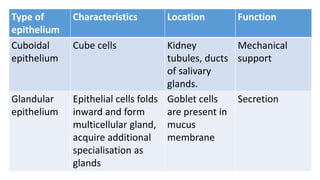
Cuboidal
epithelium
Cube cells Kidney
tubules, ducts
of salivary
glands.
Mechanical
support
Glandular
epithelium
Epithelial cells folds
inward and form
multicellular gland,
acquire additional
specialisation as
glands
Goblet cells
are present in
mucus
membrane
Secretion
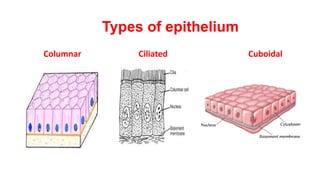
Types of epithelium
Columnar Ciliated Cuboidal
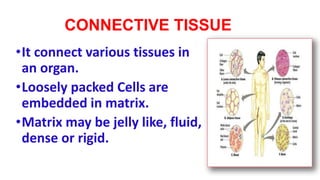
CONNECTIVE TISSUE
•It connect various tissues in
an organ.
•Loosely packed Cells are
embedded in matrix.
•Matrix may be jelly like, fluid,
dense or rigid.
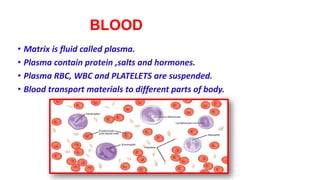
BLOOD
• Matrix is fluid called plasma.
• Plasma contain protein ,salts and hormones.
• Plasma RBC, WBC and PLATELETS are suspended.
• Blood transport materials to different parts of body.
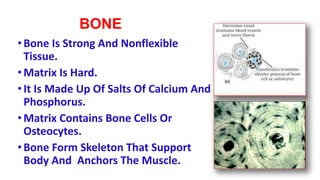
BONE
•Bone Is Strong And Nonflexible
Tissue.
•Matrix Is Hard.
•It Is Made Up Of Salts Of Calcium And
Phosphorus.
•Matrix Contains Bone Cells Or
Osteocytes.
•Bone Form Skeleton That Support
Body And Anchors The Muscle.
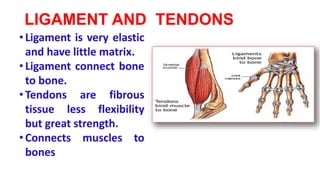
LIGAMENT AND TENDONS
•Ligament is very elastic
and have little matrix.
•Ligament connect bone
to bone.
•Tendons are fibrous
tissue less flexibility
but great strength.
•Connects muscles to
bones
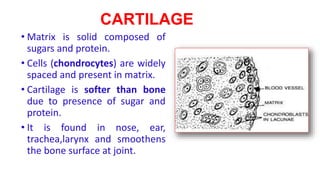
CARTILAGE
• Matrix is solid composed of
sugars and protein.
• Cells (chondrocytes) are widely
spaced and present in matrix.
• Cartilage is softer than bone
due to presence of sugar and
protein.
• It is found in nose, ear,
trachea,larynx and smoothens
the bone surface at joint.
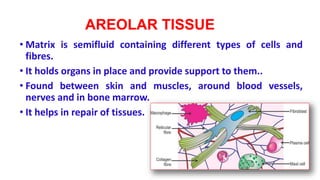
AREOLAR TISSUE
• Matrix is semifluid containing different types of cells and
fibres.
• It holds organs in place and provide support to them..
• Found between skin and muscles, around blood vessels,
nerves and in bone marrow.
• It helps in repair of tissues.
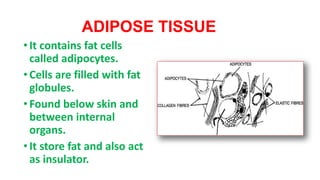
ADIPOSE TISSUE
•It contains fat cells
called adipocytes.
•Cells are filled with fat
globules.
•Found below skin and
between internal
organs.
•It store fat and also act
as insulator.
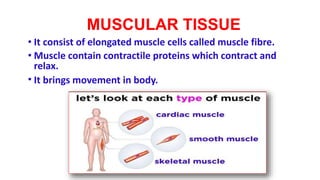
MUSCULAR TISSUE
• It consist of elongated muscle cells called muscle fibre.
• Muscle contain contractile proteins which contract and
relax.
• It brings movement in body.
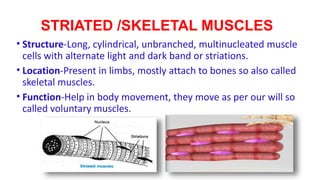
STRIATED /SKELETAL MUSCLES
• Structure-Long, cylindrical, unbranched, multinucleated muscle
cells with alternate light and dark band or striations.
• Location-Present in limbs, mostly attach to bones so also called
skeletal muscles.
• Function-Help in body movement, they move as per our will so
called voluntary muscles.
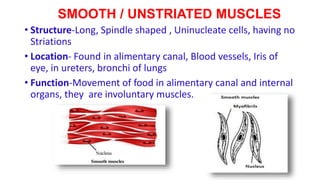
SMOOTH / UNSTRIATED MUSCLES
• Structure-Long, Spindle shaped , Uninucleate cells, having no
Striations
• Location- Found in alimentary canal, Blood vessels, Iris of
eye, in ureters, bronchi of lungs
• Function-Movement of food in alimentary canal and internal
organs, they are involuntary muscles.
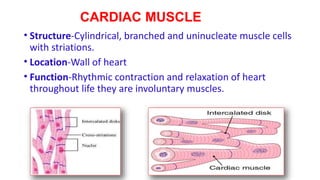
CARDIAC MUSCLE
• Structure-Cylindrical, branched and uninucleate muscle cells
with striations.
• Location-Wall of heart
• Function-Rhythmic contraction and relaxation of heart
throughout life they are involuntary muscles.
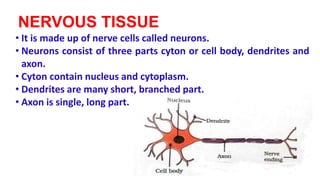
NERVOUS TISSUE
• It is made up of nerve cells called neurons.
• Neurons consist of three parts cyton or cell body, dendrites and
axon.
• Cyton contain nucleus and cytoplasm.
• Dendrites are many short, branched part.
• Axon is single, long part.
NERVOUS TISSUE
•Location-Brain, spinal cord and nerves.
•Function-Respond to stimulus and transmit
response very rapidly from one part to another.
In the body.
•Nerves and muscles form functional
combination which make animals to move
rapidly in response to stimuli.
RECAPITULATION
•What are different types of epithelial tissues?
•Why is blood called a connective tissue.
•Which tissue acts like an insulator?
•Which tissue connects bone to bone?
•What are different types of muscles?
•Name the tissue that transmits stimulus in the
body.
Home Work
• Ncert exercise on page :- 69,73,78,79.
• Activities-6.1 to 6.5.
• Prepare a Fact sheet about simple permanent plant
tissues, Epithelial tissues and connective tissues
Using points structure, location and functions.
• Prepare mind maps for plant tissues and animal
tissues.
References
• Ncert:Science class 9th text book Chapter-6 Tissues Page no
68 to 79
• https://www.britannica.com/science/fundamental-tissue
• https://youtu.be/fNQ92ZGWpOAhttps
• https://youtu.be/f483wM28FNk
Ch 6 Tissues 1.pptx

Ch 6 Tissues 1.pptx

  • 1.
    NAVODAYA VIDYALAYA SAMITI,NOIDA By Ashish Rana, PGT-Biology JNV- Dewas M.P E-content Class IX Sub: Science Chapter: Tissue
  • 2.
    LEARNING OUTCOMES Students willable to: 1. Define tissue and differentiate it from cell. 2. Differentiate between plant and animal tissue. 3. Classify, explain, compare and differentiate various types of plant tissue like meristematic simple permanent and complex permanent tissue on the basis of structure ,location and function.
  • 3.
    4. Identify, explain,classify and describe the function of different type of animal tissues like epithelial, connective, muscular, nervous tissue and draw their diagrams. 5. Expected skill development: Skill developing scientific vocabulary ,critical thinking and comprehension of text. 6. Development of creativity, reasoning, analytical skill and accuracy of diagrams. LEARNING OUTCOMES
  • 4.
    TOPICS TO BECOVERED • Tissue –Definition • Are plant and animals made up of same types of tissues? • Plant tissue • Meristematic tissue • Permanent tissue- simple and complex permanent tissue • Animal tissues • Epithelial tissue • Connective tissue • Muscular tissue And Nervous tissue
  • 5.
    INTRODUCTION •What is acell? •What are unicellular organism? •What are multicellular organisms? •Does multicellular organisms are made up of same types of cells? •What is the organization of multicellular organisms?
  • 6.
    Tissue: A groupof cells that are similar in structure and work together to perform a particular function. • Examples:- In plants vascular tissue Xylem and phloem Conduct food and water are example of tissue. • In animals Muscles contracts and relax to cause movements are examples of tissue.
  • 7.
    Difference between plantand animal tissues Plant Tissues Animal Tissues Plants do not move. Plants required less energy Animals moves from one place to another . Animals required more energy than plants. Most of the tissue provide them support and structural strength. Their tissues are the ones that can support movement.
  • 8.
    Difference between plantand animal tissues Plant Tissues Animal Tissues Most of tissues are dead in plants as they can provide mechanical strength easily and required less maintaince Most tissues in them are living. So they can move and perform several functions.
  • 9.
    Difference between plantand animal tissues Plant Tissues Animal Tissues Only certain parts of the plant can grow. The tissues present in such regions divide themselves and form new tissues. Growth in animals is uniform and not only in certain regions of the body. The structure of plant tissues is not very specialized as compared to animals The organs and organ systems in animals are highly developed
  • 10.
    Plant tissues Meristematic Permanent (cellsdivide) (cells do not divide) Apical Intercalary Lateral Simple Complex Protective (one type of cell) (Many type of cells) Epidermis, Cork, Stomata Parenchyma collenchyma Sclerenchyma Protective tissue Xylem Phloem
  • 11.
    Meristematic tissue (Meristem) •Havethe ability to divide and form new cells. Cells of meristems are active having dense cytoplasm thin cell wall and prominent nucleus. •They lack vacuoles because it provide rigidity to cell and prevent quick cell division. •It increase length and width of plant.
  • 12.
    Three type ofmeristematic tissue on the basis of their location Type Location Function Apical Meristem Growing tip of shoot and root. Increase the length of stem and root. Intercalary Meristem At the base of leaves and internode Increase the length of internode or leaf. Lateral Meristem (Cambium) On the side of stem and root. Increase the girth of stem and root
  • 13.
    PERMANENT TISSUE • Arisefrom meristematic tissue. Loss the ability to divide. • Have definite shape, size and function. • The process by which meristematic tissue form permanent tissue is called differentiation. • It is of two types: - • Simple and complex permanent tissue.
  • 14.
    SIMPLE PERMANENT TISSUE •Parenchyma:- • It is basic (simple) type of packaging tissue. • Has relatively unspecialised living cells. • Thin cell wall and large intercellular spaces between the cell. • It store food and provide support to plant. • Found in soft parts of plants.
  • 15.
    Chlorenchyma and Aerenchyma •Parenchyma contains chlorophyll and perform photosynthesis it is called chlorenchyma. • In aquatic plants, parenchyma has large air space to provide buoyancy to plants and exchange of gases it is called aerenchyma. Chlorenchyma
  • 16.
    COLLENCHYMA • Contains elongatedliving cells irregularly thickened at the corners. • Intercellular space is less. • Provide flexibility and mechanical support to leaves and stem and allow easy bending without break. • Found in leaf stalks below the epidermis.
  • 17.
    SCLERENCHYMA • Consist oflong, narrow, thick walled dead cell. • Cell wall contains lignin which act as cement and harden them. • Intercellular space absent. • It provide strength and rigidity to plant and make them hard and stiff. • Present around vascular bundles, in leaf veins, in the hard covering of seed, husk of coconut and nuts.
  • 18.
    Protective Tissue It isfound on the surface of the roots, stems and leaves. It consists of cells with thick walls. It provides protection against mechanical injury or invasion by parasitic fungi. Types of Protective TissueTYPE EPIDERMIS Characteristics :Cells are elongated and flattened with no intercellular spaces between them. Location :Present in the outermost layer of leaves, flowers, stem and roots. Function :Protects the plant from desiccation and infection. CORK : Characteristics : Cells are rectangular with vacuolated protoplasts. Location : It is the outermost layer formed after the epidermis undergoes certain changes. Function :Prevents desiccation, infection and mechanical injury.
  • 19.
    EPIDERMIS • It isoutermost protective layer of plant parts. • It is usually made up of single layer of flat cells without inter cellular spaces. Outer and side walls are thicker. • On aerial parts epidermal cells secretes waxy water resistant layer called cuticle. Which prevent loss of water , injury and invasion of pathogens.
  • 20.
    EPIDERMIS • Plants ofdry habitats have thick epidermis and thick waxy layer of cutin on their outer surface. • Epidermal cells of root have root hairs which increase the surface area.
  • 21.
    CORK • As plantsgrow older epidermis is replaced by secondary meristem. • It divide and form cells on both side. • Cells of on outside cut of from this layer and form several layer thick cork or bark. • Cells of cork are dead, without intercellular spaces and have chemical suberin in their walls.
  • 22.
    STOMATA • Stomata aresmall pores in the epidermis of leaf. • Stomata are enclosed by two kidney shaped guard cells. • They help in exchange of gases with the atmosphere. • Transpiration also occur through it.
  • 23.
    COMPLEX PERMANENT TISSUE •Theyare made up of more than one type of cells. •Xylem and phloem are examples. •Both are conducting tissue and form vascular bundles. •They made possible survival of vascular plant in terrestrial environment.
  • 24.
    XYLEM • It consistof tracheids, vessels, xylem fibre and xylem parenchyma. • Contains thick cell walls. • Except xylem parenchyma all are dead Cells. • Xylem fibre are provide support. • Parenchyma store food and do sidewise conduction. • Tracheids and vessels are tubular structure which conduct water and minerals vertically.
  • 25.
    PHLOEM • Made upof four elements sieve tubes, companion cells, phloem fibres and phloem parenchyma. • Except phloem fibre all are living cells. • Sieve tubes are tubular cells with perforated walls. • Phloem transport food. • Phloem transport is bidirectional.
  • 26.
    RECAPITULATION •What is theunique feature of meristem? • What are different types of permanent tissues? •Name the dead elements of xylem and phloem. • Name the protective tissue present in plants. •State the characteristics of cells of epidermis. •Name the chemical present in cork.
  • 27.
  • 28.
    Epithelial tissue (Epithelium) •It is the covering or protective tissue of animals. • Made up of tightly packed cell which form continuous layer with no intercellular spaces . • Separated from underlying tissue by fibrous basement membrane. • The permeability of epithelial cells regulate the exchange of material between body and environment.
  • 29.
    Types of epithelium Typeof epithelium Characteristics Location Function Squamous epithelium Cells are thin and flat. Lungs alveoli, Blood Vessels, Oesophagus Lining of mouth Protection Exchange of substances between blood and cells and at alveoli Stratified Squamous epithelium Flat cells arranged in many layers to prevent wear and tear. Skin Protection
  • 30.
    TYPES OF EPITHELIUM •Squamous epithelium Stratified squamous epithelium
  • 31.
    TYPES OF EPITHELIUM Typeof epithelium Characteristics Location Function Columnar epithelium Tall pillar like cells. Nucleus at the base Inner lining of intestine, Absorption and secretion Ciliated columnar epithelium Tall cells with cilia Respiratory tract Pushes the mucus forward to clear respiratory tract
  • 32.
    Type of epithelium Characteristics LocationFunction Cuboidal epithelium Cube cells Kidney tubules, ducts of salivary glands. Mechanical support Glandular epithelium Epithelial cells folds inward and form multicellular gland, acquire additional specialisation as glands Goblet cells are present in mucus membrane Secretion
  • 33.
  • 34.
    CONNECTIVE TISSUE •It connectvarious tissues in an organ. •Loosely packed Cells are embedded in matrix. •Matrix may be jelly like, fluid, dense or rigid.
  • 35.
    BLOOD • Matrix isfluid called plasma. • Plasma contain protein ,salts and hormones. • Plasma RBC, WBC and PLATELETS are suspended. • Blood transport materials to different parts of body.
  • 36.
    BONE •Bone Is StrongAnd Nonflexible Tissue. •Matrix Is Hard. •It Is Made Up Of Salts Of Calcium And Phosphorus. •Matrix Contains Bone Cells Or Osteocytes. •Bone Form Skeleton That Support Body And Anchors The Muscle.
  • 37.
    LIGAMENT AND TENDONS •Ligamentis very elastic and have little matrix. •Ligament connect bone to bone. •Tendons are fibrous tissue less flexibility but great strength. •Connects muscles to bones
  • 38.
    CARTILAGE • Matrix issolid composed of sugars and protein. • Cells (chondrocytes) are widely spaced and present in matrix. • Cartilage is softer than bone due to presence of sugar and protein. • It is found in nose, ear, trachea,larynx and smoothens the bone surface at joint.
  • 39.
    AREOLAR TISSUE • Matrixis semifluid containing different types of cells and fibres. • It holds organs in place and provide support to them.. • Found between skin and muscles, around blood vessels, nerves and in bone marrow. • It helps in repair of tissues.
  • 40.
    ADIPOSE TISSUE •It containsfat cells called adipocytes. •Cells are filled with fat globules. •Found below skin and between internal organs. •It store fat and also act as insulator.
  • 41.
    MUSCULAR TISSUE • Itconsist of elongated muscle cells called muscle fibre. • Muscle contain contractile proteins which contract and relax. • It brings movement in body.
  • 42.
    STRIATED /SKELETAL MUSCLES •Structure-Long, cylindrical, unbranched, multinucleated muscle cells with alternate light and dark band or striations. • Location-Present in limbs, mostly attach to bones so also called skeletal muscles. • Function-Help in body movement, they move as per our will so called voluntary muscles.
  • 43.
    SMOOTH / UNSTRIATEDMUSCLES • Structure-Long, Spindle shaped , Uninucleate cells, having no Striations • Location- Found in alimentary canal, Blood vessels, Iris of eye, in ureters, bronchi of lungs • Function-Movement of food in alimentary canal and internal organs, they are involuntary muscles.
  • 44.
    CARDIAC MUSCLE • Structure-Cylindrical,branched and uninucleate muscle cells with striations. • Location-Wall of heart • Function-Rhythmic contraction and relaxation of heart throughout life they are involuntary muscles.
  • 45.
    NERVOUS TISSUE • Itis made up of nerve cells called neurons. • Neurons consist of three parts cyton or cell body, dendrites and axon. • Cyton contain nucleus and cytoplasm. • Dendrites are many short, branched part. • Axon is single, long part.
  • 46.
    NERVOUS TISSUE •Location-Brain, spinalcord and nerves. •Function-Respond to stimulus and transmit response very rapidly from one part to another. In the body. •Nerves and muscles form functional combination which make animals to move rapidly in response to stimuli.
  • 47.
    RECAPITULATION •What are differenttypes of epithelial tissues? •Why is blood called a connective tissue. •Which tissue acts like an insulator? •Which tissue connects bone to bone? •What are different types of muscles? •Name the tissue that transmits stimulus in the body.
  • 48.
    Home Work • Ncertexercise on page :- 69,73,78,79. • Activities-6.1 to 6.5. • Prepare a Fact sheet about simple permanent plant tissues, Epithelial tissues and connective tissues Using points structure, location and functions. • Prepare mind maps for plant tissues and animal tissues.
  • 49.
    References • Ncert:Science class9th text book Chapter-6 Tissues Page no 68 to 79 • https://www.britannica.com/science/fundamental-tissue • https://youtu.be/fNQ92ZGWpOAhttps • https://youtu.be/f483wM28FNk