THE FUNDAMENTAL
UNIT OF LIFE
DISCOVERY OF CELL
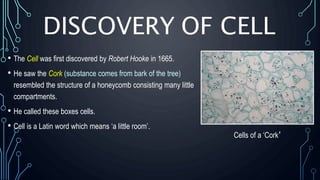
• The Cell was first discovered by Robert Hooke in 1665.
• He saw the Cork (substance comes from bark of the tree)
resembled the structure of a honeycomb consisting many little
compartments.
• He called these boxes cells.
• Cell is a Latin word which means ‘a little room’.
Cells of a ‘Cork’
WHAT ARE LIVING BEINGS MADE UP
OF ?
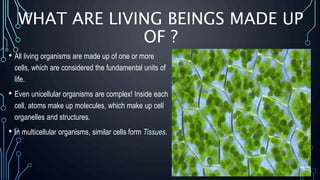
• All living organisms are made up of one or more
cells, which are considered the fundamental units of
life.
• Even unicellular organisms are complex! Inside each
cell, atoms make up molecules, which make up cell
organelles and structures.
• In multicellular organisms, similar cells form Tissues.
IMPORTANT BIOLOGIST IN CELL
DISCOVERY
• Robert Hooke – The cell was 1st discovered by him in 1665.
He observed the cork slice with a primitive microscope.
• Leeuwenhoek – With the help of the improved microscope,
he discovered the free living cells in pond water in 1674.
• Robert Brown – In 1831, he discovered the nucleus in the
cell.
• Purkinjee – In 1839, he coined the term ‘protoplasm’ for the
fluid substance of the cell.
CELL THEORY
• The cell theory says that all plants and animals are
composed of cells.
• The cell is the basic structural and the functional unit of
life.
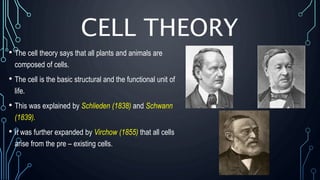
• This was explained by Schlieden (1838) and Schwann
(1839).
• It was further expanded by Virchow (1855) that all cells
arise from the pre – existing cells.
LABOUR DIVISION IN CELLS
Multicellular Organisms also shows division of labour,
which means that different parts of human body do
different functions. The human body has heart to pump
blood, a stomach to digest food and so on.
Division of labour is also seen within a single cell. Each
cell has a specific component called Cell Organelles.
Each cell organelle performs a specific function like
digestion, excretion and so on.
PROKARYOTIC CELLS
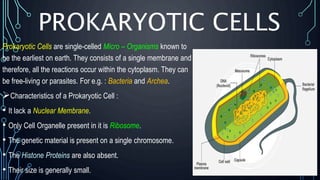
Prokaryotic Cells are single-celled Micro – Organisms known to
be the earliest on earth. They consists of a single membrane and
therefore, all the reactions occur within the cytoplasm. They can
be free-living or parasites. For e.g. : Bacteria and Archea.
Characteristics of a Prokaryotic Cell :
• It lack a Nuclear Membrane.
• Only Cell Organelle present in it is Ribosome.
• The genetic material is present on a single chromosome.
• The Histone Proteins are also absent.
• Their size is generally small.
EUKARYOTIC CELLS
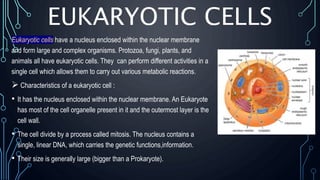
Eukaryotic cells have a nucleus enclosed within the nuclear membrane
and form large and complex organisms. Protozoa, fungi, plants, and
animals all have eukaryotic cells. They can perform different activities in a
single cell which allows them to carry out various metabolic reactions.
 Characteristics of a eukaryotic cell :
• It has the nucleus enclosed within the nuclear membrane. An Eukaryote
has most of the cell organelle present in it and the outermost layer is the
cell wall.
• The cell divide by a process called mitosis. The nucleus contains a
single, linear DNA, which carries the genetic functions,information.
• Their size is generally large (bigger than a Prokaryote).
THE STURUCTRAL ORGANISATION OF
CELL
Every cell consists of :
• Plasma Membrane
• Cytoplasm
• Nucleus
All chemical activities inside the cell are possible
due to these features.
PLASMA MEMBRANE
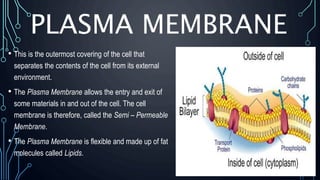
• This is the outermost covering of the cell that
separates the contents of the cell from its external
environment.
• The Plasma Membrane allows the entry and exit of
some materials in and out of the cell. The cell
membrane is therefore, called the Semi – Permeable
Membrane.
• The Plasma Membrane is flexible and made up of fat
molecules called Lipids.
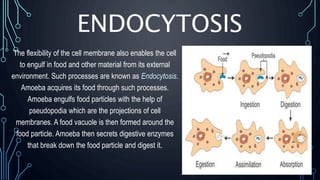
ENDOCYTOSIS
The flexibility of the cell membrane also enables the cell
to engulf in food and other material from its external
environment. Such processes are known as Endocytosis.
Amoeba acquires its food through such processes.
Amoeba engulfs food particles with the help of
pseudopodia which are the projections of cell
membranes. A food vacuole is then formed around the
food particle. Amoeba then secrets digestive enzymes
that break down the food particle and digest it.
DIFFUSION
• Substances like Carbon Dioxide and Oxygen can
move across the plasma membrane through the
process called Diffusion.
• Diffusion is the spontaneous movement of a
substance from a region of high concentration to a
region of lower concentration.
• Thus, diffusion plays an important role in exchange of
gases between the cells as well as the cell and its
external environment.
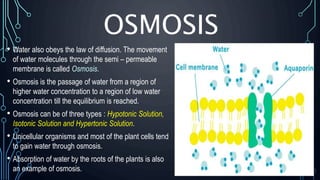
OSMOSIS
• Water also obeys the law of diffusion. The movement
of water molecules through the semi – permeable
membrane is called Osmosis.
• Osmosis is the passage of water from a region of
higher water concentration to a region of low water
concentration till the equilibrium is reached.
• Osmosis can be of three types : Hypotonic Solution,
Isotonic Solution and Hypertonic Solution.
• Unicellular organisms and most of the plant cells tend
to gain water through osmosis.
• Absorption of water by the roots of the plants is also
an example of osmosis.
HYPOTONIC SOLUTION
If the medium surrounding the cell has a higher water
concentration than the cell, meaning that the outside solution
is very dilute, the cell will gain water by osmosis. Such a
solution is known as a Hypotonic Solution. Water molecules
are free to pass across the cell membrane in both directions,
but more water will come into the cell than will leave. The net
(overall) result is that water enters the cell. The cell is likely to
swell up.
ISOTONIC SOLUTION
If the medium has exactly the same water concentration as the
cell, there will be no net movement of water across the cell
membrane. Such a solution is known as an Isotonic Solution.
Water crosses the cell membrane in both directions, but the
amount going in is the same as the amount going out, so there
is no overall movement of water. The cell will stay the same
size.
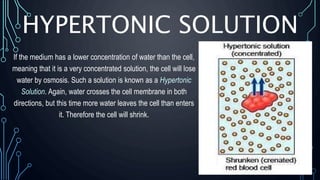
HYPERTONIC SOLUTION
If the medium has a lower concentration of water than the cell,
meaning that it is a very concentrated solution, the cell will lose
water by osmosis. Such a solution is known as a Hypertonic
Solution. Again, water crosses the cell membrane in both
directions, but this time more water leaves the cell than enters
it. Therefore the cell will shrink.
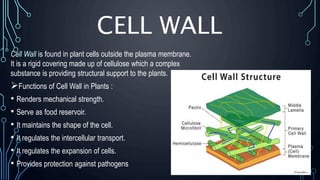
CELL WALL
Cell Wall is found in plant cells outside the plasma membrane.
It is a rigid covering made up of cellulose which a complex
substance is providing structural support to the plants.
Functions of Cell Wall in Plants :
• Renders mechanical strength.
• Serve as food reservoir.
• It maintains the shape of the cell.
• It regulates the intercellular transport.
• It regulates the expansion of cells.
• Provides protection against pathogens
PLASMOLYSIS
When a living plant cell loses water through osmosis there is
shrinkage or contraction of the contents of the cell away
from the cell wall. This phenomenon is known as
Plasmolysis.
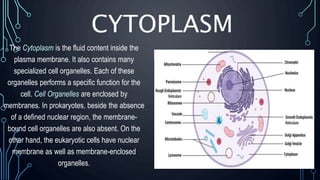
CYTOPLASM
The Cytoplasm is the fluid content inside the
plasma membrane. It also contains many
specialized cell organelles. Each of these
organelles performs a specific function for the
cell. Cell Organelles are enclosed by
membranes. In prokaryotes, beside the absence
of a defined nuclear region, the membrane-
bound cell organelles are also absent. On the
other hand, the eukaryotic cells have nuclear
membrane as well as membrane-enclosed
organelles.
ENDOPLASMIC
RETICULUM
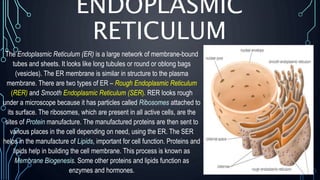
The Endoplasmic Reticulum (ER) is a large network of membrane-bound
tubes and sheets. It looks like long tubules or round or oblong bags
(vesicles). The ER membrane is similar in structure to the plasma
membrane. There are two types of ER – Rough Endoplasmic Reticulum
(RER) and Smooth Endoplasmic Reticulum (SER). RER looks rough
under a microscope because it has particles called Ribosomes attached to
its surface. The ribosomes, which are present in all active cells, are the
sites of Protein manufacture. The manufactured proteins are then sent to
various places in the cell depending on need, using the ER. The SER
helps in the manufacture of Lipids, important for cell function. Proteins and
lipids help in building the cell membrane. This process is known as
Membrane Biogenesis. Some other proteins and lipids function as
enzymes and hormones.
FUNCTIONS OF (ER)
• Thus, one function of the ER is to serve as channels for the
transport of materials (especially proteins) between various
regions of the cytoplasm or between the cytoplasm and the
nucleus.
• The ER also functions as a cytoplasmic framework providing a
surface for some of the biochemical activities of the cell.
• In the liver cells of the group of animals called vertebrates, SER
plays a crucial role in detoxifying many poisons and drugs.
GOLGI APPARATUS
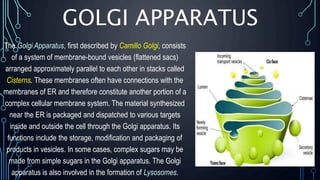
The Golgi Apparatus, first described by Camillo Golgi, consists
of a system of membrane-bound vesicles (flattened sacs)
arranged approximately parallel to each other in stacks called
Cisterns. These membranes often have connections with the
membranes of ER and therefore constitute another portion of a
complex cellular membrane system. The material synthesized
near the ER is packaged and dispatched to various targets
inside and outside the cell through the Golgi apparatus. Its
functions include the storage, modification and packaging of
products in vesicles. In some cases, complex sugars may be
made from simple sugars in the Golgi apparatus. The Golgi
apparatus is also involved in the formation of Lysosomes.
LYSOSOMES
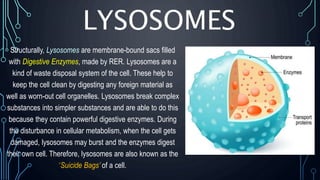
Structurally, Lysosomes are membrane-bound sacs filled
with Digestive Enzymes, made by RER. Lysosomes are a
kind of waste disposal system of the cell. These help to
keep the cell clean by digesting any foreign material as
well as worn-out cell organelles. Lysosomes break complex
substances into simpler substances and are able to do this
because they contain powerful digestive enzymes. During
the disturbance in cellular metabolism, when the cell gets
damaged, lysosomes may burst and the enzymes digest
their own cell. Therefore, lysosomes are also known as the
‘Suicide Bags’ of a cell.
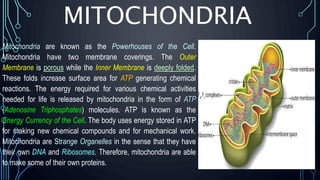
MITOCHONDRIA
Mitochondria are known as the Powerhouses of the Cell.
Mitochondria have two membrane coverings. The Outer
Membrane is porous while the Inner Membrane is deeply folded.
These folds increase surface area for ATP generating chemical
reactions. The energy required for various chemical activities
needed for life is released by mitochondria in the form of ATP
(Adenosine Triphosphates) molecules. ATP is known as the
Energy Currency of the Cell. The body uses energy stored in ATP
for making new chemical compounds and for mechanical work.
Mitochondria are Strange Organelles in the sense that they have
their own DNA and Ribosomes. Therefore, mitochondria are able
to make some of their own proteins.
PLASTIDS
Plastids are present only in plant cells. There are two types of
plastids – Chromoplasts (Coloured Plastids) and Leucoplasts
(White or Colourless Plastids). Chromoplasts containing the
pigment chlorophyll are known as chloroplasts. Chloroplasts are
important for photosynthesis in plants. Chloroplasts also contain
various yellow or orange pigments in addition to chlorophyll.
Leucoplasts are primarily organelles in which materials such as
starch, oils and protein granules are stored. The internal
organization of the Chloroplast consists of numerous membrane
layers embedded in a material called the Stroma. These are
similar to mitochondria in external structure. Like the
mitochondria, plastids also have their own DNA and Ribosomes.
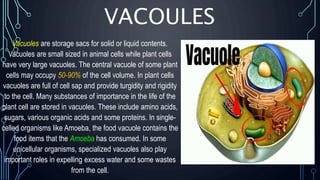
VACOULES
Vacuoles are storage sacs for solid or liquid contents.
Vacuoles are small sized in animal cells while plant cells
have very large vacuoles. The central vacuole of some plant
cells may occupy 50-90% of the cell volume. In plant cells
vacuoles are full of cell sap and provide turgidity and rigidity
to the cell. Many substances of importance in the life of the
plant cell are stored in vacuoles. These include amino acids,
sugars, various organic acids and some proteins. In single-
celled organisms like Amoeba, the food vacuole contains the
food items that the Amoeba has consumed. In some
unicellular organisms, specialized vacuoles also play
important roles in expelling excess water and some wastes
from the cell.
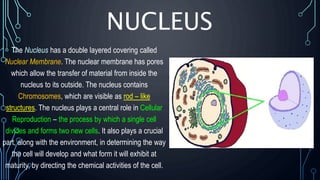
NUCLEUS
The Nucleus has a double layered covering called
Nuclear Membrane. The nuclear membrane has pores
which allow the transfer of material from inside the
nucleus to its outside. The nucleus contains
Chromosomes, which are visible as rod – like
structures. The nucleus plays a central role in Cellular
Reproduction – the process by which a single cell
divides and forms two new cells. It also plays a crucial
part, along with the environment, in determining the way
the cell will develop and what form it will exhibit at
maturity, by directing the chemical activities of the cell.
ORGANIZATION OF
NUCLEUS
The Nucleus contains Chromosomes, which are visible as rod-
shaped structures only when the cell is about to divide.
Chromosomes contain information for inheritance of characters
from parents to next generation in the form of DNA (Deoxyribo
Nucleic Acid) molecules. Chromosomes are composed of DNA
and Protein. DNA molecules contain the information necessary
for constructing and organizing cells. Functional segments of
DNA are called Genes. In a cell which is not dividing, this DNA
is present as part of chromatin material. Chromatin Material is
visible as entangled mass of thread like structures. Whenever
the cell is about to divide, the chromatin material gets organized
into chromosomes.
CELL DIVISION
New cells are formed in organisms in order to grow, to
replace old, dead and injured cells, and to form gametes
required for reproduction. The process by which new
cells are made is called Cell Division.
 There are two types of Cell Division :
• Mitosis
• Meiosis
MITOSIS AND MEIOSIS
• Mitosis – The process of cell division by which most
of the cells divide for growth is called Mitosis. In this
process, each cell called mother cell divides to form
two identical daughter cells. The daughter cells have
the same number of chromosomes as mother cell. It
helps in growth and repair of tissues in organisms.
• Meiosis – Specific cells of reproductive organs or
tissues in animals and plants divide to form gametes,
which after fertilization give rise to offspring. This
process is called Meiosis it involves two consecutive
divisions. When a cell divides by meiosis it produces
four new cells and have half the number of
chromosomes than that of the mother cells.
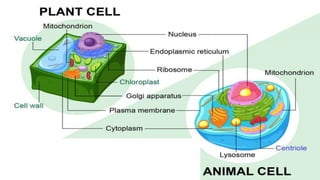
PLANT CELL VS. ANIMAL
CELL
PLANT CELL
• A Plant Cell is surrounded by rigid Cell Wall.
• Large vacuole is present in plant cell.
• Plant cells are larger than animal cells.
• Plant cells have plastids.
• Centrosomes are absent in plant cell.
• Lysosomes are very rare in plant cells.
ANIMAL CELL
• An Animal Cell lack a Cell Wall.
• Vacuoles are present in a small size.
• Animal cells are smaller than a plant cell.
• Animal cells don’ t have plastids.
• Centrosomes are present in an animal cell.
• Animal cells contain Lysosomes.
THANK
YOU