ANIMAL TISSUES
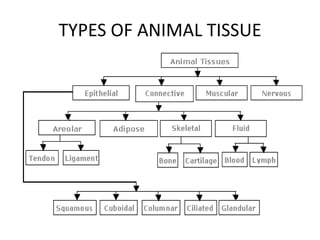
TYPES OF ANIMAL TISSUE
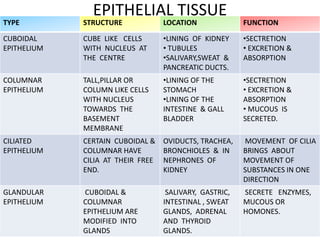
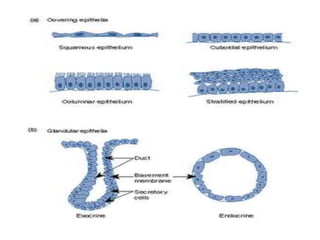
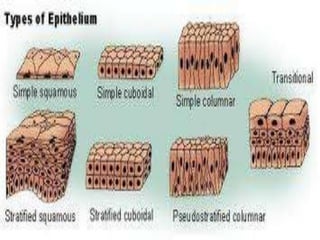
EPITHELIAL TISSUE
TYPE         STRUCTURE             LOCATION              FUNCTION

CUBOIDAL     CUBE LIKE CELLS       •LINING OF KIDNEY     •SECTRETION
EPITHELIUM   WITH NUCLEUS AT       • TUBULES             • EXCRETION &
             THE CENTRE            •SALIVARY,SWEAT &     ABSORPTION
                                   PANCREATIC DUCTS.
COLUMNAR     TALL,PILLAR OR        •LINING OF THE        •SECTRETION
EPITHELIUM   COLUMN LIKE CELLS     STOMACH               • EXCRETION &
             WITH NUCLEUS          •LINING OF THE        ABSORPTION
             TOWARDS THE           INTESTINE & GALL      • MUCOUS IS
             BASEMENT              BLADDER               SECRETED.
             MEMBRANE
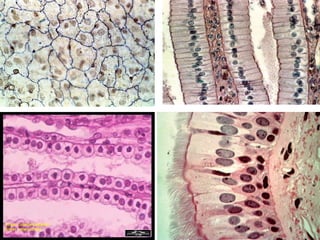
CILIATED     CERTAIN CUBOIDAL &    OVIDUCTS, TRACHEA,    MOVEMENT OF CILIA
EPITHELIUM   COLUMNAR HAVE         BRONCHIOLES & IN      BRINGS ABOUT
             CILIA AT THEIR FREE   NEPHRONES OF          MOVEMENT OF
             END.                  KIDNEY                SUBSTANCES IN ONE
                                                         DIRECTION
GLANDULAR    CUBOIDAL &             SALIVARY, GASTRIC,   SECRETE ENZYMES,
EPITHELIUM   COLUMNAR              INTESTINAL , SWEAT    MUCOUS OR
             EPITHELIUM ARE        GLANDS, ADRENAL       HOMONES.
             MODIFIED INTO         AND THYROID
             GLANDS                GLANDS.
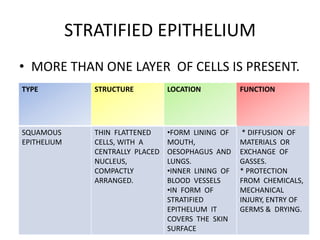
STRATIFIED EPITHELIUM
• MORE THAN ONE LAYER OF CELLS IS PRESENT.
TYPE            STRUCTURE          LOCATION           FUNCTION


SQUAMOUS        THIN FLATTENED     •FORM LINING OF     * DIFFUSION OF
EPITHELIUM      CELLS, WITH A      MOUTH,             MATERIALS OR
                CENTRALLY PLACED   OESOPHAGUS AND     EXCHANGE OF
                NUCLEUS,           LUNGS.             GASSES.
                COMPACTLY          •INNER LINING OF   * PROTECTION
                ARRANGED.          BLOOD VESSELS      FROM CHEMICALS,
                                   •IN FORM OF        MECHANICAL
                                   STRATIFIED         INJURY, ENTRY OF
                                   EPITHELIUM IT      GERMS & DRYING.
                                   COVERS THE SKIN
                                   SURFACE
CONNETIVE TISSUES
• They have the basic characteristics as :
• Cells, which are loosely packed, fibres which
  are scattered in between the cells and matrix
  which is the ground tissue.
• It may be jelly like fluid, dense and/ or rigid.
• They are located widely throughout the body,
  present between different tissues and organs.
• They mainly function in binding , packaging &
  other functions as storing fats, transporting
  substances etc.
Liquid connective tissue
• Our body contains two liquid connective
  tissues:
  1) blood
  2) lymph
 Blood is the major liquid connective tissue. It’s
  constituents are divided into two types
  Liquid : plasma
  Solid : corpuscles [ cells]
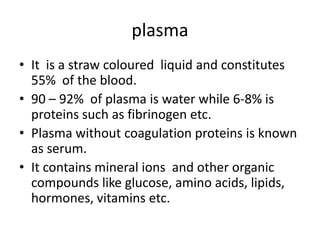
plasma
• It is a straw coloured liquid and constitutes
  55% of the blood.
• 90 – 92% of plasma is water while 6-8% is
  proteins such as fibrinogen etc.
• Plasma without coagulation proteins is known
  as serum.
• It contains mineral ions and other organic
  compounds like glucose, amino acids, lipids,
  hormones, vitamins etc.
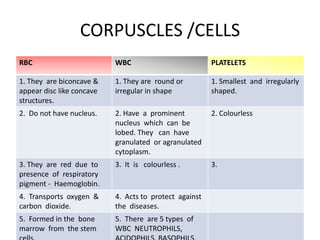
CORPUSCLES /CELLS
RBC                        WBC                          PLATELETS

1. They are biconcave &    1. They are round or         1. Smallest and irregularly
appear disc like concave   irregular in shape           shaped.
structures.
2. Do not have nucleus.    2. Have a prominent          2. Colourless
                           nucleus which can be
                           lobed. They can have
                           granulated or agranulated
                           cytoplasm.
3. They are red due to     3. It is colourless .        3.
presence of respiratory
pigment - Haemoglobin.
4. Transports oxygen &     4. Acts to protect against
carbon dioxide.            the diseases.
5. Formed in the bone      5. There are 5 types of
marrow from the stem       WBC NEUTROPHILS,

Animal tissues, 9 cbse

  • 1.
  • 2.
  • 3.
    EPITHELIAL TISSUE TYPE STRUCTURE LOCATION FUNCTION CUBOIDAL CUBE LIKE CELLS •LINING OF KIDNEY •SECTRETION EPITHELIUM WITH NUCLEUS AT • TUBULES • EXCRETION & THE CENTRE •SALIVARY,SWEAT & ABSORPTION PANCREATIC DUCTS. COLUMNAR TALL,PILLAR OR •LINING OF THE •SECTRETION EPITHELIUM COLUMN LIKE CELLS STOMACH • EXCRETION & WITH NUCLEUS •LINING OF THE ABSORPTION TOWARDS THE INTESTINE & GALL • MUCOUS IS BASEMENT BLADDER SECRETED. MEMBRANE CILIATED CERTAIN CUBOIDAL & OVIDUCTS, TRACHEA, MOVEMENT OF CILIA EPITHELIUM COLUMNAR HAVE BRONCHIOLES & IN BRINGS ABOUT CILIA AT THEIR FREE NEPHRONES OF MOVEMENT OF END. KIDNEY SUBSTANCES IN ONE DIRECTION GLANDULAR CUBOIDAL & SALIVARY, GASTRIC, SECRETE ENZYMES, EPITHELIUM COLUMNAR INTESTINAL , SWEAT MUCOUS OR EPITHELIUM ARE GLANDS, ADRENAL HOMONES. MODIFIED INTO AND THYROID GLANDS GLANDS.
  • 4.
    STRATIFIED EPITHELIUM • MORETHAN ONE LAYER OF CELLS IS PRESENT. TYPE STRUCTURE LOCATION FUNCTION SQUAMOUS THIN FLATTENED •FORM LINING OF * DIFFUSION OF EPITHELIUM CELLS, WITH A MOUTH, MATERIALS OR CENTRALLY PLACED OESOPHAGUS AND EXCHANGE OF NUCLEUS, LUNGS. GASSES. COMPACTLY •INNER LINING OF * PROTECTION ARRANGED. BLOOD VESSELS FROM CHEMICALS, •IN FORM OF MECHANICAL STRATIFIED INJURY, ENTRY OF EPITHELIUM IT GERMS & DRYING. COVERS THE SKIN SURFACE
  • 8.
    CONNETIVE TISSUES • Theyhave the basic characteristics as : • Cells, which are loosely packed, fibres which are scattered in between the cells and matrix which is the ground tissue. • It may be jelly like fluid, dense and/ or rigid. • They are located widely throughout the body, present between different tissues and organs. • They mainly function in binding , packaging & other functions as storing fats, transporting substances etc.
  • 9.
    Liquid connective tissue •Our body contains two liquid connective tissues: 1) blood 2) lymph Blood is the major liquid connective tissue. It’s constituents are divided into two types Liquid : plasma Solid : corpuscles [ cells]
  • 10.
    plasma • It isa straw coloured liquid and constitutes 55% of the blood. • 90 – 92% of plasma is water while 6-8% is proteins such as fibrinogen etc. • Plasma without coagulation proteins is known as serum. • It contains mineral ions and other organic compounds like glucose, amino acids, lipids, hormones, vitamins etc.
  • 11.
    CORPUSCLES /CELLS RBC WBC PLATELETS 1. They are biconcave & 1. They are round or 1. Smallest and irregularly appear disc like concave irregular in shape shaped. structures. 2. Do not have nucleus. 2. Have a prominent 2. Colourless nucleus which can be lobed. They can have granulated or agranulated cytoplasm. 3. They are red due to 3. It is colourless . 3. presence of respiratory pigment - Haemoglobin. 4. Transports oxygen & 4. Acts to protect against carbon dioxide. the diseases. 5. Formed in the bone 5. There are 5 types of marrow from the stem WBC NEUTROPHILS,