Tissue system
A group of cell which have same
structure and function known as tissue.
First time tissue describe by Bichat in
1801
• The study of internal structure of plants /animal called anatomy includes histology; that
is organization and structure of tissue. Different type of tissue have different physical
properties. Tissues may be hard (bone), soft (muscle) of liquid (blood). In this chapter
we will learn different type of tissue present in plant and animal and their structural
details.
• In unicellular organisms a single cell performs all the vital activities for example,
digestion, respiration, excretion etc.
• In case of Multicellular organisms specialized functions are performed by a different
groups of cells. As blood flows for transportation of O2, CO2, food hormones & waste
material, muscle cells are involved in movement etc.
• In plants vascular tissue conduct food & water from one plant to another par to the plant
Thus Multicellular organisms possess well-developed division of provide highest
possible efficiency or particular function.
• A tissue is defined as a group of cells with similar structure, organized to do a common
function.
• Term tissue was coined by Bichat.
• As plants are fixed or stationary, most of their tissues are of supportive type. Animals
move around in search of food, mate & shelter so they consume more energy as
compared to plants.
• Plants have some localized regions with special tissue but there are no such distinct
regions in animals. Growth in animals remains uniform. Branch of biology deals with the
study of tissue is called Histology
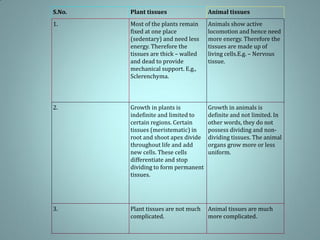
S.No. Plant tissues Animal tissues
1. Most of the plants remain
fixed at one place
(sedentary) and need less
energy. Therefore the
tissues are thick – walled
and dead to provide
mechanical support. E.g.,
Sclerenchyma.
Animals show active
locomotion and hence need
more energy. Therefore the
tissues are made up of
living cells.E.g. – Nervous
tissue.
2. Growth in plants is
indefinite and limited to
certain regions. Certain
tissues (meristematic) in
root and shoot apex divide
throughout life and add
new cells. These cells
differentiate and stop
dividing to form permanent
tissues.
Growth in animals is
definite and not limited. In
other words, they do not
possess dividing and non-
dividing tissues. The animal
organs grow more or less
uniform.
3. Plant tissues are not much
complicated.
Animal tissues are much
more complicated.
• A multicellular organism (plants and animals)
develops from single ‘initial cell’ which undergoes
repeated cell division. The large number of cells
so formed undergoes cellular differentiation (a
process of qualitative changes in the cells to
perform different functions in the living
organisms). Cell division and differentiation leads
to the development of specific organs, each,
consisting of specific groups of cells to perform
specific functions in the body. With the increase
in complexity of organisms, the level of
organization also becomes complex.
Plant tissue
• PLANT TISSUES
• Plant tissues are of two types
• Meristematic tissue
• Permanent tissue
• This differentiation is based on the ability of the mature cells of
the tissue to divide and produce new cells. Meristematic tissue
cells are capable of dividing, while permanent tissue cells are not.
• CLASSIFICATION OF PLANT TISSUES:
• Meristematic Tissue: Totipotent cells are capable of giving rise
to all the various cell types of the body of an organism.
• Meristematic tissue, commonly
called meristem (Gk. meristems: divisible) is composed of cells
which possess the power of cell division. The term ‘meristem’ was
introduced by C. Nageli (1858) for a group of continuously
dividing cells.
CHARACTERISTICS OF MERISTEMS
• Cells of meristems are living and are at active
divisional stage.
• The cells are compactly arranged without
any intercellular spaces
• The cell wall is thin and made up of cellulose
• Cytoplasm is dense, granular with a central,
large and prominent nucleus.
• Vacuoles are either very small or absent.
• Cytoplasm has all the cell organelles.
• Ribosomes are abundant, ER is simple.
CLASSIFICATION OF MERISTEMS
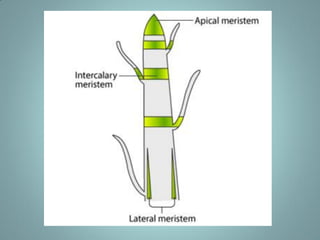
• APICAL MERISTEM
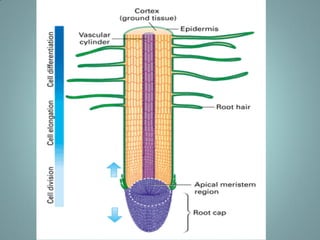
• The Meristem situated at the growing tips of root, shoot and their branches is
called Apical meristem.
• It is a primary meristem and is responsible for increase in length (primary
growth) is called Apical meristem
• LATERAL MERISTEM
• The meristem situated on the sides of the axis of plants is called lateral
meristem and is responsible for secondary growth.
• Lateral meristems are secondary meristems, except intrafascicular cambium.
• INTERCALARY MERISTEM
• The meristem present at the nodal region of stem and its branches and
intercalated between permanent cells is called intercalary meristem.
• It may be present either at the base of internodes (e.g., grasses, bamboo,
wheat) or nodes (e.g., mint) or leaves (e.g., Pinus)
• It is responsible for the elongation of internodes, increase in length and
formation of lateral appendages.
• It is short lived and very soon becomes permanent.
Shoot apical meristmatic tissue
Those all type of meristmatic tissue which is
Preset on the stem part of plant called shoot
apical meristmatic tissue.
#Root apical meristmatic tissue:-
This type of merismatic tissue present at
the tip par of root. This is most important
for development of root part of plant.
(2) PERMANENT TISSUE
• The permanent tissues are composed of
those cells which have lost their
capability to divide. They have definite
shape, size and thickness. The
permanent tissue may be dead or living.
CHARACTERISTICS OF PERMANENT TISSUES:
• The cells have lost their power of division.
• The cells possess definite shape, size and
function.
• They may be living or dead.
• The living permanent cells are large, thin
walled with a vacuolated cytoplasm.
• Dead permanent cells are thick walled
without cytoplasm.
TYPES OF PERMANENT TISSUES:
The permanent tissues are classified on the basis of
their composition into two types.
(1)simple permanent tissue
(2)Complex permanent tissue
• (1) Simple permanent tissues: on the basis of
structure of constituent cell, Simple tissues are
of three types Parenchyma, Collenchyma and
sclerenchyma.
(i)Parenchyma
Parenchyma (Gk. para = beside; en-chein = to pour; i.e., some
semi liquid substance poured beside other solid
tissues; Grew 1682) is the most basic type of differentiated
tissue from which other types have evolved.
Characteristics
• The cells are living and may be rounded, oval, rectangular, star shaped but
usually polygonal. Number of sides in a polygonal cell is usually 14 but
in Elodea, it may be 17.
• Cells are loosely arranged with many intercellular spaces,
either schizogenous or lysigenous (exception epidermis/epiblema,
endodermis, pericycle and pith rays, where cells are compactly arranged).
• The cell wall is thin and is made up of cellulose, hemicellulose and pectin.
Though the cell wall of xylem parenchyma is thick, that of epidermal cells is
cutinised and that of endodermal cells is suberised.
• Cytoplasm is dense, granular with a central, large prominent nucleus.
• Vacuoles are many but small.
• Cytoplasm has all the cell organelles but instead of chloroplasts, there
are leucoplasts.
• Chlorenchyma: Parenc
in mesophyll of leaves;
• Aerenchyma: Parenchy
hydrophytes, meant for
• Origin
• Parenchyma originates
loosening their division
• functions
• Storage of food is the m
• Storage of water especi
• Parenchyma associated
phloem) plays an impor
and transportation of fo
COLLENCHYMA
• Collenchyma [Gk. Colla: glue, referring to its characteristic shining
wall; Schleiden, (1839)] is a specialized supporting tissue which has living cells
and possesses considerable tensile strength.
• It is usually found in stems beneath the epidermis as a complete
cylinder or in the form of longitudinal strips.
#STRUCTURE
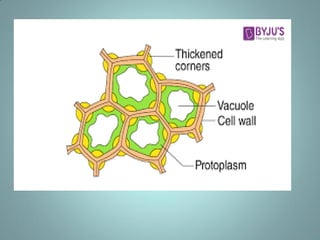
• Cells of collenchyma are elongated, tubular and are arranged along the long axis
of the stem but in T.S. they appear as circular, oval or polyhedral.
• The peculiarity of collenchyma cells is the unevenly thickened cell wall i.e.,
thickenings are restricted to the corners of the cells.
• The thickening materials are mostly pectin in addition
to cellulose and hemicellulose.
• The cells are living and the protoplast is highly vacuolated. Therefore, cytoplasm
and nucleus become peripheral.
• Cytoplasm has all the cell organelles including chloroplasts.
FUNCTIONS
• It is simple living mechanical tissue which
provides mechanical support.
• Being flexible in nature, it provides tensile
strength to the plant body.
• As the cells of collenchyma are living and
often contain chloroplasts they also take part
in photosynthesis.
SCLERENCHYMA
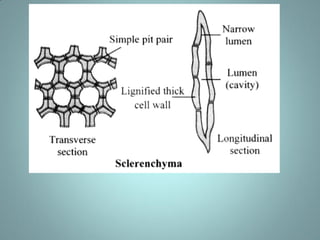
Sclerenchyma
(Gk. Scleros: hard; Mettenius 1805) is also a
simple permanent tissue composed of thick
walled, dead often lignified and hard cells. There
is considerable variation in shape, size, origin
and development of the cells.
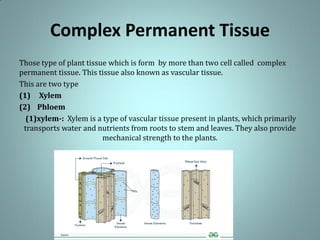
Complex Permanent Tissue
Those type of plant tissue which is form by more than two cell called complex
permanent tissue. This tissue also known as vascular tissue.
This are two type
(1) Xylem
(2) Phloem
(1)xylem-: Xylem is a type of vascular tissue present in plants, which primarily
transports water and nutrients from roots to stem and leaves. They also provide
mechanical strength to the plants.
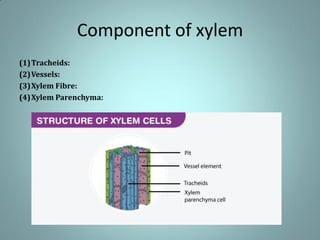
Component of xylem
(1)Tracheids:
(2)Vessels:
(3)Xylem Fibre:
(4)Xylem Parenchyma:
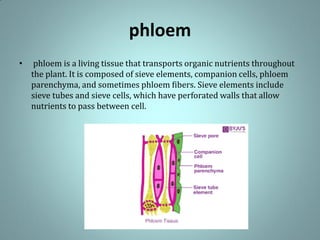
phloem
• phloem is a living tissue that transports organic nutrients throughout
the plant. It is composed of sieve elements, companion cells, phloem
parenchyma, and sometimes phloem fibers. Sieve elements include
sieve tubes and sieve cells, which have perforated walls that allow
nutrients to pass between cell.
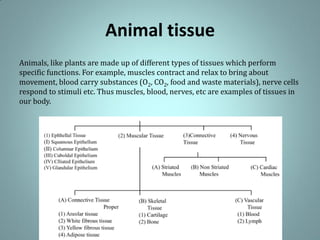
Animal tissue
Animals, like plants are made up of different types of tissues which perform
specific functions. For example, muscles contract and relax to bring about
movement, blood carry substances (O2, CO2, food and waste materials), nerve cells
respond to stimuli etc. Thus muscles, blood, nerves, etc are examples of tissues in
our body.
EPITHELIAL TISSUES:
 General Characteristics
• It occurs as a protective covering and consists of one or more layers of
cells.
• The epithelium is not traversed by blood vessels.
• The epithelial tissue rests on non-cellular basement membrane.
• The cells are closely packed forming a continuous sheet and held
together by intercellular junctions.
• The have small amount of cementing material between them and
almost about no intercellular spaces. Thus, anything entering or
leaving the body must cross at least one layer of epithelium. As a result,
the permeability of the cells of various epithelia play an important role
in regulating the exchange of materials between the body and the
external medium and also between different parts of the body.
Types of epithelial tissue:
• Based on cell layers and shape, epithelial tissues are further classified.
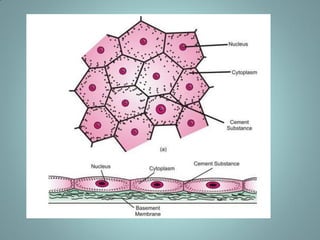
• (a) Squamous Epithelium
• Cells arranged end to end like tiles on a floor.
• Cells are polygonal in surface view.
• It forms the delicate lining of cavities (mouth, oesophagus, nose,
pericardium, alveoli etc.) blood vessels and covering of the tongue and
skin.
• Epithelial cells are arranged in many layers (stratum) to prevent wear
and tear in skin. This pattern is stratified squalors epithelium.
•
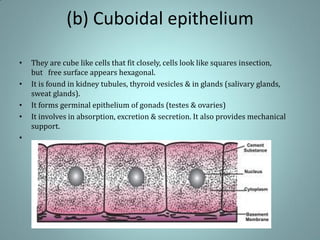
(b) Cuboidal epithelium
• They are cube like cells that fit closely, cells look like squares insection,
but free surface appears hexagonal.
• It is found in kidney tubules, thyroid vesicles & in glands (salivary glands,
sweat glands).
• It forms germinal epithelium of gonads (testes & ovaries)
• It involves in absorption, excretion & secretion. It also provides mechanical
support.
•
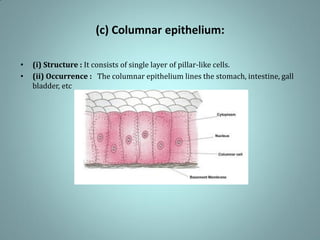
(c) Columnar epithelium:
• (i) Structure : It consists of single layer of pillar-like cells.
• (ii) Occurrence : The columnar epithelium lines the stomach, intestine, gall
bladder, etc
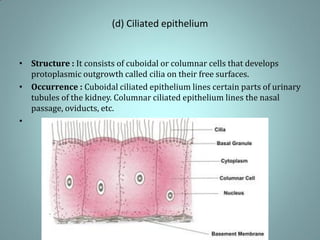
(d) Ciliated epithelium
• Structure : It consists of cuboidal or columnar cells that develops
protoplasmic outgrowth called cilia on their free surfaces.
• Occurrence : Cuboidal ciliated epithelium lines certain parts of urinary
tubules of the kidney. Columnar ciliated epithelium lines the nasal
passage, oviducts, etc.
•
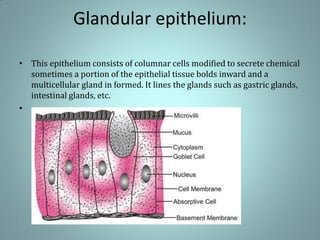
Glandular epithelium:
• This epithelium consists of columnar cells modified to secrete chemical
sometimes a portion of the epithelial tissue bolds inward and a
multicellular gland in formed. It lines the glands such as gastric glands,
intestinal glands, etc.
•
Functions of Epithelial Tissue
• Squamous epithelium (both types) provides protection to underlying
parts (organs) against mechanical injury, drying up, entry of germs, etc.
It also helps in excretion, gaseous exchange, etc.
• Cuboidal epithelium helps in protection, mechanical support,
absorption, excretion, etc.
• Columnar epithelium helps in absorption, secretion and protection.
Columnar epithelium of intestine is meant for absorption of water and
digested food.
• Ciliated epithelium helps in movement of mucus, urine, eggs, sperms,
etc.
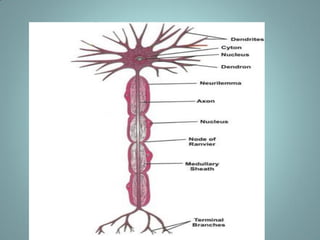
NERVOUS TISSUE
• They are highly specialized tissue due to which the animals are table to
perceive and respond to the stimuli.
• Their functional unit is called as never cell or neuron.
• Cell body is cyton covered by plasma membrane.
• Short, hair like extensions siring from cyton are dendron which are
future subdivide into dendrites.
• Axon is long, tail like cylindrical process with fine branches at the end.
Axon is covered by a sheath.
• Axon one neuron is very closely placed to the dendrons of another
neuron to carry impulses from one to another neuron in the from of
electrochemical waves. This close proximity is called as synapse
•
Tissue system by kishan kumar m. SC lnmu.

Tissue system by kishan kumar m. SC lnmu.

  • 1.
    Tissue system A groupof cell which have same structure and function known as tissue. First time tissue describe by Bichat in 1801
  • 2.
    • The studyof internal structure of plants /animal called anatomy includes histology; that is organization and structure of tissue. Different type of tissue have different physical properties. Tissues may be hard (bone), soft (muscle) of liquid (blood). In this chapter we will learn different type of tissue present in plant and animal and their structural details. • In unicellular organisms a single cell performs all the vital activities for example, digestion, respiration, excretion etc. • In case of Multicellular organisms specialized functions are performed by a different groups of cells. As blood flows for transportation of O2, CO2, food hormones & waste material, muscle cells are involved in movement etc. • In plants vascular tissue conduct food & water from one plant to another par to the plant Thus Multicellular organisms possess well-developed division of provide highest possible efficiency or particular function. • A tissue is defined as a group of cells with similar structure, organized to do a common function. • Term tissue was coined by Bichat. • As plants are fixed or stationary, most of their tissues are of supportive type. Animals move around in search of food, mate & shelter so they consume more energy as compared to plants. • Plants have some localized regions with special tissue but there are no such distinct regions in animals. Growth in animals remains uniform. Branch of biology deals with the study of tissue is called Histology
  • 3.
    S.No. Plant tissuesAnimal tissues 1. Most of the plants remain fixed at one place (sedentary) and need less energy. Therefore the tissues are thick – walled and dead to provide mechanical support. E.g., Sclerenchyma. Animals show active locomotion and hence need more energy. Therefore the tissues are made up of living cells.E.g. – Nervous tissue. 2. Growth in plants is indefinite and limited to certain regions. Certain tissues (meristematic) in root and shoot apex divide throughout life and add new cells. These cells differentiate and stop dividing to form permanent tissues. Growth in animals is definite and not limited. In other words, they do not possess dividing and non- dividing tissues. The animal organs grow more or less uniform. 3. Plant tissues are not much complicated. Animal tissues are much more complicated.
  • 4.
    • A multicellularorganism (plants and animals) develops from single ‘initial cell’ which undergoes repeated cell division. The large number of cells so formed undergoes cellular differentiation (a process of qualitative changes in the cells to perform different functions in the living organisms). Cell division and differentiation leads to the development of specific organs, each, consisting of specific groups of cells to perform specific functions in the body. With the increase in complexity of organisms, the level of organization also becomes complex.
  • 5.
    Plant tissue • PLANTTISSUES • Plant tissues are of two types • Meristematic tissue • Permanent tissue • This differentiation is based on the ability of the mature cells of the tissue to divide and produce new cells. Meristematic tissue cells are capable of dividing, while permanent tissue cells are not. • CLASSIFICATION OF PLANT TISSUES: • Meristematic Tissue: Totipotent cells are capable of giving rise to all the various cell types of the body of an organism. • Meristematic tissue, commonly called meristem (Gk. meristems: divisible) is composed of cells which possess the power of cell division. The term ‘meristem’ was introduced by C. Nageli (1858) for a group of continuously dividing cells.
  • 6.
    CHARACTERISTICS OF MERISTEMS •Cells of meristems are living and are at active divisional stage. • The cells are compactly arranged without any intercellular spaces • The cell wall is thin and made up of cellulose • Cytoplasm is dense, granular with a central, large and prominent nucleus. • Vacuoles are either very small or absent. • Cytoplasm has all the cell organelles. • Ribosomes are abundant, ER is simple.
  • 7.
    CLASSIFICATION OF MERISTEMS •APICAL MERISTEM • The Meristem situated at the growing tips of root, shoot and their branches is called Apical meristem. • It is a primary meristem and is responsible for increase in length (primary growth) is called Apical meristem • LATERAL MERISTEM • The meristem situated on the sides of the axis of plants is called lateral meristem and is responsible for secondary growth. • Lateral meristems are secondary meristems, except intrafascicular cambium. • INTERCALARY MERISTEM • The meristem present at the nodal region of stem and its branches and intercalated between permanent cells is called intercalary meristem. • It may be present either at the base of internodes (e.g., grasses, bamboo, wheat) or nodes (e.g., mint) or leaves (e.g., Pinus) • It is responsible for the elongation of internodes, increase in length and formation of lateral appendages. • It is short lived and very soon becomes permanent.
  • 9.
    Shoot apical meristmatictissue Those all type of meristmatic tissue which is Preset on the stem part of plant called shoot apical meristmatic tissue. #Root apical meristmatic tissue:- This type of merismatic tissue present at the tip par of root. This is most important for development of root part of plant.
  • 11.
    (2) PERMANENT TISSUE •The permanent tissues are composed of those cells which have lost their capability to divide. They have definite shape, size and thickness. The permanent tissue may be dead or living.
  • 12.
    CHARACTERISTICS OF PERMANENTTISSUES: • The cells have lost their power of division. • The cells possess definite shape, size and function. • They may be living or dead. • The living permanent cells are large, thin walled with a vacuolated cytoplasm. • Dead permanent cells are thick walled without cytoplasm.
  • 13.
    TYPES OF PERMANENTTISSUES: The permanent tissues are classified on the basis of their composition into two types. (1)simple permanent tissue (2)Complex permanent tissue • (1) Simple permanent tissues: on the basis of structure of constituent cell, Simple tissues are of three types Parenchyma, Collenchyma and sclerenchyma.
  • 14.
    (i)Parenchyma Parenchyma (Gk. para= beside; en-chein = to pour; i.e., some semi liquid substance poured beside other solid tissues; Grew 1682) is the most basic type of differentiated tissue from which other types have evolved.
  • 15.
    Characteristics • The cellsare living and may be rounded, oval, rectangular, star shaped but usually polygonal. Number of sides in a polygonal cell is usually 14 but in Elodea, it may be 17. • Cells are loosely arranged with many intercellular spaces, either schizogenous or lysigenous (exception epidermis/epiblema, endodermis, pericycle and pith rays, where cells are compactly arranged). • The cell wall is thin and is made up of cellulose, hemicellulose and pectin. Though the cell wall of xylem parenchyma is thick, that of epidermal cells is cutinised and that of endodermal cells is suberised. • Cytoplasm is dense, granular with a central, large prominent nucleus. • Vacuoles are many but small. • Cytoplasm has all the cell organelles but instead of chloroplasts, there are leucoplasts.
  • 16.
    • Chlorenchyma: Parenc inmesophyll of leaves; • Aerenchyma: Parenchy hydrophytes, meant for • Origin • Parenchyma originates loosening their division • functions • Storage of food is the m • Storage of water especi • Parenchyma associated phloem) plays an impor and transportation of fo
  • 17.
    COLLENCHYMA • Collenchyma [Gk.Colla: glue, referring to its characteristic shining wall; Schleiden, (1839)] is a specialized supporting tissue which has living cells and possesses considerable tensile strength. • It is usually found in stems beneath the epidermis as a complete cylinder or in the form of longitudinal strips. #STRUCTURE • Cells of collenchyma are elongated, tubular and are arranged along the long axis of the stem but in T.S. they appear as circular, oval or polyhedral. • The peculiarity of collenchyma cells is the unevenly thickened cell wall i.e., thickenings are restricted to the corners of the cells. • The thickening materials are mostly pectin in addition to cellulose and hemicellulose. • The cells are living and the protoplast is highly vacuolated. Therefore, cytoplasm and nucleus become peripheral. • Cytoplasm has all the cell organelles including chloroplasts.
  • 19.
    FUNCTIONS • It issimple living mechanical tissue which provides mechanical support. • Being flexible in nature, it provides tensile strength to the plant body. • As the cells of collenchyma are living and often contain chloroplasts they also take part in photosynthesis.
  • 20.
    SCLERENCHYMA Sclerenchyma (Gk. Scleros: hard;Mettenius 1805) is also a simple permanent tissue composed of thick walled, dead often lignified and hard cells. There is considerable variation in shape, size, origin and development of the cells.
  • 22.
    Complex Permanent Tissue Thosetype of plant tissue which is form by more than two cell called complex permanent tissue. This tissue also known as vascular tissue. This are two type (1) Xylem (2) Phloem (1)xylem-: Xylem is a type of vascular tissue present in plants, which primarily transports water and nutrients from roots to stem and leaves. They also provide mechanical strength to the plants.
  • 23.
  • 24.
    phloem • phloem isa living tissue that transports organic nutrients throughout the plant. It is composed of sieve elements, companion cells, phloem parenchyma, and sometimes phloem fibers. Sieve elements include sieve tubes and sieve cells, which have perforated walls that allow nutrients to pass between cell.
  • 25.
    Animal tissue Animals, likeplants are made up of different types of tissues which perform specific functions. For example, muscles contract and relax to bring about movement, blood carry substances (O2, CO2, food and waste materials), nerve cells respond to stimuli etc. Thus muscles, blood, nerves, etc are examples of tissues in our body.
  • 26.
    EPITHELIAL TISSUES:  GeneralCharacteristics • It occurs as a protective covering and consists of one or more layers of cells. • The epithelium is not traversed by blood vessels. • The epithelial tissue rests on non-cellular basement membrane. • The cells are closely packed forming a continuous sheet and held together by intercellular junctions. • The have small amount of cementing material between them and almost about no intercellular spaces. Thus, anything entering or leaving the body must cross at least one layer of epithelium. As a result, the permeability of the cells of various epithelia play an important role in regulating the exchange of materials between the body and the external medium and also between different parts of the body.
  • 27.
    Types of epithelialtissue: • Based on cell layers and shape, epithelial tissues are further classified. • (a) Squamous Epithelium • Cells arranged end to end like tiles on a floor. • Cells are polygonal in surface view. • It forms the delicate lining of cavities (mouth, oesophagus, nose, pericardium, alveoli etc.) blood vessels and covering of the tongue and skin. • Epithelial cells are arranged in many layers (stratum) to prevent wear and tear in skin. This pattern is stratified squalors epithelium. •
  • 29.
    (b) Cuboidal epithelium •They are cube like cells that fit closely, cells look like squares insection, but free surface appears hexagonal. • It is found in kidney tubules, thyroid vesicles & in glands (salivary glands, sweat glands). • It forms germinal epithelium of gonads (testes & ovaries) • It involves in absorption, excretion & secretion. It also provides mechanical support. •
  • 30.
    (c) Columnar epithelium: •(i) Structure : It consists of single layer of pillar-like cells. • (ii) Occurrence : The columnar epithelium lines the stomach, intestine, gall bladder, etc
  • 31.
    (d) Ciliated epithelium •Structure : It consists of cuboidal or columnar cells that develops protoplasmic outgrowth called cilia on their free surfaces. • Occurrence : Cuboidal ciliated epithelium lines certain parts of urinary tubules of the kidney. Columnar ciliated epithelium lines the nasal passage, oviducts, etc. •
  • 32.
    Glandular epithelium: • Thisepithelium consists of columnar cells modified to secrete chemical sometimes a portion of the epithelial tissue bolds inward and a multicellular gland in formed. It lines the glands such as gastric glands, intestinal glands, etc. •
  • 33.
    Functions of EpithelialTissue • Squamous epithelium (both types) provides protection to underlying parts (organs) against mechanical injury, drying up, entry of germs, etc. It also helps in excretion, gaseous exchange, etc. • Cuboidal epithelium helps in protection, mechanical support, absorption, excretion, etc. • Columnar epithelium helps in absorption, secretion and protection. Columnar epithelium of intestine is meant for absorption of water and digested food. • Ciliated epithelium helps in movement of mucus, urine, eggs, sperms, etc.
  • 34.
    NERVOUS TISSUE • Theyare highly specialized tissue due to which the animals are table to perceive and respond to the stimuli. • Their functional unit is called as never cell or neuron. • Cell body is cyton covered by plasma membrane. • Short, hair like extensions siring from cyton are dendron which are future subdivide into dendrites. • Axon is long, tail like cylindrical process with fine branches at the end. Axon is covered by a sheath. • Axon one neuron is very closely placed to the dendrons of another neuron to carry impulses from one to another neuron in the from of electrochemical waves. This close proximity is called as synapse •