WHAT ARE POLITICAL
PARTIES?
• A politicalpartyis a groupof peoplewhocometogetherto contest
electionsandholdpowerinthegovernment.
• Theyagreeon somepoliciesandprogrammesfora societywitha
viewto promotecollectivegood.
• A politicalpartyhasthreemaincomponents-
1.Theleaders
2.Theactivemembersand
3. Thesupporters.
WHAT A COMMON INDIAN
THINK ABOUT POLITICAL
PARTIES?
Most people in India tend to be very
critical of political parties. They
blame parties for all the wrong with
our democracy and our political life.
the parties were also identified with
social and political divisions in our
country.
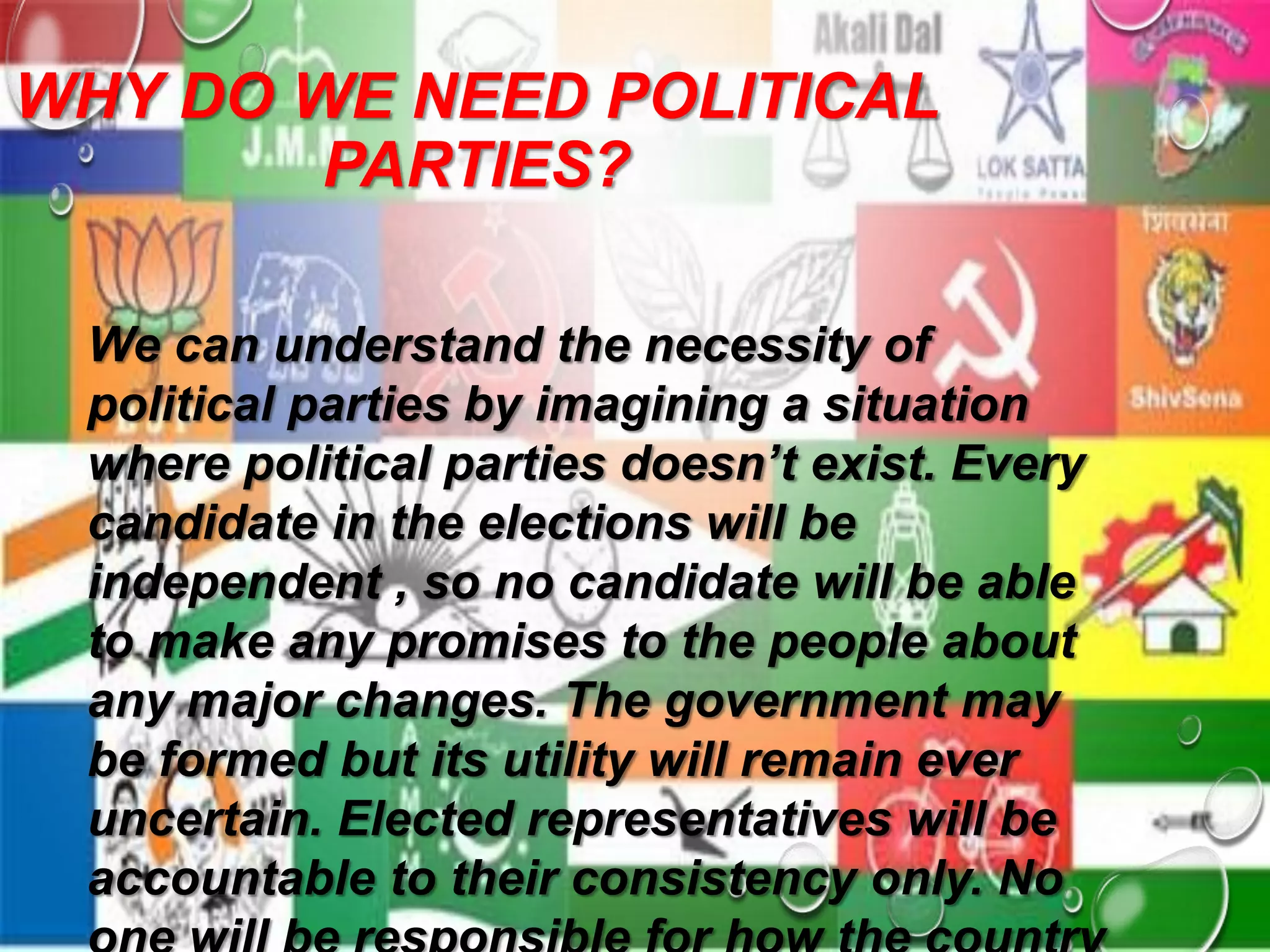
WHY DO WE NEED POLITICAL
PARTIES?
We can understand the necessity of
political parties by imagining a situation
where political parties doesn’t exist. Every
candidate in the elections will be
independent , so no candidate will be able
to make any promises to the people about
any major changes. The government may
be formed but its utility will remain ever
uncertain. Elected representatives will be
accountable to their consistency only. No
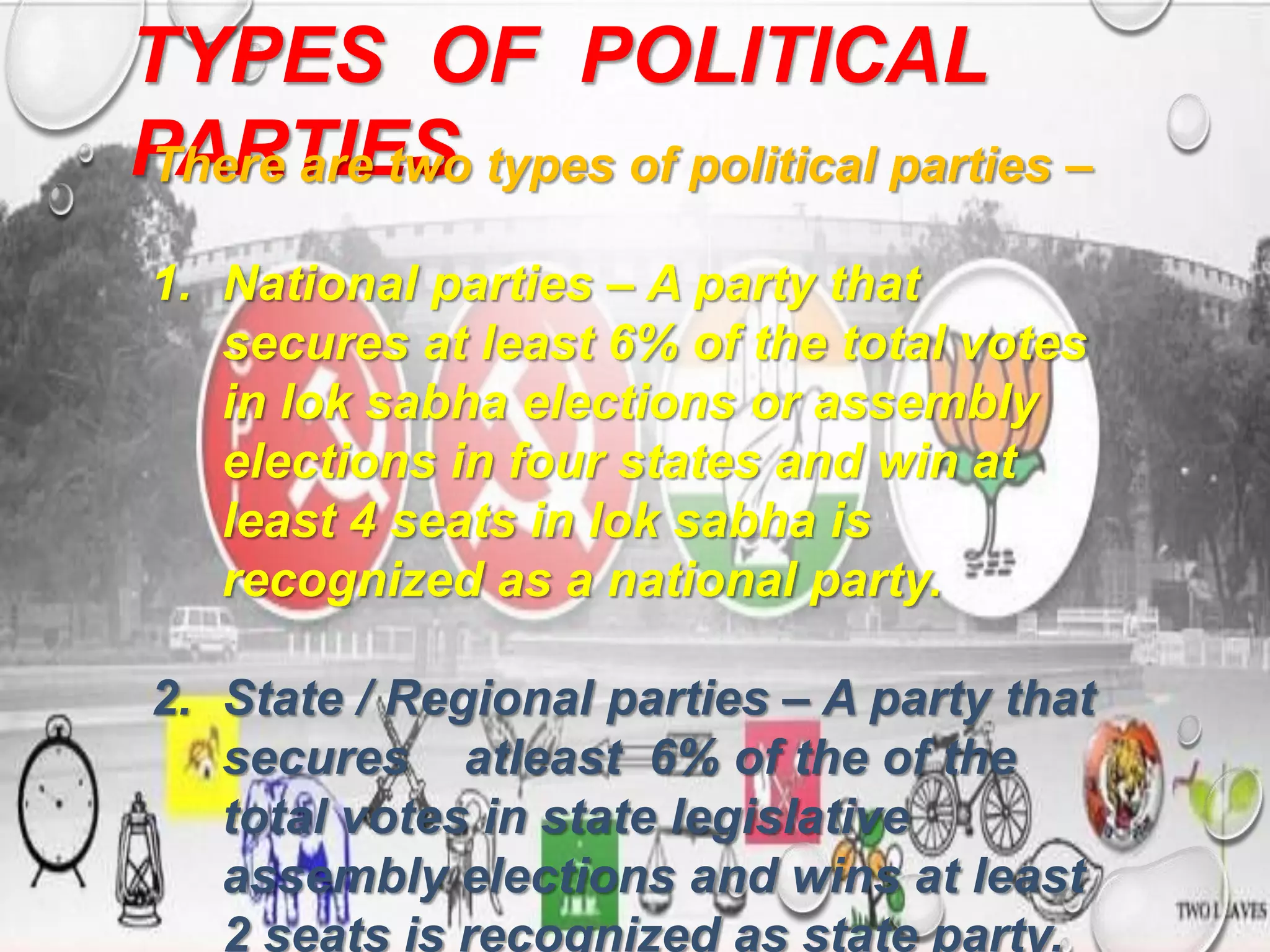
TYPES OF POLITICAL
PARTIESThere are two types of political parties –
1. National parties – A party that
secures at least 6% of the total votes
in lok sabha elections or assembly
elections in four states and win at
least 4 seats in lok sabha is
recognized as a national party.
2. State / Regional parties – A party that
secures atleast 6% of the of the
total votes in state legislative
assembly elections and wins at least
2 seats is recognized as state party.
Functions of the political
parties
 Parties contest elections.
Parties form and run governments in country.
Parties put different policies and programmes.
Parties play a decisive role in making laws for a
country.
Those parties that lose in the elections play the
role of opposition to the parties in power.
Parties shape public opinion by raising and
highlighting issues.
Parties provide people access to gov.t machinery
and welfare schemes implemented.
Owing to the diverse geographical, social and
cultural concerns, India has nurtured the
growth of the multi-party system. Over a
period of time, national and regional
political parties became the vital
constituents of the world’s largest
democracy, India. Whether the proliferation
of parties has helped the country’s cause, is
a different debate altogether. However, it’s
important to know what exactly these
political parties stand for and what role do
they play within the parliamentary democracy.
DEMOCRACYIN INDIA
PowersVestedinPoliticalPartiesinIndia
Every political party has its own set of vision
and ideologies , which are often aligned with the
needs and concerns of the state or region they
belong to.
Once people choose them during the
elections, they become legitimate rulers of the
country.
 The party members get the power to run the
executive, as well as the legislative machinery of
India.
Roles& Responsibilitiesof RulingPartiesinIndia
 The party that wields the power also bears certain
responsibilities.
 The primary onus of building political and social
consciousness lies on the parties.
 Under the greater objective of serving the nation
and its people, there are several smaller goals that
parties set for themselves to ensure that public
concerns are allayed, social indicators are favored
and corruption is eradicated.
In case of a coalition
setup, the national and
regional parties work
together to become a
platform for common people
to put forward their views.
 They become the voice
of the people by
representing them at a
Roles& Responsibilitiesof Opposition
Partiesin India
 While the primary role of the ruling party is to run the
government effectively, the ones who sit in the opposition also have
their tasks cut out.
 They position themselves as government watchdogs, with the
sole mission of scrutinizing the ruling party’s actions.
 It is incumbent upon them to prevent the ruling party from
becoming dictatorial.
 On a much broader level, the opposition gives a probing look
into the performance of the government and sees to it that good
governance benefits the entire nation and not just a few
communities.
 In India, the opposition parties are quick to act against faulty
policies and unjust laws.
 There had been incidents when strong protests were staged
against certain bills forcing the government to retract.
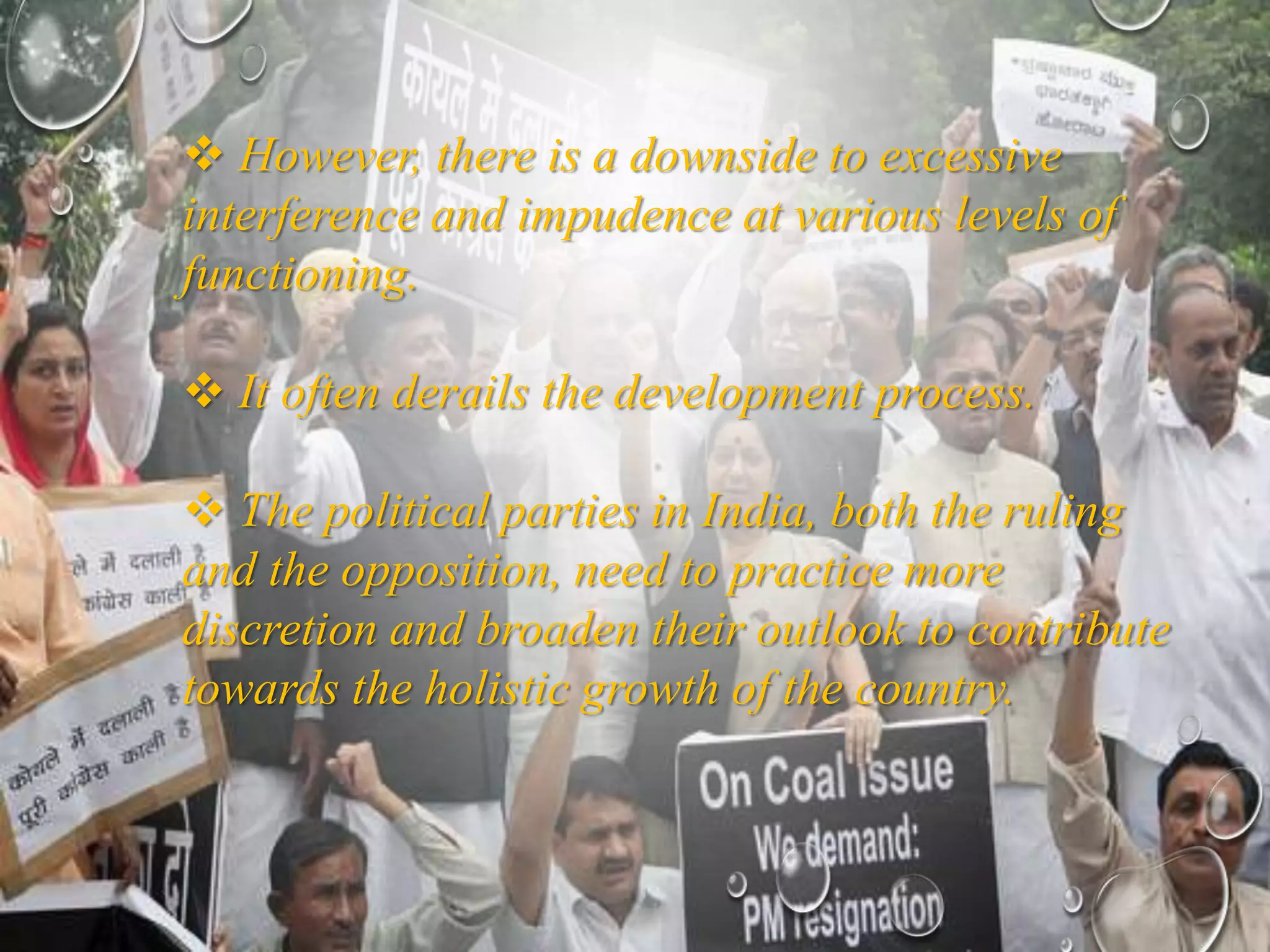
 However, there is a downside to excessive
interference and impudence at various levels of
functioning.
 It often derails the development process.
 The political parties in India, both the ruling
and the opposition, need to practice more
discretion and broaden their outlook to contribute
towards the holistic growth of the country.
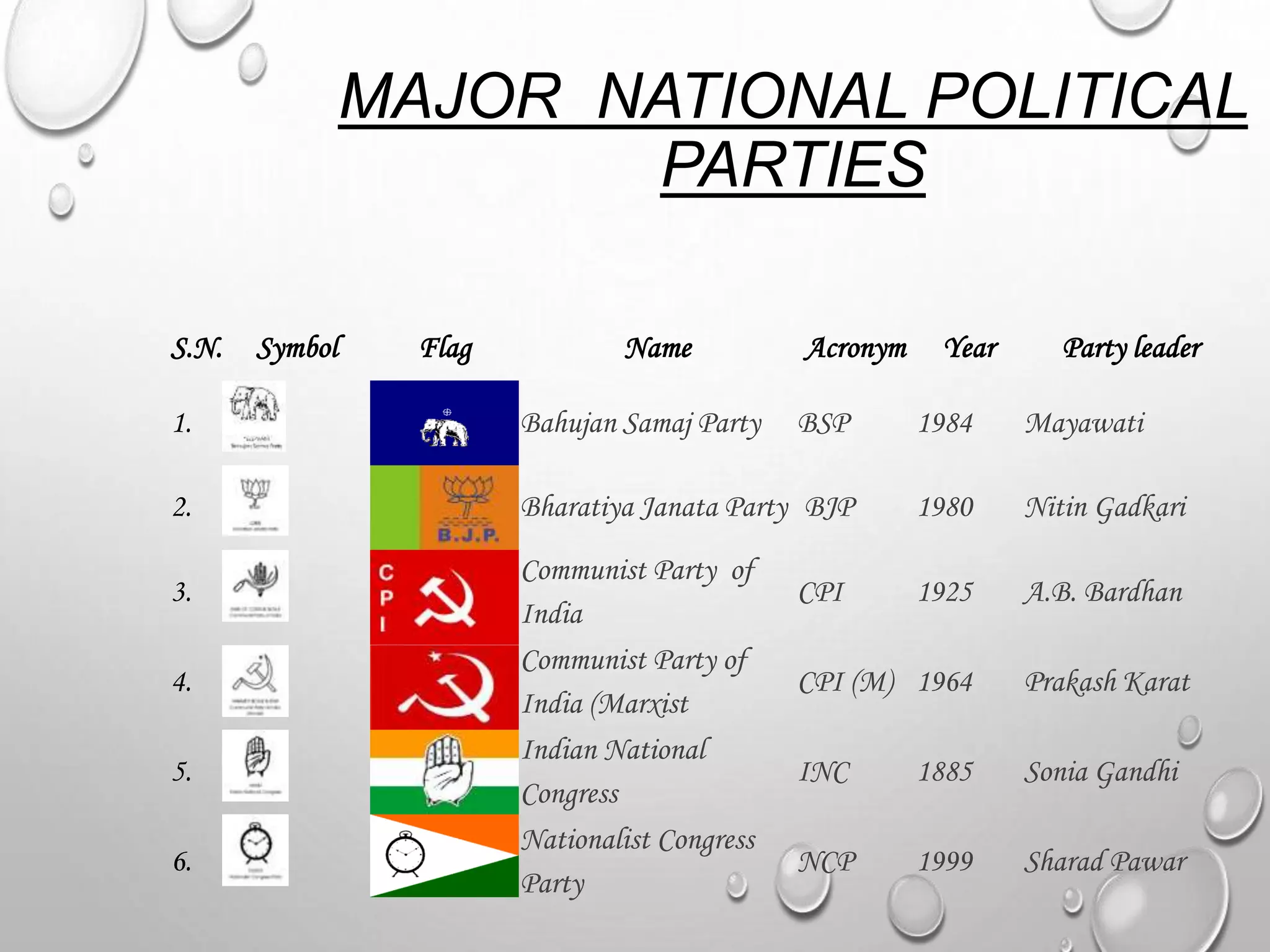
MAJOR NATIONAL POLITICAL
PARTIES
S.N. Symbol Flag Name Acronym Year Party leader
1. Bahujan Samaj Party BSP 1984 Mayawati
2. Bharatiya Janata Party BJP 1980 Nitin Gadkari
3.
Communist Party of
India
CPI 1925 A.B. Bardhan
4.
Communist Party of
India (Marxist
CPI (M) 1964 Prakash Karat
5.
Indian National
Congress
INC 1885 Sonia Gandhi
6.
Nationalist Congress
Party
NCP 1999 Sharad Pawar
A presentation by
Harshpreet Kaur
Of Class XI- A

Role of political parties in democray of India

  • 2.
  • 3.
    • A politicalpartyisa groupof peoplewhocometogetherto contest electionsandholdpowerinthegovernment. • Theyagreeon somepoliciesandprogrammesfora societywitha viewto promotecollectivegood. • A politicalpartyhasthreemaincomponents- 1.Theleaders 2.Theactivemembersand 3. Thesupporters.
  • 4.
    WHAT A COMMONINDIAN THINK ABOUT POLITICAL PARTIES? Most people in India tend to be very critical of political parties. They blame parties for all the wrong with our democracy and our political life. the parties were also identified with social and political divisions in our country.
  • 5.
    WHY DO WENEED POLITICAL PARTIES? We can understand the necessity of political parties by imagining a situation where political parties doesn’t exist. Every candidate in the elections will be independent , so no candidate will be able to make any promises to the people about any major changes. The government may be formed but its utility will remain ever uncertain. Elected representatives will be accountable to their consistency only. No
  • 6.
    TYPES OF POLITICAL PARTIESThereare two types of political parties – 1. National parties – A party that secures at least 6% of the total votes in lok sabha elections or assembly elections in four states and win at least 4 seats in lok sabha is recognized as a national party. 2. State / Regional parties – A party that secures atleast 6% of the of the total votes in state legislative assembly elections and wins at least 2 seats is recognized as state party.
  • 7.
    Functions of thepolitical parties  Parties contest elections. Parties form and run governments in country. Parties put different policies and programmes. Parties play a decisive role in making laws for a country. Those parties that lose in the elections play the role of opposition to the parties in power. Parties shape public opinion by raising and highlighting issues. Parties provide people access to gov.t machinery and welfare schemes implemented.
  • 8.
    Owing to thediverse geographical, social and cultural concerns, India has nurtured the growth of the multi-party system. Over a period of time, national and regional political parties became the vital constituents of the world’s largest democracy, India. Whether the proliferation of parties has helped the country’s cause, is a different debate altogether. However, it’s important to know what exactly these political parties stand for and what role do they play within the parliamentary democracy. DEMOCRACYIN INDIA
  • 9.
    PowersVestedinPoliticalPartiesinIndia Every political partyhas its own set of vision and ideologies , which are often aligned with the needs and concerns of the state or region they belong to. Once people choose them during the elections, they become legitimate rulers of the country.  The party members get the power to run the executive, as well as the legislative machinery of India.
  • 10.
    Roles& Responsibilitiesof RulingPartiesinIndia The party that wields the power also bears certain responsibilities.  The primary onus of building political and social consciousness lies on the parties.  Under the greater objective of serving the nation and its people, there are several smaller goals that parties set for themselves to ensure that public concerns are allayed, social indicators are favored and corruption is eradicated.
  • 11.
    In case ofa coalition setup, the national and regional parties work together to become a platform for common people to put forward their views.  They become the voice of the people by representing them at a
  • 12.
    Roles& Responsibilitiesof Opposition PartiesinIndia  While the primary role of the ruling party is to run the government effectively, the ones who sit in the opposition also have their tasks cut out.  They position themselves as government watchdogs, with the sole mission of scrutinizing the ruling party’s actions.  It is incumbent upon them to prevent the ruling party from becoming dictatorial.  On a much broader level, the opposition gives a probing look into the performance of the government and sees to it that good governance benefits the entire nation and not just a few communities.  In India, the opposition parties are quick to act against faulty policies and unjust laws.  There had been incidents when strong protests were staged against certain bills forcing the government to retract.
  • 13.
     However, thereis a downside to excessive interference and impudence at various levels of functioning.  It often derails the development process.  The political parties in India, both the ruling and the opposition, need to practice more discretion and broaden their outlook to contribute towards the holistic growth of the country.
  • 14.
    MAJOR NATIONAL POLITICAL PARTIES S.N.Symbol Flag Name Acronym Year Party leader 1. Bahujan Samaj Party BSP 1984 Mayawati 2. Bharatiya Janata Party BJP 1980 Nitin Gadkari 3. Communist Party of India CPI 1925 A.B. Bardhan 4. Communist Party of India (Marxist CPI (M) 1964 Prakash Karat 5. Indian National Congress INC 1885 Sonia Gandhi 6. Nationalist Congress Party NCP 1999 Sharad Pawar
  • 15.
    A presentation by HarshpreetKaur Of Class XI- A