SCIENCE PROJECT
WORK
ON
TISSUES
TISSUES
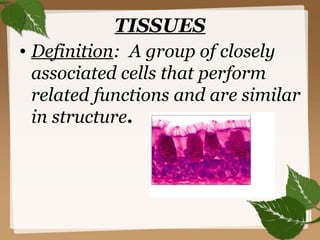
• Definition: A group of closely
associated cells that perform
related functions and are similar
in structure.
FOUR BASIC TYPES OF ANIMAL TISSUES
Epithelial tissue
Connective tissue
• Connective tissue proper (examples: fat tissue,
fibrous tissue of ligaments)
• Cartilage
• Bone
• Blood
Muscle tissue
Nervous tissue
EPITHELIAL TISSUE
• Epithelium: sheet of cells that covers a body
surface or lines a body cavity; also form most
of the body’s glands
• Roles: as interfaces and as boundaries
• Functions:
Protection Absorption
Sensory reception Ion transport
Secretion Filtration
Formation of slippery surfaces for
movement
SPECIAL CHARACTERISTICS OFSPECIAL CHARACTERISTICS OF
EPITHELIAEPITHELIA
 CellularityCellularity
 Specialized contactsSpecialized contacts
 PolarityPolarity
 Free upper (apical) surfaceFree upper (apical) surface
 Lower (basal) surface contributing basal laminaLower (basal) surface contributing basal lamina
to basement membraneto basement membrane
 Support by connective tissueSupport by connective tissue
 A vascular but innervatedA vascular but innervated
 Without vesselsWithout vessels
 With nerve endingsWith nerve endings
 RegenerationRegeneration
CLASSIFICATION OF EPITHELIA
• According to thickness
– “simple” - one cell layer
– “stratified” – more than one layer of cells
(which are named according to the shape
of the cells in the apical layer)
• According to shape
– “squamous” – wider than tall
– “cuboidal” – as tall as wide
– “columnar” - taller than wide
Where diffusion is
important.
Where tissues are
involved in secretion
and absorption: larger
cells because of the
machinery of
production, packaging,
and energy
requirements.
SIMPLE SQUAMOUS EPITHELIUM
CUBOIDAL EPITHELIUM
COLUMNAR EPITHELIUM
CONNECTIVE TISSUECONNECTIVE TISSUE
 Originate from embryonic tissue calledOriginate from embryonic tissue called
mesenchyme.mesenchyme.
 Most diverse and abundant type ofMost diverse and abundant type of
tissue.tissue.
 Many subclasses:Many subclasses:
EmbryonicEmbryonic
ProperProper
SpecialSpecial
 Cells separated from one another byCells separated from one another by
large amount of nonliving extracellularlarge amount of nonliving extracellular
FUNCTIONS OF CONNECTIVEFUNCTIONS OF CONNECTIVE
TISSUETISSUE
►Storage of energy.Storage of energy.
►Protection of organs.Protection of organs.
►Providing structural frameworkProviding structural framework
for the body.for the body.
►Connection of body tissues.Connection of body tissues.
MESENCHYME
MESENCHYME
AREOLAR TISSUE
ADIPOSE TISSUE
RECTICULAR TISSUE
BONE & CARTILAGE
Bone is a very strong and non flexible
tissue. The matrix of the bone is heavily
coated with calcium salts.
Cartilage is somewhat flexible. This
type of tissue is present comparatively in
very few parts of the body. The best
example is the tip of nose and external
ear.
HYALINE CARTILAGE
TENDONS & LIGAMENTSTENDONS & LIGAMENTS
Tendons and ligaments are thickTendons and ligaments are thick
network of fibres. The fibres arenetwork of fibres. The fibres are
loose and very elastic in nature.loose and very elastic in nature.
These fibres are secreted by theThese fibres are secreted by the
surrounding connective tissue cells.surrounding connective tissue cells.
The tendons are strong and connectThe tendons are strong and connect
the muscle to bone. The ligamentsthe muscle to bone. The ligaments
are elastic and connect bone toare elastic and connect bone to
bone.bone.
BLOOD
 Blood is also a connective tissue. In this
tissue the cells move in a fluid matrix or
medium called blood plasma. The blood
plasma contain cells called blood
corpuscles. They are red blood corpuscles
(RBC), white blood corpuscles (WBC) and
platelets. Blood flows to all parts of the
animal body and thus connects every part
of the body.
BLOOD CELLS
MUSCULAR TISSUE
It consists of elongated cells called
muscle fibres and is responsible for
movement in our body. Muscles
contain special proteins, which
contract and relax to cause movement.
TYPES OF MUSCULARTYPES OF MUSCULAR
TISSUETISSUE
 There are three types of
muscular tissue:
Skeletal muscles
Smooth muscles
Cardiac muscles
STRIATED MUSCLES
These muscles are attached to the bones and
help in body movement. The main
characteristic features of this type of tissue
are :
i. cells of the tissue are long cylindrical ,non-
tapering and unbranched
ii. transverse alternate light and dark bands or
striations can be seen
iii. there are many nuclei (multinucleated),
which are situated towards the periphery of
the muscle fibre.
STRIATED MUSCLES
UNSTRIATED MUSCLE
These tissue are found within the walls of all
the tubular organs such as stomach,
intestine, ureter, bronchi, etc. The smooth
muscle tissue have following features:
i. The cells are long with pointed ends (spindle
shape).
ii. The cells has only one nucleus (uninucleated)
situated in the centre.
iii. It does not show any strips or striations
across the muscle.
UNSTRIATED MUSCLES
CARDIAC MUSCLES
These type of muscles tissue is exclusively
present the heart. The main features are:
i. composed of non-tapering cells with faint
cross striations
ii. each cell contains one or two nuclei situated
in the centre
iii. the function is rhythmic contraction and
relaxation throughout life without fatigue
under normal conditions
iv. the cells are cylindrical and branched.
CARDIAC MUSCLES
NERVOUS TISSUENERVOUS TISSUE
• It is composed of brain , spinal cord andIt is composed of brain , spinal cord and
nerves. The cells of this tissue are callednerves. The cells of this tissue are called
neurons.neurons.
• A neuron has a single long part , called theA neuron has a single long part , called the
axon, and many short ,branched parts calledaxon, and many short ,branched parts called
dendrites.dendrites.
• Neurons are highly specialized for beingNeurons are highly specialized for being
stimulated and then transmitting the stimulusstimulated and then transmitting the stimulus
very rapidly from one place to another.very rapidly from one place to another.
NEURON
PLANT TISSUE
The plant body is made up of
different kinds of tissues. These
tissues may primarily be classified
into two groups:
a) Meristematic tissues and
b) Permanent tissues.
(A)MERISTEMATIC TISSUES
(MERISTEMS)
The meristematic tissue are present
only at the growing regions like
shoot tip, root tip and cambium
(region which is responsible for
growth in thickness). These cells
divide continuously thus helping in
increasing the length and the girth
of the plant.
CHARACTERISTIC
FEATURES OF MERISTEMS
 The cells of this tissue are similar in structure
and have thin walls.
 The cells may be spherical, oval, polygonal or
rectangular.
 They are compactly arranged without any
intercellular spaces between them.
 They contain dense or abundant cytoplasm and
single large nucleus.
 They contain few vacuoles or no vacuoles at all.
CLASSIFICATION ON THE
BASIS OF LOCATIOIN
 Apical meristems: at the growing
tips of the stem and roots.
 Lateral meristems: around the stem
and root.
 Intercalary meristems: at the base
of the leaves or internodes (on
either side of the node) on twings.
(B) PERMANENT TISSUE
Permanent tissue are derived from
meristematic tissues till they loose the
ability to divide.
Permanent cells have definite shape.
They may be living or dead, and thin
walled or thick walled.
The cells are large having vacuolated
cytoplasm.
SIMPLE PERMANENT TISSUE
A simple tissues is a group of one type
of cells only. The common simple
tissue of plant body are:
a) Parenchyma
b) Collenchyma
c)Sclerenchyma
(A) PARENCHYMA
 It is widely distributed in plant body like stem,
roots, leaves, flowers and fruits.
 Cells are isodiametric.
 Cells may be oval, round, polygonal or elongated
and have thin walls.
 There may or may not be intercellular spaces
between them.
 They are usually living and contains dense
cytoplasm.
 A large central vacuole is present in the cell.
FUNCTIONS OF
PARENCHYMATOUS TISSUE
to store assimilate food
to provide mechanical strength( as
they maintain the turgidity of cells)
they also store waste products such as
tannin, gum, crystals, resins of
inorganic waste, etc.
PARENCHYMA
Aerenchyma
1.bulliformcell 2.mesophyll
3.vascular bundle 4.air cavity 5.midribAbsorption parenchyma
Assimilation parenchyma Storage parenchyma
(B) COLLENCHYMA
 A living tissue like parenchyma.
Located below the epidermis.
Consists of thin walled cells which
are thickened at the corners.
Intercellular spaces are absent.
Cells may be oval, circular or
polygonal.
FUNCTIONS OF COLLENCHYMA
Provide mechanical support
Provide elasticity
Manufacture sugar and starch when
they contain chloroplasts
COLLENCHYMA
TRASVERSE AND LONGITUDINAL SECTION OF COLLENCHYMAS
(C) SCLERENCHYMA
 Dead cells devoid of protoplasm.
 Length varies from 1mm to 550mm in
different plants.
 They are long, narrow, thick and lignified.
 Closely packed without intercellular spaces.
 They are pointed at the ends.
 Cell walls are so thick so that the cell cavity
or lumen is nearly absent.
 They provide mechanical support to plants.
COMPLEX PERMANENTCOMPLEX PERMANENT
TISSUETISSUE
Complex tissue is made up of more than oneComplex tissue is made up of more than one
type of cells and they work together as a unit.type of cells and they work together as a unit.
Complex tissues transport water, salt and foodComplex tissues transport water, salt and food
material to various parts of plant body. They arematerial to various parts of plant body. They are
of following types:of following types:
• XylemXylem
• Phloem or bastPhloem or bast
Xylem and phloem are also called vascularXylem and phloem are also called vascular
tissue and together they constitute vasculartissue and together they constitute vascular
bundles.bundles.
(1) XYLEM
• Xylem is a conducting tissue. It is composed
of cells, i.e. elements of four different kinds-
tracheids, vessels or tracheae, xylem
parenchyma and xylem sclerenchyma.
Important one is tubular vessel. They carry
water from root to different parts of shoot.
Xylem gives mechanical strength to the
plant body.
(2) PHLOEM
• Phloem is a living conducting tissue. It is
composed of four elements-
a) sieve tubes
b) companion cells
c) phloem parenchyma
d) phloem fibres
The most important are the sieve tubes.
These tubular cells have perforated walls,
which translocate food materials from leaves
to other parts of the plant.
PHLOEM
SIEVE TUBE AND COMPANION CELL
I. Longitudinal section II.Transverse section
1.sieve plate   2.sieve tube  
3.companion cell   4.leucoplast 5.phloem
THANK
YOU !
MADE BY :- VAIBHAV KUMAR SHRAWAN
CLASS:- 9th

Science project work

  • 1.
  • 2.
    TISSUES • Definition: Agroup of closely associated cells that perform related functions and are similar in structure.
  • 3.
    FOUR BASIC TYPESOF ANIMAL TISSUES Epithelial tissue Connective tissue • Connective tissue proper (examples: fat tissue, fibrous tissue of ligaments) • Cartilage • Bone • Blood Muscle tissue Nervous tissue
  • 4.
    EPITHELIAL TISSUE • Epithelium:sheet of cells that covers a body surface or lines a body cavity; also form most of the body’s glands • Roles: as interfaces and as boundaries • Functions: Protection Absorption Sensory reception Ion transport Secretion Filtration Formation of slippery surfaces for movement
  • 5.
    SPECIAL CHARACTERISTICS OFSPECIALCHARACTERISTICS OF EPITHELIAEPITHELIA  CellularityCellularity  Specialized contactsSpecialized contacts  PolarityPolarity  Free upper (apical) surfaceFree upper (apical) surface  Lower (basal) surface contributing basal laminaLower (basal) surface contributing basal lamina to basement membraneto basement membrane  Support by connective tissueSupport by connective tissue  A vascular but innervatedA vascular but innervated  Without vesselsWithout vessels  With nerve endingsWith nerve endings  RegenerationRegeneration
  • 6.
    CLASSIFICATION OF EPITHELIA •According to thickness – “simple” - one cell layer – “stratified” – more than one layer of cells (which are named according to the shape of the cells in the apical layer) • According to shape – “squamous” – wider than tall – “cuboidal” – as tall as wide – “columnar” - taller than wide
  • 7.
    Where diffusion is important. Wheretissues are involved in secretion and absorption: larger cells because of the machinery of production, packaging, and energy requirements.
  • 8.
  • 9.
  • 10.
  • 11.
    CONNECTIVE TISSUECONNECTIVE TISSUE Originate from embryonic tissue calledOriginate from embryonic tissue called mesenchyme.mesenchyme.  Most diverse and abundant type ofMost diverse and abundant type of tissue.tissue.  Many subclasses:Many subclasses: EmbryonicEmbryonic ProperProper SpecialSpecial  Cells separated from one another byCells separated from one another by large amount of nonliving extracellularlarge amount of nonliving extracellular
  • 12.
    FUNCTIONS OF CONNECTIVEFUNCTIONSOF CONNECTIVE TISSUETISSUE ►Storage of energy.Storage of energy. ►Protection of organs.Protection of organs. ►Providing structural frameworkProviding structural framework for the body.for the body. ►Connection of body tissues.Connection of body tissues.
  • 13.
  • 14.
  • 15.
  • 16.
  • 17.
  • 18.
    BONE & CARTILAGE Boneis a very strong and non flexible tissue. The matrix of the bone is heavily coated with calcium salts. Cartilage is somewhat flexible. This type of tissue is present comparatively in very few parts of the body. The best example is the tip of nose and external ear.
  • 19.
  • 20.
    TENDONS & LIGAMENTSTENDONS& LIGAMENTS Tendons and ligaments are thickTendons and ligaments are thick network of fibres. The fibres arenetwork of fibres. The fibres are loose and very elastic in nature.loose and very elastic in nature. These fibres are secreted by theThese fibres are secreted by the surrounding connective tissue cells.surrounding connective tissue cells. The tendons are strong and connectThe tendons are strong and connect the muscle to bone. The ligamentsthe muscle to bone. The ligaments are elastic and connect bone toare elastic and connect bone to bone.bone.
  • 21.
    BLOOD  Blood isalso a connective tissue. In this tissue the cells move in a fluid matrix or medium called blood plasma. The blood plasma contain cells called blood corpuscles. They are red blood corpuscles (RBC), white blood corpuscles (WBC) and platelets. Blood flows to all parts of the animal body and thus connects every part of the body.
  • 22.
  • 23.
    MUSCULAR TISSUE It consistsof elongated cells called muscle fibres and is responsible for movement in our body. Muscles contain special proteins, which contract and relax to cause movement.
  • 24.
    TYPES OF MUSCULARTYPESOF MUSCULAR TISSUETISSUE  There are three types of muscular tissue: Skeletal muscles Smooth muscles Cardiac muscles
  • 25.
    STRIATED MUSCLES These musclesare attached to the bones and help in body movement. The main characteristic features of this type of tissue are : i. cells of the tissue are long cylindrical ,non- tapering and unbranched ii. transverse alternate light and dark bands or striations can be seen iii. there are many nuclei (multinucleated), which are situated towards the periphery of the muscle fibre.
  • 26.
  • 27.
    UNSTRIATED MUSCLE These tissueare found within the walls of all the tubular organs such as stomach, intestine, ureter, bronchi, etc. The smooth muscle tissue have following features: i. The cells are long with pointed ends (spindle shape). ii. The cells has only one nucleus (uninucleated) situated in the centre. iii. It does not show any strips or striations across the muscle.
  • 28.
  • 29.
    CARDIAC MUSCLES These typeof muscles tissue is exclusively present the heart. The main features are: i. composed of non-tapering cells with faint cross striations ii. each cell contains one or two nuclei situated in the centre iii. the function is rhythmic contraction and relaxation throughout life without fatigue under normal conditions iv. the cells are cylindrical and branched.
  • 30.
  • 31.
    NERVOUS TISSUENERVOUS TISSUE •It is composed of brain , spinal cord andIt is composed of brain , spinal cord and nerves. The cells of this tissue are callednerves. The cells of this tissue are called neurons.neurons. • A neuron has a single long part , called theA neuron has a single long part , called the axon, and many short ,branched parts calledaxon, and many short ,branched parts called dendrites.dendrites. • Neurons are highly specialized for beingNeurons are highly specialized for being stimulated and then transmitting the stimulusstimulated and then transmitting the stimulus very rapidly from one place to another.very rapidly from one place to another.
  • 32.
  • 33.
    PLANT TISSUE The plantbody is made up of different kinds of tissues. These tissues may primarily be classified into two groups: a) Meristematic tissues and b) Permanent tissues.
  • 34.
    (A)MERISTEMATIC TISSUES (MERISTEMS) The meristematictissue are present only at the growing regions like shoot tip, root tip and cambium (region which is responsible for growth in thickness). These cells divide continuously thus helping in increasing the length and the girth of the plant.
  • 35.
    CHARACTERISTIC FEATURES OF MERISTEMS The cells of this tissue are similar in structure and have thin walls.  The cells may be spherical, oval, polygonal or rectangular.  They are compactly arranged without any intercellular spaces between them.  They contain dense or abundant cytoplasm and single large nucleus.  They contain few vacuoles or no vacuoles at all.
  • 36.
    CLASSIFICATION ON THE BASISOF LOCATIOIN  Apical meristems: at the growing tips of the stem and roots.  Lateral meristems: around the stem and root.  Intercalary meristems: at the base of the leaves or internodes (on either side of the node) on twings.
  • 37.
    (B) PERMANENT TISSUE Permanenttissue are derived from meristematic tissues till they loose the ability to divide. Permanent cells have definite shape. They may be living or dead, and thin walled or thick walled. The cells are large having vacuolated cytoplasm.
  • 38.
    SIMPLE PERMANENT TISSUE Asimple tissues is a group of one type of cells only. The common simple tissue of plant body are: a) Parenchyma b) Collenchyma c)Sclerenchyma
  • 39.
    (A) PARENCHYMA  Itis widely distributed in plant body like stem, roots, leaves, flowers and fruits.  Cells are isodiametric.  Cells may be oval, round, polygonal or elongated and have thin walls.  There may or may not be intercellular spaces between them.  They are usually living and contains dense cytoplasm.  A large central vacuole is present in the cell.
  • 40.
    FUNCTIONS OF PARENCHYMATOUS TISSUE tostore assimilate food to provide mechanical strength( as they maintain the turgidity of cells) they also store waste products such as tannin, gum, crystals, resins of inorganic waste, etc.
  • 41.
    PARENCHYMA Aerenchyma 1.bulliformcell 2.mesophyll 3.vascular bundle4.air cavity 5.midribAbsorption parenchyma Assimilation parenchyma Storage parenchyma
  • 42.
    (B) COLLENCHYMA  Aliving tissue like parenchyma. Located below the epidermis. Consists of thin walled cells which are thickened at the corners. Intercellular spaces are absent. Cells may be oval, circular or polygonal.
  • 43.
    FUNCTIONS OF COLLENCHYMA Providemechanical support Provide elasticity Manufacture sugar and starch when they contain chloroplasts
  • 44.
  • 45.
    (C) SCLERENCHYMA  Deadcells devoid of protoplasm.  Length varies from 1mm to 550mm in different plants.  They are long, narrow, thick and lignified.  Closely packed without intercellular spaces.  They are pointed at the ends.  Cell walls are so thick so that the cell cavity or lumen is nearly absent.  They provide mechanical support to plants.
  • 46.
    COMPLEX PERMANENTCOMPLEX PERMANENT TISSUETISSUE Complextissue is made up of more than oneComplex tissue is made up of more than one type of cells and they work together as a unit.type of cells and they work together as a unit. Complex tissues transport water, salt and foodComplex tissues transport water, salt and food material to various parts of plant body. They arematerial to various parts of plant body. They are of following types:of following types: • XylemXylem • Phloem or bastPhloem or bast Xylem and phloem are also called vascularXylem and phloem are also called vascular tissue and together they constitute vasculartissue and together they constitute vascular bundles.bundles.
  • 47.
    (1) XYLEM • Xylemis a conducting tissue. It is composed of cells, i.e. elements of four different kinds- tracheids, vessels or tracheae, xylem parenchyma and xylem sclerenchyma. Important one is tubular vessel. They carry water from root to different parts of shoot. Xylem gives mechanical strength to the plant body.
  • 48.
    (2) PHLOEM • Phloemis a living conducting tissue. It is composed of four elements- a) sieve tubes b) companion cells c) phloem parenchyma d) phloem fibres The most important are the sieve tubes. These tubular cells have perforated walls, which translocate food materials from leaves to other parts of the plant.
  • 49.
    PHLOEM SIEVE TUBE ANDCOMPANION CELL I. Longitudinal section II.Transverse section 1.sieve plate   2.sieve tube   3.companion cell   4.leucoplast 5.phloem
  • 50.
    THANK YOU ! MADE BY:- VAIBHAV KUMAR SHRAWAN CLASS:- 9th