CHAPTER – 6

 TISSUES
DEFINITION
A group or collection of similar cells
 performing or help to perform same
 function and arise from the same origin
 are called tissues.
The tissues are of different types depending
 on the functions of the organism, they are
 mainly of two categories PLANT TISSUES and
 ANIMAL TISSUES.
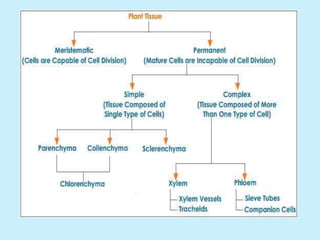
PLANT TISSUES
Plants perform functions which are different
  from animals and also their structure is
  different , hence they have tissues which are
  different from animals. They are further
  classified into many sub categories which is
  shown in the table below:
MERISTEMATIC TISSUE

• The main characteristic of this tissue is
  that it is responsible for the growth of
  plants.
• The cells of this tissue continuously
  divide and later differentiate ( i.e. get
  converted ) into permanent tissue.
Characteristics of the cells/ tissue
• The cells are made of thin & elastic cell wall
  made of cellulose.
• The cells may be round , oval, polygonal or
  rectangular in shape.
• They are compact, having no intercellular
  space.
• There is a large nucleus and abundant
  cytoplasm.
• The protoplasm contains very few or no
  vacuoles at all.
This tissue occurs at specific regions of
             the plant body
                     • This is so because in plant
                       body growth occurs only at
                       these regions.
                     • Hence , on the basis of this
                       there are 3 types of
                       meristem :
                     1. APICAL MERISTEM
                     2. INTERCALARY MERISTEM
                     3. LATERAL MERISTEM
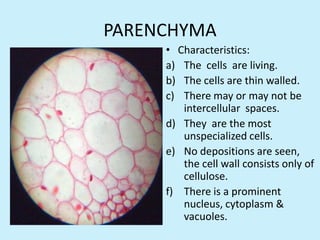
APICAL MERISTEM
        As the name suggests
          this tissue is present at
          the apex of the main
          & lateral shoots and
          roots.
        This tissue gives the
          plant body a linear
          growth.
LATERAL MERISTEM
        This tissue lies on the
           sides of the plant
           body.
        It lies under the bark of
           the plant in form of
           cork cambium.
        It gives the plant it’s
           width or girth.
INTERCALARY MERISTEM
          This tissue is present at
            the base of the
            nodes, internodes,
            leaves etc.
          They are also present in
            between the
            permanent tissue.
          They give the plant
            growth in length.
PERMANENT TTISSUE
• These tissues arise from the meristematic
  tissue.
• The cells of this tissue gradually loose their
  power to divide and acquire a definite
  shape, size and function.
• These tissues may be living or dead.
• There are 2 types of permanent tissues
1. Simple permanent tissue
2. Complex permanent tissue.
SIMPLE PERMANENT TISSUE
• This tissue comprises of same type of cells
  which perform the same function and all arise
  from the same origin. There are three
  categories of simple permanent tissues:
  Parenchyma, Collenchyma, & Sclerenchyma.
THE THREE SIMPLE PERMANENT
           TISSUES
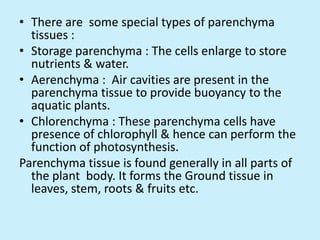
PARENCHYMA
     • Characteristics:
     a) The cells are living.
     b) The cells are thin walled.
     c) There may or may not be
        intercellular spaces.
     d) They are the most
        unspecialized cells.
     e) No depositions are seen,
        the cell wall consists only of
        cellulose.
     f) There is a prominent
        nucleus, cytoplasm &
        vacuoles.
• There are some special types of parenchyma
  tissues :
• Storage parenchyma : The cells enlarge to store
  nutrients & water.
• Aerenchyma : Air cavities are present in the
  parenchyma tissue to provide buoyancy to the
  aquatic plants.
• Chlorenchyma : These parenchyma cells have
  presence of chlorophyll & hence can perform the
  function of photosynthesis.
Parenchyma tissue is found generally in all parts of
  the plant body. It forms the Ground tissue in
  leaves, stem, roots & fruits etc.
Functions of parenchyma :
a) To store materials such as starch, proteins,
   hormones etc and waste products such as gum,
   tannin, resin etc.
b) Parenchyma cells perform the metabolic
   activities of the plant.
c) Forms the packaging tissue between the
   specialized tissue.
d) By providing turgidity , they provide mechanical
   strength.
e) Chlorenchyma helps in performing
   photosynthesis.
COLLENCHYMA
• Characteristics:              • Functions :
a) It has cells which are       a) Providing mechanical
   somewhat elongated.             strength is the primary
b) The cell walls are thin         function.
   except at the angular        b) Provide flexibility.
   region ( where the cells     c) Photosynthesis, as they
   join). The thickenings are      contain chlorophyll.
   caused due to deposition
   of cellulose or pectin.
                                They are present below
c) There is o or less              the epidermis in dicot
   intercellular space.            stems and leaves. They
d) The cells are living, have      absent in dicot roots
   distinct nucleus & dense        and all parts of
   protoplasm.                     monocot plants.
e) They often contain
   chlorophyll.
SCLERENCHYMA