OPTOM FASLU MUHAMMED
 The optical center (OC) of a lens is the
point at which light rays can pass with
no deviation.
 It is important that a lens is ground so that
its optical center is directly in front of the
patient’s pupils to allow optimum vision
through the lens.
 The patient’s PD and an optical center height
will determine the placement of the lens
within the frame
 Hold the lens as in step 2 above: that is, with
the cross lines of the image perpendicular
to each other.  
 Now move the lens up-and-down or side-to-
side to ensure that the lines of the cross
image exactly overlap with the lines of the
object cross.
 Held in this position, the point at which the
cross lines intersect on the lens is the
optical centre of the lens.  
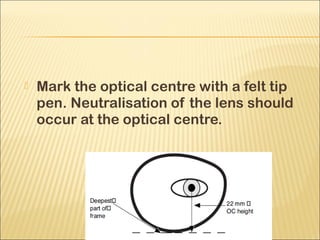
 Mark the optical centre with a felt tip
pen. Neutralisation of the lens should
occur at the optical centre.
 When light goes through the optical center
(OC) of the lens, it goes straight through. It
is not bent.
 When light goes through any other point on
a lens, the ray of light is bent.
 When the optical center of a lens is moved
away from its expected position in front of
the eye, that lens now causes a prismatic
effect.
 The farther the lens is moved or decentered
from its original position the greater the
amount of resulting prism.
 At the exact OC of a lens, front and
back lens surfaces are parallel to each
other. The line that passes through the
OC of a lens is known as the optical
axis.
 If the optic axis of a lens passes through the
center of the pupil, the lens is centered in
front of the eye. If the lens is moved so that
it does not coincide with the line of sight of
the eye (for our purposes at the center of the
pupil), it is said to be decentered.
 What happens when the lens is moved so
that the center of the lens is no longer in
front of the center of the eye?
 When the wearer looks right through
the center of the lens, the object is
not displaced from its actual
location.
 But when a plus or minus lens is
moved off-center in relationship to
the location of the eye, the object
appears displaced . This means that
a decentered lens causes a
PRISMATIC EFFECT.
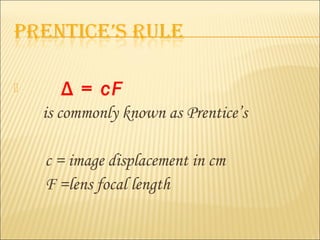
 Δ = cF
is commonly known as Prentice’s
c = image displacement in cm
F =lens focal length
When a lens is decentered, a prismatic
effect is created. With decentration,
both prism power and prism base
direction are manifested.
 The power of the prism depends on
the amount of lens decentration and
the refractive power of the lens
being decentered.
 The prism base orientation depends on
the direction of decentration and whether
the lens is positive or negative.
Q
Q: If a lens having a power of +3.00 D
is decentered 5 mm away from the
center of the eye, how much prismatic
effect will this cause?
To find the prismatic effect, simply
multiply the distance in centimeters
that the lens has been displaced by the
power of the lens. Since 5 mm equals
0.5 cm,
Prism dioptres = 0.5 (3.00)
 When a sphere lens is decentered both
horizontally and vertically, the most
straightforward solution for finding the
prismatic effect is to consider each
component by itself.
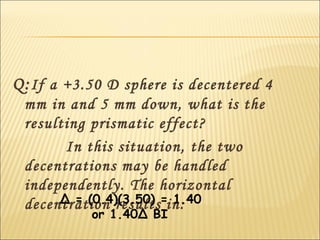
Q:If a +3.50 D sphere is decentered 4
mm in and 5 mm down, what is the
resulting prismatic effect?
In this situation, the two
decentrations may be handled
independently. The horizontal
decentration results in:Δ = (0.4)(3.50) = 1.40
or 1.40Δ BI
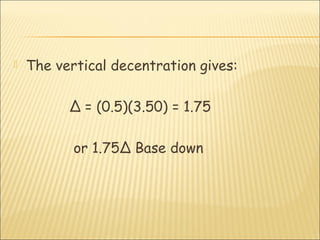
 The vertical decentration gives:
Δ = (0.5)(3.50) = 1.75
or 1.75Δ Base down
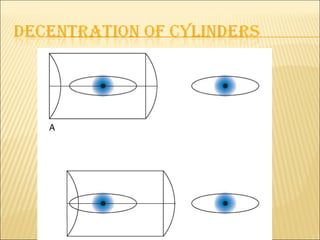
 Cylinders produce varying prismatic effects
when decentered. These prismatic effects
depend not only on the power of the cylinder
but also on the orientation of the cylinder
axis.
 If the axis of a Plano cylinder is
oriented in the direction of decent
ration, there will be no prismatic
effect induced regardless of the
amount of decentration - no power in
the axis meridian of a Plano cylinder.
 If, however, the cylinder axis is at
right angles to the direction of decent
ration, the amount of prism induced
varies according to Prentice’s rule.
 1. Calculate for the sphere and cylinder
separately and combine the results.
 2. Transpose the prescription to crossed
cylinder form. Each cylinder may then be
worked independentlyand the results combined.
 3. Use higher mathematical computations
Optical prism decentration

Optical prism decentration

  • 1.
  • 2.
     The opticalcenter (OC) of a lens is the point at which light rays can pass with no deviation.  It is important that a lens is ground so that its optical center is directly in front of the patient’s pupils to allow optimum vision through the lens.  The patient’s PD and an optical center height will determine the placement of the lens within the frame
  • 3.
     Hold thelens as in step 2 above: that is, with the cross lines of the image perpendicular to each other.    Now move the lens up-and-down or side-to- side to ensure that the lines of the cross image exactly overlap with the lines of the object cross.  Held in this position, the point at which the cross lines intersect on the lens is the optical centre of the lens.  
  • 4.
     Mark theoptical centre with a felt tip pen. Neutralisation of the lens should occur at the optical centre.
  • 6.
     When lightgoes through the optical center (OC) of the lens, it goes straight through. It is not bent.  When light goes through any other point on a lens, the ray of light is bent.
  • 7.
     When theoptical center of a lens is moved away from its expected position in front of the eye, that lens now causes a prismatic effect.  The farther the lens is moved or decentered from its original position the greater the amount of resulting prism.
  • 8.
     At theexact OC of a lens, front and back lens surfaces are parallel to each other. The line that passes through the OC of a lens is known as the optical axis.
  • 9.
     If theoptic axis of a lens passes through the center of the pupil, the lens is centered in front of the eye. If the lens is moved so that it does not coincide with the line of sight of the eye (for our purposes at the center of the pupil), it is said to be decentered.
  • 10.
     What happenswhen the lens is moved so that the center of the lens is no longer in front of the center of the eye?
  • 11.
     When thewearer looks right through the center of the lens, the object is not displaced from its actual location.  But when a plus or minus lens is moved off-center in relationship to the location of the eye, the object appears displaced . This means that a decentered lens causes a PRISMATIC EFFECT.
  • 12.
     Δ =cF is commonly known as Prentice’s c = image displacement in cm F =lens focal length
  • 14.
    When a lensis decentered, a prismatic effect is created. With decentration, both prism power and prism base direction are manifested.  The power of the prism depends on the amount of lens decentration and the refractive power of the lens being decentered.
  • 15.
     The prismbase orientation depends on the direction of decentration and whether the lens is positive or negative.
  • 16.
    Q Q: If alens having a power of +3.00 D is decentered 5 mm away from the center of the eye, how much prismatic effect will this cause? To find the prismatic effect, simply multiply the distance in centimeters that the lens has been displaced by the power of the lens. Since 5 mm equals 0.5 cm, Prism dioptres = 0.5 (3.00)
  • 17.
     When asphere lens is decentered both horizontally and vertically, the most straightforward solution for finding the prismatic effect is to consider each component by itself.
  • 18.
    Q:If a +3.50D sphere is decentered 4 mm in and 5 mm down, what is the resulting prismatic effect? In this situation, the two decentrations may be handled independently. The horizontal decentration results in:Δ = (0.4)(3.50) = 1.40 or 1.40Δ BI
  • 19.
     The verticaldecentration gives: Δ = (0.5)(3.50) = 1.75 or 1.75Δ Base down
  • 20.
     Cylinders producevarying prismatic effects when decentered. These prismatic effects depend not only on the power of the cylinder but also on the orientation of the cylinder axis.
  • 21.
     If theaxis of a Plano cylinder is oriented in the direction of decent ration, there will be no prismatic effect induced regardless of the amount of decentration - no power in the axis meridian of a Plano cylinder.  If, however, the cylinder axis is at right angles to the direction of decent ration, the amount of prism induced varies according to Prentice’s rule.
  • 23.
     1. Calculatefor the sphere and cylinder separately and combine the results.  2. Transpose the prescription to crossed cylinder form. Each cylinder may then be worked independentlyand the results combined.  3. Use higher mathematical computations