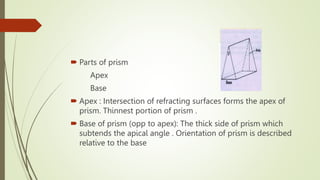
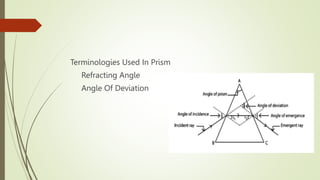
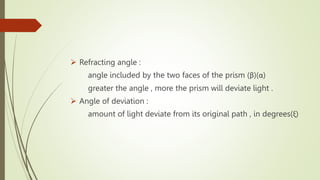
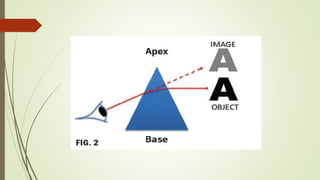
- A prism refracts light, causing the object to be displaced towards the apex of the prism while maintaining the light's vergence. It produces an erect virtual image that is displaced towards the apex.
- The power of a prism is measured in prism diopters, which is the angle of deviation in centimeters of light passing through the prism at a distance of 100 cm. Prisms are used to treat binocular vision disorders by compensating for phorias and tropias.
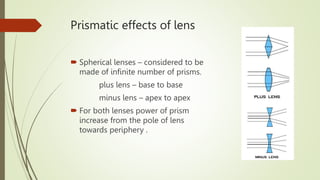
- Prismatic effects can be produced by decentration of lenses. The amount of prismatic effect depends on the lens power and distance from the lens pole, as described by the Prentice rule. Prismatic effects are