DUOCHROME
DR VISHNU
INTRODUCTION
• Known as duochrome or bichrome test
• Used as a check on the best vision sphere during mono ocular refraction
( end of subjective refraction )
• Used at 2 points:
- After initial determination of the best vision sphere and prior of use of
JCC ( to ensure the circle of least confusion is on retina )
- After the JCC test prior finalizing the refractive correction
PRINCIPLE
• It uses the principle of chromatic aberration to monocularly refine the
spherical endpoint.
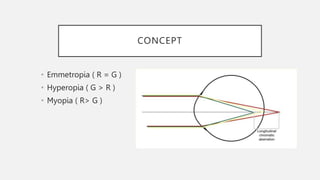
• Shorter wavelength of light ( green ) is refracted more by eye optics
compared to longer wavelength ( red )
CONCEPT
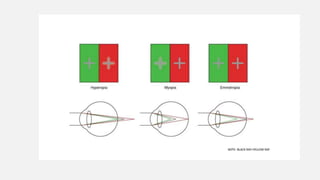
• Emmetropia ( R = G )
• Hyperopia ( G > R )
• Myopia ( R> G )
EMMETROPIA
• In emmetropic patient, the green colour light focus in front of the retina,
the yellow light on the retina and the red colour behind the retina
HYPERMETROPIA
• In hypermetropia the plus power ( converging power ) is deficient, so all
the rays diverge
• This results in the green light to diverge near retina, the yellow light
behind and red even further behind
MYOPIA
• In myopia minus power is deficient ( diverging power ), so all light
converge
• This results in red light to converge on the retina, the yellow light in
front the retina, and the green light even further in front the retina
PROCEDURE
1. Occlude one eye. Turn off the room lights to dilate the pupil, which
increases the chromatic aberration of the eye.
2. Ask the patient: "Are the rings/letters/dots clearer and blacker on the red or
on the green, or are they the same?" If they are the same, this suggests the
best vision sphere has been obtained and the circle of least confusion is on the
retina.
3. If the rings on the green are clearer, add plus +0.25 DS until you obtain
balance. Note the additional spherical power needed to obtain balance.
4. If the rings on the red look clearer, add minus -0.25 DS until you obtain
balance, noting the additional power required.
5. If more than +/- 0.50 DS is required to balance, this usually indicated the
duochrome test is not reliable for this patient and should be ignored.
INTERPRETATION
If patient says the letter on the red background is clearer/sharper
It means
- Patient is a overcorrected hyperope
- Or under corrected myope
Add -0.25DS until patient reports both same
Red Add Minus ( RAM )
INTERPRETATION
If patient says letter on green background clearer/sharper
It means
- Patient is overcorrected myope
- Or under corrected hyperope
Add plus + 0.25DS for until patient reports both same
Green Add Plus ( GAP )
FOR FINAL POWER
• Target is for patient to see letters in red/green in equal clarity
• If clarity or sharpness of letters or rings changes from green to red with
+0.25DS or red to green with – 0.25DS, keep patient on red side.
RELIABILITY OF DUO CHROME TEST IN DIFFERENT AGE
GROUPS CONSIDERING PATIENT SATISFACTION AS GOLD
STANDARD
- Z E H W A M A Z H A R 1 , R A B I A M A N Z O O R 2 , S H A Z I A K A N W A L 3 , G H A Z A L A I Q B A L 4
1 - 4 D E P A R T M E N T O F O P H T H A L M O L O G Y , K I N G E D W A R D M E D I C A L U N I V E R S I T Y , L A H O R E
Study Design: Descriptive, Cross Sectional Study.
Place and Duration of Study: College of Ophthalmology and Allied Vision Sciences. King Edward
Medical University, Lahore from September 2019 – December 2019.
Methods: Forty two cooperative patients of both genders more than 15 years of age were included but
patients with poor fixation, any opacity or any other ocular pathology were excluded. Equipment used
was Trial box Trial frame Auto-refractor and Snellen Chart. Group 1 composed of 17 patients (15 – 35
years of age). Group 2 (36 – 60 years) had 15 patients and group 3 (age 61-80 years) comprised of 10
patients. Data was collected on self- designed Performa. Duo Chrome was dependent variable and
gender was independent variable. Data was analyzed by using statistical package for social science
(SPSS22.00) and chi square test was applied.
Results: Out 42, 21 patients reported red, 12 reported green and 9 patients reported equally clear in
the right eye. P value=0.156 showed that duo chrome test was equally reliable in every age group in
the right eye. Similar results with p = 0.755 showed that duo chrome test was equally reliable in every
age group in the left eye. Test when performed bilaterally, showed similar results. Out of 42 patients,
32 were satisfied and 10 were not satisfied with the test.
Conclusion: Red Green duo-chrome test is equally reliable in all age groups to confirm refraction.
CAN THE RED-GREEN DUOCHROME TEST BE USED PRIOR TO
CORRECTING THE REFRACTIVE CYLINDER COMPONENT?
L I A T G A N T Z , S H L O M O S C H R A D E R , R U T H I E R U B E N ,
A R I Z . Z I V O T O F S K Y 2 0 1 5
Purpose : The duochrome red-green test is recommended for use both prior to and subsequent to
determining the cylindrical or astigmatic component of the refraction. In order for it to be effective
when used before correcting the cylinder it is necessary that the COLC (Circle of Least Confusion) be
on the retina. This study examined whether it is necessarily true that the duochrome response in
uncorrected astigmatism will be as trust-worthy as it is with corrected cylinders.
Results : The intervals between “red” and “green” responses were not significantly different in the
population as a whole and in the uncorrected physiological cylinder and induced cylinder subgroups
examined.
Conclusion: Based on the finding that the interval of red-green equality with fully corrected cylinder
and without the cylindrical correction are not significantly different, the red-green duochrome test can
indeed be used both before and after cylindrical correction.
QUESTIONS?
1. What is the principle of duochrome test?
2. Can we perform duochrome test in patient who is colour blind?
3. What is the visual acuity required to do the test? And why?
4. If a patient has -2.00DS and is saying R>G, what lens do we add? And
what is the final correction?
5. If patient has +4.75DS and is saying G>R, what lens do we add?, after
that he says R>G, what is the interpretation and final correction?
ANSWERS
1. It uses principle of chromatic aberration to monocularly refine the
spherical endpoint.
2. Yes. Because the test does not involve colour discrimination.
3. 6/9 and better. The green and red filter create a 0.5D difference, VA
worse than 6/9 is not able to distinguish the small difference.
4. -0.25D, -2.25D
5. +0.25D, leave it at +5.00DS, as our aim is to prevent overminusing
MCQ
Duochrome Test
a. Uses letters or numbers of different colours against the same
background
b. Uses blue and red colours
c. Is sensitive to changes in refraction of 0.25D or less
d. Is useful in myopic patients to avoid undercorrection
e. Can not be used in colour blind patients
ANSWERS
a.F b.F c.T d.F e.F
It uses letters or numbers of the same colour usually black against red and
green.
It is sensitive to changes in refraction of 0.25D or less
It is useful in myopic patients to avoid overcorrection, in in which case the
eye needs to accommodate causing eyestrain
Can be used in colour blind patient, because it does not involve colour
descrimination

Duochrome.pptx

  • 1.
  • 2.
    INTRODUCTION • Known asduochrome or bichrome test • Used as a check on the best vision sphere during mono ocular refraction ( end of subjective refraction ) • Used at 2 points: - After initial determination of the best vision sphere and prior of use of JCC ( to ensure the circle of least confusion is on retina ) - After the JCC test prior finalizing the refractive correction
  • 3.
    PRINCIPLE • It usesthe principle of chromatic aberration to monocularly refine the spherical endpoint. • Shorter wavelength of light ( green ) is refracted more by eye optics compared to longer wavelength ( red )
  • 4.
    CONCEPT • Emmetropia (R = G ) • Hyperopia ( G > R ) • Myopia ( R> G )
  • 6.
    EMMETROPIA • In emmetropicpatient, the green colour light focus in front of the retina, the yellow light on the retina and the red colour behind the retina
  • 7.
    HYPERMETROPIA • In hypermetropiathe plus power ( converging power ) is deficient, so all the rays diverge • This results in the green light to diverge near retina, the yellow light behind and red even further behind
  • 8.
    MYOPIA • In myopiaminus power is deficient ( diverging power ), so all light converge • This results in red light to converge on the retina, the yellow light in front the retina, and the green light even further in front the retina
  • 9.
    PROCEDURE 1. Occlude oneeye. Turn off the room lights to dilate the pupil, which increases the chromatic aberration of the eye. 2. Ask the patient: "Are the rings/letters/dots clearer and blacker on the red or on the green, or are they the same?" If they are the same, this suggests the best vision sphere has been obtained and the circle of least confusion is on the retina. 3. If the rings on the green are clearer, add plus +0.25 DS until you obtain balance. Note the additional spherical power needed to obtain balance. 4. If the rings on the red look clearer, add minus -0.25 DS until you obtain balance, noting the additional power required. 5. If more than +/- 0.50 DS is required to balance, this usually indicated the duochrome test is not reliable for this patient and should be ignored.
  • 10.
    INTERPRETATION If patient saysthe letter on the red background is clearer/sharper It means - Patient is a overcorrected hyperope - Or under corrected myope Add -0.25DS until patient reports both same Red Add Minus ( RAM )
  • 11.
    INTERPRETATION If patient saysletter on green background clearer/sharper It means - Patient is overcorrected myope - Or under corrected hyperope Add plus + 0.25DS for until patient reports both same Green Add Plus ( GAP )
  • 12.
    FOR FINAL POWER •Target is for patient to see letters in red/green in equal clarity • If clarity or sharpness of letters or rings changes from green to red with +0.25DS or red to green with – 0.25DS, keep patient on red side.
  • 13.
    RELIABILITY OF DUOCHROME TEST IN DIFFERENT AGE GROUPS CONSIDERING PATIENT SATISFACTION AS GOLD STANDARD - Z E H W A M A Z H A R 1 , R A B I A M A N Z O O R 2 , S H A Z I A K A N W A L 3 , G H A Z A L A I Q B A L 4 1 - 4 D E P A R T M E N T O F O P H T H A L M O L O G Y , K I N G E D W A R D M E D I C A L U N I V E R S I T Y , L A H O R E Study Design: Descriptive, Cross Sectional Study. Place and Duration of Study: College of Ophthalmology and Allied Vision Sciences. King Edward Medical University, Lahore from September 2019 – December 2019. Methods: Forty two cooperative patients of both genders more than 15 years of age were included but patients with poor fixation, any opacity or any other ocular pathology were excluded. Equipment used was Trial box Trial frame Auto-refractor and Snellen Chart. Group 1 composed of 17 patients (15 – 35 years of age). Group 2 (36 – 60 years) had 15 patients and group 3 (age 61-80 years) comprised of 10 patients. Data was collected on self- designed Performa. Duo Chrome was dependent variable and gender was independent variable. Data was analyzed by using statistical package for social science (SPSS22.00) and chi square test was applied. Results: Out 42, 21 patients reported red, 12 reported green and 9 patients reported equally clear in the right eye. P value=0.156 showed that duo chrome test was equally reliable in every age group in the right eye. Similar results with p = 0.755 showed that duo chrome test was equally reliable in every age group in the left eye. Test when performed bilaterally, showed similar results. Out of 42 patients, 32 were satisfied and 10 were not satisfied with the test. Conclusion: Red Green duo-chrome test is equally reliable in all age groups to confirm refraction.
  • 14.
    CAN THE RED-GREENDUOCHROME TEST BE USED PRIOR TO CORRECTING THE REFRACTIVE CYLINDER COMPONENT? L I A T G A N T Z , S H L O M O S C H R A D E R , R U T H I E R U B E N , A R I Z . Z I V O T O F S K Y 2 0 1 5 Purpose : The duochrome red-green test is recommended for use both prior to and subsequent to determining the cylindrical or astigmatic component of the refraction. In order for it to be effective when used before correcting the cylinder it is necessary that the COLC (Circle of Least Confusion) be on the retina. This study examined whether it is necessarily true that the duochrome response in uncorrected astigmatism will be as trust-worthy as it is with corrected cylinders. Results : The intervals between “red” and “green” responses were not significantly different in the population as a whole and in the uncorrected physiological cylinder and induced cylinder subgroups examined. Conclusion: Based on the finding that the interval of red-green equality with fully corrected cylinder and without the cylindrical correction are not significantly different, the red-green duochrome test can indeed be used both before and after cylindrical correction.
  • 15.
    QUESTIONS? 1. What isthe principle of duochrome test? 2. Can we perform duochrome test in patient who is colour blind? 3. What is the visual acuity required to do the test? And why? 4. If a patient has -2.00DS and is saying R>G, what lens do we add? And what is the final correction? 5. If patient has +4.75DS and is saying G>R, what lens do we add?, after that he says R>G, what is the interpretation and final correction?
  • 16.
    ANSWERS 1. It usesprinciple of chromatic aberration to monocularly refine the spherical endpoint. 2. Yes. Because the test does not involve colour discrimination. 3. 6/9 and better. The green and red filter create a 0.5D difference, VA worse than 6/9 is not able to distinguish the small difference. 4. -0.25D, -2.25D 5. +0.25D, leave it at +5.00DS, as our aim is to prevent overminusing
  • 17.
    MCQ Duochrome Test a. Usesletters or numbers of different colours against the same background b. Uses blue and red colours c. Is sensitive to changes in refraction of 0.25D or less d. Is useful in myopic patients to avoid undercorrection e. Can not be used in colour blind patients
  • 18.
    ANSWERS a.F b.F c.Td.F e.F It uses letters or numbers of the same colour usually black against red and green. It is sensitive to changes in refraction of 0.25D or less It is useful in myopic patients to avoid overcorrection, in in which case the eye needs to accommodate causing eyestrain Can be used in colour blind patient, because it does not involve colour descrimination