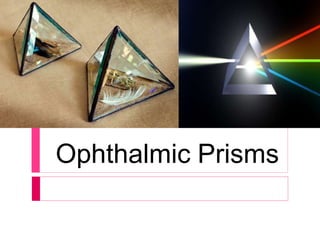
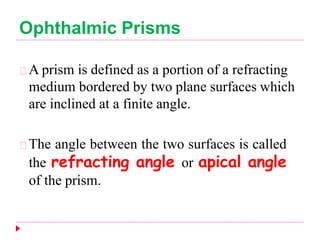
Ophthalmic Prisms
Ophthalmic Prisms
A prism is defined as a portion of a refracting
medium bordered by two plane surfaces which
are inclined at a finite angle.
The angle between the two surfaces is called
the refracting angle or apical angle
of the prism.
A line bisecting the angle is called the axis of the
prism.
The opposite surface is called the base of the
prism.
When prescribing prisms ,the orientation is
indicated by the position of the base , ‘base in’,
base up’, base down, base out.
A prism consists of two angled refracting
surfaces.
The simplest form of a prism is two flat
surfaces that come together at an angle at the
top. The point is called the apex of the prism;
the wider bottom of the prism is called the
base.
Ophthalmic Prisms
REFRACTION THROUGH PRISM
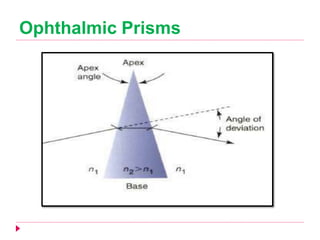
Light passing through a prism obey snell’s law
at each surface.
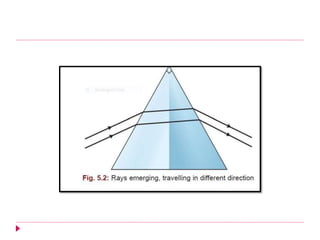
The ray is deviated towards the base of the
prism.
This causes objects to be displaced away from
the base of the prism towards its apex.
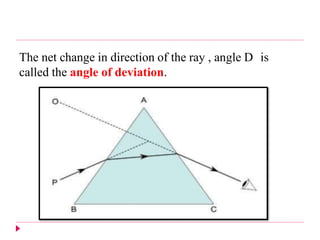
The net change in direction of the ray , angle D is
called the angle of deviation.
All varieties of spectacle lens has the effect of
a prism when viewed through a point away
from the optical center.
The further the away from the optical center,
the greater is the prismatic effect
For a prism in air ,the angle of deviation is
determined by three factors
1.The refractive index of the material of which
the prism is made.
2. The refracting angle of the prism
3. The angle of incidence of the ray considered.
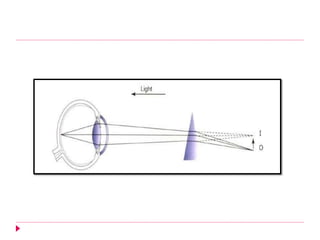
Light rays entering and leaving a prism are
bent towards the base of the prism.
This causes objects to be displaced away from the
base of the prism towards its apex.
Base down prism - upward.
Base up prism - downward
To the right or left when seen through a base-out or
base-in prism
CHARACTERISTICS OF PRISM
A prism has a thickest edge, the base and a
thinnest edge, the apex.
A prism displaces the incident rays towards the
base of the prism.
A prism displaces the image towards the apex
of the prism.
CHARACTERISTICS OF PRISM
A prism does not change the vergence ofthe
rays.
A prism does not magnify or minify the image.
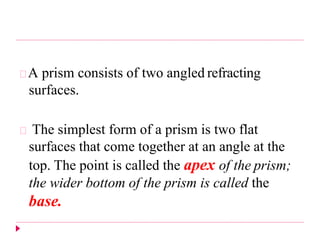
A prism also disperses incident pencil rays into
its component colours.
Angle of Minimum Deviation
For any particular prism, the angle of
deviation D is least when the angle of
incidence equals the angle of emergence.
Refraction is then said to be symmetrical and
the angle is called the Angle of minimum
deviation.
Image Formation
The image formed by a prism is
Erect
Virtual
Displaced towards the apex of the prism.
There are two primary positions in which the
power of a prism may be specified
The position of minimum deviation
The prentice position.
Units of prisms
The power of a prism can be expressed in
various unit.
1. The prism dioptre
2. The centrad
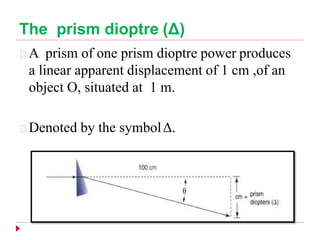
The prism dioptre (Δ)
A prism of one prism dioptre power produces
a linear apparent displacement of 1 cm ,of an
object O, situated at 1 m.
Denoted by the symbolΔ.
The centrad
This unit differs from the prism dioptre only in
that the image displacement is measured along
an arc 1m from the prism.
The centrad produces a very slightly greater
angle of deviation than the prism dioptre, but
the difference ,in practice is negligible.
Refracting angle
A prism may also be described by its refracting
angle.
DEVIATION PRODUCED BY PRISM
The deviation so produced can be measured by
the Prentice’s Rule:
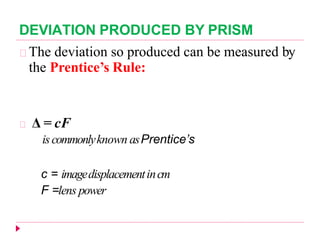
Δ = cF
iscommonlyknown asPrentice’s
c = imagedisplacementincm
F =lens power
PRISM ORIENTATION
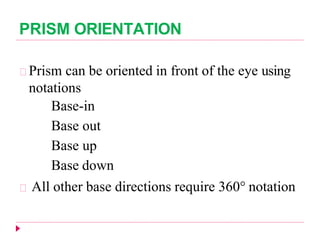
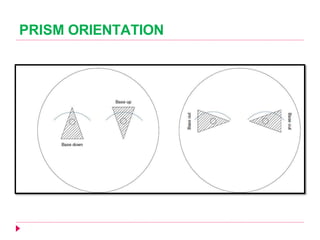
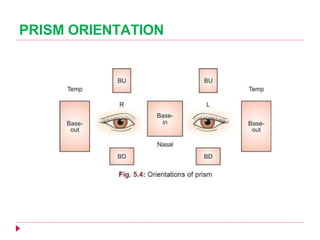
Prism can be oriented in front of the eye using
notations
Base-in
Base out
Base up
Base down
All other base directions require 360° notation
PRISM ORIENTATION
PRISM ORIENTATION
To Be Continued……..
Thank u …….

prism basics PART 1.pptx

  • 1.
  • 2.
    Ophthalmic Prisms A prismis defined as a portion of a refracting medium bordered by two plane surfaces which are inclined at a finite angle. The angle between the two surfaces is called the refracting angle or apical angle of the prism.
  • 3.
    A line bisectingthe angle is called the axis of the prism. The opposite surface is called the base of the prism. When prescribing prisms ,the orientation is indicated by the position of the base , ‘base in’, base up’, base down, base out.
  • 4.
    A prism consistsof two angled refracting surfaces. The simplest form of a prism is two flat surfaces that come together at an angle at the top. The point is called the apex of the prism; the wider bottom of the prism is called the base.
  • 5.
  • 6.
    REFRACTION THROUGH PRISM Lightpassing through a prism obey snell’s law at each surface. The ray is deviated towards the base of the prism. This causes objects to be displaced away from the base of the prism towards its apex.
  • 7.
    The net changein direction of the ray , angle D is called the angle of deviation.
  • 8.
    All varieties ofspectacle lens has the effect of a prism when viewed through a point away from the optical center. The further the away from the optical center, the greater is the prismatic effect
  • 9.
    For a prismin air ,the angle of deviation is determined by three factors 1.The refractive index of the material of which the prism is made. 2. The refracting angle of the prism 3. The angle of incidence of the ray considered.
  • 10.
    Light rays enteringand leaving a prism are bent towards the base of the prism. This causes objects to be displaced away from the base of the prism towards its apex. Base down prism - upward. Base up prism - downward To the right or left when seen through a base-out or base-in prism
  • 12.
    CHARACTERISTICS OF PRISM Aprism has a thickest edge, the base and a thinnest edge, the apex. A prism displaces the incident rays towards the base of the prism. A prism displaces the image towards the apex of the prism.
  • 13.
    CHARACTERISTICS OF PRISM Aprism does not change the vergence ofthe rays. A prism does not magnify or minify the image. A prism also disperses incident pencil rays into its component colours.
  • 15.
    Angle of MinimumDeviation For any particular prism, the angle of deviation D is least when the angle of incidence equals the angle of emergence. Refraction is then said to be symmetrical and the angle is called the Angle of minimum deviation.
  • 16.
    Image Formation The imageformed by a prism is Erect Virtual Displaced towards the apex of the prism.
  • 17.
    There are twoprimary positions in which the power of a prism may be specified The position of minimum deviation The prentice position.
  • 18.
    Units of prisms Thepower of a prism can be expressed in various unit. 1. The prism dioptre 2. The centrad
  • 19.
    The prism dioptre(Δ) A prism of one prism dioptre power produces a linear apparent displacement of 1 cm ,of an object O, situated at 1 m. Denoted by the symbolΔ.
  • 20.
    The centrad This unitdiffers from the prism dioptre only in that the image displacement is measured along an arc 1m from the prism. The centrad produces a very slightly greater angle of deviation than the prism dioptre, but the difference ,in practice is negligible.
  • 21.
    Refracting angle A prismmay also be described by its refracting angle.
  • 22.
    DEVIATION PRODUCED BYPRISM The deviation so produced can be measured by the Prentice’s Rule: Δ = cF iscommonlyknown asPrentice’s c = imagedisplacementincm F =lens power
  • 23.
    PRISM ORIENTATION Prism canbe oriented in front of the eye using notations Base-in Base out Base up Base down All other base directions require 360° notation
  • 24.
  • 25.
  • 26.
  • 27.