













boundless.com
Magnifying
Glass
wikipedia.org
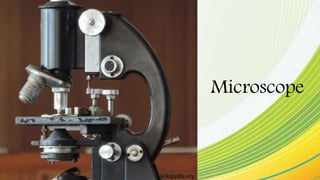
Microscope
etsy.com
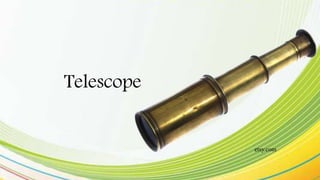
Telescope
bebusinessed.com
Telescope
wikipedia.org
Camera
bhphotovideo.com
Camera
What do these devices have in
common?
Image Formation on Lenses
Ray Tracing
Today
• Refraction (background)
• Converging Rays
– Applications
– Characteristics
– Image formation through ray tracing
– Exercises
Refraction
• Light also goes through some things
• The presence of material slows light’s progress
– interactions with electrical properties of atoms
• The “light slowing factor” is called the index of
refraction
– glass has n = 1.52 (meaning that light travels about 1.5
times slower in glass than in vacuum)
– water has n = 1.33
– air has n = 1.00028
glass; n2 = 1.5
air; n1 = 1.0
A
B
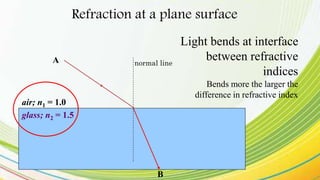
Refraction at a plane surface
Light bends at interface
between refractive
indices
Bends more the larger the
difference in refractive index
normal line
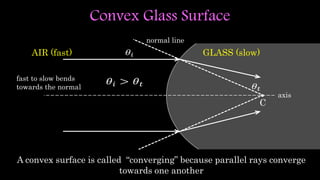
Convex Glass Surface
C
axis
A convex surface is called “converging” because parallel rays converge
towards one another
AIR (fast) GLASS (slow)
normal line
fast to slow bends
towards the normal
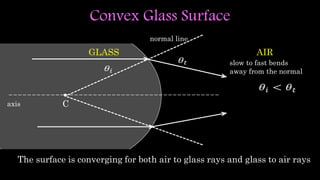
Convex Glass Surface
Caxis
The surface is converging for both air to glass rays and glass to air rays
AIRGLASS
normal line
slow to fast bends
away from the normal
Caxis
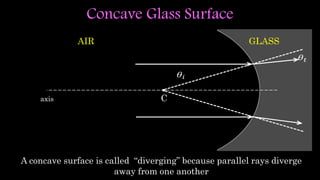
A concave surface is called “diverging” because parallel rays diverge
away from one another
Concave Glass Surface
AIR GLASS
C axis
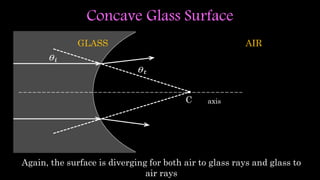
Again, the surface is diverging for both air to glass rays and glass to
air rays
Concave Glass Surface
AIRGLASS
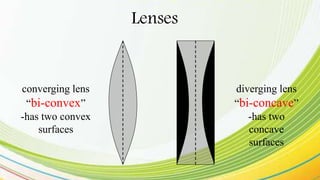
Lenses
converging lens
“bi-convex”
-has two convex
surfaces
diverging lens
“bi-concave”
-has two
concave
surfaces
CONVERGING LENS
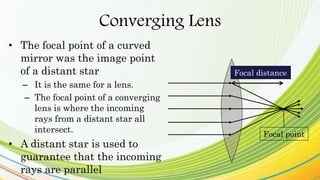
Converging Lens
• The focal point of a curved
mirror was the image point
of a distant star
– It is the same for a lens.
– The focal point of a converging
lens is where the incoming
rays from a distant star all
intersect.
• A distant star is used to
guarantee that the incoming
rays are parallel
Focal point
Focal distance
F’F
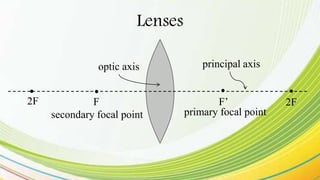
Lenses
optic axis
2F 2F
principal axis
secondary focal point primary focal point
F
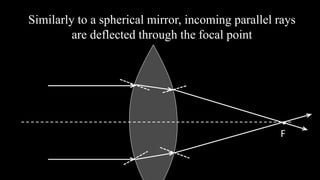
Similarly to a spherical mirror, incoming parallel rays
are deflected through the focal point
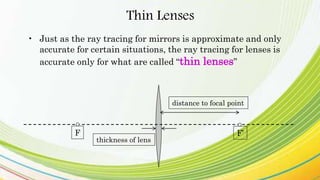
Thin Lenses
• Just as the ray tracing for mirrors is approximate and only
accurate for certain situations, the ray tracing for lenses is
accurate only for what are called “thin lenses”
F’F
thickness of lens
distance to focal point
How is the image formed by a
converging lens?
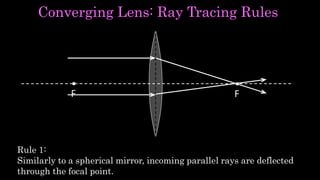
Converging Lens: Ray Tracing Rules
Rule 1:
Similarly to a spherical mirror, incoming parallel rays are deflected
through the focal point.
FF
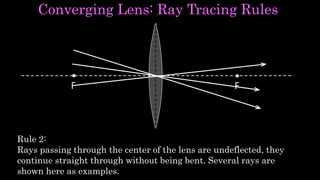
Converging Lens: Ray Tracing Rules
Rule 2:
Rays passing through the center of the lens are undeflected, they
continue straight through without being bent. Several rays are
shown here as examples.
FF
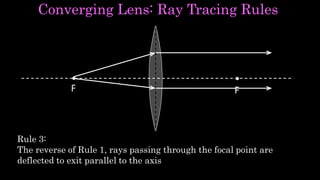
Converging Lens: Ray Tracing Rules
Rule 3:
The reverse of Rule 1, rays passing through the focal point are
deflected to exit parallel to the axis
FF
Major Rays used in Ray Tracing
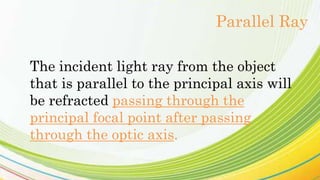
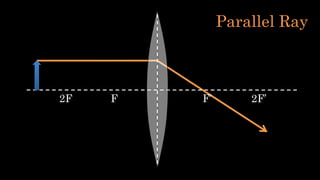
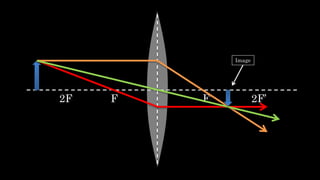
The incident light ray from the object
that is parallel to the principal axis will
be refracted passing through the
principal focal point after passing
through the optic axis.
Parallel Ray
F F’2F 2F’
Parallel Ray
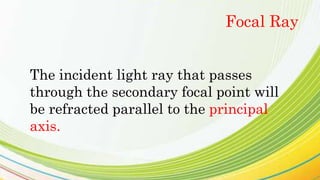
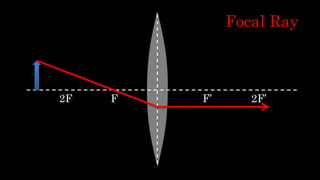
The incident light ray that passes
through the secondary focal point will
be refracted parallel to the principal
axis.
Focal Ray
F F’2F 2F’
Focal Ray
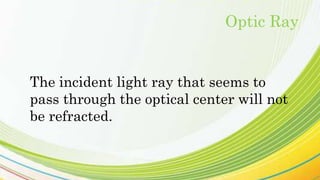
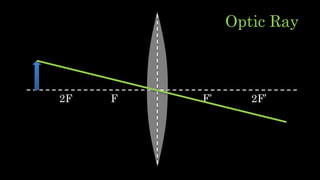
The incident light ray that seems to
pass through the optical center will not
be refracted.
Optic Ray
F F’2F 2F’
Optic Ray
F F’2F 2F’
Image
Exercises
F F’2F 2F’
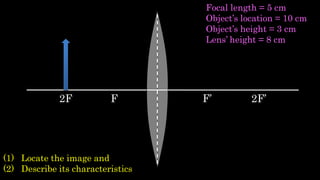
(1) Locate the image and
(2) Describe its characteristics
Focal length = 5 cm
Object’s location = 10 cm
Object’s height = 3 cm
Lens’ height = 8 cm
F F’2F 2F’
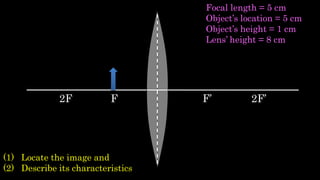
(1) Locate the image and
(2) Describe its characteristics
Focal length = 5 cm
Object’s location = 5 cm
Object’s height = 1 cm
Lens’ height = 8 cm
DIVERGING LENS
F’F
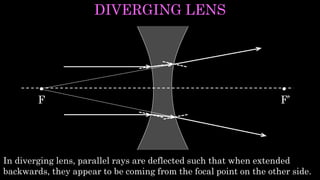
In diverging lens, parallel rays are deflected such that when extended
backwards, they appear to be coming from the focal point on the other side.
DIVERGING LENS
How is the image formed by a
diverging lens?
Diverging Lens: Ray Tracing
F’F
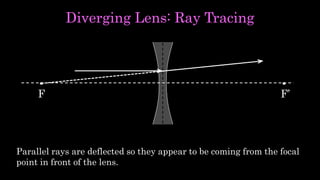
Parallel rays are deflected so they appear to be coming from the focal
point in front of the lens.
Diverging Lens: Ray Tracing
F’F
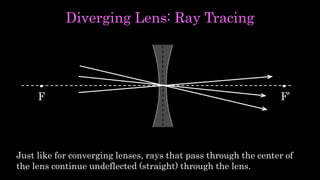
Just like for converging lenses, rays that pass through the center of
the lens continue undeflected (straight) through the lens.
Diverging Lens: Ray Tracing
F’F
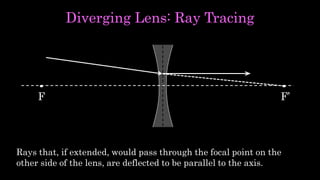
Rays that, if extended, would pass through the focal point on the
other side of the lens, are deflected to be parallel to the axis.
Major Rays used in Ray Tracing
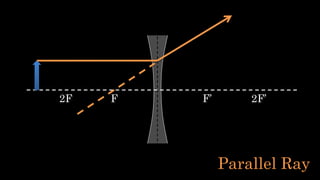
The incident light ray from the object
that is parallel to the principal axis will
be refracted as if it came from the
secondary focal point.
Parallel Ray
F F’2F 2F’
Parallel Ray
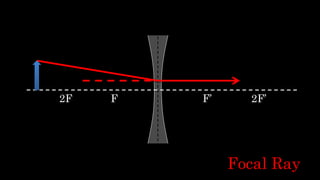
The incident light ray that seems to
pass through the principal focal point
will be refracted parallel to the
principal axis.
Focal Ray
F F’2F 2F’
Focal Ray
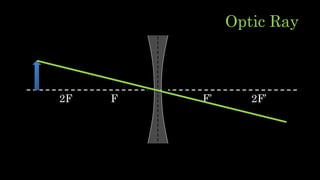
The incident light ray that seems to
pass through the optical center will not
be refracted.
Optic Ray
F F’2F 2F’
Optic Ray
F F’2F 2F’
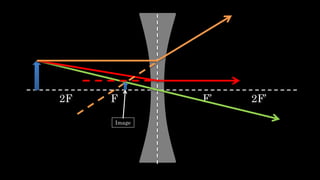
Image
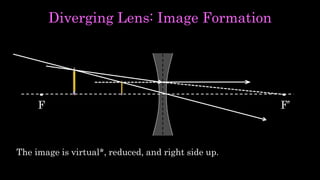
Diverging Lens: Image Formation
F’F
The image is virtual*, reduced, and right side up.
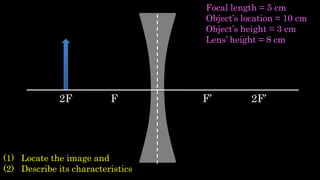
F F’2F 2F’
(1) Locate the image and
(2) Describe its characteristics
Focal length = 5 cm
Object’s location = 10 cm
Object’s height = 3 cm
Lens’ height = 8 cm
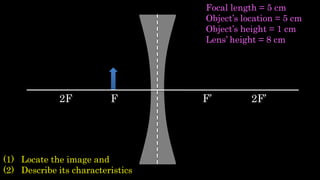
F F’2F 2F’
(1) Locate the image and
(2) Describe its characteristics
Focal length = 5 cm
Object’s location = 5 cm
Object’s height = 1 cm
Lens’ height = 8 cm
CORRECTIVE
LENSES
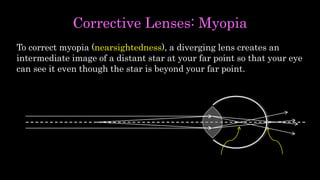
Corrective Lenses: Myopia
To correct myopia (nearsightedness), a diverging lens creates an
intermediate image of a distant star at your far point so that your eye
can see it even though the star is beyond your far point.
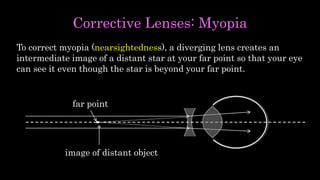
Corrective Lenses: Myopia
To correct myopia (nearsightedness), a diverging lens creates an
intermediate image of a distant star at your far point so that your eye
can see it even though the star is beyond your far point.
far point
image of distant object
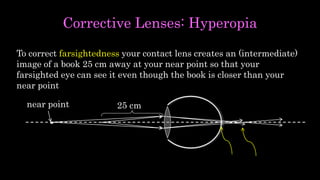
Corrective Lenses: Hyperopia
To correct farsightedness your contact lens creates an (intermediate)
image of a book 25 cm away at your near point so that your
farsighted eye can see it even though the book is closer than your
near point
25 cmnear point
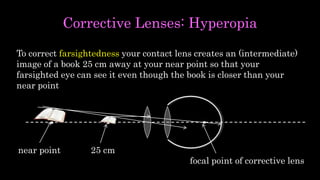
Corrective Lenses: Hyperopia
To correct farsightedness your contact lens creates an (intermediate)
image of a book 25 cm away at your near point so that your
farsighted eye can see it even though the book is closer than your
near point
near point 25 cm
focal point of corrective lens

Lenses in Optics

  • 1.
  • 2.
  • 3.
  • 4.
  • 5.
  • 6.
  • 7.
    What do thesedevices have in common?
  • 8.
    Image Formation onLenses Ray Tracing
  • 9.
    Today • Refraction (background) •Converging Rays – Applications – Characteristics – Image formation through ray tracing – Exercises
  • 10.
    Refraction • Light alsogoes through some things • The presence of material slows light’s progress – interactions with electrical properties of atoms • The “light slowing factor” is called the index of refraction – glass has n = 1.52 (meaning that light travels about 1.5 times slower in glass than in vacuum) – water has n = 1.33 – air has n = 1.00028
  • 11.
    glass; n2 =1.5 air; n1 = 1.0 A B Refraction at a plane surface Light bends at interface between refractive indices Bends more the larger the difference in refractive index normal line
  • 12.
    Convex Glass Surface C axis Aconvex surface is called “converging” because parallel rays converge towards one another AIR (fast) GLASS (slow) normal line fast to slow bends towards the normal
  • 13.
    Convex Glass Surface Caxis Thesurface is converging for both air to glass rays and glass to air rays AIRGLASS normal line slow to fast bends away from the normal
  • 14.
    Caxis A concave surfaceis called “diverging” because parallel rays diverge away from one another Concave Glass Surface AIR GLASS
  • 15.
    C axis Again, thesurface is diverging for both air to glass rays and glass to air rays Concave Glass Surface AIRGLASS
  • 16.
    Lenses converging lens “bi-convex” -has twoconvex surfaces diverging lens “bi-concave” -has two concave surfaces
  • 17.
  • 18.
    Converging Lens • Thefocal point of a curved mirror was the image point of a distant star – It is the same for a lens. – The focal point of a converging lens is where the incoming rays from a distant star all intersect. • A distant star is used to guarantee that the incoming rays are parallel Focal point Focal distance
  • 19.
    F’F Lenses optic axis 2F 2F principalaxis secondary focal point primary focal point
  • 20.
    F Similarly to aspherical mirror, incoming parallel rays are deflected through the focal point
  • 21.
    Thin Lenses • Justas the ray tracing for mirrors is approximate and only accurate for certain situations, the ray tracing for lenses is accurate only for what are called “thin lenses” F’F thickness of lens distance to focal point
  • 22.
    How is theimage formed by a converging lens?
  • 23.
    Converging Lens: RayTracing Rules Rule 1: Similarly to a spherical mirror, incoming parallel rays are deflected through the focal point. FF
  • 24.
    Converging Lens: RayTracing Rules Rule 2: Rays passing through the center of the lens are undeflected, they continue straight through without being bent. Several rays are shown here as examples. FF
  • 25.
    Converging Lens: RayTracing Rules Rule 3: The reverse of Rule 1, rays passing through the focal point are deflected to exit parallel to the axis FF
  • 26.
    Major Rays usedin Ray Tracing
  • 27.
    The incident lightray from the object that is parallel to the principal axis will be refracted passing through the principal focal point after passing through the optic axis. Parallel Ray
  • 28.
  • 29.
    The incident lightray that passes through the secondary focal point will be refracted parallel to the principal axis. Focal Ray
  • 30.
  • 31.
    The incident lightray that seems to pass through the optical center will not be refracted. Optic Ray
  • 32.
  • 33.
  • 34.
  • 35.
    F F’2F 2F’ (1)Locate the image and (2) Describe its characteristics Focal length = 5 cm Object’s location = 10 cm Object’s height = 3 cm Lens’ height = 8 cm
  • 36.
    F F’2F 2F’ (1)Locate the image and (2) Describe its characteristics Focal length = 5 cm Object’s location = 5 cm Object’s height = 1 cm Lens’ height = 8 cm
  • 37.
  • 38.
    F’F In diverging lens,parallel rays are deflected such that when extended backwards, they appear to be coming from the focal point on the other side. DIVERGING LENS
  • 39.
    How is theimage formed by a diverging lens?
  • 40.
    Diverging Lens: RayTracing F’F Parallel rays are deflected so they appear to be coming from the focal point in front of the lens.
  • 41.
    Diverging Lens: RayTracing F’F Just like for converging lenses, rays that pass through the center of the lens continue undeflected (straight) through the lens.
  • 42.
    Diverging Lens: RayTracing F’F Rays that, if extended, would pass through the focal point on the other side of the lens, are deflected to be parallel to the axis.
  • 43.
    Major Rays usedin Ray Tracing
  • 44.
    The incident lightray from the object that is parallel to the principal axis will be refracted as if it came from the secondary focal point. Parallel Ray
  • 45.
  • 46.
    The incident lightray that seems to pass through the principal focal point will be refracted parallel to the principal axis. Focal Ray
  • 47.
  • 48.
    The incident lightray that seems to pass through the optical center will not be refracted. Optic Ray
  • 49.
  • 50.
  • 51.
    Diverging Lens: ImageFormation F’F The image is virtual*, reduced, and right side up.
  • 52.
    F F’2F 2F’ (1)Locate the image and (2) Describe its characteristics Focal length = 5 cm Object’s location = 10 cm Object’s height = 3 cm Lens’ height = 8 cm
  • 53.
    F F’2F 2F’ (1)Locate the image and (2) Describe its characteristics Focal length = 5 cm Object’s location = 5 cm Object’s height = 1 cm Lens’ height = 8 cm
  • 54.
  • 55.
    Corrective Lenses: Myopia Tocorrect myopia (nearsightedness), a diverging lens creates an intermediate image of a distant star at your far point so that your eye can see it even though the star is beyond your far point.
  • 56.
    Corrective Lenses: Myopia Tocorrect myopia (nearsightedness), a diverging lens creates an intermediate image of a distant star at your far point so that your eye can see it even though the star is beyond your far point. far point image of distant object
  • 57.
    Corrective Lenses: Hyperopia Tocorrect farsightedness your contact lens creates an (intermediate) image of a book 25 cm away at your near point so that your farsighted eye can see it even though the book is closer than your near point 25 cmnear point
  • 58.
    Corrective Lenses: Hyperopia Tocorrect farsightedness your contact lens creates an (intermediate) image of a book 25 cm away at your near point so that your farsighted eye can see it even though the book is closer than your near point near point 25 cm focal point of corrective lens

Editor's Notes

  • #20 Note that a lens has a focal point on both sides of the lens, as compared to a mirror that only has one focal point
  • #22 A lens is considered “thin” if the thickness of the lens is much less than the distance from the lens to the focal point.