 Prism is transparent refracting body bounded
by two triangular and three rectangular
surfaces .
OR
 Portion of refracting body/medium bordered
by two plane surfaces which are inclined at a
finite angle.
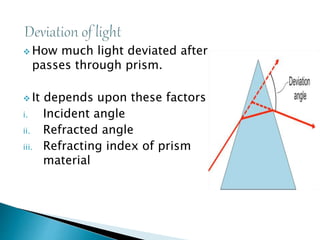
 How much light deviated after
passes through prism.
 It depends upon these factors
i. Incident angle
ii. Refracted angle
iii. Refracting index of prism
material
 Power of prism can be expressed in various
units:
 PRISM DIOPTER:
 A prism of one prism diopter power produces
a linear apparent displacement of 1cm of an
object situated at 1m(100cm).
 CENTRAD:
 This unit differs from prism diopter only in that
the image displacement is measured along an arc
1m from prism.
 Refracting angle:
 A prism may also be described by its refracting
angle but refracting index of prism must be
known.
 GRINDING:
 This is a manufacturing technique.
 Usually applied when large amount of prism is needed.
 DECENTRATION:
 A prism is added to spectacle lens by decentering the lens
in frame so that patient visual axis in primary position
passes through an off center portion of the lens.
 Usually applied when small amount of prism is needed.
 Prentice rule
Prismatic power of a lens in prism diopter at any
point on its surface is equal to the distance from
optical center(in cm) times the power of the lens
(in diopter).
Uses:
It is used to determine amount of prescribed
prism in lenses by decentration.
It is used to determined either unprescribed
prism present in lenses by decentration.
PRENTICE’S RULE
p=d*F
p=Prism power(in prism diopter)
D=Decentration(in cm)
F=Refracting power of lens(in diopter)
 Prismatic power is neutralized by two ways:
HAND NEUTRALIZATION :
Two prisms of equal strength placed base to apex.
LENSOMETER:
 Two types of lensometer available
1. Automatic lensmeter
2. Manual lensmeter
 Diagnostic uses
 Objective measurement of angle of deviation (PCT, krimsky
test).
 Subjective measurement of angle of deviation with Maddox
Rod.
 Measurement of fusional reserve.
 Diagnosis of microtropia (4Dprism test).
 To asses diplopia after squint surgery in adults.
 After subjective refraction in binocular balancing.
PRISM USED FOR DIAGNOSTIC PURPOSE :
 Risley prism.
 Mounted prism from trial lens set.
 Prism bar(horizontal and vertical).
Therapeutic uses:
 To build up fusional reserve in patient with
convergence insufficiency (BO).
 To relieve diplopia .
 Prism ballast
Prism used for therapeutic purpose:
 Clip on spectacle prisms
 Fresnel prism
 Permanent wear(incorporate prism in lens by
decentration)
 Prism are commonly used as reflectors of
light in ophthalmic instruments such as:
 Slit lamp bimicroscope
 Keratometer
 Applanation tonometer
 Gonioscope
REFERENCE
 A.K Khorana
 Duke elder
 Clinical optics
 American academy
 Internet
Thank you
Thankyou

Prism

  • 2.
     Prism istransparent refracting body bounded by two triangular and three rectangular surfaces . OR  Portion of refracting body/medium bordered by two plane surfaces which are inclined at a finite angle.
  • 4.
     How muchlight deviated after passes through prism.  It depends upon these factors i. Incident angle ii. Refracted angle iii. Refracting index of prism material
  • 5.
     Power ofprism can be expressed in various units:  PRISM DIOPTER:  A prism of one prism diopter power produces a linear apparent displacement of 1cm of an object situated at 1m(100cm).
  • 6.
     CENTRAD:  Thisunit differs from prism diopter only in that the image displacement is measured along an arc 1m from prism.  Refracting angle:  A prism may also be described by its refracting angle but refracting index of prism must be known.
  • 7.
     GRINDING:  Thisis a manufacturing technique.  Usually applied when large amount of prism is needed.  DECENTRATION:  A prism is added to spectacle lens by decentering the lens in frame so that patient visual axis in primary position passes through an off center portion of the lens.  Usually applied when small amount of prism is needed.
  • 8.
     Prentice rule Prismaticpower of a lens in prism diopter at any point on its surface is equal to the distance from optical center(in cm) times the power of the lens (in diopter). Uses: It is used to determine amount of prescribed prism in lenses by decentration. It is used to determined either unprescribed prism present in lenses by decentration.
  • 9.
    PRENTICE’S RULE p=d*F p=Prism power(inprism diopter) D=Decentration(in cm) F=Refracting power of lens(in diopter)
  • 10.
     Prismatic poweris neutralized by two ways: HAND NEUTRALIZATION : Two prisms of equal strength placed base to apex. LENSOMETER:  Two types of lensometer available 1. Automatic lensmeter 2. Manual lensmeter
  • 11.
     Diagnostic uses Objective measurement of angle of deviation (PCT, krimsky test).  Subjective measurement of angle of deviation with Maddox Rod.  Measurement of fusional reserve.  Diagnosis of microtropia (4Dprism test).  To asses diplopia after squint surgery in adults.  After subjective refraction in binocular balancing. PRISM USED FOR DIAGNOSTIC PURPOSE :  Risley prism.  Mounted prism from trial lens set.  Prism bar(horizontal and vertical).
  • 12.
    Therapeutic uses:  Tobuild up fusional reserve in patient with convergence insufficiency (BO).  To relieve diplopia .  Prism ballast Prism used for therapeutic purpose:  Clip on spectacle prisms  Fresnel prism  Permanent wear(incorporate prism in lens by decentration)
  • 13.
     Prism arecommonly used as reflectors of light in ophthalmic instruments such as:  Slit lamp bimicroscope  Keratometer  Applanation tonometer  Gonioscope
  • 14.
    REFERENCE  A.K Khorana Duke elder  Clinical optics  American academy  Internet Thank you Thankyou