ARC- WHY DO THEY APPEAR IN
DIFFERENT SHADES..?
SLIDES PREPARED BY
OPTOM FASLU MUHAMMED
Why Choose an Anti-Reflection
Coating?
 As light passes through an uncoated glass
substrate, approximately 4% will be reflected at
each interface. This results in a total transmission
of only 92% of the incident light. Applying an AR
coating on each surface will increase the
throughput of the system and reduce hazards
caused by reflections traveling backwards
through the system (ghost images). Anti-
reflection coatings are especially important if the
system contains many transmitting optical
elements. Also, many low-light systems
incorporate AR coated optics to allow for
efficient use of light.
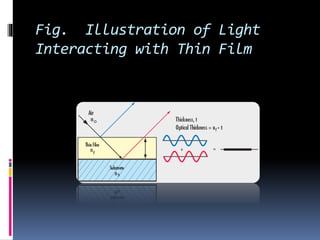
Fig. Illustration of Light
Interacting with Thin Film
How Does an Anti-Reflection
Coating Work?
 The transmission properties of a coating are dependent
upon the wavelength of light being used, the substrate's
index of refraction, the index of refraction of the coating,
the thickness of the coating, and the angle of the incident
light.
 The coating is designed so that the relative phase shift
between the beam reflected at the upper and lower
boundary of the thin film is 180°. Destructive interference
between the two reflected beams occurs, cancelling both
beams before they exit the surface. The optical thickness of
the coating must be an odd number of quarter wavelengths
(λ/4, where λ is the design wavelength or wavelength being
optimized for peak performance), in order to achieve the
desired path difference of one half wavelength between
the reflected beams, which leads to their cancellation.
Anti-Reflection Coating &
Its Color
 All AR lenses reflect a small amount of color, typically referred to as residual
color. Many AR lenses have a green residual color, while others have a blue or
yellow-green residual color.
 This phenomenon is associated with the reflectance curve of a broadband AR
coating across the visible spectrum of light. AR has a peak reflectance at some
point on the visible light spectrum (400–760 nm), and it is the color associated
with that peak that is reflected most. AR lenses with a green residual color tend
to have peak reflectance in the 520 - 550nm range, which is also the easiest color
to produce consistently. Some manufacturers move the curve peak closer to the
blue end of the spectrum, while others move the peak towards yellow. Most AR
producers choose their AR design and resulting peak color reflection based on
customer preference or visual performance goals. Eye sensitivity during daytime
or twilight has also been cited as criteria for residual color choice.
 The most common method to precisely measure the thickness of anti-reflection
coatings is using ellipsometry which looks at the way polarized light is reflected.
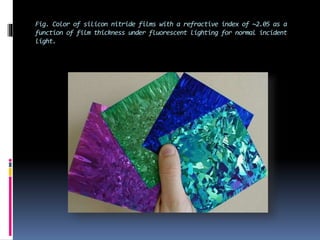
Fig. Color of silicon nitride films with a refractive index of ~2.05 as a
function of film thickness under fluorescent lighting for normal incident
light.
 Four multi crystalline wafers covered with films of silicon nitride.
The difference in color is solely due to the thickness of the film.
The green wafers are very thick films and so don't appear in the
color chart of the next figure.
 The color of the film is affected by the thickness as well as the
refractive index so the film color is merely a rough guide to
thickness. There are multiple tables for determining the films
thickness for films of silicon dioxide or silicon nitride such as
those shown below. It is common to fabricate film standards so
that variations in process conditions can be quickly detected by
comparing samples to the standard.
 The chart is merely a guide as the color of films on films in
commercial production will be affected by texturing and changes
in the refractive index
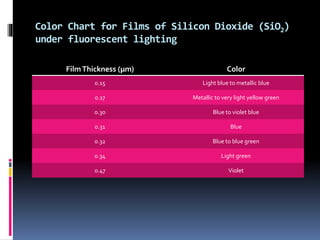
Color Chart for Films of Silicon Dioxide (SiO2)
under fluorescent lighting
FilmThickness (µm) Color
0.15 Light blue to metallic blue
0.17 Metallic to very light yellow green
0.30 Blue to violet blue
0.31 Blue
0.32 Blue to blue green
0.34 Light green
0.47 Violet
CONTENT PREPARED BY

Arc ppt

  • 1.
    ARC- WHY DOTHEY APPEAR IN DIFFERENT SHADES..? SLIDES PREPARED BY OPTOM FASLU MUHAMMED
  • 2.
    Why Choose anAnti-Reflection Coating?  As light passes through an uncoated glass substrate, approximately 4% will be reflected at each interface. This results in a total transmission of only 92% of the incident light. Applying an AR coating on each surface will increase the throughput of the system and reduce hazards caused by reflections traveling backwards through the system (ghost images). Anti- reflection coatings are especially important if the system contains many transmitting optical elements. Also, many low-light systems incorporate AR coated optics to allow for efficient use of light.
  • 3.
    Fig. Illustration ofLight Interacting with Thin Film
  • 4.
    How Does anAnti-Reflection Coating Work?  The transmission properties of a coating are dependent upon the wavelength of light being used, the substrate's index of refraction, the index of refraction of the coating, the thickness of the coating, and the angle of the incident light.  The coating is designed so that the relative phase shift between the beam reflected at the upper and lower boundary of the thin film is 180°. Destructive interference between the two reflected beams occurs, cancelling both beams before they exit the surface. The optical thickness of the coating must be an odd number of quarter wavelengths (λ/4, where λ is the design wavelength or wavelength being optimized for peak performance), in order to achieve the desired path difference of one half wavelength between the reflected beams, which leads to their cancellation.
  • 5.
    Anti-Reflection Coating & ItsColor  All AR lenses reflect a small amount of color, typically referred to as residual color. Many AR lenses have a green residual color, while others have a blue or yellow-green residual color.  This phenomenon is associated with the reflectance curve of a broadband AR coating across the visible spectrum of light. AR has a peak reflectance at some point on the visible light spectrum (400–760 nm), and it is the color associated with that peak that is reflected most. AR lenses with a green residual color tend to have peak reflectance in the 520 - 550nm range, which is also the easiest color to produce consistently. Some manufacturers move the curve peak closer to the blue end of the spectrum, while others move the peak towards yellow. Most AR producers choose their AR design and resulting peak color reflection based on customer preference or visual performance goals. Eye sensitivity during daytime or twilight has also been cited as criteria for residual color choice.  The most common method to precisely measure the thickness of anti-reflection coatings is using ellipsometry which looks at the way polarized light is reflected.
  • 6.
    Fig. Color ofsilicon nitride films with a refractive index of ~2.05 as a function of film thickness under fluorescent lighting for normal incident light.
  • 7.
     Four multicrystalline wafers covered with films of silicon nitride. The difference in color is solely due to the thickness of the film. The green wafers are very thick films and so don't appear in the color chart of the next figure.  The color of the film is affected by the thickness as well as the refractive index so the film color is merely a rough guide to thickness. There are multiple tables for determining the films thickness for films of silicon dioxide or silicon nitride such as those shown below. It is common to fabricate film standards so that variations in process conditions can be quickly detected by comparing samples to the standard.  The chart is merely a guide as the color of films on films in commercial production will be affected by texturing and changes in the refractive index
  • 8.
    Color Chart forFilms of Silicon Dioxide (SiO2) under fluorescent lighting FilmThickness (µm) Color 0.15 Light blue to metallic blue 0.17 Metallic to very light yellow green 0.30 Blue to violet blue 0.31 Blue 0.32 Blue to blue green 0.34 Light green 0.47 Violet
  • 9.