PRISM
Dr.Shazia Gul
KMU-IHS Kohat
Definition
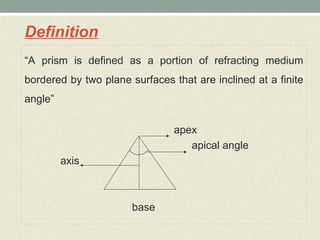
“A prism is defined as a portion of refracting medium
bordered by two plane surfaces that are inclined at a finite
angle”
apex
apical angle
axis
base
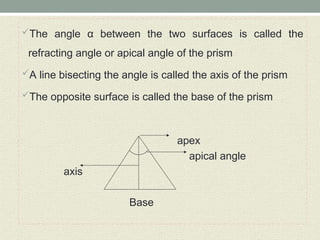
The angle α between the two surfaces is called the
refracting angle or apical angle of the prism
A line bisecting the angle is called the axis of the prism
The opposite surface is called the base of the prism
apex
apical angle
axis
Base
Refraction by the prism
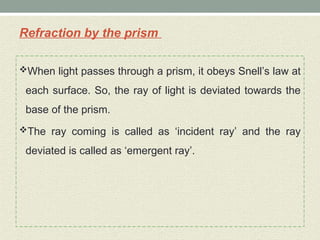
When light passes through a prism, it obeys Snell’s law at
each surface. So, the ray of light is deviated towards the
base of the prism.
The ray coming is called as ‘incident ray’ and the ray
deviated is called as ‘emergent ray’.
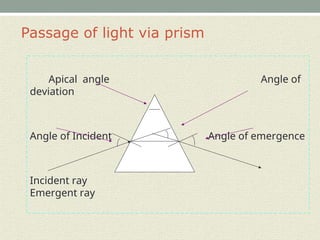
Passage of light via prism
Apical angle Angle of
deviation
Angle of Incident Angle of emergence
Incident ray
Emergent ray
Angle of deviation
When a light ray passes via prism, it deviates and
changes its direction. Thus the net change in direction
of the ray is called as “angle of deviation (D)”.
(OR)
The sum of the deviations produced at each of the
surfaces of the prism.
Determination of “angle of deviation”
The angle of deviation for a prism in the air, is
determined by the following three factors:
The refractive index of the material of which the
prism is made
The refracting or apical angle of prism
The angle of incidence of the ray considered
For any particular prism, the angle of deviation D is least
when the angle of incidence equals the angle of
emergence. Refraction is then said to be symmetrical and
the angle is called the angle of minimum deviation.
Under these conditions the angle of deviation is given by
the formula:
D = (n-1) α
For a glass prism of refractive index 1.5
D = (1.5 – 1) α
D = (0.5) α or (1/2) α
D = α/2
The angle of deviation equals half the refracting angle for a
glass prism.
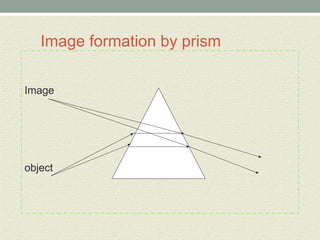
Image formation
The image formed by prism is
 Erect
 Virtual
 Displaced towards the apex of the prism.
Image formation by prism
Image
object
Prism on the basis of position
There are two primary positions in which the power of a
prism may be specified:
1) The position of minimum deviation
2) Prentice position of prism
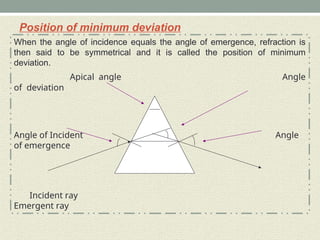
Position of minimum deviation
When the angle of incidence equals the angle of emergence, refraction is
then said to be symmetrical and it is called the position of minimum
deviation.
Apical angle Angle
of deviation
Angle of Incident Angle
of emergence
Incident ray
Emergent ray
The power in the position of minimum deviation which is
specified for plastic ophthalmic prisms:
e.g. prism bars
Prentice position
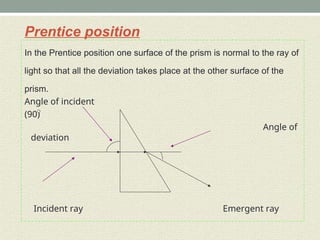
In the Prentice position one surface of the prism is normal to the ray of
light so that all the deviation takes place at the other surface of the
prism.
Angle of incident
(90)
Angle of
deviation
Incident ray Emergent ray
The deviation of light in the prentice position is greater than
that in the position of minimum deviation, because in the
prentice position the angle of incidence does not equal the
angle of emergence. Therefore the prentice position power
of any prism is greater than its power in the position of
minimum deviation.
It is the prentice position power which is normally specified
for glass ophthalmic prisms:
e.g. trial lens prisms
Notation of prism
The power of any prism can be expressed in various units
e.g
Prism dioptre
Angle of apparent deviation
Centrad
Refracting angle
Prism dioptre ( )
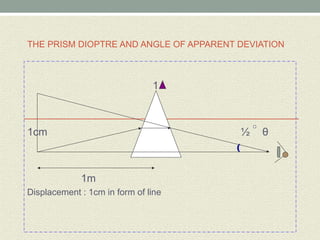
A prism of one prism dioptre power (1 ) produces a linear
apparent displacement of 1cm, of an object O, situated at
1m.
Angle of Apparent Deviation
The apparent displacement of the object O can also be
measured in terms of the angle θ, the angle of apparent
deviation. Under conditions of ophthalmic usage a prism of
1 prism dioptre power produces an angle of apparent
deviation of 1/2°. Thus 1 prism dioptre = 1/2°.
THE PRISM DIOPTRE AND ANGLE OF APPARENT DEVIATION
1
1cm ½ θ
1m
Displacement : 1cm in form of line
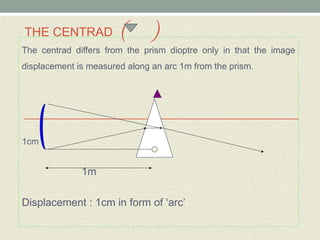
THE CENTRAD ( )
The centrad differs from the prism dioptre only in that the image
displacement is measured along an arc 1m from the prism.
1
1cm
1m
Displacement : 1cm in form of ‘arc’
Refracting Angle
A prism may also be described by its refracting angle
However, unless the refractive index of the prism material
is also known, the prism power cannot be deduced.
Summary of Prism Units
Thus a glass prism of refracting angle 10° (a ten-degree
prism) deviates light through 5° and has a power of 10
prism dioptres (10∆), assuming its refractive index is 1.5.
USES OF PRISMS
The main uses of prisms are :
Prisms for diagnostic purposes
Prisms for therapeutic purposes
Diagnostic uses:
( 1 )Assessment of squint and Heterophoria :
Prism cover test ( PCT )
For measurement of angle objectively
Maddox rod test
For measurement of angle subjectively
 Assessment of diplopia
To assess likelihood of diplopia after proposed squint
surgery in adults
 Fusional reserve test
For measurement of fusional reserve, increasingly powerful
prisms are placed before one eye until fusion breaks down.
This is very useful in assessing the presence of binocular
single vision in children under 2 years of age.
Four-dioptre prism test
This is a delicate test for small degrees of esotropia
( microtropia )
In this test a four dioptre prism placed base-out before
the deviating eye causes no movement as the image
remains within the suppression scotoma. When placed
before the normal ( fixing ) eye, movement occurs.
( 2 ) Assessment of simulated blindness
For assessment of simulated blindness, a prism is placed
in front of a seeing eye, the eye will move to regain
fixation
Forms of Prism Used in Diagnosis
Forms of prism used in assessment include:
 Single unmounted prisms
 The prisms from the trial lens set
 Prism bars
These are bars composed of adjacent prisms of increasing
power.
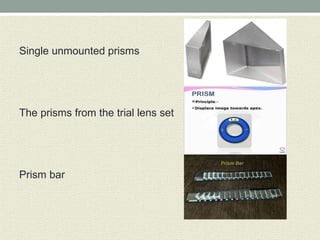
Single unmounted prisms
The prisms from the trial lens set
Prism bar
Therapeutic uses of Prism :
Therapeutically prisms are used for:
Convergence insufficiency
To relieve diplopia in squint
( 1 )…Convergence insufficiency
The commonest therapeutic use of prisms in orthoptics is in
building up the fusional reserve of patients with
convergence insufficiency.
The prisms are used base-out during the patients' exercise
periods.
( 2 )…To relieve diplopia in squint
In certain cases of squint, to relieve diplopia , include:
 Decompensated heterophorias
 Small vertical squints
 Some paralytic squints with diplopia in the primary
position
Prisms are reserved for those patients for whom surgery is
not indicated.
Forms of Therapeutic Prism
(1) Temporary wear
Prisms used in treatment include clip-on spectacle prisms for
trial wear. An improvement on these are Fresnel prisms,
which are available in all powers employed clinically.
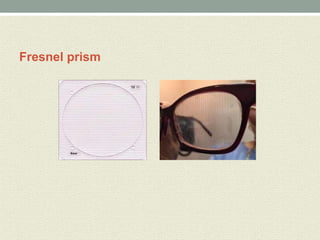
A Fresnel prism consists of a plastic sheet of parallel tiny
prisms of identical refracting angle. The overall prismatic
effect is the same as that of a single large prism. The
sheets are lighter than a glass prism and can be stuck on
to the patient's glasses.
Fresnel prism
Fresnel prism
(2) Permanent wear
Permanent incorporation of a prism into a patient's
spectacles can be achieved:
1. By decentration the spherical lens already present
2. By grounding prism in the spectacles
Decentration
Decentration of the spectacle lenses
When the optical center of the lens and the visual axis are
not align, is termed as decentration.
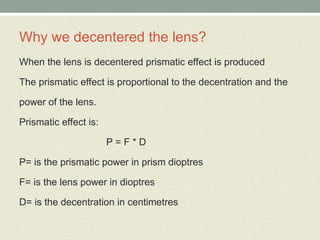
Why we decentered the lens?
When the lens is decentered prismatic effect is produced
The prismatic effect is proportional to the decentration and the
power of the lens.
Prismatic effect is:
P = F * D
P= is the prismatic power in prism dioptres
F= is the lens power in dioptres
D= is the decentration in centimetres
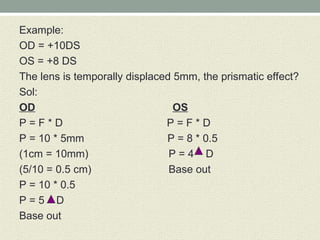
Example:
OD = +10DS
OS = +8 DS
The lens is temporally displaced 5mm, the prismatic effect?
Sol:
OD OS
P = F * D P = F * D
P = 10 * 5mm P = 8 * 0.5
(1cm = 10mm) P = 4 D
(5/10 = 0.5 cm) Base out
P = 10 * 0.5
P = 5 D
Base out
Prescription of prism :
When prescribing prisms the orientation is indicated by
the position of the base
e.g. “base-in, base-out, base-down, and base-up etc.
Generally, when prescribing prisms, the correction
is split between the two eyes.
To correct convergence the prisms must be base-out
To correct divergence the prisms must be base -in
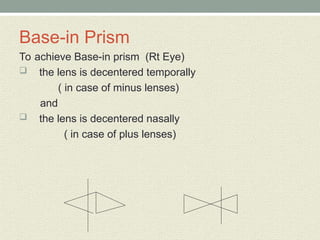
Base-in Prism
To achieve Base-in prism (Rt Eye)
 the lens is decentered temporally
( in case of minus lenses)
and
 the lens is decentered nasally
( in case of plus lenses)
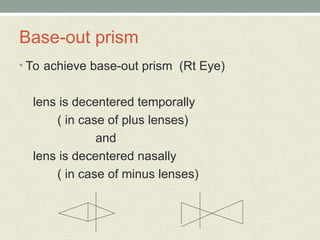
Base-out prism
• To achieve base-out prism (Rt Eye)
lens is decentered temporally
( in case of plus lenses)
and
lens is decentered nasally
( in case of minus lenses)
Cont :
To correct vertical deviation the orientation
of the prisms is opposite for the two eyes.
e.g
Base-down
( right eye )
Base-up
( left eye for right hypertropia )
Determination of prism
• How we can determine either the prism is due to
decentration of lens?
Or
the prism is grounded in the glass?
 it can be determine by the lensmeter
It can achieved simply by locating the optical center by
moving the lens about until the lensmeter target is
centered.
If the greatest distance from the optical center to the
edge of the lens is more than half the diameter of the
usual kens blank size ( 60 mm). Prism must have been
ground into the lens.
Prisms used in optical instruments
Instruments in which prisms are used are:
Slit lamp microscope
Applanation tonometer
and
Keratometer.
Prisms are used in instrument due to some
characteristics:
Prisms are commonly used in ophthalmic
instruments as “reflectors of light”.
The prism is designed and orientated so that
total internal reflection occurs within it.
It can also be seen that prisms give greater
flexibility in dealing with an image than do
mirrors.
Types of Prisms
Dispersive prisms
 Reflective prisms
 Polarizing prisms
Dispersive prisms
Dispersive prisms are used to break up light into its
constituent spectral colors because the refractive index
depends on frequency, the white light entering the prism is
a mixture of different frequencies, each of which gets bent
slightly differently. Blue light is slowed down more than red
light and will therefore be bent more than red light.
Reflective prisms
Reflective prisms are used to reflect light, It works on total
internal reflection.
Types of reflective prism
• Pentaprism
• Right angle prism
• Porro prism
• Porro-Abbe prism
• Abbe-Koenig prism
• Schmidt-Pechan prism
• Dove prism
• Dichroic prism
• Amici roof prism
Polarizing prisms
There are also polarizing prisms which can split a beam of
light into components of varying polarization.
Types of polarizing prisms
• Nicol prism
• Wollaston prism
• Rochon prism
• Glan-Foucault prism
• Glan-Taylor prism
• Glan-Thompson prism
prism.mcqs for paper......................

prism.mcqs for paper......................

  • 1.
  • 2.
    Definition “A prism isdefined as a portion of refracting medium bordered by two plane surfaces that are inclined at a finite angle” apex apical angle axis base
  • 3.
    The angle αbetween the two surfaces is called the refracting angle or apical angle of the prism A line bisecting the angle is called the axis of the prism The opposite surface is called the base of the prism apex apical angle axis Base
  • 4.
    Refraction by theprism When light passes through a prism, it obeys Snell’s law at each surface. So, the ray of light is deviated towards the base of the prism. The ray coming is called as ‘incident ray’ and the ray deviated is called as ‘emergent ray’.
  • 5.
    Passage of lightvia prism Apical angle Angle of deviation Angle of Incident Angle of emergence Incident ray Emergent ray
  • 6.
    Angle of deviation Whena light ray passes via prism, it deviates and changes its direction. Thus the net change in direction of the ray is called as “angle of deviation (D)”. (OR) The sum of the deviations produced at each of the surfaces of the prism.
  • 7.
    Determination of “angleof deviation” The angle of deviation for a prism in the air, is determined by the following three factors: The refractive index of the material of which the prism is made The refracting or apical angle of prism The angle of incidence of the ray considered
  • 8.
    For any particularprism, the angle of deviation D is least when the angle of incidence equals the angle of emergence. Refraction is then said to be symmetrical and the angle is called the angle of minimum deviation. Under these conditions the angle of deviation is given by the formula: D = (n-1) α For a glass prism of refractive index 1.5 D = (1.5 – 1) α D = (0.5) α or (1/2) α D = α/2 The angle of deviation equals half the refracting angle for a glass prism.
  • 9.
    Image formation The imageformed by prism is  Erect  Virtual  Displaced towards the apex of the prism.
  • 10.
    Image formation byprism Image object
  • 11.
    Prism on thebasis of position There are two primary positions in which the power of a prism may be specified: 1) The position of minimum deviation 2) Prentice position of prism
  • 12.
    Position of minimumdeviation When the angle of incidence equals the angle of emergence, refraction is then said to be symmetrical and it is called the position of minimum deviation. Apical angle Angle of deviation Angle of Incident Angle of emergence Incident ray Emergent ray
  • 13.
    The power inthe position of minimum deviation which is specified for plastic ophthalmic prisms: e.g. prism bars
  • 14.
    Prentice position In thePrentice position one surface of the prism is normal to the ray of light so that all the deviation takes place at the other surface of the prism. Angle of incident (90) Angle of deviation Incident ray Emergent ray
  • 15.
    The deviation oflight in the prentice position is greater than that in the position of minimum deviation, because in the prentice position the angle of incidence does not equal the angle of emergence. Therefore the prentice position power of any prism is greater than its power in the position of minimum deviation. It is the prentice position power which is normally specified for glass ophthalmic prisms: e.g. trial lens prisms
  • 16.
    Notation of prism Thepower of any prism can be expressed in various units e.g Prism dioptre Angle of apparent deviation Centrad Refracting angle
  • 17.
    Prism dioptre () A prism of one prism dioptre power (1 ) produces a linear apparent displacement of 1cm, of an object O, situated at 1m. Angle of Apparent Deviation The apparent displacement of the object O can also be measured in terms of the angle θ, the angle of apparent deviation. Under conditions of ophthalmic usage a prism of 1 prism dioptre power produces an angle of apparent deviation of 1/2°. Thus 1 prism dioptre = 1/2°.
  • 18.
    THE PRISM DIOPTREAND ANGLE OF APPARENT DEVIATION 1 1cm ½ θ 1m Displacement : 1cm in form of line
  • 19.
    THE CENTRAD () The centrad differs from the prism dioptre only in that the image displacement is measured along an arc 1m from the prism. 1 1cm 1m Displacement : 1cm in form of ‘arc’
  • 20.
    Refracting Angle A prismmay also be described by its refracting angle However, unless the refractive index of the prism material is also known, the prism power cannot be deduced. Summary of Prism Units Thus a glass prism of refracting angle 10° (a ten-degree prism) deviates light through 5° and has a power of 10 prism dioptres (10∆), assuming its refractive index is 1.5.
  • 21.
    USES OF PRISMS Themain uses of prisms are : Prisms for diagnostic purposes Prisms for therapeutic purposes
  • 22.
    Diagnostic uses: ( 1)Assessment of squint and Heterophoria : Prism cover test ( PCT ) For measurement of angle objectively Maddox rod test For measurement of angle subjectively
  • 23.
     Assessment ofdiplopia To assess likelihood of diplopia after proposed squint surgery in adults  Fusional reserve test For measurement of fusional reserve, increasingly powerful prisms are placed before one eye until fusion breaks down. This is very useful in assessing the presence of binocular single vision in children under 2 years of age.
  • 24.
    Four-dioptre prism test Thisis a delicate test for small degrees of esotropia ( microtropia ) In this test a four dioptre prism placed base-out before the deviating eye causes no movement as the image remains within the suppression scotoma. When placed before the normal ( fixing ) eye, movement occurs.
  • 25.
    ( 2 )Assessment of simulated blindness For assessment of simulated blindness, a prism is placed in front of a seeing eye, the eye will move to regain fixation
  • 26.
    Forms of PrismUsed in Diagnosis Forms of prism used in assessment include:  Single unmounted prisms  The prisms from the trial lens set  Prism bars These are bars composed of adjacent prisms of increasing power.
  • 27.
    Single unmounted prisms Theprisms from the trial lens set Prism bar
  • 28.
    Therapeutic uses ofPrism : Therapeutically prisms are used for: Convergence insufficiency To relieve diplopia in squint
  • 29.
    ( 1 )…Convergenceinsufficiency The commonest therapeutic use of prisms in orthoptics is in building up the fusional reserve of patients with convergence insufficiency. The prisms are used base-out during the patients' exercise periods.
  • 30.
    ( 2 )…Torelieve diplopia in squint In certain cases of squint, to relieve diplopia , include:  Decompensated heterophorias  Small vertical squints  Some paralytic squints with diplopia in the primary position Prisms are reserved for those patients for whom surgery is not indicated.
  • 31.
    Forms of TherapeuticPrism (1) Temporary wear Prisms used in treatment include clip-on spectacle prisms for trial wear. An improvement on these are Fresnel prisms, which are available in all powers employed clinically. A Fresnel prism consists of a plastic sheet of parallel tiny prisms of identical refracting angle. The overall prismatic effect is the same as that of a single large prism. The sheets are lighter than a glass prism and can be stuck on to the patient's glasses.
  • 32.
  • 33.
  • 34.
    (2) Permanent wear Permanentincorporation of a prism into a patient's spectacles can be achieved: 1. By decentration the spherical lens already present 2. By grounding prism in the spectacles
  • 35.
    Decentration Decentration of thespectacle lenses When the optical center of the lens and the visual axis are not align, is termed as decentration.
  • 36.
    Why we decenteredthe lens? When the lens is decentered prismatic effect is produced The prismatic effect is proportional to the decentration and the power of the lens. Prismatic effect is: P = F * D P= is the prismatic power in prism dioptres F= is the lens power in dioptres D= is the decentration in centimetres
  • 37.
    Example: OD = +10DS OS= +8 DS The lens is temporally displaced 5mm, the prismatic effect? Sol: OD OS P = F * D P = F * D P = 10 * 5mm P = 8 * 0.5 (1cm = 10mm) P = 4 D (5/10 = 0.5 cm) Base out P = 10 * 0.5 P = 5 D Base out
  • 38.
    Prescription of prism: When prescribing prisms the orientation is indicated by the position of the base e.g. “base-in, base-out, base-down, and base-up etc. Generally, when prescribing prisms, the correction is split between the two eyes. To correct convergence the prisms must be base-out To correct divergence the prisms must be base -in
  • 39.
    Base-in Prism To achieveBase-in prism (Rt Eye)  the lens is decentered temporally ( in case of minus lenses) and  the lens is decentered nasally ( in case of plus lenses)
  • 40.
    Base-out prism • Toachieve base-out prism (Rt Eye) lens is decentered temporally ( in case of plus lenses) and lens is decentered nasally ( in case of minus lenses)
  • 41.
    Cont : To correctvertical deviation the orientation of the prisms is opposite for the two eyes. e.g Base-down ( right eye ) Base-up ( left eye for right hypertropia )
  • 42.
    Determination of prism •How we can determine either the prism is due to decentration of lens? Or the prism is grounded in the glass?  it can be determine by the lensmeter
  • 43.
    It can achievedsimply by locating the optical center by moving the lens about until the lensmeter target is centered. If the greatest distance from the optical center to the edge of the lens is more than half the diameter of the usual kens blank size ( 60 mm). Prism must have been ground into the lens.
  • 44.
    Prisms used inoptical instruments Instruments in which prisms are used are: Slit lamp microscope Applanation tonometer and Keratometer.
  • 45.
    Prisms are usedin instrument due to some characteristics: Prisms are commonly used in ophthalmic instruments as “reflectors of light”. The prism is designed and orientated so that total internal reflection occurs within it. It can also be seen that prisms give greater flexibility in dealing with an image than do mirrors.
  • 46.
    Types of Prisms Dispersiveprisms  Reflective prisms  Polarizing prisms
  • 47.
    Dispersive prisms Dispersive prismsare used to break up light into its constituent spectral colors because the refractive index depends on frequency, the white light entering the prism is a mixture of different frequencies, each of which gets bent slightly differently. Blue light is slowed down more than red light and will therefore be bent more than red light.

  • 48.
    Reflective prisms Reflective prismsare used to reflect light, It works on total internal reflection.
  • 49.
    Types of reflectiveprism • Pentaprism • Right angle prism • Porro prism • Porro-Abbe prism • Abbe-Koenig prism • Schmidt-Pechan prism • Dove prism • Dichroic prism • Amici roof prism
  • 50.
    Polarizing prisms There arealso polarizing prisms which can split a beam of light into components of varying polarization.
  • 51.
    Types of polarizingprisms • Nicol prism • Wollaston prism • Rochon prism • Glan-Foucault prism • Glan-Taylor prism • Glan-Thompson prism