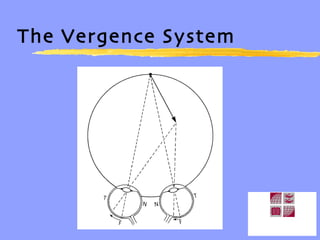
The Vergence System
Eye Movements Postural eye movements Psycho optical eye movements Fixation; Pursuit; Vergence
Vergence Eye Movements A disjunctive movement of the eyes that changes the angle formed by the visual axes
Vergence Eye Movements Convergence and divergence are terms found in the literature
Near Point of Convergence The closest point to which the eyes can be converged whilst retaining bifoveal fixation A normal NPC would be between 8cm-12cm
NPC
Unit of Measurement Metre Angle (MA) 1D of accommodation equivalent to 1MA of convergence
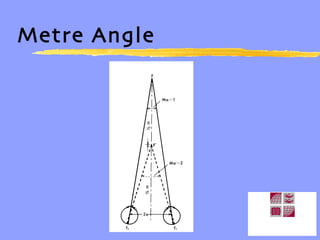
Metre Angle
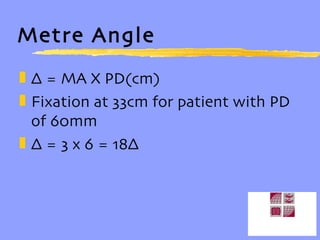
Metre Angle ∆  = MA X PD(cm) Fixation at 33cm for patient with PD of 60mm ∆  = 3 x 6 = 18∆
Vergence Voluntary Reflex
Reflex Vergence (Maddox) Tonic Accommodative Proximal Fusional Total = T+A+P+F
Tonic Vergence Anatomical position of rest Physiological position of rest
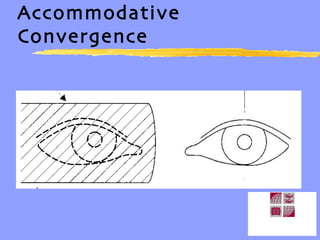
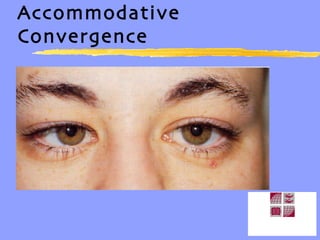
Accommodative Convergence Muller 1826 Minus lens stimulate accommodation and caused a vergence response in covered eye AC/A ratio
Accommodative Convergence
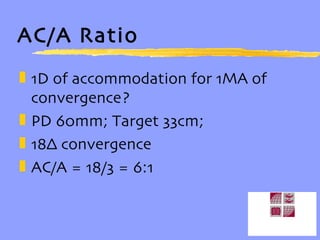
AC/A Ratio 1D of accommodation for 1MA of convergence? PD 60mm; Target 33cm;  18∆ convergence AC/A = 18/3 = 6:1
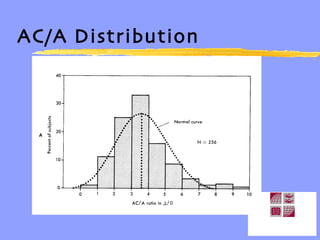
AC/A Distribution
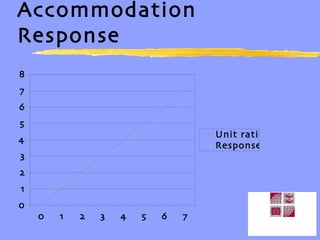
AC/A Ratio This is NOT found Accommodation not accurate?
Accommodation Response
Proximal Vergence Awareness of near object Instrument accommodation  Instrument vergence
Fusional Vergence Corrects any residual error from other components Effort can cause patient to experience symptoms Important that fusional effort is within middle third of total range
Heterophoria Alignment maintained by fusion reflex Suspend fusion and eyes adopt “fusion free” position Error of alignment is called a heterophoria Phoria is a measure of error between desired alignment and position resulting from proximal, tonic and accommodative components
Summary Vergence highest order eye movement Problems of vergence lead to symptoms Management of BV problems needs understanding of vergence system Total vergence response made up from Tonic, Proximal, Accommodative and Fusional Consider balance of components

Vergence