OPHTHALMIC PRISMS
Fakhruddin Aliasger
Lecturer, SPIO (a unit of Dr. Agarwal’s Eye Hospital)
4/5/2017Fakhruddin Alliasger 1
Prism
 A prism consists of two angled refracting
surfaces
 The simplest form of prism is two flat
surfaces coming together at an angle at the
top
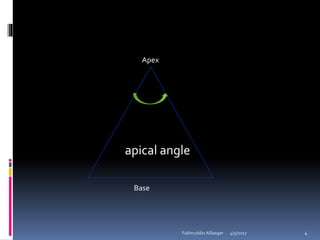
 The point is called Apex of the prism
 The wider bottom of the prism is called the
base
4/5/2017Fakhruddin Alliasger 2
 The base of all prisms are thicker than the
apex
 The angle between the two refracting surface
of the prism is known as apical angle
4/5/2017Fakhruddin Alliasger 3
apical angle
Base
Apex
4/5/2017Fakhruddin Alliasger 4
Ophthalmic Prisms
 Ophthalmic prisms are, generally, thin
prisms.They have an apical angle of less than
10º to 15.
 Thin prism have no dioptric power but can be
combined with dioptric lenses in a refractive
correction.
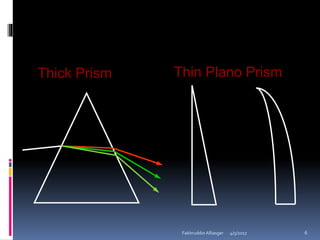
 A curved thin prism of Plano dioptric power
has a front and back surface of equal and
opposite power.
4/5/2017Fakhruddin Alliasger 5
Thick Prism Thin Plano Prism
4/5/2017Fakhruddin Alliasger 6
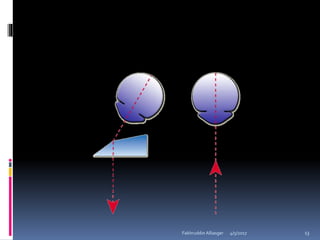
 The orientation of the prism in front of the
eye will affect the position at which the eye
perceives any object to be viewed through
the prism. It is, therefore, important to
specify accurately the orientation of the
prism so that its effect on the eyes is known
when incorporated into a refractive
correction.
4/5/2017Fakhruddin Alliasger 7
 The orientation of a prism is specified in
terms of the position of the base and axis.
4/5/2017Fakhruddin Alliasger 8
Properties of prism
 The position of an object will appear to change
when viewed through a prism.
 White light incident on a thick prism will appear
to be dispersed into the colour spectrum when
emergent from the second surface.
 A prism displaying this phenomenon is often
known as a Newton prism.
 Dispersion is usually seen in thick prism i.e.. a
prism whose apical angle is greater than 15º to
20º.
4/5/2017Fakhruddin Alliasger 9
UNITS OF PRISM POWER
 The apical angle and the refractive index of the
prism determine its deviating power.
 Angular Units
 The deviation produced by the prism is
expressed in degrees or radians.
 Prism Dioptres
 One prism dioptre produces a deviation of one
unit at a plane 100 units from the prism
 The unit of prism dioptres is denoted  .Three
prism dioptres would be written as 3 
4/5/2017Fakhruddin Alliasger 10
 Centrads
 One Centrad produces a deviation of one unit
of arc at a distance of 100 units from the
prism
 The unit of Centrads is denoted .Thus,
three Centrads would be written as 3 .
4/5/2017Fakhruddin Alliasger 11
Prism in spectacles
 Prism is prescribed for various reasons,
strabismus (the most common reason),
convergence problems, hemianopia etc. Its
purpose is to deviate the path of the incident
light so that it corresponds with the visual
axes of the eyes. So, for example, if one eye
(the right in the side) has an exotropia base in
prism can be prescribed to bring the path of
light from the object being viewed back along
the visual axis.
4/5/2017Fakhruddin Alliasger 12
4/5/2017Fakhruddin Alliasger 13
Orientation of prism
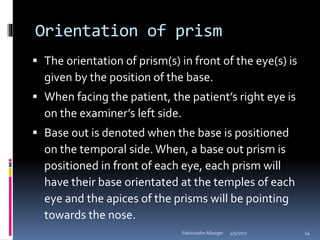
 The orientation of prism(s) in front of the eye(s) is
given by the position of the base.
 When facing the patient, the patient’s right eye is
on the examiner’s left side.
 Base out is denoted when the base is positioned
on the temporal side.When, a base out prism is
positioned in front of each eye, each prism will
have their base orientated at the temples of each
eye and the apices of the prisms will be pointing
towards the nose.
4/5/2017Fakhruddin Alliasger 14
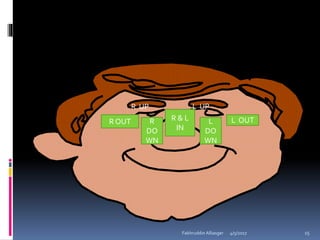
L UPR UP
R OUT R & L
IN
L OUTR
DO
WN
L
DO
WN
4/5/2017Fakhruddin Alliasger 15
 Similarly, base in prism is denoted when the
base of the prism is orientated on the nasal
side of the eye and the apex is pointing
towards the temple
4/5/2017Fakhruddin Alliasger 16
Base orientation
 When prescribing prism it is, of course,
necessary to indicate the direction of the
prism base. While most cases will involve
prism in one of the four main directions, up,
down, in and out, oblique prism may also be
ordered.There are two accepted methods for
indicating the direction of an oblique prism.
4/5/2017Fakhruddin Alliasger 17
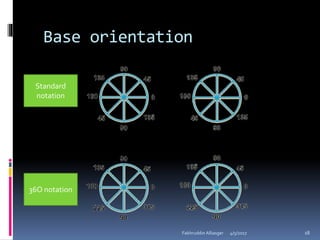
Base orientation
Standard
notation
36O notation
4/5/2017Fakhruddin Alliasger 18
 Standard notation:
 This is the same axis notation as used for the
axis of astigmatic lenses.This notation
requires further indication of the direction of
the base. For example, it is not sufficient to
order RE: 4  at 135.This could be either up
and out at 135 or down and in. So the
prescription needs the direction as well as the
angle.
4/5/2017Fakhruddin Alliasger 19
 360° notation:This system of notation is the
same as standard notation in the top two
quadrants but continues to 360 ° in the
bottom quadrants.This system requires no
other notation that the angle. So,
 RE: 4  at 135 would mean up and out, there is
no other possibility since down and in would
be RE: 4 at 315.
4/5/2017Fakhruddin Alliasger 20
Clinical consideration
 Due to the difference in thickness between the
base and the apex of a prism, refractive
corrections incorporating prism power for one
eye only, the spectacles may be dispensed with
the prism power split between the two eyes.This
is usually due to a noticeable and cosmetically
unacceptable difference in thickness between
the spectacle lenses if they were made up as
prescribed.
4/5/2017Fakhruddin Alliasger 21
 It is important that the effect on the eyes as a
pair is maintained when the prism power is
split between the spectacle lenses.This can
be achieved using the following rules.
 If the prismatic power is prescribed
monocularly in a refractive correction that is
similar between the two eyes, the prismatic
power should be split evenly.
4/5/2017Fakhruddin Alliasger 22
 Prism power with horizontal base direction
should have the same base direction in both
eyes
 Prism power with a vertical direction should
have opposite base directions in each eye,
with the base direction for the eye in which the
prism was originally prescribed remaining the
same.
4/5/2017Fakhruddin Alliasger 23
Compounding prism power
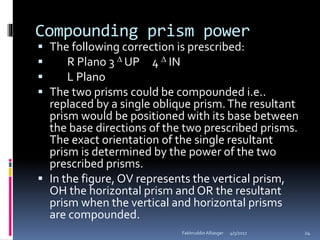
 The following correction is prescribed:
 R Plano 3  UP 4  IN
 L Plano
 The two prisms could be compounded i.e..
replaced by a single oblique prism.The resultant
prism would be positioned with its base between
the base directions of the two prescribed prisms.
The exact orientation of the single resultant
prism is determined by the power of the two
prescribed prisms.
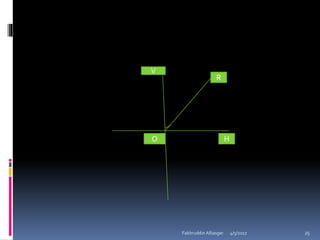
 In the figure, OV represents the vertical prism,
OH the horizontal prism and OR the resultant
prism when the vertical and horizontal prisms
are compounded.
4/5/2017Fakhruddin Alliasger 24
HO
R
V
H
4/5/2017Fakhruddin Alliasger 25
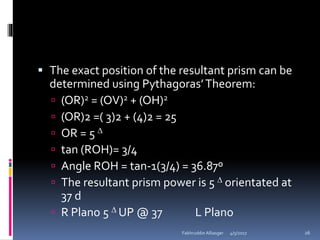
 The exact position of the resultant prism can be
determined using Pythagoras’Theorem:
 (OR)2 = (OV)2 + (OH)2
 (OR)2 =( 3)2 + (4)2 = 25
 OR = 5 
 tan (ROH)= 3/4
 Angle ROH = tan-1(3/4) = 36.87º
 The resultant prism power is 5  orientated at
37 d
 R Plano 5  UP @ 37 L Plano
4/5/2017Fakhruddin Alliasger 26
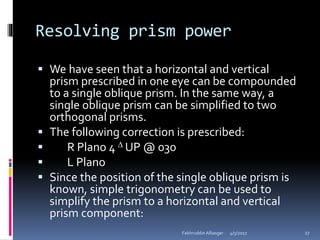
Resolving prism power
 We have seen that a horizontal and vertical
prism prescribed in one eye can be compounded
to a single oblique prism. In the same way, a
single oblique prism can be simplified to two
orthogonal prisms.
 The following correction is prescribed:
 R Plano 4  UP @ 030
 L Plano
 Since the position of the single oblique prism is
known, simple trigonometry can be used to
simplify the prism to a horizontal and vertical
prism component:
4/5/2017Fakhruddin Alliasger 27
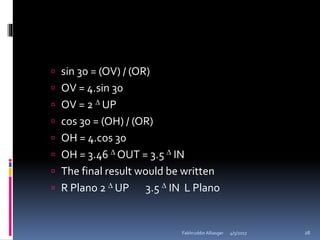
 sin 30 = (OV) / (OR)
 OV = 4.sin 30
 OV = 2  UP
 cos 30 = (OH) / (OR)
 OH = 4.cos 30
 OH = 3.46  OUT = 3.5  IN
 The final result would be written
 R Plano 2  UP 3.5  IN L Plano
4/5/2017Fakhruddin Alliasger 28
Prentice’s rule
 Prentice’s rule is the formula used to calculate
the decentration needed to create prism or
the prismatic effect of a lens at a given point.
For example, if we are required to find the
prismatic effect of a +5.00 D lens at a point 4
mm below the optical centre we use
Prentice’s rule. So,
 P = cF = 0.45 = 2  base up
4/5/2017Fakhruddin Alliasger 29
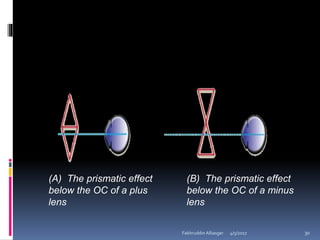
(A) The prismatic effect
below the OC of a plus
lens
(B) The prismatic effect
below the OC of a minus
lens
4/5/2017Fakhruddin Alliasger 30
 the prismatic effect at a point 4 mm below
the optical centre of a -4.00 D lens.
 P = cF = 0.44 = 1.6  base down
 Calculation of the prismatic effect for sphero-
cylinder lenses is the same if the prismatic
effect is required in a principal meridian. It is a
little more complex for oblique axes.
4/5/2017Fakhruddin Alliasger 31
 Axes of 90 and 180
 The decentration required to create prism
or the prismatic effect at any point on
cylinders and sphero-cylinders can be
determined using Prentice’s Rule, where:
 c is the distance from the optical centre for
each of the vertical and horizontal
meridians
4/5/2017Fakhruddin Alliasger 32
 For example:
 Find the prismatic effect at a point 10 mm below and 2 mm nasal of the optical
centre of a+2.00/-1.0090 lens.
 Horizontal prism
 P180 = c180  F180
 P180 = 0.2  +1.00
 P180 = 0.2 Base Up
 Vertical prism
 P90 = c90  F90
 P90 = 1.0  +2.00
 P90 = 2 Base Up
4/5/2017Fakhruddin Alliasger 33
Calculation of prismatic
effect in oblique cylinder
• The calculation of prismatic effect in oblique
cylinders requires a more complex set of
formulae. Before these formulae can be
applied certain notation and conventions
need to be established.
4/5/2017Fakhruddin Alliasger 34
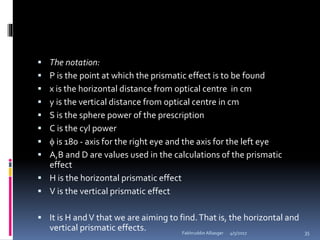
 The notation:
 P is the point at which the prismatic effect is to be found
 x is the horizontal distance from optical centre in cm
 y is the vertical distance from optical centre in cm
 S is the sphere power of the prescription
 C is the cyl power
  is 180 - axis for the right eye and the axis for the left eye
 A,B and D are values used in the calculations of the prismatic
effect
 H is the horizontal prismatic effect
 V is the vertical prismatic effect
 It is H andV that we are aiming to find.That is, the horizontal and
vertical prismatic effects. 4/5/2017Fakhruddin Alliasger 35
Calculation of prismatic
effect in oblique cylinder
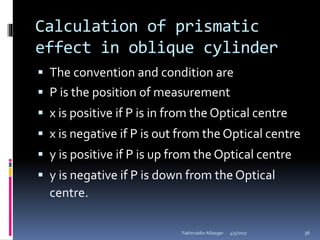
 The convention and condition are
 P is the position of measurement
 x is positive if P is in from the Optical centre
 x is negative if P is out from the Optical centre
 y is positive if P is up from the Optical centre
 y is negative if P is down from the Optical
centre.
4/5/2017Fakhruddin Alliasger 36
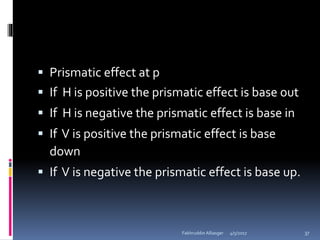
 Prismatic effect at p
 If H is positive the prismatic effect is base out
 If H is negative the prismatic effect is base in
 If V is positive the prismatic effect is base
down
 If V is negative the prismatic effect is base up.
4/5/2017Fakhruddin Alliasger 37
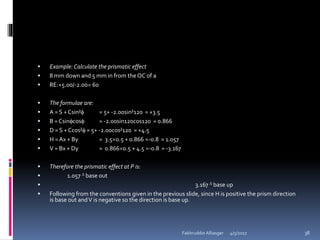
 Example: Calculate the prismatic effect
 8 mm down and 5 mm in from theOC of a
 RE:+5.00/-2.00 60
 The formulae are:
 A = S + Csin² = 5+ -2.00sin²120 = +3.5
 B =Csincos = -2.00sin120cos120 = 0.866
 D = S + Ccos² = 5+ -2.00cos²120 = +4.5
 H =Ax + By = 3.50.5 + 0.866 -0.8 = 1.057
 V = Bx + Dy = 0.8660.5 + 4.5 -0.8 = -3.167
 Therefore the prismatic effect at P is:
 1.057  base out
 3.167  base up
 Following from the conventions given in the previous slide, since H is positive the prism direction
is base out andV is negative so the direction is base up.
4/5/2017Fakhruddin Alliasger 38

Ophthalmic prisms

  • 1.
    OPHTHALMIC PRISMS Fakhruddin Aliasger Lecturer,SPIO (a unit of Dr. Agarwal’s Eye Hospital) 4/5/2017Fakhruddin Alliasger 1
  • 2.
    Prism  A prismconsists of two angled refracting surfaces  The simplest form of prism is two flat surfaces coming together at an angle at the top  The point is called Apex of the prism  The wider bottom of the prism is called the base 4/5/2017Fakhruddin Alliasger 2
  • 3.
     The baseof all prisms are thicker than the apex  The angle between the two refracting surface of the prism is known as apical angle 4/5/2017Fakhruddin Alliasger 3
  • 4.
  • 5.
    Ophthalmic Prisms  Ophthalmicprisms are, generally, thin prisms.They have an apical angle of less than 10º to 15.  Thin prism have no dioptric power but can be combined with dioptric lenses in a refractive correction.  A curved thin prism of Plano dioptric power has a front and back surface of equal and opposite power. 4/5/2017Fakhruddin Alliasger 5
  • 6.
    Thick Prism ThinPlano Prism 4/5/2017Fakhruddin Alliasger 6
  • 7.
     The orientationof the prism in front of the eye will affect the position at which the eye perceives any object to be viewed through the prism. It is, therefore, important to specify accurately the orientation of the prism so that its effect on the eyes is known when incorporated into a refractive correction. 4/5/2017Fakhruddin Alliasger 7
  • 8.
     The orientationof a prism is specified in terms of the position of the base and axis. 4/5/2017Fakhruddin Alliasger 8
  • 9.
    Properties of prism The position of an object will appear to change when viewed through a prism.  White light incident on a thick prism will appear to be dispersed into the colour spectrum when emergent from the second surface.  A prism displaying this phenomenon is often known as a Newton prism.  Dispersion is usually seen in thick prism i.e.. a prism whose apical angle is greater than 15º to 20º. 4/5/2017Fakhruddin Alliasger 9
  • 10.
    UNITS OF PRISMPOWER  The apical angle and the refractive index of the prism determine its deviating power.  Angular Units  The deviation produced by the prism is expressed in degrees or radians.  Prism Dioptres  One prism dioptre produces a deviation of one unit at a plane 100 units from the prism  The unit of prism dioptres is denoted  .Three prism dioptres would be written as 3  4/5/2017Fakhruddin Alliasger 10
  • 11.
     Centrads  OneCentrad produces a deviation of one unit of arc at a distance of 100 units from the prism  The unit of Centrads is denoted .Thus, three Centrads would be written as 3 . 4/5/2017Fakhruddin Alliasger 11
  • 12.
    Prism in spectacles Prism is prescribed for various reasons, strabismus (the most common reason), convergence problems, hemianopia etc. Its purpose is to deviate the path of the incident light so that it corresponds with the visual axes of the eyes. So, for example, if one eye (the right in the side) has an exotropia base in prism can be prescribed to bring the path of light from the object being viewed back along the visual axis. 4/5/2017Fakhruddin Alliasger 12
  • 13.
  • 14.
    Orientation of prism The orientation of prism(s) in front of the eye(s) is given by the position of the base.  When facing the patient, the patient’s right eye is on the examiner’s left side.  Base out is denoted when the base is positioned on the temporal side.When, a base out prism is positioned in front of each eye, each prism will have their base orientated at the temples of each eye and the apices of the prisms will be pointing towards the nose. 4/5/2017Fakhruddin Alliasger 14
  • 15.
    L UPR UP ROUT R & L IN L OUTR DO WN L DO WN 4/5/2017Fakhruddin Alliasger 15
  • 16.
     Similarly, basein prism is denoted when the base of the prism is orientated on the nasal side of the eye and the apex is pointing towards the temple 4/5/2017Fakhruddin Alliasger 16
  • 17.
    Base orientation  Whenprescribing prism it is, of course, necessary to indicate the direction of the prism base. While most cases will involve prism in one of the four main directions, up, down, in and out, oblique prism may also be ordered.There are two accepted methods for indicating the direction of an oblique prism. 4/5/2017Fakhruddin Alliasger 17
  • 18.
  • 19.
     Standard notation: This is the same axis notation as used for the axis of astigmatic lenses.This notation requires further indication of the direction of the base. For example, it is not sufficient to order RE: 4  at 135.This could be either up and out at 135 or down and in. So the prescription needs the direction as well as the angle. 4/5/2017Fakhruddin Alliasger 19
  • 20.
     360° notation:Thissystem of notation is the same as standard notation in the top two quadrants but continues to 360 ° in the bottom quadrants.This system requires no other notation that the angle. So,  RE: 4  at 135 would mean up and out, there is no other possibility since down and in would be RE: 4 at 315. 4/5/2017Fakhruddin Alliasger 20
  • 21.
    Clinical consideration  Dueto the difference in thickness between the base and the apex of a prism, refractive corrections incorporating prism power for one eye only, the spectacles may be dispensed with the prism power split between the two eyes.This is usually due to a noticeable and cosmetically unacceptable difference in thickness between the spectacle lenses if they were made up as prescribed. 4/5/2017Fakhruddin Alliasger 21
  • 22.
     It isimportant that the effect on the eyes as a pair is maintained when the prism power is split between the spectacle lenses.This can be achieved using the following rules.  If the prismatic power is prescribed monocularly in a refractive correction that is similar between the two eyes, the prismatic power should be split evenly. 4/5/2017Fakhruddin Alliasger 22
  • 23.
     Prism powerwith horizontal base direction should have the same base direction in both eyes  Prism power with a vertical direction should have opposite base directions in each eye, with the base direction for the eye in which the prism was originally prescribed remaining the same. 4/5/2017Fakhruddin Alliasger 23
  • 24.
    Compounding prism power The following correction is prescribed:  R Plano 3  UP 4  IN  L Plano  The two prisms could be compounded i.e.. replaced by a single oblique prism.The resultant prism would be positioned with its base between the base directions of the two prescribed prisms. The exact orientation of the single resultant prism is determined by the power of the two prescribed prisms.  In the figure, OV represents the vertical prism, OH the horizontal prism and OR the resultant prism when the vertical and horizontal prisms are compounded. 4/5/2017Fakhruddin Alliasger 24
  • 25.
  • 26.
     The exactposition of the resultant prism can be determined using Pythagoras’Theorem:  (OR)2 = (OV)2 + (OH)2  (OR)2 =( 3)2 + (4)2 = 25  OR = 5   tan (ROH)= 3/4  Angle ROH = tan-1(3/4) = 36.87º  The resultant prism power is 5  orientated at 37 d  R Plano 5  UP @ 37 L Plano 4/5/2017Fakhruddin Alliasger 26
  • 27.
    Resolving prism power We have seen that a horizontal and vertical prism prescribed in one eye can be compounded to a single oblique prism. In the same way, a single oblique prism can be simplified to two orthogonal prisms.  The following correction is prescribed:  R Plano 4  UP @ 030  L Plano  Since the position of the single oblique prism is known, simple trigonometry can be used to simplify the prism to a horizontal and vertical prism component: 4/5/2017Fakhruddin Alliasger 27
  • 28.
     sin 30= (OV) / (OR)  OV = 4.sin 30  OV = 2  UP  cos 30 = (OH) / (OR)  OH = 4.cos 30  OH = 3.46  OUT = 3.5  IN  The final result would be written  R Plano 2  UP 3.5  IN L Plano 4/5/2017Fakhruddin Alliasger 28
  • 29.
    Prentice’s rule  Prentice’srule is the formula used to calculate the decentration needed to create prism or the prismatic effect of a lens at a given point. For example, if we are required to find the prismatic effect of a +5.00 D lens at a point 4 mm below the optical centre we use Prentice’s rule. So,  P = cF = 0.45 = 2  base up 4/5/2017Fakhruddin Alliasger 29
  • 30.
    (A) The prismaticeffect below the OC of a plus lens (B) The prismatic effect below the OC of a minus lens 4/5/2017Fakhruddin Alliasger 30
  • 31.
     the prismaticeffect at a point 4 mm below the optical centre of a -4.00 D lens.  P = cF = 0.44 = 1.6  base down  Calculation of the prismatic effect for sphero- cylinder lenses is the same if the prismatic effect is required in a principal meridian. It is a little more complex for oblique axes. 4/5/2017Fakhruddin Alliasger 31
  • 32.
     Axes of90 and 180  The decentration required to create prism or the prismatic effect at any point on cylinders and sphero-cylinders can be determined using Prentice’s Rule, where:  c is the distance from the optical centre for each of the vertical and horizontal meridians 4/5/2017Fakhruddin Alliasger 32
  • 33.
     For example: Find the prismatic effect at a point 10 mm below and 2 mm nasal of the optical centre of a+2.00/-1.0090 lens.  Horizontal prism  P180 = c180  F180  P180 = 0.2  +1.00  P180 = 0.2 Base Up  Vertical prism  P90 = c90  F90  P90 = 1.0  +2.00  P90 = 2 Base Up 4/5/2017Fakhruddin Alliasger 33
  • 34.
    Calculation of prismatic effectin oblique cylinder • The calculation of prismatic effect in oblique cylinders requires a more complex set of formulae. Before these formulae can be applied certain notation and conventions need to be established. 4/5/2017Fakhruddin Alliasger 34
  • 35.
     The notation: P is the point at which the prismatic effect is to be found  x is the horizontal distance from optical centre in cm  y is the vertical distance from optical centre in cm  S is the sphere power of the prescription  C is the cyl power   is 180 - axis for the right eye and the axis for the left eye  A,B and D are values used in the calculations of the prismatic effect  H is the horizontal prismatic effect  V is the vertical prismatic effect  It is H andV that we are aiming to find.That is, the horizontal and vertical prismatic effects. 4/5/2017Fakhruddin Alliasger 35
  • 36.
    Calculation of prismatic effectin oblique cylinder  The convention and condition are  P is the position of measurement  x is positive if P is in from the Optical centre  x is negative if P is out from the Optical centre  y is positive if P is up from the Optical centre  y is negative if P is down from the Optical centre. 4/5/2017Fakhruddin Alliasger 36
  • 37.
     Prismatic effectat p  If H is positive the prismatic effect is base out  If H is negative the prismatic effect is base in  If V is positive the prismatic effect is base down  If V is negative the prismatic effect is base up. 4/5/2017Fakhruddin Alliasger 37
  • 38.
     Example: Calculatethe prismatic effect  8 mm down and 5 mm in from theOC of a  RE:+5.00/-2.00 60  The formulae are:  A = S + Csin² = 5+ -2.00sin²120 = +3.5  B =Csincos = -2.00sin120cos120 = 0.866  D = S + Ccos² = 5+ -2.00cos²120 = +4.5  H =Ax + By = 3.50.5 + 0.866 -0.8 = 1.057  V = Bx + Dy = 0.8660.5 + 4.5 -0.8 = -3.167  Therefore the prismatic effect at P is:  1.057  base out  3.167  base up  Following from the conventions given in the previous slide, since H is positive the prism direction is base out andV is negative so the direction is base up. 4/5/2017Fakhruddin Alliasger 38