Dispensing (7)
Dr. Atif Babiker Mohamed Ali
Faculty of Optometry
2023
MTC
Ophthalmic prisms
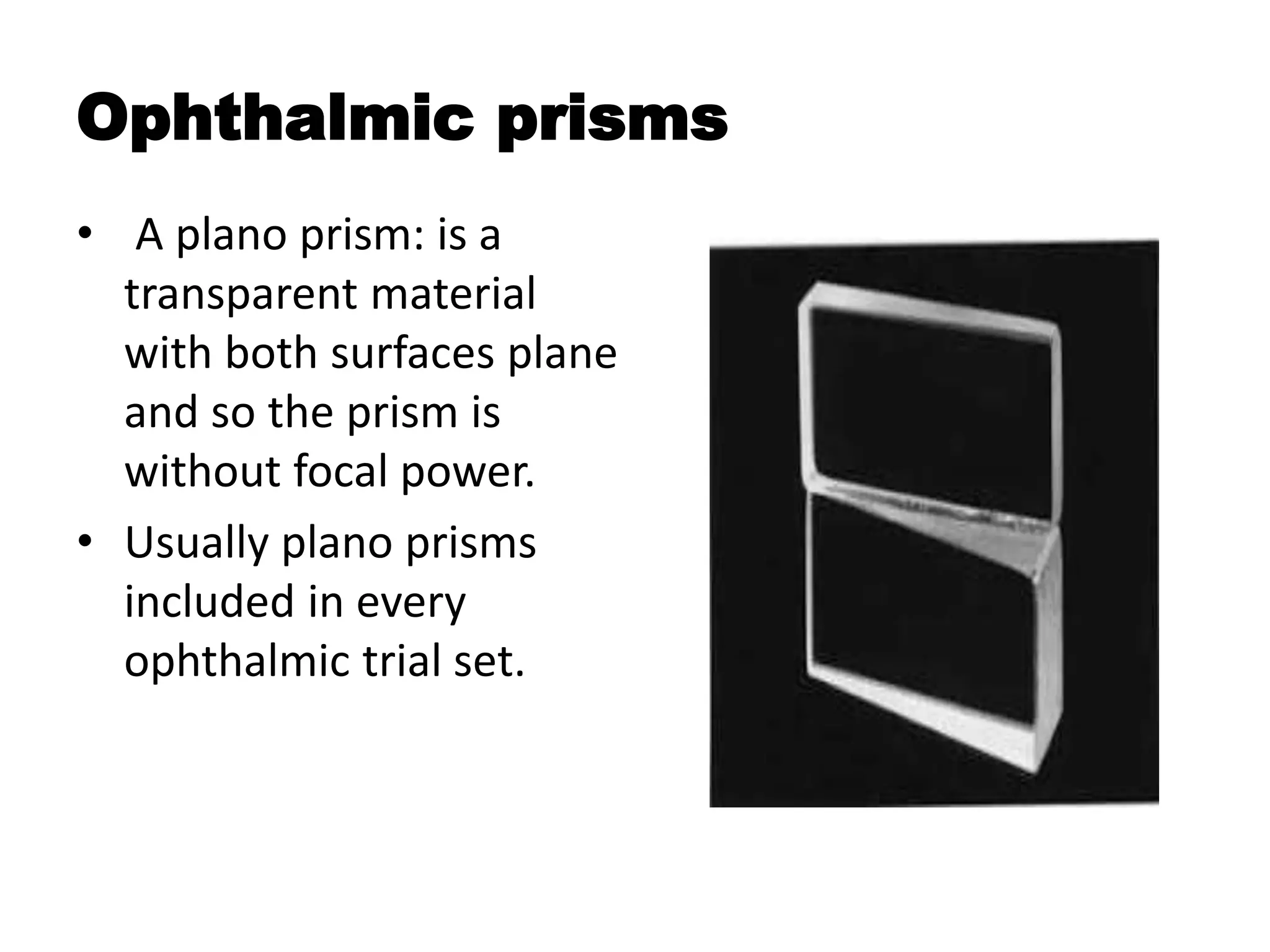
• A plano prism: is a
transparent material
with both surfaces plane
and so the prism is
without focal power.
• Usually plano prisms
included in every
ophthalmic trial set.
Base-apex line
• Any straight line passing
from apex to the base is
called base-apex line.
• This line is important to
fix the direction in
which deviation
produced.
Prism base setting
• It is conventionally used the base of the prism
to specify it is setting in relation to the eye (
this known as base setting).
• Two vertical settings Base-up & Base-down .
• Two horizontal settings Base-in & Base-out .
Oblique setting
• The oblique settings are
specified by the use of
standard axis notation of
cylinders followed by up
or down.
• For example; “base 150
up” means that the base-
apex-line lies along the 150
degree axis meridian and
the direction of the base
being upwards above the
horizontal.
A convex lens is considered as prisms placed base to base
A concave lens is considered as prisms placed apex to apex
Prismatic effects
• It is important that when the glasses are fitted the optical
centers should correspond to visual axes of the patient’s eyes.
• When light passes through any part of lens out side its optical
center the effect is that of a prism.
• Always the base of the prism is directed towards the thickest
part of the lens.
Power of prism
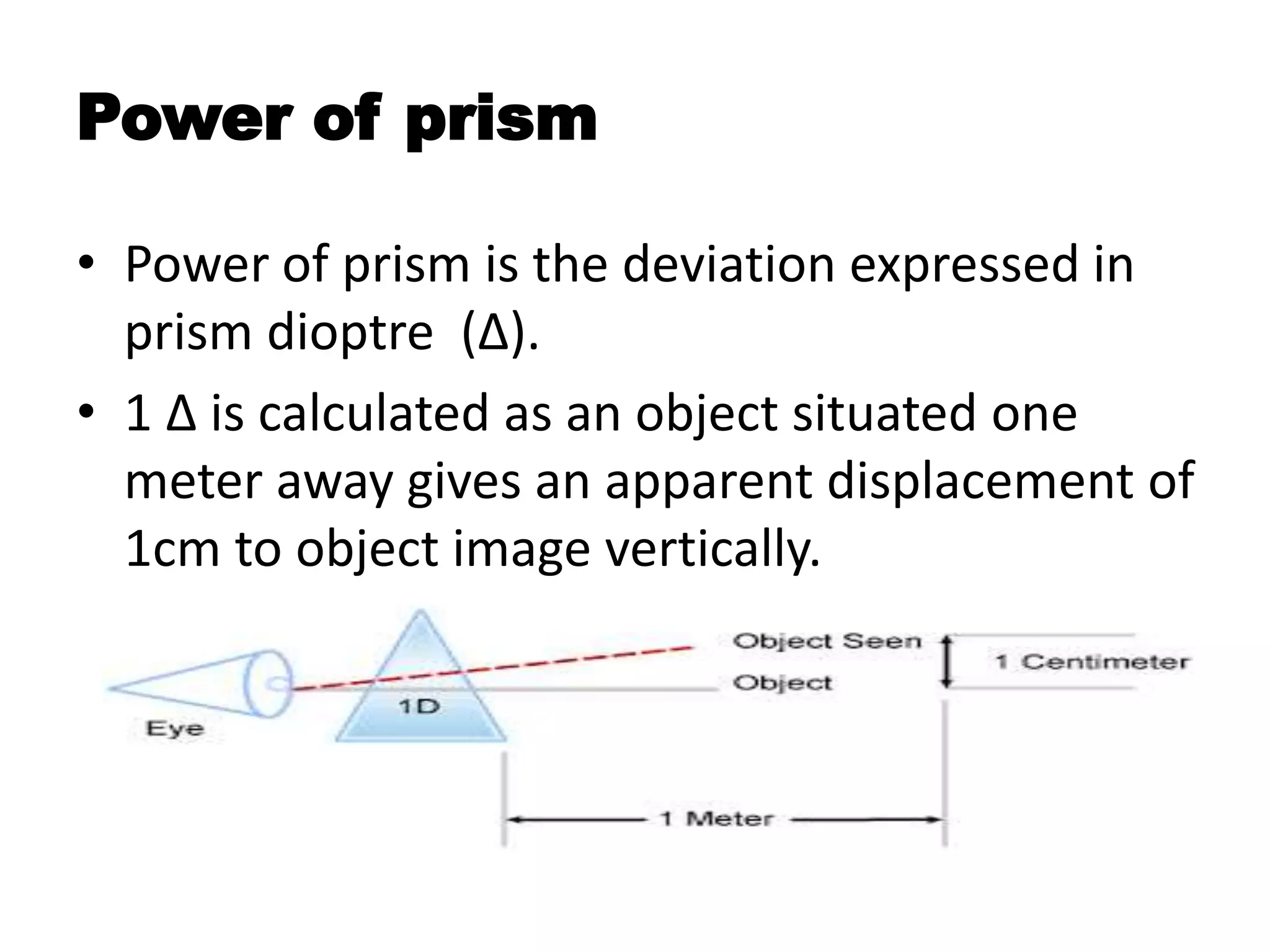
• Power of prism is the deviation expressed in
prism dioptre (∆).
• 1 ∆ is calculated as an object situated one
meter away gives an apparent displacement of
1cm to object image vertically.
Prismatic effect of spherical lenses
• Usually incident parallel
rays on a spherical lens
surface meet at one point
(focus).
• The action of lens in
deviating incident rays is
termed its prismatic effect
(v = cxf ).Thus
• P = C X F
• P (in prism dioptre) = C (in
centimeters) X F (in
diopteres) .
Lens Centration
• When the two eyes are directed to an object at infinity the
visual axes will be parallel.
• Thus the distance between the centers of pupils should be the
same as distance between optical centers of lenses when
used for distance vision.
• In this condition the accurate measurement of pupillay
distance is very important.
Decentration
• Decentration is a process in which the visual
axes of the eyes are allowed to pass away
from the optical centers of spectacle lenses.
• This practically means the pupillary distance
(PD) is not equal to the distance between
centers of glasses (centration distance or CD).
• Mathematically the PD ≠ CD so the prismatic
effect will appear and increases or decreases
according to the difference (C in centimeters).

DispensingBSc (7).pptx

  • 1.
    Dispensing (7) Dr. AtifBabiker Mohamed Ali Faculty of Optometry 2023 MTC
  • 2.
    Ophthalmic prisms • Aplano prism: is a transparent material with both surfaces plane and so the prism is without focal power. • Usually plano prisms included in every ophthalmic trial set.
  • 3.
    Base-apex line • Anystraight line passing from apex to the base is called base-apex line. • This line is important to fix the direction in which deviation produced.
  • 4.
    Prism base setting •It is conventionally used the base of the prism to specify it is setting in relation to the eye ( this known as base setting). • Two vertical settings Base-up & Base-down . • Two horizontal settings Base-in & Base-out .
  • 5.
    Oblique setting • Theoblique settings are specified by the use of standard axis notation of cylinders followed by up or down. • For example; “base 150 up” means that the base- apex-line lies along the 150 degree axis meridian and the direction of the base being upwards above the horizontal.
  • 6.
    A convex lensis considered as prisms placed base to base A concave lens is considered as prisms placed apex to apex
  • 7.
    Prismatic effects • Itis important that when the glasses are fitted the optical centers should correspond to visual axes of the patient’s eyes. • When light passes through any part of lens out side its optical center the effect is that of a prism. • Always the base of the prism is directed towards the thickest part of the lens.
  • 8.
    Power of prism •Power of prism is the deviation expressed in prism dioptre (∆). • 1 ∆ is calculated as an object situated one meter away gives an apparent displacement of 1cm to object image vertically.
  • 9.
    Prismatic effect ofspherical lenses • Usually incident parallel rays on a spherical lens surface meet at one point (focus). • The action of lens in deviating incident rays is termed its prismatic effect (v = cxf ).Thus • P = C X F • P (in prism dioptre) = C (in centimeters) X F (in diopteres) .
  • 10.
    Lens Centration • Whenthe two eyes are directed to an object at infinity the visual axes will be parallel. • Thus the distance between the centers of pupils should be the same as distance between optical centers of lenses when used for distance vision. • In this condition the accurate measurement of pupillay distance is very important.
  • 11.
    Decentration • Decentration isa process in which the visual axes of the eyes are allowed to pass away from the optical centers of spectacle lenses. • This practically means the pupillary distance (PD) is not equal to the distance between centers of glasses (centration distance or CD). • Mathematically the PD ≠ CD so the prismatic effect will appear and increases or decreases according to the difference (C in centimeters).