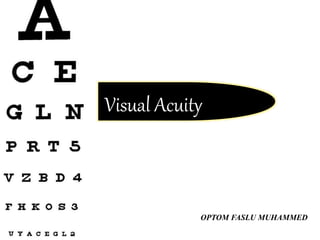
Visual Acuity
OPTOM FASLU MUHAMMED
Vision
Vision
 Vision or visual perception is a
complex integration of light sense,
form sense, contrast sense & colour
sense.
 Visual acuity is considered a measure
of Form Sense
Visual Angle
 In term of visual angle , VA is
defined as the reciprocal of the
minimum resolvable VA measured in
minutes of arc for a standard test
pattern
 Angle subtended at the nodal point of
the eye by the physical dimensions of
an object in the visual field
Contd…….
 Depends up on
◦ Size of the object
◦ Distance from the eye
Components of visual acuity
 Minimum Visible
 Resolution
 Recognition
 Minimum Discriminable
Minimum Visible
 The ability to determine whether or
not object is present.
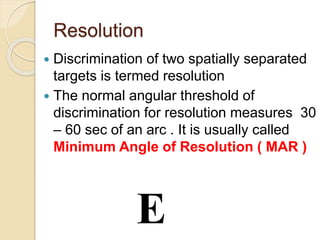
Resolution
 Discrimination of two spatially separated
targets is termed resolution
 The normal angular threshold of
discrimination for resolution measures 30
– 60 sec of an arc . It is usually called
Minimum Angle of Resolution ( MAR )
E
Recognition
 Not only discriminates the spatial
characteristics of the test pattern but
also identifies the pattern with which
one has had an experience
 Familiar with the set of test figures
 The test targets are called optotypes
G L N
Minimum Discriminable
 Minimum Discriminablerefers to
spatial distinction by an observer
when the threshold is much lower than
the ordinary acuity
Vernier acuity
Factors affecting VA
1. Stimulus related factors
◦ Luminance of test objects
◦ Geometrical configuration of the
stimulus
◦ Contrast of the stimulus from the
surround
◦ Influence of wavelength
◦ Exposure duration
◦ Interaction effects of the two targets
Contd……..
2. Observer related factors
 Retinal locus of stimulation
 Pupil size
 Accommodation
 Effect of the eye movement
 Meridonial variation in acuity
 Optical element of the eye
 Developmental aspects
Principle measures of VA
 Unaided VA
 Habitual VA
 Optimal VA
Standard testing conditions
1. Letter Size
VA involves the ability to detect a
gap subtending an angle of 1 minute of
arc
Testing Distance
 6 m distance ,Parallel rays of light.
Contd……….
 If testing distance must be less than
20 feet ,the use of a mirror system
should be considered.
ILLUMINATION
 Illumination for VA testing can be
consider in terms of either illuminance
or luminance.
ILLUMINANCE
12 to 20 foot candles
LUMINANCE
10 to 16 foot lamberts.
Contd…….
Visual acuity Notations
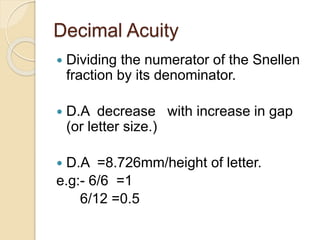
Decimal Acuity
 Dividing the numerator of the Snellen
fraction by its denominator.
 D.A decrease with increase in gap
(or letter size.)
 D.A =8.726mm/height of letter.
e.g:- 6/6 =1
6/12 =0.5
PERCENTAGE ACUITY
 D.A is multiplied by 100.
 If D.A is 1 P.A acuity is 100%
 D.A 0.1 P.A 10%
SNELLEN ACUITY
 Snellen Fraction =Testing
Distance/Designation of smallest line
read
or
Snellen Fraction =Testing
Distance/Distance at which the
smallest letter read subtends an angle
of 5’ of arc
Contd……..
 Snellen fraction stated either metric or
english units at 6m distance or 20 feet
 The numerator of the snellen fraction
is almost always 6 or 20 depending on
whether the metric or english system
is used
 To convert decimal acuity into the
snellen fraction ; it is necessary only to
multiply the numerator of the
reciprocal of the decimal acuity
Contd……..
 Eg: 0.5
1/ 0.5 = 2
2(6)= 12 or 2 (20) = 40
6/ 12 or 20/40
Contd……….
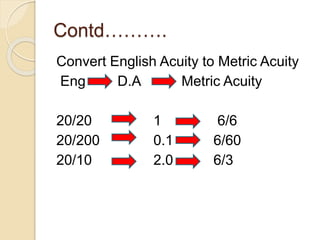
Convert English Acuity to Metric Acuity
Eng D.A Metric Acuity
20/20 1 6/6
20/200 0.1 6/60
20/10 2.0 6/3
Contd………
 Communicating with patients
 Snellen fraction = testing distance /
distance at which a normal eye can
see the smallest letter read
Thank u……….

Visual acuity

  • 1.
  • 2.
  • 3.
    Vision  Vision orvisual perception is a complex integration of light sense, form sense, contrast sense & colour sense.  Visual acuity is considered a measure of Form Sense
  • 4.
    Visual Angle  Interm of visual angle , VA is defined as the reciprocal of the minimum resolvable VA measured in minutes of arc for a standard test pattern  Angle subtended at the nodal point of the eye by the physical dimensions of an object in the visual field
  • 5.
    Contd…….  Depends upon ◦ Size of the object ◦ Distance from the eye
  • 6.
    Components of visualacuity  Minimum Visible  Resolution  Recognition  Minimum Discriminable
  • 7.
    Minimum Visible  Theability to determine whether or not object is present.
  • 8.
    Resolution  Discrimination oftwo spatially separated targets is termed resolution  The normal angular threshold of discrimination for resolution measures 30 – 60 sec of an arc . It is usually called Minimum Angle of Resolution ( MAR ) E
  • 9.
    Recognition  Not onlydiscriminates the spatial characteristics of the test pattern but also identifies the pattern with which one has had an experience  Familiar with the set of test figures  The test targets are called optotypes G L N
  • 10.
    Minimum Discriminable  MinimumDiscriminablerefers to spatial distinction by an observer when the threshold is much lower than the ordinary acuity Vernier acuity
  • 11.
    Factors affecting VA 1.Stimulus related factors ◦ Luminance of test objects ◦ Geometrical configuration of the stimulus ◦ Contrast of the stimulus from the surround ◦ Influence of wavelength ◦ Exposure duration ◦ Interaction effects of the two targets
  • 12.
    Contd…….. 2. Observer relatedfactors  Retinal locus of stimulation  Pupil size  Accommodation  Effect of the eye movement  Meridonial variation in acuity  Optical element of the eye  Developmental aspects
  • 13.
    Principle measures ofVA  Unaided VA  Habitual VA  Optimal VA
  • 14.
    Standard testing conditions 1.Letter Size VA involves the ability to detect a gap subtending an angle of 1 minute of arc
  • 15.
    Testing Distance  6m distance ,Parallel rays of light.
  • 16.
    Contd……….  If testingdistance must be less than 20 feet ,the use of a mirror system should be considered.
  • 17.
    ILLUMINATION  Illumination forVA testing can be consider in terms of either illuminance or luminance. ILLUMINANCE 12 to 20 foot candles LUMINANCE 10 to 16 foot lamberts.
  • 18.
  • 19.
  • 20.
    Decimal Acuity  Dividingthe numerator of the Snellen fraction by its denominator.  D.A decrease with increase in gap (or letter size.)  D.A =8.726mm/height of letter. e.g:- 6/6 =1 6/12 =0.5
  • 21.
    PERCENTAGE ACUITY  D.Ais multiplied by 100.  If D.A is 1 P.A acuity is 100%  D.A 0.1 P.A 10%
  • 22.
    SNELLEN ACUITY  SnellenFraction =Testing Distance/Designation of smallest line read or Snellen Fraction =Testing Distance/Distance at which the smallest letter read subtends an angle of 5’ of arc
  • 23.
    Contd……..  Snellen fractionstated either metric or english units at 6m distance or 20 feet  The numerator of the snellen fraction is almost always 6 or 20 depending on whether the metric or english system is used  To convert decimal acuity into the snellen fraction ; it is necessary only to multiply the numerator of the reciprocal of the decimal acuity
  • 24.
    Contd……..  Eg: 0.5 1/0.5 = 2 2(6)= 12 or 2 (20) = 40 6/ 12 or 20/40
  • 26.
    Contd………. Convert English Acuityto Metric Acuity Eng D.A Metric Acuity 20/20 1 6/6 20/200 0.1 6/60 20/10 2.0 6/3
  • 27.
    Contd………  Communicating withpatients  Snellen fraction = testing distance / distance at which a normal eye can see the smallest letter read
  • 28.