OPHTHALMIC STASNDARDS
Functions of ophthalmic
standards
 To provide a standard nomenclature,
definitions & terminology
 To provide quality control
 To provide protection for the public
Effectiveness of Standards
 Standard setting bodies in the United
states are Voluntary,Nongovernmental
groups
 Standards usually have an effect up on
trade,commerce,and public goods
 ANSI procedure states that “Any
person,organization,company,government
agency,individual with direct have a right
to participate to the following things
ANSI states that…..
 Expressing a position and its basis
 Having that position considered
 Appealing if adversely affected
 FDA adopted the impact resistant testing of
ophthalmic lenses ANSI Z80.1.that is all
ophthalmic lenses dispensed in this country had
to meet this standard
 OSHA adopted ANSI Z87.1 all industrial safety
eyewear must meet the standard
Continued….
 GATT (General Agreement on Tariff & Trade)
standard code require s government to use
international code,national technical rules &
regulation concerning international trade
 Purpose of these to eliminate technical barriers
to trade that may be caused by differences in
national laws,regulations & standards
 There for GATT effectively gives ISO standards
the force of international law
American National Standards
Institute(ANSI)
 ANSI plays an important role in the area of
ophthalmic products
 It is nonprofit institute that accredits & approve
committees, which develop standards for
particular segment of products
 No employees of ANSI participate in the work of
the committees
 The committees are composed of professional
societies,trade associations,other organization &
individuals
Continued…
 Each committee must meet the
requirements established by ANSI in order
to be accredited
 Standards developed by each committee
must be shown to have met a consensus
 Committee must be held open by ANSI for
public comment before the standards are
adopted
ANSI Z80
 These standards relate to industrial
safety,safe use of lasers,sports protective
eye wear & the design of video display
work station
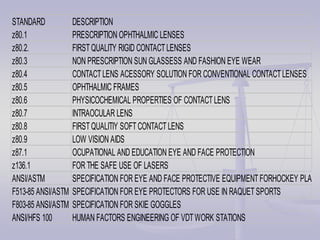
STANDARD DESCRIPTION
z80.1 PRESCRIPTION OPHTHALMIC LENSES
z80.2. FIRSTQUALITY RIGID CONTACTLENSES
z80.3 NON PRESCRIPTION SUN GLASSESS AND FASHION EYE WEAR
z80.4 CONTACTLENS ACESSORY SOLUTION FOR CONVENTIONAL CONTACTLENSES
z80.5 OPHTHALMIC FRAMES
z80.6 PHYSICOCHEMICAL PROPERTIES OF CONTACTLENS
z80.7 INTRAOCULAR LENS
z80.8 FIRSTQUALITIY SOFTCONTACTLENS
z80.9 LOW VISION AIDS
z87.1 OCUPATIONAL AND EDUCATION EYE AND FACE PROTECTION
z136.1 FOR THE SAFE USE OF LASERS
ANSI/ASTM SPECIFICATION FOR EYE AND FACE PROTECTIVE EQUIPMENTFORHOCKEY PLAYE
F513-85 ANSI/ASTM SPECIFICATION FOR EYE PROTECTORS FOR USE IN RAQUETSPORTS
F803-85 ANSI/ASTM SPECIFICATION FOR SKIE GOGGLES
ANSI/HFS 100 HUMAN FACTORS ENGINEERING OF VDTWORK STATIONS
Clinical Standards Acceptable in
Practice
 Spherical power difference ±0.12 Dsph for
low powers
 Spherical power difference ±0.25Dsph for
high powers
 Cylindrical power differance±0.12Dcyl for
low powers
 Cylindrical power differance±0.25Dcyl for
high powers
Axis Difference Variation
Acceptable in Practice
 Low power cylinder axis 5-10º
 High power cylinder axis 5º
 Oblique cylinder axis 2-5º
 It will Vary the subjective response and
sensitivity of patient
Decenterd Optic Center
Acceptable in Practice
 Low spherical powers
 Low cylindrical powers
 High spherical powers
 High cylindrical powers
Impact Resistance Standard
 FDA has no minimum thickness requirement for
safety lenses
 Lens made from all the materials should pass
drop ball test
 Thickness of the lens should be 1.5- 3mm
 Polycarbonate lenses should have1.5 to <3mm
thickness
 Nonprescription lenses should have 3mm
thickness
Industrial safety protection
standards for impact resistance
& industrial safety eyewear
 According to OSHA
 All lenses must be able to with stand the
impact resistance of 1-inch steel ball dropped
50 inches on to the lens front surface also
called(industrial drop ball test)
 All lenses must have a minimum thickness of
3mm.
 Lenses of power greater than +3diopter,in the
most plus meridian can have a minimum
thickness of 2.5mm
Industrial safety protection
standards for impact resistance
& industrial safety eyewear
 All lenses must be permanently marked with the
monogram or trademark of optical laboratory
that edges the lenses
 This provides proof to the customer that truly
industrial safety lens
 General standards not follow for industrial safety
tinted lens,sunglass
 Tints must be prescribed with a knowledge of
patients lighting and working condition
Industrial safety protection
standards for impact resistance
& industrial safety eyewear
 Lenses of low transmittance should not be worn
indoors
 Lightly tinted lenses for indoor use should be
prescribed only if the workplace has adequate
lighting or if glare problem
 Sunglasses should not be worn by the operator
of vehicle with tinted wind shield
 Sun glasses should not worn by driving at night
Industrial safety protection
standards for impact resistance
& industrial safety eyewear
 Older patients with decreased media
transmittance should not worn tinted lenses
 Photo chromatic lenses prohibited in situation
where use of lens could present a hazard by
OSHA
 Industrial safety spectacle frames for use in
prescription eyewear must meet high mass-low
velocity,low mass-high velocity impact
resistance,flammability standards& corrosion
standards
Industrial safety protection
standards for impact resistance
& industrial safety eyewear
 All industrial safety frames must be
marked with frame “A” “DBL”,overall
temple length,& all frames must be
marked with”Z87” to indicate
compliance with standard
 Polycarbonate is the best lens material
to use in industrial safety eyewear
Industrial safety protection
standards for impact resistance
& industrial safety eyewear
 According to ANSI
 All protective lenses must meet high mass
& low mass impact resistance
standards,penetration resistance
standards & filter minimum thickness
requirement & standard for prism
refractive power
error,transmittance,corrosion resistance
,flammability resistance,haze & definition
Ophthalmic lenses in sports
 Appropriate lens material for sports
protection is poly carbonate
 Sports frames should make from injection
molded polycarbonate
 According to ASTM (American Society for
Testing Material)best recommendation for
type of spectacle frame use in sports is
frame no rimless
Legal considerations
 Be familiar with the current ANSI
 Recommend polycarbonate to
 Athletes
 Monocular patients
 Amblyopes
 patients with hazardous occupation
 Children
 Take care full case histories to determine
patients have special need for eye protection
 Discuss the properties of different lens material
Legal considerations
 Recommend special eye and face protectors for
sports
 When prescribing specially designed protectors
for sports that must be meet the standards
 Maintain records
 Avoid the term using “unbreakable” use the term
“impact resistant”
 Do not guarantee the lenses are unbreakable
Legal considerations
 Optometrist are the people recommend lens
materials & sports protectors to the patients
 Always verify all spectacle before dispensing
 If a manufacturer of frames or lenses supplies
warning about the product ,be sure to pass the
warning to patient
 Never place industrial safety lenses in dress
safety frames or dress safety lenses in an
industrial safety frame
Optimum sunglass lens
 Reduce the solar ambient luminance for
optimum visual comfort & visual performance
 Elimination of the optical spectrum not required
for vision that serves as a hazard to the eye
 Maintenance of a optimum dark adaptation or
night vision
 Maintenance of normal color vision.traffic signal
lights must be able to seen quickly and correctly
 Minimum care & increased resistance against
impact & scratching
Absorptive lenses
 These lenses selectively transmit potion of
the optical spectrum with transmittance &
reflectance characteristics providing the
hue or color of the lens
 These lenses do not add light but reduce
the absorbed wavelength from total light
available
Neutral lenses
 These lenses absorb almost equally across
the VIS spectrum and appear grey in color
 It prevent color distortion because they
transmit almost evenly across the VIS
spectrum
Polarized filter lenses
 These lenses are constructed by stretching
a thin polyvinyl film that contains iodine
and quinine compounds crystal placed
between two thin glass or plastic lenses
 The color of the lens is derived from the
glass or plastic
 The transmittance of polarizing lenses
variable & depend on the degree & plane
of polarization the incident light
Reflecting filter
 Manufactured by vacuum deposition of
metallic coatings on a glass or plastic
substrate
 Metallic filters are the preferred method to
control IR
Recommended standard for the
optical spectrum
 Spectrum Wave band Standard
 UVC 290-315nm 0.1micro W/cm2
 UVB
 UVA 320-400 nm 1mw/cm2
 VIS 380-760 nm 1cd/cm2
 IR 700-1400 nm 10mw/cm2

Ophthalmic Standards_6th_sem.ppt

  • 1.
  • 2.
    Functions of ophthalmic standards To provide a standard nomenclature, definitions & terminology  To provide quality control  To provide protection for the public
  • 3.
    Effectiveness of Standards Standard setting bodies in the United states are Voluntary,Nongovernmental groups  Standards usually have an effect up on trade,commerce,and public goods  ANSI procedure states that “Any person,organization,company,government agency,individual with direct have a right to participate to the following things
  • 4.
    ANSI states that….. Expressing a position and its basis  Having that position considered  Appealing if adversely affected  FDA adopted the impact resistant testing of ophthalmic lenses ANSI Z80.1.that is all ophthalmic lenses dispensed in this country had to meet this standard  OSHA adopted ANSI Z87.1 all industrial safety eyewear must meet the standard
  • 5.
    Continued….  GATT (GeneralAgreement on Tariff & Trade) standard code require s government to use international code,national technical rules & regulation concerning international trade  Purpose of these to eliminate technical barriers to trade that may be caused by differences in national laws,regulations & standards  There for GATT effectively gives ISO standards the force of international law
  • 6.
    American National Standards Institute(ANSI) ANSI plays an important role in the area of ophthalmic products  It is nonprofit institute that accredits & approve committees, which develop standards for particular segment of products  No employees of ANSI participate in the work of the committees  The committees are composed of professional societies,trade associations,other organization & individuals
  • 7.
    Continued…  Each committeemust meet the requirements established by ANSI in order to be accredited  Standards developed by each committee must be shown to have met a consensus  Committee must be held open by ANSI for public comment before the standards are adopted
  • 8.
    ANSI Z80  Thesestandards relate to industrial safety,safe use of lasers,sports protective eye wear & the design of video display work station
  • 9.
    STANDARD DESCRIPTION z80.1 PRESCRIPTIONOPHTHALMIC LENSES z80.2. FIRSTQUALITY RIGID CONTACTLENSES z80.3 NON PRESCRIPTION SUN GLASSESS AND FASHION EYE WEAR z80.4 CONTACTLENS ACESSORY SOLUTION FOR CONVENTIONAL CONTACTLENSES z80.5 OPHTHALMIC FRAMES z80.6 PHYSICOCHEMICAL PROPERTIES OF CONTACTLENS z80.7 INTRAOCULAR LENS z80.8 FIRSTQUALITIY SOFTCONTACTLENS z80.9 LOW VISION AIDS z87.1 OCUPATIONAL AND EDUCATION EYE AND FACE PROTECTION z136.1 FOR THE SAFE USE OF LASERS ANSI/ASTM SPECIFICATION FOR EYE AND FACE PROTECTIVE EQUIPMENTFORHOCKEY PLAYE F513-85 ANSI/ASTM SPECIFICATION FOR EYE PROTECTORS FOR USE IN RAQUETSPORTS F803-85 ANSI/ASTM SPECIFICATION FOR SKIE GOGGLES ANSI/HFS 100 HUMAN FACTORS ENGINEERING OF VDTWORK STATIONS
  • 10.
    Clinical Standards Acceptablein Practice  Spherical power difference ±0.12 Dsph for low powers  Spherical power difference ±0.25Dsph for high powers  Cylindrical power differance±0.12Dcyl for low powers  Cylindrical power differance±0.25Dcyl for high powers
  • 11.
    Axis Difference Variation Acceptablein Practice  Low power cylinder axis 5-10º  High power cylinder axis 5º  Oblique cylinder axis 2-5º  It will Vary the subjective response and sensitivity of patient
  • 12.
    Decenterd Optic Center Acceptablein Practice  Low spherical powers  Low cylindrical powers  High spherical powers  High cylindrical powers
  • 13.
    Impact Resistance Standard FDA has no minimum thickness requirement for safety lenses  Lens made from all the materials should pass drop ball test  Thickness of the lens should be 1.5- 3mm  Polycarbonate lenses should have1.5 to <3mm thickness  Nonprescription lenses should have 3mm thickness
  • 14.
    Industrial safety protection standardsfor impact resistance & industrial safety eyewear  According to OSHA  All lenses must be able to with stand the impact resistance of 1-inch steel ball dropped 50 inches on to the lens front surface also called(industrial drop ball test)  All lenses must have a minimum thickness of 3mm.  Lenses of power greater than +3diopter,in the most plus meridian can have a minimum thickness of 2.5mm
  • 15.
    Industrial safety protection standardsfor impact resistance & industrial safety eyewear  All lenses must be permanently marked with the monogram or trademark of optical laboratory that edges the lenses  This provides proof to the customer that truly industrial safety lens  General standards not follow for industrial safety tinted lens,sunglass  Tints must be prescribed with a knowledge of patients lighting and working condition
  • 16.
    Industrial safety protection standardsfor impact resistance & industrial safety eyewear  Lenses of low transmittance should not be worn indoors  Lightly tinted lenses for indoor use should be prescribed only if the workplace has adequate lighting or if glare problem  Sunglasses should not be worn by the operator of vehicle with tinted wind shield  Sun glasses should not worn by driving at night
  • 17.
    Industrial safety protection standardsfor impact resistance & industrial safety eyewear  Older patients with decreased media transmittance should not worn tinted lenses  Photo chromatic lenses prohibited in situation where use of lens could present a hazard by OSHA  Industrial safety spectacle frames for use in prescription eyewear must meet high mass-low velocity,low mass-high velocity impact resistance,flammability standards& corrosion standards
  • 18.
    Industrial safety protection standardsfor impact resistance & industrial safety eyewear  All industrial safety frames must be marked with frame “A” “DBL”,overall temple length,& all frames must be marked with”Z87” to indicate compliance with standard  Polycarbonate is the best lens material to use in industrial safety eyewear
  • 19.
    Industrial safety protection standardsfor impact resistance & industrial safety eyewear  According to ANSI  All protective lenses must meet high mass & low mass impact resistance standards,penetration resistance standards & filter minimum thickness requirement & standard for prism refractive power error,transmittance,corrosion resistance ,flammability resistance,haze & definition
  • 20.
    Ophthalmic lenses insports  Appropriate lens material for sports protection is poly carbonate  Sports frames should make from injection molded polycarbonate  According to ASTM (American Society for Testing Material)best recommendation for type of spectacle frame use in sports is frame no rimless
  • 21.
    Legal considerations  Befamiliar with the current ANSI  Recommend polycarbonate to  Athletes  Monocular patients  Amblyopes  patients with hazardous occupation  Children  Take care full case histories to determine patients have special need for eye protection  Discuss the properties of different lens material
  • 22.
    Legal considerations  Recommendspecial eye and face protectors for sports  When prescribing specially designed protectors for sports that must be meet the standards  Maintain records  Avoid the term using “unbreakable” use the term “impact resistant”  Do not guarantee the lenses are unbreakable
  • 23.
    Legal considerations  Optometristare the people recommend lens materials & sports protectors to the patients  Always verify all spectacle before dispensing  If a manufacturer of frames or lenses supplies warning about the product ,be sure to pass the warning to patient  Never place industrial safety lenses in dress safety frames or dress safety lenses in an industrial safety frame
  • 24.
    Optimum sunglass lens Reduce the solar ambient luminance for optimum visual comfort & visual performance  Elimination of the optical spectrum not required for vision that serves as a hazard to the eye  Maintenance of a optimum dark adaptation or night vision  Maintenance of normal color vision.traffic signal lights must be able to seen quickly and correctly  Minimum care & increased resistance against impact & scratching
  • 25.
    Absorptive lenses  Theselenses selectively transmit potion of the optical spectrum with transmittance & reflectance characteristics providing the hue or color of the lens  These lenses do not add light but reduce the absorbed wavelength from total light available
  • 26.
    Neutral lenses  Theselenses absorb almost equally across the VIS spectrum and appear grey in color  It prevent color distortion because they transmit almost evenly across the VIS spectrum
  • 27.
    Polarized filter lenses These lenses are constructed by stretching a thin polyvinyl film that contains iodine and quinine compounds crystal placed between two thin glass or plastic lenses  The color of the lens is derived from the glass or plastic  The transmittance of polarizing lenses variable & depend on the degree & plane of polarization the incident light
  • 28.
    Reflecting filter  Manufacturedby vacuum deposition of metallic coatings on a glass or plastic substrate  Metallic filters are the preferred method to control IR
  • 29.
    Recommended standard forthe optical spectrum  Spectrum Wave band Standard  UVC 290-315nm 0.1micro W/cm2  UVB  UVA 320-400 nm 1mw/cm2  VIS 380-760 nm 1cd/cm2  IR 700-1400 nm 10mw/cm2