 A lens is defined as a portion of a refracting
medium bordered by two curved surfaces
which have a common axis.
 When each surface forms a part of sphere, the
lens is called a spherical lens.
SPHERICAL LENS
 SPHERICAL LENS
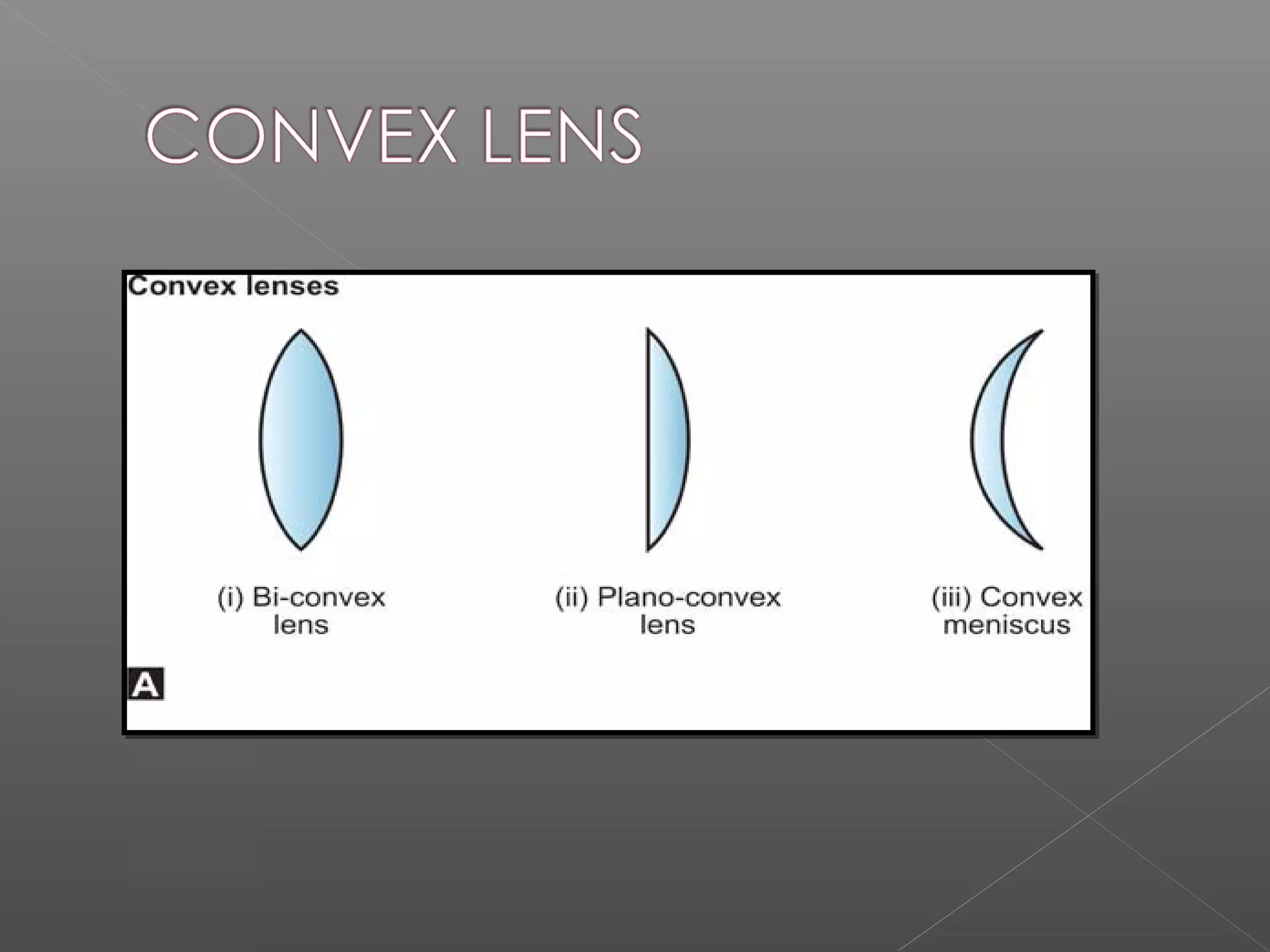
- CONVEX LENS
- CONCAVE LENS
 CYLINDRICAL LENS
 CONVEX LENS
 CONCAVE LENS
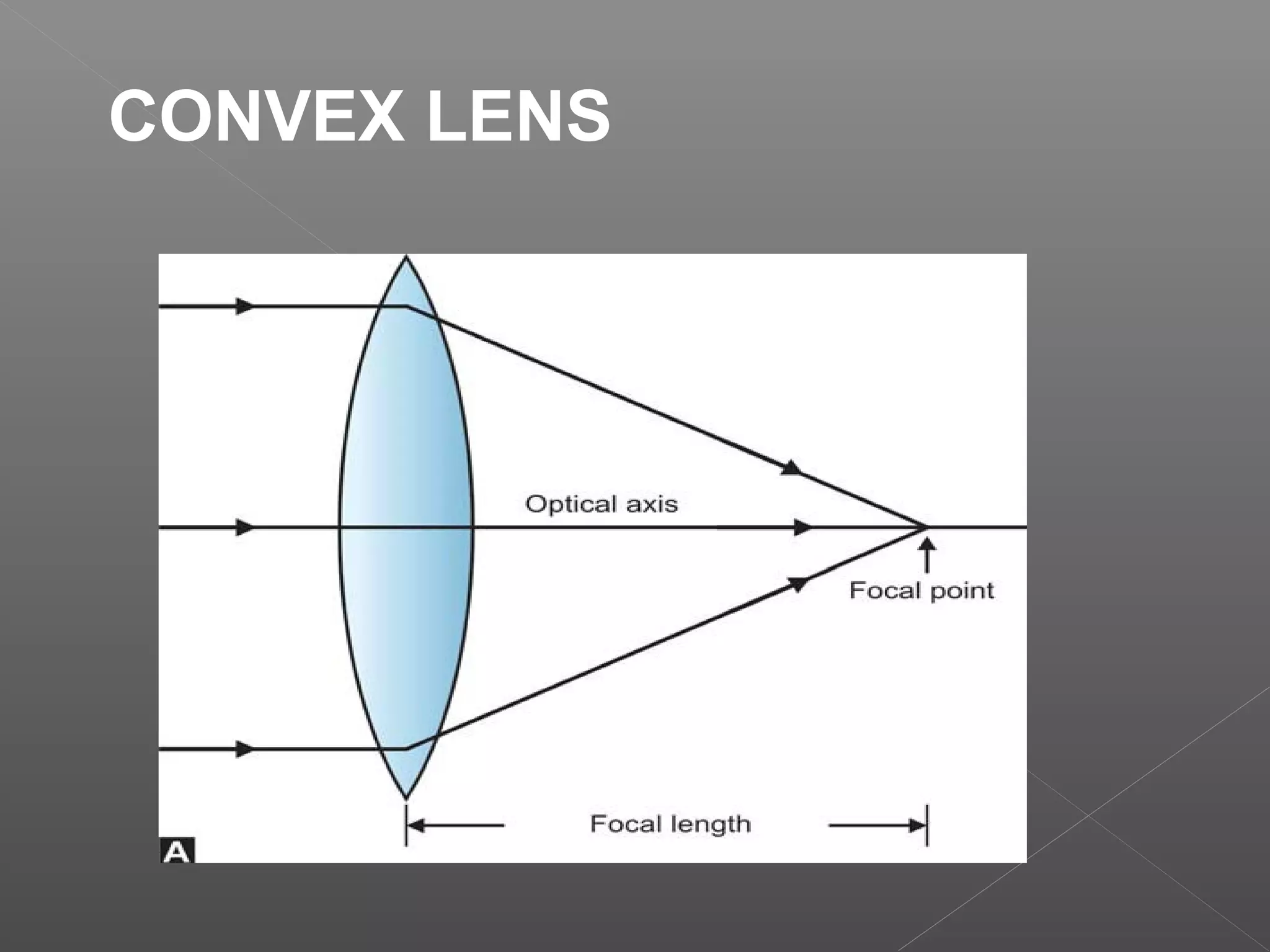
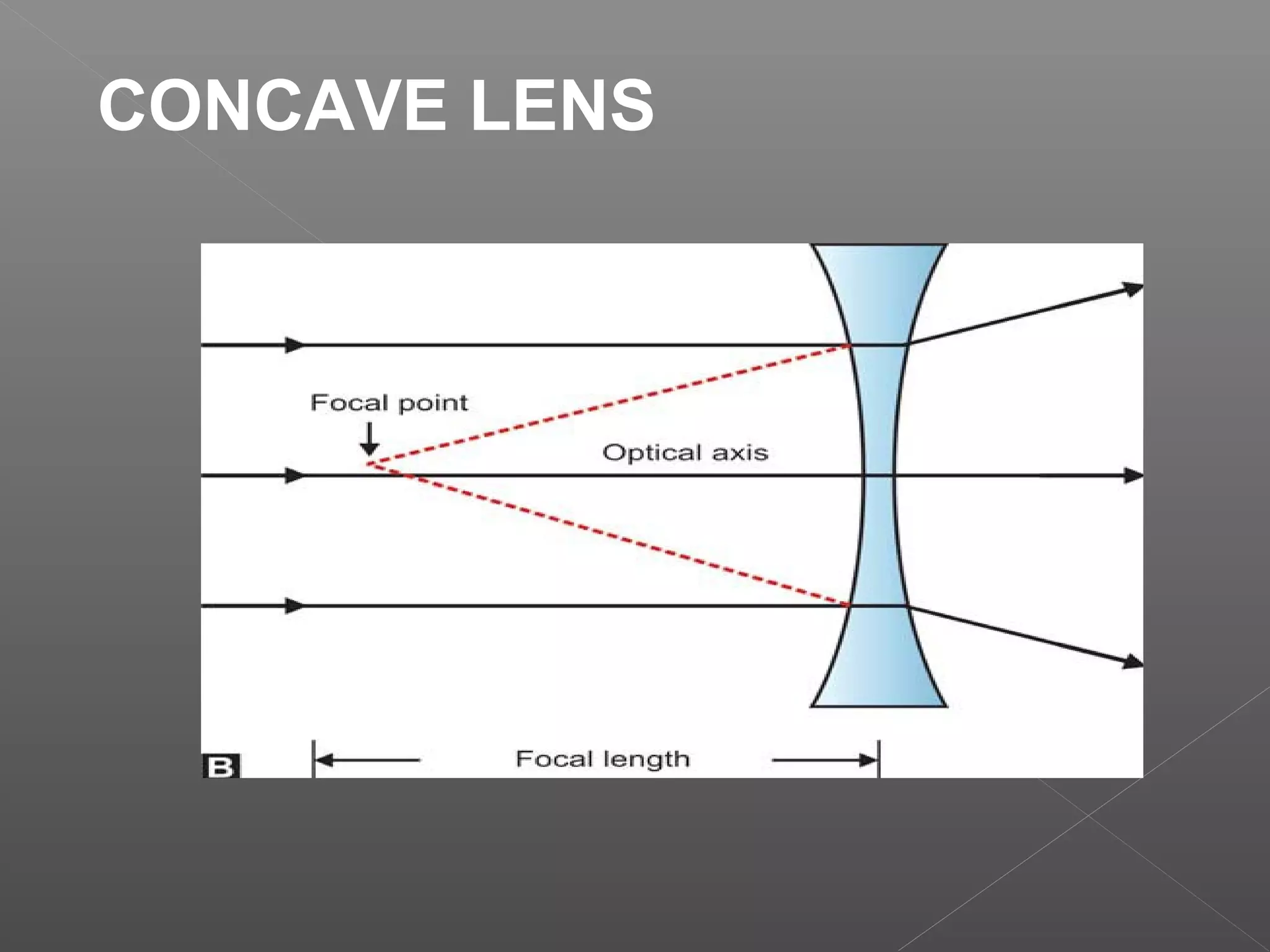
 A convex lens causes convergence of
incident light, whereas a concave lens
causes divergence of incident light.
CONVEX LENS
CONCAVE LENS
Center of curvature (C)
The centre of the sphere of which the
refracting lens surface is a part.
Radius of curvature (r)
It is the radius of the sphere of which the
refracting surface is a part.
The principal axis (AB)
It is the line joining the centers of
curvature of its surfaces.
Optical centre (N) of the lens
corresponds to the nodal point of a thick
lens.
The principle focus (F) of a lens is that
point on the principal axis where parallel
rays of light, after passing through the
lens ,converge (in convex lens) or appear
to diverge (in concave lens)
The Focal length of a lens is the
distance b/w the optical centre and the
principal focus.
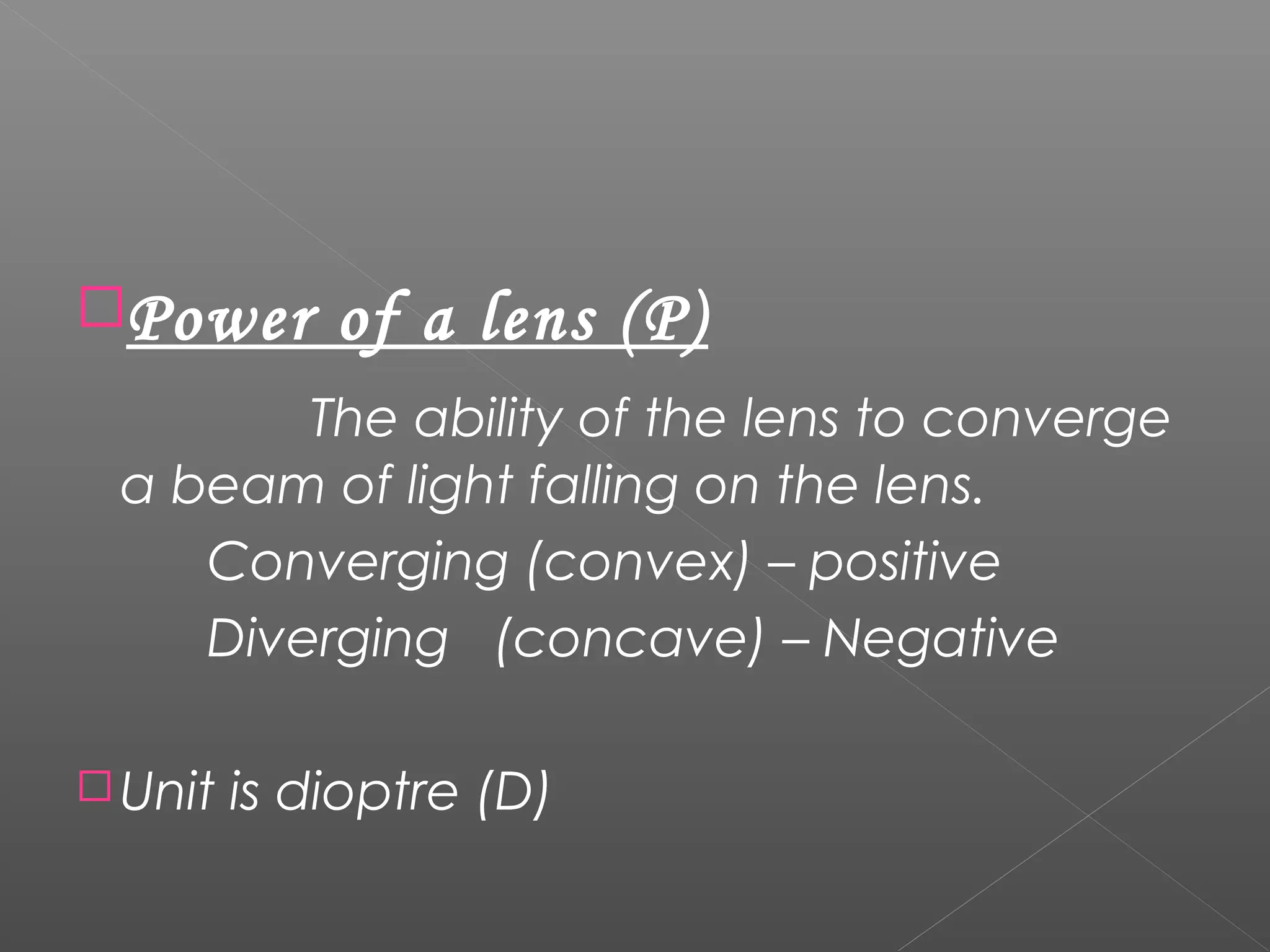
Power of a lens (P)
The ability of the lens to converge
a beam of light falling on the lens.
Converging (convex) – positive
Diverging (concave) – Negative
 Unit is dioptre (D)
Lenses of shorter focal length are more
powerful than lenses of longer focal
length.
F = 1/ f2
Where F = Vergence power of lens in
dioptres.
f2 = Second focal length in metres
So, in the above vergence at the lens
is:
F = 1 / 0.25 = 4.00 D.
vergence at the lens is:
F = 1/ 0.10 = 10.00 D.
 Vergence is the term that determines the
direction and power of light transmission.
 The vergence of light is defined by:
V = n/L
Where n = refractive index of the material.
L = the distance in accordance
 Since the distance L1 is measured from the
wavefront and the light is traveling from left
to right, it is a negative distance and the
vergence is negative (divergent).
 L2 is positive since it is directed to the right
from the wavefront (convergent)
 Parallel light rays are said to have zero
vergence.
 The unit to measure vergence is “dioptre”.
The change in vergence when the light
encounters a refracting surface is equal to the
power of the surface.
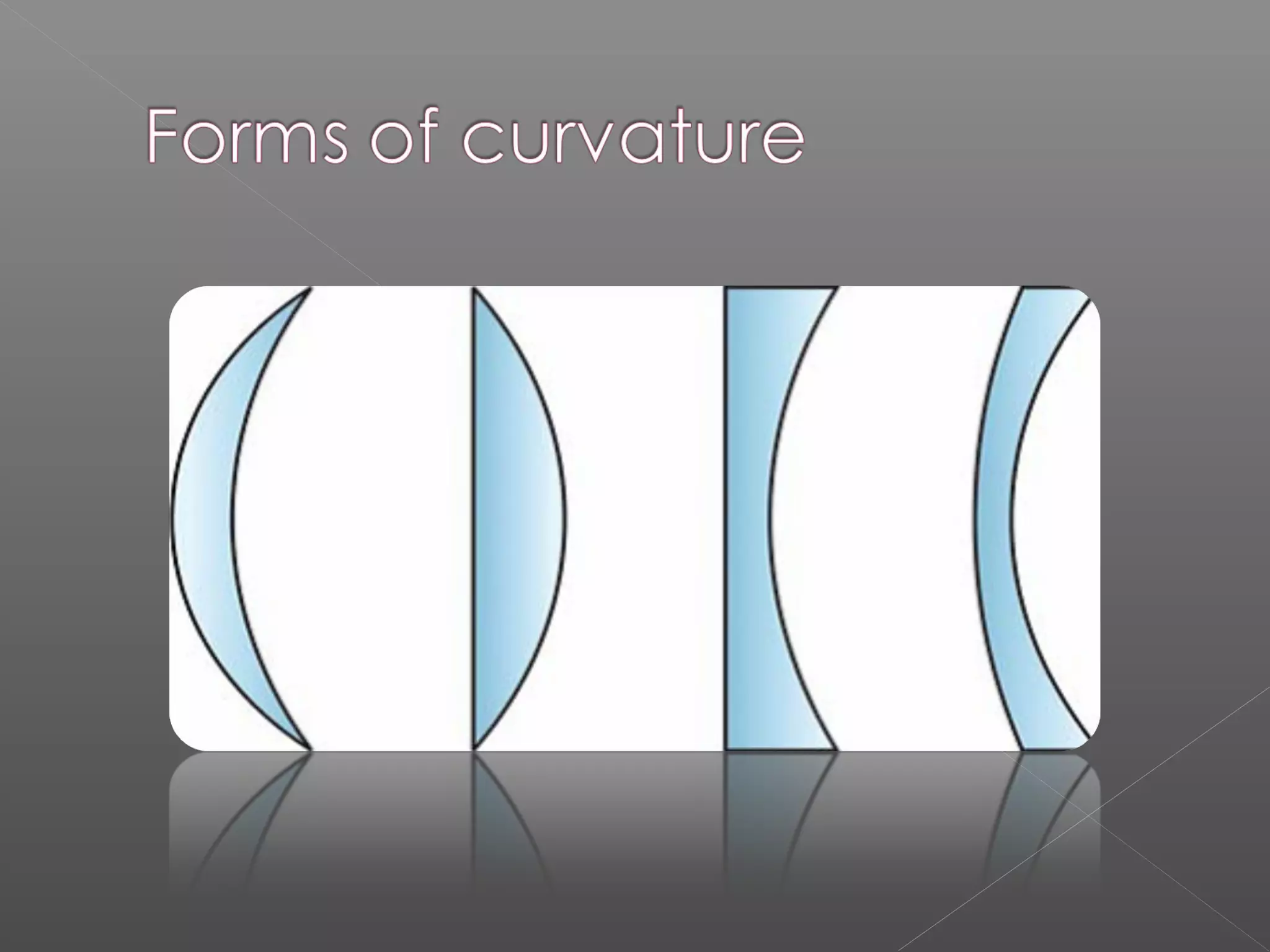
 Most of the optical lenses have curved
surfaces; the surface may be described as
convex, if it bulges out of the material, and
concave if it is depressed into the material.
 The measure of the shape of a curved surface
is known as curvature.
 The curvature of a spherical surface can be
read with a simple instrument called
“spherometer”.
 The common form of spherometer
normally available is the “Optician’s
lens measure”.
 More accurate version of this simple
lens measure is used in surfacing
laboratory and is known as
“Sagometers”.
 Trial lens hand neutralizationTrial lens hand neutralization
 Lensometer / FocimeterLensometer / Focimeter
 Geneva lens measureGeneva lens measure oror Lens clockLens clock
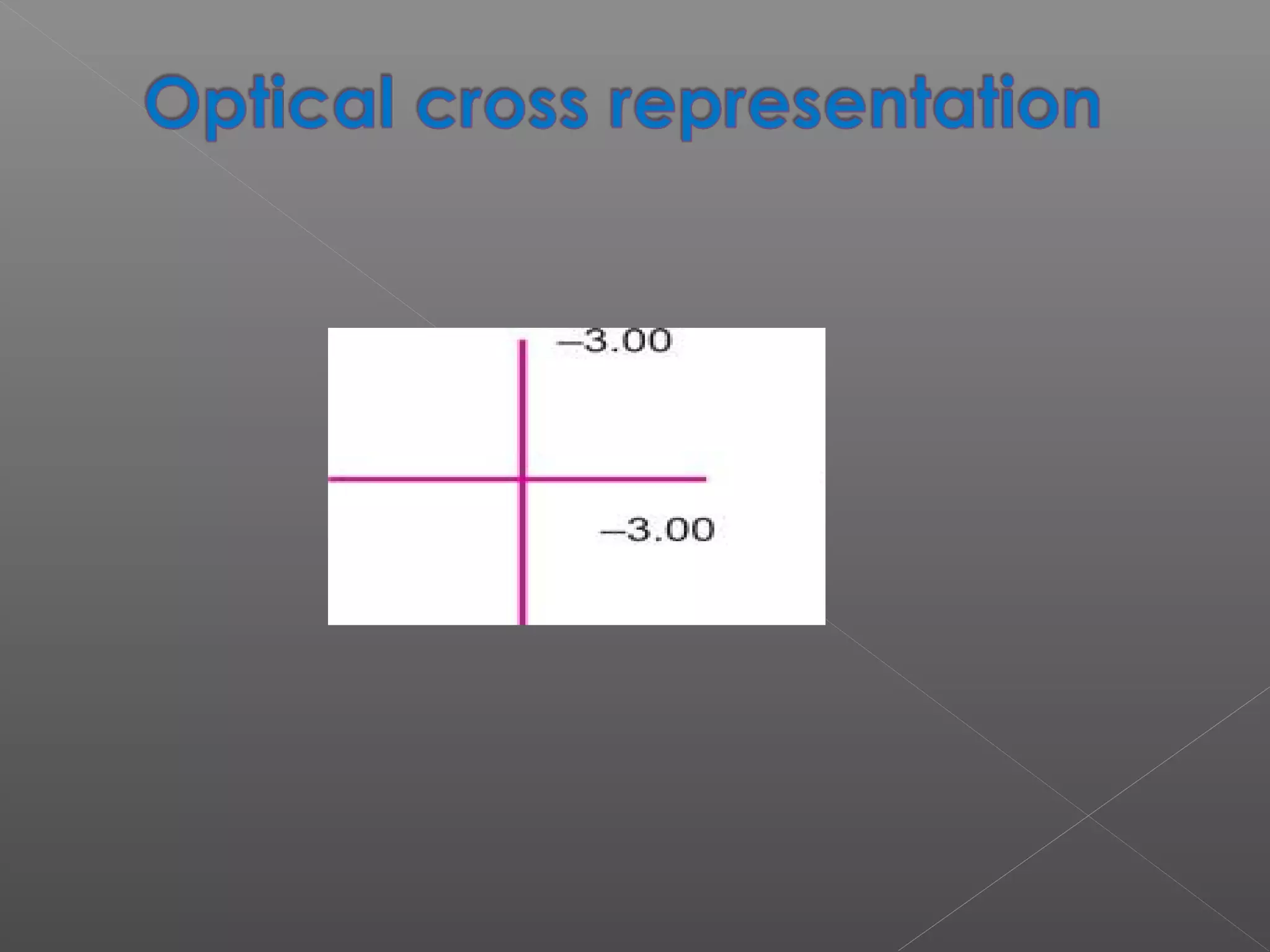
 It is possible to determine the spherical lens by
studying the image formed when two lines crossed at
90º, are viewed through the lens.
 Spherical lens causes no distortion of the cross.
However, when the lens is moved from side to side
and up and down along the axis of the cross, the cross
also appears to move.
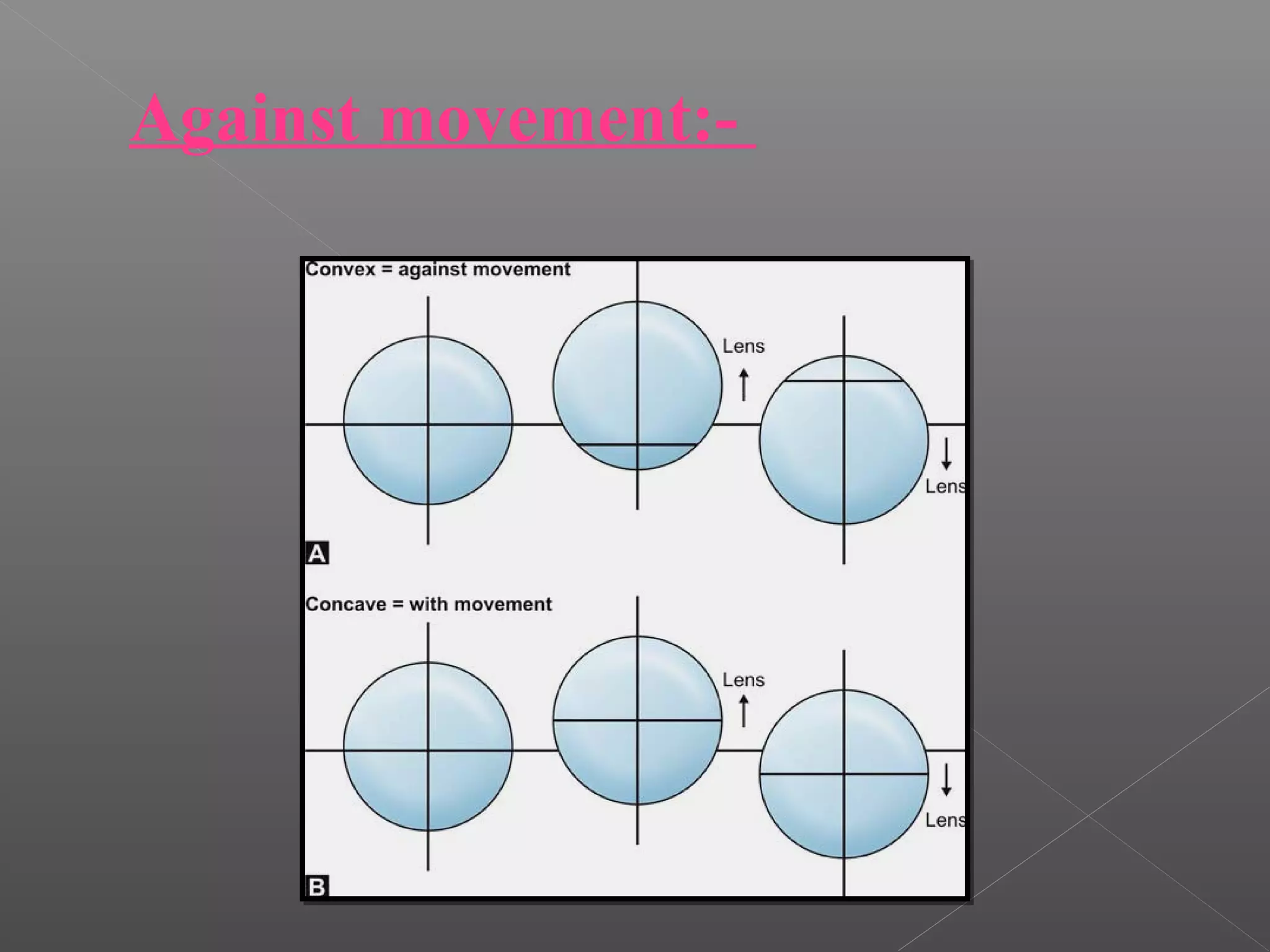
 Against movement:- In the case of a convex
lens, the cross appears to move in the opposite
direction to the lens .
 With movement :- a movement in the same
direction, is observed if the lens is concave.
 Rotation of a spherical lens has no effect upon
the image of the crossed lines.
Against movement:-
With movement
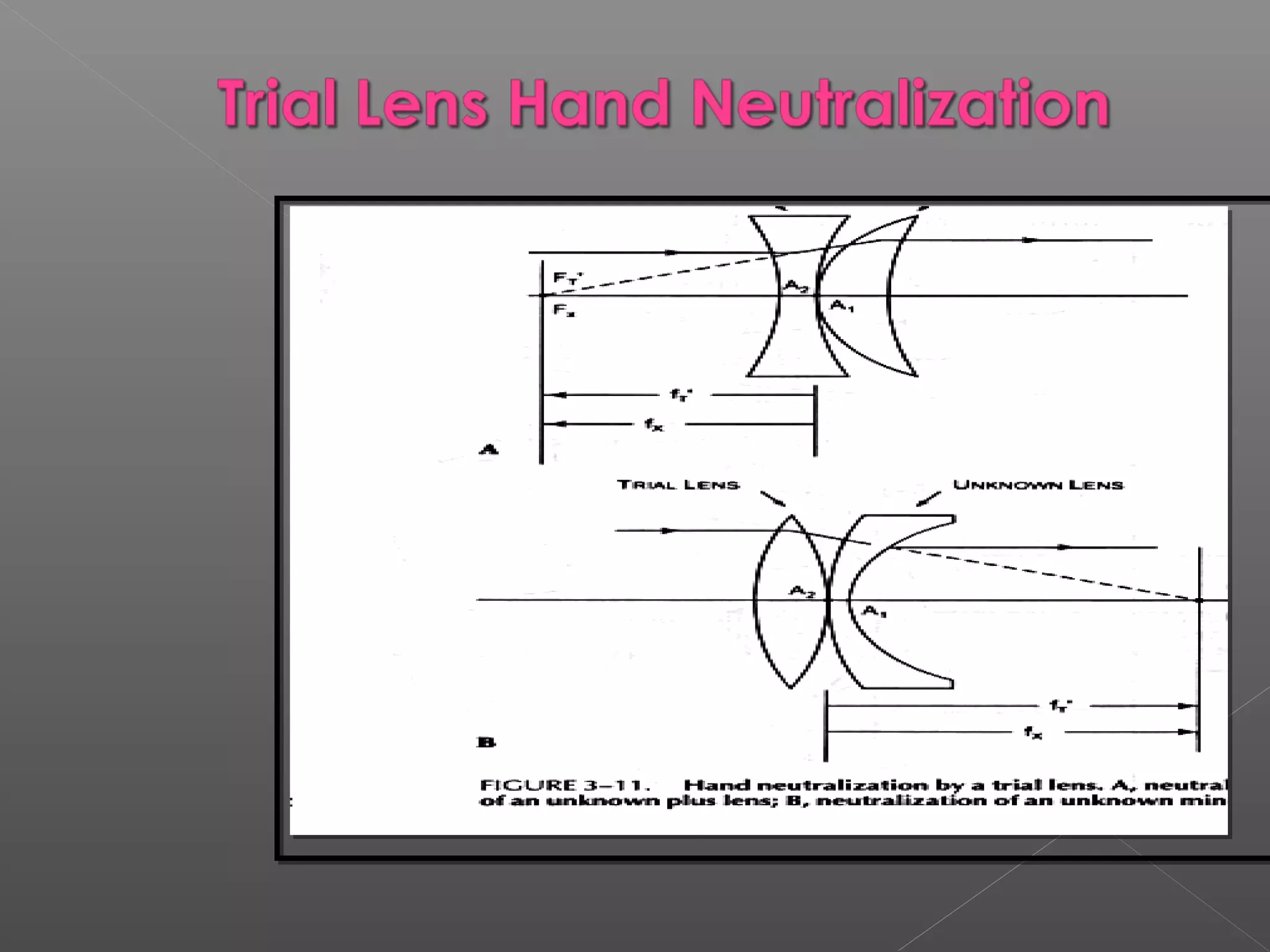
Two lenses neutralize each other when placedTwo lenses neutralize each other when placed
in contact with each other so that the combinedin contact with each other so that the combined
power of the two lenses is equal to zero.power of the two lenses is equal to zero.
An unknown lens is neutralized by a knownAn unknown lens is neutralized by a known
trial lens of equal power but opposite in sign.trial lens of equal power but opposite in sign.
This is performed in the absence of a lensometerThis is performed in the absence of a lensometer
It more accurately estimates low plus and minusIt more accurately estimates low plus and minus
power lenses than toric lenses.power lenses than toric lenses.
It is used to measure theIt is used to measure the front vertex powerfront vertex power ofof
the lensthe lens
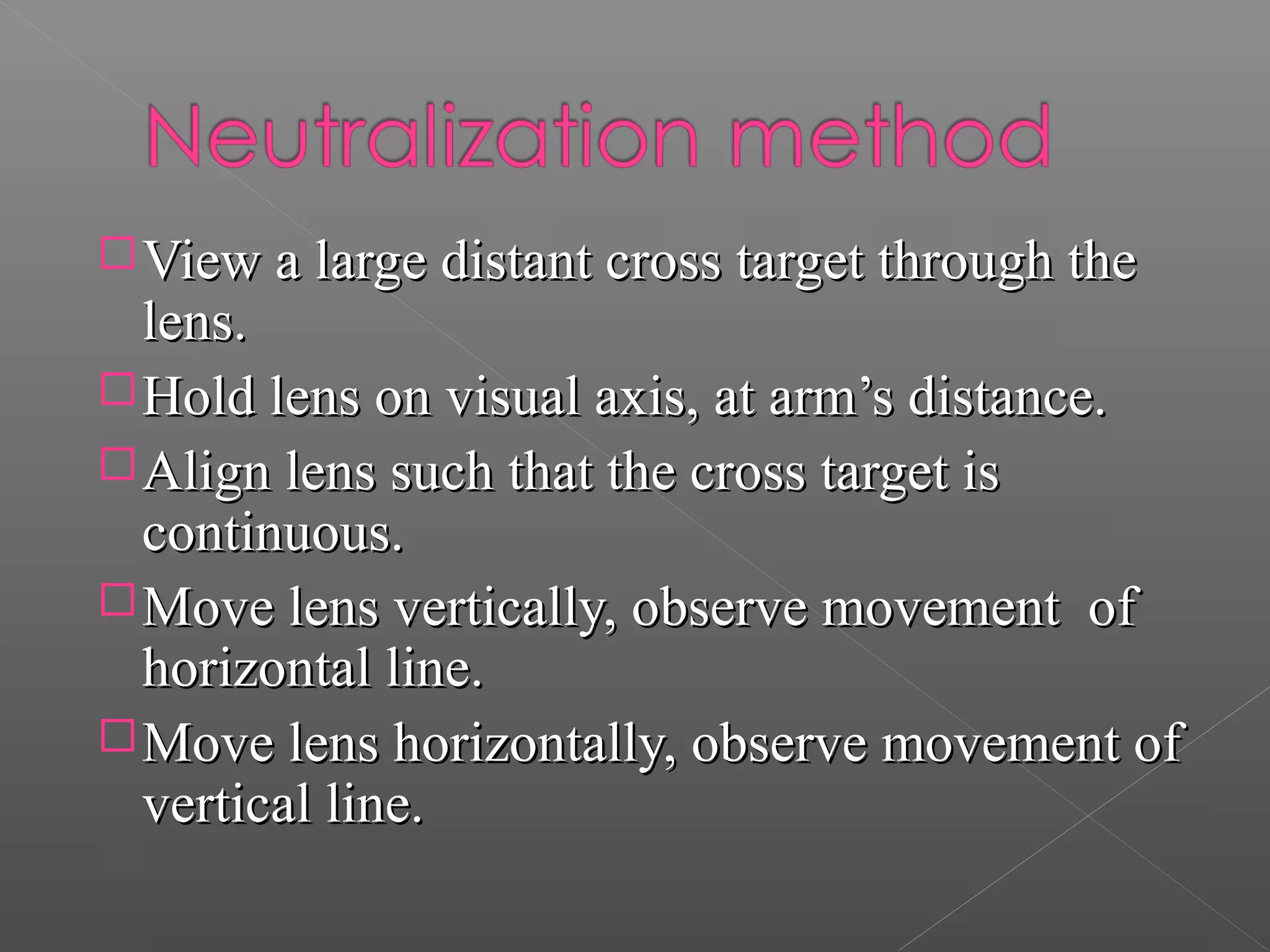
View a large distant cross target through theView a large distant cross target through the
lens.lens.
Hold lens on visual axis, at arm’s distance.Hold lens on visual axis, at arm’s distance.
Align lens such that the cross target isAlign lens such that the cross target is
continuous.continuous.
Move lens vertically, observe movement ofMove lens vertically, observe movement of
horizontal line.horizontal line.
Move lens horizontally, observe movement ofMove lens horizontally, observe movement of
vertical line.vertical line.
For a plus or a minus lens, movement is usedFor a plus or a minus lens, movement is used
to neutralize powerto neutralize power
 If observe “If observe “against movementagainst movement - use- use MINUSMINUS lenslens
 If observeIf observe “with movement“with movement -use-use PlusPlus lenslens
Place known trial lens against front surface ofPlace known trial lens against front surface of
unknown lensunknown lens
No movement indicatesNo movement indicates neutrality.neutrality.
The dioptric power of the unknown lens must
equal that of the trial lens of opposite sign, e.g,
a + 2.00 D lens neutralizes a – 2.00 D.
 To measure this accurately, the neutralizing lens must
be placed in contact with the back surface of the
spectacle lens.
 with highly curved lenses, this is not possible and an
air space intervenes. It is, therefore, better to place the
neutralizing lens against the front surface of the
spectacle lens.
 Neutralization is, thus, somewhat inaccurate
for curved lenses of more than about 2.00D
 Large distant cross targetLarge distant cross target
Plus lensPlus lens
Minus lensMinus lens
 Focimeter is an optical instrument for determining
the vertex power, axis direction and optical center
of an ophthalmic lens.
 It is used to measure theIt is used to measure the back vertex powerback vertex power oror frontfront
vertex powervertex power of the lensof the lens
 The image of the target is seen as a ring of dots
when a spherical lens is tested
 Target as seen in
Focimeter
Lensometer
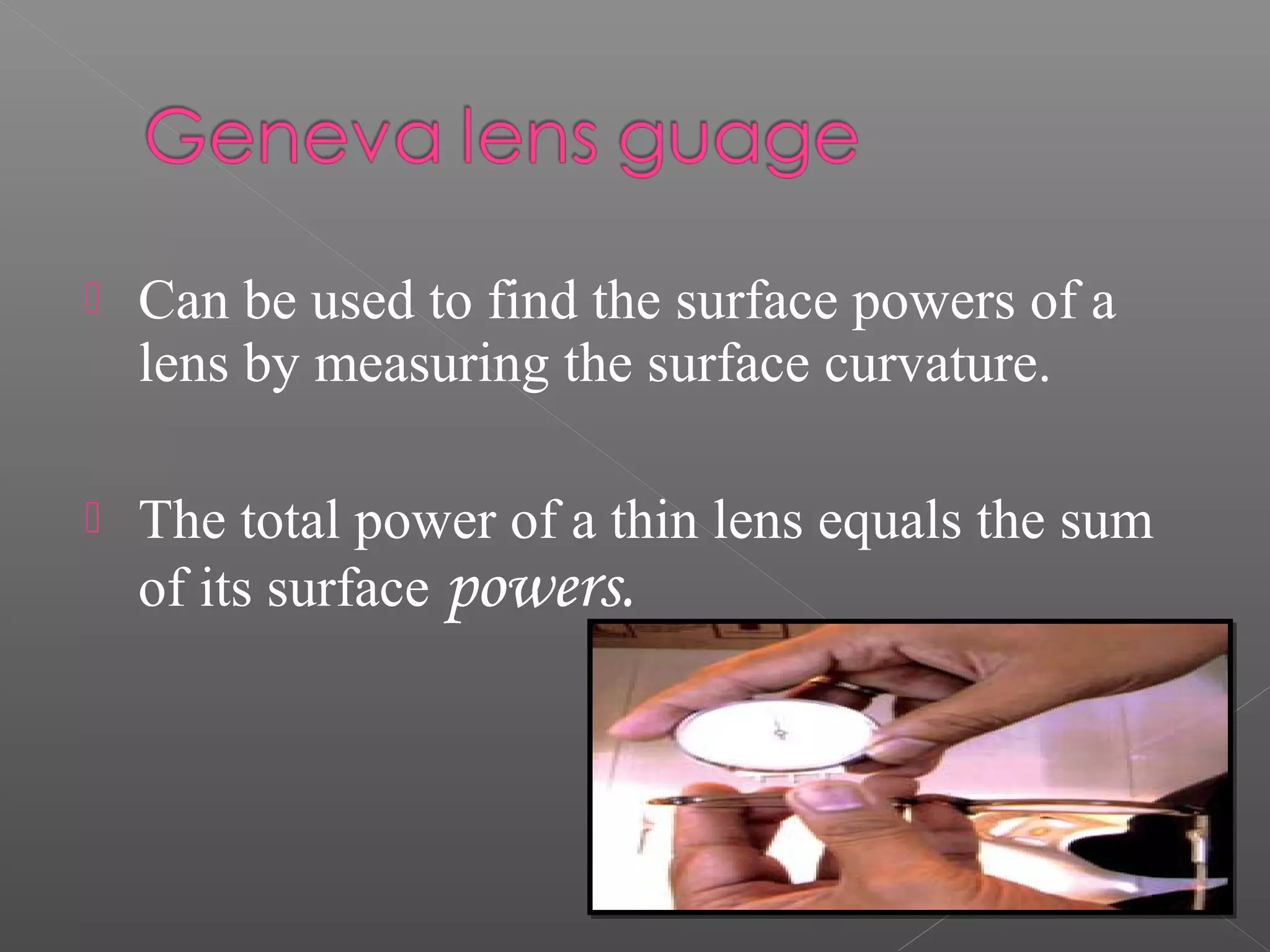
 Can be used to find the surface powers of a
lens by measuring the surface curvature.
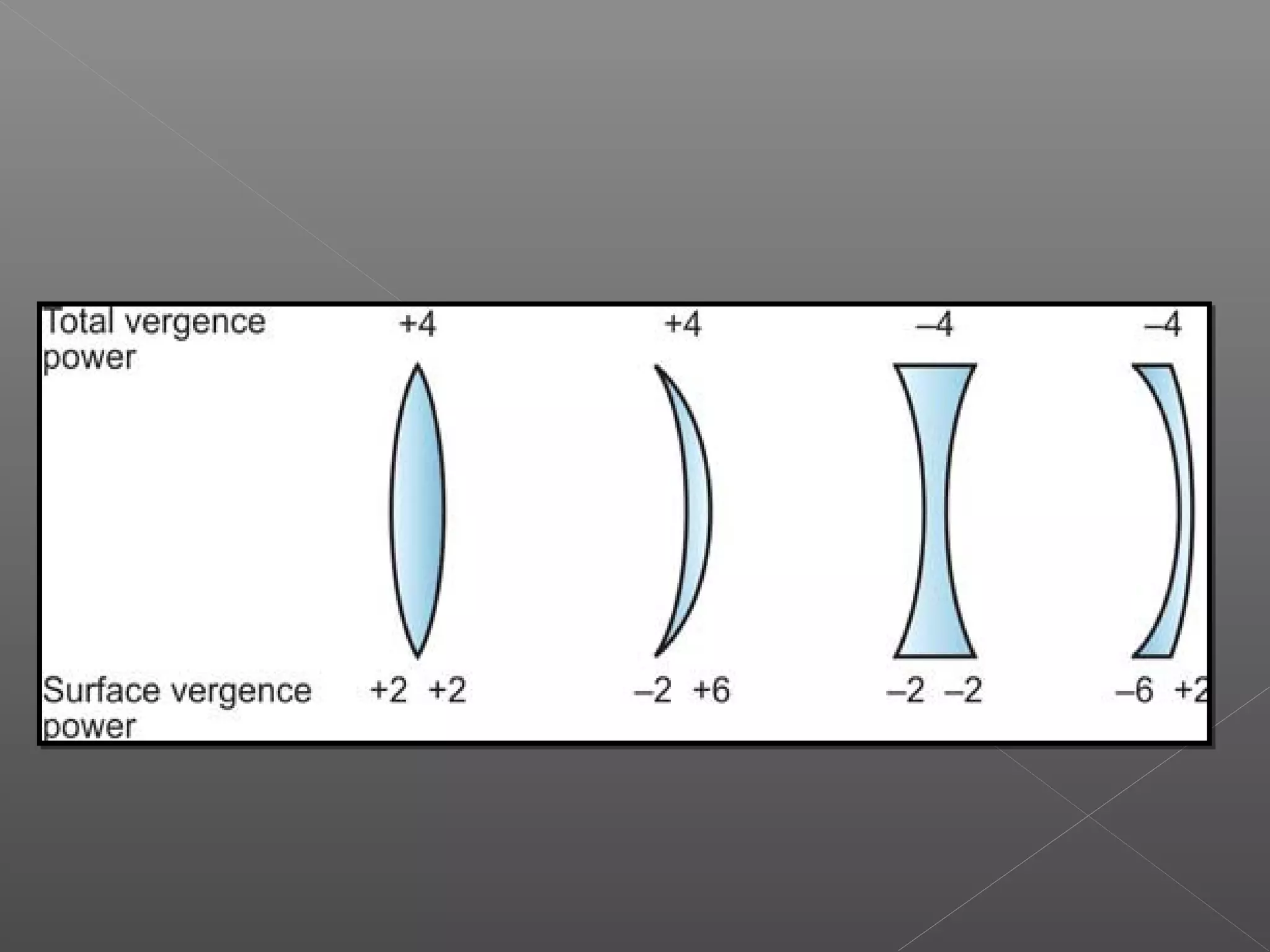
 The total power of a thin lens equals the sum
of its surface powers.
 It is called as Geneva Lens Gauge, Lens
measure or Lens Clock

Spherical lens

  • 2.
     A lensis defined as a portion of a refracting medium bordered by two curved surfaces which have a common axis.  When each surface forms a part of sphere, the lens is called a spherical lens.
  • 3.
  • 4.
     SPHERICAL LENS -CONVEX LENS - CONCAVE LENS  CYLINDRICAL LENS
  • 5.
     CONVEX LENS CONCAVE LENS
  • 8.
     A convexlens causes convergence of incident light, whereas a concave lens causes divergence of incident light.
  • 9.
  • 10.
  • 11.
    Center of curvature(C) The centre of the sphere of which the refracting lens surface is a part. Radius of curvature (r) It is the radius of the sphere of which the refracting surface is a part.
  • 12.
    The principal axis(AB) It is the line joining the centers of curvature of its surfaces. Optical centre (N) of the lens corresponds to the nodal point of a thick lens.
  • 13.
    The principle focus(F) of a lens is that point on the principal axis where parallel rays of light, after passing through the lens ,converge (in convex lens) or appear to diverge (in concave lens) The Focal length of a lens is the distance b/w the optical centre and the principal focus.
  • 14.
    Power of alens (P) The ability of the lens to converge a beam of light falling on the lens. Converging (convex) – positive Diverging (concave) – Negative  Unit is dioptre (D)
  • 15.
    Lenses of shorterfocal length are more powerful than lenses of longer focal length. F = 1/ f2 Where F = Vergence power of lens in dioptres. f2 = Second focal length in metres
  • 17.
    So, in theabove vergence at the lens is: F = 1 / 0.25 = 4.00 D. vergence at the lens is: F = 1/ 0.10 = 10.00 D.
  • 18.
     Vergence isthe term that determines the direction and power of light transmission.  The vergence of light is defined by: V = n/L Where n = refractive index of the material. L = the distance in accordance
  • 19.
     Since thedistance L1 is measured from the wavefront and the light is traveling from left to right, it is a negative distance and the vergence is negative (divergent).  L2 is positive since it is directed to the right from the wavefront (convergent)
  • 21.
     Parallel lightrays are said to have zero vergence.  The unit to measure vergence is “dioptre”. The change in vergence when the light encounters a refracting surface is equal to the power of the surface.
  • 23.
     Most ofthe optical lenses have curved surfaces; the surface may be described as convex, if it bulges out of the material, and concave if it is depressed into the material.  The measure of the shape of a curved surface is known as curvature.
  • 25.
     The curvatureof a spherical surface can be read with a simple instrument called “spherometer”.
  • 26.
     The commonform of spherometer normally available is the “Optician’s lens measure”.  More accurate version of this simple lens measure is used in surfacing laboratory and is known as “Sagometers”.
  • 29.
     Trial lenshand neutralizationTrial lens hand neutralization  Lensometer / FocimeterLensometer / Focimeter  Geneva lens measureGeneva lens measure oror Lens clockLens clock
  • 30.
     It ispossible to determine the spherical lens by studying the image formed when two lines crossed at 90º, are viewed through the lens.  Spherical lens causes no distortion of the cross. However, when the lens is moved from side to side and up and down along the axis of the cross, the cross also appears to move.
  • 31.
     Against movement:-In the case of a convex lens, the cross appears to move in the opposite direction to the lens .  With movement :- a movement in the same direction, is observed if the lens is concave.  Rotation of a spherical lens has no effect upon the image of the crossed lines.
  • 32.
  • 33.
  • 34.
    Two lenses neutralizeeach other when placedTwo lenses neutralize each other when placed in contact with each other so that the combinedin contact with each other so that the combined power of the two lenses is equal to zero.power of the two lenses is equal to zero. An unknown lens is neutralized by a knownAn unknown lens is neutralized by a known trial lens of equal power but opposite in sign.trial lens of equal power but opposite in sign.
  • 36.
    This is performedin the absence of a lensometerThis is performed in the absence of a lensometer It more accurately estimates low plus and minusIt more accurately estimates low plus and minus power lenses than toric lenses.power lenses than toric lenses. It is used to measure theIt is used to measure the front vertex powerfront vertex power ofof the lensthe lens
  • 37.
    View a largedistant cross target through theView a large distant cross target through the lens.lens. Hold lens on visual axis, at arm’s distance.Hold lens on visual axis, at arm’s distance. Align lens such that the cross target isAlign lens such that the cross target is continuous.continuous. Move lens vertically, observe movement ofMove lens vertically, observe movement of horizontal line.horizontal line. Move lens horizontally, observe movement ofMove lens horizontally, observe movement of vertical line.vertical line.
  • 38.
    For a plusor a minus lens, movement is usedFor a plus or a minus lens, movement is used to neutralize powerto neutralize power  If observe “If observe “against movementagainst movement - use- use MINUSMINUS lenslens  If observeIf observe “with movement“with movement -use-use PlusPlus lenslens
  • 39.
    Place known triallens against front surface ofPlace known trial lens against front surface of unknown lensunknown lens No movement indicatesNo movement indicates neutrality.neutrality. The dioptric power of the unknown lens must equal that of the trial lens of opposite sign, e.g, a + 2.00 D lens neutralizes a – 2.00 D.
  • 40.
     To measurethis accurately, the neutralizing lens must be placed in contact with the back surface of the spectacle lens.  with highly curved lenses, this is not possible and an air space intervenes. It is, therefore, better to place the neutralizing lens against the front surface of the spectacle lens.
  • 41.
     Neutralization is,thus, somewhat inaccurate for curved lenses of more than about 2.00D
  • 42.
     Large distantcross targetLarge distant cross target
  • 43.
  • 44.
  • 45.
     Focimeter isan optical instrument for determining the vertex power, axis direction and optical center of an ophthalmic lens.  It is used to measure theIt is used to measure the back vertex powerback vertex power oror frontfront vertex powervertex power of the lensof the lens  The image of the target is seen as a ring of dots when a spherical lens is tested
  • 46.
     Target asseen in Focimeter Lensometer
  • 47.
     Can beused to find the surface powers of a lens by measuring the surface curvature.  The total power of a thin lens equals the sum of its surface powers.
  • 48.
     It iscalled as Geneva Lens Gauge, Lens measure or Lens Clock