Nawat Watanachai
Sakarin Ausayakhun
2010
Visual optics
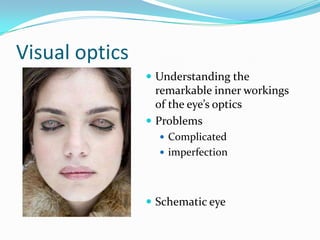
 Understanding the

remarkable inner workings
of the eye’s optics
 Problems
 Complicated
 imperfection

 Schematic eye
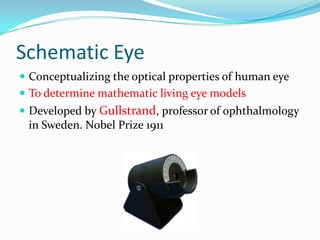
Schematic Eye
 Conceptualizing the optical properties of human eye
 To determine mathematic living eye models
 Developed by Gullstrand, professor of ophthalmology

in Sweden. Nobel Prize 1911
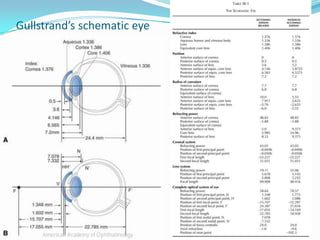
Gullstrand’s schematic eye
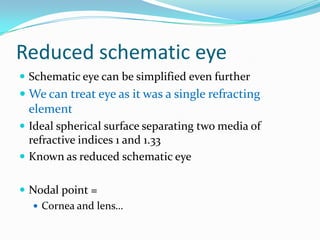
Reduced schematic eye
 Schematic eye can be simplified even further

 We can treat eye as it was a single refracting
element
 Ideal spherical surface separating two media of
refractive indices 1 and 1.33
 Known as reduced schematic eye
 Nodal point =
 Cornea and lens…
Reduced schematic eye
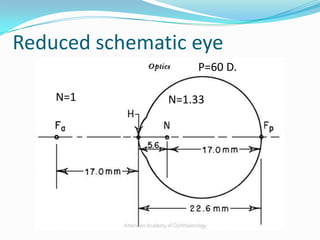
P=60 D.
N=1

N=1.33
Reduced schematic eye
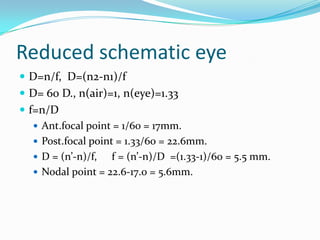
 D=n/f, D=(n2-n1)/f
 D= 60 D., n(air)=1, n(eye)=1.33
 f=n/D
 Ant.focal point = 1/60 = 17mm.
 Post.focal point = 1.33/60 = 22.6mm.
 D = (n’-n)/f,
f = (n’-n)/D =(1.33-1)/60 = 5.5 mm.
 Nodal point = 22.6-17.0 = 5.6mm.
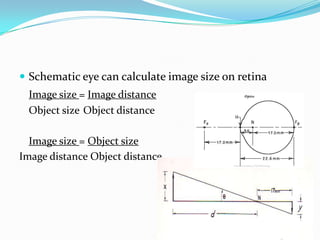
 Schematic eye can calculate image size on retina
Image size = Image distance
Object size Object distance

Image size = Object size
Image distance Object distance
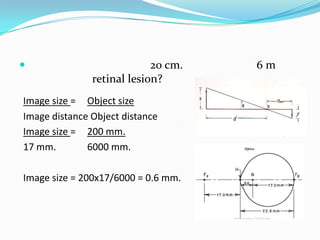
Example


m

20 cm.
retinal image?

6
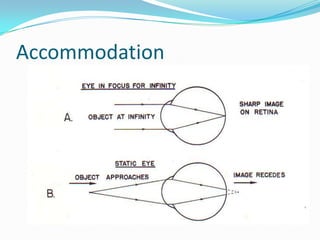


20 cm.
retinal lesion?

Image size = Object size
Image distance Object distance
Image size = 200 mm.
17 mm.
6000 mm.
Image size = 200x17/6000 = 0.6 mm.

6m
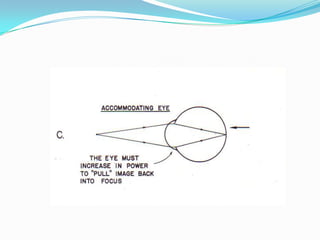
Accommodation
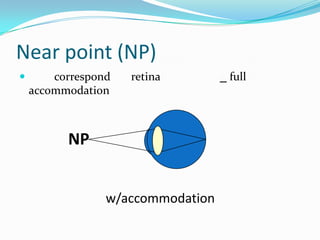
Near point (NP)


correspond
accommodation

retina

NP
w/accommodation

full
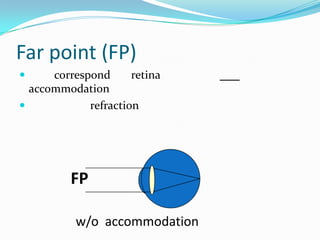
Far point (FP)


correspond
retina
accommodation

refraction

FP
w/o accommodation
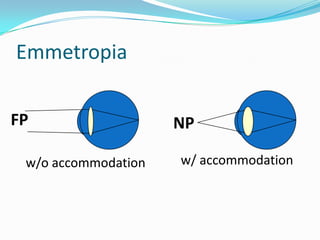
Emmetropia
FP
w/o accommodation

NP
w/ accommodation
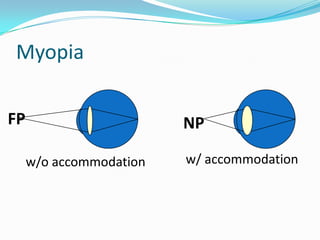
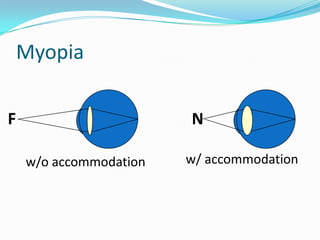
Myopia
FP

NP
w/o accommodation

w/ accommodation
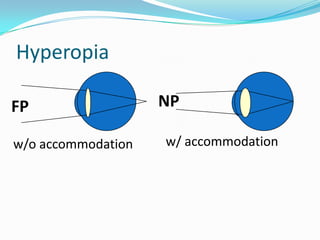
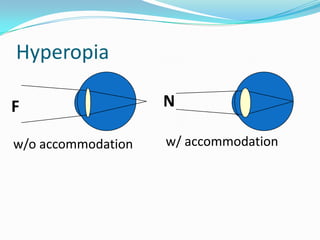
Hyperopia
FP
w/o accommodation

NP
w/ accommodation
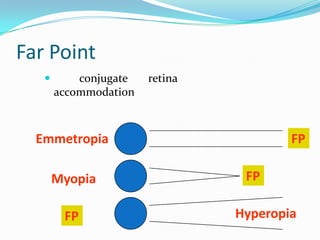
Far Point


conjugate
accommodation

retina

Emmetropia
Myopia
FP

FP
FP
Hyperopia
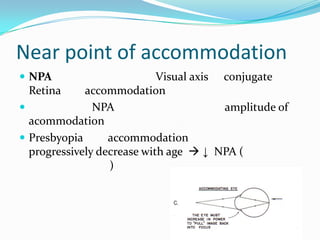
Near point of accommodation
 NPA

Visual axis conjugate
Retina
accommodation

NPA
amplitude of
acommodation
 Presbyopia
accommodation
progressively decrease with age  ↓ NPA (
)
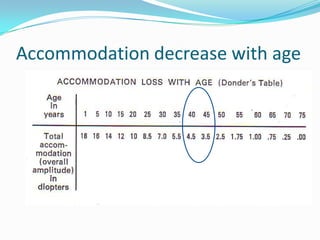
Accommodation decrease with age
Presbyopia
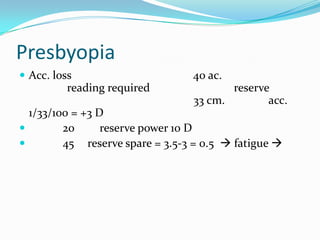
 Acc. loss

reading required

40 ac.

reserve
33 cm.
acc.

1/33/100 = +3 D

20
reserve power 10 D

45 reserve spare = 3.5-3 = 0.5  fatigue 
Accommodative amplitude
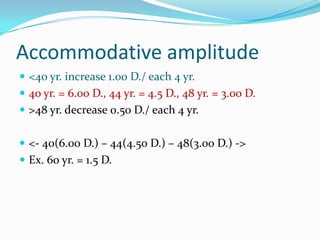
 <40 yr. increase 1.00 D./ each 4 yr.
 40 yr. = 6.00 D., 44 yr. = 4.5 D., 48 yr. = 3.00 D.
 >48 yr. decrease 0.50 D./ each 4 yr.

 <- 40(6.00 D.) – 44(4.50 D.) – 48(3.00 D.) ->
 Ex. 60 yr. = 1.5 D.
Accommodation
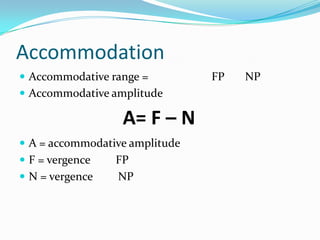
 Accommodative range =
 Accommodative amplitude

A= F – N
 A = accommodative amplitude
 F = vergence
 N = vergence

FP
NP

FP

NP
Example


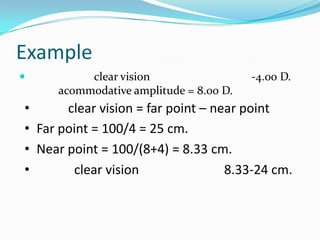
clear vision
acommodative amplitude = 8.00 D.

-4.00 D.

•
clear vision = far point – near point
• Far point = 100/4 = 25 cm.
• Near point = 100/(8+4) = 8.33 cm.
•
clear vision
8.33-24 cm.
Myopia
F

N
w/o accommodation

w/ accommodation
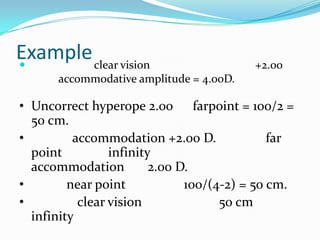
Example clear vision


+2.00

accommodative amplitude = 4.00D.

• Uncorrect hyperope 2.00 farpoint = 100/2 =
50 cm.
•
accommodation +2.00 D.
far
point
infinity
accommodation
2.00 D.
•
near point
100/(4-2) = 50 cm.
•
clear vision
50 cm
infinity
Hyperopia
F

N

w/o accommodation

w/ accommodation
Example
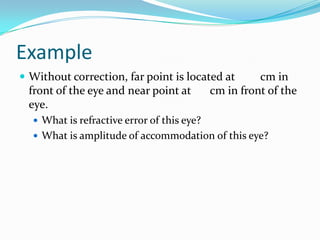
 Without correction, far point is located at

front of the eye and near point at
eye.

cm in
cm in front of the

 What is refractive error of this eye?
 What is amplitude of accommodation of this eye?
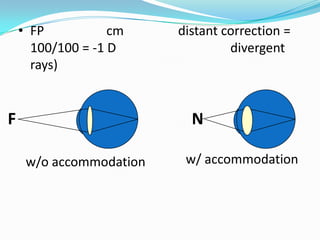
• FP
cm
100/100 = -1 D
rays)

F

distant correction =
divergent

N
w/o accommodation

w/ accommodation


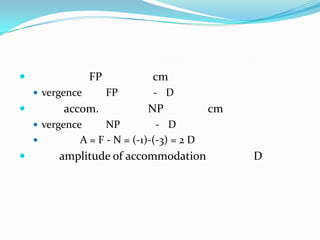
FP
 vergence



accom.

cm
FP

- D

NP

cm

 vergence





NP
- D
A = F - N = (-1)-(-3) = 2 D

amplitude of accommodation

D
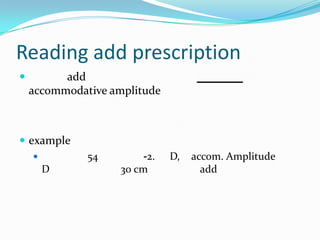
Reading add prescription


add
accommodative amplitude

 example
54



D

-2.
30 cm

D,

accom. Amplitude
add
•
•
•

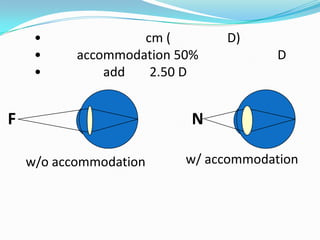
cm (
accommodation 50%
add
2.50 D

F

D)

D

N
w/o accommodation

w/ accommodation
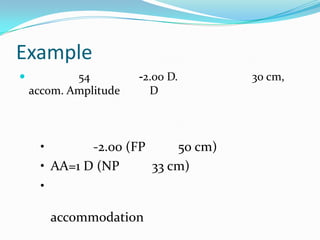
Example


54
accom. Amplitude

-2.00 D.
D

•
-2.00 (FP
50 cm)
• AA=1 D (NP
33 cm)
•

accommodation

30 cm,
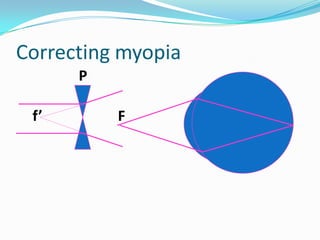
Correcting myopia
P
f’

F
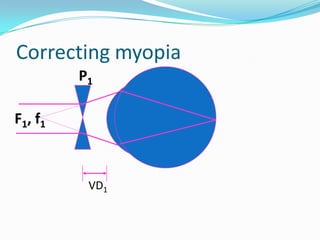
Correcting myopia
P1
F1, f1

VD1
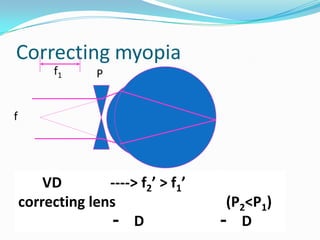
Correcting myopia
f1

P

f

VD
----> f2’ > f1’
correcting lens
- D

(P2<P1)
- D
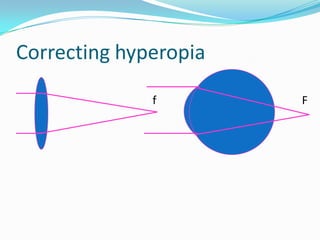
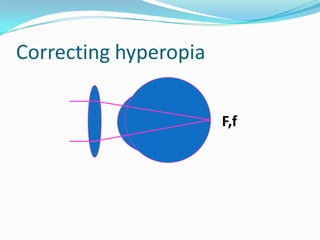
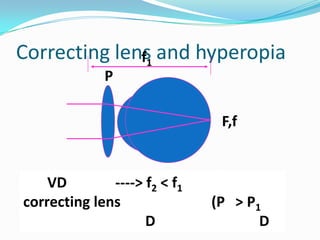
Correcting hyperopia
f

F
Correcting hyperopia
F,f
Correcting lens and hyperopia
f1
P
F,f

VD
----> f2 < f1
correcting lens
D

(P > P1
D
Vertex distance


refractive error

power

refractive error
lens power

VD
significant change
lens
D

VD

contact
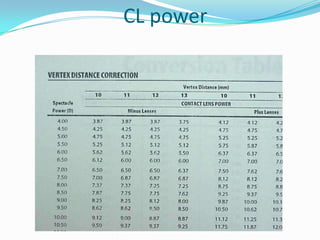
CL power


Aphakic lens +12 D (

VD

15 mm)

prescribe


VD
Dioptric error

10 mm.
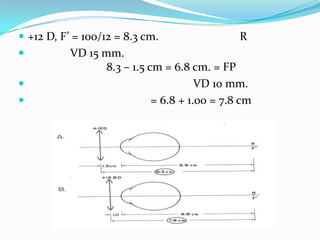
 +12 D, F’ = 100/12 = 8.3 cm.




R

VD 15 mm.
8.3 – 1.5 cm = 6.8 cm. = FP
VD 10 mm.
= 6.8 + 1.00 = 7.8 cm
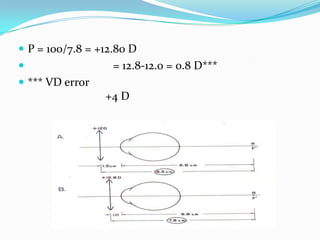
 P = 100/7.8 = +12.80 D


= 12.8-12.0 = 0.8 D***

 *** VD error

+4 D
Example


+

D
mm

mm
power
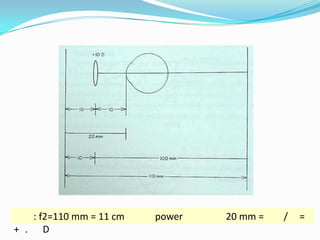
: f2=110 mm = 11 cm
+ . D

power

20 mm =

/

=
Cylinder and Astigmatism
 Astigmatic Expression



Spherocylinder form
Combined cylinder form
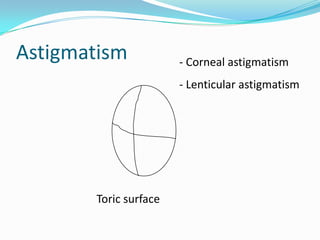
Astigmatism

- Corneal astigmatism
- Lenticular astigmatism

Toric surface
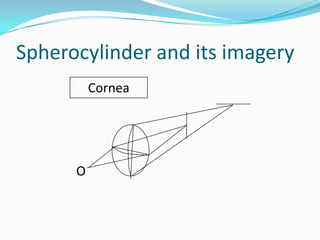
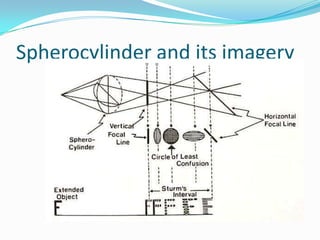
Spherocylinder and its imagery
Cornea

O
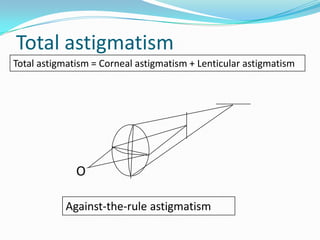
Total astigmatism
Total astigmatism = Corneal astigmatism + Lenticular astigmatism

O
Against-the-rule astigmatism
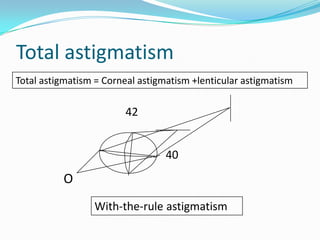
Total astigmatism
Total astigmatism = Corneal astigmatism +lenticular astigmatism

42

40

O
With-the-rule astigmatism
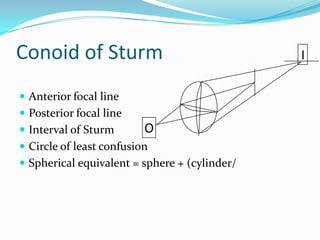
Conoid of Sturm
 Anterior focal line
 Posterior focal line

 Interval of Sturm

O

 Circle of least confusion
 Spherical equivalent = sphere + (cylinder/

I
Spherocylinder and its imagery
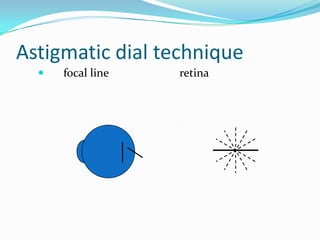
Astigmatic dial technique


focal line

retina
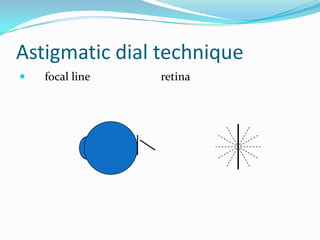
Astigmatic dial technique


focal line

retina
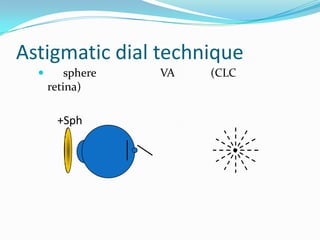
Astigmatic dial technique


sphere
retina)

+Sph

VA

(CLC
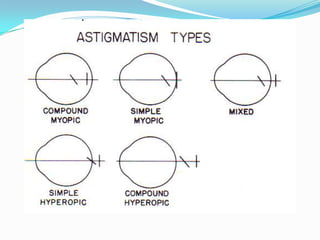
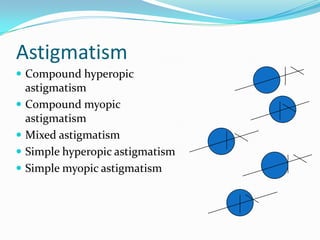
Astigmatism
 Compound hyperopic

astigmatism
 Compound myopic
astigmatism
 Mixed astigmatism
 Simple hyperopic astigmatism
 Simple myopic astigmatism
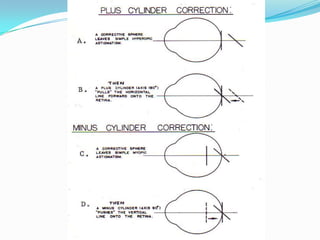
Cylinder
 Plus cylinder
 Minus cylinder
 Power

cylinder

axis
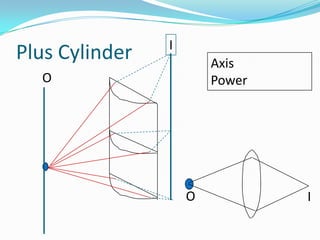
Plus Cylinder

I
Axis
Power

O

O

I
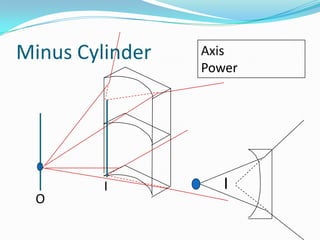
Minus Cylinder

O

I

Axis
Power

I
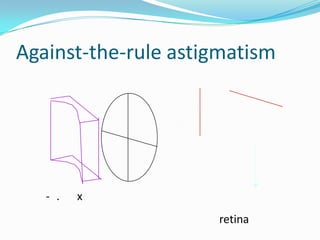
Against-the-rule astigmatism

- .

x
retina
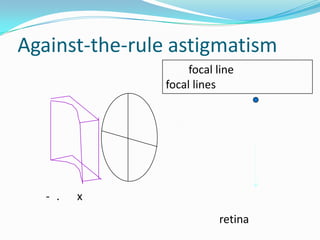
Against-the-rule astigmatism
focal line
focal lines

- .

x
retina
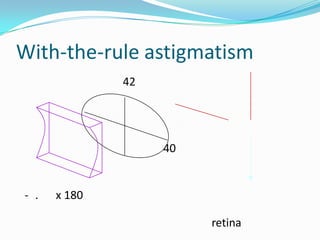
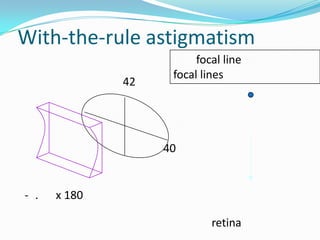
With-the-rule astigmatism
42

40

- .

x 180
retina
With-the-rule astigmatism
42

focal line
focal lines

40

- .

x 180
retina
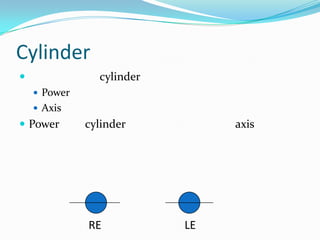
Cylinder


cylinder
 Power
 Axis

 Power

cylinder

RE

axis

LE
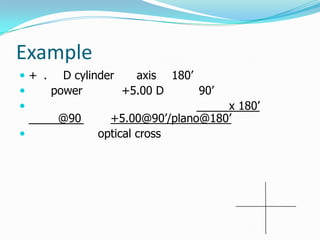
Example
 + . D cylinder
axis 180’

power
+5.00 D
90’


@90



x 180’
+5.00@90’/plano@180’
optical cross
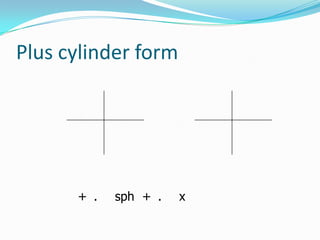
Plus cylinder form

+ .

sph + .

x
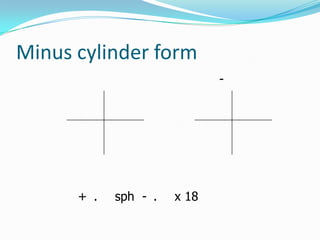
Minus cylinder form
-

+ .

sph - .

x 18
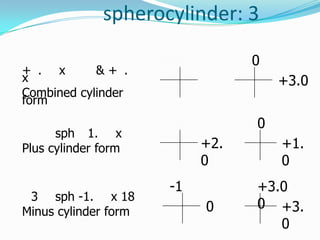
spherocylinder: 3
0

+ . x
&+ .
x
Combined cylinder
form

+3.0

0

sph 1. x
Plus cylinder form

3 sph -1. x 18
Minus cylinder form

+2.
0
-1
0

+1.
0
+3.0
0 +3.
0
Transposition


minus


sphere
sphere

cylinder
cylinder




plus cylinder

axis

new
Example


form


shp + . x
combined cylinder form
spherical equivalent

minus cylinder
.
+ .
x
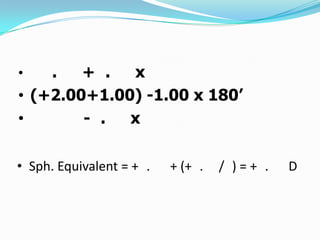
• (+2.00+1.00) -1.00 x 180’
•
- .
x
•

• Sph. Equivalent = + .

+ (+ .

/ )=+ .

D
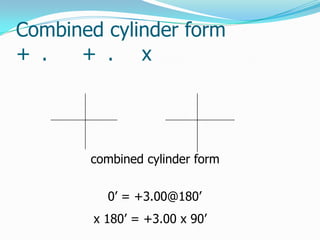
Combined cylinder form
+ .
+ . x

combined cylinder form

0’ = +3.00@180’
x 180’ = +3.00 x 90’
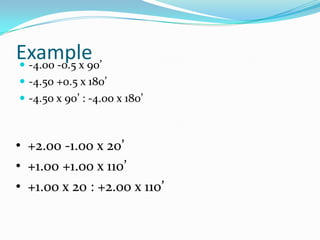
Example
 -4.00 -0.5 x 90’
 -4.50 +0.5 x 180’
 -4.50 x 90’ : -4.00 x 180’

• +2.00 -1.00 x 20’
• +1.00 +1.00 x 110’
• +1.00 x 20 : +2.00 x 110’
The end
 Confusing???

NW2011 Optic of human eye