OPTOM FASLU MUHAMMED
The following standards have been reproduce by kind
permission of the association of optometrists and the
civil aviation authority
MOTORISTS
STATIC VISUAL ACUITY
The standard for the ordinary drivers is
the ability toread in goof light
THE STANDARD OF VISUAL ACUITY APPLICABLE IS
Acuity [with aid of corrective
lenses if necessary] of atleast 6/9 in the better eye or
6/12 in the worse eye or uncorrected acuity of 3/60 in
one eye
VISAL FIELD
Ordinary drivers are required to have a field of vision
atleast 120 degree within the horizontal measure by
the Gold Man perimeter
If any homonymous or bitemporal defects that come
close to fixation, whether hemianopic or
quandrantopic, are accepted as safe for driving.
Isolated scotoma repesented in the binocular field
near to the central fixation point may be inconsistent
with safe driving
DIPLOPIA
Diplopia causes unfitness to drive. Late onset sudden
diplopia due to a minor stroke precludes driving for 1
month. Then if persisting and superable with
prismatic lens masking.
Driving is permitted providing the d the driver gives an
undertaking always to wear the lens or patch when
driving
COLOUR VISION
Impaired colour vision is sometimes a bar to driving.
Methods of testing colour perception is , Ishihara test
VISION UNDER ADVERSE LIGHTING
CONDITIONS
Pts who have cataracts and those having undergone
refractive Sx may be unable to meet the required
conditions of poor light or glare.
A history of inability to see effectively when driving at
night with headlights is due to a night vision defects
such as retinitis pigmentosa or choridoretinitis
precludes in issuing driving license
MONOCULAR DRIVERS
Recent loss of an eye may require a period of driving
for adaptation, but then driving may be resumed
subject to meeting the above standard to meeting the
above standards
DIABETIC RETINOPATHY
Treatment of proliferative diabetic retinopathy by
pan retinal photocoagulation can cause reduced
visual field and jeopardize the right to drive
Optometrists are frequently asked by the pts whether
they are visually fit to drive
Visual acuity can be measured on the basis of snellen
acuity
The other aspect of vision outlined above should be
taken in account
An appropriate should be given on the pt’s record
card.
FRAMES AND LENSES
Care should be taken in frame selection not to
obscure lateral vision
Advise should be given on the limitations of high
power lenses or at nightand of photochromic lenses
when entering road tunnels and roads shaded by trees
from good day light conditions
FOLLOW UP
The AOP recommends that drivers and riders should
have a retest at the most every 3 yrs upto the age of 70
yrs
Any pathological eye disease should ofcourse be
refered for investigation
ROYAL NAVY
for medical standards the navy uses a form of
equivalents as follows
Eye sight and colour perception standards
The standards of visual acuity is
garded below
Visual acuity to be achieved without correcting lenses
Better eye : 6/12 N5
Worse eye : 6/12 N5
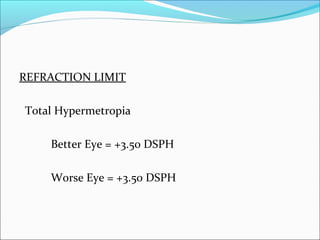
REFRACTION LIMIT
Total Hypermetropia
Better Eye = +3.50 DSPH
Worse Eye = +3.50 DSPH
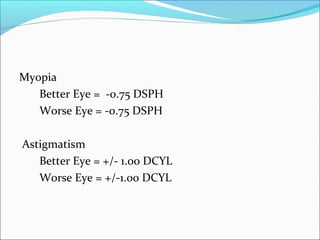
Myopia
Better Eye = -0.75 DSPH
Worse Eye = -0.75 DSPH
Astigmatism
Better Eye = +/- 1.00 DCYL
Worse Eye = +/-1.00 DCYL
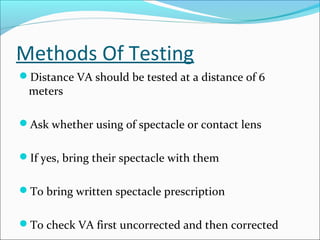
Methods Of Testing
Distance VA should be tested at a distance of 6
meters
Ask whether using of spectacle or contact lens
If yes, bring their spectacle with them
To bring written spectacle prescription
To check VA first uncorrected and then corrected
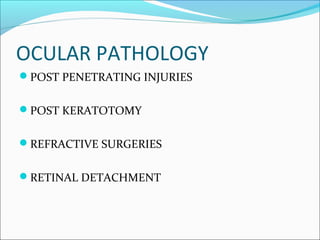
OCULAR PATHOLOGY
POST PENETRATING INJURIES
POST KERATOTOMY
REFRACTIVE SURGERIES
RETINAL DETACHMENT
NEAR VISION TESTING
NEAR VA IS TESTED USING TIMES ROMAN PRINT
ON READING CHARTS APPROVED BY THE
BRITISH FACULTY OF OPHTHALMOLOGISTS
COLOUR PERCEPTION
THE CORRECT RECOGNITION OF 16 PLATES OF
ISHIHARA TEST SHOULD BE GIVEN
ISHIHARA PLATES ARE USED AS A SCREENING
FOR ALL COLOUR PERCEPTION
BINOCULAR EFFICIEBCY
BIFOVEAL FIXATION AND PRFECT BINOCULAR
FUNCTIONS ARE FOR ESSENTIAL REQUIREMENTS
UNLESS SPECIFIED BUT A SQUINT MUST BE
COSMETICALLY ACCEPTABLE
SPECTACLES AND CONTACT
LENS
RESTRICTION ON THE WEARING OF SPECTACLES
OR CONTACT LENS.THOSE WHO HAVE CL
SHOULD WEAR DEFENCE SPECTACLES.
CL MAY WELL PROVIDE ADVANTAGES OVER
SPECATCLES.ENHANCING PERIPHERAL VISION
AND REDUCING REFLECTION AND ABERRATIONS
REFRACTION
HYPERMETROPIA
IN YOUNG PERSON,CONSIDERABLE
HEPERMETROPIA MAY BE PRESENT WITHOUT
ANY APPARENT EFFECT ON EITHER NEAR OR
DISTANT VISION.FOGGING SHOULD BE DONE TO
MEASURE MANIFEST HYPERMETROPIA.
MYOPIA
SHORT SIGHT AFFECTS DISTANCE VA.THE
CANDIDATES SHOULD BE ASKED TO PROVIDE A
SPECTACLE PRESCRIPTION,WHICH WILL SHOW
THE DEGREE OF MYOPIA PRESENT.
OTHER ABNORMALITIES OF THE EYES
OR VISUAL SYSTEM
ANY ABNORMALITIES OF THE EYE OR VISUAL
SYSTEM MAY BE CAUSE FOR REJECTION
EVENTHOUGH VISUAL FUNCTIONS WITHIN THE
STANDARDS LIIMITS.

Vision standards for various occupation

  • 1.
  • 2.
    The following standardshave been reproduce by kind permission of the association of optometrists and the civil aviation authority
  • 3.
    MOTORISTS STATIC VISUAL ACUITY Thestandard for the ordinary drivers is the ability toread in goof light
  • 4.
    THE STANDARD OFVISUAL ACUITY APPLICABLE IS Acuity [with aid of corrective lenses if necessary] of atleast 6/9 in the better eye or 6/12 in the worse eye or uncorrected acuity of 3/60 in one eye
  • 5.
    VISAL FIELD Ordinary driversare required to have a field of vision atleast 120 degree within the horizontal measure by the Gold Man perimeter
  • 6.
    If any homonymousor bitemporal defects that come close to fixation, whether hemianopic or quandrantopic, are accepted as safe for driving. Isolated scotoma repesented in the binocular field near to the central fixation point may be inconsistent with safe driving
  • 7.
    DIPLOPIA Diplopia causes unfitnessto drive. Late onset sudden diplopia due to a minor stroke precludes driving for 1 month. Then if persisting and superable with prismatic lens masking.
  • 8.
    Driving is permittedproviding the d the driver gives an undertaking always to wear the lens or patch when driving
  • 9.
    COLOUR VISION Impaired colourvision is sometimes a bar to driving. Methods of testing colour perception is , Ishihara test
  • 10.
    VISION UNDER ADVERSELIGHTING CONDITIONS Pts who have cataracts and those having undergone refractive Sx may be unable to meet the required conditions of poor light or glare.
  • 11.
    A history ofinability to see effectively when driving at night with headlights is due to a night vision defects such as retinitis pigmentosa or choridoretinitis precludes in issuing driving license
  • 12.
    MONOCULAR DRIVERS Recent lossof an eye may require a period of driving for adaptation, but then driving may be resumed subject to meeting the above standard to meeting the above standards
  • 13.
    DIABETIC RETINOPATHY Treatment ofproliferative diabetic retinopathy by pan retinal photocoagulation can cause reduced visual field and jeopardize the right to drive
  • 14.
    Optometrists are frequentlyasked by the pts whether they are visually fit to drive Visual acuity can be measured on the basis of snellen acuity The other aspect of vision outlined above should be taken in account An appropriate should be given on the pt’s record card.
  • 15.
    FRAMES AND LENSES Careshould be taken in frame selection not to obscure lateral vision Advise should be given on the limitations of high power lenses or at nightand of photochromic lenses when entering road tunnels and roads shaded by trees from good day light conditions
  • 16.
    FOLLOW UP The AOPrecommends that drivers and riders should have a retest at the most every 3 yrs upto the age of 70 yrs Any pathological eye disease should ofcourse be refered for investigation
  • 17.
    ROYAL NAVY for medicalstandards the navy uses a form of equivalents as follows
  • 18.
    Eye sight andcolour perception standards The standards of visual acuity is garded below Visual acuity to be achieved without correcting lenses Better eye : 6/12 N5 Worse eye : 6/12 N5
  • 19.
    REFRACTION LIMIT Total Hypermetropia BetterEye = +3.50 DSPH Worse Eye = +3.50 DSPH
  • 20.
    Myopia Better Eye =-0.75 DSPH Worse Eye = -0.75 DSPH Astigmatism Better Eye = +/- 1.00 DCYL Worse Eye = +/-1.00 DCYL
  • 21.
    Methods Of Testing DistanceVA should be tested at a distance of 6 meters Ask whether using of spectacle or contact lens If yes, bring their spectacle with them To bring written spectacle prescription To check VA first uncorrected and then corrected
  • 22.
    OCULAR PATHOLOGY POST PENETRATINGINJURIES POST KERATOTOMY REFRACTIVE SURGERIES RETINAL DETACHMENT
  • 23.
    NEAR VISION TESTING NEARVA IS TESTED USING TIMES ROMAN PRINT ON READING CHARTS APPROVED BY THE BRITISH FACULTY OF OPHTHALMOLOGISTS
  • 24.
    COLOUR PERCEPTION THE CORRECTRECOGNITION OF 16 PLATES OF ISHIHARA TEST SHOULD BE GIVEN ISHIHARA PLATES ARE USED AS A SCREENING FOR ALL COLOUR PERCEPTION
  • 25.
    BINOCULAR EFFICIEBCY BIFOVEAL FIXATIONAND PRFECT BINOCULAR FUNCTIONS ARE FOR ESSENTIAL REQUIREMENTS UNLESS SPECIFIED BUT A SQUINT MUST BE COSMETICALLY ACCEPTABLE
  • 26.
    SPECTACLES AND CONTACT LENS RESTRICTIONON THE WEARING OF SPECTACLES OR CONTACT LENS.THOSE WHO HAVE CL SHOULD WEAR DEFENCE SPECTACLES. CL MAY WELL PROVIDE ADVANTAGES OVER SPECATCLES.ENHANCING PERIPHERAL VISION AND REDUCING REFLECTION AND ABERRATIONS
  • 27.
    REFRACTION HYPERMETROPIA IN YOUNG PERSON,CONSIDERABLE HEPERMETROPIAMAY BE PRESENT WITHOUT ANY APPARENT EFFECT ON EITHER NEAR OR DISTANT VISION.FOGGING SHOULD BE DONE TO MEASURE MANIFEST HYPERMETROPIA.
  • 28.
    MYOPIA SHORT SIGHT AFFECTSDISTANCE VA.THE CANDIDATES SHOULD BE ASKED TO PROVIDE A SPECTACLE PRESCRIPTION,WHICH WILL SHOW THE DEGREE OF MYOPIA PRESENT.
  • 29.
    OTHER ABNORMALITIES OFTHE EYES OR VISUAL SYSTEM ANY ABNORMALITIES OF THE EYE OR VISUAL SYSTEM MAY BE CAUSE FOR REJECTION EVENTHOUGH VISUAL FUNCTIONS WITHIN THE STANDARDS LIIMITS.