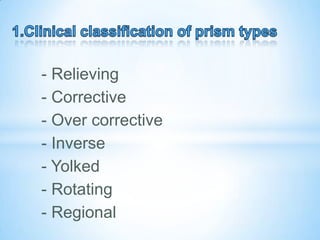
- Relieving
- Corrective
- Over corrective
- Inverse
- Yolked
- Rotating
- Regional
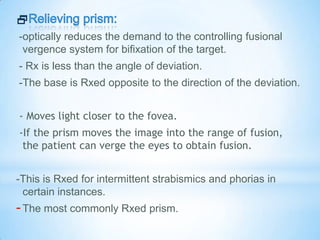
-optically reduces the demand to the controlling fusional
 vergence system for bifixation of the target.
- Rx is less than the angle of deviation.
-The base is Rxed opposite to the direction of the deviation.


- Moves light closer to the fovea.
-If the prism moves the image into the range of fusion,
 the patient can verge the eyes to obtain fusion.


-This is Rxed for intermittent strabismics and phorias in
 certain instances.
- The most commonly Rxed prism.
-Optically eliminates the oculomotor deviation.
- Rx prism equal to the magnitude of the
  objective angle.
- The residual vergence demand is zero.
- Rx the base opposite to the direction of the
  deviation.
- In certain cases, sensory fusion can occur
  without the need for any fusional vergence if
  there's no ARC or deep suppression.
- don't give patients with ARC or deep
  suppression corrective prism.


    -optically changes the direction of the deviation.
    -the power of the prism is greater than the
      magnitude of the deviation.
    - Example :        20 ∆ XT  give 25 – 30 ∆ BI
    -In such a position on a cover test ,you see the
      deviation reverse in terms of direction.
    This kind of like when you get reversal on ACT.
    An eso becomes an optical exo.
    -Used on certain instances to disrupt ARC through a
      specific technique.

-You put the base in the same direction as the deviation and
 optically increase the demand to the controlling vergence
 system.
Eso  give BI
Exo  give BO


-only used for a phoria patient in the later stages of strab VT.
Ex) Give BO to an exophoria to increase the convergence demand for
  bifixation.
-the patient has to use vergence to control his deviation and also to meet
  the demand of the prism.
-a passive technique.
-commonly used for VT (ex: read through prism).
-some people Rx in glasses~ less common

-to eliminate EF and ARC
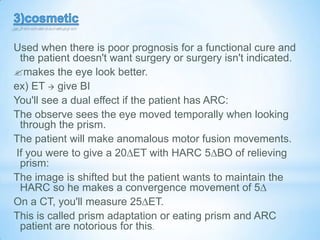
Used when there is poor prognosis for a functional cure and
 the patient doesn't want surgery or surgery isn't indicated.
makes the eye look better.
ex) ET  give BI
You'll see a dual effect if the patient has ARC:
The observe sees the eye moved temporally when looking
 through the prism.
The patient will make anomalous motor fusion movements.
If you were to give a 20∆ET with HARC 5∆BO of relieving
 prism:
The image is shifted but the patient wants to maintain the
 HARC so he makes a convergence movement of 5∆
On a CT, you'll measure 25∆ET.
This is called prism adaptation or eating prism and ARC
 patient are notorious for this.
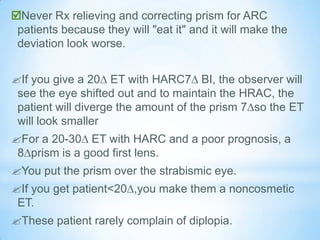
Never Rx relieving and correcting prism for ARC
 patients because they will "eat it" and it will make the
 deviation look worse.


If you give a 20∆ ET with HARC7∆ BI, the observer will
 see the eye shifted out and to maintain the HRAC, the
 patient will diverge the amount of the prism 7∆so the ET
 will look smaller
For a 20-30∆ ET with HARC and a poor prognosis, a
 8∆prism is a good first lens.
You put the prism over the strabismic eye.
If you get patient<20∆,you make them a noncosmetic
 ET.
These patient rarely complain of diplopia.

-Optically moves the retinal images of a fixed target
 in a parallel direction toward the base and moves
 the light toward the base and shows the target
 toward the apex.
-Both of the eyes move in the same direction.


Example ) BASE RIGHT prism ( BO OD & BI OS )
          BASE LEFT prism ( BI OD & BO OS )
          BASE DOWN prism ( OU )
more : in low vision
-Give prism so you shift the patient's world over so that they're
 never looking where they're missing vision.


Ex) A little girl with a Duane's Syndrome OS (13y.o.)
-abduction deficit
-she presented with a small head turn
-If you straighten her head or she looks into L gaze, she sees
  double.
We could have given her base L prism if she would have had a
 significant head turn.
The prism would shift the world over to the R and move the
 eyes from L gaze so she won't have to turn her head
 To move the eyes into the null position.

Null position = position where the frequency and
 magnitude of the nystagmus is dampened or
 eliminated.

when you Rx prism with non concomitant
 deviations to get fusion ,you put all or most of
 the prism in front of the paretic eye.

Typically we just split prism equally between the two
 eyes for cosmetic purposes.
Ex) 10 ∆ Right ET & has a RLR paresis
when the prism is before the OS, the light is bent toward the
 base and the image is projected toward the apex. Initially, the
 first movement is going to be a version inward by the left eye.
BY Herring's Low , the right eye will move outward and then
 there will be a fusional vergence movement.


since you are forcing the OD to move into the field of gaze of
 the eye to move.


If you were to put the prism over the paretic eye, you would
 get a version and then a vergence .the version would be
 away from the DAF of the paretic muscle so you would need
 less prism. Less prism means less distortion, etc.


    A method to change the sensory input for
     constant strab to precipitate a change from
     ARC to NRC.

    Take a Fresnel prism and cut it round. For one
     week ,the patient wears it BO and then you
     rotate it to BU, then BI, then BD.
    Take prism and change the base.

       - to break down ARC.
       -This is a disruptive prism technique.

   Different amounts of prism are needed in
     different fields of gaze or for different
                    distances.


ex) 20∆ET at distance and 10∆ET at near
    Only put the prism on a portion of the lens.
ex)only need prism in R gaze.

Think what type of Prism you are going to give the patient.
  If the patient doesn't have normal sensory fusion or has
 ARC or suppression ,don't Rx relieving prism or corrective
 prism right away.
Prism to break down ARC or suppression:
    Over corrective
    Inverse (disruptive)
    Rotating
Regional Prism describes where you are mounting the
 Prism.
     you can Rx corrective regional relieving Prism.
     you aren't putting Prism over the entire lens.
These are only guidelines.

1) BO useful for distance ET with NRC
     don't give convergence excess patients BO,
an add works Better
   BI  more useful for XT than with exophoria because exophoria
 are so easy to train.

2) Rx Relieving prism when normal sensory fusion is present (NRC &
  no suppression) and normal binocularity can be sustained

3) Do not Rx Relieving prism if ARC is present (except when using
 inverse prism cosmetically).
4) Do not Rx vertical relieving prism for secondary vertical
 deviations or DVD's.


Primary  it's the deviation and is present all the time. The
 vertical deviation is still present when you eliminate the
 horizontal deviation.


Secondary  the vertical deviation is not present when the
 horizontal deviation is gone.


Many people with intermittent diplopia can relate to this
 because when they are diplopic, the 2 images are separated
 horizontally with a little bit of vertical misalignment.
ex) when the eye moves out 25∆, it's in the DAF or vertically
 acting muscles ( SR & IR ). If the actions of the SR & IR
 aren't exactly symmetrical, there will be a vertical
 deviation.

On a secondary vertical deviation, when the eyes are
 straight , the patient will never show a vertical deviation on
 any test (Phoria, Torrington, Disparometer)

5) Rx neutralizing (corrective) prism in the initial Rx when
 there's NRC and shallow suppression / amblyopia.

6) Nonconcomitant deviations: put all or most of the prism in
  front of the paretic eye if you are Rxing for fusion.
.
7) Whenever you Rx prism, watch for prism adaptation even if
 you think your patient has NRC and shallow or no
 suppression. You
don't want the deviation to get larger


8) Consider cosmetic
1-30∆each eye (available in 1-10∆,12∆,15∆,20∆,25∆,30∆)
 Quick
 Less expensive($10-12/ prism vs . replacing an entire lens
with ground in prism). Good if you need to replace and
change the prism.
 Can rotate
   You can rotate it a pinch to neutralize a little bit of
vertical.
 Decreases VA and contrast sensitivity
   The more prism ,the more blur.
 You can give it right away to alleviate symptoms.
Limit 8-10∆ each eye, maybe 12∆
Prism.ppt

Prism.ppt

  • 2.
    - Relieving - Corrective -Over corrective - Inverse - Yolked - Rotating - Regional
  • 3.
    -optically reduces thedemand to the controlling fusional vergence system for bifixation of the target. - Rx is less than the angle of deviation. -The base is Rxed opposite to the direction of the deviation. - Moves light closer to the fovea. -If the prism moves the image into the range of fusion, the patient can verge the eyes to obtain fusion. -This is Rxed for intermittent strabismics and phorias in certain instances. - The most commonly Rxed prism.
  • 4.
    -Optically eliminates theoculomotor deviation. - Rx prism equal to the magnitude of the objective angle. - The residual vergence demand is zero. - Rx the base opposite to the direction of the deviation. - In certain cases, sensory fusion can occur without the need for any fusional vergence if there's no ARC or deep suppression. - don't give patients with ARC or deep suppression corrective prism.
  • 5.
    -optically changes the direction of the deviation. -the power of the prism is greater than the magnitude of the deviation. - Example : 20 ∆ XT  give 25 – 30 ∆ BI -In such a position on a cover test ,you see the deviation reverse in terms of direction. This kind of like when you get reversal on ACT. An eso becomes an optical exo. -Used on certain instances to disrupt ARC through a specific technique.
  • 6.
     -You put thebase in the same direction as the deviation and optically increase the demand to the controlling vergence system. Eso  give BI Exo  give BO -only used for a phoria patient in the later stages of strab VT. Ex) Give BO to an exophoria to increase the convergence demand for bifixation. -the patient has to use vergence to control his deviation and also to meet the demand of the prism. -a passive technique. -commonly used for VT (ex: read through prism). -some people Rx in glasses~ less common -to eliminate EF and ARC
  • 7.
    Used when thereis poor prognosis for a functional cure and the patient doesn't want surgery or surgery isn't indicated. makes the eye look better. ex) ET  give BI You'll see a dual effect if the patient has ARC: The observe sees the eye moved temporally when looking through the prism. The patient will make anomalous motor fusion movements. If you were to give a 20∆ET with HARC 5∆BO of relieving prism: The image is shifted but the patient wants to maintain the HARC so he makes a convergence movement of 5∆ On a CT, you'll measure 25∆ET. This is called prism adaptation or eating prism and ARC patient are notorious for this.
  • 8.
    Never Rx relievingand correcting prism for ARC patients because they will "eat it" and it will make the deviation look worse. If you give a 20∆ ET with HARC7∆ BI, the observer will see the eye shifted out and to maintain the HRAC, the patient will diverge the amount of the prism 7∆so the ET will look smaller For a 20-30∆ ET with HARC and a poor prognosis, a 8∆prism is a good first lens. You put the prism over the strabismic eye. If you get patient<20∆,you make them a noncosmetic ET. These patient rarely complain of diplopia.
  • 9.
     -Optically moves theretinal images of a fixed target in a parallel direction toward the base and moves the light toward the base and shows the target toward the apex. -Both of the eyes move in the same direction. Example ) BASE RIGHT prism ( BO OD & BI OS ) BASE LEFT prism ( BI OD & BO OS ) BASE DOWN prism ( OU )
  • 10.
    more : inlow vision -Give prism so you shift the patient's world over so that they're never looking where they're missing vision. Ex) A little girl with a Duane's Syndrome OS (13y.o.) -abduction deficit -she presented with a small head turn -If you straighten her head or she looks into L gaze, she sees double. We could have given her base L prism if she would have had a significant head turn. The prism would shift the world over to the R and move the eyes from L gaze so she won't have to turn her head
  • 11.
     To movethe eyes into the null position. Null position = position where the frequency and magnitude of the nystagmus is dampened or eliminated. when you Rx prism with non concomitant deviations to get fusion ,you put all or most of the prism in front of the paretic eye. Typically we just split prism equally between the two eyes for cosmetic purposes.
  • 12.
    Ex) 10 ∆Right ET & has a RLR paresis when the prism is before the OS, the light is bent toward the base and the image is projected toward the apex. Initially, the first movement is going to be a version inward by the left eye. BY Herring's Low , the right eye will move outward and then there will be a fusional vergence movement. since you are forcing the OD to move into the field of gaze of the eye to move. If you were to put the prism over the paretic eye, you would get a version and then a vergence .the version would be away from the DAF of the paretic muscle so you would need less prism. Less prism means less distortion, etc.
  • 13.
    A method to change the sensory input for constant strab to precipitate a change from ARC to NRC. Take a Fresnel prism and cut it round. For one week ,the patient wears it BO and then you rotate it to BU, then BI, then BD. Take prism and change the base. - to break down ARC. -This is a disruptive prism technique.
  • 14.
    Different amounts of prism are needed in different fields of gaze or for different distances. ex) 20∆ET at distance and 10∆ET at near Only put the prism on a portion of the lens. ex)only need prism in R gaze.
  • 15.
     Think what typeof Prism you are going to give the patient. If the patient doesn't have normal sensory fusion or has ARC or suppression ,don't Rx relieving prism or corrective prism right away. Prism to break down ARC or suppression: Over corrective Inverse (disruptive) Rotating Regional Prism describes where you are mounting the Prism.  you can Rx corrective regional relieving Prism.  you aren't putting Prism over the entire lens.
  • 16.
    These are onlyguidelines. 1) BO useful for distance ET with NRC  don't give convergence excess patients BO, an add works Better BI  more useful for XT than with exophoria because exophoria are so easy to train. 2) Rx Relieving prism when normal sensory fusion is present (NRC & no suppression) and normal binocularity can be sustained 3) Do not Rx Relieving prism if ARC is present (except when using inverse prism cosmetically).
  • 17.
    4) Do notRx vertical relieving prism for secondary vertical deviations or DVD's. Primary  it's the deviation and is present all the time. The vertical deviation is still present when you eliminate the horizontal deviation. Secondary  the vertical deviation is not present when the horizontal deviation is gone. Many people with intermittent diplopia can relate to this because when they are diplopic, the 2 images are separated horizontally with a little bit of vertical misalignment.
  • 18.
    ex) when theeye moves out 25∆, it's in the DAF or vertically acting muscles ( SR & IR ). If the actions of the SR & IR aren't exactly symmetrical, there will be a vertical deviation. On a secondary vertical deviation, when the eyes are straight , the patient will never show a vertical deviation on any test (Phoria, Torrington, Disparometer) 5) Rx neutralizing (corrective) prism in the initial Rx when there's NRC and shallow suppression / amblyopia. 6) Nonconcomitant deviations: put all or most of the prism in front of the paretic eye if you are Rxing for fusion. .
  • 19.
    7) Whenever youRx prism, watch for prism adaptation even if you think your patient has NRC and shallow or no suppression. You don't want the deviation to get larger 8) Consider cosmetic
  • 20.
    1-30∆each eye (availablein 1-10∆,12∆,15∆,20∆,25∆,30∆) Quick Less expensive($10-12/ prism vs . replacing an entire lens with ground in prism). Good if you need to replace and change the prism. Can rotate  You can rotate it a pinch to neutralize a little bit of vertical. Decreases VA and contrast sensitivity  The more prism ,the more blur. You can give it right away to alleviate symptoms.
  • 21.
    Limit 8-10∆ eacheye, maybe 12∆