Hyperbolic Functions


Dr. Farhana Shaheen
Yanbu University College
KSA
Hyperbolic Functions
   Vincenzo Riccati
   (1707 - 1775) is
    given credit for
    introducing the
    hyperbolic functions.

    Hyperbolic functions are very useful
    in both mathematics and physics.
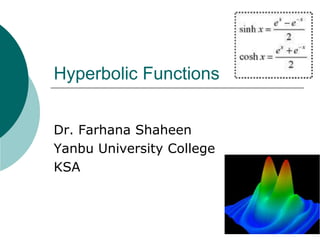
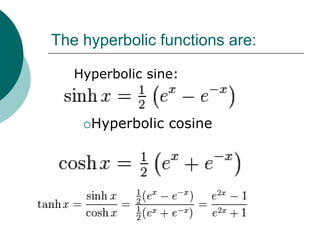
The hyperbolic functions are:

   Hyperbolic sine:


    Hyperbolic   cosine
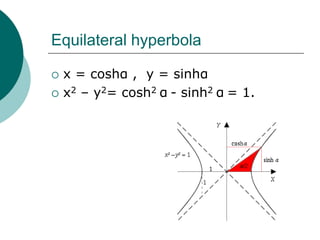
Equilateral hyperbola

   x = coshα , y = sinhα
   x2 – y2= cosh2 α - sinh2 α = 1.
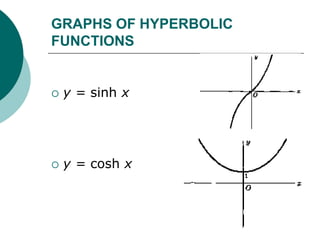
GRAPHS OF HYPERBOLIC
FUNCTIONS


   y = sinh x


   y = cosh x
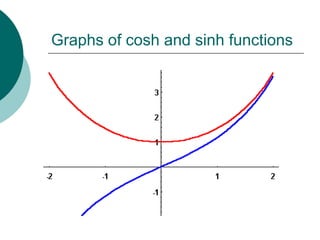
Graphs of cosh and sinh functions
The St. Louis arch is in the shape of a
hyperbolic cosine.
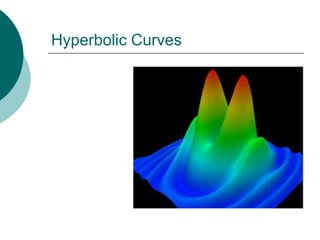
Hyperbolic Curves
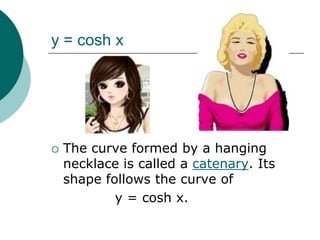
y = cosh x


   The curve formed by a hanging
    necklace is called a catenary. Its
    shape follows the curve of
            y = cosh x.
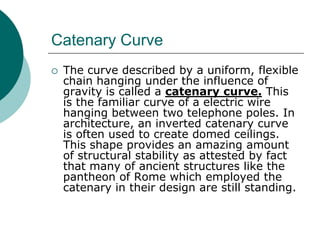
Catenary Curve
   The curve described by a uniform, flexible
    chain hanging under the influence of
    gravity is called a catenary curve. This
    is the familiar curve of a electric wire
    hanging between two telephone poles. In
    architecture, an inverted catenary curve
    is often used to create domed ceilings.
    This shape provides an amazing amount
    of structural stability as attested by fact
    that many of ancient structures like the
    pantheon of Rome which employed the
    catenary in their design are still standing.
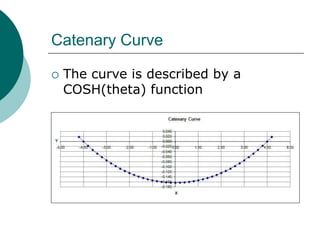
Catenary Curve

   The curve is described by a
    COSH(theta) function
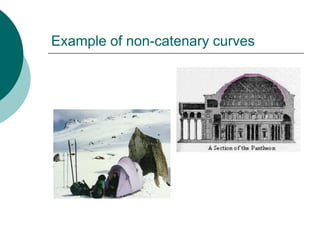
Example of non-catenary curves
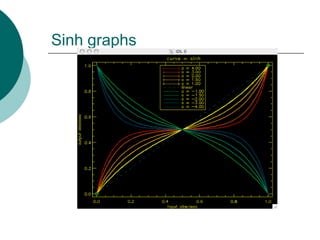
Sinh graphs
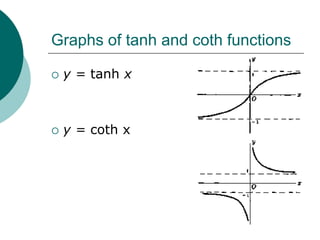
Graphs of tanh and coth functions

   y = tanh x


   y = coth x
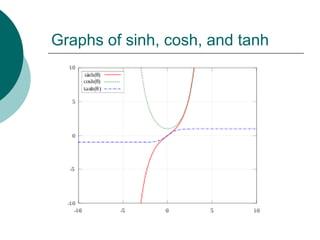
Graphs of sinh, cosh, and tanh
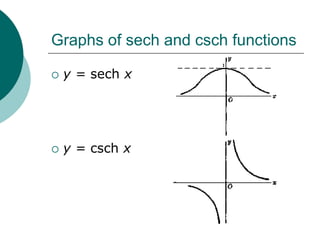
Graphs of sech and csch functions

   y = sech x


   y = csch x
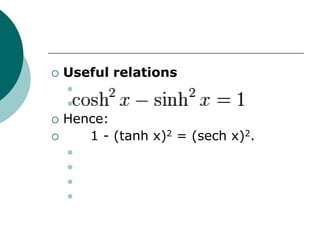
   Useful relations
    
    

   Hence:
      1 - (tanh x)2 = (sech x)2.
    
    
    
    
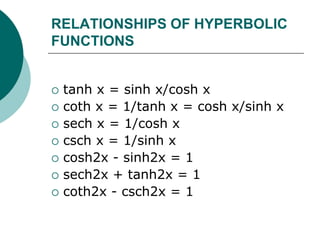
RELATIONSHIPS OF HYPERBOLIC
FUNCTIONS


   tanh x = sinh x/cosh x
   coth x = 1/tanh x = cosh x/sinh x
   sech x = 1/cosh x
   csch x = 1/sinh x
   cosh2x - sinh2x = 1
   sech2x + tanh2x = 1
   coth2x - csch2x = 1
   The following list shows the
    principal values of the inverse
    hyperbolic functions expressed in
    terms of logarithmic functions which
    are taken as real valued.
   sinh-1 x = ln (x +       )    -∞ < x < ∞
   cosh-1 x = ln (x +       )    x≥1
   [cosh-1 x > 0 is principal value]
   tanh-1x = ½ln((1 + x)/(1 - x))     -1 < x
    <1
   coth-1 x = ½ln((x + 1)/(x - 1))     x>1
    or x < -1
   sech-1 x = ln ( 1/x +       )
   0 < x ≤ 1 [sech-1 a; > 0 is principal
    value]
   csch-1 x = ln(1/x +        )   x≠0
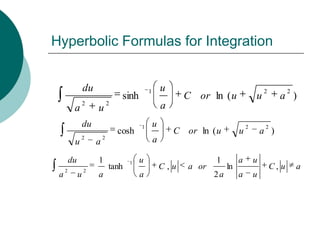
Hyperbolic Formulas for Integration


                  du                           1       u                                   2           2
                                    sinh                     C or ln ( u               u          a )
                  2            2
          a            u                               a
                  du                       1       u                               2        2
                                   cosh                    C or ln ( u         u           a )
              2            2
          u            a                           a

         du            1              1    u                         1         a       u
     2            2
                               tanh                    C,u    a or        ln                    C, u       a
 a            u        a                   a                         2a        a       u
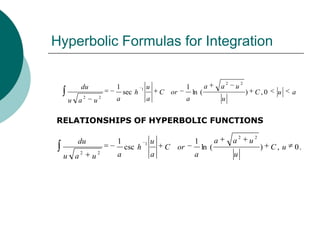
Hyperbolic Formulas for Integration

                                                                              2       2
       du              1           1   u               1          a       a       u
                           sec h               C or        ln (                           )       C,0      u     a
           2       2
  u a          u       a               a               a                  u


RELATIONSHIPS OF HYPERBOLIC FUNCTIONS
                                                                                      2           2
    du                 1               1   u               1          a           a           u
                           csc h                C or           ln (                                   )   C, u   0.
       2           2
 u a           u       a                   a               a                      u
   The hyperbolic functions share many properties with
    the corresponding circular functions. In fact, just as
    the circle can be represented parametrically by
    x = a cos t
    y = a sin t,
   a rectangular hyperbola (or, more specifically, its
    right branch) can be analogously represented by
    x = a cosh t
    y = a sinh t
   where cosh t is the hyperbolic cosine and sinh t is
    the hyperbolic sine.
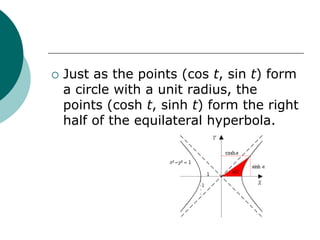
   Just as the points (cos t, sin t) form
    a circle with a unit radius, the
    points (cosh t, sinh t) form the right
    half of the equilateral hyperbola.
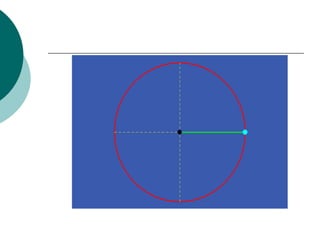
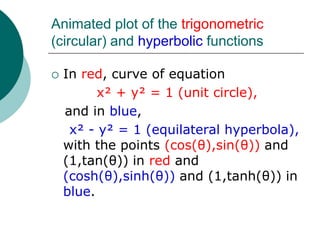
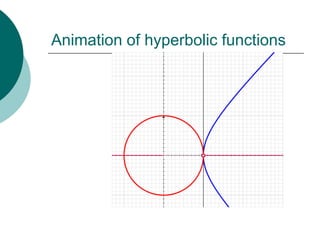
Animated plot of the trigonometric
(circular) and hyperbolic functions

   In red, curve of equation
          x² + y² = 1 (unit circle),
    and in blue,
     x² - y² = 1 (equilateral hyperbola),
    with the points (cos(θ),sin(θ)) and
    (1,tan(θ)) in red and
    (cosh(θ),sinh(θ)) and (1,tanh(θ)) in
    blue.
Animation of hyperbolic functions
Applications of Hyperbolic functions

   Hyperbolic functions occur in the
    solutions of some important linear
    differential equations, for example
    the equation defining a catenary,
    and Laplace's equation in Cartesian
    coordinates. The latter is important
    in many areas of physics, including
    electromagnetic theory, heat
    transfer, fluid dynamics, and special
    relativity.
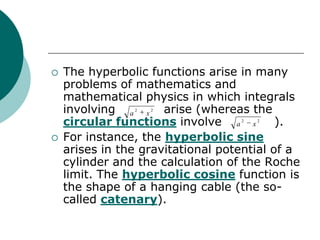
   The hyperbolic functions arise in many
    problems of mathematics and
    mathematical physics in which integrals
    involving a x arise (whereas the
                2   2


    circular functions involve a x 2   2
                                           ).
   For instance, the hyperbolic sine
    arises in the gravitational potential of a
    cylinder and the calculation of the Roche
    limit. The hyperbolic cosine function is
    the shape of a hanging cable (the so-
    called catenary).
   The hyperbolic tangent arises in the
    calculation and rapidity of special
    relativity. All three appear in the
    Schwarzschild metric using external
    isotropic Kruskal coordinates in general
    relativity. The hyperbolic secant arises
    in the profile of a laminar jet. The
    hyperbolic cotangent arises in the
    Langevin function for magnetic
    polarization.
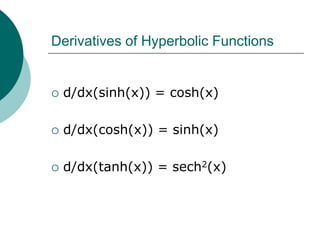
Derivatives of Hyperbolic Functions


   d/dx(sinh(x)) = cosh(x)

   d/dx(cosh(x)) = sinh(x)

   d/dx(tanh(x)) = sech2(x)
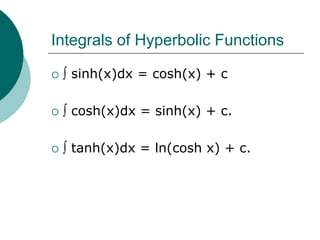
Integrals of Hyperbolic Functions

   ∫ sinh(x)dx = cosh(x) + c

   ∫ cosh(x)dx = sinh(x) + c.

   ∫ tanh(x)dx = ln(cosh x) + c.
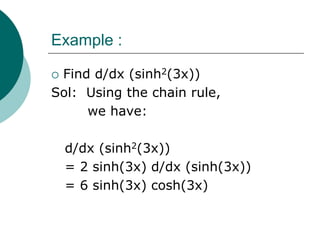
Example :

Find d/dx (sinh2(3x))
Sol: Using the chain rule,
     we have:

    d/dx (sinh2(3x))
    = 2 sinh(3x) d/dx (sinh(3x))
    = 6 sinh(3x) cosh(3x)
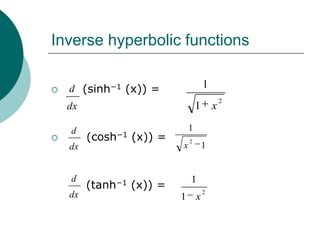
Inverse hyperbolic functions

   d (sinh−1 (x)) =                 1
                                          2
    dx                              1 x

    d                           1
        (cosh−1 (x)) =         2
    dx                      x       1


    d                           1
         (tanh−1   (x)) =           2
    dx                      1 x
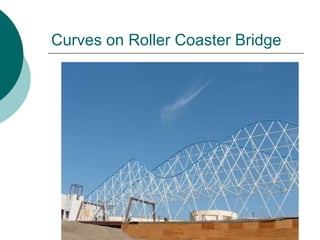
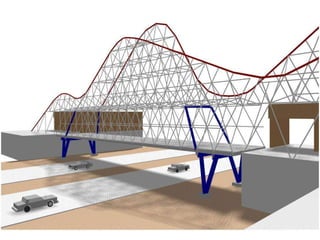
Curves on Roller Coaster Bridge
Masjid in Kazkhistan
Fatima masjid in Kuwait
Kul Sharif Masjid in Russia
Masjid in Georgia
Great Masjid in China
Thank You
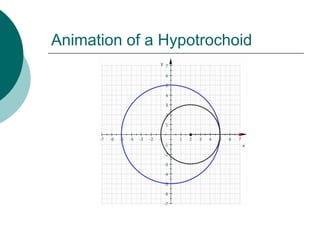
Animation of a Hypotrochoid
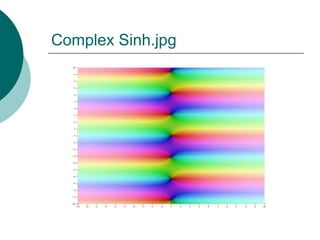
Complex Sinh.jpg

Hyperbolic functions dfs

  • 1.
    Hyperbolic Functions Dr. FarhanaShaheen Yanbu University College KSA
  • 2.
    Hyperbolic Functions  Vincenzo Riccati  (1707 - 1775) is given credit for introducing the hyperbolic functions. Hyperbolic functions are very useful in both mathematics and physics.
  • 3.
    The hyperbolic functionsare: Hyperbolic sine: Hyperbolic cosine
  • 4.
    Equilateral hyperbola  x = coshα , y = sinhα  x2 – y2= cosh2 α - sinh2 α = 1.
  • 5.
    GRAPHS OF HYPERBOLIC FUNCTIONS  y = sinh x  y = cosh x
  • 6.
    Graphs of coshand sinh functions
  • 7.
    The St. Louisarch is in the shape of a hyperbolic cosine.
  • 8.
  • 9.
    y = coshx  The curve formed by a hanging necklace is called a catenary. Its shape follows the curve of y = cosh x.
  • 10.
    Catenary Curve  The curve described by a uniform, flexible chain hanging under the influence of gravity is called a catenary curve. This is the familiar curve of a electric wire hanging between two telephone poles. In architecture, an inverted catenary curve is often used to create domed ceilings. This shape provides an amazing amount of structural stability as attested by fact that many of ancient structures like the pantheon of Rome which employed the catenary in their design are still standing.
  • 11.
    Catenary Curve  The curve is described by a COSH(theta) function
  • 12.
  • 13.
  • 14.
    Graphs of tanhand coth functions  y = tanh x  y = coth x
  • 15.
    Graphs of sinh,cosh, and tanh
  • 16.
    Graphs of sechand csch functions  y = sech x  y = csch x
  • 17.
    Useful relations    Hence:  1 - (tanh x)2 = (sech x)2.    
  • 18.
    RELATIONSHIPS OF HYPERBOLIC FUNCTIONS  tanh x = sinh x/cosh x  coth x = 1/tanh x = cosh x/sinh x  sech x = 1/cosh x  csch x = 1/sinh x  cosh2x - sinh2x = 1  sech2x + tanh2x = 1  coth2x - csch2x = 1
  • 19.
    The following list shows the principal values of the inverse hyperbolic functions expressed in terms of logarithmic functions which are taken as real valued.
  • 20.
    sinh-1 x = ln (x + ) -∞ < x < ∞  cosh-1 x = ln (x + ) x≥1  [cosh-1 x > 0 is principal value]  tanh-1x = ½ln((1 + x)/(1 - x)) -1 < x <1  coth-1 x = ½ln((x + 1)/(x - 1)) x>1 or x < -1  sech-1 x = ln ( 1/x + )  0 < x ≤ 1 [sech-1 a; > 0 is principal value]  csch-1 x = ln(1/x + ) x≠0
  • 21.
    Hyperbolic Formulas forIntegration du 1 u 2 2 sinh C or ln ( u u a ) 2 2 a u a du 1 u 2 2 cosh C or ln ( u u a ) 2 2 u a a du 1 1 u 1 a u 2 2 tanh C,u a or ln C, u a a u a a 2a a u
  • 22.
    Hyperbolic Formulas forIntegration 2 2 du 1 1 u 1 a a u sec h C or ln ( ) C,0 u a 2 2 u a u a a a u RELATIONSHIPS OF HYPERBOLIC FUNCTIONS 2 2 du 1 1 u 1 a a u csc h C or ln ( ) C, u 0. 2 2 u a u a a a u
  • 23.
    The hyperbolic functions share many properties with the corresponding circular functions. In fact, just as the circle can be represented parametrically by  x = a cos t  y = a sin t,  a rectangular hyperbola (or, more specifically, its right branch) can be analogously represented by  x = a cosh t  y = a sinh t  where cosh t is the hyperbolic cosine and sinh t is the hyperbolic sine.
  • 24.
    Just as the points (cos t, sin t) form a circle with a unit radius, the points (cosh t, sinh t) form the right half of the equilateral hyperbola.
  • 26.
    Animated plot ofthe trigonometric (circular) and hyperbolic functions  In red, curve of equation x² + y² = 1 (unit circle), and in blue, x² - y² = 1 (equilateral hyperbola), with the points (cos(θ),sin(θ)) and (1,tan(θ)) in red and (cosh(θ),sinh(θ)) and (1,tanh(θ)) in blue.
  • 27.
  • 28.
    Applications of Hyperbolicfunctions  Hyperbolic functions occur in the solutions of some important linear differential equations, for example the equation defining a catenary, and Laplace's equation in Cartesian coordinates. The latter is important in many areas of physics, including electromagnetic theory, heat transfer, fluid dynamics, and special relativity.
  • 29.
    The hyperbolic functions arise in many problems of mathematics and mathematical physics in which integrals involving a x arise (whereas the 2 2 circular functions involve a x 2 2 ).  For instance, the hyperbolic sine arises in the gravitational potential of a cylinder and the calculation of the Roche limit. The hyperbolic cosine function is the shape of a hanging cable (the so- called catenary).
  • 30.
    The hyperbolic tangent arises in the calculation and rapidity of special relativity. All three appear in the Schwarzschild metric using external isotropic Kruskal coordinates in general relativity. The hyperbolic secant arises in the profile of a laminar jet. The hyperbolic cotangent arises in the Langevin function for magnetic polarization.
  • 31.
    Derivatives of HyperbolicFunctions  d/dx(sinh(x)) = cosh(x)  d/dx(cosh(x)) = sinh(x)  d/dx(tanh(x)) = sech2(x)
  • 32.
    Integrals of HyperbolicFunctions  ∫ sinh(x)dx = cosh(x) + c  ∫ cosh(x)dx = sinh(x) + c.  ∫ tanh(x)dx = ln(cosh x) + c.
  • 33.
    Example : Find d/dx(sinh2(3x)) Sol: Using the chain rule, we have: d/dx (sinh2(3x)) = 2 sinh(3x) d/dx (sinh(3x)) = 6 sinh(3x) cosh(3x)
  • 34.
    Inverse hyperbolic functions  d (sinh−1 (x)) = 1 2 dx 1 x d 1  (cosh−1 (x)) = 2 dx x 1 d 1 (tanh−1 (x)) = 2 dx 1 x
  • 35.
    Curves on RollerCoaster Bridge
  • 37.
  • 38.
  • 39.
  • 40.
  • 41.
  • 42.
  • 44.
    Animation of aHypotrochoid
  • 45.