Develop properties of hyperbolic functions Differentiate and integrate hyperbolic functions Develop properties of inverse hyperbolic functions Differentiate and integrate inverse hyperbolic functions Whew!  Just a quick look at hyperbolic functions.
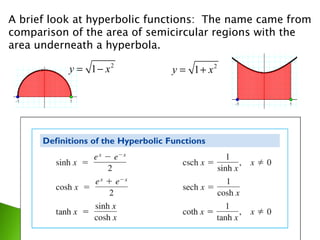
A brief look at hyperbolic functions:  The name came from comparison of the area of semicircular regions with the area underneath a hyperbola.
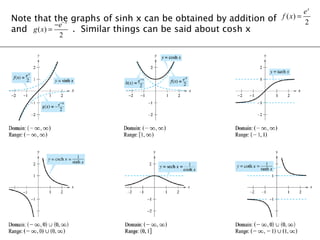
Note that the graphs of sinh x can be obtained by addition of and  .  Similar things can be said about cosh x
Here are some youtube videos that were helpful with pronunciation and with interesting things about the hyperbolic functions:  http://youtu.be/vqfVKsBkB1s   How the Arch got its shape (2:59) http://youtu.be/uW30SVZ68cU   Hyperbolic Functions NJIT (7:16) http://youtu.be/er_tQOBgo-I  Hyperbolic Trig Functions MIT (13:25)
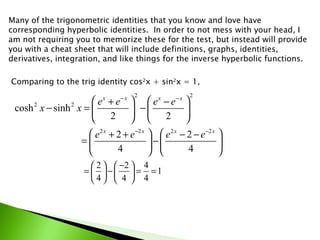
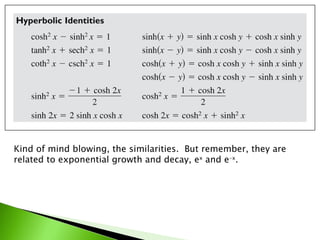
Many of the trigonometric identities that you know and love have corresponding hyperbolic identities.  In order to not mess with your head, I am not requiring you to memorize these for the test, but instead will provide you with a cheat sheet that will include definitions, graphs, identities, derivatives, integration, and like things for the inverse hyperbolic functions. Comparing to the trig identity cos 2 x + sin 2 x = 1,
Kind of mind blowing, the similarities.  But remember, they are related to exponential growth and decay, e x  and e -x .
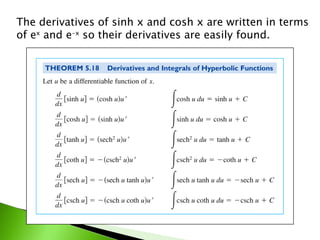
The derivatives of sinh x and cosh x are written in terms of e x  and e -x  so their derivatives are easily found.
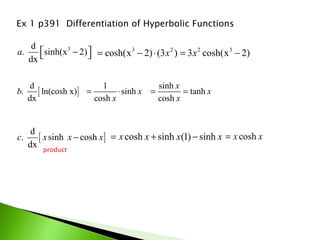
Ex 1 p391  Differentiation of Hyperbolic Functions product
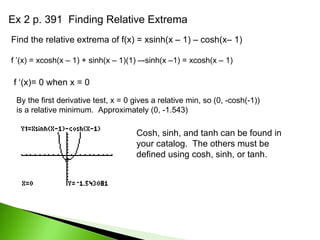
Ex 2 p. 391  Finding Relative Extrema Find the relative extrema of f(x) = xsinh(x – 1) – cosh(x– 1) f ’(x) = xcosh(x – 1) + sinh(x – 1)(1) –-sinh(x –1) = xcosh(x – 1)  f ‘(x)= 0 when x = 0 By the first derivative test, x = 0 gives a relative min, so (0, -cosh(-1)) is a relative minimum.  Approximately (0, -1.543) Cosh, sinh, and tanh can be found in your catalog.  The others must be defined using cosh, sinh, or tanh.
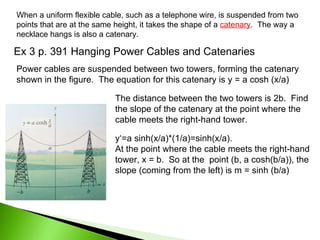
Ex 3 p. 391 Hanging Power Cables and Catenaries When a uniform flexible cable, such as a telephone wire, is suspended from two points that are at the same height, it takes the shape of a  catenary .  The way a necklace hangs is also a catenary. Power cables are suspended between two towers, forming the catenary shown in the figure.  The equation for this catenary is y = a cosh (x/a) The distance between the two towers is 2b.  Find the slope of the catenary at the point where the cable meets the right-hand tower. y‘=a sinh(x/a)*(1/a)=sinh(x/a).  At the point where the cable meets the right-hand tower, x = b.  So at the  point (b, a cosh(b/a)), the slope (coming from the left) is m = sinh (b/a)
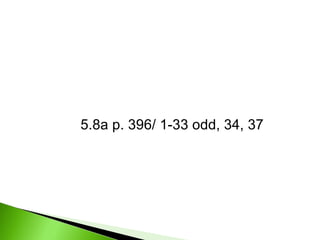
5.8a p. 396/ 1-33 odd, 34, 37

Calc 5.8a

  • 1.
    Develop properties ofhyperbolic functions Differentiate and integrate hyperbolic functions Develop properties of inverse hyperbolic functions Differentiate and integrate inverse hyperbolic functions Whew! Just a quick look at hyperbolic functions.
  • 2.
    A brief lookat hyperbolic functions: The name came from comparison of the area of semicircular regions with the area underneath a hyperbola.
  • 3.
    Note that thegraphs of sinh x can be obtained by addition of and . Similar things can be said about cosh x
  • 4.
    Here are someyoutube videos that were helpful with pronunciation and with interesting things about the hyperbolic functions: http://youtu.be/vqfVKsBkB1s How the Arch got its shape (2:59) http://youtu.be/uW30SVZ68cU Hyperbolic Functions NJIT (7:16) http://youtu.be/er_tQOBgo-I Hyperbolic Trig Functions MIT (13:25)
  • 5.
    Many of thetrigonometric identities that you know and love have corresponding hyperbolic identities. In order to not mess with your head, I am not requiring you to memorize these for the test, but instead will provide you with a cheat sheet that will include definitions, graphs, identities, derivatives, integration, and like things for the inverse hyperbolic functions. Comparing to the trig identity cos 2 x + sin 2 x = 1,
  • 6.
    Kind of mindblowing, the similarities. But remember, they are related to exponential growth and decay, e x and e -x .
  • 7.
    The derivatives ofsinh x and cosh x are written in terms of e x and e -x so their derivatives are easily found.
  • 8.
    Ex 1 p391 Differentiation of Hyperbolic Functions product
  • 9.
    Ex 2 p.391 Finding Relative Extrema Find the relative extrema of f(x) = xsinh(x – 1) – cosh(x– 1) f ’(x) = xcosh(x – 1) + sinh(x – 1)(1) –-sinh(x –1) = xcosh(x – 1) f ‘(x)= 0 when x = 0 By the first derivative test, x = 0 gives a relative min, so (0, -cosh(-1)) is a relative minimum. Approximately (0, -1.543) Cosh, sinh, and tanh can be found in your catalog. The others must be defined using cosh, sinh, or tanh.
  • 10.
    Ex 3 p.391 Hanging Power Cables and Catenaries When a uniform flexible cable, such as a telephone wire, is suspended from two points that are at the same height, it takes the shape of a catenary . The way a necklace hangs is also a catenary. Power cables are suspended between two towers, forming the catenary shown in the figure. The equation for this catenary is y = a cosh (x/a) The distance between the two towers is 2b. Find the slope of the catenary at the point where the cable meets the right-hand tower. y‘=a sinh(x/a)*(1/a)=sinh(x/a). At the point where the cable meets the right-hand tower, x = b. So at the point (b, a cosh(b/a)), the slope (coming from the left) is m = sinh (b/a)
  • 11.
    5.8a p. 396/1-33 odd, 34, 37