LIMITS
OF
FUNCTIONS
INFINITE LIMITS; VERTICAL AND
HORIZONTAL ASYMPTOTES;
SQUEEZE THEOREM
OBJECTIVES:
•define infinite limits;
•illustrate the infinite limits ; and
•use the theorems to evaluate the limits of
functions.
•determine vertical and horizontal asymptotes
•define squeeze theorem
DEFINITION: INFINITE LIMITS
Sometimes one-sided or two-sided limits fail to exist
because the value of the function increase or
decrease without bound.
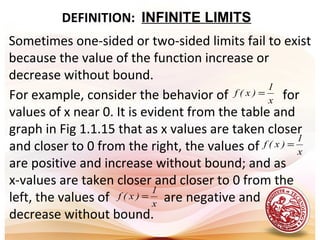
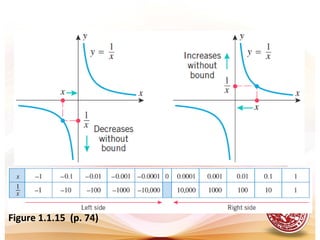
For example, consider the behavior of for
values of x near 0. It is evident from the table and
graph in Fig 1.1.15 that as x values are taken closer
and closer to 0 from the right, the values of
are positive and increase without bound; and as
x-values are taken closer and closer to 0 from the
left, the values of are negative and
decrease without bound.
x
1
)x(f =
x
1
)x(f =
x
1
)x(f =
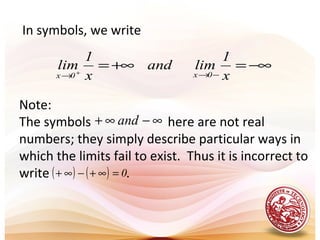
In symbols, we write
−∞=+∞=
−→→ +
x
1
limand
x
1
lim
0x0x
Note:
The symbols here are not real
numbers; they simply describe particular ways in
which the limits fail to exist. Thus it is incorrect to
write .
∞−∞+ and
( ) ( ) 0=∞+−∞+
Figure 1.1.15 (p. 74)
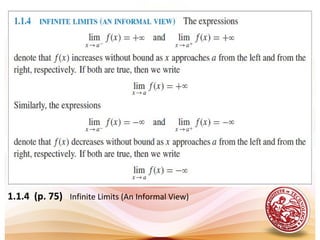
1.1.4 (p. 75) Infinite Limits (An Informal View)
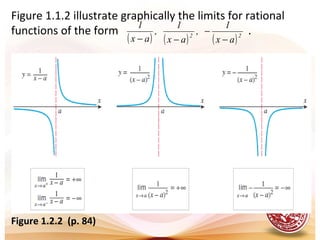
Figure 1.2.2 (p. 84)
Figure 1.1.2 illustrate graphically the limits for rational
functions of the form .
( ) ( ) ( )22
ax
1
,
ax
1
,
ax
1
−
−
−−
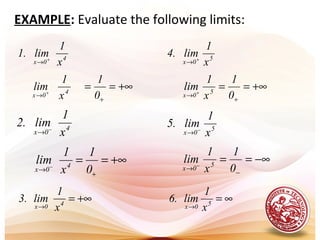
EXAMPLE: Evaluate the following limits:
4
0x x
1
lim.1 +
→
4
0x x
1
lim.2 −
→
5
0x x
1
lim.4 +
→
−∞==
−
→ −
0
1
x
1
lim 5
0x
+∞==
+
→ +
0
1
x
1
lim 4
0x
+∞==
+
→ −
0
1
x
1
lim 4
0x
+∞==
+
→ +
0
1
x
1
lim 5
0x
5
0x x
1
lim.5 −
→
+∞=
→ 40x x
1
lim.3 ∞=
→ 50x x
1
lim.6
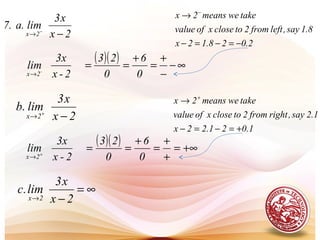
2x
x3
lima..7
2x −−
→
2x
x3
lim.b
2x −+
→
( )( ) ∞−
−
+
=
+
==
→ 0
6
0
23
2-x
3x
lim-
2x
2.028.12x
8.1say,leftfrom2toclosexofvalue
takewemeans2x
−=−=−
→ −
( )( ) +∞=
+
+
=
+
==+
→ 0
6
0
23
2-x
3x
lim
2x
1.021.22x
1.2say,rightfrom2toclosexofvalue
takewemeans2x
+=−=−
→ +
∞=
−→ 2x
x3
lim.c
2x
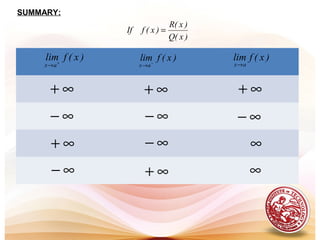
)x(flim
ax +
→
)x(flim
ax −
→
)x(flim
ax→
∞+ ∞+ ∞+
∞+
∞+
∞− ∞− ∞−
∞−
∞−
∞
∞
SUMMARY:
)x(Q
)x(R
)x(fIf =
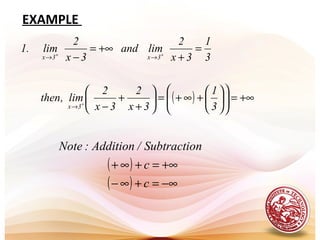
EXAMPLE
( ) +∞=











+∞+=





+
+
−
=
+
+∞=
−
+
++
→
→→
3
1
3x
2
3x
2
lim,then
3
1
3x
2
limand
3x
2
lim.1
3x
3x3x
( )
( ) −∞=+∞−
+∞=+∞+
c
c
nSubtractio/Addition:Note
( ) ( ) ( ) ( )
( ) ( ) ( ) ( ) +∞=−∞−−∞=+∞−
−∞=−∞++∞=+∞+
cc
cc
:Note
( )( )( ) −∞=−∞+=





+
−
⋅
−
−=
+
−
+∞=
−
+
++
→
→→
1
1x
3x
1x
x2
lim,then
1
1x
3x
limand
1x
x2
lim.2
1x
1x1x
( ) +∞=











−∞−=





+
−
⋅
−
−=
+
−
−∞=
−
−
−−
→
→→
3
1
4x
6x2
2x
x3
lim,then
3
1
4x
6x2
limand
2x
x3
lim.3
2x
2x2x
VERTICAL AND
HORIZONTAL
ASYMPTOTES
DEFINITION:
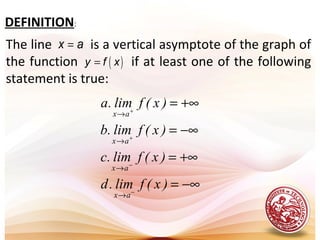
−∞=
+∞=
−∞=
+∞=
−
−
+
+
→
→
→
→
)x(flim.d
)x(flim.c
)x(flim.b
)x(flim.a
ax
ax
ax
ax
The line is a vertical asymptote of the graph of
the function if at least one of the following
statement is true:
x a=
( )y f x=
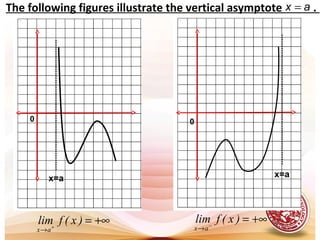
x=a
0
+∞=+
→
)x(flim
ax
+∞=−
→
)x(flim
ax
The following figures illustrate the vertical asymptote .x a=
x=a
0
x=a
0
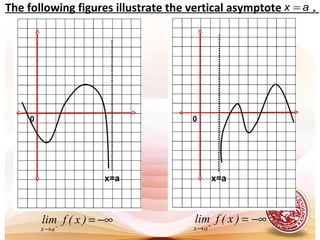
x=a
−∞=−
→
)x(flim
ax
−∞=+
→
)x(flim
ax
The following figures illustrate the vertical asymptote .x a=
0
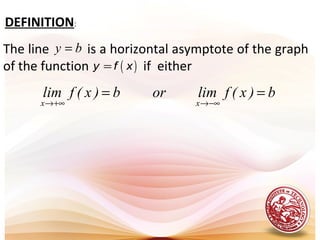
DEFINITION:
b)x(flimorb)x(flim
xx
==
−∞→+∞→
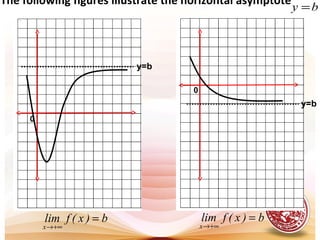
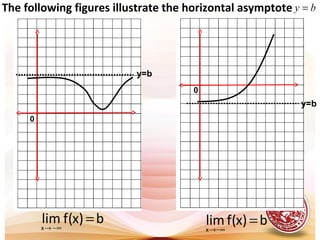
The line is a horizontal asymptote of the graph
of the function if either
by =
( )y f x=
y=b
0
y=b
b)x(flim
x
=
+∞→
The following figures illustrate the horizontal asymptote
by =
0
b)x(flim
x
=
+∞→
y=b
0
y=b
b)x(flimx
=∞−→
The following figures illustrate the horizontal asymptote by =
0
b)x(flimx
=−∞→
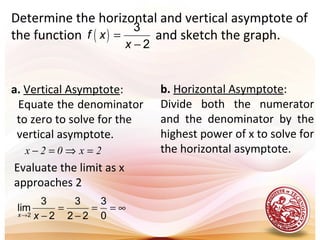
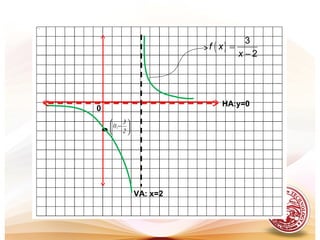
Determine the horizontal and vertical asymptote of
the function and sketch the graph.( )
3
2
f x
x
=
−
a. Vertical Asymptote:
Equate the denominator
to zero to solve for the
vertical asymptote.
2x02x =⇒=−
Evaluate the limit as x
approaches 2
2
3 3 3
lim
2 2 2 0x x→
= = = ∞
− −
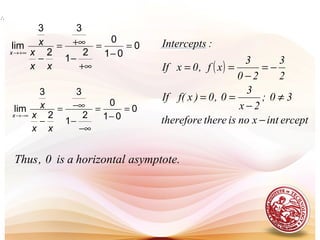
b. Horizontal Asymptote:
Divide both the numerator
and the denominator by the
highest power of x to solve for
the horizontal asymptote.
3 3
0
lim 0
2 2 1 01
x
x
x
x x
→+∞
+∞= = =
−− −
+∞
3 3
0
lim 0
2 2 1 01
x
x
x
x x
→−∞
−∞= = =
−− −
−∞
∴
( )
erceptintxnoistheretherefore
30;
2x
3
0,0)xf(If
2
3
20
3
xf,0xIf
:Intercepts
−
≠
−
==
−=
−
==
.asymptotehorizontalais0,Thus
• 





−
2
3
,0
VA: x=2
HA:y=0
0
( )
3
2
f x
x
=
−
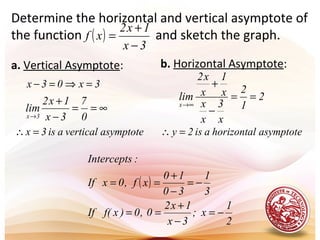
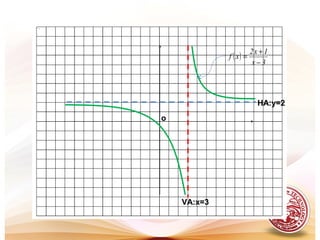
Determine the horizontal and vertical asymptote of
the function and sketch the graph.( )
3x
1x2
xf
−
+
=
a. Vertical Asymptote: b. Horizontal Asymptote:
3x03x =⇒=−
∞==
−
+
→ 0
7
3x
1x2
lim
3x
2
1
2
x
3
x
x
x
1
x
x2
lim
x
==
−
+
∞→
asymptotehorizontalais2y =∴asymptoteverticalais3x =∴
( )
2
1
x;
3x
1x2
0,0)xf(If
3
1
30
10
xf,0xIf
:Intercepts
−=
−
+
==
−=
−
+
==
HA:y=2
VA:x=3
o
( )
3x
1x2
xf
−
+
=
SQUEEZE THEOREM
LIMITS OF FUNCTIONS USING THE SQUEEZE PRINCIPLE
The Squeeze Principle is used on limit problems where the
usual algebraic methods (factoring, conjugation, algebraic
manipulation, etc.) are not effective. However, it requires
that you be able to ``squeeze'' your problem in between
two other ``simpler'' functions whose limits are easily
computable and equal. The use of the Squeeze Principle
requires accurate analysis, algebra skills, and careful use
of inequalities. The method of squeezing is used to prove
that f(x)→L as x→c by “trapping or squeezing” f between
two functions, g and h, whose limits as x→c are known
with certainty to be L.
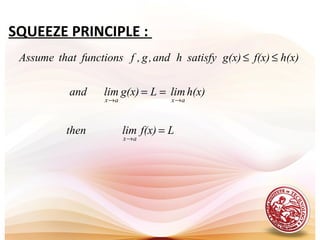
SQUEEZE PRINCIPLE :
Lf(x)limthen
h(x)limLg(x)limand
h(x)f(x)g(x)satisfyhand,g,ffunctionsthatAssume
ax
axax
=
==
≤≤
→
→→
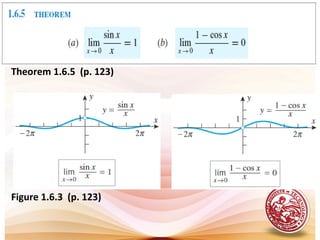
Theorem 1.6.5 (p. 123)
Figure 1.6.3 (p. 123)
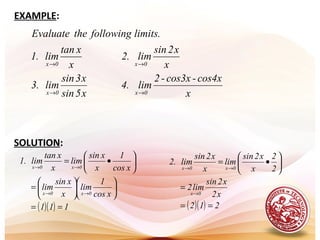
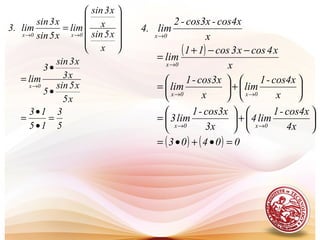
EXAMPLE:
x
cos4x-cos3x-2
lim4.
x5sin
x3sin
lim.3
x
x2sin
lim.2
x
xtan
lim.1
limits.followingtheEvaluate
0x0x
0x0x
→→
→→
( )( ) 111
xcos
1
lim
x
xsin
lim
xcos
1
x
xsin
lim
x
xtan
lim.1
0x0x
0x0x
==












=






•=
→→
→→
( )( ) 212
x2
x2sin
lim2
2
2
x
x2sin
lim
x
x2sin
lim.2
0x
0x0x
==
=






•=
→
→→
SOLUTION:
5
3
15
13
x5
x5sin
5
x3
x3sin
3
lim
x
x5sin
x
x3sin
lim
x5sin
x3sin
lim.3
0x
0x0x
=
•
•
=
•
•
=












=
→
→→
( )
( ) ( ) 00403
4x
cos4x-1
lim4
3x
cos3x-1
lim3
x
cos4x-1
lim
x
cos3x-1
lim
x
x4cosx3cos11
lim
x
cos4x-cos3x-2
lim4.
0x0x
0x0x
0x
0x
=•+•=






+





=






+





=
−−+
=
→→
→→
→
→
3x2x
2xx
lim.4
4x
x16
lim.3
4t
2t
lim.2
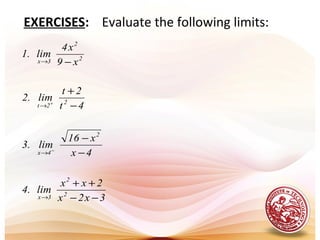
x9
x4
lim.1
2
2
3x
2
4x
2
2t
2
2
3x
−−
++
−
−
−
+
−
→
→
→
→
−
+
EXERCISES: Evaluate the following limits:

L5 infinite limits squeeze theorem