



9. GEOMETRICAL
TRANSFORMATION
DR. FARHANA SHAHEEN
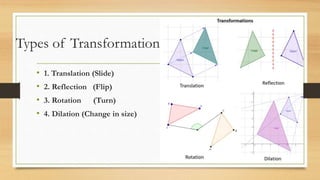
Types of Transformations
• 1. Translation (Slide)
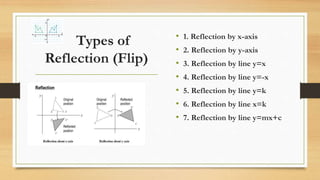
• 2. Reflection (Flip)
• 3. Rotation (Turn)
• 4. Dilation (Change in size)
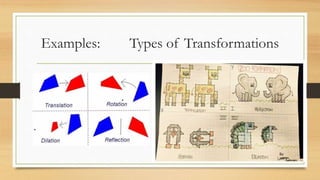
Examples: Types of Transformations
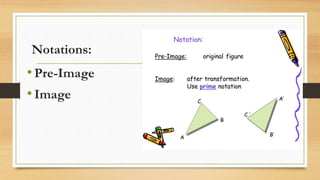
Notations:
•Pre-Image
•Image
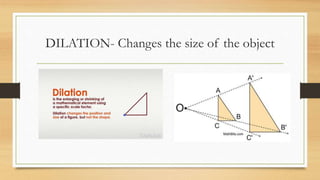
DILATION- Changes the size of the object
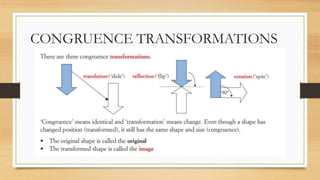
CONGRUENCE TRANSFORMATIONS
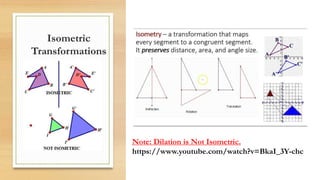
Isometric
Transformations
Note: Dilation is Not Isometric.
https://www.youtube.com/watch?v=BkaI_3Y-chc
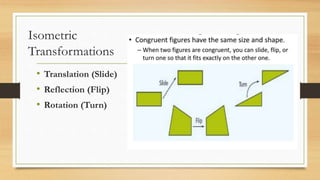
Isometric
Transformations
• Translation (Slide)
• Reflection (Flip)
• Rotation (Turn)
Types of
Transformations
Types of
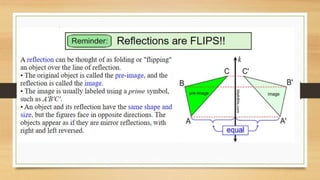
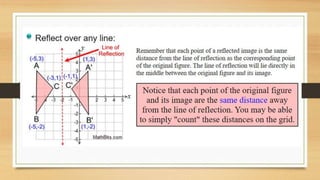
Reflection (Flip)
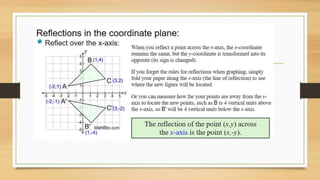
• 1. Reflection by x-axis
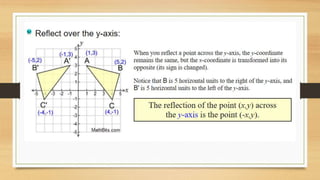
• 2. Reflection by y-axis
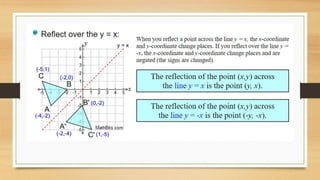
• 3. Reflection by line y=x
• 4. Reflection by line y=-x
• 5. Reflection by line y=k
• 6. Reflection by line x=k
• 7. Reflection by line y=mx+c
Reflection along x- and y-axis
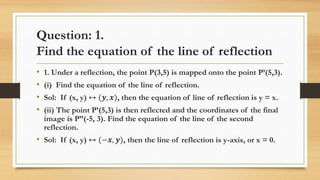
Question: 1.
Find the equation of the line of reflection
• 1. Under a reflection, the point P(3,5) is mapped onto the point P’(5,3).
• (i) Find the equation of the line of reflection.
• Sol: If (x, y) ↔ (𝒚, 𝒙), then the equation of line of reflection is y = x.
• (ii) The point P’(5,3) is then reflected and the coordinates of the final
image is P”(-5, 3). Find the equation of the line of the second
reflection.
• Sol: If (x, y) ↔ (−𝒙, 𝒚), then the line of reflection is y-axis, or x = 0.
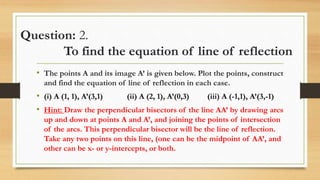
Question: 2.
To find the equation of line of reflection
• The points A and its image A’ is given below. Plot the points, construct
and find the equation of line of reflection in each case.
• (i) A (1, 1), A’(3,1) (ii) A (2, 1), A’(0,3) (iii) A (-1,1), A’(3,-1)
• Hint: Draw the perpendicular bisectors of the line AA’ by drawing arcs
up and down at points A and A’, and joining the points of intersection
of the arcs. This perpendicular bisector will be the line of reflection.
Take any two points on this line, (one can be the midpoint of AA’, and
other can be x- or y-intercepts, or both.
• https://mathbitsnotebook.com/Algebra1/FunctionGraphs/FNGTransform
ationRotation.html
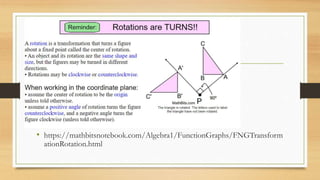
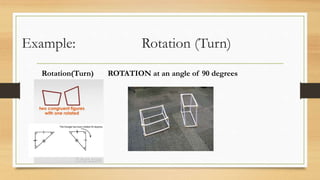
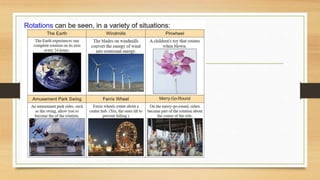
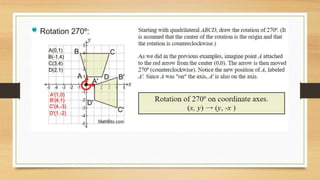
Example: Rotation (Turn)
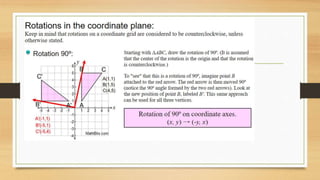
Rotation(Turn) ROTATION at an angle of 90 degrees
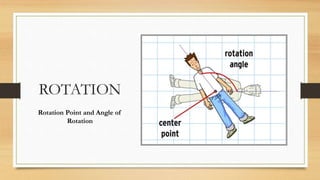
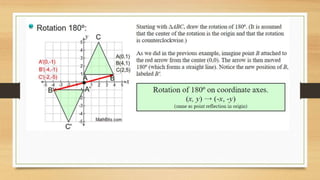
ROTATION
Rotation Point and Angle of
Rotation
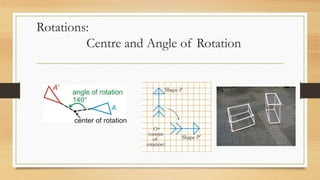
Rotations:
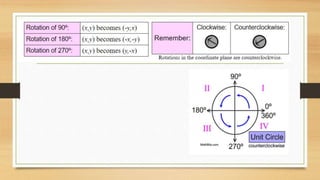
Centre and Angle of Rotation
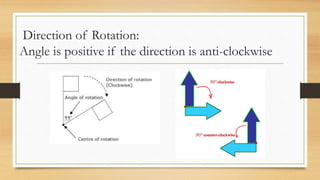
Direction of Rotation:
Angle is positive if the direction is anti-clockwise
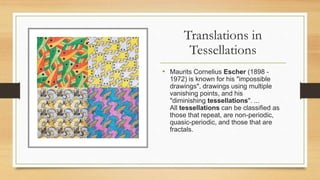
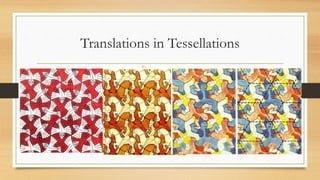
Translations in
Tessellations
• Maurits Cornelius Escher (1898 -
1972) is known for his "impossible
drawings", drawings using multiple
vanishing points, and his
"diminishing tessellations". ...
All tessellations can be classified as
those that repeat, are non-periodic,
quasic-periodic, and those that are
fractals.
Translations in Tessellations
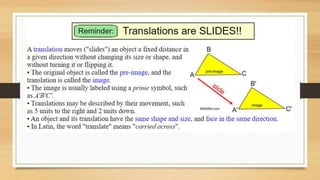
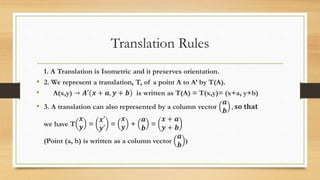
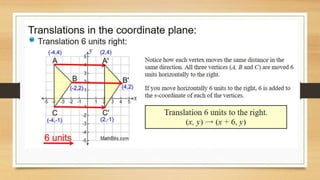
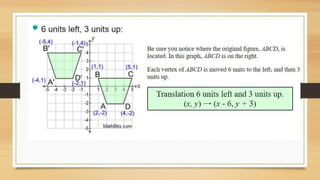
Translation Rules
1. A Translation is Isometric and it preserves orientation.
• 2. We represent a translation, T, of a point A to A’ by T(A).
• A(x,y) → 𝑨′(𝒙 + 𝒂, 𝒚 + 𝒃) is written as T(A) = T(x,y)= (x+a, y+b)
• 3. A translation can also represented by a column vector
𝒂
𝒃
, 𝐬𝐨 𝐭𝐡𝐚𝐭
we have T
𝒙
𝒚 =
𝒙′
𝒚′
=
𝒙
𝒚 +
𝒂
𝒃
=
𝒙 + 𝒂
𝒚 + 𝒃
(Point (a, b) is written as a column vector
𝒂
𝒃
)
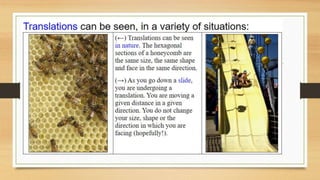
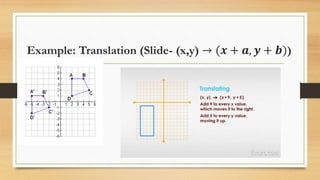
Example: Translation (Slide- (x,y) → (𝒙 + 𝒂, 𝒚 + 𝒃))
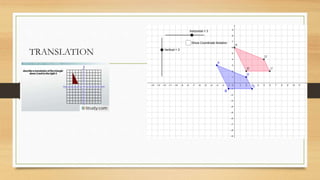
TRANSLATION
Example: 2
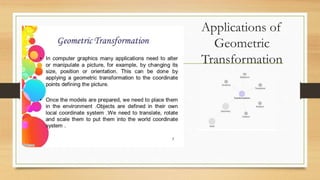
Applications of
Geometric
Transformation
GeoGebra
• https://www.geogebra.
org/m/k9qvbe7n#mate
rial/dvxpfdxy
How to Animate a Transformation
• https://www.youtube.com/watch?v=v9CHlUxnoT8
Animation Challenge Roundup:
Transformations!
• https://www.youtube.com/watch?v=21aWtuJanx8

Geometrical transformation