ELEMENTARY MATHEMATICS
                             W W L CHEN and X T DUONG

                                 c    W W L Chen, X T Duong and Macquarie University, 1999.
                                  This work is available free, in the hope that it will be useful.
  Any part of this work may be reproduced or transmitted in any form or by any means, electronic or mechanical, including
   photocopying, recording, or any information storage and retrieval system, with or without permission from the authors.


                                            Chapter 12
                                FURTHER TECHNIQUES OF

                                          DIFFERENTIATION


12.1.     The Chain Rule

We begin by re-examining a few examples discussed in the previous chapter.

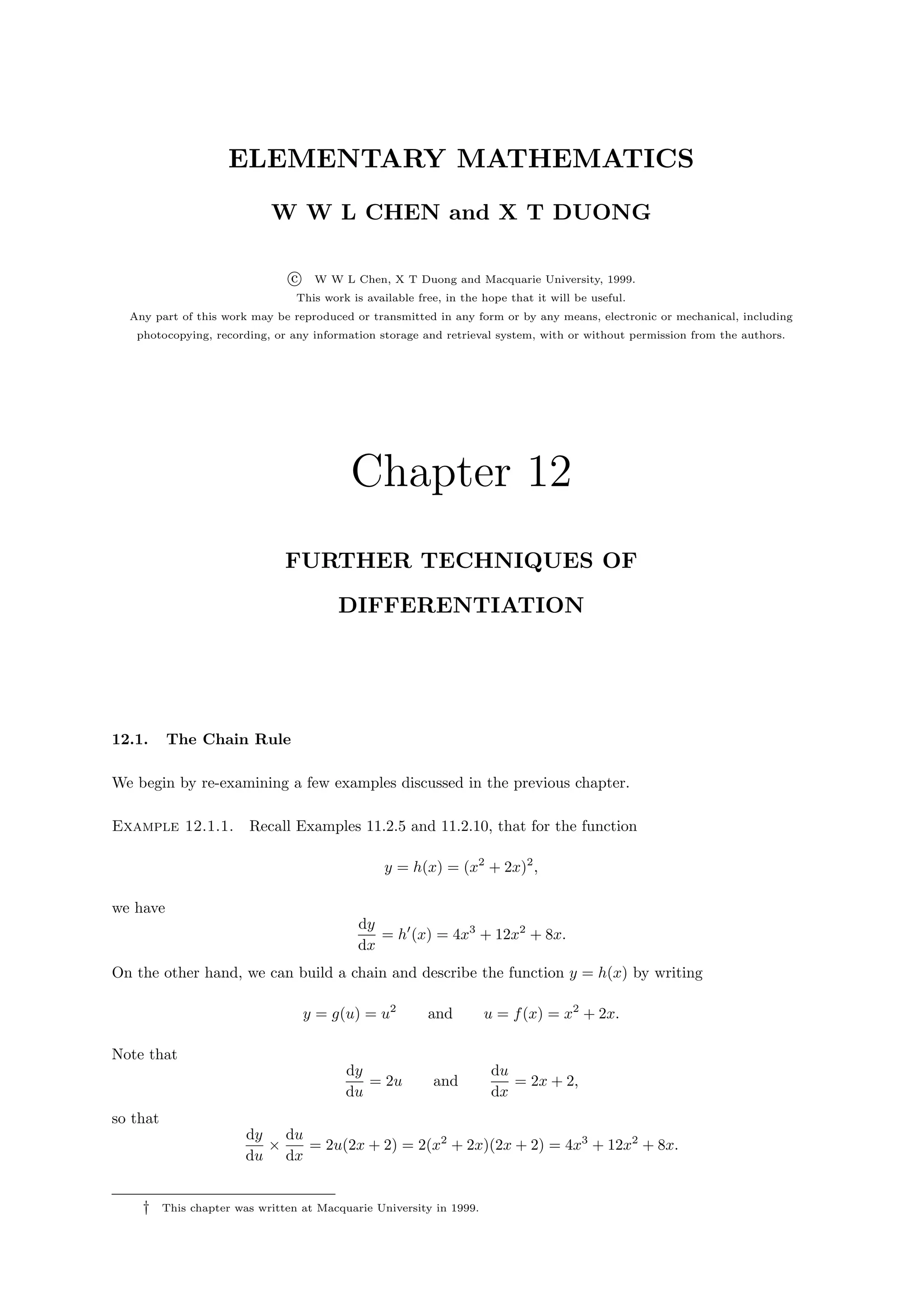
Example 12.1.1.          Recall Examples 11.2.5 and 11.2.10, that for the function

                                                   y = h(x) = (x2 + 2x)2 ,

we have
                                             dy
                                                = h (x) = 4x3 + 12x2 + 8x.
                                             dx
On the other hand, we can build a chain and describe the function y = h(x) by writing

                                     y = g(u) = u2         and        u = f (x) = x2 + 2x.

Note that
                                           dy                          du
                                              = 2u          and           = 2x + 2,
                                           du                          dx
so that
                         dy   du
                            ×    = 2u(2x + 2) = 2(x2 + 2x)(2x + 2) = 4x3 + 12x2 + 8x.
                         du dx


    †     This chapter was written at Macquarie University in 1999.
12–2            W W L Chen and X T Duong : Elementary Mathematics


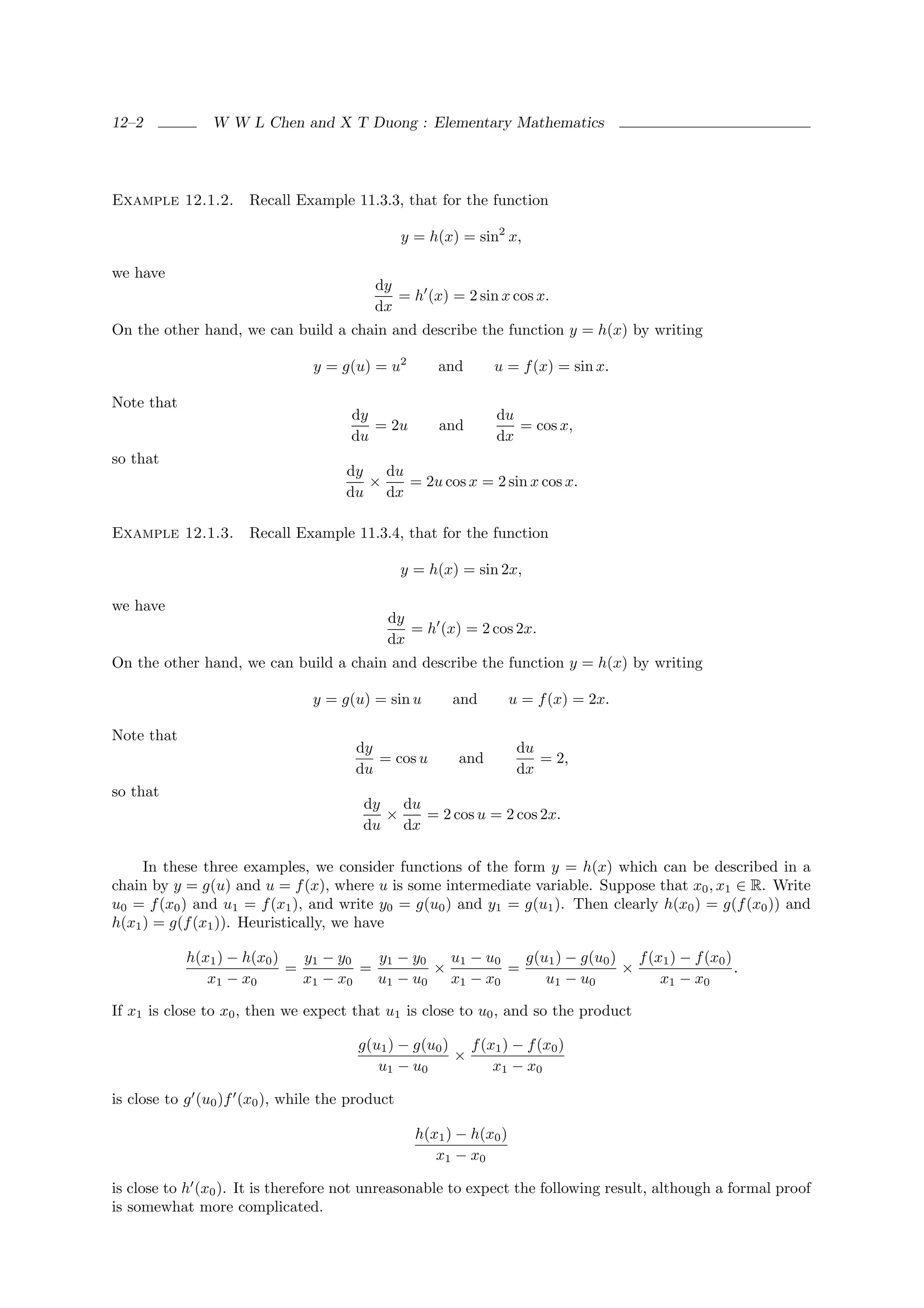
Example 12.1.2.      Recall Example 11.3.3, that for the function

                                                y = h(x) = sin2 x,

we have
                                         dy
                                            = h (x) = 2 sin x cos x.
                                         dx
On the other hand, we can build a chain and describe the function y = h(x) by writing

                                y = g(u) = u2        and       u = f (x) = sin x.

Note that
                                      dy                       du
                                         = 2u        and          = cos x,
                                      du                       dx
so that
                                     dy   du
                                        ×    = 2u cos x = 2 sin x cos x.
                                     du dx

Example 12.1.3.      Recall Example 11.3.4, that for the function

                                                y = h(x) = sin 2x,

we have
                                           dy
                                              = h (x) = 2 cos 2x.
                                           dx
On the other hand, we can build a chain and describe the function y = h(x) by writing

                                y = g(u) = sin u        and         u = f (x) = 2x.

Note that
                                      dy                             du
                                         = cos u         and            = 2,
                                      du                             dx
so that
                                        dy   du
                                           ×    = 2 cos u = 2 cos 2x.
                                        du dx

     In these three examples, we consider functions of the form y = h(x) which can be described in a
chain by y = g(u) and u = f (x), where u is some intermediate variable. Suppose that x0 , x1 ∈ R. Write
u0 = f (x0 ) and u1 = f (x1 ), and write y0 = g(u0 ) and y1 = g(u1 ). Then clearly h(x0 ) = g(f (x0 )) and
h(x1 ) = g(f (x1 )). Heuristically, we have

            h(x1 ) − h(x0 )   y1 − y0   y1 − y0   u1 − u0   g(u1 ) − g(u0 ) f (x1 ) − f (x0 )
                            =         =         ×         =                ×                  .
               x1 − x0        x1 − x0   u1 − u0   x1 − x0      u1 − u0          x1 − x0

If x1 is close to x0 , then we expect that u1 is close to u0 , and so the product

                                       g(u1 ) − g(u0 ) f (x1 ) − f (x0 )
                                                      ×
                                          u1 − u0          x1 − x0

is close to g (u0 )f (x0 ), while the product

                                                  h(x1 ) − h(x0 )
                                                     x1 − x0

is close to h (x0 ). It is therefore not unreasonable to expect the following result, although a formal proof
is somewhat more complicated.
Chapter 12 : Further Techniques of Differentiation           12–3


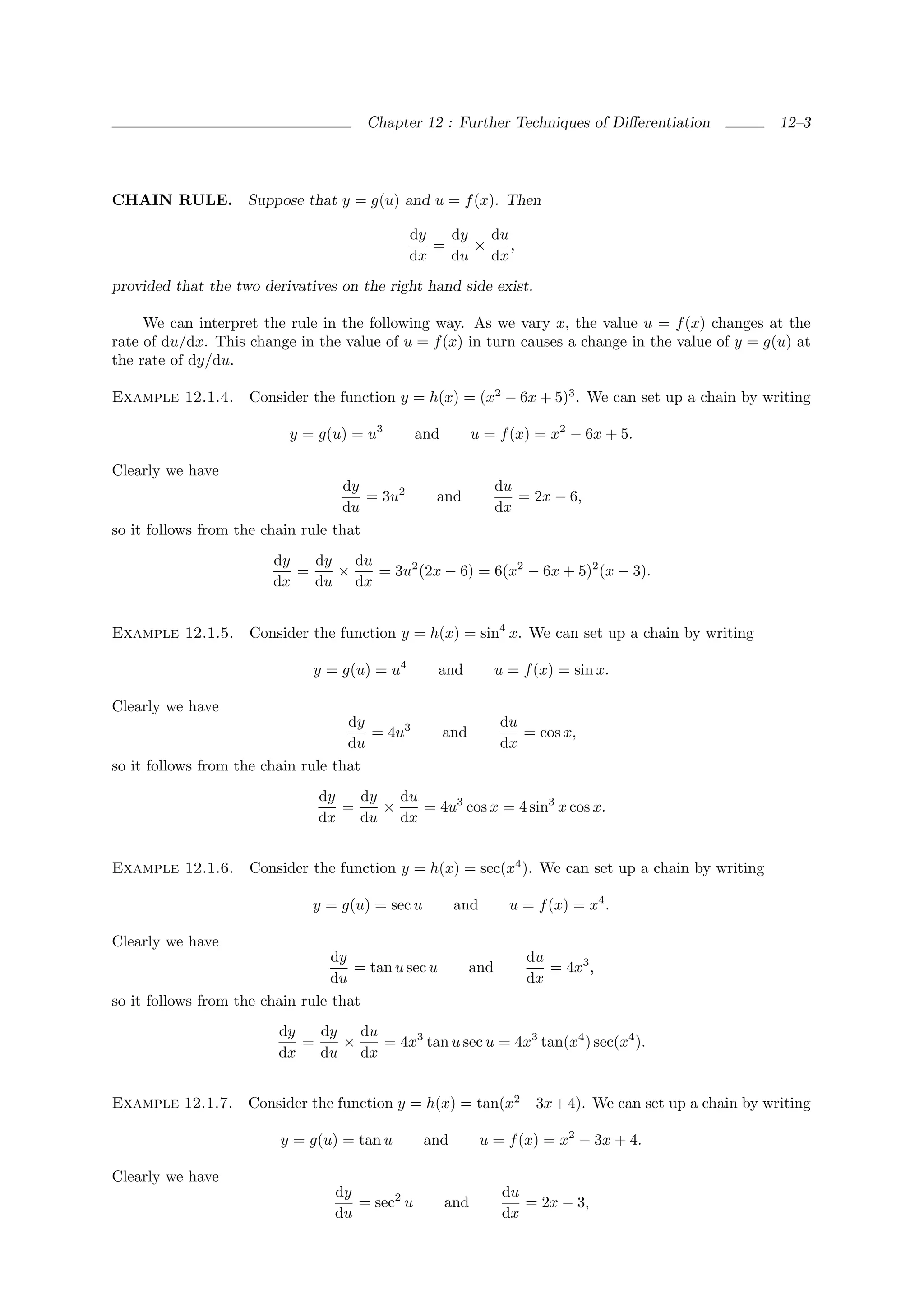
CHAIN RULE. Suppose that y = g(u) and u = f (x). Then

                                               dy   dy   du
                                                  =    ×    ,
                                               dx   du dx
provided that the two derivatives on the right hand side exist.

     We can interpret the rule in the following way. As we vary x, the value u = f (x) changes at the
rate of du/dx. This change in the value of u = f (x) in turn causes a change in the value of y = g(u) at
the rate of dy/du.

Example 12.1.4.      Consider the function y = h(x) = (x2 − 6x + 5)3 . We can set up a chain by writing

                           y = g(u) = u3        and         u = f (x) = x2 − 6x + 5.

Clearly we have
                                    dy                            du
                                       = 3u2      and                = 2x − 6,
                                   du                             dx
so it follows from the chain rule that
                        dy   dy   du
                           =    ×    = 3u2 (2x − 6) = 6(x2 − 6x + 5)2 (x − 3).
                        dx   du dx


Example 12.1.5.      Consider the function y = h(x) = sin4 x. We can set up a chain by writing

                              y = g(u) = u4          and          u = f (x) = sin x.

Clearly we have
                                    dy                            du
                                       = 4u3          and            = cos x,
                                    du                            dx
so it follows from the chain rule that
                               dy   dy   du
                                  =    ×    = 4u3 cos x = 4 sin3 x cos x.
                               dx   du dx


Example 12.1.6.      Consider the function y = h(x) = sec(x4 ). We can set up a chain by writing

                              y = g(u) = sec u         and          u = f (x) = x4 .

Clearly we have
                                  dy                                   du
                                     = tan u sec u          and           = 4x3 ,
                                  du                                   dx
so it follows from the chain rule that
                         dy   dy   du
                            =    ×    = 4x3 tan u sec u = 4x3 tan(x4 ) sec(x4 ).
                         dx   du dx


Example 12.1.7.     Consider the function y = h(x) = tan(x2 − 3x + 4). We can set up a chain by writing

                         y = g(u) = tan u        and         u = f (x) = x2 − 3x + 4.

Clearly we have
                                  dy                               du
                                     = sec2 u         and             = 2x − 3,
                                  du                               dx
12–4           W W L Chen and X T Duong : Elementary Mathematics


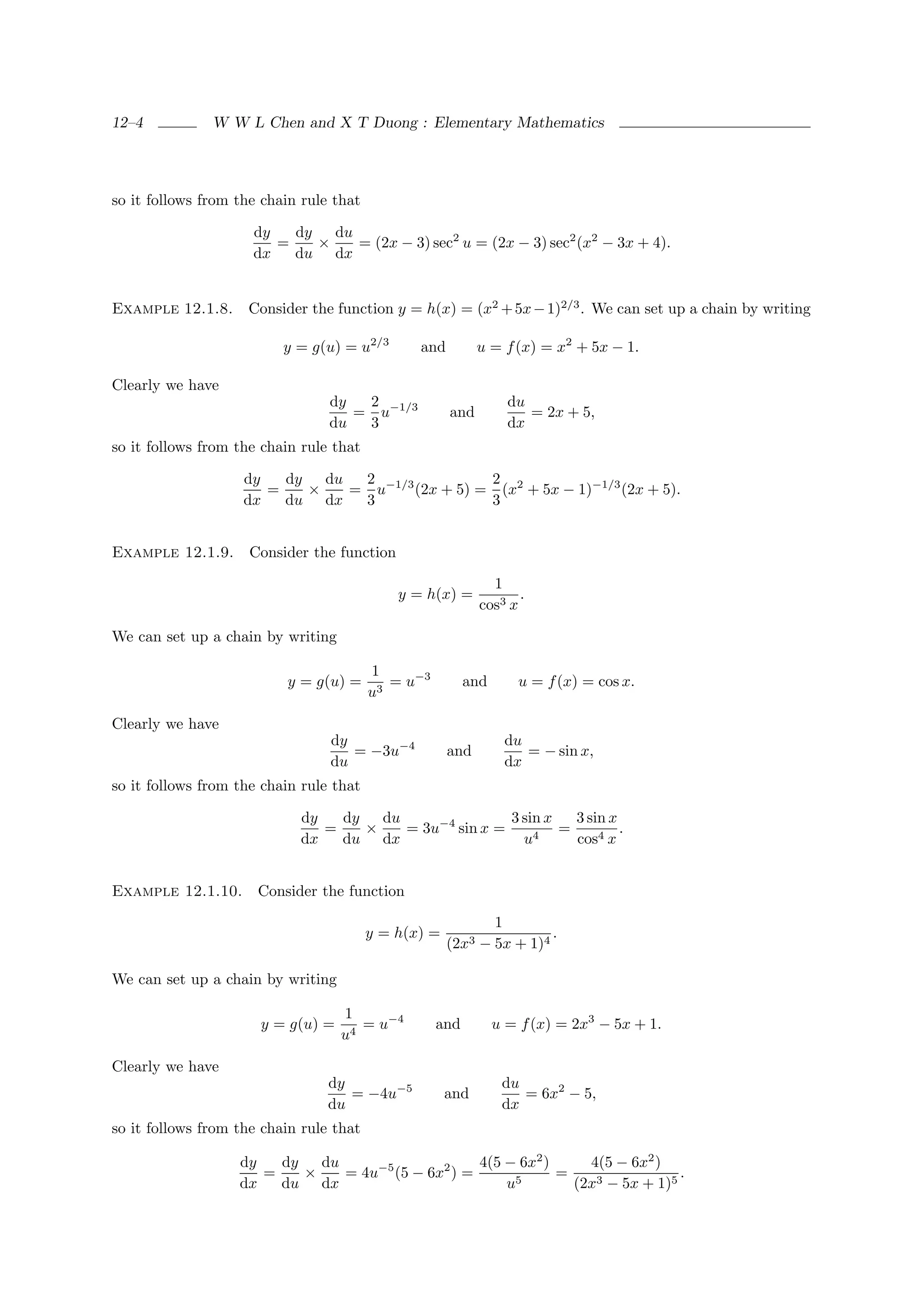
so it follows from the chain rule that

                     dy   dy   du
                        =    ×    = (2x − 3) sec2 u = (2x − 3) sec2 (x2 − 3x + 4).
                     dx   du dx


Example 12.1.8.     Consider the function y = h(x) = (x2 + 5x − 1)2/3 . We can set up a chain by writing

                          y = g(u) = u2/3       and         u = f (x) = x2 + 5x − 1.

Clearly we have
                                 dy  2                            du
                                    = u−1/3           and            = 2x + 5,
                                 du  3                            dx
so it follows from the chain rule that

                    dy   dy   du  2                2
                       =    ×    = u−1/3 (2x + 5) = (x2 + 5x − 1)−1/3 (2x + 5).
                    dx   du dx    3                3


Example 12.1.9.      Consider the function

                                                              1
                                             y = h(x) =            .
                                                            cos3 x

We can set up a chain by writing

                                         1
                          y = g(u) =        = u−3         and      u = f (x) = cos x.
                                         u3

Clearly we have
                                 dy                              du
                                    = −3u−4           and           = − sin x,
                                 du                              dx
so it follows from the chain rule that

                            dy   dy   du                3 sin x   3 sin x
                               =    ×    = 3u−4 sin x =         =         .
                            dx   du dx                    u4      cos4 x


Example 12.1.10.      Consider the function

                                                             1
                                         y = h(x) =                   .
                                                      (2x3 − 5x + 1)4

We can set up a chain by writing

                                   1
                      y = g(u) =      = u−4         and         u = f (x) = 2x3 − 5x + 1.
                                   u4

Clearly we have
                                 dy                              du
                                    = −4u−5           and           = 6x2 − 5,
                                 du                              dx
so it follows from the chain rule that

                   dy   dy   du                     4(5 − 6x2 )     4(5 − 6x2 )
                      =    ×    = 4u−5 (5 − 6x2 ) =             =                 .
                   dx   du dx                           u5        (2x3 − 5x + 1)5
Chapter 12 : Further Techniques of Differentiation            12–5


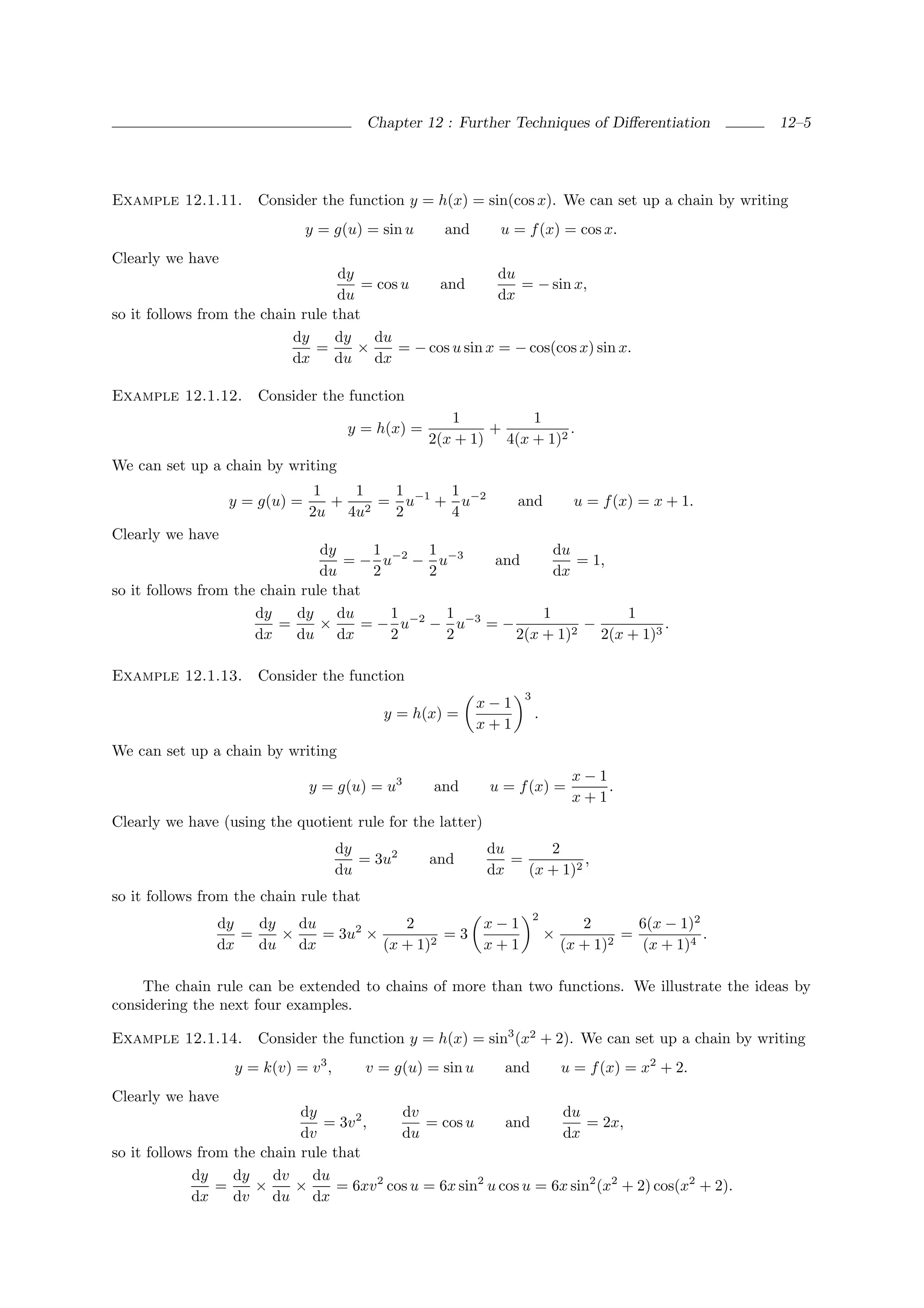
Example 12.1.11.       Consider the function y = h(x) = sin(cos x). We can set up a chain by writing
                               y = g(u) = sin u       and     u = f (x) = cos x.
Clearly we have
                                   dy                       du
                                       = cos u    and          = − sin x,
                                   du                       dx
so it follows from the chain rule that
                            dy    dy    du
                               =      ×     = − cos u sin x = − cos(cos x) sin x.
                            dx    du dx

Example 12.1.12.       Consider the function
                                                       1         1
                                       y = h(x) =           +          .
                                                    2(x + 1) 4(x + 1)2
We can set up a chain by writing
                                1   1  1     1
                  y = g(u) =      + 2 = u−1 + u−2                 and           u = f (x) = x + 1.
                               2u 4u   2     4
Clearly we have
                                dy     1      1               du
                                    = − u−2 − u−3    and         = 1,
                                du     2      2               dx
so it follows from the chain rule that
                      dy    dy     du    1      1           1           1
                         =      ×     = − u−2 − u−3 = −           −           .
                      dx    du dx        2      2       2(x + 1)2   2(x + 1)3

Example 12.1.13.       Consider the function
                                                                  3
                                                            x−1
                                            y = h(x) =                .
                                                            x+1
We can set up a chain by writing
                                                                               x−1
                               y = g(u) = u3        and      u = f (x) =           .
                                                                               x+1
Clearly we have (using the quotient rule for the latter)
                                      dy                    du      2
                                         = 3u2      and        =          ,
                                      du                    dx   (x + 1)2
so it follows from the chain rule that
                                                                      2
                dy   dy   du            2                   x−1                  2       6(x − 1)2
                   =    ×    = 3u2 ×          =3                          ×            =           .
                dx   du dx           (x + 1)2               x+1               (x + 1)2    (x + 1)4

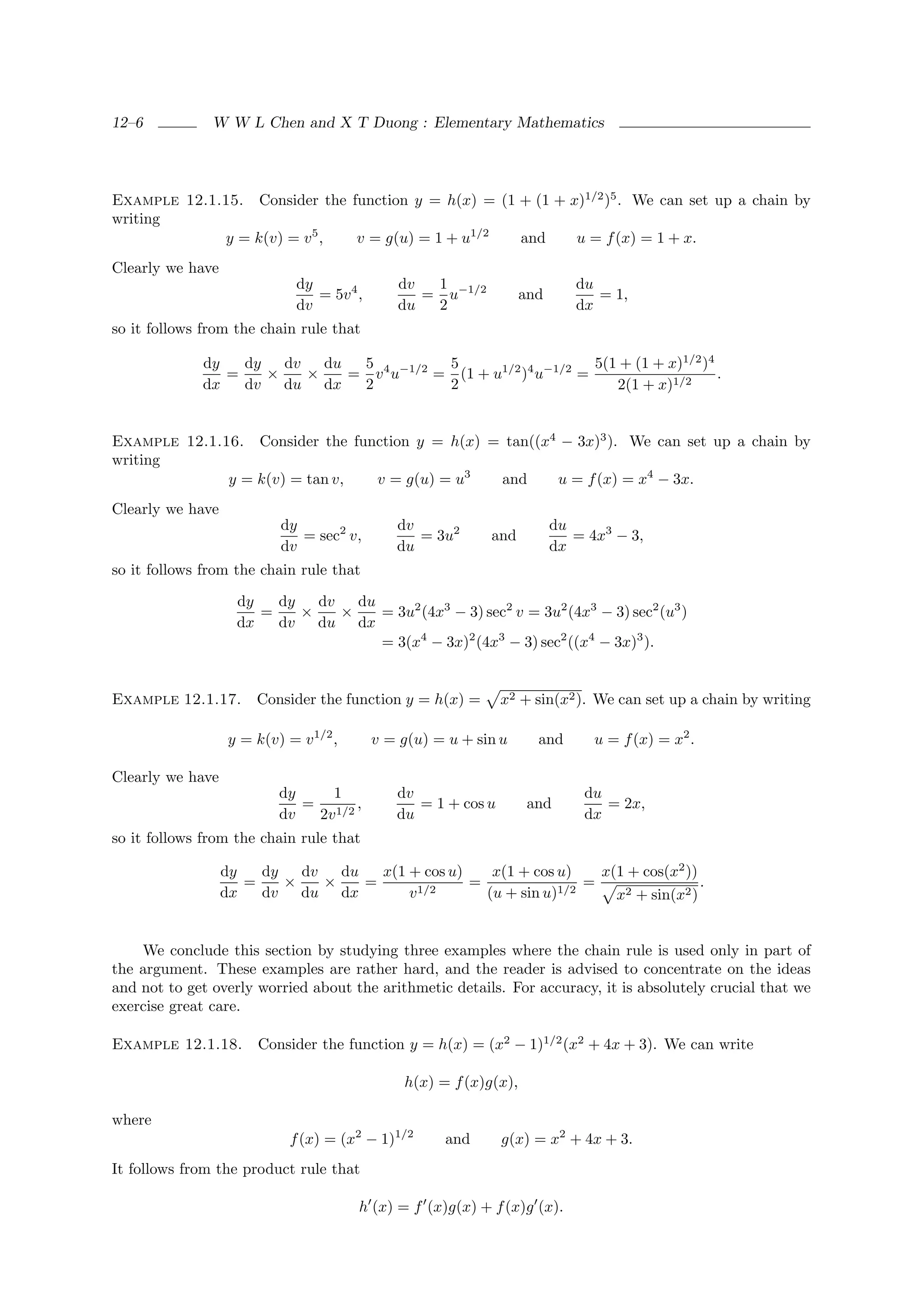
    The chain rule can be extended to chains of more than two functions. We illustrate the ideas by
considering the next four examples.

Example 12.1.14.       Consider the function y = h(x) = sin3 (x2 + 2). We can set up a chain by writing
                   y = k(v) = v 3 ,      v = g(u) = sin u      and            u = f (x) = x2 + 2.
Clearly we have
                             dy              dv                       du
                                = 3v 2 ,         = cos u      and          = 2x,
                             dv              du                       dx
so it follows from the chain rule that
             dy    dy    dv    du
                 =    ×     ×      = 6xv 2 cos u = 6x sin2 u cos u = 6x sin2 (x2 + 2) cos(x2 + 2).
             dx    dv    du dx
12–6           W W L Chen and X T Duong : Elementary Mathematics


Example 12.1.15. Consider the function y = h(x) = (1 + (1 + x)1/2 )5 . We can set up a chain by
writing
             y = k(v) = v 5 ,  v = g(u) = 1 + u1/2   and     u = f (x) = 1 + x.
Clearly we have
                              dy               dv  1                         du
                                 = 5v 4 ,         = u−1/2           and         = 1,
                              dv               du  2                         dx
so it follows from the chain rule that

             dy   dy   dv   du  5           5                     5(1 + (1 + x)1/2 )4
                =    ×    ×    = v 4 u−1/2 = (1 + u1/2 )4 u−1/2 =                     .
             dx   dv   du dx    2           2                        2(1 + x)1/2


Example 12.1.16. Consider the function y = h(x) = tan((x4 − 3x)3 ). We can set up a chain by
writing
              y = k(v) = tan v,  v = g(u) = u3   and     u = f (x) = x4 − 3x.
Clearly we have
                           dy                  dv                         du
                              = sec2 v,           = 3u2      and             = 4x3 − 3,
                           dv                  du                         dx
so it follows from the chain rule that

                    dy   dy   dv   du
                       =    ×    ×    = 3u2 (4x3 − 3) sec2 v = 3u2 (4x3 − 3) sec2 (u3 )
                    dx   dv   du dx
                                      = 3(x4 − 3x)2 (4x3 − 3) sec2 ((x4 − 3x)3 ).


Example 12.1.17.       Consider the function y = h(x) =         x2 + sin(x2 ). We can set up a chain by writing

                   y = k(v) = v 1/2 ,       v = g(u) = u + sin u      and       u = f (x) = x2 .

Clearly we have
                           dy    1             dv                             du
                              = 1/2 ,             = 1 + cos u        and         = 2x,
                           dv  2v              du                             dx
so it follows from the chain rule that

                  dy   dy   dv   du   x(1 + cos u)    x(1 + cos u)    x(1 + cos(x2 ))
                     =    ×    ×    =       1/2
                                                   =            1/2
                                                                    =                 .
                  dx   dv   du dx         v          (u + sin u)        x2 + sin(x2 )


    We conclude this section by studying three examples where the chain rule is used only in part of
the argument. These examples are rather hard, and the reader is advised to concentrate on the ideas
and not to get overly worried about the arithmetic details. For accuracy, it is absolutely crucial that we
exercise great care.

Example 12.1.18.       Consider the function y = h(x) = (x2 − 1)1/2 (x2 + 4x + 3). We can write

                                                h(x) = f (x)g(x),

where
                             f (x) = (x2 − 1)1/2      and       g(x) = x2 + 4x + 3.
It follows from the product rule that

                                        h (x) = f (x)g(x) + f (x)g (x).
Chapter 12 : Further Techniques of Differentiation      12–7


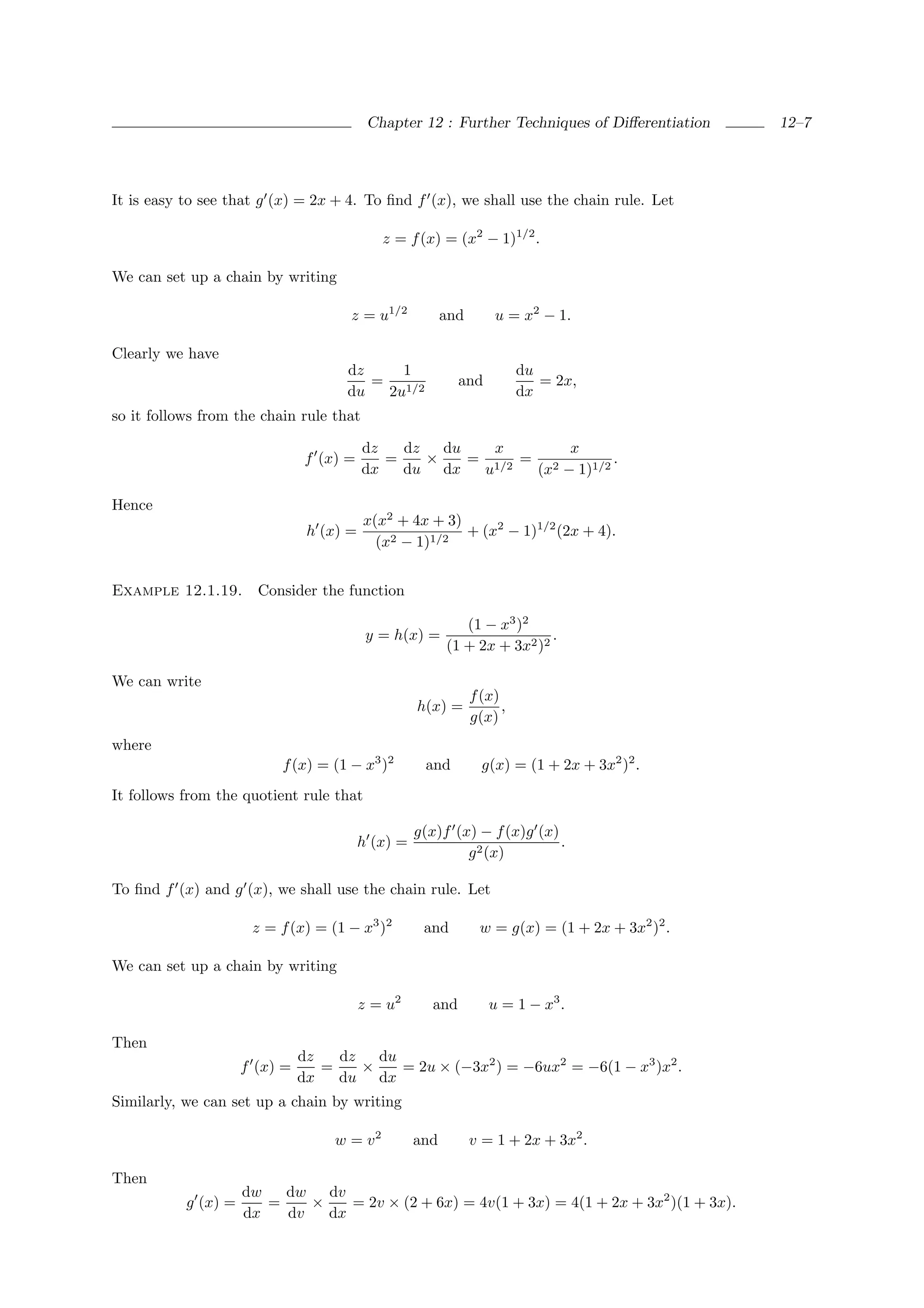
It is easy to see that g (x) = 2x + 4. To find f (x), we shall use the chain rule. Let

                                             z = f (x) = (x2 − 1)1/2 .

We can set up a chain by writing

                                      z = u1/2            and       u = x2 − 1.

Clearly we have
                                     dz    1                              du
                                        = 1/2                and             = 2x,
                                     du  2u                               dx
so it follows from the chain rule that

                                          dz   dz   du    x       x
                                f (x) =      =    ×    = 1/2 = 2         .
                                          dx   du dx    u     (x − 1)1/2

Hence
                                          x(x2 + 4x + 3)
                                h (x) =                  + (x2 − 1)1/2 (2x + 4).
                                            (x2 − 1)1/2


Example 12.1.19.       Consider the function

                                                             (1 − x3 )2
                                           y = h(x) =                      .
                                                          (1 + 2x + 3x2 )2

We can write
                                                                f (x)
                                                    h(x) =            ,
                                                                g(x)
where
                          f (x) = (1 − x3 )2         and          g(x) = (1 + 2x + 3x2 )2 .
It follows from the quotient rule that

                                                    g(x)f (x) − f (x)g (x)
                                          h (x) =                          .
                                                            g 2 (x)

To find f (x) and g (x), we shall use the chain rule. Let

                      z = f (x) = (1 − x3 )2         and          w = g(x) = (1 + 2x + 3x2 )2 .

We can set up a chain by writing

                                          z = u2       and         u = 1 − x3 .

Then
                               dz   dz   du
                     f (x) =      =    ×    = 2u × (−3x2 ) = −6ux2 = −6(1 − x3 )x2 .
                               dx   du dx
Similarly, we can set up a chain by writing

                                    w = v2          and         v = 1 + 2x + 3x2 .

Then
                     dw   dw   dv
           g (x) =      =    ×    = 2v × (2 + 6x) = 4v(1 + 3x) = 4(1 + 2x + 3x2 )(1 + 3x).
                     dx   dv   dx
12–8           W W L Chen and X T Duong : Elementary Mathematics


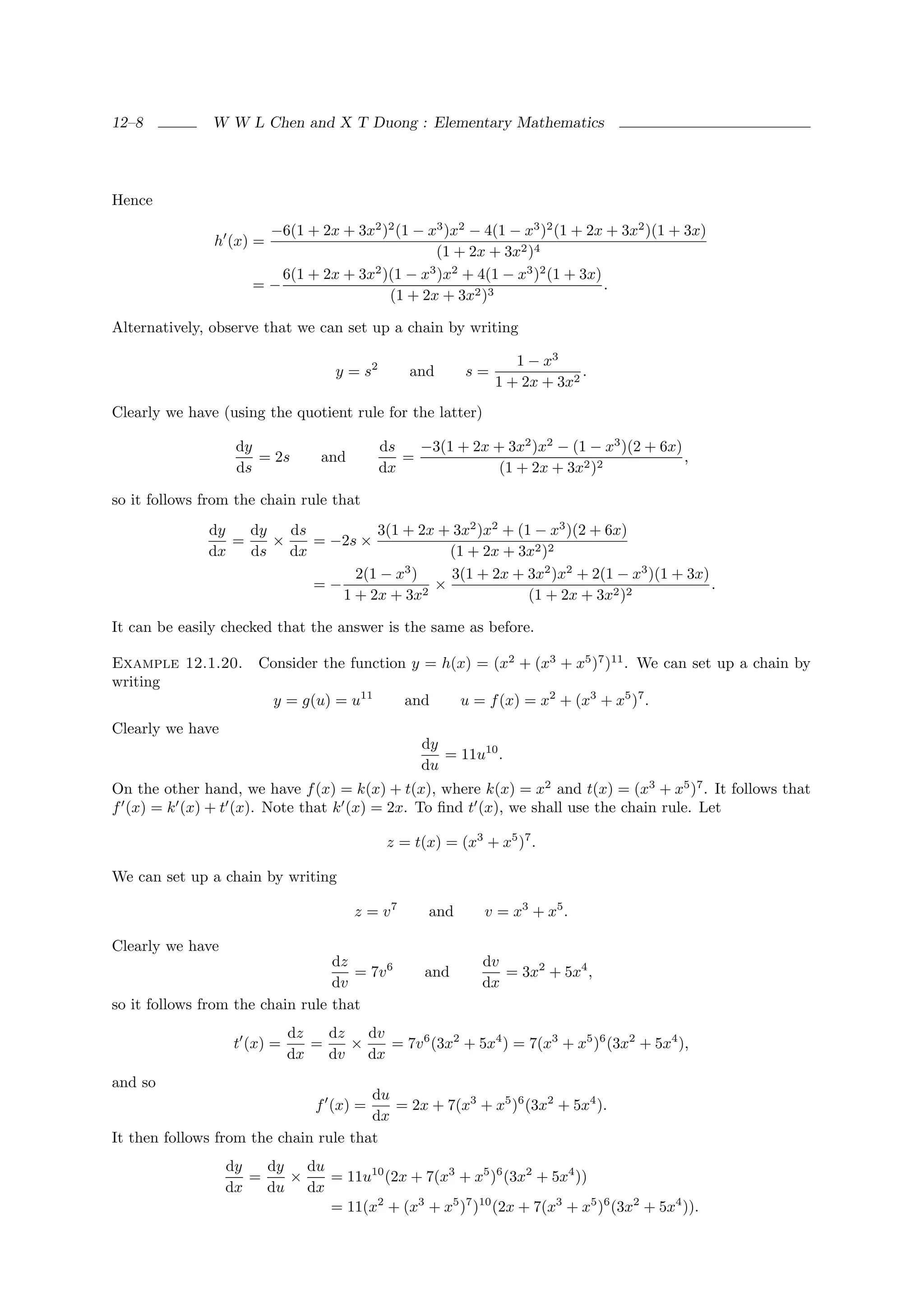
Hence
                       −6(1 + 2x + 3x2 )2 (1 − x3 )x2 − 4(1 − x3 )2 (1 + 2x + 3x2 )(1 + 3x)
               h (x) =
                                                (1 + 2x + 3x2 )4
                         6(1 + 2x + 3x )(1 − x )x + 4(1 − x3 )2 (1 + 3x)
                                      2        3 2
                      =−                                                   .
                                        (1 + 2x + 3x2 )3

Alternatively, observe that we can set up a chain by writing

                                                                  1 − x3
                                    y = s2       and      s=                .
                                                               1 + 2x + 3x2
Clearly we have (using the quotient rule for the latter)

                   dy                        ds   −3(1 + 2x + 3x2 )x2 − (1 − x3 )(2 + 6x)
                      = 2s        and           =                                         ,
                   ds                        dx              (1 + 2x + 3x2 )2

so it follows from the chain rule that
              dy   dy   ds         3(1 + 2x + 3x2 )x2 + (1 − x3 )(2 + 6x)
                 =    ×    = −2s ×
              dx   ds dx                       (1 + 2x + 3x2 )2
                                2(1 − x3 )     3(1 + 2x + 3x2 )x2 + 2(1 − x3 )(1 + 3x)
                           =−              2
                                             ×                                         .
                              1 + 2x + 3x                 (1 + 2x + 3x2 )2

It can be easily checked that the answer is the same as before.

Example 12.1.20.       Consider the function y = h(x) = (x2 + (x3 + x5 )7 )11 . We can set up a chain by
writing
                         y = g(u) = u11          and      u = f (x) = x2 + (x3 + x5 )7 .
Clearly we have
                                                   dy
                                                      = 11u10 .
                                                   du
On the other hand, we have f (x) = k(x) + t(x), where k(x) = x2 and t(x) = (x3 + x5 )7 . It follows that
f (x) = k (x) + t (x). Note that k (x) = 2x. To find t (x), we shall use the chain rule. Let

                                              z = t(x) = (x3 + x5 )7 .

We can set up a chain by writing

                                        z = v7      and      v = x3 + x5 .

Clearly we have
                                  dz                         dv
                                     = 7v 6         and         = 3x2 + 5x4 ,
                                  dv                         dx
so it follows from the chain rule that
                             dz   dz   dv
                   t (x) =      =    ×    = 7v 6 (3x2 + 5x4 ) = 7(x3 + x5 )6 (3x2 + 5x4 ),
                             dx   dv dx
and so
                                       du
                                 f (x) =  = 2x + 7(x3 + x5 )6 (3x2 + 5x4 ).
                                       dx
It then follows from the chain rule that
                  dy   dy   du
                     =    ×    = 11u10 (2x + 7(x3 + x5 )6 (3x2 + 5x4 ))
                  dx   du dx
                               = 11(x2 + (x3 + x5 )7 )10 (2x + 7(x3 + x5 )6 (3x2 + 5x4 )).
Chapter 12 : Further Techniques of Differentiation                 12–9


12.2.   Implicit Differentiation

A function y = f (x) can usually be viewed as a curve on the xy-plane, and gives a relationship between
the (independent) variable x and the (dependent) variable y by describing y explicitly in terms of
x. However, a relationship between two variables x and y cannot always be expressed as a function
y = f (x). Moreover, we may even choose to describe a function y = f (x) implicitly by simply giving
some relationship between the variables x and y, and not describing y explicitly in terms of x.

Example 12.2.1. Consider the equation x2 + y 2 = 25, representing a circle of radius 5 and centred at
the origin (0, 0). This equation expresses a relationship between the two variables x and y, but y is not
given explicitly in terms of x. Indeed, it is not possible to give y explicitly in terms of x, as this equation
does not represent a function y = f (x). To see this, note that if x = 3, then both y = 4 and y = −4
will satisfy the equation, so it is meaningless to talk of f (3). On the other hand, we see that the point
(3, 4) is on the circle, and clearly there is a tangent line to the circle at the point (3, 4), as shown in the
picture below.
                                                    y


                                                4


                                                                                   x
                                                              3    5


                                              -4


If we restrict our attention to the upper semicircle, then we can express the variable y explicitly as a
function of the variable x by writing
                                           y = (25 − x2 )1/2 .
We can set up a chain by writing

                                     y = u1/2           and       u = 25 − x2 .

Clearly we have
                                   dy  1                               du
                                      = u−1/2             and             = −2x,
                                   du  2                               dx
so it follows from the chain rule that
                              dy   dy   du
                                 =    ×    = −xu−1/2 = −x(25 − x2 )−1/2 .
                              dx   du dx
Hence
                                            dy                      3
                                                                  =− .
                                            dx      (x,y)=(3,4)     4
Note that our argument here involves obtaining an explicit expression for the variable y in terms of the
variable x from similar information given implicitly by the equation x2 +y 2 = 25. Now let us see whether
we can obtain a similar conclusion concerning the slope of the tangent line at the point (3, 4) without
first having to obtain the explicit expression y = (25 − x2 )1/2 of the upper semicircle. Let us start from
the equation x2 + y 2 = 25 of the circle. Differentiating both sides with respect to x, we obtain
                                            d 2             d
                                              (x + y 2 ) =    (25).
                                           dx              dx
12–10             W W L Chen and X T Duong : Elementary Mathematics


Using the rule on the derivatives of constants, we obtain
                                                 d
                                                   (25) = 0.
                                                dx
Using the sum rule and the rule on the derivatives of powers, we obtain
                             d 2             d 2       d 2            d 2
                               (x + y 2 ) =    (x ) +    (y ) = 2x +    (y ).
                            dx              dx        dx             dx
We next set up a chain by writing

                                      z = y2         and      y = f (x),

where there is no need to know precisely what f (x) is. Then using the chain rule and the rule on the
derivatives of powers, we obtain
                                     d 2      dz   dz   dy     dy
                                       (y ) =    =    ×    = 2y .
                                    dx        dx   dy dx       dx
Summarizing, we obtain
                                                         dy
                                               2x + 2y      = 0,
                                                         dx
and so
                                                    dy   x
                                                       =− .
                                                    dx   y
Hence
                                           dy                      3
                                                              =−
                                           dx   (x,y)=(3,4)        4
as before.

     The second part of the example above is a case of using implicit differentiation, where we find the
derivative of a function y = f (x) without knowing any explicit expression for the variable y in terms of
the variable x. We shall describe this technique further by discussing a few more examples. In some of
these examples, it may be very difficult, if not impossible, to find any explicit expression for the variable
y in terms of the variable x.

Example 12.2.2.      Suppose that y 2 − x2 = 4. Differentiating both sides with respect to x, we obtain
                                        d 2            d
                                          (y − x2 ) =    (4) = 0.
                                       dx             dx
It follows that
                         d 2            d 2       d 2       d 2
                           (y − x2 ) =    (y ) −    (x ) =    (y ) − 2x = 0.
                        dx             dx        dx        dx
We next set up a chain by writing

                                      z = y2         and      y = f (x),

where there is no need to know precisely what f (x) is. Then
                                     d 2      dz   dz   dy     dy
                                       (y ) =    =    ×    = 2y .
                                    dx        dx   dy dx       dx
Summarizing, we obtain
                                                    dy
                                               2y      − 2x = 0,
                                                    dx
and so
                                                     dy  x
                                                        = .
                                                     dx  y
Chapter 12 : Further Techniques of Differentiation            12–11


Example 12.2.3.     Suppose that y 3 + sin x = 3. Differentiating both sides with respect to x, we obtain

                                         d 3              d
                                           (y + sin x) =    (3) = 0.
                                        dx               dx
It follows that
                      d 3              d 3       d            d 3
                        (y + sin x) =    (y ) +    (sin x) =    (y ) + cos x = 0.
                     dx               dx        dx           dx
We next set up a chain by writing

                                        z = y3       and     y = f (x),

where there is no need to know precisely what f (x) is. Then

                                   d 3      dz   dz   dy       dy
                                     (y ) =    =    ×    = 3y 2 .
                                  dx        dx   dy dx         dx

Summarizing, we obtain
                                                   dy
                                            3y 2      + cos x = 0,
                                                   dx
and so
                                                 dy   cos x
                                                    =− 2 .
                                                 dx    3y

Example 12.2.4.     Suppose that y 5 + 3y 2 − 2x2 + 4 = 0. Differentiating both sides with respect to x,
we obtain
                                   d 5                       d
                                     (y + 3y 2 − 2x2 + 4) =    (0) = 0.
                                  dx                        dx
It follows that
     d 5                       d 5        d          d        d        d 5        d
       (y + 3y 2 − 2x2 + 4) =    (y ) + 3 (y 2 ) − 2 (x2 ) +    (4) =    (y ) + 3 (y 2 ) − 4x = 0.
    dx                        dx         dx         dx       dx       dx         dx
Using the chain rule, we obtain

              d 5      d 5       dy        dy                   d 2      d 2       dy     dy
                (y ) =    (y ) ×    = 5y 4             and        (y ) =    (y ) ×    = 2y .
             dx        dy        dx        dx                  dx        dy        dx     dx

Summarizing, we obtain
                                                        dy
                                          (5y 4 + 6y)      − 4x = 0,
                                                        dx
and so
                                                 dy    4x
                                                    = 4      .
                                                 dx  5y + 6y

Example 12.2.5.     Suppose that xy = 6. Differentiating both sides with respect to x, we obtain

                                            d         d
                                              (xy) =    (6) = 0.
                                           dx        dx
It follows from the product rule that

                            d         d                d             dy
                              (xy) =    (x) × y + x ×    (y) = y + x    = 0,
                           dx        dx               dx             dx
and so
                                                   dy   y
                                                      =− .
                                                   dx   x
12–12             W W L Chen and X T Duong : Elementary Mathematics


Example 12.2.6.      Suppose that x3 + 2x2 y 3 + 3y 4 = 6. Differentiating both sides with respect to x, we
obtain
                                     d 3                        d
                                       (x + 2x2 y 3 + 3y 4 ) =    (6) = 0.
                                    dx                         dx
It follows that
              d 3                        d 3          d 2                  d 3        d
                (x + 2x2 y 3 + 3y 4 ) =    (x ) + 2     (x ) × y 3 + x2 ×    (y ) + 3 (y 4 )
             dx                         dx           dx                   dx         dx
                                                          d 3         d 4
                                     = 3x2 + 4xy 3 + 2x2 (y ) + 3 (y ) = 0.
                                                         dx          dx
Using the chain rule, we obtain

              d 3      d 3       dy        dy                      d 4      d 4       dy       dy
                (y ) =    (y ) ×    = 3y 2               and         (y ) =    (y ) ×    = 4y 3 .
             dx        dy        dx        dx                     dx        dy        dx       dx

Summarizing, we obtain
                                                                        dy
                                   3x2 + 4xy 3 + (6x2 y 2 + 12y 3 )        = 0,
                                                                        dx
and so
                                             dy    3x2 + 4xy 3
                                                =− 2 2         .
                                             dx   6x y + 12y 3
Note next that the point (1, 1) satisfies the equation. It follows that

                                             dy                      7
                                                                =−      .
                                             dx   (x,y)=(1,1)        18

Check that the equation of the tangent line at this point is given by 7x + 18y = 25.

Example 12.2.7.      Suppose that (x2 + y 3 )2 = 9. Differentiating both sides with respect to x, we obtain

                                          d                    d
                                            ((x2 + y 3 )2 ) =    (9) = 0.
                                         dx                   dx
Let w = (x2 + y 3 )2 . We can set up a chain by writing

                                     w = z2         and         z = x2 + y 3 ,

so it follows from the chain rule that
                    d                   dw   dw   dz      dz                d
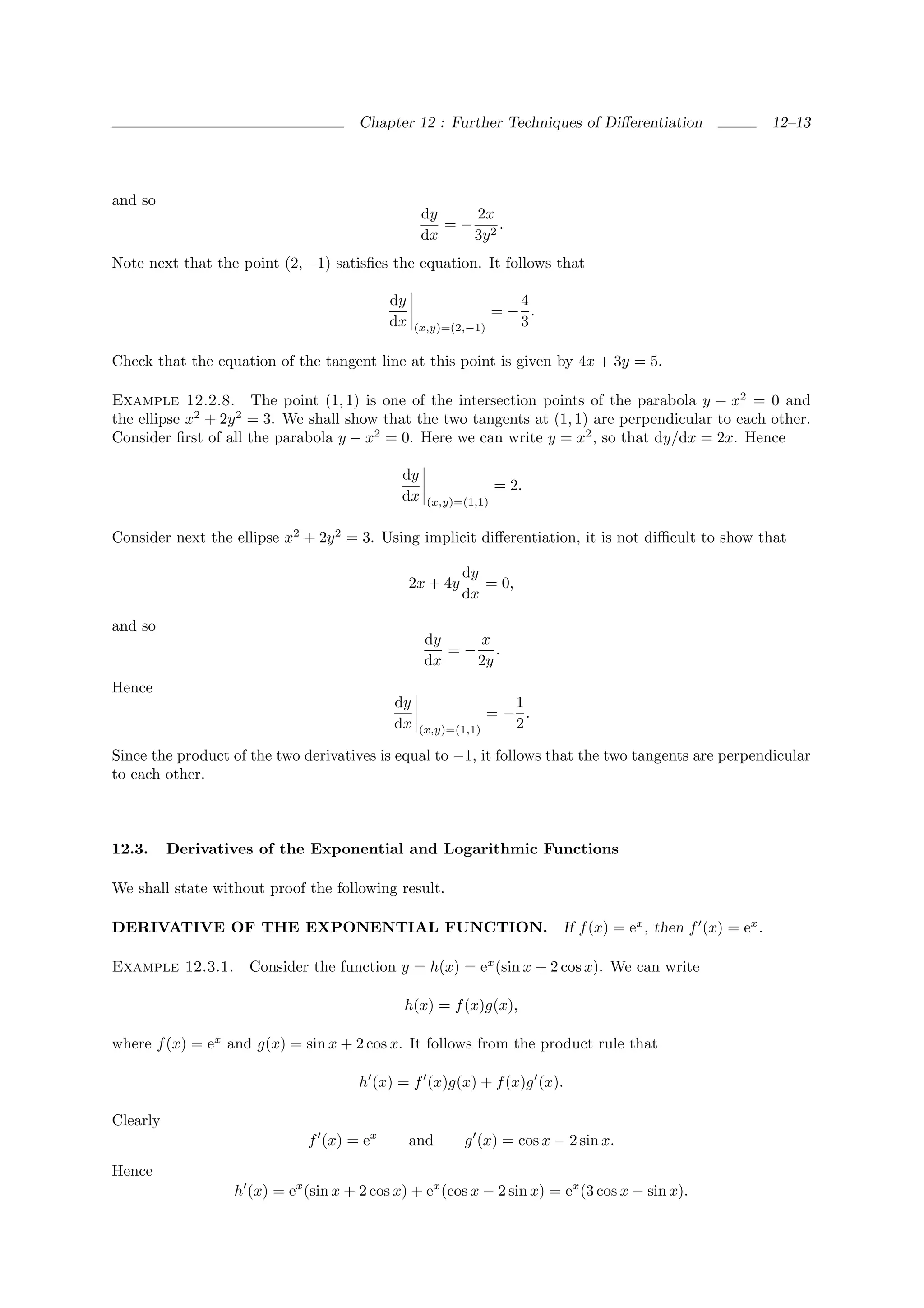
                      ((x2 + y 3 )2 ) =    =    ×    = 2z    = 2(x2 + y 3 ) (x2 + y 3 ).
                   dx                   dx   dz   dx      dx               dx
Hence
                                                         d 2
                                          (x2 + y 3 )      (x + y 3 ) = 0.
                                                        dx
On the other hand,
                           d 2              d 2       d 3               dy
                             (x + y 3 ) =     (x ) +    (y ) = 2x + 3y 2 ,
                          dx               dx        dx                 dx
where we have used the chain rule at the last step. Summarizing, we obtain

                                                                 dy
                                         (x2 + y 3 ) 2x + 3y 2          = 0.
                                                                 dx

It is clear that x2 + y 3 = 0 for any point (x, y) satisfying the equation. It follows that

                                                            dy
                                               2x + 3y 2       = 0,
                                                            dx
Chapter 12 : Further Techniques of Differentiation              12–13


and so
                                                  dy    2x
                                                     = − 2.
                                                  dx    3y
Note next that the point (2, −1) satisfies the equation. It follows that

                                           dy                      4
                                                                 =− .
                                           dx    (x,y)=(2,−1)      3

Check that the equation of the tangent line at this point is given by 4x + 3y = 5.

Example 12.2.8. The point (1, 1) is one of the intersection points of the parabola y − x2 = 0 and
the ellipse x2 + 2y 2 = 3. We shall show that the two tangents at (1, 1) are perpendicular to each other.
Consider first of all the parabola y − x2 = 0. Here we can write y = x2 , so that dy/dx = 2x. Hence

                                             dy
                                                                 = 2.
                                             dx    (x,y)=(1,1)


Consider next the ellipse x2 + 2y 2 = 3. Using implicit differentiation, it is not difficult to show that

                                                          dy
                                                2x + 4y      = 0,
                                                          dx

and so
                                                  dy   x
                                                     =− .
                                                  dx   2y
Hence
                                            dy                    1
                                                                =− .
                                            dx   (x,y)=(1,1)      2

Since the product of the two derivatives is equal to −1, it follows that the two tangents are perpendicular
to each other.


12.3.     Derivatives of the Exponential and Logarithmic Functions

We shall state without proof the following result.

DERIVATIVE OF THE EXPONENTIAL FUNCTION. If f (x) = ex , then f (x) = ex .

Example 12.3.1.      Consider the function y = h(x) = ex (sin x + 2 cos x). We can write

                                              h(x) = f (x)g(x),

where f (x) = ex and g(x) = sin x + 2 cos x. It follows from the product rule that

                                      h (x) = f (x)g(x) + f (x)g (x).

Clearly
                              f (x) = ex        and       g (x) = cos x − 2 sin x.
Hence
                  h (x) = ex (sin x + 2 cos x) + ex (cos x − 2 sin x) = ex (3 cos x − sin x).
12–14             W W L Chen and X T Duong : Elementary Mathematics


Example 12.3.2.      Consider the function y = h(x) = ex (x2 + x + 2). We can write

                                              h(x) = f (x)g(x),

where f (x) = ex and g(x) = x2 + x + 2. It follows from the product rule that

                                     h (x) = f (x)g(x) + f (x)g (x).

Clearly
                                 f (x) = ex        and     g (x) = 2x + 1.

Hence
                         h (x) = ex (x2 + x + 2) + ex (2x + 1) = ex (x2 + 3x + 3).


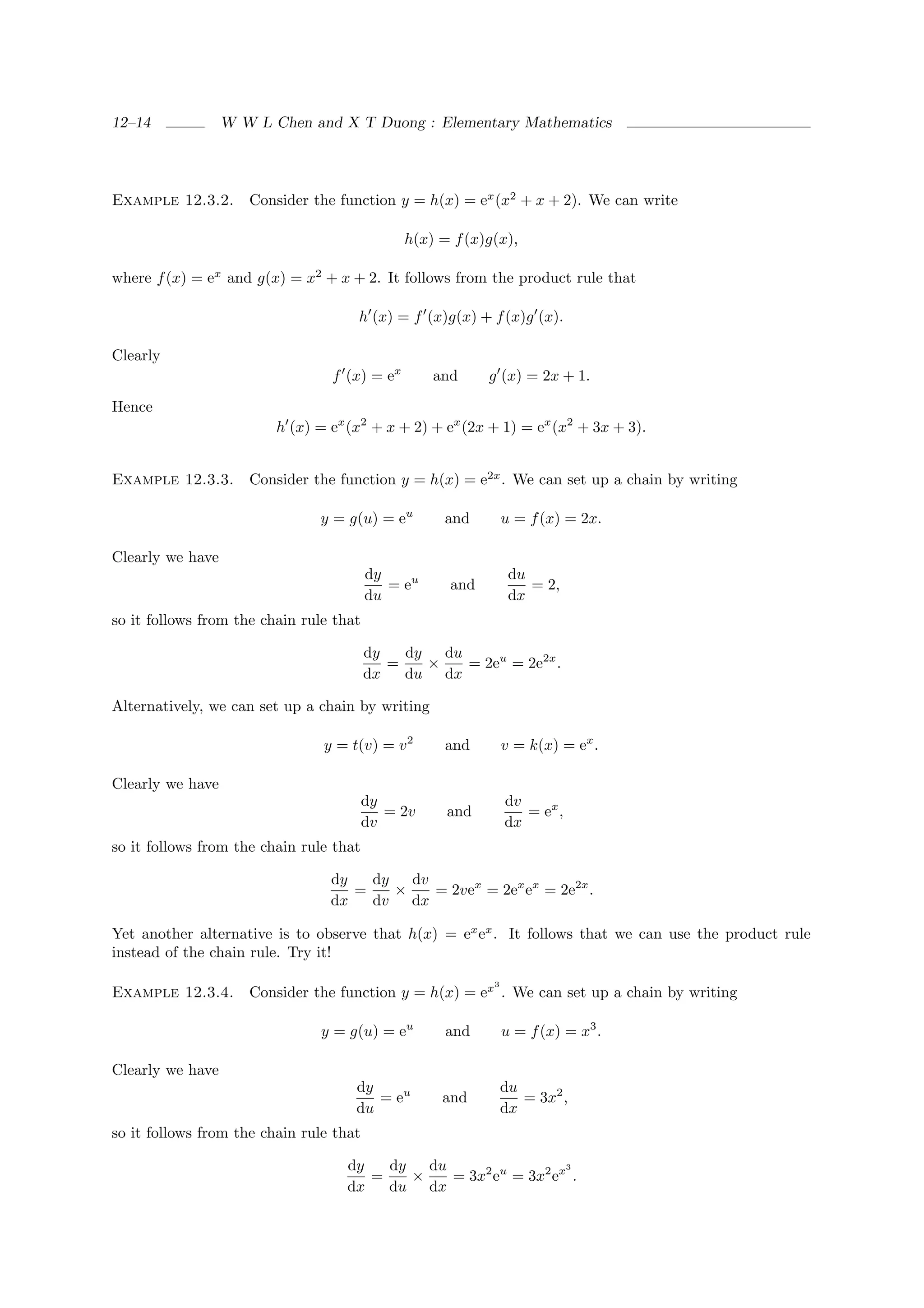
Example 12.3.3.      Consider the function y = h(x) = e2x . We can set up a chain by writing

                               y = g(u) = eu        and        u = f (x) = 2x.

Clearly we have
                                         dy                     du
                                            = eu     and           = 2,
                                         du                     dx
so it follows from the chain rule that

                                         dy   dy   du
                                            =    ×    = 2eu = 2e2x .
                                         dx   du dx

Alternatively, we can set up a chain by writing

                                y = t(v) = v 2      and        v = k(x) = ex .

Clearly we have
                                         dy                    dv
                                            = 2v    and           = ex ,
                                         dv                    dx
so it follows from the chain rule that

                                 dy   dy   dv
                                    =    ×    = 2vex = 2ex ex = 2e2x .
                                 dx   dv   dx

Yet another alternative is to observe that h(x) = ex ex . It follows that we can use the product rule
instead of the chain rule. Try it!
                                                           3
Example 12.3.4.      Consider the function y = h(x) = ex . We can set up a chain by writing

                               y = g(u) = eu        and        u = f (x) = x3 .

Clearly we have
                                     dy                        du
                                        = eu        and           = 3x2 ,
                                     du                        dx
so it follows from the chain rule that

                                    dy   dy   du                  3
                                       =    ×    = 3x2 eu = 3x2 ex .
                                    dx   du dx
Chapter 12 : Further Techniques of Differentiation                   12–15


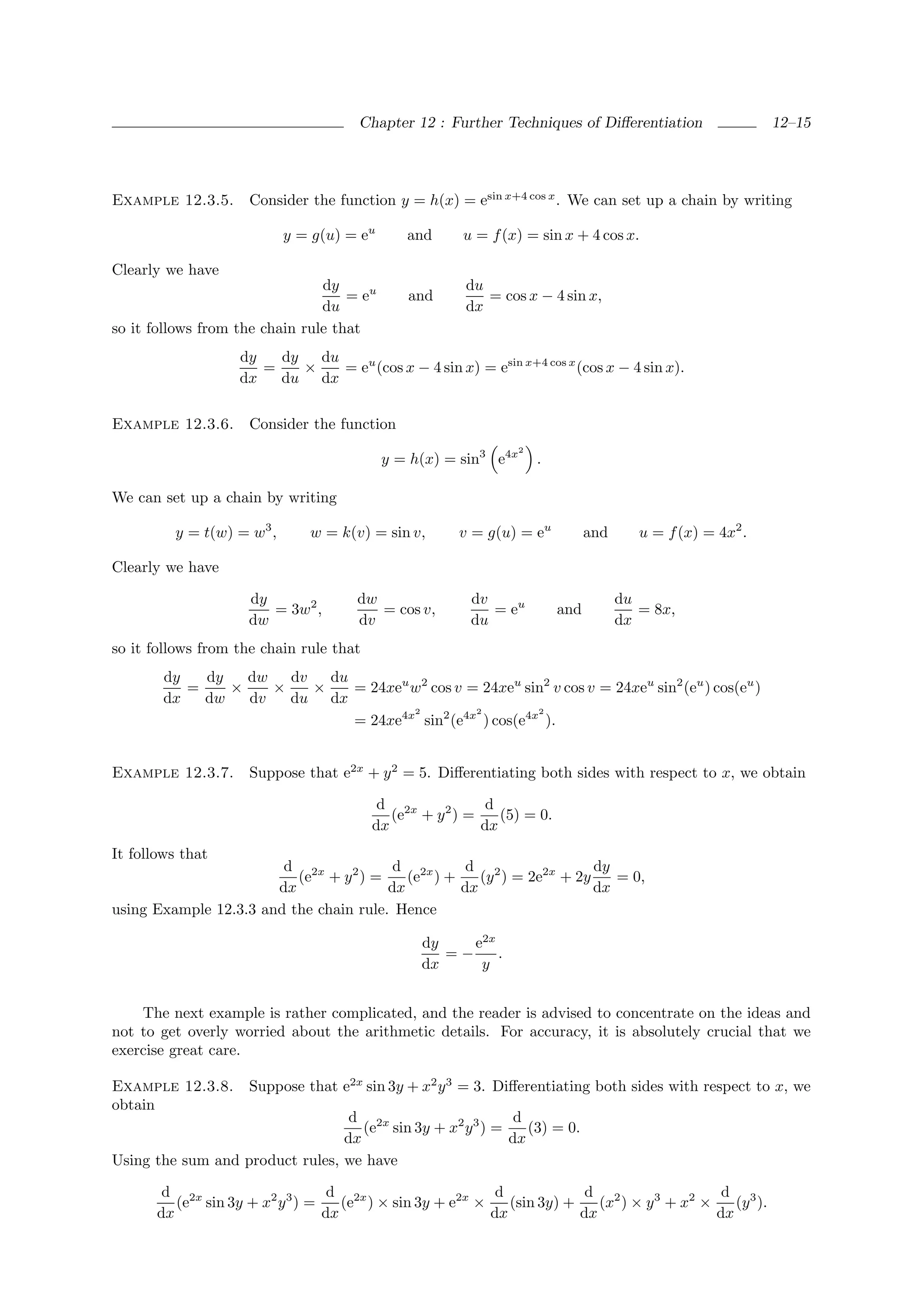
Example 12.3.5.      Consider the function y = h(x) = esin x+4 cos x . We can set up a chain by writing

                           y = g(u) = eu      and     u = f (x) = sin x + 4 cos x.

Clearly we have
                                dy                     du
                                    = eu      and         = cos x − 4 sin x,
                                du                     dx
so it follows from the chain rule that
                   dy   dy   du
                      =    ×    = eu (cos x − 4 sin x) = esin x+4 cos x (cos x − 4 sin x).
                   dx   du dx

Example 12.3.6.      Consider the function
                                                               2
                                           y = h(x) = sin3 e4x     .

We can set up a chain by writing

         y = t(w) = w3 ,      w = k(v) = sin v,       v = g(u) = eu          and      u = f (x) = 4x2 .

Clearly we have

                     dy              dw                dv                          du
                        = 3w2 ,         = cos v,          = eu         and            = 8x,
                     dw              dv                du                          dx
so it follows from the chain rule that
        dy   dy   dw   dv   du
           =    ×    ×    ×    = 24xeu w2 cos v = 24xeu sin2 v cos v = 24xeu sin2 (eu ) cos(eu )
        dx   dw   dv   du dx
                                       2         2         2
                               = 24xe4x sin2 (e4x ) cos(e4x ).


Example 12.3.7.      Suppose that e2x + y 2 = 5. Differentiating both sides with respect to x, we obtain

                                          d 2x            d
                                            (e + y 2 ) =    (5) = 0.
                                         dx              dx
It follows that
                        d 2x             d 2x      d 2                dy
                          (e + y 2 ) =     (e ) +    (y ) = 2e2x + 2y    = 0,
                       dx               dx        dx                  dx
using Example 12.3.3 and the chain rule. Hence

                                                dy    e2x
                                                   =−     .
                                                dx     y


    The next example is rather complicated, and the reader is advised to concentrate on the ideas and
not to get overly worried about the arithmetic details. For accuracy, it is absolutely crucial that we
exercise great care.

Example 12.3.8.      Suppose that e2x sin 3y + x2 y 3 = 3. Differentiating both sides with respect to x, we
obtain
                                  d 2x                      d
                                    (e sin 3y + x2 y 3 ) =    (3) = 0.
                                 dx                        dx
Using the sum and product rules, we have

        d 2x                      d 2x                     d             d 2                  d 3
          (e sin 3y + x2 y 3 ) =    (e ) × sin 3y + e2x ×    (sin 3y) +    (x ) × y 3 + x2 ×    (y ).
       dx                        dx                       dx            dx                   dx
12–16           W W L Chen and X T Duong : Elementary Mathematics


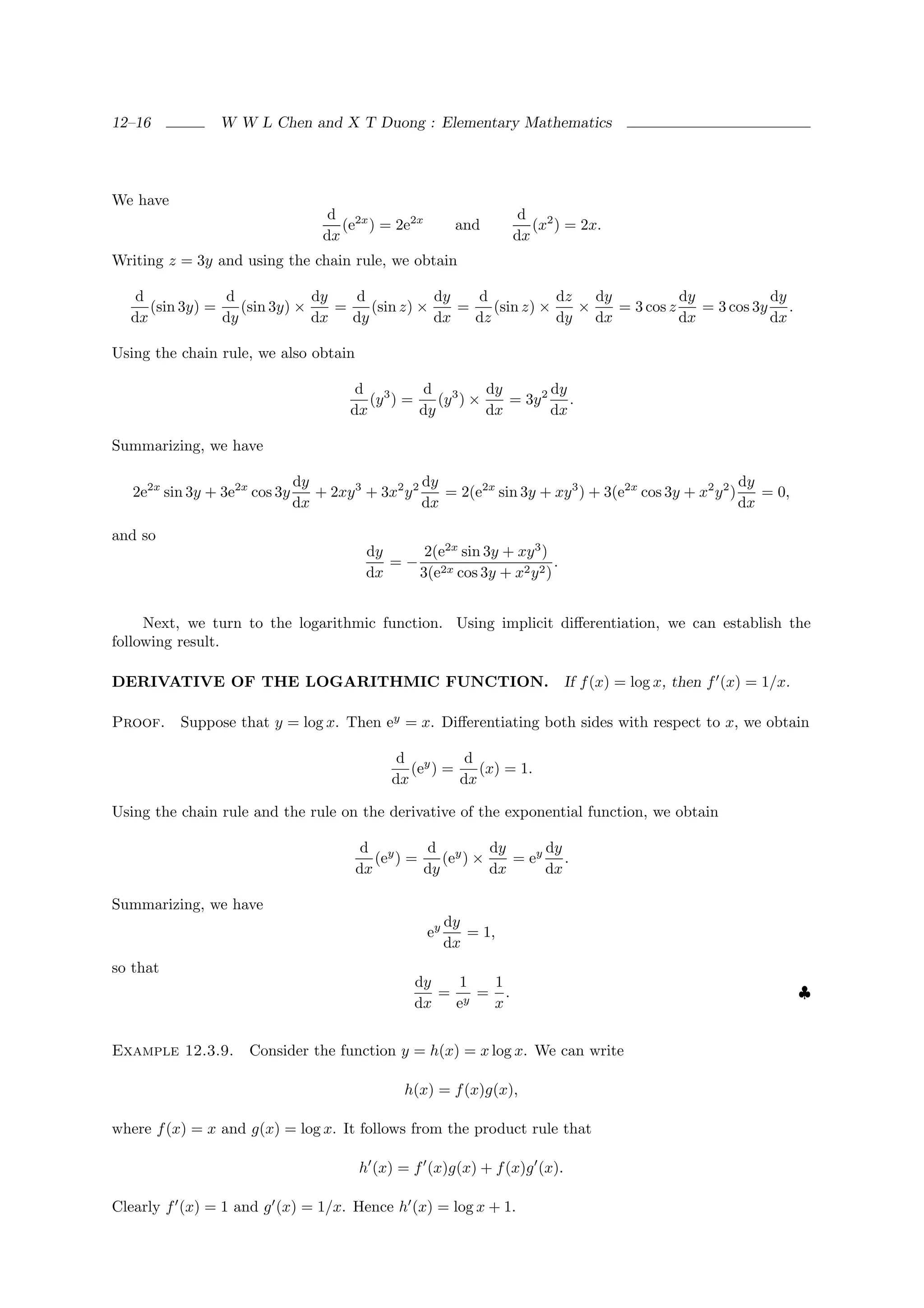
We have
                                    d 2x                            d 2
                                      (e ) = 2e2x         and         (x ) = 2x.
                                   dx                              dx
Writing z = 3y and using the chain rule, we obtain

   d            d             dy   d            dy   d            dz   dy           dy           dy
     (sin 3y) =    (sin 3y) ×    =    (sin z) ×    =    (sin z) ×    ×    = 3 cos z    = 3 cos 3y .
  dx            dy            dx   dy           dx   dz           dy dx             dx           dx

Using the chain rule, we also obtain

                                         d 3      d 3       dy       dy
                                           (y ) =    (y ) ×    = 3y 2 .
                                        dx        dy        dx       dx

Summarizing, we have

                               dy                   dy                                                   dy
   2e2x sin 3y + 3e2x cos 3y      + 2xy 3 + 3x2 y 2    = 2(e2x sin 3y + xy 3 ) + 3(e2x cos 3y + x2 y 2 )    = 0,
                               dx                   dx                                                   dx

and so
                                           dy     2(e2x sin 3y + xy 3 )
                                              = − 2x                    .
                                           dx    3(e cos 3y + x2 y 2 )


     Next, we turn to the logarithmic function. Using implicit differentiation, we can establish the
following result.

DERIVATIVE OF THE LOGARITHMIC FUNCTION. If f (x) = log x, then f (x) = 1/x.

Proof. Suppose that y = log x. Then ey = x. Differentiating both sides with respect to x, we obtain

                                                d y       d
                                                  (e ) =    (x) = 1.
                                               dx        dx

Using the chain rule and the rule on the derivative of the exponential function, we obtain

                                          d y      d y       dy     dy
                                            (e ) =    (e ) ×    = ey .
                                         dx        dy        dx     dx

Summarizing, we have
                                                         dy
                                                    ey      = 1,
                                                         dx
so that
                                                  dy   1  1
                                                     = y = .                                                       ♣
                                                  dx  e   x


Example 12.3.9.      Consider the function y = h(x) = x log x. We can write

                                                 h(x) = f (x)g(x),

where f (x) = x and g(x) = log x. It follows from the product rule that

                                         h (x) = f (x)g(x) + f (x)g (x).

Clearly f (x) = 1 and g (x) = 1/x. Hence h (x) = log x + 1.
Chapter 12 : Further Techniques of Differentiation                12–17


Example 12.3.10.      Consider the function

                                                          x log x + sin x
                                         y = h(x) =                       .
                                                                 ex

We can write
                                                         f (x) + k(x)
                                             h(x) =                   ,
                                                             g(x)
where f (x) = x log x, k(x) = sin x and g(x) = ex . It follows from the sum and quotient rules that

                                      g(x)(f (x) + k (x)) − (f (x) + k(x))g (x)
                            h (x) =                                             .
                                                       g 2 (x)

Clearly k (x) = cos x and g (x) = ex . Observe also from Example 12.3.9 that f (x) = log x + 1. Hence

                   ex (log x + 1 + cos x) − (x log x + sin x)ex   (1 − x) log x + 1 + cos x − sin x
         h (x) =                                                =                                   .
                                        e2x                                      ex


Example 12.3.11.      Consider the function y = h(x) = log(5x2 + 3). We can set up a chain by writing

                            y = g(u) = log u         and        u = f (x) = 5x2 + 3.

Clearly we have
                                       dy   1                    du
                                          =           and           = 10x,
                                       du   u                    dx
so it follows from the chain rule that

                                      dy   dy   du   10x    10x
                                         =    ×    =     = 2     .
                                      dx   du dx      u   5x + 3


Example 12.3.12.       Consider the function y = h(x) = log(tan x + sec x). We can set up a chain by
writing
                          y = g(u) = log u         and       u = f (x) = tan x + sec x.
Clearly we have
                              dy   1                     du
                                 =           and            = sec2 x + tan x sec x,
                              du   u                     dx
so it follows from the chain rule that

                   dy   dy   du   sec2 x + tan x sec x   sec2 x + tan x sec x
                      =    ×    =                      =                      = sec x.
                   dx   du dx              u                tan x + sec x


Example 12.3.13.       Consider the function y = h(x) = log(cot x + csc x). We can set up a chain by
writing
                          y = g(u) = log u         and        u = f (x) = cot x + csc x.
Clearly we have
                             dy   1                   du
                                =          and           = − csc2 x − cot x csc x,
                             du   u                   dx
so it follows from the chain rule that

               dy   dy   du   − csc2 x − cot x csc x    csc2 x + cot x csc x
                  =    ×    =                        =−                      = − csc x.
               dx   du dx               u                  cot x + csc x
12–18             W W L Chen and X T Duong : Elementary Mathematics


Example 12.3.14.       Consider the function y = h(x) = log(sin(x1/2 )). We can set up a chain by writing

                   y = k(v) = log v,        v = g(u) = sin u         and       u = f (x) = x1/2 .

Clearly we have
                            dy     1        dv                             du    1
                               = ,             = cos u         and            = 1/2 ,
                            dv     v        du                             dx  2x
so it follows from the chain rule that
                      dy   dy   dv   du   cos u   cos u     cos(x1/2 )
                         =    ×    ×    = 1/2 = 1/2      = 1/2          .
                      dx   dv   du dx    2x v   2x sin u  2x sin(x1/2 )


Example 12.3.15.       Suppose that x log y + y 2 = 4. Differentiating both sides with respect to x, we
obtain
                                          d                     d
                                            (x log y + y 2 ) =    (4) = 0.
                                         dx                    dx
It follows that
         d                     d                    d            d 2                d          d 2
           (x log y + y 2 ) =    (x) × log y + x ×    (log y) +    (y ) = log y + x (log y) +    (y ).
        dx                    dx                   dx           dx                 dx         dx
By the chain rule, we have
                                     d           d            dy   1 dy
                                       (log y) =    (log y) ×    =
                                    dx           dy           dx   y dx
and
                                        d 2      d 2       dy     dy
                                          (y ) =    (y ) ×    = 2y .
                                       dx        dy        dx     dx
Summarizing, we have
                                                     x          dy
                                          log y +      + 2y        = 0,
                                                     y          dx
so that
                                                dy     y log y
                                                   =−          .
                                                dx    x + 2y 2

Example 12.3.16.       Suppose that log(xy 2 ) = 2x2 . Differentiating both sides with respect to x, we
obtain
                                      d                 d
                                        (log(xy 2 )) =    (2x2 ) = 4x.
                                     dx                dx
Let z = log(xy 2 ). We can set up a chain by writing

                                       z = log u         and      u = xy 2 .

Then it follows from the chain rule that
                        d                dz   dz   du  1 du   1   d
                          (log(xy 2 )) =    =    ×    = ×   = 2×    (xy 2 ).
                       dx                dx   du dx    u dx  xy  dx
Next, we observe that
               d            d                  d 2                d 2       dy            dy
                 (xy 2 ) =    (x) × y 2 + x ×    (y ) = y 2 + x ×    (y ) ×    = y 2 + 2xy .
              dx           dx                 dx                  dy        dx            dx
Summarizing, we have
                                                         dy
                                             y 2 + 2xy      = 4x2 y 2 ,
                                                         dx
so that
                                               dy   (4x2 − 1)y 2
                                                  =              .
                                               dx       2xy
Chapter 12 : Further Techniques of Differentiation           12–19


12.4.     Derivatives of the Inverse Trigonometric Functions

The purpose of this last section is to determine the derivatives of the inverse trigonometric functions by
using implicit differentiation and our knowledge on the derivatives of the trigonometric functions.
    For notational purposes, we shall write
                                 y = sin−1 x     if and only if        x = sin y,
and similarly for the other trigonometric functions. These inverse trigonometric functions are well
defined, provided that we restrict the values for x to suitable intervals of real numbers.

DERIVATIVES OF THE INVERSE TRIGONOMETRIC FUNCTIONS.
                         dy       1
(a) If y = sin−1 x, then    =√           .
                         dx     1 − x2
                         dy          1
(b) If y = cos−1 x, then    = −√            .
                         dx       1 − x2
                         dy      1
(c) If y = tan−1 x, then    =          .
                         dx   1 + x2
                         dy        1
(d) If y = cot−1 x, then    =−           .
                         dx     1 + x2
                         dy        1
(e) If y = sec−1 x, then    = √            .
                         dx   x x2 − 1
                         dy          1
(f) If y = csc−1 x, then    =− √              .
                         dx     x x2 − 1
Sketch of Proof. For simplicity, we shall assume that 0 < y < π/2, so that y is in the first quadrant,
and so all the trigonometric functions have positive values.
    (a) If y = sin−1 x, then x = sin y. Differentiating with respect to x, we obtain
                                                            dy
                                                1 = cos y      ,
                                                            dx
so that
                                    dy     1           1                    1
                                       =       =                     =√          .
                                    dx   cos y      1 − sin y 2           1 − x2
                     −1
    (b) If y = cos        x, then x = cos y. Differentiating with respect to x, we obtain
                                                              dy
                                                1 = − sin y      ,
                                                              dx
so that
                                 dy      1              1                     1
                                    =−       =−                      = −√          .
                                 dx    sin y         1 − cos2 y             1 − x2
    (c) If y = tan−1 x, then x = tan y. Differentiating with respect to x, we obtain
                                                             dy
                                                1 = sec2 y      ,
                                                             dx
so that
                                     dy     1          1          1
                                        =     2y
                                                 =        2  =        .
                                     dx   sec      1 + tan y   1 + x2
    (d)    If y = cot−1 x, then x = cot y. Differentiating with respect to x, we obtain
                                                              dy
                                               1 = − csc2 y      ,
                                                              dx
so that
                                  dy     1       1           1
                                     =− 2 =−        2  =−        .
                                  dx   csc y 1 + cot y    1 + x2
12–20             W W L Chen and X T Duong : Elementary Mathematics


      (e)   If y = sec−1 x, then x = sec y. Differentiating with respect to x, we obtain

                                                                      dy
                                                    1 = tan y sec y      ,
                                                                      dx
so that
                                dy        1                 1                1
                                   =             =                       = √       .
                                dx   tan y sec y   (sec2 y − 1)1/2 sec y  x x2 − 1
      (f)   If y = csc−1 x, then x = csc y. Differentiating with respect to x, we obtain

                                                                       dy
                                                1 = − cot y csc y         ,
                                                                       dx
so that
                            dy         1                  1                 1
                               =−             =−                       =− √       .                            ♣
                            dx    cot y csc y    (csc2 y − 1)1/2 csc y   x x2 − 1

      There is no need to remember the derivatives of any of these inverse trigonometric functions.


                                           Problems for Chapter 12

 1. By making suitable use of the chain rule and other rules as appropriate, find the derivative of each
    of the following functions:
                 √
     a) h(x) = 1 − cos x               b) h(x) = sin(3x)                  c) h(x) = cos(sin x)
     d) h(x) = x2 cos x                e) h(x) = sin(2x) sin(3x)          f) h(x) = 2x sin(3x)
     g) h(x) = tan(3x)                 h) h(x) = 4 sec(5x)                i) h(x) = cos(x3 )
                    3
      j) h(x) = cos x                                     2
                                       k) h(x) = (1 + cos x)  6
                                                                          l) h(x) = tan(x2 ) + tan2 x
     m) h(x) = cos(tan x)              n) h(x) = sin(sin x)

 2. Find the derivative of each of the following functions:
     a) h(x) = sin(ex )                  b) h(x) = esin x                             c) h(x) = e−2x sin x
                 x
     d) h(x) = e sin(2x)                 e) h(x) = tan(e−3x )                         f) h(x) = tan(ex )

 3.     a) For each k = 0, 1, 2, 3, . . . , find a function fk (x) such that fk (x) = xk .
        b) For each k = −2, −3, −4, . . . , find a function fk (x) such that fk (x) = xk .
        c) Find a function f−1 (x) such that f−1 (x) = x−1 .

 4. Find the derivative of each of the following functions:
                                                                              2                        1
        a) h(x) = (3x2 + π)(ex − 4)           b) h(x) = x5 + 3x2 +               +1   c) h(x) = 2x − √ + e2x
                                                                              x4                      3
                                                                                                        x
        d) h(x) = 2ex + xe3x                  e) h(x) = etan x                        f) h(x) = 2xex − x−2
                                                        √                                        x+2
        g) h(x) = log(log(2x3 ))              h) h(x) = x + 5                         i) h(x) = 2
                                                                                                x +1
        j) h(x) = sin(2x + 3)                 k) h(x) = cos2 (2x)                     l) h(x) = log(e−x − 1)
                     x
                         +e−x                           x2 + 1
      m) h(x) = ee                            n) h(x) = √                             o) h(x) = (x + 3)2
                                                            x
        p) h(x) = log(2x + 3)                 q) h(x) = tan(3x + 2x2 )                r) h(x) = cos(e2x )

                                              dy
 5. Use implicit differentiation to find              for each of the following relations:
                                              dx                √                        √     √
        a) x2 + xy − y 3 = xy 2               b)    x2 + y 2 = 7                     c) x + y = 25
        d) sin(xy) = 2x + 5                    e)   x log y + y 3 = log x            f) y 3 − xy = −6
        g) x2 − xy + y 4 = x2 y               h)    sin(xy) = 3x2 − 2
Chapter 12 : Further Techniques of Differentiation            12–21


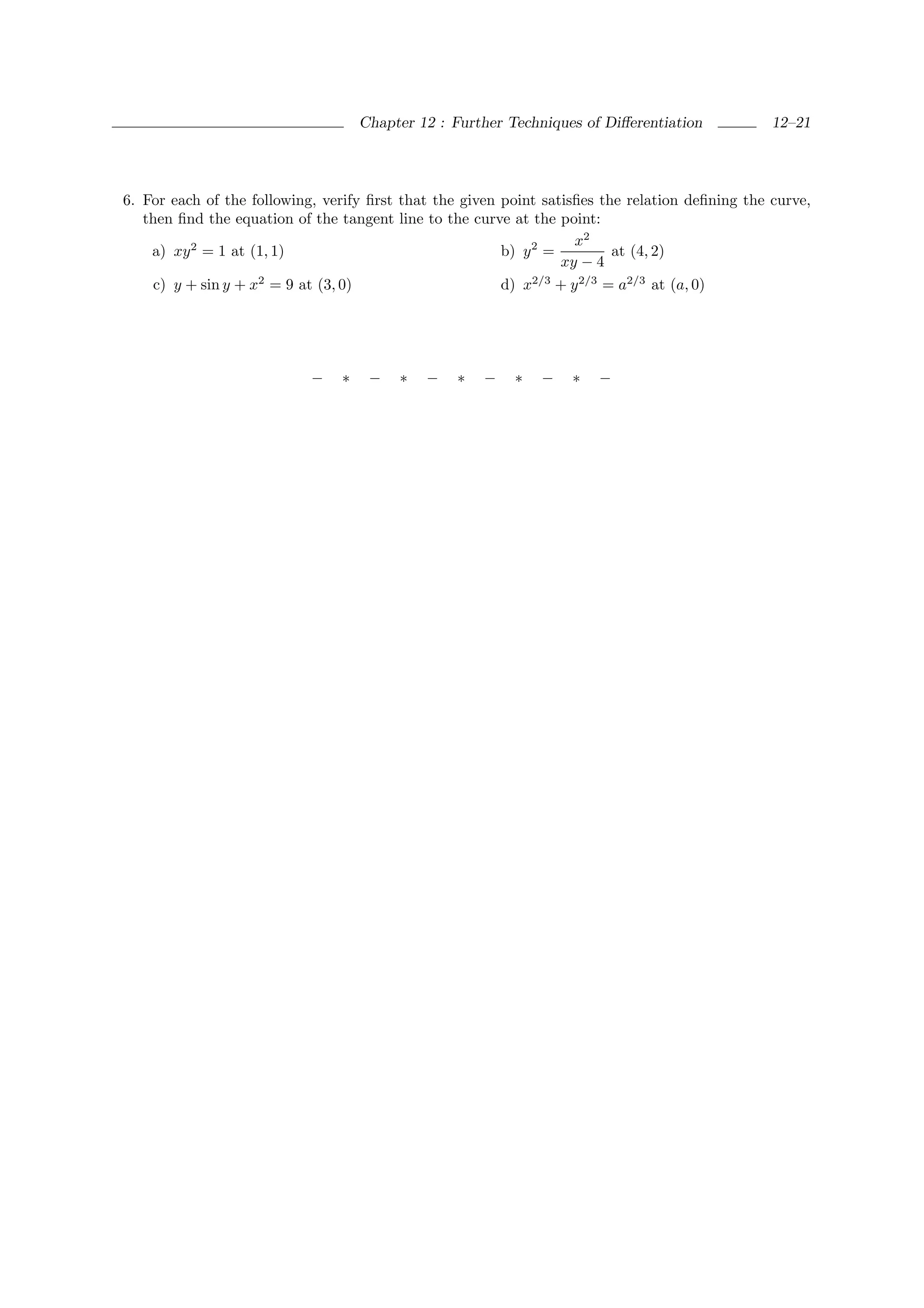
6. For each of the following, verify first that the given point satisfies the relation defining the curve,
   then find the equation of the tangent line to the curve at the point:
                                                                    x2
    a) xy 2 = 1 at (1, 1)                                b) y 2 =         at (4, 2)
                                                                  xy − 4
    c) y + sin y + x2 = 9 at (3, 0)                      d) x2/3 + y 2/3 = a2/3 at (a, 0)


                            −   ∗    −   ∗   −    ∗   −   ∗   −    ∗   −

Techniques of differentiation further

  • 1.
    ELEMENTARY MATHEMATICS W W L CHEN and X T DUONG c W W L Chen, X T Duong and Macquarie University, 1999. This work is available free, in the hope that it will be useful. Any part of this work may be reproduced or transmitted in any form or by any means, electronic or mechanical, including photocopying, recording, or any information storage and retrieval system, with or without permission from the authors. Chapter 12 FURTHER TECHNIQUES OF DIFFERENTIATION 12.1. The Chain Rule We begin by re-examining a few examples discussed in the previous chapter. Example 12.1.1. Recall Examples 11.2.5 and 11.2.10, that for the function y = h(x) = (x2 + 2x)2 , we have dy = h (x) = 4x3 + 12x2 + 8x. dx On the other hand, we can build a chain and describe the function y = h(x) by writing y = g(u) = u2 and u = f (x) = x2 + 2x. Note that dy du = 2u and = 2x + 2, du dx so that dy du × = 2u(2x + 2) = 2(x2 + 2x)(2x + 2) = 4x3 + 12x2 + 8x. du dx † This chapter was written at Macquarie University in 1999.
  • 2.
    12–2 W W L Chen and X T Duong : Elementary Mathematics Example 12.1.2. Recall Example 11.3.3, that for the function y = h(x) = sin2 x, we have dy = h (x) = 2 sin x cos x. dx On the other hand, we can build a chain and describe the function y = h(x) by writing y = g(u) = u2 and u = f (x) = sin x. Note that dy du = 2u and = cos x, du dx so that dy du × = 2u cos x = 2 sin x cos x. du dx Example 12.1.3. Recall Example 11.3.4, that for the function y = h(x) = sin 2x, we have dy = h (x) = 2 cos 2x. dx On the other hand, we can build a chain and describe the function y = h(x) by writing y = g(u) = sin u and u = f (x) = 2x. Note that dy du = cos u and = 2, du dx so that dy du × = 2 cos u = 2 cos 2x. du dx In these three examples, we consider functions of the form y = h(x) which can be described in a chain by y = g(u) and u = f (x), where u is some intermediate variable. Suppose that x0 , x1 ∈ R. Write u0 = f (x0 ) and u1 = f (x1 ), and write y0 = g(u0 ) and y1 = g(u1 ). Then clearly h(x0 ) = g(f (x0 )) and h(x1 ) = g(f (x1 )). Heuristically, we have h(x1 ) − h(x0 ) y1 − y0 y1 − y0 u1 − u0 g(u1 ) − g(u0 ) f (x1 ) − f (x0 ) = = × = × . x1 − x0 x1 − x0 u1 − u0 x1 − x0 u1 − u0 x1 − x0 If x1 is close to x0 , then we expect that u1 is close to u0 , and so the product g(u1 ) − g(u0 ) f (x1 ) − f (x0 ) × u1 − u0 x1 − x0 is close to g (u0 )f (x0 ), while the product h(x1 ) − h(x0 ) x1 − x0 is close to h (x0 ). It is therefore not unreasonable to expect the following result, although a formal proof is somewhat more complicated.
  • 3.
    Chapter 12 :Further Techniques of Differentiation 12–3 CHAIN RULE. Suppose that y = g(u) and u = f (x). Then dy dy du = × , dx du dx provided that the two derivatives on the right hand side exist. We can interpret the rule in the following way. As we vary x, the value u = f (x) changes at the rate of du/dx. This change in the value of u = f (x) in turn causes a change in the value of y = g(u) at the rate of dy/du. Example 12.1.4. Consider the function y = h(x) = (x2 − 6x + 5)3 . We can set up a chain by writing y = g(u) = u3 and u = f (x) = x2 − 6x + 5. Clearly we have dy du = 3u2 and = 2x − 6, du dx so it follows from the chain rule that dy dy du = × = 3u2 (2x − 6) = 6(x2 − 6x + 5)2 (x − 3). dx du dx Example 12.1.5. Consider the function y = h(x) = sin4 x. We can set up a chain by writing y = g(u) = u4 and u = f (x) = sin x. Clearly we have dy du = 4u3 and = cos x, du dx so it follows from the chain rule that dy dy du = × = 4u3 cos x = 4 sin3 x cos x. dx du dx Example 12.1.6. Consider the function y = h(x) = sec(x4 ). We can set up a chain by writing y = g(u) = sec u and u = f (x) = x4 . Clearly we have dy du = tan u sec u and = 4x3 , du dx so it follows from the chain rule that dy dy du = × = 4x3 tan u sec u = 4x3 tan(x4 ) sec(x4 ). dx du dx Example 12.1.7. Consider the function y = h(x) = tan(x2 − 3x + 4). We can set up a chain by writing y = g(u) = tan u and u = f (x) = x2 − 3x + 4. Clearly we have dy du = sec2 u and = 2x − 3, du dx
  • 4.
    12–4 W W L Chen and X T Duong : Elementary Mathematics so it follows from the chain rule that dy dy du = × = (2x − 3) sec2 u = (2x − 3) sec2 (x2 − 3x + 4). dx du dx Example 12.1.8. Consider the function y = h(x) = (x2 + 5x − 1)2/3 . We can set up a chain by writing y = g(u) = u2/3 and u = f (x) = x2 + 5x − 1. Clearly we have dy 2 du = u−1/3 and = 2x + 5, du 3 dx so it follows from the chain rule that dy dy du 2 2 = × = u−1/3 (2x + 5) = (x2 + 5x − 1)−1/3 (2x + 5). dx du dx 3 3 Example 12.1.9. Consider the function 1 y = h(x) = . cos3 x We can set up a chain by writing 1 y = g(u) = = u−3 and u = f (x) = cos x. u3 Clearly we have dy du = −3u−4 and = − sin x, du dx so it follows from the chain rule that dy dy du 3 sin x 3 sin x = × = 3u−4 sin x = = . dx du dx u4 cos4 x Example 12.1.10. Consider the function 1 y = h(x) = . (2x3 − 5x + 1)4 We can set up a chain by writing 1 y = g(u) = = u−4 and u = f (x) = 2x3 − 5x + 1. u4 Clearly we have dy du = −4u−5 and = 6x2 − 5, du dx so it follows from the chain rule that dy dy du 4(5 − 6x2 ) 4(5 − 6x2 ) = × = 4u−5 (5 − 6x2 ) = = . dx du dx u5 (2x3 − 5x + 1)5
  • 5.
    Chapter 12 :Further Techniques of Differentiation 12–5 Example 12.1.11. Consider the function y = h(x) = sin(cos x). We can set up a chain by writing y = g(u) = sin u and u = f (x) = cos x. Clearly we have dy du = cos u and = − sin x, du dx so it follows from the chain rule that dy dy du = × = − cos u sin x = − cos(cos x) sin x. dx du dx Example 12.1.12. Consider the function 1 1 y = h(x) = + . 2(x + 1) 4(x + 1)2 We can set up a chain by writing 1 1 1 1 y = g(u) = + 2 = u−1 + u−2 and u = f (x) = x + 1. 2u 4u 2 4 Clearly we have dy 1 1 du = − u−2 − u−3 and = 1, du 2 2 dx so it follows from the chain rule that dy dy du 1 1 1 1 = × = − u−2 − u−3 = − − . dx du dx 2 2 2(x + 1)2 2(x + 1)3 Example 12.1.13. Consider the function 3 x−1 y = h(x) = . x+1 We can set up a chain by writing x−1 y = g(u) = u3 and u = f (x) = . x+1 Clearly we have (using the quotient rule for the latter) dy du 2 = 3u2 and = , du dx (x + 1)2 so it follows from the chain rule that 2 dy dy du 2 x−1 2 6(x − 1)2 = × = 3u2 × =3 × = . dx du dx (x + 1)2 x+1 (x + 1)2 (x + 1)4 The chain rule can be extended to chains of more than two functions. We illustrate the ideas by considering the next four examples. Example 12.1.14. Consider the function y = h(x) = sin3 (x2 + 2). We can set up a chain by writing y = k(v) = v 3 , v = g(u) = sin u and u = f (x) = x2 + 2. Clearly we have dy dv du = 3v 2 , = cos u and = 2x, dv du dx so it follows from the chain rule that dy dy dv du = × × = 6xv 2 cos u = 6x sin2 u cos u = 6x sin2 (x2 + 2) cos(x2 + 2). dx dv du dx
  • 6.
    12–6 W W L Chen and X T Duong : Elementary Mathematics Example 12.1.15. Consider the function y = h(x) = (1 + (1 + x)1/2 )5 . We can set up a chain by writing y = k(v) = v 5 , v = g(u) = 1 + u1/2 and u = f (x) = 1 + x. Clearly we have dy dv 1 du = 5v 4 , = u−1/2 and = 1, dv du 2 dx so it follows from the chain rule that dy dy dv du 5 5 5(1 + (1 + x)1/2 )4 = × × = v 4 u−1/2 = (1 + u1/2 )4 u−1/2 = . dx dv du dx 2 2 2(1 + x)1/2 Example 12.1.16. Consider the function y = h(x) = tan((x4 − 3x)3 ). We can set up a chain by writing y = k(v) = tan v, v = g(u) = u3 and u = f (x) = x4 − 3x. Clearly we have dy dv du = sec2 v, = 3u2 and = 4x3 − 3, dv du dx so it follows from the chain rule that dy dy dv du = × × = 3u2 (4x3 − 3) sec2 v = 3u2 (4x3 − 3) sec2 (u3 ) dx dv du dx = 3(x4 − 3x)2 (4x3 − 3) sec2 ((x4 − 3x)3 ). Example 12.1.17. Consider the function y = h(x) = x2 + sin(x2 ). We can set up a chain by writing y = k(v) = v 1/2 , v = g(u) = u + sin u and u = f (x) = x2 . Clearly we have dy 1 dv du = 1/2 , = 1 + cos u and = 2x, dv 2v du dx so it follows from the chain rule that dy dy dv du x(1 + cos u) x(1 + cos u) x(1 + cos(x2 )) = × × = 1/2 = 1/2 = . dx dv du dx v (u + sin u) x2 + sin(x2 ) We conclude this section by studying three examples where the chain rule is used only in part of the argument. These examples are rather hard, and the reader is advised to concentrate on the ideas and not to get overly worried about the arithmetic details. For accuracy, it is absolutely crucial that we exercise great care. Example 12.1.18. Consider the function y = h(x) = (x2 − 1)1/2 (x2 + 4x + 3). We can write h(x) = f (x)g(x), where f (x) = (x2 − 1)1/2 and g(x) = x2 + 4x + 3. It follows from the product rule that h (x) = f (x)g(x) + f (x)g (x).
  • 7.
    Chapter 12 :Further Techniques of Differentiation 12–7 It is easy to see that g (x) = 2x + 4. To find f (x), we shall use the chain rule. Let z = f (x) = (x2 − 1)1/2 . We can set up a chain by writing z = u1/2 and u = x2 − 1. Clearly we have dz 1 du = 1/2 and = 2x, du 2u dx so it follows from the chain rule that dz dz du x x f (x) = = × = 1/2 = 2 . dx du dx u (x − 1)1/2 Hence x(x2 + 4x + 3) h (x) = + (x2 − 1)1/2 (2x + 4). (x2 − 1)1/2 Example 12.1.19. Consider the function (1 − x3 )2 y = h(x) = . (1 + 2x + 3x2 )2 We can write f (x) h(x) = , g(x) where f (x) = (1 − x3 )2 and g(x) = (1 + 2x + 3x2 )2 . It follows from the quotient rule that g(x)f (x) − f (x)g (x) h (x) = . g 2 (x) To find f (x) and g (x), we shall use the chain rule. Let z = f (x) = (1 − x3 )2 and w = g(x) = (1 + 2x + 3x2 )2 . We can set up a chain by writing z = u2 and u = 1 − x3 . Then dz dz du f (x) = = × = 2u × (−3x2 ) = −6ux2 = −6(1 − x3 )x2 . dx du dx Similarly, we can set up a chain by writing w = v2 and v = 1 + 2x + 3x2 . Then dw dw dv g (x) = = × = 2v × (2 + 6x) = 4v(1 + 3x) = 4(1 + 2x + 3x2 )(1 + 3x). dx dv dx
  • 8.
    12–8 W W L Chen and X T Duong : Elementary Mathematics Hence −6(1 + 2x + 3x2 )2 (1 − x3 )x2 − 4(1 − x3 )2 (1 + 2x + 3x2 )(1 + 3x) h (x) = (1 + 2x + 3x2 )4 6(1 + 2x + 3x )(1 − x )x + 4(1 − x3 )2 (1 + 3x) 2 3 2 =− . (1 + 2x + 3x2 )3 Alternatively, observe that we can set up a chain by writing 1 − x3 y = s2 and s= . 1 + 2x + 3x2 Clearly we have (using the quotient rule for the latter) dy ds −3(1 + 2x + 3x2 )x2 − (1 − x3 )(2 + 6x) = 2s and = , ds dx (1 + 2x + 3x2 )2 so it follows from the chain rule that dy dy ds 3(1 + 2x + 3x2 )x2 + (1 − x3 )(2 + 6x) = × = −2s × dx ds dx (1 + 2x + 3x2 )2 2(1 − x3 ) 3(1 + 2x + 3x2 )x2 + 2(1 − x3 )(1 + 3x) =− 2 × . 1 + 2x + 3x (1 + 2x + 3x2 )2 It can be easily checked that the answer is the same as before. Example 12.1.20. Consider the function y = h(x) = (x2 + (x3 + x5 )7 )11 . We can set up a chain by writing y = g(u) = u11 and u = f (x) = x2 + (x3 + x5 )7 . Clearly we have dy = 11u10 . du On the other hand, we have f (x) = k(x) + t(x), where k(x) = x2 and t(x) = (x3 + x5 )7 . It follows that f (x) = k (x) + t (x). Note that k (x) = 2x. To find t (x), we shall use the chain rule. Let z = t(x) = (x3 + x5 )7 . We can set up a chain by writing z = v7 and v = x3 + x5 . Clearly we have dz dv = 7v 6 and = 3x2 + 5x4 , dv dx so it follows from the chain rule that dz dz dv t (x) = = × = 7v 6 (3x2 + 5x4 ) = 7(x3 + x5 )6 (3x2 + 5x4 ), dx dv dx and so du f (x) = = 2x + 7(x3 + x5 )6 (3x2 + 5x4 ). dx It then follows from the chain rule that dy dy du = × = 11u10 (2x + 7(x3 + x5 )6 (3x2 + 5x4 )) dx du dx = 11(x2 + (x3 + x5 )7 )10 (2x + 7(x3 + x5 )6 (3x2 + 5x4 )).
  • 9.
    Chapter 12 :Further Techniques of Differentiation 12–9 12.2. Implicit Differentiation A function y = f (x) can usually be viewed as a curve on the xy-plane, and gives a relationship between the (independent) variable x and the (dependent) variable y by describing y explicitly in terms of x. However, a relationship between two variables x and y cannot always be expressed as a function y = f (x). Moreover, we may even choose to describe a function y = f (x) implicitly by simply giving some relationship between the variables x and y, and not describing y explicitly in terms of x. Example 12.2.1. Consider the equation x2 + y 2 = 25, representing a circle of radius 5 and centred at the origin (0, 0). This equation expresses a relationship between the two variables x and y, but y is not given explicitly in terms of x. Indeed, it is not possible to give y explicitly in terms of x, as this equation does not represent a function y = f (x). To see this, note that if x = 3, then both y = 4 and y = −4 will satisfy the equation, so it is meaningless to talk of f (3). On the other hand, we see that the point (3, 4) is on the circle, and clearly there is a tangent line to the circle at the point (3, 4), as shown in the picture below. y 4 x 3 5 -4 If we restrict our attention to the upper semicircle, then we can express the variable y explicitly as a function of the variable x by writing y = (25 − x2 )1/2 . We can set up a chain by writing y = u1/2 and u = 25 − x2 . Clearly we have dy 1 du = u−1/2 and = −2x, du 2 dx so it follows from the chain rule that dy dy du = × = −xu−1/2 = −x(25 − x2 )−1/2 . dx du dx Hence dy 3 =− . dx (x,y)=(3,4) 4 Note that our argument here involves obtaining an explicit expression for the variable y in terms of the variable x from similar information given implicitly by the equation x2 +y 2 = 25. Now let us see whether we can obtain a similar conclusion concerning the slope of the tangent line at the point (3, 4) without first having to obtain the explicit expression y = (25 − x2 )1/2 of the upper semicircle. Let us start from the equation x2 + y 2 = 25 of the circle. Differentiating both sides with respect to x, we obtain d 2 d (x + y 2 ) = (25). dx dx
  • 10.
    12–10 W W L Chen and X T Duong : Elementary Mathematics Using the rule on the derivatives of constants, we obtain d (25) = 0. dx Using the sum rule and the rule on the derivatives of powers, we obtain d 2 d 2 d 2 d 2 (x + y 2 ) = (x ) + (y ) = 2x + (y ). dx dx dx dx We next set up a chain by writing z = y2 and y = f (x), where there is no need to know precisely what f (x) is. Then using the chain rule and the rule on the derivatives of powers, we obtain d 2 dz dz dy dy (y ) = = × = 2y . dx dx dy dx dx Summarizing, we obtain dy 2x + 2y = 0, dx and so dy x =− . dx y Hence dy 3 =− dx (x,y)=(3,4) 4 as before. The second part of the example above is a case of using implicit differentiation, where we find the derivative of a function y = f (x) without knowing any explicit expression for the variable y in terms of the variable x. We shall describe this technique further by discussing a few more examples. In some of these examples, it may be very difficult, if not impossible, to find any explicit expression for the variable y in terms of the variable x. Example 12.2.2. Suppose that y 2 − x2 = 4. Differentiating both sides with respect to x, we obtain d 2 d (y − x2 ) = (4) = 0. dx dx It follows that d 2 d 2 d 2 d 2 (y − x2 ) = (y ) − (x ) = (y ) − 2x = 0. dx dx dx dx We next set up a chain by writing z = y2 and y = f (x), where there is no need to know precisely what f (x) is. Then d 2 dz dz dy dy (y ) = = × = 2y . dx dx dy dx dx Summarizing, we obtain dy 2y − 2x = 0, dx and so dy x = . dx y
  • 11.
    Chapter 12 :Further Techniques of Differentiation 12–11 Example 12.2.3. Suppose that y 3 + sin x = 3. Differentiating both sides with respect to x, we obtain d 3 d (y + sin x) = (3) = 0. dx dx It follows that d 3 d 3 d d 3 (y + sin x) = (y ) + (sin x) = (y ) + cos x = 0. dx dx dx dx We next set up a chain by writing z = y3 and y = f (x), where there is no need to know precisely what f (x) is. Then d 3 dz dz dy dy (y ) = = × = 3y 2 . dx dx dy dx dx Summarizing, we obtain dy 3y 2 + cos x = 0, dx and so dy cos x =− 2 . dx 3y Example 12.2.4. Suppose that y 5 + 3y 2 − 2x2 + 4 = 0. Differentiating both sides with respect to x, we obtain d 5 d (y + 3y 2 − 2x2 + 4) = (0) = 0. dx dx It follows that d 5 d 5 d d d d 5 d (y + 3y 2 − 2x2 + 4) = (y ) + 3 (y 2 ) − 2 (x2 ) + (4) = (y ) + 3 (y 2 ) − 4x = 0. dx dx dx dx dx dx dx Using the chain rule, we obtain d 5 d 5 dy dy d 2 d 2 dy dy (y ) = (y ) × = 5y 4 and (y ) = (y ) × = 2y . dx dy dx dx dx dy dx dx Summarizing, we obtain dy (5y 4 + 6y) − 4x = 0, dx and so dy 4x = 4 . dx 5y + 6y Example 12.2.5. Suppose that xy = 6. Differentiating both sides with respect to x, we obtain d d (xy) = (6) = 0. dx dx It follows from the product rule that d d d dy (xy) = (x) × y + x × (y) = y + x = 0, dx dx dx dx and so dy y =− . dx x
  • 12.
    12–12 W W L Chen and X T Duong : Elementary Mathematics Example 12.2.6. Suppose that x3 + 2x2 y 3 + 3y 4 = 6. Differentiating both sides with respect to x, we obtain d 3 d (x + 2x2 y 3 + 3y 4 ) = (6) = 0. dx dx It follows that d 3 d 3 d 2 d 3 d (x + 2x2 y 3 + 3y 4 ) = (x ) + 2 (x ) × y 3 + x2 × (y ) + 3 (y 4 ) dx dx dx dx dx d 3 d 4 = 3x2 + 4xy 3 + 2x2 (y ) + 3 (y ) = 0. dx dx Using the chain rule, we obtain d 3 d 3 dy dy d 4 d 4 dy dy (y ) = (y ) × = 3y 2 and (y ) = (y ) × = 4y 3 . dx dy dx dx dx dy dx dx Summarizing, we obtain dy 3x2 + 4xy 3 + (6x2 y 2 + 12y 3 ) = 0, dx and so dy 3x2 + 4xy 3 =− 2 2 . dx 6x y + 12y 3 Note next that the point (1, 1) satisfies the equation. It follows that dy 7 =− . dx (x,y)=(1,1) 18 Check that the equation of the tangent line at this point is given by 7x + 18y = 25. Example 12.2.7. Suppose that (x2 + y 3 )2 = 9. Differentiating both sides with respect to x, we obtain d d ((x2 + y 3 )2 ) = (9) = 0. dx dx Let w = (x2 + y 3 )2 . We can set up a chain by writing w = z2 and z = x2 + y 3 , so it follows from the chain rule that d dw dw dz dz d ((x2 + y 3 )2 ) = = × = 2z = 2(x2 + y 3 ) (x2 + y 3 ). dx dx dz dx dx dx Hence d 2 (x2 + y 3 ) (x + y 3 ) = 0. dx On the other hand, d 2 d 2 d 3 dy (x + y 3 ) = (x ) + (y ) = 2x + 3y 2 , dx dx dx dx where we have used the chain rule at the last step. Summarizing, we obtain dy (x2 + y 3 ) 2x + 3y 2 = 0. dx It is clear that x2 + y 3 = 0 for any point (x, y) satisfying the equation. It follows that dy 2x + 3y 2 = 0, dx
  • 13.
    Chapter 12 :Further Techniques of Differentiation 12–13 and so dy 2x = − 2. dx 3y Note next that the point (2, −1) satisfies the equation. It follows that dy 4 =− . dx (x,y)=(2,−1) 3 Check that the equation of the tangent line at this point is given by 4x + 3y = 5. Example 12.2.8. The point (1, 1) is one of the intersection points of the parabola y − x2 = 0 and the ellipse x2 + 2y 2 = 3. We shall show that the two tangents at (1, 1) are perpendicular to each other. Consider first of all the parabola y − x2 = 0. Here we can write y = x2 , so that dy/dx = 2x. Hence dy = 2. dx (x,y)=(1,1) Consider next the ellipse x2 + 2y 2 = 3. Using implicit differentiation, it is not difficult to show that dy 2x + 4y = 0, dx and so dy x =− . dx 2y Hence dy 1 =− . dx (x,y)=(1,1) 2 Since the product of the two derivatives is equal to −1, it follows that the two tangents are perpendicular to each other. 12.3. Derivatives of the Exponential and Logarithmic Functions We shall state without proof the following result. DERIVATIVE OF THE EXPONENTIAL FUNCTION. If f (x) = ex , then f (x) = ex . Example 12.3.1. Consider the function y = h(x) = ex (sin x + 2 cos x). We can write h(x) = f (x)g(x), where f (x) = ex and g(x) = sin x + 2 cos x. It follows from the product rule that h (x) = f (x)g(x) + f (x)g (x). Clearly f (x) = ex and g (x) = cos x − 2 sin x. Hence h (x) = ex (sin x + 2 cos x) + ex (cos x − 2 sin x) = ex (3 cos x − sin x).
  • 14.
    12–14 W W L Chen and X T Duong : Elementary Mathematics Example 12.3.2. Consider the function y = h(x) = ex (x2 + x + 2). We can write h(x) = f (x)g(x), where f (x) = ex and g(x) = x2 + x + 2. It follows from the product rule that h (x) = f (x)g(x) + f (x)g (x). Clearly f (x) = ex and g (x) = 2x + 1. Hence h (x) = ex (x2 + x + 2) + ex (2x + 1) = ex (x2 + 3x + 3). Example 12.3.3. Consider the function y = h(x) = e2x . We can set up a chain by writing y = g(u) = eu and u = f (x) = 2x. Clearly we have dy du = eu and = 2, du dx so it follows from the chain rule that dy dy du = × = 2eu = 2e2x . dx du dx Alternatively, we can set up a chain by writing y = t(v) = v 2 and v = k(x) = ex . Clearly we have dy dv = 2v and = ex , dv dx so it follows from the chain rule that dy dy dv = × = 2vex = 2ex ex = 2e2x . dx dv dx Yet another alternative is to observe that h(x) = ex ex . It follows that we can use the product rule instead of the chain rule. Try it! 3 Example 12.3.4. Consider the function y = h(x) = ex . We can set up a chain by writing y = g(u) = eu and u = f (x) = x3 . Clearly we have dy du = eu and = 3x2 , du dx so it follows from the chain rule that dy dy du 3 = × = 3x2 eu = 3x2 ex . dx du dx
  • 15.
    Chapter 12 :Further Techniques of Differentiation 12–15 Example 12.3.5. Consider the function y = h(x) = esin x+4 cos x . We can set up a chain by writing y = g(u) = eu and u = f (x) = sin x + 4 cos x. Clearly we have dy du = eu and = cos x − 4 sin x, du dx so it follows from the chain rule that dy dy du = × = eu (cos x − 4 sin x) = esin x+4 cos x (cos x − 4 sin x). dx du dx Example 12.3.6. Consider the function 2 y = h(x) = sin3 e4x . We can set up a chain by writing y = t(w) = w3 , w = k(v) = sin v, v = g(u) = eu and u = f (x) = 4x2 . Clearly we have dy dw dv du = 3w2 , = cos v, = eu and = 8x, dw dv du dx so it follows from the chain rule that dy dy dw dv du = × × × = 24xeu w2 cos v = 24xeu sin2 v cos v = 24xeu sin2 (eu ) cos(eu ) dx dw dv du dx 2 2 2 = 24xe4x sin2 (e4x ) cos(e4x ). Example 12.3.7. Suppose that e2x + y 2 = 5. Differentiating both sides with respect to x, we obtain d 2x d (e + y 2 ) = (5) = 0. dx dx It follows that d 2x d 2x d 2 dy (e + y 2 ) = (e ) + (y ) = 2e2x + 2y = 0, dx dx dx dx using Example 12.3.3 and the chain rule. Hence dy e2x =− . dx y The next example is rather complicated, and the reader is advised to concentrate on the ideas and not to get overly worried about the arithmetic details. For accuracy, it is absolutely crucial that we exercise great care. Example 12.3.8. Suppose that e2x sin 3y + x2 y 3 = 3. Differentiating both sides with respect to x, we obtain d 2x d (e sin 3y + x2 y 3 ) = (3) = 0. dx dx Using the sum and product rules, we have d 2x d 2x d d 2 d 3 (e sin 3y + x2 y 3 ) = (e ) × sin 3y + e2x × (sin 3y) + (x ) × y 3 + x2 × (y ). dx dx dx dx dx
  • 16.
    12–16 W W L Chen and X T Duong : Elementary Mathematics We have d 2x d 2 (e ) = 2e2x and (x ) = 2x. dx dx Writing z = 3y and using the chain rule, we obtain d d dy d dy d dz dy dy dy (sin 3y) = (sin 3y) × = (sin z) × = (sin z) × × = 3 cos z = 3 cos 3y . dx dy dx dy dx dz dy dx dx dx Using the chain rule, we also obtain d 3 d 3 dy dy (y ) = (y ) × = 3y 2 . dx dy dx dx Summarizing, we have dy dy dy 2e2x sin 3y + 3e2x cos 3y + 2xy 3 + 3x2 y 2 = 2(e2x sin 3y + xy 3 ) + 3(e2x cos 3y + x2 y 2 ) = 0, dx dx dx and so dy 2(e2x sin 3y + xy 3 ) = − 2x . dx 3(e cos 3y + x2 y 2 ) Next, we turn to the logarithmic function. Using implicit differentiation, we can establish the following result. DERIVATIVE OF THE LOGARITHMIC FUNCTION. If f (x) = log x, then f (x) = 1/x. Proof. Suppose that y = log x. Then ey = x. Differentiating both sides with respect to x, we obtain d y d (e ) = (x) = 1. dx dx Using the chain rule and the rule on the derivative of the exponential function, we obtain d y d y dy dy (e ) = (e ) × = ey . dx dy dx dx Summarizing, we have dy ey = 1, dx so that dy 1 1 = y = . ♣ dx e x Example 12.3.9. Consider the function y = h(x) = x log x. We can write h(x) = f (x)g(x), where f (x) = x and g(x) = log x. It follows from the product rule that h (x) = f (x)g(x) + f (x)g (x). Clearly f (x) = 1 and g (x) = 1/x. Hence h (x) = log x + 1.
  • 17.
    Chapter 12 :Further Techniques of Differentiation 12–17 Example 12.3.10. Consider the function x log x + sin x y = h(x) = . ex We can write f (x) + k(x) h(x) = , g(x) where f (x) = x log x, k(x) = sin x and g(x) = ex . It follows from the sum and quotient rules that g(x)(f (x) + k (x)) − (f (x) + k(x))g (x) h (x) = . g 2 (x) Clearly k (x) = cos x and g (x) = ex . Observe also from Example 12.3.9 that f (x) = log x + 1. Hence ex (log x + 1 + cos x) − (x log x + sin x)ex (1 − x) log x + 1 + cos x − sin x h (x) = = . e2x ex Example 12.3.11. Consider the function y = h(x) = log(5x2 + 3). We can set up a chain by writing y = g(u) = log u and u = f (x) = 5x2 + 3. Clearly we have dy 1 du = and = 10x, du u dx so it follows from the chain rule that dy dy du 10x 10x = × = = 2 . dx du dx u 5x + 3 Example 12.3.12. Consider the function y = h(x) = log(tan x + sec x). We can set up a chain by writing y = g(u) = log u and u = f (x) = tan x + sec x. Clearly we have dy 1 du = and = sec2 x + tan x sec x, du u dx so it follows from the chain rule that dy dy du sec2 x + tan x sec x sec2 x + tan x sec x = × = = = sec x. dx du dx u tan x + sec x Example 12.3.13. Consider the function y = h(x) = log(cot x + csc x). We can set up a chain by writing y = g(u) = log u and u = f (x) = cot x + csc x. Clearly we have dy 1 du = and = − csc2 x − cot x csc x, du u dx so it follows from the chain rule that dy dy du − csc2 x − cot x csc x csc2 x + cot x csc x = × = =− = − csc x. dx du dx u cot x + csc x
  • 18.
    12–18 W W L Chen and X T Duong : Elementary Mathematics Example 12.3.14. Consider the function y = h(x) = log(sin(x1/2 )). We can set up a chain by writing y = k(v) = log v, v = g(u) = sin u and u = f (x) = x1/2 . Clearly we have dy 1 dv du 1 = , = cos u and = 1/2 , dv v du dx 2x so it follows from the chain rule that dy dy dv du cos u cos u cos(x1/2 ) = × × = 1/2 = 1/2 = 1/2 . dx dv du dx 2x v 2x sin u 2x sin(x1/2 ) Example 12.3.15. Suppose that x log y + y 2 = 4. Differentiating both sides with respect to x, we obtain d d (x log y + y 2 ) = (4) = 0. dx dx It follows that d d d d 2 d d 2 (x log y + y 2 ) = (x) × log y + x × (log y) + (y ) = log y + x (log y) + (y ). dx dx dx dx dx dx By the chain rule, we have d d dy 1 dy (log y) = (log y) × = dx dy dx y dx and d 2 d 2 dy dy (y ) = (y ) × = 2y . dx dy dx dx Summarizing, we have x dy log y + + 2y = 0, y dx so that dy y log y =− . dx x + 2y 2 Example 12.3.16. Suppose that log(xy 2 ) = 2x2 . Differentiating both sides with respect to x, we obtain d d (log(xy 2 )) = (2x2 ) = 4x. dx dx Let z = log(xy 2 ). We can set up a chain by writing z = log u and u = xy 2 . Then it follows from the chain rule that d dz dz du 1 du 1 d (log(xy 2 )) = = × = × = 2× (xy 2 ). dx dx du dx u dx xy dx Next, we observe that d d d 2 d 2 dy dy (xy 2 ) = (x) × y 2 + x × (y ) = y 2 + x × (y ) × = y 2 + 2xy . dx dx dx dy dx dx Summarizing, we have dy y 2 + 2xy = 4x2 y 2 , dx so that dy (4x2 − 1)y 2 = . dx 2xy
  • 19.
    Chapter 12 :Further Techniques of Differentiation 12–19 12.4. Derivatives of the Inverse Trigonometric Functions The purpose of this last section is to determine the derivatives of the inverse trigonometric functions by using implicit differentiation and our knowledge on the derivatives of the trigonometric functions. For notational purposes, we shall write y = sin−1 x if and only if x = sin y, and similarly for the other trigonometric functions. These inverse trigonometric functions are well defined, provided that we restrict the values for x to suitable intervals of real numbers. DERIVATIVES OF THE INVERSE TRIGONOMETRIC FUNCTIONS. dy 1 (a) If y = sin−1 x, then =√ . dx 1 − x2 dy 1 (b) If y = cos−1 x, then = −√ . dx 1 − x2 dy 1 (c) If y = tan−1 x, then = . dx 1 + x2 dy 1 (d) If y = cot−1 x, then =− . dx 1 + x2 dy 1 (e) If y = sec−1 x, then = √ . dx x x2 − 1 dy 1 (f) If y = csc−1 x, then =− √ . dx x x2 − 1 Sketch of Proof. For simplicity, we shall assume that 0 < y < π/2, so that y is in the first quadrant, and so all the trigonometric functions have positive values. (a) If y = sin−1 x, then x = sin y. Differentiating with respect to x, we obtain dy 1 = cos y , dx so that dy 1 1 1 = = =√ . dx cos y 1 − sin y 2 1 − x2 −1 (b) If y = cos x, then x = cos y. Differentiating with respect to x, we obtain dy 1 = − sin y , dx so that dy 1 1 1 =− =− = −√ . dx sin y 1 − cos2 y 1 − x2 (c) If y = tan−1 x, then x = tan y. Differentiating with respect to x, we obtain dy 1 = sec2 y , dx so that dy 1 1 1 = 2y = 2 = . dx sec 1 + tan y 1 + x2 (d) If y = cot−1 x, then x = cot y. Differentiating with respect to x, we obtain dy 1 = − csc2 y , dx so that dy 1 1 1 =− 2 =− 2 =− . dx csc y 1 + cot y 1 + x2
  • 20.
    12–20 W W L Chen and X T Duong : Elementary Mathematics (e) If y = sec−1 x, then x = sec y. Differentiating with respect to x, we obtain dy 1 = tan y sec y , dx so that dy 1 1 1 = = = √ . dx tan y sec y (sec2 y − 1)1/2 sec y x x2 − 1 (f) If y = csc−1 x, then x = csc y. Differentiating with respect to x, we obtain dy 1 = − cot y csc y , dx so that dy 1 1 1 =− =− =− √ . ♣ dx cot y csc y (csc2 y − 1)1/2 csc y x x2 − 1 There is no need to remember the derivatives of any of these inverse trigonometric functions. Problems for Chapter 12 1. By making suitable use of the chain rule and other rules as appropriate, find the derivative of each of the following functions: √ a) h(x) = 1 − cos x b) h(x) = sin(3x) c) h(x) = cos(sin x) d) h(x) = x2 cos x e) h(x) = sin(2x) sin(3x) f) h(x) = 2x sin(3x) g) h(x) = tan(3x) h) h(x) = 4 sec(5x) i) h(x) = cos(x3 ) 3 j) h(x) = cos x 2 k) h(x) = (1 + cos x) 6 l) h(x) = tan(x2 ) + tan2 x m) h(x) = cos(tan x) n) h(x) = sin(sin x) 2. Find the derivative of each of the following functions: a) h(x) = sin(ex ) b) h(x) = esin x c) h(x) = e−2x sin x x d) h(x) = e sin(2x) e) h(x) = tan(e−3x ) f) h(x) = tan(ex ) 3. a) For each k = 0, 1, 2, 3, . . . , find a function fk (x) such that fk (x) = xk . b) For each k = −2, −3, −4, . . . , find a function fk (x) such that fk (x) = xk . c) Find a function f−1 (x) such that f−1 (x) = x−1 . 4. Find the derivative of each of the following functions: 2 1 a) h(x) = (3x2 + π)(ex − 4) b) h(x) = x5 + 3x2 + +1 c) h(x) = 2x − √ + e2x x4 3 x d) h(x) = 2ex + xe3x e) h(x) = etan x f) h(x) = 2xex − x−2 √ x+2 g) h(x) = log(log(2x3 )) h) h(x) = x + 5 i) h(x) = 2 x +1 j) h(x) = sin(2x + 3) k) h(x) = cos2 (2x) l) h(x) = log(e−x − 1) x +e−x x2 + 1 m) h(x) = ee n) h(x) = √ o) h(x) = (x + 3)2 x p) h(x) = log(2x + 3) q) h(x) = tan(3x + 2x2 ) r) h(x) = cos(e2x ) dy 5. Use implicit differentiation to find for each of the following relations: dx √ √ √ a) x2 + xy − y 3 = xy 2 b) x2 + y 2 = 7 c) x + y = 25 d) sin(xy) = 2x + 5 e) x log y + y 3 = log x f) y 3 − xy = −6 g) x2 − xy + y 4 = x2 y h) sin(xy) = 3x2 − 2
  • 21.
    Chapter 12 :Further Techniques of Differentiation 12–21 6. For each of the following, verify first that the given point satisfies the relation defining the curve, then find the equation of the tangent line to the curve at the point: x2 a) xy 2 = 1 at (1, 1) b) y 2 = at (4, 2) xy − 4 c) y + sin y + x2 = 9 at (3, 0) d) x2/3 + y 2/3 = a2/3 at (a, 0) − ∗ − ∗ − ∗ − ∗ − ∗ −