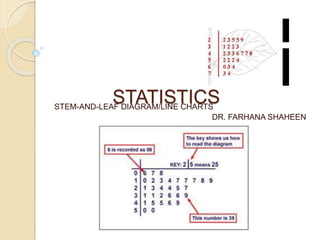
STATISTICS STEM-AND-LEAF DIAGRAM/LINE CHARTS 
DR. FARHANA SHAHEEN
SYLLABUS 
FOR Wk-II 
 Statistics 
 Stem and Leaf diagram 
 Line Charts and Scatter Diagrams
Stem and Leaf Diagram 
A stem-and-leaf diagram is an arrangement of digits that is 
used to display and order numerical data. 
A stem and leaf diagram provides a visual summary of your data. This 
diagram provides a partial sorting of the data and allows you to detect 
the distributional pattern of the data. 
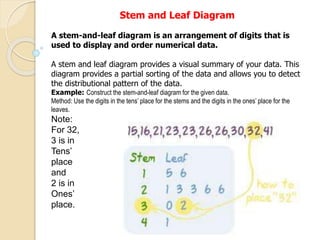
Example: Construct the stem-and-leaf diagram for the given data. 
Method: Use the digits in the tens’ place for the stems and the digits in the ones’ place for the 
leaves. 
Note: 
For 32, 
3 is in 
Tens’ 
place 
and 
2 is in 
Ones’ 
place.
STEM-AND-LEAF 
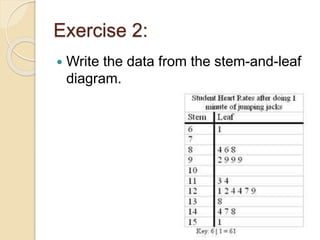
 Write the data from the stem-and-leaf 
diagram.
Constructing Stem and Leaf 
Diagrams: 
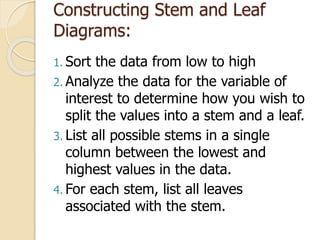
1. Sort the data from low to high 
2. Analyze the data for the variable of 
interest to determine how you wish to 
split the values into a stem and a leaf. 
3. List all possible stems in a single 
column between the lowest and 
highest values in the data. 
4. For each stem, list all leaves 
associated with the stem.
Example: 
 Note: First make a KEY for the data.
Exercise: 1 
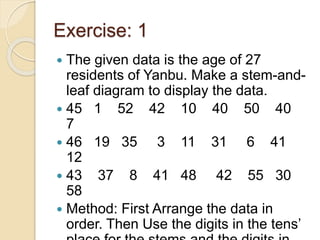
 The given data is the age of 27 
residents of Yanbu. Make a stem-and-leaf 
diagram to display the data. 
 45 1 52 42 10 40 50 40 
7 
 46 19 35 3 11 31 6 41 
12 
 43 37 8 41 48 42 55 30 
58 
 Method: First Arrange the data in 
order. Then Use the digits in the tens’ 
place for the stems and the digits in
Exercise 2: 
 Write the data from the stem-and-leaf 
diagram.
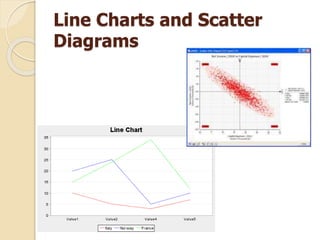
Line Charts and Scatter 
Diagrams
Line Chart 
A two-dimensional chart showing time on the horizontal axis and 
the variable of interest on the vertical axis. It is used when a time-series 
data is given.
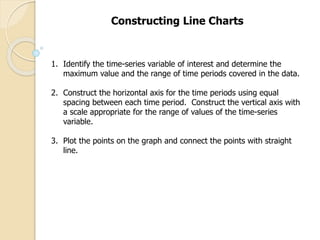
Constructing Line Charts 
1. Identify the time-series variable of interest and determine the 
maximum value and the range of time periods covered in the data. 
2. Construct the horizontal axis for the time periods using equal 
spacing between each time period. Construct the vertical axis with 
a scale appropriate for the range of values of the time-series 
variable. 
3. Plot the points on the graph and connect the points with straight 
line.
Example: 1 
 The table below shows daily 
temperatures for New York City, 
recorded for 6 days, in degrees 
Fahrenheit. 
 Temperatures In NY City 
 Day Temperature 
 1 43° F 
 2 53° F 
 3 50° F 
 4 57° F 
 5 59° F 
 6 67° F
Example 2: 
 Sarah bought a new car in 2001 for $24,000. The dollar value 
of her car changed each year as shown in the table below.
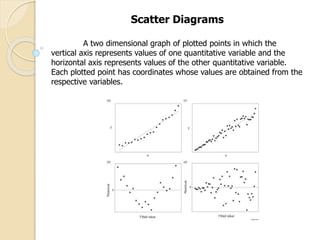
Scatter Diagrams 
A two dimensional graph of plotted points in which the 
vertical axis represents values of one quantitative variable and the 
horizontal axis represents values of the other quantitative variable. 
Each plotted point has coordinates whose values are obtained from the 
respective variables.
Scatter Diagram 
 A scatter plot or scatter diagram is a 
type of mathematical diagram using 
Cartesian coordinates to display 
values for two variables for a set of 
data. 
 X-Y plots, or scatter plots, can be 
used to see if one event affects 
another event. For example, if you 
spend more hours studying, will you 
get better grades?
 Examples of Scatter Plot 
 The scatter plot shows the hours of 
study and test scores of 20 students. 
As the number of hours of study 
increases, the marks scored tend to 
increase. 
So, the scatter plot describes a 
positive trend.
Constructing Scatter Diagrams 
1. Identify the two quantitative variables and collect paired responses 
for the two variables. 
2. Determine which variable will be placed on the vertical axis and 
which variable will be placed on the horizontal axis. Often the 
vertical axis can be considered the dependent variable (y) and the 
horizontal axis can be considered the independent variable (x). 
3. Define the range of values for each variable and define the 
appropriate for the x and y axes. 
4. Plot the joint values for the two variables by placing a point in the 
x,y space. Do not connect the points.
 http://www.icoachmath.com/math_dicti 
onary/Scatter_Plot.html 
 http://www.mathgoodies.com/lessons/ 
graphs/line.html

Stem and-leaf-diagram-ppt.-dfs

  • 1.
    STATISTICS STEM-AND-LEAF DIAGRAM/LINECHARTS DR. FARHANA SHAHEEN
  • 2.
    SYLLABUS FOR Wk-II  Statistics  Stem and Leaf diagram  Line Charts and Scatter Diagrams
  • 3.
    Stem and LeafDiagram A stem-and-leaf diagram is an arrangement of digits that is used to display and order numerical data. A stem and leaf diagram provides a visual summary of your data. This diagram provides a partial sorting of the data and allows you to detect the distributional pattern of the data. Example: Construct the stem-and-leaf diagram for the given data. Method: Use the digits in the tens’ place for the stems and the digits in the ones’ place for the leaves. Note: For 32, 3 is in Tens’ place and 2 is in Ones’ place.
  • 4.
    STEM-AND-LEAF  Writethe data from the stem-and-leaf diagram.
  • 5.
    Constructing Stem andLeaf Diagrams: 1. Sort the data from low to high 2. Analyze the data for the variable of interest to determine how you wish to split the values into a stem and a leaf. 3. List all possible stems in a single column between the lowest and highest values in the data. 4. For each stem, list all leaves associated with the stem.
  • 6.
    Example:  Note:First make a KEY for the data.
  • 7.
    Exercise: 1 The given data is the age of 27 residents of Yanbu. Make a stem-and-leaf diagram to display the data.  45 1 52 42 10 40 50 40 7  46 19 35 3 11 31 6 41 12  43 37 8 41 48 42 55 30 58  Method: First Arrange the data in order. Then Use the digits in the tens’ place for the stems and the digits in
  • 8.
    Exercise 2: Write the data from the stem-and-leaf diagram.
  • 9.
    Line Charts andScatter Diagrams
  • 10.
    Line Chart Atwo-dimensional chart showing time on the horizontal axis and the variable of interest on the vertical axis. It is used when a time-series data is given.
  • 11.
    Constructing Line Charts 1. Identify the time-series variable of interest and determine the maximum value and the range of time periods covered in the data. 2. Construct the horizontal axis for the time periods using equal spacing between each time period. Construct the vertical axis with a scale appropriate for the range of values of the time-series variable. 3. Plot the points on the graph and connect the points with straight line.
  • 12.
    Example: 1 The table below shows daily temperatures for New York City, recorded for 6 days, in degrees Fahrenheit.  Temperatures In NY City  Day Temperature  1 43° F  2 53° F  3 50° F  4 57° F  5 59° F  6 67° F
  • 14.
    Example 2: Sarah bought a new car in 2001 for $24,000. The dollar value of her car changed each year as shown in the table below.
  • 15.
    Scatter Diagrams Atwo dimensional graph of plotted points in which the vertical axis represents values of one quantitative variable and the horizontal axis represents values of the other quantitative variable. Each plotted point has coordinates whose values are obtained from the respective variables.
  • 16.
    Scatter Diagram A scatter plot or scatter diagram is a type of mathematical diagram using Cartesian coordinates to display values for two variables for a set of data.  X-Y plots, or scatter plots, can be used to see if one event affects another event. For example, if you spend more hours studying, will you get better grades?
  • 17.
     Examples ofScatter Plot  The scatter plot shows the hours of study and test scores of 20 students. As the number of hours of study increases, the marks scored tend to increase. So, the scatter plot describes a positive trend.
  • 19.
    Constructing Scatter Diagrams 1. Identify the two quantitative variables and collect paired responses for the two variables. 2. Determine which variable will be placed on the vertical axis and which variable will be placed on the horizontal axis. Often the vertical axis can be considered the dependent variable (y) and the horizontal axis can be considered the independent variable (x). 3. Define the range of values for each variable and define the appropriate for the x and y axes. 4. Plot the joint values for the two variables by placing a point in the x,y space. Do not connect the points.
  • 20.
     http://www.icoachmath.com/math_dicti onary/Scatter_Plot.html  http://www.mathgoodies.com/lessons/ graphs/line.html