WORKING OF TABLET 
PUNCHING MACHINE 
Presented by- 
Chetan Singh Bisht
Introduction 
 The tablet press is a high-speed mechanical 
device. It compresses the ingredients into the 
required tablet shape with extreme precision. It 
can make the tablet in many shapes, although 
they are usually round or oval. Also, it can press 
the name of the manufacturer or the product into 
the top of the tablet . 
 Tablet punching machines work on the principle of 
compression. 
 A tablet is formed by the combined pressing 
action of two punches and a die.
Punches & Dies 
Tooling Station :- The upper 
punch ,the lower punch and 
the die which accommodate 
one station in a tablet press. 
Tooling Set :- A complete set 
of punches and dies to 
accommodate all stations in a 
tablet press.
Standards 
 Internationally there are two recognized standards 
for tablet compression tooling the TSM standard 
and the EU standard. 
 TSM is acronym for the ‘TABLET 
SPECIFICATION MANUAL’ and is recognized in 
the America and is considered exclusive in the 
United States. 
 The EU tooling standard is internationally 
recognized and is more widely used than TSM 
standard.EU which is the acronym for 
‘EUROSTNADARD’ is considered the European 
standard for interchangeable B and D type 
compression tools
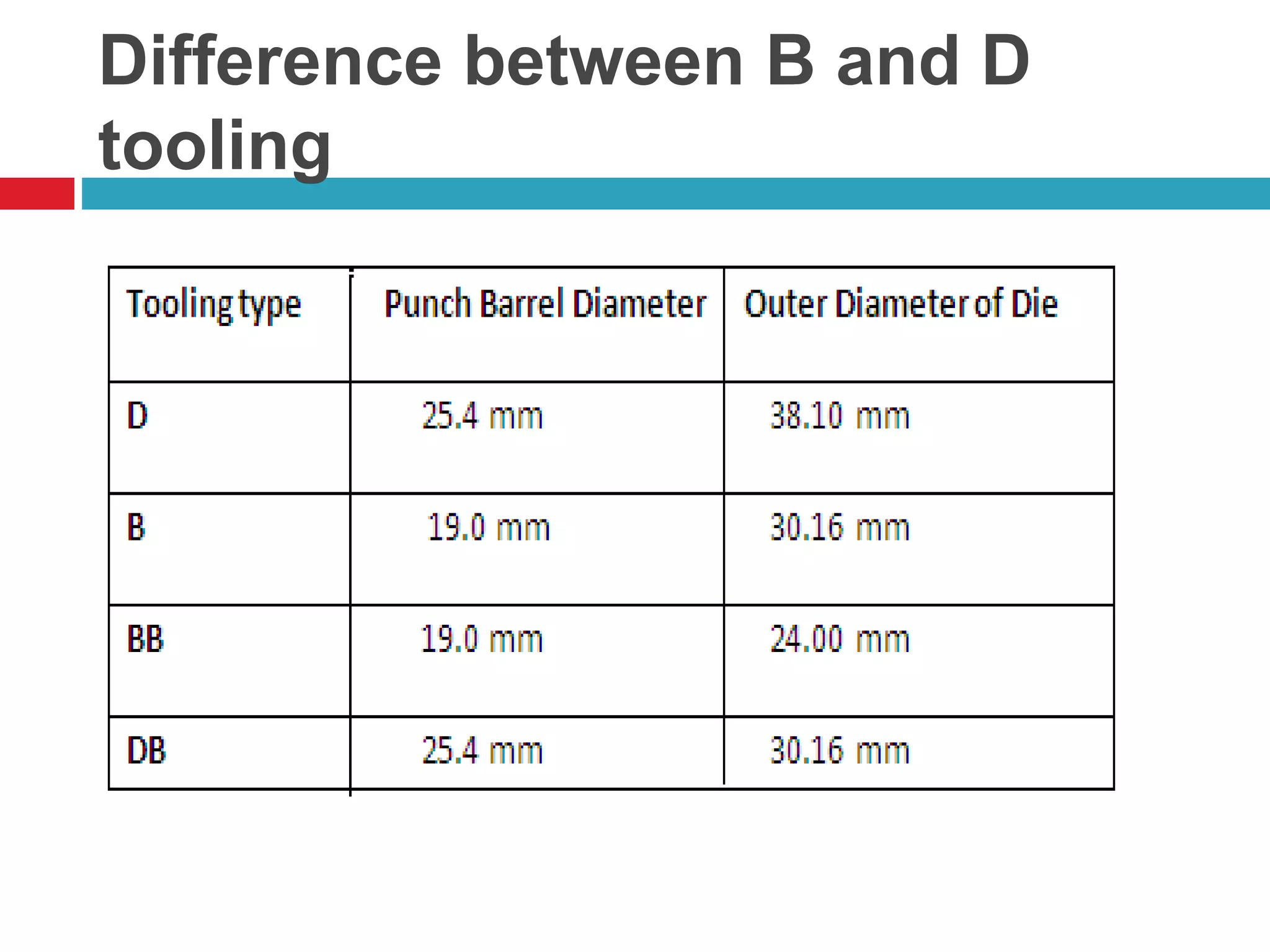
B and D tooling 
 Tablet compression machines are made in 
keeping in view the type of dies and punches will 
be used on them , The dies and punches and 
their setup on compression machine is called 
tooling , it is classified as B and D mainly . 
The B tooling dies and punch can be further 
have specifications as BB and D tooling can also 
be dies and punches can be utilsed on B tooling 
machine which is called as DB 
Mainly there are two standards, a D and B .
Difference between B and D 
tooling
Different Shapes of Dies and 
Punches 
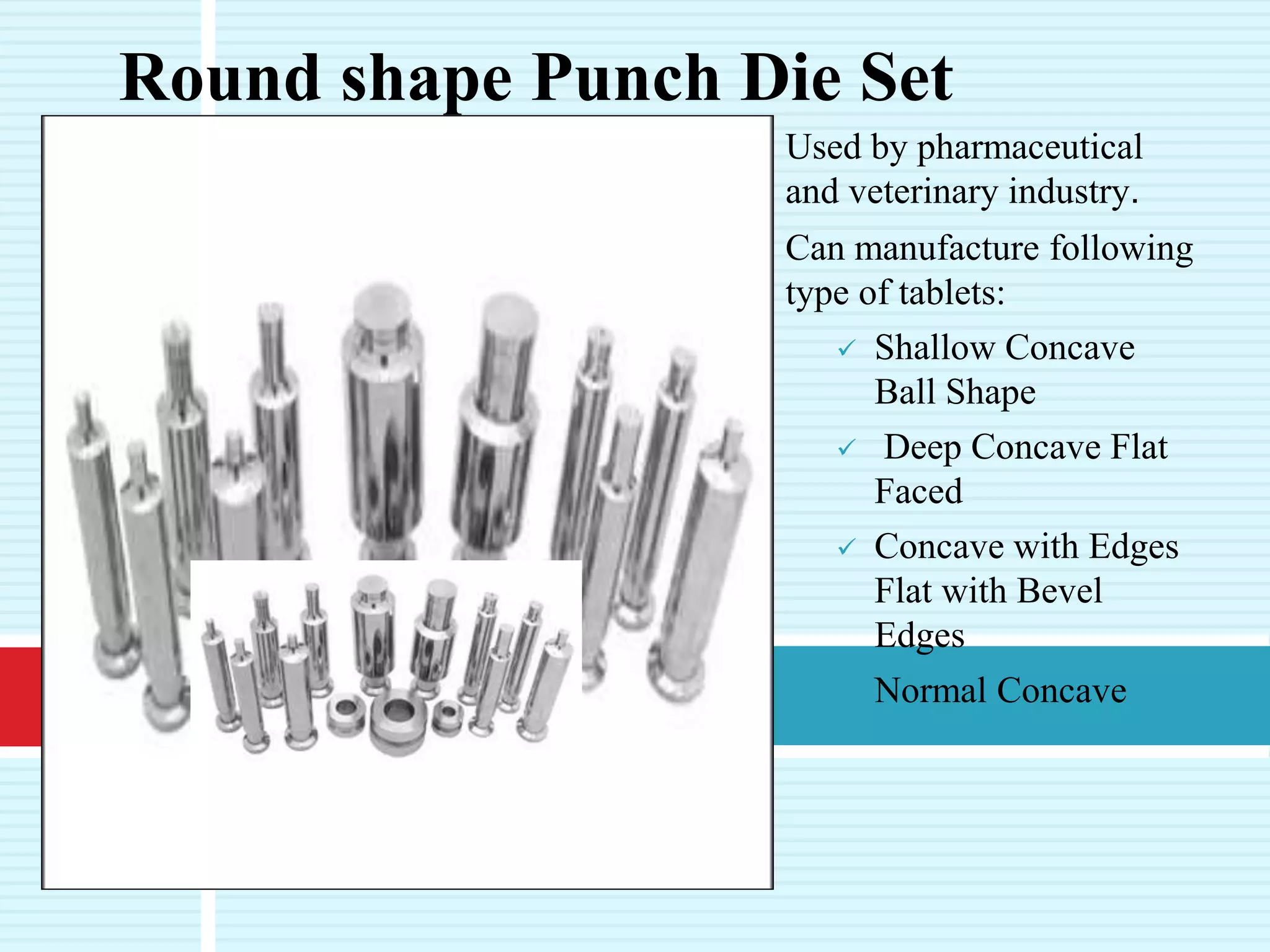
 Round shape punch die set 
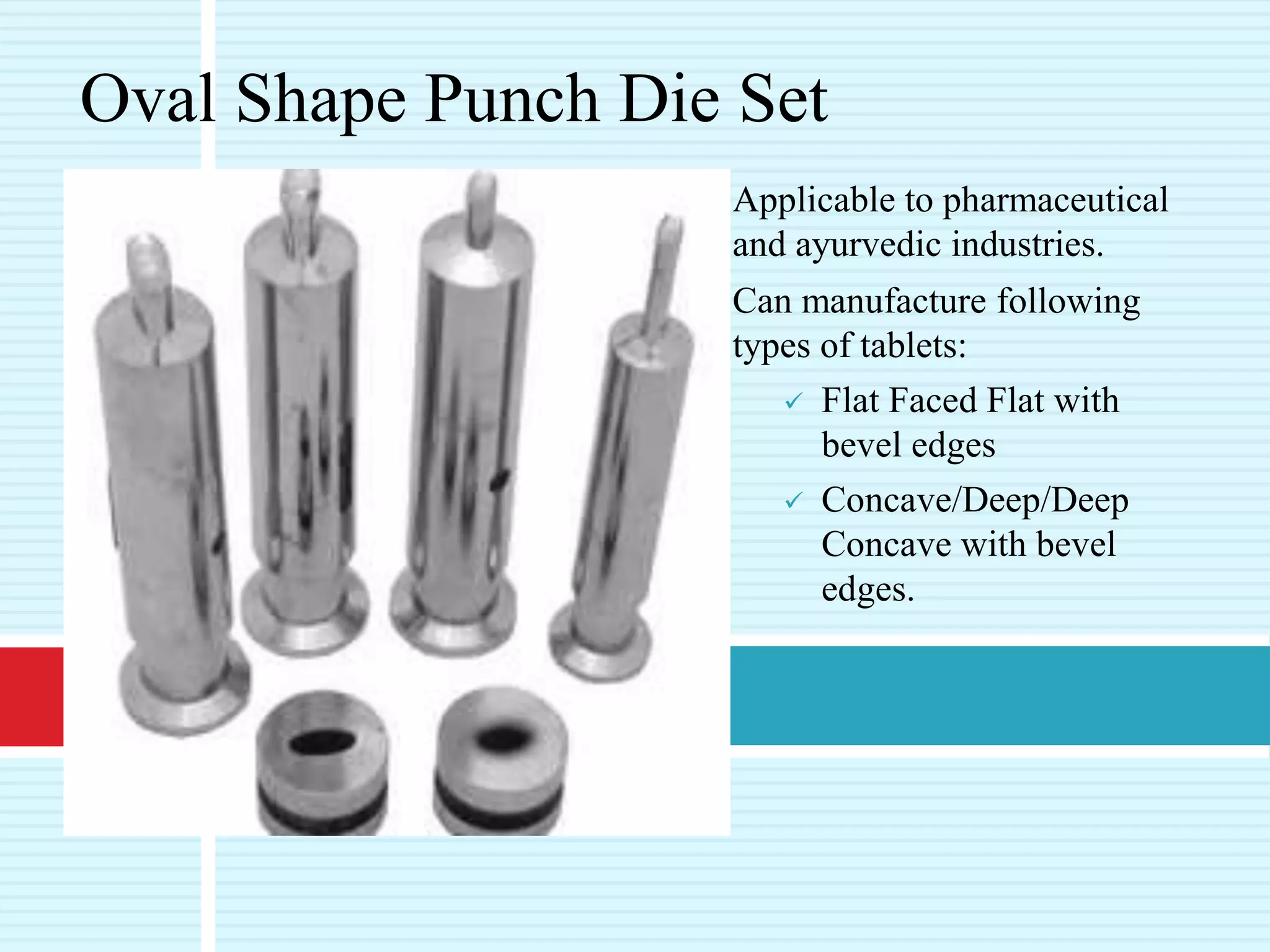
 Oval shape punch die set 
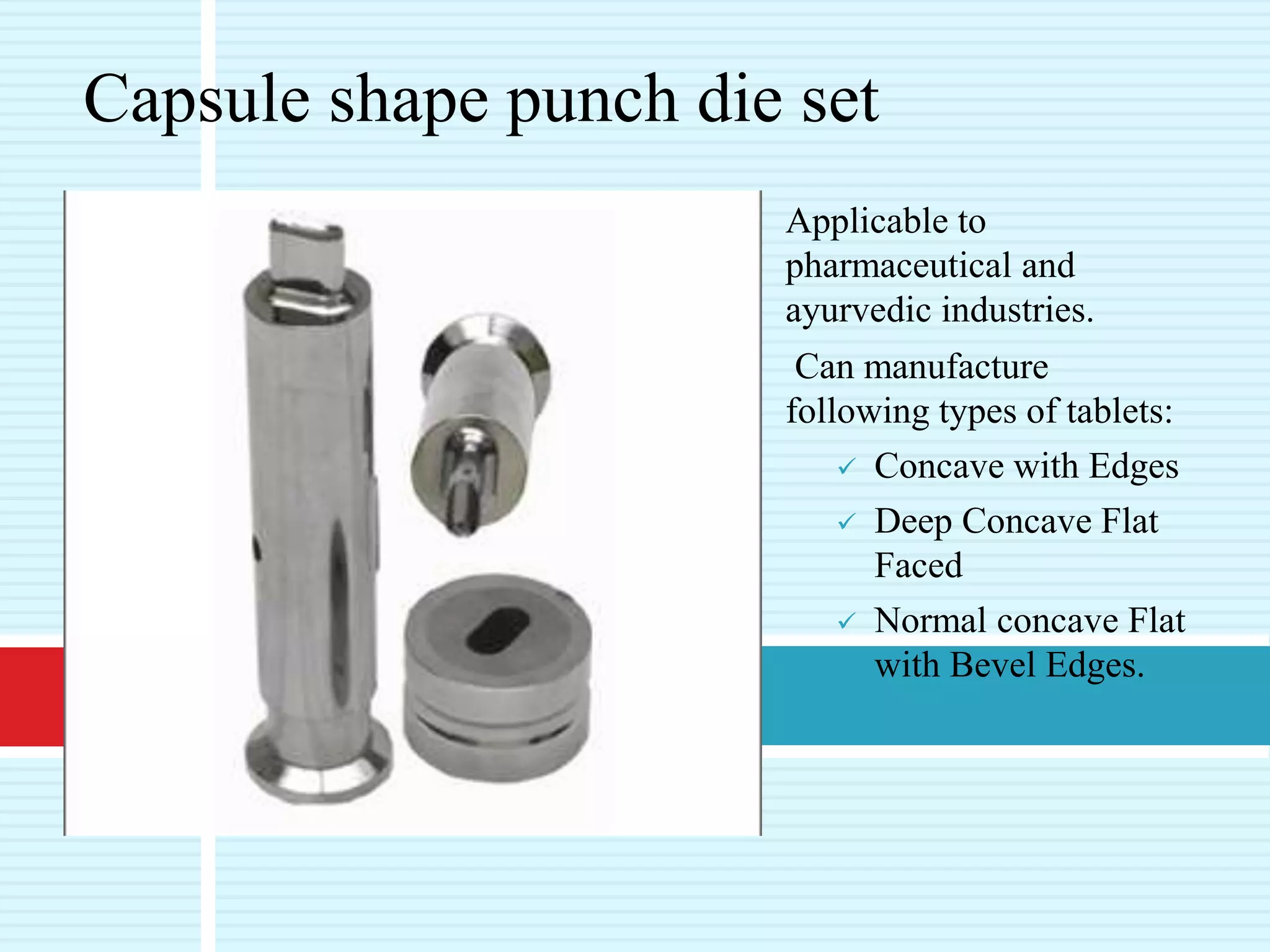
 Capsule shape punch die set 
 Geometric shape punch die set 
 Irregular shape punch die set 
 Core rod tooling punch die set
Round shape Punch Die Set 
Used by pharmaceutical 
and veterinary industry. 
Can manufacture following 
type of tablets: 
 Shallow Concave 
Ball Shape 
 Deep Concave Flat 
Faced 
 Concave with Edges 
Flat with Bevel 
Edges 
 Normal Concave
Oval Shape Punch Die Set 
Applicable to pharmaceutical 
and ayurvedic industries. 
Can manufacture following 
types of tablets: 
 Flat Faced Flat with 
bevel edges 
 Concave/Deep/Deep 
Concave with bevel 
edges.
Capsule shape punch die set 
Applicable to 
pharmaceutical and 
ayurvedic industries. 
Can manufacture 
following types of tablets: 
 Concave with Edges 
 Deep Concave Flat 
Faced 
 Normal concave Flat 
with Bevel Edges.
Geometric Shape Punch Die Set 
Applicable to 
pharmaceutical, 
confectionery, chemical, 
industrial powder 
metallurgy industries.Can 
manufacture following 
types of tablet: 
 Triangular 
 Benzene 
 Rhombus 
 Rectangular Square
Irregular Shape Punch Die Set 
Are applicable to 
confectionery 
industries. 
Available with different 
size, concavity, and flat 
in plain or engraved 
break line.
Parts Of A Tablet Press 
Tablet presses are designed with following basic 
components: 
1. Hopper for holding and feeding granulation 
2. Dies that define the size and shape of the tablet. 
3.Punches for compressing the granulation within 
the dies. 
4.Cam tracks for guiding the movement of the 
punches. 
5. A feeding mechanism for moving granulation from 
hopper 
into the dies.
Auxiliary Equipments 
1.Granulation Feeding Device: 
In many cases, speed of die table is such that the time of 
die under feed frame is too short to allow adequate or 
consistent gravity filling of die with granules, resulting in 
weight variation and content uniformity. These also seen 
with poorly flowing granules. To avoid these problems, 
mechanized feeder can employ to force granules into die 
cavity. 
2..Tablet weight monitoring devices:- 
High rate of tablet output with modern press requires 
continuous tablet weight monitoring with electronic 
monitoring devices
3. Tablet Deduster : - 
In almost all cases, tablets coming out of a tablet 
machine bear excess powder on its surface and are 
run through the tablet deduster to remove that 
excess powder. 
4. Fette machine 
Fette machine is device that chills the compression 
components to allow the compression of low melting 
point substance such as waxes and thereby making 
it possible to compress product with low meting 
points.
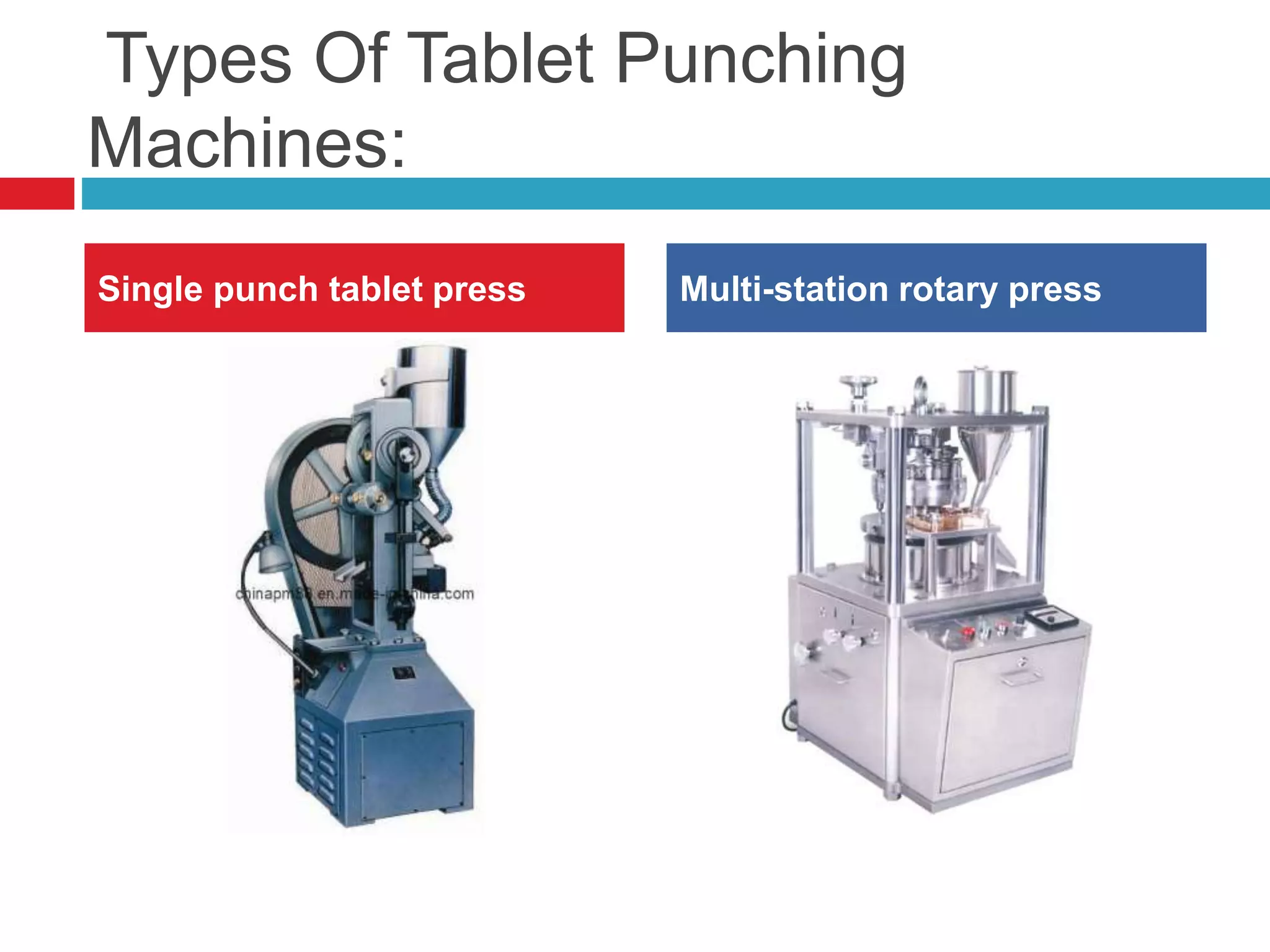
Types Of Tablet Punching 
Machines: 
Single punch tablet press Multi-station rotary press
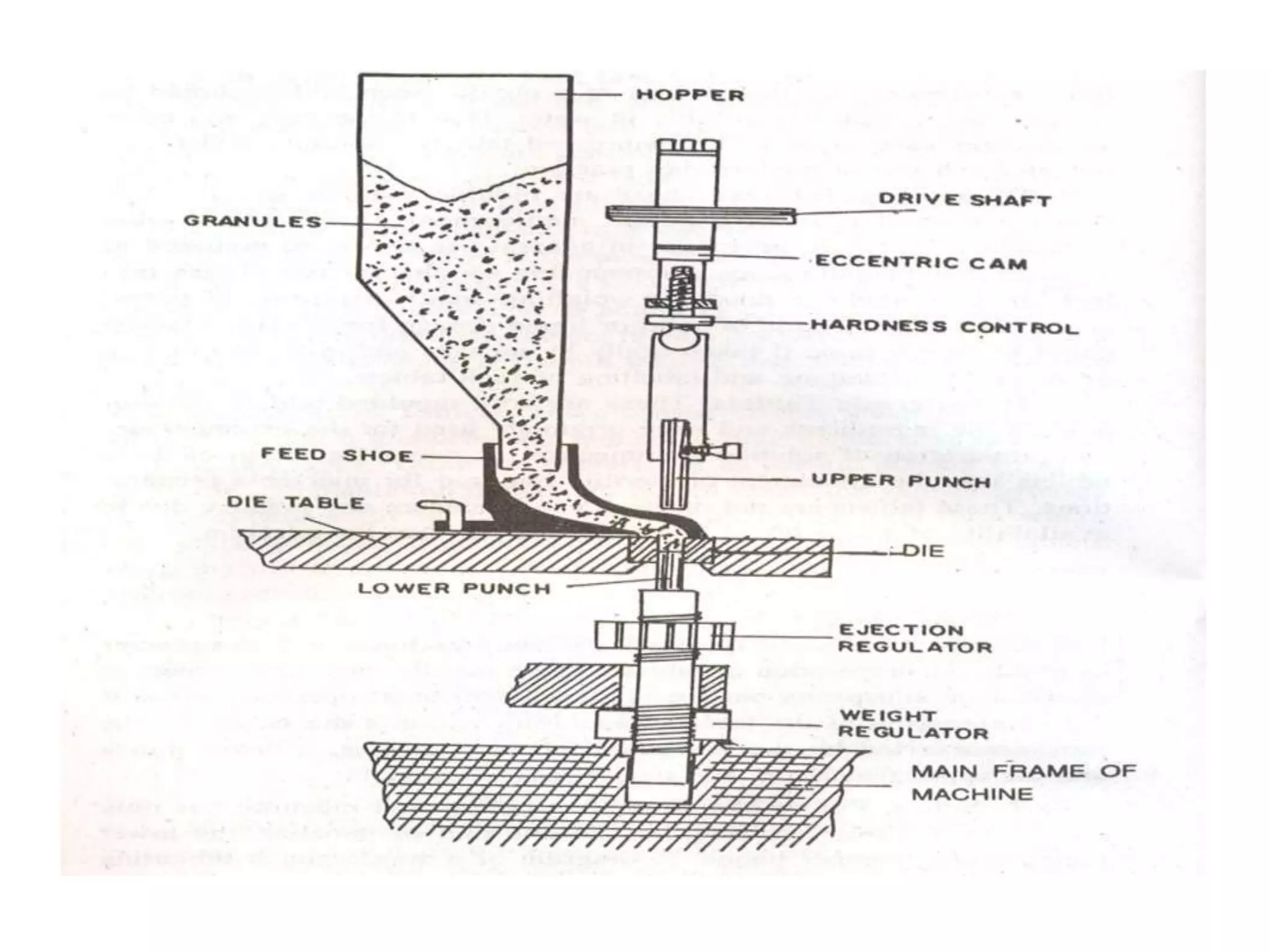
Single Punch Tablet Press 
 Single punch tablet press is also called as a 
eccentric press or single station press 
 It is most simplest machine for tablet 
manufacturing 
 Single station tablet press employs a single 
tooling station that is a die and a pair of upper 
and lower punches 
 This tablet press is available as both manually 
operated and power driven
In this single punch 
tablet press, the 
compaction force on 
the fill material is 
exerted by only the 
upper punch while 
the lower punch is 
immovable such as 
action equivalent to 
hammering motion
It is also called multi 
station tablet press. 
Multi station presses 
are termed rotary 
because the head of 
the machine that 
holds the upper 
punches, dies and 
lower punches in 
place rotates. 
Rotary Tablet Press
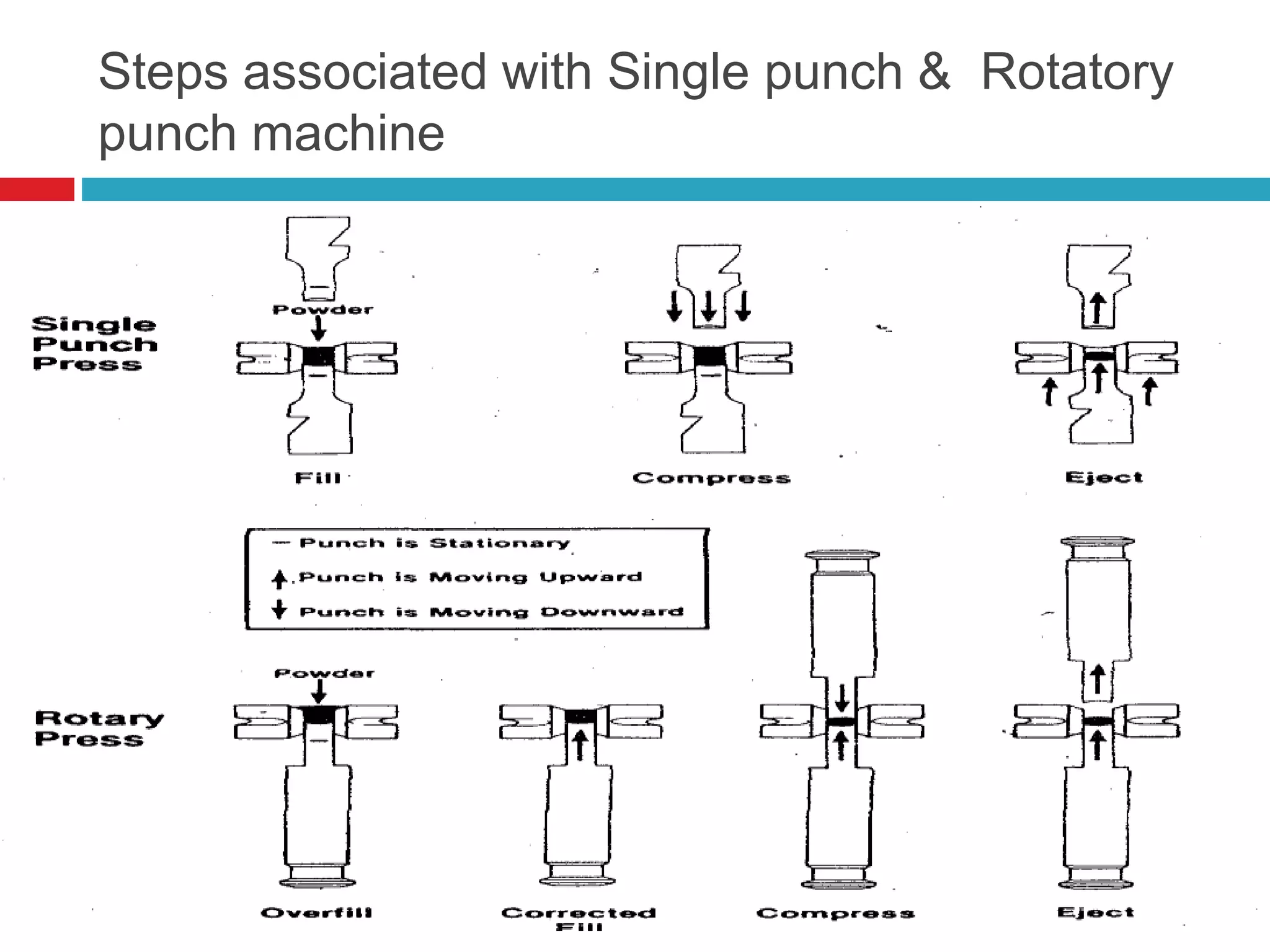
Steps associated with Single punch & Rotatory 
punch machine
Working Principle of Compression 
Machine: 
1. Filling and Dosing of the Dies 
The material to be pressed reaches the rotary or 
gravityfeeder 
from the material supply. The fill cam below the feeder 
pulls 
the lower punches down by a fixed amount and the dies 
are 
filled with material. The quantity of the material filled in is 
larger than the actual amount required i.e. excess dosing 
is 
done. 
Thereafter, the dosing unit lifts the lower punches until 
only
2. Compression of the Tablets 
After that, the upper cam course lowers the 
upper punch until the upper punches are 
inserted into the dies. The lower punches are 
guide to the pre-compression cam. 
When the punches pass the pre-compression 
cam, they are inserted a little more into the 
dies and the material is pre-compressed and 
the slugs are formed. Thereafter, in the main 
compression roller, 
the tablets reach their final height and hardness.
3. Ejection and Exit of the Tablets 
After the compression, the upper cam course pulls 
the 
upper punches into their top position and 
simultaneously the ejection device lifts the lower 
punches until the tablets are ejected from the dies. 
The tablet stripping device strips the tablets off the 
lower punches and passes them on to the 
discharge chute.
The stages in the compression cycle are shown in figure
TABLET PROCESSING 
PROBLEMS AND ITS REMEDIES 
Capping 
The upper or lower segment of the tablet separates 
horizontally, either partially or completely from the main body 
and comes off as a cap, during ejection from the tablet press, 
or during subsequent handling. 
Reason: 
Due to the air–entrapment in a compact during 
compression, and subsequent expansion of tablet on 
ejection of a tablet from a die.
The Causes and Remedies of 
Capping related to ‘Machine’ 
Sr. 
No. 
CAUSES REMEDIES 
1. Poorly finished dies Polish dies properly. Investigate other steels or 
other materials. 
2. Deep concave punches or beveled-edge 
faces of punches. 
Use flat punches. 
3. Lower punch remains below the face of die 
during ejection. 
Make proper setting of lower punch during 
ejection. 
4. Incorrect adjustment of sweep-off blade. Adjust sweep-off blade correctly to facilitate 
proper ejection. 
5. High turret speed. Reduce speed of turret (Increase dwell time).
Lamination 
Separation of a tablet into two or more distinct 
horizontal layers. 
Reason: 
Air–entrapment during compression and subsequent 
release on ejection. 
The condition is exaggerated by higher speed of 
turret.
The Causes and Remedies of Lamination 
related to ‘Machine’ 
Sr. 
No. 
CAUSES REMEDIES 
1. Rapid relaxation of the peripheral 
regions of a tablet, on ejection from a 
die. 
Use tapered dies, i.e. upper part of the die 
bore has an outward taper of 3° to 5°. 
2. Rapid decompression Use pre-compression step. Reduce turret 
speed and reduce the final compression 
pressure.
Chipping 
Breaking of tablet edges, while the tablet 
leaves the press or during subsequent 
handling and coating operations. 
Reason: 
Incorrect machine settings, specially mis-set 
ejection take-off.
The Causes and Remedies of Chipping 
related to ‘Machine’ 
Sr. 
No. 
CAUSES REMEDIES 
1. Groove of die worn at compression 
point. 
Polish to open end, reverse or replace the 
die. 
2. Barreled die (center of the die wider 
than ends) 
Polish the die to make it cylindrical 
3. Edge of punch face turned 
inside/inward. 
Polish the punch edges 
4. Concavity too deep to compress powder 
blend. 
Reduce concavity of punch faces. Use flat 
punches.
Cracking 
Small, fine cracks observed on the upper and lower 
central surface of tablets, or very rarely on the 
sidewall are referred to as ‘Cracks’. 
Reason: 
It is observed as a result of rapid expansion of tablets, 
especially when deep concave punches are used.
The Causes and Remedies of Cracking 
related to ‘Machine’ 
Sr. No. 
CAUSES REMEDIES 
1. Tablet expands on ejection due to air entrapment. Use tapered die. 
2. Deep concavities cause cracking while 
removing tablets 
Use special take-off.
Sticking 
Tablet material adhering to the die wall. 
Filming is a slow form of sticking and is largely due to 
excess moisture in the granulation. 
Reason: 
Improperly dried or improperly lubricated granules.
The Causes and Remedies of 
Sticking related to ‘Machine’ 
Sr. No. 
CAUSES REMEDIES 
1. Concavity too deep for granulation. Reduce concavity to optimum. 
2. Too little pressure. Increase pressure. 
3. Compressing too fast. Reduce speed.
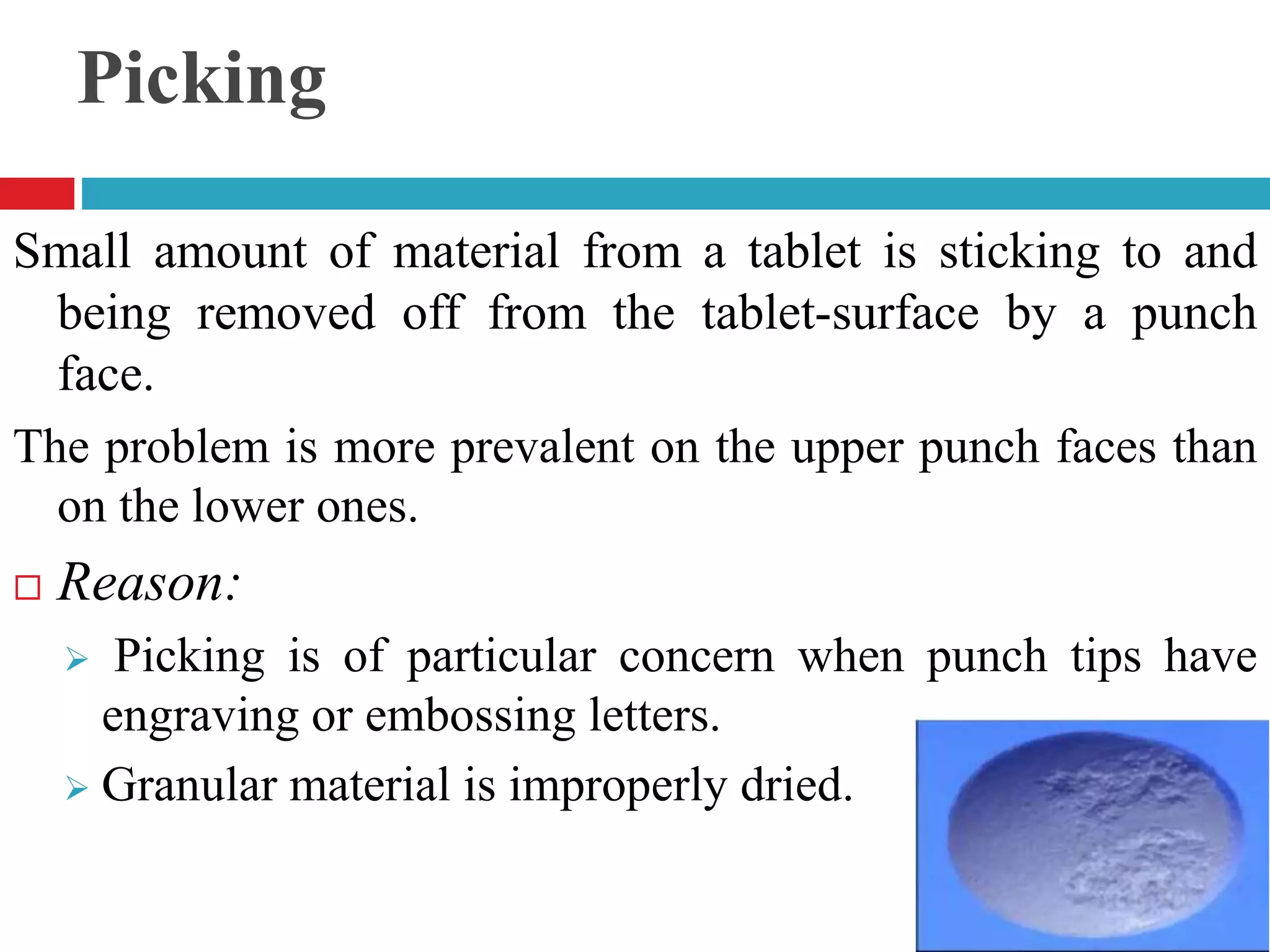
Picking 
Small amount of material from a tablet is sticking to and 
being removed off from the tablet-surface by a punch 
face. 
The problem is more prevalent on the upper punch faces than 
on the lower ones. 
 Reason: 
 Picking is of particular concern when punch tips have 
engraving or embossing letters. 
 Granular material is improperly dried.
The Causes and Remedies of Picking 
related to ‘Machine’ 
Sr. 
No. 
CAUSES REMEDIES 
1. Rough or scratched punch faces. Polish faces to high luster. 
2. Embossing or engraving letters on punch 
faces such as B, A, O, R, P, Q, G. 
Design lettering as large as possible. 
Plate the punch faces with chromium to 
produce a smooth and non-adherent face. 
3. Bevels or dividing lines too deep. Reduce depths and sharpness. 
4. Pressure applied is not enough; too soft 
tablets. 
Increase pressure to optimum.
Double Impression 
 Involves only those punches, which have a monogram or other 
engraving on them. 
 If the upper punch is uncontrolled, it can rotate during the short 
travel to the final compression stage and create a double 
impression. 
 Reason: 
 At the moment of compression, the tablet receives the imprint 
of the punch. 
 The lower punch freely drops and travels uncontrolled for a 
short distance before riding up the ejection cam to push the 
tablet out of the die 
 Now during this free travel, the punch rotates and at this point, 
the punch may make a new impression on the bottom of the 
tablet, resulting in ‘double impression’.
The Causes and Remedies of Double 
Impression 
Sr. 
No. 
CAUSE REMEDIES 
1. Free rotation of either upper 
punch or lower punch during 
ejection of a tablet. 
-Use keying in tooling, i.e. inset a key alongside of 
the punch, so that it fits the punch and prevents 
punch rotation. 
-Newer presses have anti-turning devices, which 
prevent punch rotation.
working of tablet punching machine

working of tablet punching machine

  • 1.
    WORKING OF TABLET PUNCHING MACHINE Presented by- Chetan Singh Bisht
  • 2.
    Introduction  Thetablet press is a high-speed mechanical device. It compresses the ingredients into the required tablet shape with extreme precision. It can make the tablet in many shapes, although they are usually round or oval. Also, it can press the name of the manufacturer or the product into the top of the tablet .  Tablet punching machines work on the principle of compression.  A tablet is formed by the combined pressing action of two punches and a die.
  • 3.
    Punches & Dies Tooling Station :- The upper punch ,the lower punch and the die which accommodate one station in a tablet press. Tooling Set :- A complete set of punches and dies to accommodate all stations in a tablet press.
  • 5.
    Standards  Internationallythere are two recognized standards for tablet compression tooling the TSM standard and the EU standard.  TSM is acronym for the ‘TABLET SPECIFICATION MANUAL’ and is recognized in the America and is considered exclusive in the United States.  The EU tooling standard is internationally recognized and is more widely used than TSM standard.EU which is the acronym for ‘EUROSTNADARD’ is considered the European standard for interchangeable B and D type compression tools
  • 7.
    B and Dtooling  Tablet compression machines are made in keeping in view the type of dies and punches will be used on them , The dies and punches and their setup on compression machine is called tooling , it is classified as B and D mainly . The B tooling dies and punch can be further have specifications as BB and D tooling can also be dies and punches can be utilsed on B tooling machine which is called as DB Mainly there are two standards, a D and B .
  • 8.
    Difference between Band D tooling
  • 9.
    Different Shapes ofDies and Punches  Round shape punch die set  Oval shape punch die set  Capsule shape punch die set  Geometric shape punch die set  Irregular shape punch die set  Core rod tooling punch die set
  • 10.
    Round shape PunchDie Set Used by pharmaceutical and veterinary industry. Can manufacture following type of tablets:  Shallow Concave Ball Shape  Deep Concave Flat Faced  Concave with Edges Flat with Bevel Edges  Normal Concave
  • 11.
    Oval Shape PunchDie Set Applicable to pharmaceutical and ayurvedic industries. Can manufacture following types of tablets:  Flat Faced Flat with bevel edges  Concave/Deep/Deep Concave with bevel edges.
  • 12.
    Capsule shape punchdie set Applicable to pharmaceutical and ayurvedic industries. Can manufacture following types of tablets:  Concave with Edges  Deep Concave Flat Faced  Normal concave Flat with Bevel Edges.
  • 13.
    Geometric Shape PunchDie Set Applicable to pharmaceutical, confectionery, chemical, industrial powder metallurgy industries.Can manufacture following types of tablet:  Triangular  Benzene  Rhombus  Rectangular Square
  • 14.
    Irregular Shape PunchDie Set Are applicable to confectionery industries. Available with different size, concavity, and flat in plain or engraved break line.
  • 15.
    Parts Of ATablet Press Tablet presses are designed with following basic components: 1. Hopper for holding and feeding granulation 2. Dies that define the size and shape of the tablet. 3.Punches for compressing the granulation within the dies. 4.Cam tracks for guiding the movement of the punches. 5. A feeding mechanism for moving granulation from hopper into the dies.
  • 17.
    Auxiliary Equipments 1.GranulationFeeding Device: In many cases, speed of die table is such that the time of die under feed frame is too short to allow adequate or consistent gravity filling of die with granules, resulting in weight variation and content uniformity. These also seen with poorly flowing granules. To avoid these problems, mechanized feeder can employ to force granules into die cavity. 2..Tablet weight monitoring devices:- High rate of tablet output with modern press requires continuous tablet weight monitoring with electronic monitoring devices
  • 18.
    3. Tablet Deduster: - In almost all cases, tablets coming out of a tablet machine bear excess powder on its surface and are run through the tablet deduster to remove that excess powder. 4. Fette machine Fette machine is device that chills the compression components to allow the compression of low melting point substance such as waxes and thereby making it possible to compress product with low meting points.
  • 19.
    Types Of TabletPunching Machines: Single punch tablet press Multi-station rotary press
  • 20.
    Single Punch TabletPress  Single punch tablet press is also called as a eccentric press or single station press  It is most simplest machine for tablet manufacturing  Single station tablet press employs a single tooling station that is a die and a pair of upper and lower punches  This tablet press is available as both manually operated and power driven
  • 21.
    In this singlepunch tablet press, the compaction force on the fill material is exerted by only the upper punch while the lower punch is immovable such as action equivalent to hammering motion
  • 23.
    It is alsocalled multi station tablet press. Multi station presses are termed rotary because the head of the machine that holds the upper punches, dies and lower punches in place rotates. Rotary Tablet Press
  • 24.
    Steps associated withSingle punch & Rotatory punch machine
  • 25.
    Working Principle ofCompression Machine: 1. Filling and Dosing of the Dies The material to be pressed reaches the rotary or gravityfeeder from the material supply. The fill cam below the feeder pulls the lower punches down by a fixed amount and the dies are filled with material. The quantity of the material filled in is larger than the actual amount required i.e. excess dosing is done. Thereafter, the dosing unit lifts the lower punches until only
  • 26.
    2. Compression ofthe Tablets After that, the upper cam course lowers the upper punch until the upper punches are inserted into the dies. The lower punches are guide to the pre-compression cam. When the punches pass the pre-compression cam, they are inserted a little more into the dies and the material is pre-compressed and the slugs are formed. Thereafter, in the main compression roller, the tablets reach their final height and hardness.
  • 27.
    3. Ejection andExit of the Tablets After the compression, the upper cam course pulls the upper punches into their top position and simultaneously the ejection device lifts the lower punches until the tablets are ejected from the dies. The tablet stripping device strips the tablets off the lower punches and passes them on to the discharge chute.
  • 28.
    The stages inthe compression cycle are shown in figure
  • 30.
    TABLET PROCESSING PROBLEMSAND ITS REMEDIES Capping The upper or lower segment of the tablet separates horizontally, either partially or completely from the main body and comes off as a cap, during ejection from the tablet press, or during subsequent handling. Reason: Due to the air–entrapment in a compact during compression, and subsequent expansion of tablet on ejection of a tablet from a die.
  • 31.
    The Causes andRemedies of Capping related to ‘Machine’ Sr. No. CAUSES REMEDIES 1. Poorly finished dies Polish dies properly. Investigate other steels or other materials. 2. Deep concave punches or beveled-edge faces of punches. Use flat punches. 3. Lower punch remains below the face of die during ejection. Make proper setting of lower punch during ejection. 4. Incorrect adjustment of sweep-off blade. Adjust sweep-off blade correctly to facilitate proper ejection. 5. High turret speed. Reduce speed of turret (Increase dwell time).
  • 32.
    Lamination Separation ofa tablet into two or more distinct horizontal layers. Reason: Air–entrapment during compression and subsequent release on ejection. The condition is exaggerated by higher speed of turret.
  • 33.
    The Causes andRemedies of Lamination related to ‘Machine’ Sr. No. CAUSES REMEDIES 1. Rapid relaxation of the peripheral regions of a tablet, on ejection from a die. Use tapered dies, i.e. upper part of the die bore has an outward taper of 3° to 5°. 2. Rapid decompression Use pre-compression step. Reduce turret speed and reduce the final compression pressure.
  • 34.
    Chipping Breaking oftablet edges, while the tablet leaves the press or during subsequent handling and coating operations. Reason: Incorrect machine settings, specially mis-set ejection take-off.
  • 35.
    The Causes andRemedies of Chipping related to ‘Machine’ Sr. No. CAUSES REMEDIES 1. Groove of die worn at compression point. Polish to open end, reverse or replace the die. 2. Barreled die (center of the die wider than ends) Polish the die to make it cylindrical 3. Edge of punch face turned inside/inward. Polish the punch edges 4. Concavity too deep to compress powder blend. Reduce concavity of punch faces. Use flat punches.
  • 36.
    Cracking Small, finecracks observed on the upper and lower central surface of tablets, or very rarely on the sidewall are referred to as ‘Cracks’. Reason: It is observed as a result of rapid expansion of tablets, especially when deep concave punches are used.
  • 37.
    The Causes andRemedies of Cracking related to ‘Machine’ Sr. No. CAUSES REMEDIES 1. Tablet expands on ejection due to air entrapment. Use tapered die. 2. Deep concavities cause cracking while removing tablets Use special take-off.
  • 38.
    Sticking Tablet materialadhering to the die wall. Filming is a slow form of sticking and is largely due to excess moisture in the granulation. Reason: Improperly dried or improperly lubricated granules.
  • 39.
    The Causes andRemedies of Sticking related to ‘Machine’ Sr. No. CAUSES REMEDIES 1. Concavity too deep for granulation. Reduce concavity to optimum. 2. Too little pressure. Increase pressure. 3. Compressing too fast. Reduce speed.
  • 40.
    Picking Small amountof material from a tablet is sticking to and being removed off from the tablet-surface by a punch face. The problem is more prevalent on the upper punch faces than on the lower ones.  Reason:  Picking is of particular concern when punch tips have engraving or embossing letters.  Granular material is improperly dried.
  • 41.
    The Causes andRemedies of Picking related to ‘Machine’ Sr. No. CAUSES REMEDIES 1. Rough or scratched punch faces. Polish faces to high luster. 2. Embossing or engraving letters on punch faces such as B, A, O, R, P, Q, G. Design lettering as large as possible. Plate the punch faces with chromium to produce a smooth and non-adherent face. 3. Bevels or dividing lines too deep. Reduce depths and sharpness. 4. Pressure applied is not enough; too soft tablets. Increase pressure to optimum.
  • 42.
    Double Impression Involves only those punches, which have a monogram or other engraving on them.  If the upper punch is uncontrolled, it can rotate during the short travel to the final compression stage and create a double impression.  Reason:  At the moment of compression, the tablet receives the imprint of the punch.  The lower punch freely drops and travels uncontrolled for a short distance before riding up the ejection cam to push the tablet out of the die  Now during this free travel, the punch rotates and at this point, the punch may make a new impression on the bottom of the tablet, resulting in ‘double impression’.
  • 43.
    The Causes andRemedies of Double Impression Sr. No. CAUSE REMEDIES 1. Free rotation of either upper punch or lower punch during ejection of a tablet. -Use keying in tooling, i.e. inset a key alongside of the punch, so that it fits the punch and prevents punch rotation. -Newer presses have anti-turning devices, which prevent punch rotation.