PRESENTED BY
DEORE PRASHANT ASHOK
Department of Pharmaceutics
M. Pharm. I Semester (2014-2015)
R. C. Patel Institute of Pharmaceutical Education
and Research, Shirpur .
10/10/2014 1
Email-prashantdeore92@gmail.com Mo.09881261646
CONTENTS
 Dissolution
 Dissolution vs Solubility
 Expression of Solubility
 Drug Dissolution Process
 Theories of Dissolution
 References
10/10/2014 2
DISSOLUTION
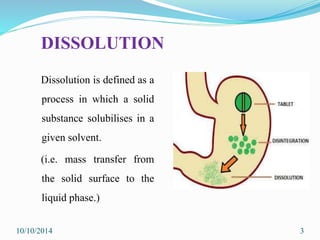
Dissolution is defined as a
process in which a solid
substance solubilises in a
given solvent.
(i.e. mass transfer from
the solid surface to the
liquid phase.)
10/10/2014 3
10/10/2014 4
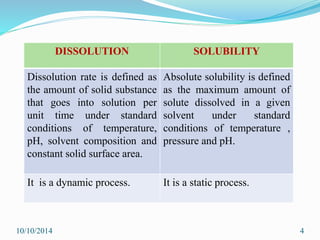
DISSOLUTION SOLUBILITY
Dissolution rate is defined as
the amount of solid substance
that goes into solution per
unit time under standard
conditions of temperature,
pH, solvent composition and
constant solid surface area.
Absolute solubility is defined
as the maximum amount of
solute dissolved in a given
solvent under standard
conditions of temperature ,
pressure and pH.
It is a dynamic process. It is a static process.
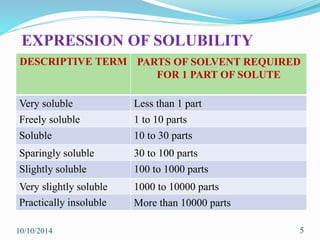
EXPRESSION OF SOLUBILITY
10/10/2014 5
DESCRIPTIVE TERM PARTS OF SOLVENT REQUIRED
FOR 1 PART OF SOLUTE
Very soluble Less than 1 part
Freely soluble 1 to 10 parts
Soluble 10 to 30 parts
Sparingly soluble 30 to 100 parts
Slightly soluble 100 to 1000 parts
Very slightly soluble 1000 to 10000 parts
Practically insoluble More than 10000 parts
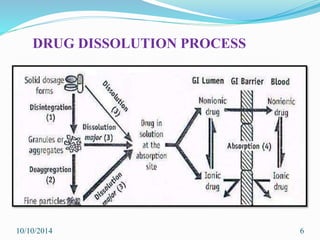
DRUG DISSOLUTION PROCESS
10/10/2014 6
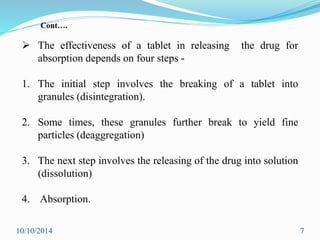
 The effectiveness of a tablet in releasing the drug for
absorption depends on four steps -
1. The initial step involves the breaking of a tablet into
granules (disintegration).
2. Some times, these granules further break to yield fine
particles (deaggregation)
3. The next step involves the releasing of the drug into solution
(dissolution)
4. Absorption.
10/10/2014 7
Cont….
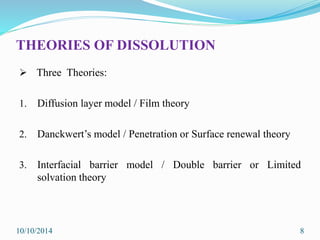
THEORIES OF DISSOLUTION
 Three Theories:
1. Diffusion layer model / Film theory
2. Danckwert’s model / Penetration or Surface renewal theory
3. Interfacial barrier model / Double barrier or Limited
solvation theory
10/10/2014 8
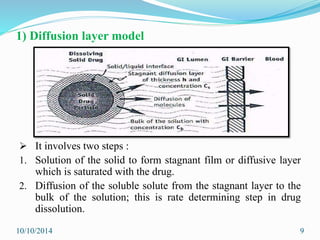
1) Diffusion layer model
 It involves two steps :
1. Solution of the solid to form stagnant film or diffusive layer
which is saturated with the drug.
2. Diffusion of the soluble solute from the stagnant layer to the
bulk of the solution; this is rate determining step in drug
dissolution.
10/10/2014 9
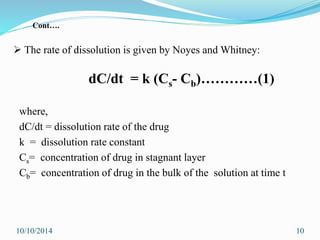
 The rate of dissolution is given by Noyes and Whitney:
dC/dt = k (Cs- Cb)…………(1)
where,
dC/dt = dissolution rate of the drug
k = dissolution rate constant
Cs= concentration of drug in stagnant layer
Cb= concentration of drug in the bulk of the solution at time t
10/10/2014 10
Cont….
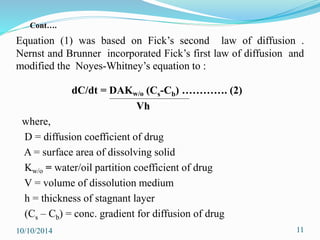
Equation (1) was based on Fick’s second law of diffusion .
Nernst and Brunner incorporated Fick’s first law of diffusion and
modified the Noyes-Whitney’s equation to :
dC/dt = DAKw/o (Cs-Cb) …………. (2)
Vh
where,
D = diffusion coefficient of drug
A = surface area of dissolving solid
Kw/o = water/oil partition coefficient of drug
V = volume of dissolution medium
h = thickness of stagnant layer
(Cs – Cb) = conc. gradient for diffusion of drug
10/10/2014 11
Cont….
Limitation :
The Noyes-Whitney’s equation assumes that the surface area of the
dissolving solid remains constant during dissolution, which is practically not
possible for dissolving particles.
Hence, dissolution methods that involves use of constant surface area discs
are employed to determine the rate of dissolution.
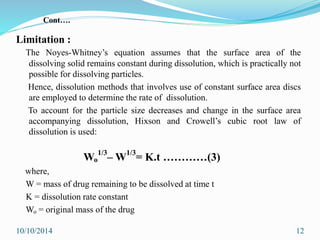
To account for the particle size decreases and change in the surface area
accompanying dissolution, Hixson and Crowell’s cubic root law of
dissolution is used:
Wo
1/3
– W1/3
= K.t …………(3)
where,
W = mass of drug remaining to be dissolved at time t
K = dissolution rate constant
Wo = original mass of the drug
10/10/2014 12
Cont….
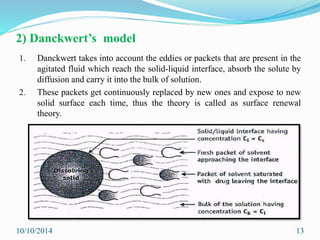
2) Danckwert’s model
1. Danckwert takes into account the eddies or packets that are present in the
agitated fluid which reach the solid-liquid interface, absorb the solute by
diffusion and carry it into the bulk of solution.
2. These packets get continuously replaced by new ones and expose to new
solid surface each time, thus the theory is called as surface renewal
theory.
10/10/2014 13
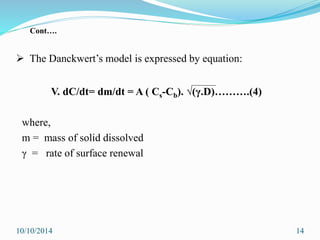
 The Danckwert’s model is expressed by equation:
V. dC/dt= dm/dt = A ( Cs-Cb). √(γ.D)……….(4)
where,
m = mass of solid dissolved
γ = rate of surface renewal
10/10/2014 14
Cont….
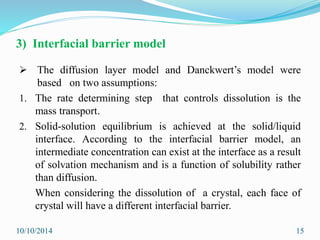
3) Interfacial barrier model
 The diffusion layer model and Danckwert’s model were
based on two assumptions:
1. The rate determining step that controls dissolution is the
mass transport.
2. Solid-solution equilibrium is achieved at the solid/liquid
interface. According to the interfacial barrier model, an
intermediate concentration can exist at the interface as a result
of solvation mechanism and is a function of solubility rather
than diffusion.
When considering the dissolution of a crystal, each face of
crystal will have a different interfacial barrier.
10/10/2014 15
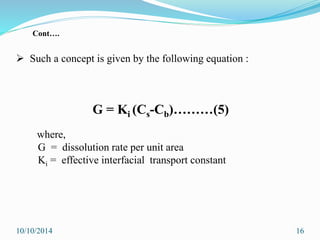
 Such a concept is given by the following equation :
G = Ki (Cs-Cb)………(5)
where,
G = dissolution rate per unit area
Ki = effective interfacial transport constant
10/10/2014 16
Cont….
REFERENCES
1. Brahmankar D.M., Jaiswal S.B. (2009), “Biopharmaceutics and
Pharmacokinetics-A Treatise” Vallabh Prakashan, 2nd Edition, Page
No. 15-48
2. Government of Indian ministry of health and family welfare (2014),
“Indian Pharmacopoeia” Indian Pharmacopoeia commission,
Ghaziabad, Volume-1, Page No. 174
3. Subrahmanyam C.V.S. (2000), “Text book of Physical Pharmaceutics”
Vallabh Prakashan, 2nd Edition, Page No. 85-105
4. Banakar U.V. (1992), “Pharmaceutical Dissolution Testing” Informa
helthcare, 1st Edition, Page No. 1-30
10/10/2014 17
Thank
You
10/10/2014 18

Theories of Dissolution

  • 1.
    PRESENTED BY DEORE PRASHANTASHOK Department of Pharmaceutics M. Pharm. I Semester (2014-2015) R. C. Patel Institute of Pharmaceutical Education and Research, Shirpur . 10/10/2014 1 Email-prashantdeore92@gmail.com Mo.09881261646
  • 2.
    CONTENTS  Dissolution  Dissolutionvs Solubility  Expression of Solubility  Drug Dissolution Process  Theories of Dissolution  References 10/10/2014 2
  • 3.
    DISSOLUTION Dissolution is definedas a process in which a solid substance solubilises in a given solvent. (i.e. mass transfer from the solid surface to the liquid phase.) 10/10/2014 3
  • 4.
    10/10/2014 4 DISSOLUTION SOLUBILITY Dissolutionrate is defined as the amount of solid substance that goes into solution per unit time under standard conditions of temperature, pH, solvent composition and constant solid surface area. Absolute solubility is defined as the maximum amount of solute dissolved in a given solvent under standard conditions of temperature , pressure and pH. It is a dynamic process. It is a static process.
  • 5.
    EXPRESSION OF SOLUBILITY 10/10/20145 DESCRIPTIVE TERM PARTS OF SOLVENT REQUIRED FOR 1 PART OF SOLUTE Very soluble Less than 1 part Freely soluble 1 to 10 parts Soluble 10 to 30 parts Sparingly soluble 30 to 100 parts Slightly soluble 100 to 1000 parts Very slightly soluble 1000 to 10000 parts Practically insoluble More than 10000 parts
  • 6.
  • 7.
     The effectivenessof a tablet in releasing the drug for absorption depends on four steps - 1. The initial step involves the breaking of a tablet into granules (disintegration). 2. Some times, these granules further break to yield fine particles (deaggregation) 3. The next step involves the releasing of the drug into solution (dissolution) 4. Absorption. 10/10/2014 7 Cont….
  • 8.
    THEORIES OF DISSOLUTION Three Theories: 1. Diffusion layer model / Film theory 2. Danckwert’s model / Penetration or Surface renewal theory 3. Interfacial barrier model / Double barrier or Limited solvation theory 10/10/2014 8
  • 9.
    1) Diffusion layermodel  It involves two steps : 1. Solution of the solid to form stagnant film or diffusive layer which is saturated with the drug. 2. Diffusion of the soluble solute from the stagnant layer to the bulk of the solution; this is rate determining step in drug dissolution. 10/10/2014 9
  • 10.
     The rateof dissolution is given by Noyes and Whitney: dC/dt = k (Cs- Cb)…………(1) where, dC/dt = dissolution rate of the drug k = dissolution rate constant Cs= concentration of drug in stagnant layer Cb= concentration of drug in the bulk of the solution at time t 10/10/2014 10 Cont….
  • 11.
    Equation (1) wasbased on Fick’s second law of diffusion . Nernst and Brunner incorporated Fick’s first law of diffusion and modified the Noyes-Whitney’s equation to : dC/dt = DAKw/o (Cs-Cb) …………. (2) Vh where, D = diffusion coefficient of drug A = surface area of dissolving solid Kw/o = water/oil partition coefficient of drug V = volume of dissolution medium h = thickness of stagnant layer (Cs – Cb) = conc. gradient for diffusion of drug 10/10/2014 11 Cont….
  • 12.
    Limitation : The Noyes-Whitney’sequation assumes that the surface area of the dissolving solid remains constant during dissolution, which is practically not possible for dissolving particles. Hence, dissolution methods that involves use of constant surface area discs are employed to determine the rate of dissolution. To account for the particle size decreases and change in the surface area accompanying dissolution, Hixson and Crowell’s cubic root law of dissolution is used: Wo 1/3 – W1/3 = K.t …………(3) where, W = mass of drug remaining to be dissolved at time t K = dissolution rate constant Wo = original mass of the drug 10/10/2014 12 Cont….
  • 13.
    2) Danckwert’s model 1.Danckwert takes into account the eddies or packets that are present in the agitated fluid which reach the solid-liquid interface, absorb the solute by diffusion and carry it into the bulk of solution. 2. These packets get continuously replaced by new ones and expose to new solid surface each time, thus the theory is called as surface renewal theory. 10/10/2014 13
  • 14.
     The Danckwert’smodel is expressed by equation: V. dC/dt= dm/dt = A ( Cs-Cb). √(γ.D)……….(4) where, m = mass of solid dissolved γ = rate of surface renewal 10/10/2014 14 Cont….
  • 15.
    3) Interfacial barriermodel  The diffusion layer model and Danckwert’s model were based on two assumptions: 1. The rate determining step that controls dissolution is the mass transport. 2. Solid-solution equilibrium is achieved at the solid/liquid interface. According to the interfacial barrier model, an intermediate concentration can exist at the interface as a result of solvation mechanism and is a function of solubility rather than diffusion. When considering the dissolution of a crystal, each face of crystal will have a different interfacial barrier. 10/10/2014 15
  • 16.
     Such aconcept is given by the following equation : G = Ki (Cs-Cb)………(5) where, G = dissolution rate per unit area Ki = effective interfacial transport constant 10/10/2014 16 Cont….
  • 17.
    REFERENCES 1. Brahmankar D.M.,Jaiswal S.B. (2009), “Biopharmaceutics and Pharmacokinetics-A Treatise” Vallabh Prakashan, 2nd Edition, Page No. 15-48 2. Government of Indian ministry of health and family welfare (2014), “Indian Pharmacopoeia” Indian Pharmacopoeia commission, Ghaziabad, Volume-1, Page No. 174 3. Subrahmanyam C.V.S. (2000), “Text book of Physical Pharmaceutics” Vallabh Prakashan, 2nd Edition, Page No. 85-105 4. Banakar U.V. (1992), “Pharmaceutical Dissolution Testing” Informa helthcare, 1st Edition, Page No. 1-30 10/10/2014 17
  • 18.