PRESENTED BY
Mr. Sudip M. Mulik
M.PHARM .I (PHARMACEUTICS)
 Under The Guidence of
 Prof. Mr. K. K. Mali
 FACULTY OF PHARMACY
 YSPM’S-YTC WADHE, SATARA.
   INTRODUCTION
   PROPERTIES
   ANGLE OF REPOSE
   CARR’S INDEX
   COMPRESSION CYCLE
   FORCES INVOLVED IN COMPRESSION
   EQUATIONS
   CONCLUSION
   REFERENCES


                                     2
COMPRESSION
  Reduction in bulk volume of material due to
   displacement of gaseous phase.
CONSOLIDATION
 Increase in mechanical strength of material due to
   particle-particle interaction.
COMPACTION
 It is the compression & consolidation of two phases
   (solid & gas) system due to applied force.
 Itis defined as the reduction in volume of a
  powder owing to the application of a forces.
 Because of the increased proximity of
  particle surfaces accomplished during
  compression, bonds are formed between
  particles which provide coherence to the
  powder i.e. compact is formed.
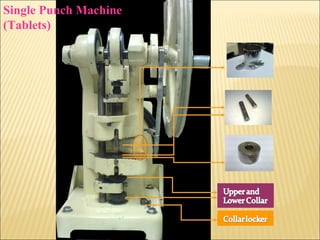
Single Punch Machine
(Tablets)
 Whenexternal mechanical forces applied to
 a powder mass there is reduction in bulk
 volume as follows
 o Repacking
 o Particles deformation
     •   Elastic deformation-e.g. acetyl salicylic acid, MCC
     •   Plastic deformation-at yield point of elastic.
 o Brittle fracture – e.g. sucrose
 o Micro quashing - irrespective of larger particles,
   smaller particles may deform plastically.
Compaction                  Consolidation
   It is defined as the         It is increase in
    formation of solid            mechanical strength of
    specimen of defined
    geometr y by powder           material from particle-
    compression.                  particle interactions.
   The compression takes
    place in a die by the
    action of two punches,
    the lower and the upper
    by which compression
    force is applied.
    Volume
1.   True volume (Vi)
2.   Bulk volume (Vb)
3.   Granular volume (Vg)
    Density
1.   True density
2.   Bulk density
3.   Granular density


                            8
   Porosity (E)
o Void volume
     Void volume = Bulk Vol – True Vol
      E = Void volume / Bulk Vol
        = V / Vb
The relation bet compression & porosity is important because it
  determines rate of dissolution, disintegration & absorption.
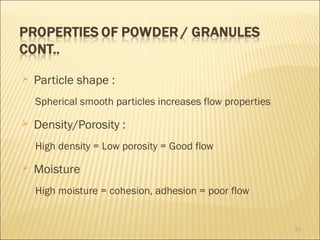
   Particle shape :
    Spherical smooth particles increases flow properties
   Density/Porosity :
    High density = Low porosity = Good flow
   Moisture
    High moisture = cohesion, adhesion = poor flow


                                                           10
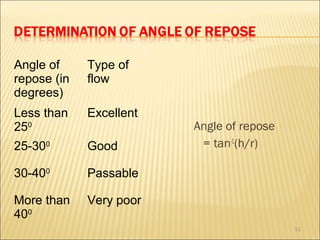
Angle of     Type of
repose (in   flow
degrees)
Less than    Excellent
250                      Angle of repose
25-300       Good         = tan-1(h/r)

30-400       Passable

More than    Very poor
400
                                           11
 Carr’s consolidation Index
consolidation Index = Tap density – Bulk density/Bulk
  density
    Carr’s Index         Flow
    5-15                 Excellent
    12-16                Good
    18-21                Pair to passable
    23-35                Poor
    33-38                Very poor
    More than 40         Very poor Very poor        12
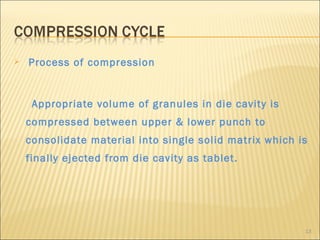
   Process of compression


     Appropriate volume of granules in die cavity is
    compressed between upper & lower punch to
    consolidate material into single solid matrix which is
    finally ejected from die cavity as tablet.


                                                         13
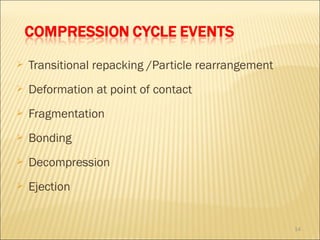
   Transitional repacking /Particle rearrangement
   Deformation at point of contact
   Fragmentation
   Bonding
   Decompression
   Ejection


                                                     14
   During initial stage of compression particles are
    subjected to low pressure during this particles moves
    with respect to each other .
   Smaller particles enter voids bet larger particles as a
    result volume decreases & density increases.
   Spherical particles undergo lesser rearrangement
    than irregular particles.


                                                              15
 Elastic : When force is applied deformation
  occurs & deformation disappears upon release
  of stress.
 Plastic : The deformation which does not
  completely recover after removal of stress.
 Yield strength : Force required to initiate plastic
  deformation
   As compression force increases deformed par ticles
    star t undergoing fragmentation due to high load
    par ticles breaks in to smaller fragments leading to
    formation of new bonding areas . The fragments
    undergo densification with infiltration of small
    fragments in to voids.

   Some par ticles undergo structural break down
    called as brittle fracture.


                                                       17
   Cold welding : When particles approach each other close
    enough (at the distance of 50µm) the unsatisfied forces
    present on their surface lead to formation of strong attractive
    forces/bonding Formation of strong attractive forces. This is
    called as cold welding.
   Fusion bonding : In the powder mass particles are in irregular
    in shape ,size & applied force to mass must pass through this
    bed of particles this transmission may lead to generation of
    heat .If this heat doesn’t disappear the raise in temperature
    could be sufficient to cause melting of contact points. This melt
    is cooled & solidifies that gives rise to fusion bonding.
   The success & failure of intact tablet depends on stress
    induced by elastic rebound & the associated deformation
    produced during compression & ejection . As the upper
    punch is withdrawn from the die the tablet is confined in
    die cavity by radial pressure consequently any radial
    change during decompression must occur in axial
    direction. Thus capping is due to unaxial relaxation in die
    cavity at the point where punch pressure is released &
    some may occur at ejection. If decompression occurs in
    all directions simultaneously capping is reduced.           19
EJECTION


 As lower punch rises & push tablet upward there is continuous
 residual die wall pressure & energy may be expanded due to die
 wall friction . As the tablet is removed from die lateral pressure
 is relieved & tablet undergoes elastic recover y with increase (2-
 10%) in the volume of that por tion of the tablet removed from
 the die. During ejection that por tion of the tablet within die is
 under strain so if exceeds the shear strength of the tablet, the
 tablet caps adjustment to the region in which the strain has
 been removed .
Various forces involved in the Compression
   Frictional force
   Distributional force
   Radial force
   Ejectional force
Frictional force
   Frictional forces are interparticulate friction & die wall
    friction. Interparticulate friction forces occur due to
    particle-particle contact & it is more significant at low
    applied load . These forces are reduced by using
    glidants e.g. colloidal silica .
   Die wall friction forces occur from material pressed
    against die wall & moved it is dominant at high applied
    load These forces are reduced using lubricants e.g.
    magnesium stearate.
Distribution Forces
   Most investigations of fundamentals of tableting have
    been carried out on single punch press or even
    isolated dies & punches with hydraulic press A force
    is applied on top of cylinder of powder mass consicder
    single isolated punch
   FA = Force applied to upper punch
   FL = Force transmitted to lower punch
   FD = Reaction at die wall due to friction at surface
        FA = FL + FD.
Compaction Force
   Because of difference between applied force at
    upper punch which affects material close to
    lower punch is called as Mean Compaction
    Force (FM).
              FM = FA + FL/2
Radial Force
As compressional force is increased any
  repacking of tableting is completed.
POISSON’S RATIO OF MATERIAL
   When force is applied on vertical direction which result
    in decrease in height (∆H) for unconfined solid body.
    The expansion is in horizontal direction (∆D). This ratio
    of two dimensional changes is known as Poisson’s
    ratio (‫ )ג‬of material.
                  ‫ג‬D = ∆D / ∆H
   The material is not free to expand in horizontal plane
    because it is confined in die at the same time a radial
    die wall force (FR) develops perpendicular to die wall
    surface. Higher Poisson's ratio (‫ )ג‬higher FR value.
Ejection Force
   Radial die wall forces & die wall friction also
    affects ejection of the compressed tablet from
    the die. The force necessary to eject the
    finished tablet is known as ejection force. This
    force can eject tablet by breaking tablet/die
    wall adhesion. Variation also occurs in ejection
    force when lubrication is inadequate.
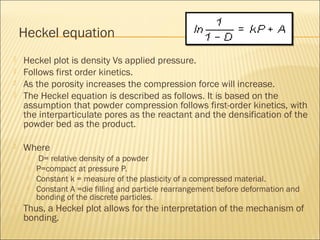
Heckel equation
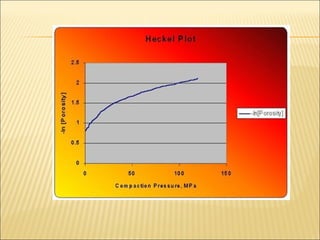
   Heckel plot is density Vs applied pressure.
   Follows first order kinetics.
   As the porosity increases the compression force will increase.
   The Heckel equation is described as follows. It is based on the
    assumption that powder compression follows first-order kinetics, with
    the interparticulate pores as the reactant and the densification of the
    powder bed as the product.

   Where
        D= relative density of a powder
        P=compact at pressure P.
        Constant k = measure of the plasticity of a compressed material.
        Constant A =die filling and particle rearrangement before deformation and
         bonding of the discrete particles.
   Thus, a Heckel plot allows for the interpretation of the mechanism of
    bonding.
Kawakita equation
   The Kawakita equation is described as follows. This equation
    describes the relationship between the degree of volume
    reduction of the powder column and the applied pressure.
    The basis for the Kawakita equation for powder compression is
    that particles subjected to a compressive load in a confined space
    are viewed as a system in equilibrium at all stages of
    compression, so that the product of the pressure term and the
    volume term is a constant.
   where
        C = degree of volume reduction of a powder compact at pressure P.
        constants (a and b) =evaluated from a plot of P/C versus P.
        a= total volume reduction for the powder bed [carr’s index]
        b= constant that is inversely related to the yield strength of the particles.
   The data from this study were modeled via the Kawakita equation
    in an attempt to evaluate the relationship between the volume
    reduction and applied pressure for each studied DC binder.
CONCLUSION
   Compression & Consolidation are important in
    tableting of materials.
   The importance of each will largely depend on
    the type of compact required whether soft or
    hard and on the brittle properties of the
    materials .
   Various mathematical equations have been
    used to describe the compaction process.
CONCLUSION CONT..
   The particular value of heckel plots arises from
    their ability to identify the predominant form of
    deformation in a given sample.
   Kawakita equation is modified form of heckel’s
    equation.
REFERENCES
   The Theory and Practice of Industrial pharmacy Leon
    Lachman, Herbert E. Lieberman, Joseph L. Kanic
    Special Indian Edition 2009 Page no.71-83.
   Aulton’s Pharmaceutics The design and Manufacture
    of Medicines Michael E. Aulton Third Edition Page
    no.478,443,468-473,355-358.
   www.google.com
   www.wikipedia.com
U !!
           Y O
   A N K
T H
                    33

Compaction and Compression

  • 1.
    PRESENTED BY Mr. SudipM. Mulik M.PHARM .I (PHARMACEUTICS) Under The Guidence of Prof. Mr. K. K. Mali FACULTY OF PHARMACY YSPM’S-YTC WADHE, SATARA.
  • 2.
    INTRODUCTION  PROPERTIES  ANGLE OF REPOSE  CARR’S INDEX  COMPRESSION CYCLE  FORCES INVOLVED IN COMPRESSION  EQUATIONS  CONCLUSION  REFERENCES 2
  • 3.
    COMPRESSION Reductionin bulk volume of material due to displacement of gaseous phase. CONSOLIDATION Increase in mechanical strength of material due to particle-particle interaction. COMPACTION It is the compression & consolidation of two phases (solid & gas) system due to applied force.
  • 4.
     Itis definedas the reduction in volume of a powder owing to the application of a forces.  Because of the increased proximity of particle surfaces accomplished during compression, bonds are formed between particles which provide coherence to the powder i.e. compact is formed.
  • 5.
  • 6.
     Whenexternal mechanicalforces applied to a powder mass there is reduction in bulk volume as follows o Repacking o Particles deformation • Elastic deformation-e.g. acetyl salicylic acid, MCC • Plastic deformation-at yield point of elastic. o Brittle fracture – e.g. sucrose o Micro quashing - irrespective of larger particles, smaller particles may deform plastically.
  • 7.
    Compaction Consolidation  It is defined as the  It is increase in formation of solid mechanical strength of specimen of defined geometr y by powder material from particle- compression. particle interactions.  The compression takes place in a die by the action of two punches, the lower and the upper by which compression force is applied.
  • 8.
    Volume 1. True volume (Vi) 2. Bulk volume (Vb) 3. Granular volume (Vg)  Density 1. True density 2. Bulk density 3. Granular density 8
  • 9.
    Porosity (E) o Void volume Void volume = Bulk Vol – True Vol E = Void volume / Bulk Vol = V / Vb The relation bet compression & porosity is important because it determines rate of dissolution, disintegration & absorption.
  • 10.
    Particle shape : Spherical smooth particles increases flow properties  Density/Porosity : High density = Low porosity = Good flow  Moisture High moisture = cohesion, adhesion = poor flow 10
  • 11.
    Angle of Type of repose (in flow degrees) Less than Excellent 250 Angle of repose 25-300 Good = tan-1(h/r) 30-400 Passable More than Very poor 400 11
  • 12.
     Carr’s consolidationIndex consolidation Index = Tap density – Bulk density/Bulk density Carr’s Index Flow 5-15 Excellent 12-16 Good 18-21 Pair to passable 23-35 Poor 33-38 Very poor More than 40 Very poor Very poor 12
  • 13.
    Process of compression Appropriate volume of granules in die cavity is compressed between upper & lower punch to consolidate material into single solid matrix which is finally ejected from die cavity as tablet. 13
  • 14.
    Transitional repacking /Particle rearrangement  Deformation at point of contact  Fragmentation  Bonding  Decompression  Ejection 14
  • 15.
    During initial stage of compression particles are subjected to low pressure during this particles moves with respect to each other .  Smaller particles enter voids bet larger particles as a result volume decreases & density increases.  Spherical particles undergo lesser rearrangement than irregular particles. 15
  • 16.
     Elastic :When force is applied deformation occurs & deformation disappears upon release of stress.  Plastic : The deformation which does not completely recover after removal of stress.  Yield strength : Force required to initiate plastic deformation
  • 17.
    As compression force increases deformed par ticles star t undergoing fragmentation due to high load par ticles breaks in to smaller fragments leading to formation of new bonding areas . The fragments undergo densification with infiltration of small fragments in to voids.  Some par ticles undergo structural break down called as brittle fracture. 17
  • 18.
    Cold welding : When particles approach each other close enough (at the distance of 50µm) the unsatisfied forces present on their surface lead to formation of strong attractive forces/bonding Formation of strong attractive forces. This is called as cold welding.  Fusion bonding : In the powder mass particles are in irregular in shape ,size & applied force to mass must pass through this bed of particles this transmission may lead to generation of heat .If this heat doesn’t disappear the raise in temperature could be sufficient to cause melting of contact points. This melt is cooled & solidifies that gives rise to fusion bonding.
  • 19.
    The success & failure of intact tablet depends on stress induced by elastic rebound & the associated deformation produced during compression & ejection . As the upper punch is withdrawn from the die the tablet is confined in die cavity by radial pressure consequently any radial change during decompression must occur in axial direction. Thus capping is due to unaxial relaxation in die cavity at the point where punch pressure is released & some may occur at ejection. If decompression occurs in all directions simultaneously capping is reduced. 19
  • 20.
    EJECTION As lowerpunch rises & push tablet upward there is continuous residual die wall pressure & energy may be expanded due to die wall friction . As the tablet is removed from die lateral pressure is relieved & tablet undergoes elastic recover y with increase (2- 10%) in the volume of that por tion of the tablet removed from the die. During ejection that por tion of the tablet within die is under strain so if exceeds the shear strength of the tablet, the tablet caps adjustment to the region in which the strain has been removed .
  • 21.
    Various forces involvedin the Compression  Frictional force  Distributional force  Radial force  Ejectional force
  • 22.
    Frictional force  Frictional forces are interparticulate friction & die wall friction. Interparticulate friction forces occur due to particle-particle contact & it is more significant at low applied load . These forces are reduced by using glidants e.g. colloidal silica .  Die wall friction forces occur from material pressed against die wall & moved it is dominant at high applied load These forces are reduced using lubricants e.g. magnesium stearate.
  • 23.
    Distribution Forces  Most investigations of fundamentals of tableting have been carried out on single punch press or even isolated dies & punches with hydraulic press A force is applied on top of cylinder of powder mass consicder single isolated punch  FA = Force applied to upper punch  FL = Force transmitted to lower punch  FD = Reaction at die wall due to friction at surface FA = FL + FD.
  • 24.
    Compaction Force  Because of difference between applied force at upper punch which affects material close to lower punch is called as Mean Compaction Force (FM). FM = FA + FL/2 Radial Force As compressional force is increased any repacking of tableting is completed.
  • 25.
    POISSON’S RATIO OFMATERIAL  When force is applied on vertical direction which result in decrease in height (∆H) for unconfined solid body. The expansion is in horizontal direction (∆D). This ratio of two dimensional changes is known as Poisson’s ratio (‫ )ג‬of material. ‫ג‬D = ∆D / ∆H  The material is not free to expand in horizontal plane because it is confined in die at the same time a radial die wall force (FR) develops perpendicular to die wall surface. Higher Poisson's ratio (‫ )ג‬higher FR value.
  • 26.
    Ejection Force  Radial die wall forces & die wall friction also affects ejection of the compressed tablet from the die. The force necessary to eject the finished tablet is known as ejection force. This force can eject tablet by breaking tablet/die wall adhesion. Variation also occurs in ejection force when lubrication is inadequate.
  • 27.
    Heckel equation  Heckel plot is density Vs applied pressure.  Follows first order kinetics.  As the porosity increases the compression force will increase.  The Heckel equation is described as follows. It is based on the assumption that powder compression follows first-order kinetics, with the interparticulate pores as the reactant and the densification of the powder bed as the product.  Where  D= relative density of a powder  P=compact at pressure P.  Constant k = measure of the plasticity of a compressed material.  Constant A =die filling and particle rearrangement before deformation and bonding of the discrete particles.  Thus, a Heckel plot allows for the interpretation of the mechanism of bonding.
  • 29.
    Kawakita equation  The Kawakita equation is described as follows. This equation describes the relationship between the degree of volume reduction of the powder column and the applied pressure.  The basis for the Kawakita equation for powder compression is that particles subjected to a compressive load in a confined space are viewed as a system in equilibrium at all stages of compression, so that the product of the pressure term and the volume term is a constant.  where  C = degree of volume reduction of a powder compact at pressure P.  constants (a and b) =evaluated from a plot of P/C versus P.  a= total volume reduction for the powder bed [carr’s index]  b= constant that is inversely related to the yield strength of the particles.  The data from this study were modeled via the Kawakita equation in an attempt to evaluate the relationship between the volume reduction and applied pressure for each studied DC binder.
  • 30.
    CONCLUSION  Compression & Consolidation are important in tableting of materials.  The importance of each will largely depend on the type of compact required whether soft or hard and on the brittle properties of the materials .  Various mathematical equations have been used to describe the compaction process.
  • 31.
    CONCLUSION CONT..  The particular value of heckel plots arises from their ability to identify the predominant form of deformation in a given sample.  Kawakita equation is modified form of heckel’s equation.
  • 32.
    REFERENCES  The Theory and Practice of Industrial pharmacy Leon Lachman, Herbert E. Lieberman, Joseph L. Kanic Special Indian Edition 2009 Page no.71-83.  Aulton’s Pharmaceutics The design and Manufacture of Medicines Michael E. Aulton Third Edition Page no.478,443,468-473,355-358.  www.google.com  www.wikipedia.com
  • 33.
    U !! Y O A N K T H 33