1A.B.C.P.Sangli
 Tablet coating is the application of coating
material to the exterior of a tablet with the
intention of conferring benefits and properties to
dosage form over the uncoated variety.
Why Tablet Coating is Required?
A number of reasons can be suggested:
 The core contains a material which has a bitter
taste in the mouth or has an unpleasant odour .
 Coating will protect the drug from the
surroundings with a view to improve its stability .
 Coating will increase the ease by which a tablet
can be ingested by the patient . 2A.B.C.P.Sangli
 The core contains a substance which is incompatible
in the presence of light and subject to atmospheric
oxidation , i.e. a coating is added to improve
stability.
 The core alone is inelegant.
 The active substance is colored and migrates easily
to stain hands and clothes.
 The coated tablet is packed on high-speed packaging
machine.
 Coating reduces friction and increases packaging
rate .
 Coating can modify the drug release profile , e.g.,
enteric coating, osmotic pump, pulsatile delivery. 3A.B.C.P.Sangli
Most commonly used equipments are,
 The standard coating pan .
 The perforated coating pan .
 The Fluidized bed coater.
4A.B.C.P.Sangli
 This consists of a circular metal pan between about 15 and
200 cm (6 to 80 inches) in diameter that is tilted on a
benchtop stand. The pan can be rotated with an electric
motor.
 A batch of tablets are loaded into the pan which is set to
rotate. The rotating motion causes the tablets to tumble
within the pan. Coating solution is applied to the rotating
tablet bed by spraying in atomized form which can
produce a faster and more even distribution than simply
introducing it as a liquid.
 Drying efficiency can easily be achieved by
 an immersion sword – the drying air is distributed through
a perforated metal sword that is immersed in the bed. 5A.B.C.P.Sangli
 Use of a baffled pan and diffuser (as marketed by pellegrini)
which allows the distribution of drying air uniformly over
the surface of the tablets.
 An immersion tube system – the tube is immersed in the bed
where the tube delivers heated air through the spray nozzle.
Advantages of standard coating pan
 It is a continuous process
 Low drying time
 Can be use for both sugar coating and film coating
 The pellegrini system can improve drying efficiency
 A rapid method of coating and therefore takes less time to
coat the tablet than other methods
 Takes less time to coat the tablet
6A.B.C.P.Sangli
 This equipment consists of a partial or full perforated drum
that rotates on its horizontal axis, the whole system being
enclosed in a sealed housing. Examples are:
Accela-cota/Hi-coater Systems –
 with this equipment, the drying air is directed to the drum,
passing through the tablet bed and is released through the
perforations in the drum.
Driacoater –
Similar to the Accela-cota in the Driacoater, channels for
directing the supply and exhaust air the drying air are
integrated into the drum wall as reinforcing elements. is
introduced through a hollow area located inside the drum’s
periphery. During the drying process, the drum rotates the
dip into the tablet bed and dry air passes up through and
fluidizes the tablet bed with the air exhausting through the
back of the pan. 7A.B.C.P.Sangli
Glatt coater –
 This design uses fully perforated drums – a feature
which combines maximum spray rates and extremely
short process times.
 The horizontal process air flow minimises turbulence in
the nozzle area and therefore also contributes to a
perfect coating result.
 The drum geometry and the glatt fischer baffles mix
and protect the product at the same time, guaranteeing a
very even and exceptionally high-quality coating.
 The drum is integrated in the unique GC smart housing,
where all points are extremely easy to access; it is fully
welded and the suspended drum is mounted at the rear
without any front support to get in the way.
8A.B.C.P.Sangli
 Drying air directly passes to the drum.
 Configuration of the air flow is possible in the case
of the Glatt coater.
 Shows increasingly versatile coating capability.
 More efficient than other methods in drying of the
tablet bed.
9A.B.C.P.Sangli
 In a fluidized bed coater, the chamber is usually a vertical
cylinder. Fluidization of the pellets is achieved by a column
of air flowing upwards from the bottom centre of the
cylinder. The tablets in the centre move upwards in the air
flow and fall outwards and downwards to the chamber wall,
re-entering the air stream from the bottom part of the
column. Spray nozzles for introducing the coating solution
are located in the bottom and top of the chamber.
 The tablet’s core is frail and is prone to abrasion and
chipping making it difficult to fully coat the tablet even
under optimum conditions. This is due to the rough tablet to
tablet impact as well as the tablet chamber contact.
 There are two principal arrangements used to apply finely
divided spray coating solutions to tablets:
10A.B.C.P.Sangli
High pressure airless system –
 Airless spray liquid are pumped at high pressure of
between 1.7 and 20 mpa (250 and 3000 psig) through a
small orifice of between 0.02 and 0.2 mm diameter,
which results to a finely divided spray. The degree of
atomization degree and spray rate are all controlled by
fluid pressure, liquid viscosity and orifice size.
Low pressurized air atomized systems –
 The liquid is pumped through a larger orifice of between
0.05 and 2.5 mm diameter a relatively low pressure of
35 – 350 kpa (5 to 50 psig). The low pressure air
contacts the liquid stream at the top of the atomizer and
a finely divided spray is achieved. The atomization
degree is controlled by the fluid cap orifice, fluid
viscosity, fluid pressure, and air cap design and air
pressure. 11A.B.C.P.Sangli
 Perforated drum coating machines are popular in the industry
and the following need to be addressed when considering the
purchase of a machine:
 Air capacity – the amount of air flowing through the bed will
determine the amount of water or solvent that can be
removed during the coating process.
 Coating composition – the coating composition includes the
ingredients that are applied to the surface as well as to the
solvent that acts as a carrier for the ingredients. The solvent
is removed during the coating process by the flow of air
through the coating machine. To speed up this process the
incoming air can be heated, however, there is a fine balance
between the rate at which solvent can be evaporated and the
rate at which the coating liquid can be introduced. 12A.B.C.P.Sangli
 Tablet surface area – it is easy to weigh a batch of
tablets that are to be coated, to give an idea of the
amount of coating solution that needs to be applied.
However, it is the surface area of the tablets that
determines the total amount of coating solution
required. The size of the tablets and nature of their
surface can significantly affect the coating conditions
and quantities of solution required. The total area/weight
ratio decreases quite significantly from a smaller to a
larger tablet.
 Efficiency of equipment – conventional sugar coating
efficiency is not very efficient and 60% is deemed to be
acceptable. The efficiency depends on the coating
material that is collected on the pan walls.
13A.B.C.P.Sangli
 Coating is the final step in the production cycle of
pharmaceutical tablets. To be successful, the final product
must demonstrate enhanced visual appeal compared with
uncoated products.
 Broadly there are two types of coating that may be applied to
pharmaceutical tablets – sugar coating and polymer film
coating.
 Sugar coating is the traditional means of coating tablets,
and takes place in 5 distinct steps:
 Sealing
 Applying a subcoat
 Smoothing
 Applying a finishing coat
14A.B.C.P.Sangli
 Polishing
 Film coating is a more recent innovation and is
applied in a single step using either a pan pour
method or a pan spray method. Generally the same
coating machine can be used for the both sugar
coating and polymer film coating. The following are
some characteristics and advantages of the three
types of coating machines
15A.B.C.P.Sangli
 It consists of a circular metal pan mounted
somewhat angularly on a stand and is rotated on its
horizontal axis by a motor .
 Heated air is directed into the pan and onto the
tablet bed surface , and is exhausted by means of
ducts positioned through the front of the pan.
16A.B.C.P.Sangli
 Upgraded Conventional Coating Pan
 Side Vented Coating Pan
 Conventional Coating Pan
17A.B.C.P.Sangli
 Much of drying takes place on the surface of the bed of
material being coated, thus dry efficiency is often low.
 Mixing efficiency can be poor, many dead spots may exists
in the product bed .
 Improper balance between inlet and exhaust air can with
organic solvent based film coating.
A significant improvement in the particle movement & drying
efficiency of the standard coating pan is achieved by the,
 Pellegrini pan
 Immersion sword
 Immersion tube systems
18A.B.C.P.Sangli
 Mixing of the core bed is important for a uniform
application of the coating material as well as for effective
drying.
 The most basic approach to improve the core bed
movement in pans rotating on inclined or horizontal axes
was to introduce baffles and blades in the pan. One of the
first pans with a single baffle was invented by keil in
1965.
 The first coating pan rotating on a horizontal axis
equipped with tapered side walls and an integral baffle
system was introduced by pellegrini and is well-known as
the pellegrini pan.
19A.B.C.P.Sangli
 The side walls of this pan are shaped with a
pronounced taper, which increases the efficiency of
particle movement by forcing the cores into an
additional lateral movement. This results in a
composite core movement yielding improved
exposure of the core to the coating material.
20A.B.C.P.Sangli
 USING BAFFLES AND BLADES INCREASES
RISK of friction between the core material and the
pans, potentially resulting in increased amounts of
dust formed during the coating process.
 Hence, FOCUS was on the IMPLEMENTATION
OF PERFORATED PANS to improve the air
transport in the core bed and consequently to
increase the mixing and drying efficiency .
21A.B.C.P.Sangli
 Hostetler , for instance, has modified the peripheral wall with
perforations and positioned an air supplying inlet at the lower
peripheral area, forming the so-called side-vented pan.
 The shape of the pan, the perforations in the peripheral wall,
and the side positioned air supplying inlet were not only
intended to increase core movement and air transfer, but also to
increase the contact area of the cores with the coating material.
 Fig :- Side-vented pan of Hostetler 22A.B.C.P.Sangli
 Generally, the energy required for evaporating the
moisture from the coating layers is derived from the
drying air.
 The duration of the coating process as well as the quality
of the end product thus crucially depend on the efficiency
of heat and mass transfer.
 Increasing the heat and mass transfer either directly (for
example by increasing temperature and rotation
23A.B.C.P.Sangli
 speed or implementation of perforations) or
indirectly by improving the drying air supply can
improve drying efficiency.
 With the conventional drying method, the drying air
is blown across the surface of the core bed. As only
the surface of the core bed is exposed to the drying
air, insufficient drying of core materials and
impaired spraying processes might occur.
 Hence, different drying gadgets have been
developed, of which the two conventional ones are
the immersion tube and the immersion sword.
24A.B.C.P.Sangli
 IMMERSION SWORD SYSTEM With the immersion
sword system, drying air is introduced through a
perforated metal sword device that is immersed in the
tablet bed.
 The drying air flows upward from the sword through the
bed. Since the air is more intimately mixed with the
wetted tablets, a more efficient drying environment is
provided. As shown in figure.
25A.B.C.P.Sangli
 In this type of system the immersed tube delivers the
heated air, and a spray nozzle is built in the tip of the tube.
During this operation , the coating solution is applied
simultaneously with the heated air from the immersed tube
.
 The drying air flows upward through the tablet bed and is
exhausted by a conventional duct.
26A.B.C.P.Sangli
 Both the immersion sword and immersion tube systems
are adaptable to conventional coating pans .
 Relatively rapid processing times have been reported for
both film and sugar coating with this system.
 The centrifugal force first pushes the particles outwards
from the centre to the pan wall and then upwards
following the curve of the wall. Particles then drop down
back into the middle of the container due to gravity.
Usually, such equipments include a return device at the
upper part of the wall which assists the feed material to
roll back into the container.
27A.B.C.P.Sangli
28A.B.C.P.Sangli
 Pan Coaters Rotating on Vertical Axis Represents another
approach towards the improvement of pan coating.
 Designed to overcome the problem of mechanical
abrasion of cores encountered in horizontally rotating pans
with baffles or blades.
 Generally, in coaters that rotate around vertical axes, the
feed material to be coated is placed in a container which is
moved by a driving motor.
 This causes the circulation of particles on the axis of
rotation.
29A.B.C.P.Sangli
 The centrifugal force first pushes the particles
outwards from the centre to the pan wall and then
upwards following the curve of the wall.
 Particles then drop down back into the middle of the
container due to gravity. Usually, such equipments
include a return device at the upper part of the wall
which assists the feed material to roll back into the
container.
30A.B.C.P.Sangli
 In Accela-cota and Hi-coater systems, drying air is
directed into the drum, is then passed through the tablet
bed, and is exhausted through perforation in the drum. .
Hi-coater:
 Hi-coater Stretched" Design Provides Shorter Process
Times
 An increased spray zone is accomplished by lengthening
the coating pan while maintaining the same diameter
 Fully Perforated or Integrated Plenum
31A.B.C.P.Sangli
 The Driacoater introduces drying air through hollow
perforated ribs located on inside periphery of the drum. As
coating pan rotates the ribs dip into the tablet bed, and
dying air passes through and fluidizes the tablet bed. Air is
exhausted from back of the pan .
32A.B.C.P.Sangli
 For hard sugar coating , DRIACOATERS with
perforated multisided drums are used. The machines
are capable to handle sugar and sugar free solutions,
( Sorbitol , Xylitol , Malitol , Isomalt , etc.), glazing
and polishing solutions as well as aqueous
suspensions.
 Automatic loading and unloading, inside pan
cleaning and fully automatic process capabilities
characterize this DRIACOATER with batch sizes
from 625 liters to 3750 liters.
33A.B.C.P.Sangli
 Dosing and spraying systems for solutions, flavor
and polishing.
 Dosing/distribution for solid powdery materials.
 Supply and exhaust air installations with air
conditioning
34A.B.C.P.Sangli
 Process advantages
 Uniform, continuous product coating.
 Aqueous or organic coatings can be applied. Coating and
drying take place in one machine.
 In terms of Total Containment, the coating process and
the filling and emptying of the machine can be carried out
in complete isolation and without product spreading into
the environment.
 When using organic solvents, the process machines can
also be made inert and used with a solvent recovery
system. 35A.B.C.P.Sangli
 With fluid bed coating, particles are fluidized and
the coating fluid sprayed on and dried. Small
droplets and a low viscosity of the spray medium
ensure an even product coating .
 Glatt offers Batch Fluid Bed Systems in different
batch sizes with:
 Top Spray Coating
 Bottom Spray Coating (Wurster Coating)
 Tangential Spray Coating (Rotor Pellet Coating)
36A.B.C.P.Sangli
37A.B.C.P.Sangli
 This process is used for general coatings right up to enteric
coating.
 With top spray coating in the fluid bed (batch and
continuous), particles are fluidized in the flow of heated air,
which is introduced into the product container via a base
plate.
 The coating liquid is sprayed into the fluid bed from above
against the air flow (countercurrent) by means of a nozzle.
 Drying takes place as the particles continue to move
upwards in the air flow. Small droplets and a low viscosity
of the spray medium ensure that the distribution is uniform.
 Coating in the continuous fluid bed is particularly suitable
for protective coatings/colour coatings where the product
throughput rates are high. 38A.B.C.P.Sangli
 The product is continuously fed into one side of the
machine and is transported onwards via the sieve bottom
by means of the air flow. Depending on the application,
the system is sub-divided into pre-heating zones, spray
zones and drying zones. The dry, coated particles are
continuously extracted.
39A.B.C.P.Sangli
 Particularly suitable for protective coatings/
colour coatings where the product throughput
rates are high.
 The product is continuously fed into one side of
the machine and is transported onwards via the
sieve bottom by means of the air flow.
40A.B.C.P.Sangli
 Depending on the application, the system is sub-
divided into pre-heating zones, spray zones and
drying zones whereby spraying can take place from
below in the form of a bottom spray. The dry, coated
particles are continuously extracted.
41A.B.C.P.Sangli
 Ideal for coatings with high solid content.
 The product is set into a spiral motion by means
of a rotating base plate, which has air fed into
the powder bed at its edge. The spray nozzle is
arranged tangentially to the rotor disc and also
sprays concurrently into the powder bed.
42A.B.C.P.Sangli
 Very thick film layers can be applied by means
of the rotor method.
43A.B.C.P.Sangli
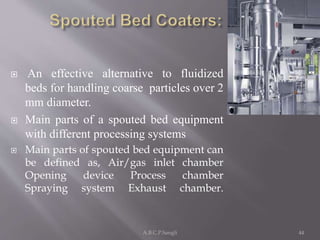
 An effective alternative to fluidized
beds for handling coarse particles over 2
mm diameter.
 Main parts of a spouted bed equipment
with different processing systems
 Main parts of spouted bed equipment can
be defined as, Air/gas inlet chamber
Opening device Process chamber
Spraying system Exhaust chamber.
44A.B.C.P.Sangli
45A.B.C.P.Sangli
 The air/gas inlet chamber comprises the lower part
of the apparatus and - like in the fluidized bed
system – can be implemented in single or divided
form.
 Unlike the fluidized bed processes, the spouting
air/gas does not enter the processing chamber
through the air distribution base plate, but through
an opening device with relatively high velocities,
typically between 1 and 30 meters/second.
46A.B.C.P.Sangli
 Coating technology, e.g. film coating technology is
now a days very important in the field of pharmacy
particularly in formulation development.
 Process parameters and coating composition play an
important role in coating of tablets.
 Therefore, to get good final quality of coated
tablets, it is necessary to optimize the parameters.
47A.B.C.P.Sangli
 “Introduction to Pharmaceutical Coating”. TIPT
Hand Notes, Toronto Institute of Pharmaceutical
Technology 2013–2014, pp. 2–27.
 “Introduction to Pharmaceutical Coating”. TIPT
Hand Notes, Toronto Institute of Pharmaceutical
Technology 2013–2014, pp. 2–27.
 Hogan J. Pharmaceutical Coating Technology.
Taylor and Francis Ltd. 1998, pp. 6–52.
 https://www.lfatabletpresses.com/articles/types-
tablet-coating-machines
48A.B.C.P.Sangli
49A.B.C.P.Sangli

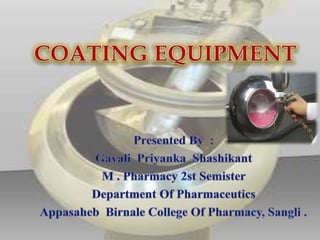
Coating equipment

  • 1.
  • 2.
     Tablet coatingis the application of coating material to the exterior of a tablet with the intention of conferring benefits and properties to dosage form over the uncoated variety. Why Tablet Coating is Required? A number of reasons can be suggested:  The core contains a material which has a bitter taste in the mouth or has an unpleasant odour .  Coating will protect the drug from the surroundings with a view to improve its stability .  Coating will increase the ease by which a tablet can be ingested by the patient . 2A.B.C.P.Sangli
  • 3.
     The corecontains a substance which is incompatible in the presence of light and subject to atmospheric oxidation , i.e. a coating is added to improve stability.  The core alone is inelegant.  The active substance is colored and migrates easily to stain hands and clothes.  The coated tablet is packed on high-speed packaging machine.  Coating reduces friction and increases packaging rate .  Coating can modify the drug release profile , e.g., enteric coating, osmotic pump, pulsatile delivery. 3A.B.C.P.Sangli
  • 4.
    Most commonly usedequipments are,  The standard coating pan .  The perforated coating pan .  The Fluidized bed coater. 4A.B.C.P.Sangli
  • 5.
     This consistsof a circular metal pan between about 15 and 200 cm (6 to 80 inches) in diameter that is tilted on a benchtop stand. The pan can be rotated with an electric motor.  A batch of tablets are loaded into the pan which is set to rotate. The rotating motion causes the tablets to tumble within the pan. Coating solution is applied to the rotating tablet bed by spraying in atomized form which can produce a faster and more even distribution than simply introducing it as a liquid.  Drying efficiency can easily be achieved by  an immersion sword – the drying air is distributed through a perforated metal sword that is immersed in the bed. 5A.B.C.P.Sangli
  • 6.
     Use ofa baffled pan and diffuser (as marketed by pellegrini) which allows the distribution of drying air uniformly over the surface of the tablets.  An immersion tube system – the tube is immersed in the bed where the tube delivers heated air through the spray nozzle. Advantages of standard coating pan  It is a continuous process  Low drying time  Can be use for both sugar coating and film coating  The pellegrini system can improve drying efficiency  A rapid method of coating and therefore takes less time to coat the tablet than other methods  Takes less time to coat the tablet 6A.B.C.P.Sangli
  • 7.
     This equipmentconsists of a partial or full perforated drum that rotates on its horizontal axis, the whole system being enclosed in a sealed housing. Examples are: Accela-cota/Hi-coater Systems –  with this equipment, the drying air is directed to the drum, passing through the tablet bed and is released through the perforations in the drum. Driacoater – Similar to the Accela-cota in the Driacoater, channels for directing the supply and exhaust air the drying air are integrated into the drum wall as reinforcing elements. is introduced through a hollow area located inside the drum’s periphery. During the drying process, the drum rotates the dip into the tablet bed and dry air passes up through and fluidizes the tablet bed with the air exhausting through the back of the pan. 7A.B.C.P.Sangli
  • 8.
    Glatt coater – This design uses fully perforated drums – a feature which combines maximum spray rates and extremely short process times.  The horizontal process air flow minimises turbulence in the nozzle area and therefore also contributes to a perfect coating result.  The drum geometry and the glatt fischer baffles mix and protect the product at the same time, guaranteeing a very even and exceptionally high-quality coating.  The drum is integrated in the unique GC smart housing, where all points are extremely easy to access; it is fully welded and the suspended drum is mounted at the rear without any front support to get in the way. 8A.B.C.P.Sangli
  • 9.
     Drying airdirectly passes to the drum.  Configuration of the air flow is possible in the case of the Glatt coater.  Shows increasingly versatile coating capability.  More efficient than other methods in drying of the tablet bed. 9A.B.C.P.Sangli
  • 10.
     In afluidized bed coater, the chamber is usually a vertical cylinder. Fluidization of the pellets is achieved by a column of air flowing upwards from the bottom centre of the cylinder. The tablets in the centre move upwards in the air flow and fall outwards and downwards to the chamber wall, re-entering the air stream from the bottom part of the column. Spray nozzles for introducing the coating solution are located in the bottom and top of the chamber.  The tablet’s core is frail and is prone to abrasion and chipping making it difficult to fully coat the tablet even under optimum conditions. This is due to the rough tablet to tablet impact as well as the tablet chamber contact.  There are two principal arrangements used to apply finely divided spray coating solutions to tablets: 10A.B.C.P.Sangli
  • 11.
    High pressure airlesssystem –  Airless spray liquid are pumped at high pressure of between 1.7 and 20 mpa (250 and 3000 psig) through a small orifice of between 0.02 and 0.2 mm diameter, which results to a finely divided spray. The degree of atomization degree and spray rate are all controlled by fluid pressure, liquid viscosity and orifice size. Low pressurized air atomized systems –  The liquid is pumped through a larger orifice of between 0.05 and 2.5 mm diameter a relatively low pressure of 35 – 350 kpa (5 to 50 psig). The low pressure air contacts the liquid stream at the top of the atomizer and a finely divided spray is achieved. The atomization degree is controlled by the fluid cap orifice, fluid viscosity, fluid pressure, and air cap design and air pressure. 11A.B.C.P.Sangli
  • 12.
     Perforated drumcoating machines are popular in the industry and the following need to be addressed when considering the purchase of a machine:  Air capacity – the amount of air flowing through the bed will determine the amount of water or solvent that can be removed during the coating process.  Coating composition – the coating composition includes the ingredients that are applied to the surface as well as to the solvent that acts as a carrier for the ingredients. The solvent is removed during the coating process by the flow of air through the coating machine. To speed up this process the incoming air can be heated, however, there is a fine balance between the rate at which solvent can be evaporated and the rate at which the coating liquid can be introduced. 12A.B.C.P.Sangli
  • 13.
     Tablet surfacearea – it is easy to weigh a batch of tablets that are to be coated, to give an idea of the amount of coating solution that needs to be applied. However, it is the surface area of the tablets that determines the total amount of coating solution required. The size of the tablets and nature of their surface can significantly affect the coating conditions and quantities of solution required. The total area/weight ratio decreases quite significantly from a smaller to a larger tablet.  Efficiency of equipment – conventional sugar coating efficiency is not very efficient and 60% is deemed to be acceptable. The efficiency depends on the coating material that is collected on the pan walls. 13A.B.C.P.Sangli
  • 14.
     Coating isthe final step in the production cycle of pharmaceutical tablets. To be successful, the final product must demonstrate enhanced visual appeal compared with uncoated products.  Broadly there are two types of coating that may be applied to pharmaceutical tablets – sugar coating and polymer film coating.  Sugar coating is the traditional means of coating tablets, and takes place in 5 distinct steps:  Sealing  Applying a subcoat  Smoothing  Applying a finishing coat 14A.B.C.P.Sangli
  • 15.
     Polishing  Filmcoating is a more recent innovation and is applied in a single step using either a pan pour method or a pan spray method. Generally the same coating machine can be used for the both sugar coating and polymer film coating. The following are some characteristics and advantages of the three types of coating machines 15A.B.C.P.Sangli
  • 16.
     It consistsof a circular metal pan mounted somewhat angularly on a stand and is rotated on its horizontal axis by a motor .  Heated air is directed into the pan and onto the tablet bed surface , and is exhausted by means of ducts positioned through the front of the pan. 16A.B.C.P.Sangli
  • 17.
     Upgraded ConventionalCoating Pan  Side Vented Coating Pan  Conventional Coating Pan 17A.B.C.P.Sangli
  • 18.
     Much ofdrying takes place on the surface of the bed of material being coated, thus dry efficiency is often low.  Mixing efficiency can be poor, many dead spots may exists in the product bed .  Improper balance between inlet and exhaust air can with organic solvent based film coating. A significant improvement in the particle movement & drying efficiency of the standard coating pan is achieved by the,  Pellegrini pan  Immersion sword  Immersion tube systems 18A.B.C.P.Sangli
  • 19.
     Mixing ofthe core bed is important for a uniform application of the coating material as well as for effective drying.  The most basic approach to improve the core bed movement in pans rotating on inclined or horizontal axes was to introduce baffles and blades in the pan. One of the first pans with a single baffle was invented by keil in 1965.  The first coating pan rotating on a horizontal axis equipped with tapered side walls and an integral baffle system was introduced by pellegrini and is well-known as the pellegrini pan. 19A.B.C.P.Sangli
  • 20.
     The sidewalls of this pan are shaped with a pronounced taper, which increases the efficiency of particle movement by forcing the cores into an additional lateral movement. This results in a composite core movement yielding improved exposure of the core to the coating material. 20A.B.C.P.Sangli
  • 21.
     USING BAFFLESAND BLADES INCREASES RISK of friction between the core material and the pans, potentially resulting in increased amounts of dust formed during the coating process.  Hence, FOCUS was on the IMPLEMENTATION OF PERFORATED PANS to improve the air transport in the core bed and consequently to increase the mixing and drying efficiency . 21A.B.C.P.Sangli
  • 22.
     Hostetler ,for instance, has modified the peripheral wall with perforations and positioned an air supplying inlet at the lower peripheral area, forming the so-called side-vented pan.  The shape of the pan, the perforations in the peripheral wall, and the side positioned air supplying inlet were not only intended to increase core movement and air transfer, but also to increase the contact area of the cores with the coating material.  Fig :- Side-vented pan of Hostetler 22A.B.C.P.Sangli
  • 23.
     Generally, theenergy required for evaporating the moisture from the coating layers is derived from the drying air.  The duration of the coating process as well as the quality of the end product thus crucially depend on the efficiency of heat and mass transfer.  Increasing the heat and mass transfer either directly (for example by increasing temperature and rotation 23A.B.C.P.Sangli
  • 24.
     speed orimplementation of perforations) or indirectly by improving the drying air supply can improve drying efficiency.  With the conventional drying method, the drying air is blown across the surface of the core bed. As only the surface of the core bed is exposed to the drying air, insufficient drying of core materials and impaired spraying processes might occur.  Hence, different drying gadgets have been developed, of which the two conventional ones are the immersion tube and the immersion sword. 24A.B.C.P.Sangli
  • 25.
     IMMERSION SWORDSYSTEM With the immersion sword system, drying air is introduced through a perforated metal sword device that is immersed in the tablet bed.  The drying air flows upward from the sword through the bed. Since the air is more intimately mixed with the wetted tablets, a more efficient drying environment is provided. As shown in figure. 25A.B.C.P.Sangli
  • 26.
     In thistype of system the immersed tube delivers the heated air, and a spray nozzle is built in the tip of the tube. During this operation , the coating solution is applied simultaneously with the heated air from the immersed tube .  The drying air flows upward through the tablet bed and is exhausted by a conventional duct. 26A.B.C.P.Sangli
  • 27.
     Both theimmersion sword and immersion tube systems are adaptable to conventional coating pans .  Relatively rapid processing times have been reported for both film and sugar coating with this system.  The centrifugal force first pushes the particles outwards from the centre to the pan wall and then upwards following the curve of the wall. Particles then drop down back into the middle of the container due to gravity. Usually, such equipments include a return device at the upper part of the wall which assists the feed material to roll back into the container. 27A.B.C.P.Sangli
  • 28.
  • 29.
     Pan CoatersRotating on Vertical Axis Represents another approach towards the improvement of pan coating.  Designed to overcome the problem of mechanical abrasion of cores encountered in horizontally rotating pans with baffles or blades.  Generally, in coaters that rotate around vertical axes, the feed material to be coated is placed in a container which is moved by a driving motor.  This causes the circulation of particles on the axis of rotation. 29A.B.C.P.Sangli
  • 30.
     The centrifugalforce first pushes the particles outwards from the centre to the pan wall and then upwards following the curve of the wall.  Particles then drop down back into the middle of the container due to gravity. Usually, such equipments include a return device at the upper part of the wall which assists the feed material to roll back into the container. 30A.B.C.P.Sangli
  • 31.
     In Accela-cotaand Hi-coater systems, drying air is directed into the drum, is then passed through the tablet bed, and is exhausted through perforation in the drum. . Hi-coater:  Hi-coater Stretched" Design Provides Shorter Process Times  An increased spray zone is accomplished by lengthening the coating pan while maintaining the same diameter  Fully Perforated or Integrated Plenum 31A.B.C.P.Sangli
  • 32.
     The Driacoaterintroduces drying air through hollow perforated ribs located on inside periphery of the drum. As coating pan rotates the ribs dip into the tablet bed, and dying air passes through and fluidizes the tablet bed. Air is exhausted from back of the pan . 32A.B.C.P.Sangli
  • 33.
     For hardsugar coating , DRIACOATERS with perforated multisided drums are used. The machines are capable to handle sugar and sugar free solutions, ( Sorbitol , Xylitol , Malitol , Isomalt , etc.), glazing and polishing solutions as well as aqueous suspensions.  Automatic loading and unloading, inside pan cleaning and fully automatic process capabilities characterize this DRIACOATER with batch sizes from 625 liters to 3750 liters. 33A.B.C.P.Sangli
  • 34.
     Dosing andspraying systems for solutions, flavor and polishing.  Dosing/distribution for solid powdery materials.  Supply and exhaust air installations with air conditioning 34A.B.C.P.Sangli
  • 35.
     Process advantages Uniform, continuous product coating.  Aqueous or organic coatings can be applied. Coating and drying take place in one machine.  In terms of Total Containment, the coating process and the filling and emptying of the machine can be carried out in complete isolation and without product spreading into the environment.  When using organic solvents, the process machines can also be made inert and used with a solvent recovery system. 35A.B.C.P.Sangli
  • 36.
     With fluidbed coating, particles are fluidized and the coating fluid sprayed on and dried. Small droplets and a low viscosity of the spray medium ensure an even product coating .  Glatt offers Batch Fluid Bed Systems in different batch sizes with:  Top Spray Coating  Bottom Spray Coating (Wurster Coating)  Tangential Spray Coating (Rotor Pellet Coating) 36A.B.C.P.Sangli
  • 37.
  • 38.
     This processis used for general coatings right up to enteric coating.  With top spray coating in the fluid bed (batch and continuous), particles are fluidized in the flow of heated air, which is introduced into the product container via a base plate.  The coating liquid is sprayed into the fluid bed from above against the air flow (countercurrent) by means of a nozzle.  Drying takes place as the particles continue to move upwards in the air flow. Small droplets and a low viscosity of the spray medium ensure that the distribution is uniform.  Coating in the continuous fluid bed is particularly suitable for protective coatings/colour coatings where the product throughput rates are high. 38A.B.C.P.Sangli
  • 39.
     The productis continuously fed into one side of the machine and is transported onwards via the sieve bottom by means of the air flow. Depending on the application, the system is sub-divided into pre-heating zones, spray zones and drying zones. The dry, coated particles are continuously extracted. 39A.B.C.P.Sangli
  • 40.
     Particularly suitablefor protective coatings/ colour coatings where the product throughput rates are high.  The product is continuously fed into one side of the machine and is transported onwards via the sieve bottom by means of the air flow. 40A.B.C.P.Sangli
  • 41.
     Depending onthe application, the system is sub- divided into pre-heating zones, spray zones and drying zones whereby spraying can take place from below in the form of a bottom spray. The dry, coated particles are continuously extracted. 41A.B.C.P.Sangli
  • 42.
     Ideal forcoatings with high solid content.  The product is set into a spiral motion by means of a rotating base plate, which has air fed into the powder bed at its edge. The spray nozzle is arranged tangentially to the rotor disc and also sprays concurrently into the powder bed. 42A.B.C.P.Sangli
  • 43.
     Very thickfilm layers can be applied by means of the rotor method. 43A.B.C.P.Sangli
  • 44.
     An effectivealternative to fluidized beds for handling coarse particles over 2 mm diameter.  Main parts of a spouted bed equipment with different processing systems  Main parts of spouted bed equipment can be defined as, Air/gas inlet chamber Opening device Process chamber Spraying system Exhaust chamber. 44A.B.C.P.Sangli
  • 45.
  • 46.
     The air/gasinlet chamber comprises the lower part of the apparatus and - like in the fluidized bed system – can be implemented in single or divided form.  Unlike the fluidized bed processes, the spouting air/gas does not enter the processing chamber through the air distribution base plate, but through an opening device with relatively high velocities, typically between 1 and 30 meters/second. 46A.B.C.P.Sangli
  • 47.
     Coating technology,e.g. film coating technology is now a days very important in the field of pharmacy particularly in formulation development.  Process parameters and coating composition play an important role in coating of tablets.  Therefore, to get good final quality of coated tablets, it is necessary to optimize the parameters. 47A.B.C.P.Sangli
  • 48.
     “Introduction toPharmaceutical Coating”. TIPT Hand Notes, Toronto Institute of Pharmaceutical Technology 2013–2014, pp. 2–27.  “Introduction to Pharmaceutical Coating”. TIPT Hand Notes, Toronto Institute of Pharmaceutical Technology 2013–2014, pp. 2–27.  Hogan J. Pharmaceutical Coating Technology. Taylor and Francis Ltd. 1998, pp. 6–52.  https://www.lfatabletpresses.com/articles/types- tablet-coating-machines 48A.B.C.P.Sangli
  • 49.