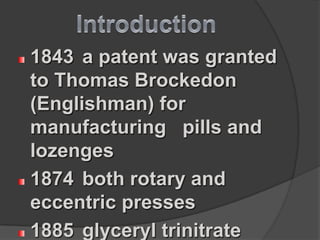
1843 a patent was granted
to Thomas Brockedon
(Englishman) for
manufacturing pills and
lozenges
1874 both rotary and
eccentric presses
1885 glyceryl trinitrate
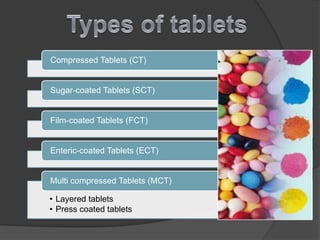
Compressed Tablets (CT)
Sugar-coated Tablets (SCT)
Film-coated Tablets (FCT)
Enteric-coated Tablets (ECT)
• Layered tablets
• Press coated tablets
Multi compressed Tablets (MCT)
Controlled-release Tablets (CRT)
Tablets for Solutions
Effervescent tablets
Buccal and Sublingual Tablets
Basic definitions:
Compression:
the reduction in the bulk volume of a
material as a result of the removal of the
gaseous phase (air) by applied pressure.
Consolidation:
Involves an increase in the mechanical
strength of a material resulting from
Compaction:
The compression and consolidation of a 2
phase (solid + gas) system due to an
applied force.
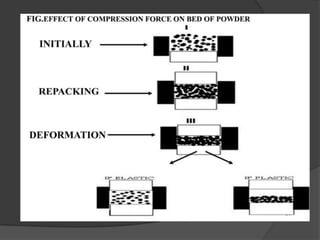
a. Particle
rearrangement/interparticles
lippage
b. Deformation of particulates
c. Bonding/Cold welding
d. Deformation of the solid
body
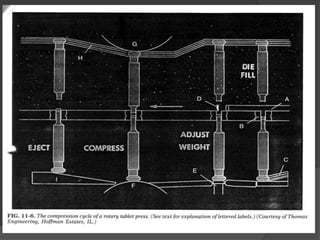
1. occurs at low pressures
2. reduction in the relative volume of
powder bed
3. small particles flow into voids
between larger particles leading to a
closer packing arrangement
As pressure increases, relative particle
movement becomes impossible,
When the surfaces of two
particles approach each
other closely enough (e.g. at
a separation of less than
50nm), their free surface
energies result in a strong
attractive force , a process
known as cold welding or
A.Solid Bridges:
form directly across
particles in the absence of any
binding elements or additives
B. Intermolecular/Electrostatic
Forces:
forces projecting beyond the
particle surface as small
discrete fields with very short
range order
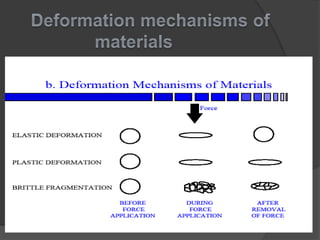
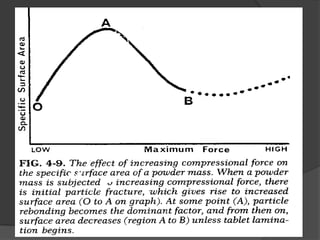
As pressure increases, the
bonded solid is consolidated
toward a limiting density by
plastic and/or elastic
deformation.
If on removal of the load, the
deformation is to a large extent
spontaneously reversible i.e., if
 Some deformation processes (plastic
deformation) are time-dependent and
occur at various rates during the
compaction sequence, so that the tablet
mass is never in a state of stress/strain
equilibrium during the actual tabletting
event.
 This means that the rate at which load
is applied and removed may be a critical
factor in materials for which dependence
on time is significant.
 The compact is ejected,
allowing radial and axial
recovery.
 Elastic character tends to
revert the compact to its original
shape.
At least some moisture is
present in all tablet formulas
 Concentration well below 1%
level can effect the behavior
of these feed materials and
finished product.
 Moisture as little as 0.002%
can affect the proportion of
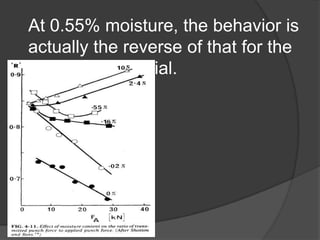
At 0.55% moisture, the behavior is
actually the reverse of that for the
totally dry material.
 Filling
 Compression
 Ejection
Hopper- for holding and feeding
granulation to be compressed.
Dies- that define the size and
shape of the tablet.
Punches- for compressing the
granulation within the dies.
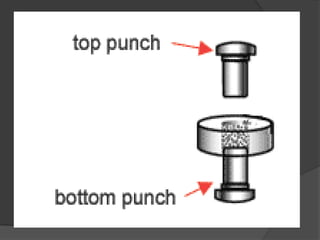
Cam tracks- for guiding the
movement of the punches.
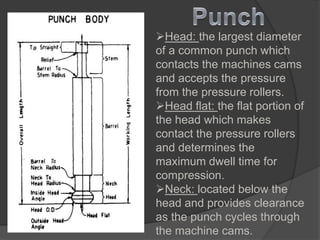
Head: the largest diameter
of a common punch which
contacts the machines cams
and accepts the pressure
from the pressure rollers.
Head flat: the flat portion of
the head which makes
contact the pressure rollers
and determines the
maximum dwell time for
compression.
Neck: located below the
head and provides clearance
as the punch cycles through
the machine cams.
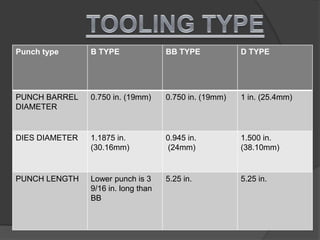
Punch type B TYPE BB TYPE D TYPE
PUNCH BARREL
DIAMETER
0.750 in. (19mm) 0.750 in. (19mm) 1 in. (25.4mm)
DIES DIAMETER 1.1875 in.
(30.16mm)
0.945 in.
(24mm)
1.500 in.
(38.10mm)
PUNCH LENGTH Lower punch is 3
9/16 in. long than
BB
5.25 in. 5.25 in.
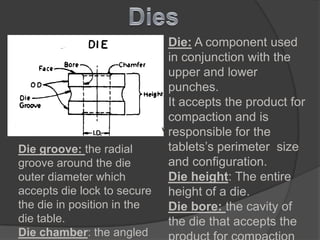
Die: A component used
in conjunction with the
upper and lower
punches.
It accepts the product for
compaction and is
responsible for the
tablets’s perimeter size
and configuration.
Die height: The entire
height of a die.
Die bore: the cavity of
the die that accepts the
Die groove: the radial
groove around the die
outer diameter which
accepts die lock to secure
the die in position in the
die table.
Die chamber: the angled
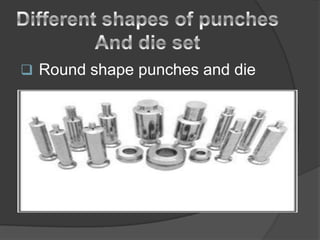
 Round shape punches and die
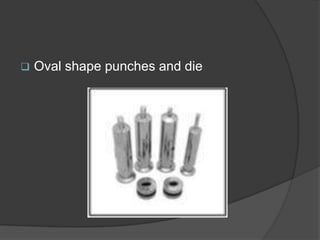
 Oval shape punches and die
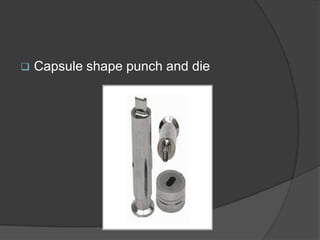
 Capsule shape punch and die
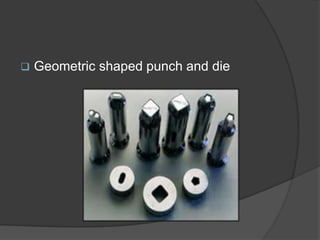
 Geometric shaped punch and die
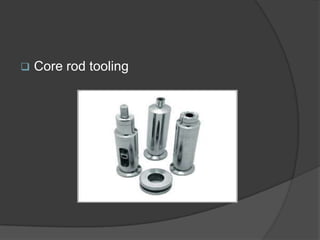
 Core rod tooling
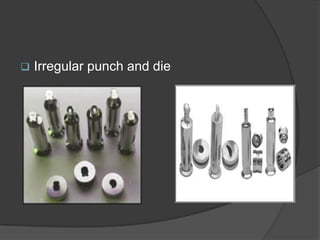
 Irregular punch and die
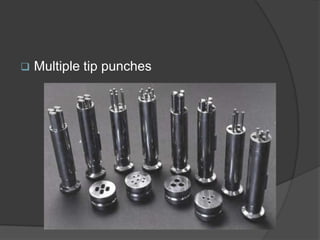
 Multiple tip punches
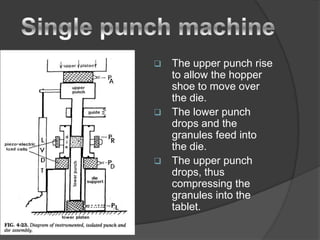
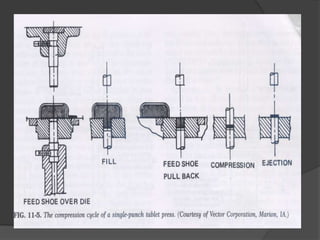
 The upper punch rise
to allow the hopper
shoe to move over
the die.
 The lower punch
drops and the
granules feed into
the die.
 The upper punch
drops, thus
compressing the
granules into the
tablet.
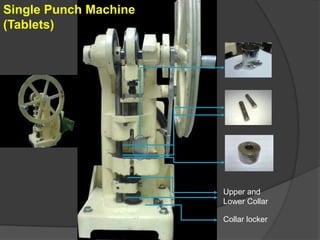
Upper and
Lower Collar
Collar locker
Single Punch Machine
(Tablets)
 The upper punch rises upword and the
lower punch rise upto the surface of the
die to eject the tablet.
 The lower punch drops and the cycle is
restarted.
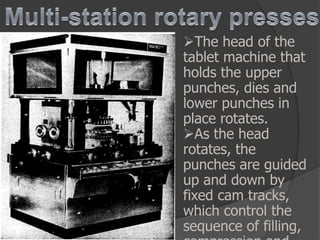
The head of the
tablet machine that
holds the upper
punches, dies and
lower punches in
place rotates.
As the head
rotates, the
punches are guided
up and down by
fixed cam tracks,
which control the
sequence of filling,
The portion holding the dies is called
the die table.
The pull down cam (C) guides the
lower punches to the bottom,
allowing the dies to overfill
The punches then pass over a weight-
control cam (E), which reduces the fill
in the dies to the desired amount.
A swipe off blade (D) at the end of
the feed frame removes the excess
granulation and directs it around the
The upper punches enter a fixed
distance into the dies, while the
lower punches are raised to squeeze
and compact the granulation within
the dies.
After the moment of compression,
the upper punches are withdrawn as
they follow the upper punch raising
cam (H).
The lower punches ride up the cam
(I) which brings the tablets flush with
In 1997, Ima introduced a line of
unique tablet presses called Ima
comprima.
Unlike traditional presses Ima
comprima feeds the granules through
the die table taking advantage of
the centrifugal force created by the
rotating turret for a rapid and
uniform die fill.
The Ima comprima ejects the
In 2005 Fette GmbH Germany
introduced new tablet press and
tooling technology.
Fette developed die segments. It
provides an advantage over
traditional dies by combining the
tablet press turret die table and
dies into 3 or 5 integral segments.
Die segments are much easier
and quicker to install.
1.Remington- the science and
practice of pharmacy, 21st edition,
volume I Lippincott Williams and
Wilkins.
2.The theory and practice of
industrial pharmacy by Leon
Lachman and Herbert A.
Lieberman, 2009 edition, CBS
Publishers.
THANK
YOU

Tablet compreesion (2)

  • 3.
    1843 a patentwas granted to Thomas Brockedon (Englishman) for manufacturing pills and lozenges 1874 both rotary and eccentric presses 1885 glyceryl trinitrate
  • 4.
    Compressed Tablets (CT) Sugar-coatedTablets (SCT) Film-coated Tablets (FCT) Enteric-coated Tablets (ECT) • Layered tablets • Press coated tablets Multi compressed Tablets (MCT)
  • 5.
    Controlled-release Tablets (CRT) Tabletsfor Solutions Effervescent tablets Buccal and Sublingual Tablets
  • 6.
    Basic definitions: Compression: the reductionin the bulk volume of a material as a result of the removal of the gaseous phase (air) by applied pressure. Consolidation: Involves an increase in the mechanical strength of a material resulting from
  • 7.
    Compaction: The compression andconsolidation of a 2 phase (solid + gas) system due to an applied force.
  • 8.
    a. Particle rearrangement/interparticles lippage b. Deformationof particulates c. Bonding/Cold welding d. Deformation of the solid body
  • 9.
    1. occurs atlow pressures 2. reduction in the relative volume of powder bed 3. small particles flow into voids between larger particles leading to a closer packing arrangement As pressure increases, relative particle movement becomes impossible,
  • 11.
    When the surfacesof two particles approach each other closely enough (e.g. at a separation of less than 50nm), their free surface energies result in a strong attractive force , a process known as cold welding or
  • 12.
    A.Solid Bridges: form directlyacross particles in the absence of any binding elements or additives B. Intermolecular/Electrostatic Forces: forces projecting beyond the particle surface as small discrete fields with very short range order
  • 13.
    As pressure increases,the bonded solid is consolidated toward a limiting density by plastic and/or elastic deformation. If on removal of the load, the deformation is to a large extent spontaneously reversible i.e., if
  • 14.
     Some deformationprocesses (plastic deformation) are time-dependent and occur at various rates during the compaction sequence, so that the tablet mass is never in a state of stress/strain equilibrium during the actual tabletting event.  This means that the rate at which load is applied and removed may be a critical factor in materials for which dependence on time is significant.
  • 15.
     The compactis ejected, allowing radial and axial recovery.  Elastic character tends to revert the compact to its original shape.
  • 18.
    At least somemoisture is present in all tablet formulas  Concentration well below 1% level can effect the behavior of these feed materials and finished product.  Moisture as little as 0.002% can affect the proportion of
  • 19.
    At 0.55% moisture,the behavior is actually the reverse of that for the totally dry material.
  • 20.
  • 21.
    Hopper- for holdingand feeding granulation to be compressed. Dies- that define the size and shape of the tablet. Punches- for compressing the granulation within the dies. Cam tracks- for guiding the movement of the punches.
  • 22.
    Head: the largestdiameter of a common punch which contacts the machines cams and accepts the pressure from the pressure rollers. Head flat: the flat portion of the head which makes contact the pressure rollers and determines the maximum dwell time for compression. Neck: located below the head and provides clearance as the punch cycles through the machine cams.
  • 23.
    Punch type BTYPE BB TYPE D TYPE PUNCH BARREL DIAMETER 0.750 in. (19mm) 0.750 in. (19mm) 1 in. (25.4mm) DIES DIAMETER 1.1875 in. (30.16mm) 0.945 in. (24mm) 1.500 in. (38.10mm) PUNCH LENGTH Lower punch is 3 9/16 in. long than BB 5.25 in. 5.25 in.
  • 24.
    Die: A componentused in conjunction with the upper and lower punches. It accepts the product for compaction and is responsible for the tablets’s perimeter size and configuration. Die height: The entire height of a die. Die bore: the cavity of the die that accepts the Die groove: the radial groove around the die outer diameter which accepts die lock to secure the die in position in the die table. Die chamber: the angled
  • 25.
     Round shapepunches and die
  • 26.
     Oval shapepunches and die
  • 27.
     Capsule shapepunch and die
  • 28.
     Geometric shapedpunch and die
  • 29.
     Core rodtooling
  • 30.
  • 31.
  • 33.
     The upperpunch rise to allow the hopper shoe to move over the die.  The lower punch drops and the granules feed into the die.  The upper punch drops, thus compressing the granules into the tablet.
  • 34.
    Upper and Lower Collar Collarlocker Single Punch Machine (Tablets)
  • 35.
     The upperpunch rises upword and the lower punch rise upto the surface of the die to eject the tablet.  The lower punch drops and the cycle is restarted.
  • 38.
    The head ofthe tablet machine that holds the upper punches, dies and lower punches in place rotates. As the head rotates, the punches are guided up and down by fixed cam tracks, which control the sequence of filling,
  • 39.
    The portion holdingthe dies is called the die table. The pull down cam (C) guides the lower punches to the bottom, allowing the dies to overfill The punches then pass over a weight- control cam (E), which reduces the fill in the dies to the desired amount. A swipe off blade (D) at the end of the feed frame removes the excess granulation and directs it around the
  • 40.
    The upper punchesenter a fixed distance into the dies, while the lower punches are raised to squeeze and compact the granulation within the dies. After the moment of compression, the upper punches are withdrawn as they follow the upper punch raising cam (H). The lower punches ride up the cam (I) which brings the tablets flush with
  • 43.
    In 1997, Imaintroduced a line of unique tablet presses called Ima comprima. Unlike traditional presses Ima comprima feeds the granules through the die table taking advantage of the centrifugal force created by the rotating turret for a rapid and uniform die fill. The Ima comprima ejects the
  • 44.
    In 2005 FetteGmbH Germany introduced new tablet press and tooling technology. Fette developed die segments. It provides an advantage over traditional dies by combining the tablet press turret die table and dies into 3 or 5 integral segments. Die segments are much easier and quicker to install.
  • 45.
    1.Remington- the scienceand practice of pharmacy, 21st edition, volume I Lippincott Williams and Wilkins. 2.The theory and practice of industrial pharmacy by Leon Lachman and Herbert A. Lieberman, 2009 edition, CBS Publishers.
  • 46.