Introduction
• 1843 A patent was granted to Thomas Brockedon for
manufacturing pills and lozenges
• 1874 Both rotary and eccentric presses
• 1885 glyceryl trinitrate tablets in the BP
No other tablet monograph appeared until 1945
• 1980 Around 300 monographs for tablets
Definition:
A tablet is a compressed solid unit dosage form containing
medicaments with or without excipients
IP definition:
Pharmaceutical tablets are solid flat or biconvex dishes
prepared by compressing a drug or a mixture of drugs, with
or without diluents. They vary in shape and differ greatly in
size and weight, depending on the amount of medicinal
substances and the intended mode of administration.
Advantages:
– Easy to handle
– Lightest and most compact
– Greatest dose precision & least content variability
– Coating can mask unpleasant tastes & improved
product acceptability
– Large scale production at lowest cost
– Easiest and cheapest to package and transport
– High stability
Disadvantages:
• Some drugs difficult to compress
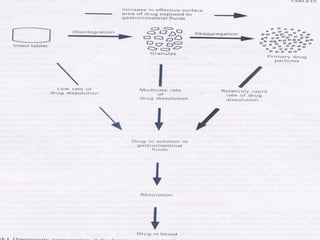
• Low bioavailability
• Drugs with bitter taste /objectionable odor
• Drugs sensitive to oxygen or moisture may require
encapsulation or entrapment prior to compression or the
tablets may require coating
METHOD OF PREPARATION
• Dry methods
– Direct compression
– Dry granulation
• Wet methods
– Wet granulation
GRANULATION: "A physical and chemical process where by
small particles are gathered into larger, permanent masses
in which the original particles can still be identified."
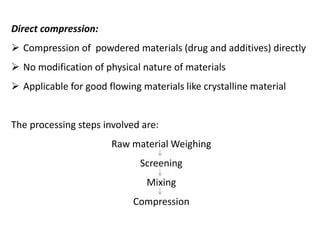
Direct compression:
➢ Compression of powdered materials (drug and additives) directly
➢ No modification of physical nature of materials
➢ Applicable for good flowing materials like crystalline material
The processing steps involved are:
Raw material Weighing
Screening
Mixing
Compression
• Advantages
– Economy
• Machine: fewer manufacturing steps
• Reduced labor costs
• Less process validation
• Lower consumption of power
– Elimination of granulation process
• Heat (wet granulation)
• Moisture (wet granulation)
• High pressure (dry granulation)
– Elimination of variabilities in wet granulation processing
• Binders (temp, viscous, age)
– Viscosity of the granulating solution (depend on its
temp)
• Concerns
– Excipient available from only one supplier and often
cost more than filler used in granulation
– Procedure conservation
– Machine investments
– Lack of material knowledge
– Physical limitation of drug
• No compressibility
• No flowability
– Physical characteristics of materials (both drug and excipient)
• Size and size distribution
• Moisture
• Shape and surface Flowability
• Density
– Lot to lot variability
– Dusting problem
– Coloring
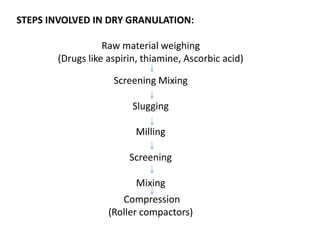
STEPS INVOLVED IN DRY GRANULATION:
Raw material weighing
(Drugs like aspirin, thiamine, Ascorbic acid)
Screening Mixing
Slugging
Milling
Screening
Mixing
Compression
(Roller compactors)
STEPS INVOLVED IN WET GRANULATION
1. Raw materials (active ingredient, diluent and disintegrants)
2. Weighing
3. Screening
4. Wet massing
5. Sieving/Milling
6. Drying (tray dryer, fluidized bed dryer)
7. Screening
8. Mixing (twin shell blenders, double cone blenders, planetary
mixers, sigma blade mixers, ribbon mixers)
9. Lubrication
10. Compression
TABLET COMPACTION /COMPRESSION
Tablet Compression Machine
Tablet presses are designed with following basic components:
1) Hopper for holding and feeding granulation
2) Dies that define the size and shape of the tablet.
3) Punches for compressing the granulation within the dies.
4) A feeding mechanism for moving granulation from hopper
into the dies.
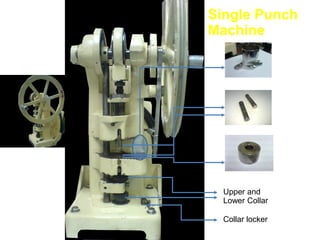
Upper and
Lower Collar
Collar locker
Single Punch
Machine
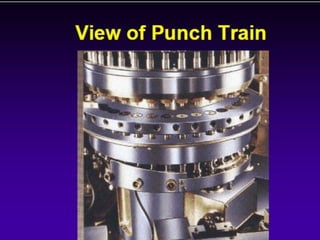
Multi-station rotary presses
• The head of the tablet machine that holds the upper punches
rotates
• As the head rotates, the punches are guided up and down by
fixed cam tracks, which control the sequence of filling,
compression and ejection.
• The portions of the head that hold the upper and lower
punches are called the upper an lower turrets
• The portion holding the dies is called the die table
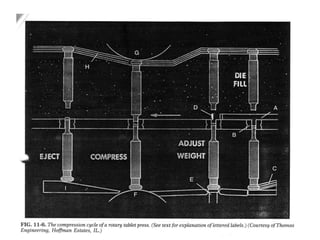
• The pull down cam (C) guides the lower punches to the bottom,
allowing the dies to overfill
• The punches then pass over a weight-control cam (E), which
reduces the fill in the dies to the desired amount
• A swipe off blade (D) in the feed frame removes the excess granules
• The lower punches travel over the lower compression roll (F) while
simultaneously the upper punches ride beneath the upper
compression roll (G)
• The upper punches enter a fixed distance into the dies, while the lower
punches are raised to squeeze and compact the granulation within the dies
• After the moment of compression, the upper punches are withdrawn as they
follow the upper punch raising cam (H)
• The lower punches ride up the cam (I) which brings the tablets flush with or
slightly above the surface of the dies
• The tablets strike a sweep off blade affixed to the front of the feed frame (A)
and slide down a chute into a receptacle
• At the same time, the lower punches re-enter the pull down cam (C) and the
cycle is repeated
• Modifications can be made by
– Number of tooling sets
– Number of compression stations
– Rotational speed of the press
• Special adaptations of tablet machines allow for the
compression of layered tablets and coated tablets
• A device that chills the compression components to allow
for the compression of low-melting point substances
such as waxes i.e. suppositories
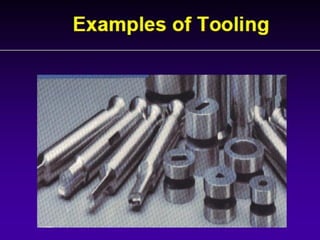
COMPRESSION MACHINE TOOLING
Size shape and identification markings like company names and
symbol, trade names, dosage strength of a tablet
Each tooling set consists of a die and upper and lower punches
Several types of steel are normally used in the manufacturing of
compression tooling
Selection of steel for a specific application must be based on
experience and an accumulated history of the product being
tableted
During normal use the punches and die become worn
To avoid tooling damage, compressive loads or pressure at
the pressure rolls must be translated into a circulation of
pressure at the punch tips. As tablet punch diameter
decreases, less force is required to produce the same
pressure at the punch face, since the face represents a
smaller fraction of a unit area (square inch).
COMMON TABLET PROCESSING PROBLEMS:
1. Capping & Lamination
2. Picking & sticking
3. Mottling
4. Hardness variation
5. Double impression
6. Weight variation
Common Processing Problems
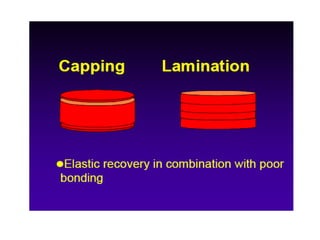
1. Capping & Lamination:
Capping - complete or partial loss of top and bottom crowns of a
tablet from the main body
lamination - separation of a tablet into two or more distinct layers.
Lamination may be due to
Over compressing
Defects in the machinery, such as deep concave punches
When groups of fine and light particles do not lock together
Remedied by precompression, by slowing the tabletting rate, or by
using flat punches.
2. Picking & Sticking:
Picking - Surface materials from a tablet that is sticking to the
punch and being removed from the tablet surface.
May be occurred when punch tips are of engraving types e.g. small
enclosed areas in letter B.
Sticking - to tablet materials adhering to the die wall. During the
compression, air entrapment occurs and creates a soft area on the
very top of the tablet.
Sticking and picking can be prevented by appropriate use of
lubricants and binders.
3. Mottling:
Unequal distribution of colors
Due to use of a drug whose color differs from that of the tablet excipients.
Colorants additives could be added to remedy the problem.
4. Hardness Variation:
Hardness depends on the weight of materials and space between upper
and lower punch at the moment of compression.
5. Double Impression:
If the engrave is present in upper punch, slight rotation of punch after
precompression produces double impression. If engrave present in lower
punch after compression is over lowered punch moves slightly downward
to free the tablet and produces double impression. This problem can be
overcome by using non-rotating cam track.
6. Weight Variation:
Variation of tablet weight also causes variation of active medicament
which changes the bioavailability.
Cause:
(a) Granule size & size distribution
(b) Poor Flow
(c) Poor Mixing

Tablets.pdf..........................................

  • 1.
    Introduction • 1843 Apatent was granted to Thomas Brockedon for manufacturing pills and lozenges • 1874 Both rotary and eccentric presses • 1885 glyceryl trinitrate tablets in the BP No other tablet monograph appeared until 1945 • 1980 Around 300 monographs for tablets
  • 2.
    Definition: A tablet isa compressed solid unit dosage form containing medicaments with or without excipients IP definition: Pharmaceutical tablets are solid flat or biconvex dishes prepared by compressing a drug or a mixture of drugs, with or without diluents. They vary in shape and differ greatly in size and weight, depending on the amount of medicinal substances and the intended mode of administration.
  • 3.
    Advantages: – Easy tohandle – Lightest and most compact – Greatest dose precision & least content variability – Coating can mask unpleasant tastes & improved product acceptability – Large scale production at lowest cost – Easiest and cheapest to package and transport – High stability
  • 4.
    Disadvantages: • Some drugsdifficult to compress • Low bioavailability • Drugs with bitter taste /objectionable odor • Drugs sensitive to oxygen or moisture may require encapsulation or entrapment prior to compression or the tablets may require coating
  • 6.
    METHOD OF PREPARATION •Dry methods – Direct compression – Dry granulation • Wet methods – Wet granulation GRANULATION: "A physical and chemical process where by small particles are gathered into larger, permanent masses in which the original particles can still be identified."
  • 7.
    Direct compression: ➢ Compressionof powdered materials (drug and additives) directly ➢ No modification of physical nature of materials ➢ Applicable for good flowing materials like crystalline material The processing steps involved are: Raw material Weighing Screening Mixing Compression
  • 8.
    • Advantages – Economy •Machine: fewer manufacturing steps • Reduced labor costs • Less process validation • Lower consumption of power
  • 9.
    – Elimination ofgranulation process • Heat (wet granulation) • Moisture (wet granulation) • High pressure (dry granulation) – Elimination of variabilities in wet granulation processing • Binders (temp, viscous, age) – Viscosity of the granulating solution (depend on its temp)
  • 10.
    • Concerns – Excipientavailable from only one supplier and often cost more than filler used in granulation – Procedure conservation – Machine investments – Lack of material knowledge
  • 11.
    – Physical limitationof drug • No compressibility • No flowability – Physical characteristics of materials (both drug and excipient) • Size and size distribution • Moisture • Shape and surface Flowability • Density – Lot to lot variability – Dusting problem – Coloring
  • 12.
    STEPS INVOLVED INDRY GRANULATION: Raw material weighing (Drugs like aspirin, thiamine, Ascorbic acid) Screening Mixing Slugging Milling Screening Mixing Compression (Roller compactors)
  • 13.
    STEPS INVOLVED INWET GRANULATION 1. Raw materials (active ingredient, diluent and disintegrants) 2. Weighing 3. Screening 4. Wet massing 5. Sieving/Milling 6. Drying (tray dryer, fluidized bed dryer) 7. Screening 8. Mixing (twin shell blenders, double cone blenders, planetary mixers, sigma blade mixers, ribbon mixers) 9. Lubrication 10. Compression
  • 14.
    TABLET COMPACTION /COMPRESSION TabletCompression Machine Tablet presses are designed with following basic components: 1) Hopper for holding and feeding granulation 2) Dies that define the size and shape of the tablet. 3) Punches for compressing the granulation within the dies. 4) A feeding mechanism for moving granulation from hopper into the dies.
  • 15.
    Upper and Lower Collar Collarlocker Single Punch Machine
  • 17.
    Multi-station rotary presses •The head of the tablet machine that holds the upper punches rotates • As the head rotates, the punches are guided up and down by fixed cam tracks, which control the sequence of filling, compression and ejection. • The portions of the head that hold the upper and lower punches are called the upper an lower turrets
  • 18.
    • The portionholding the dies is called the die table • The pull down cam (C) guides the lower punches to the bottom, allowing the dies to overfill • The punches then pass over a weight-control cam (E), which reduces the fill in the dies to the desired amount • A swipe off blade (D) in the feed frame removes the excess granules • The lower punches travel over the lower compression roll (F) while simultaneously the upper punches ride beneath the upper compression roll (G)
  • 19.
    • The upperpunches enter a fixed distance into the dies, while the lower punches are raised to squeeze and compact the granulation within the dies • After the moment of compression, the upper punches are withdrawn as they follow the upper punch raising cam (H) • The lower punches ride up the cam (I) which brings the tablets flush with or slightly above the surface of the dies • The tablets strike a sweep off blade affixed to the front of the feed frame (A) and slide down a chute into a receptacle • At the same time, the lower punches re-enter the pull down cam (C) and the cycle is repeated
  • 22.
    • Modifications canbe made by – Number of tooling sets – Number of compression stations – Rotational speed of the press • Special adaptations of tablet machines allow for the compression of layered tablets and coated tablets • A device that chills the compression components to allow for the compression of low-melting point substances such as waxes i.e. suppositories
  • 23.
    COMPRESSION MACHINE TOOLING Sizeshape and identification markings like company names and symbol, trade names, dosage strength of a tablet Each tooling set consists of a die and upper and lower punches Several types of steel are normally used in the manufacturing of compression tooling Selection of steel for a specific application must be based on experience and an accumulated history of the product being tableted
  • 24.
    During normal usethe punches and die become worn To avoid tooling damage, compressive loads or pressure at the pressure rolls must be translated into a circulation of pressure at the punch tips. As tablet punch diameter decreases, less force is required to produce the same pressure at the punch face, since the face represents a smaller fraction of a unit area (square inch).
  • 26.
    COMMON TABLET PROCESSINGPROBLEMS: 1. Capping & Lamination 2. Picking & sticking 3. Mottling 4. Hardness variation 5. Double impression 6. Weight variation
  • 27.
    Common Processing Problems 1.Capping & Lamination: Capping - complete or partial loss of top and bottom crowns of a tablet from the main body lamination - separation of a tablet into two or more distinct layers. Lamination may be due to Over compressing Defects in the machinery, such as deep concave punches When groups of fine and light particles do not lock together Remedied by precompression, by slowing the tabletting rate, or by using flat punches.
  • 29.
    2. Picking &Sticking: Picking - Surface materials from a tablet that is sticking to the punch and being removed from the tablet surface. May be occurred when punch tips are of engraving types e.g. small enclosed areas in letter B. Sticking - to tablet materials adhering to the die wall. During the compression, air entrapment occurs and creates a soft area on the very top of the tablet. Sticking and picking can be prevented by appropriate use of lubricants and binders.
  • 30.
    3. Mottling: Unequal distributionof colors Due to use of a drug whose color differs from that of the tablet excipients. Colorants additives could be added to remedy the problem. 4. Hardness Variation: Hardness depends on the weight of materials and space between upper and lower punch at the moment of compression. 5. Double Impression: If the engrave is present in upper punch, slight rotation of punch after precompression produces double impression. If engrave present in lower punch after compression is over lowered punch moves slightly downward to free the tablet and produces double impression. This problem can be overcome by using non-rotating cam track.
  • 31.
    6. Weight Variation: Variationof tablet weight also causes variation of active medicament which changes the bioavailability. Cause: (a) Granule size & size distribution (b) Poor Flow (c) Poor Mixing