Special Notice to Readers: Unless indicated other-
wise, figures and text illustrations in the manual are
not drawn to scale. Further, unless indicated other-
wise, the dimensions listed in figures and tables are
given first in inches, followed by the equivalent mil-
limeters in brackets.
The first step in learning any industry is mastering its
terminology. With this in mind, the Steering Committee
has adopted a list of standard, industry-accepted terms
for tablet manufacturing. An understanding of these
terms will provide a foundation on which persons
new to the industry can build a working knowledge
of the basic tablet categories, tooling types, press
operations, and tooling specification drawings. For
those who have industry experience, the information
in this section could be a useful reference for ensuring
clear communication between production staff, tablet
designers, tooling suppliers, and press manufacturers.
Tooling Terminology
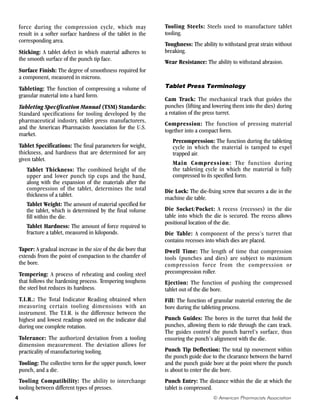
The following definitions of the standard terminology
for tooling (punches and dies) are illustrated in Figure
1 (page 3).
Abbreviations
IPT: Industrial Pharmaceutical Technology (obsolete
term replaced with TSM)
TSM: Tableting Specification Manual
APhA: American Pharmacists Association (publisher of
the Tableting Specification Manual)
EU: European union
FEA: Finite element analysis
kN: KiloNewton
kp: Kilopond
O.D.: Outside diameter
I.D.: Inside diameter
W.L.: Working length
O.L.: Overall length
General Terminology
Abrasion: The act of wearing of contact surfaces.
Alpha/Numeric Characters: A, B, C, etc./ 1, 2, 3, etc.
Anneal: A process of heating a steel followed by slow air
cooling to change the steel’s microstructure, usually to
soften it.
Angle: A figure that is formed by two lines diverging
from a common point.
Arc: A segment of a circle.
Axis: A straight line serving to orient a geometric object.
Barrel: The area between the neck and stem of a
punch.
Barrel-to-Stem Chamfer: The beveled area located
between the barrel and barrel-to-stem radius.
The chamfer allows for the proper insertion of the
punches turret oil seals.
Barrel-to-Stem Radius: The area at the junction
of the barrel and stem, which provides a curved
transition from the tip length to the barrel.
Bevel: The angle of a line that meets another at any
angle other than a right angle.
Blend: To form a rounded surface at the point where
two surfaces come together to form an angle.
Bore: To form a hole through an object.
Break (broken): To remove and round off a sharp
edge.
Burr: A rough or raised edge.
Capping: A tablet defect in which air trapped during
compression creates a layer of granulation with air
between the granules, which in turn weakens the
structure and allows a capping fracture (the tablet top
and/or bottom curvature breaks off at or above the
band).
SECTION 1
Guidelines for Using This Manual
© American Pharmacists Association 1
Chamfer: A cut or bevel applied to an edge or corner.
Chipping: A defect in the tablet in which a piece has
broken off the edge.
Clearance: The difference in size between interacting
parts, which creates a working space between the parts
and allows for their designed free movement.
Concave: Having a surface that is curved like the inner
surface of a sphere.
Convex: Having a surface that is curved like the exterior
surface of a sphere.
Concentricity: The measurement from a common
center point.
Corrosion: A chemical reaction of contact surfaces,
which causes pitting and discoloration.
Delaminate: A defect in a layered tablet in which the
layers split apart.
Dimension: The numeric measured distance.
Ductility: The ease that metal flows during the high
pressures of compression.
Finite Element Analysis (FEA): A sophisticated
computer program that is capable of modeling complex
shape configurations and performing accurate stress
analyses to determine the maximum force loading
that the punch tip can be subjected to and still permit
infinite tableting cycles.
Flashing: A slight imperfection in a tablet in which
the material has been compressed above the land in
the clearance between the punch tip and the die bore,
causing a raised edge.
Formulation: The result of bringing together all the
ingredients in a recipe (see definition below) for a
pharmaceutical, food, or nutritional product that is
manufactured by blending (mixing) followed by
compressing or molding the mixture of ingredients.
Force Tip Ratings: Maximum force loading that a
punch tip can withstand and permit infinite tableting
cycles. The rating is derived from a mathematical
equation.
Granulation: Structure of the granules (particles)
of the components of a pharmaceutical product after
blending.
Hardening: A process of heating steel at high
temperatures, then cooling it to transform the steel
from a soft (annealed) condition to a hard condition.
Identification: The application of letters, numbers,
and/or symbols to an object’s surface.
Industrial Pharmaceutical Technology (IPT)
section: The group who developed the first industry-
wide tooling standards—the IPT standards—which
were renamed the TSM standards.
KiloNewton: The unit of force use in measurement of
the loading applied or subjected to in order to compress
the tablet to the specified weight and thickness.
Kilopond: The unit of force used to measure the
fracture point of a tablet.
Lubricant: A substance applied to moving parts to
decrease the friction generated between them.
Milligrams: The unit of measurement used to
determine tablet weight.
Oil: A common lubricant used on a tablet press during
manufacturing.
Polishing Compound: Material that is used to assist in
buffing the tip faces to remove built up residue.
Product: The final blended material that is to be
processed into its final dosage form (tablet, capsule,
vial, etc.).
Recipe: The formula and contents for the ingredients
(active and inactive) and their quantities for a tablet.
Relief (Undercut): The area of increased mechanical
clearance.
Tip Relief: The undercut between the punch stem
and the tip.
Bakelite Relief: A special, designed undercut to
prevent material buildup in the die bore.
European Dust Cup Relief: A special, designed
undercut on the punch barrel that allows attachment
of a standardized dust cup with a precut hole that is
standardized to the groove seal.
Rockwell Hardness: A measurement of the hardness
of steel. The Rockwell C scale is customarily used for
measuring tool steels.
Score: An embedded line in the tablet that allows the
tablet to break when force is applied adjacent to the
area. This term includes bisect and quarter-scores.
Sharp: Term used to describe a corner or edge that is
not broken or rounded.
Soft Zone: The area on a tip face that receives unequal
© American Pharmacists Association
2
3
© American Pharmacists Association
force during the compression cycle, which may
result in a softer surface hardness of the tablet in the
corresponding area.
Sticking: A tablet defect in which material adheres to
the smooth surface of the punch tip face.
Surface Finish: The degree of smoothness required for
a component, measured in microns.
Tableting: The function of compressing a volume of
granular material into a hard form.
Tableting Specification Manual (TSM) Standards:
Standard specifications for tooling developed by the
pharmaceutical industry, tablet press manufacturers,
and the American Pharmacists Association for the U.S.
market.
Tablet Specifications: The final parameters for weight,
thickness, and hardness that are determined for any
given tablet.
Tablet Thickness: The combined height of the
upper and lower punch tip cups and the band,
along with the expansion of the materials after the
compression of the tablet, determines the total
thickness of a tablet.
Tablet Weight: The amount of material specified for
the tablet, which is determined by the final volume
fill within the die.
Tablet Hardness: The amount of force required to
fracture a tablet, measured in kiloponds.
Taper: A gradual increase in the size of the die bore that
extends from the point of compaction to the chamfer of
the bore.
Tempering: A process of reheating and cooling steel
that follows the hardening process. Tempering toughens
the steel but reduces its hardness.
T.I.R.: The Total Indicator Reading obtained when
measuring certain tooling dimensions with an
instrument. The T.I.R. is the difference between the
highest and lowest readings noted on the indicator dial
during one complete rotation.
Tolerance: The authorized deviation from a tooling
dimension measurement. The deviation allows for
practicality of manufacturing tooling.
Tooling: The collective term for the upper punch, lower
punch, and a die.
Tooling Compatibility: The ability to interchange
tooling between different types of presses.
Tooling Steels: Steels used to manufacture tablet
tooling.
Toughness: The ability to withstand great strain without
breaking.
Wear Resistance: The ability to withstand abrasion.
Tablet Press Terminology
Cam Track: The mechanical track that guides the
punches (lifting and lowering them into the dies) during
a rotation of the press turret.
Compression: The function of pressing material
together into a compact form.
Precompression: The function during the tableting
cycle in which the material is tamped to expel
trapped air.
Main Compression: The function during
the tableting cycle in which the material is fully
compressed to its specified form.
Die Lock: The die-fixing screw that secures a die in the
machine die table.
Die Socket/Pocket: A recess (recesses) in the die
table into which the die is secured. The recess allows
positional location of the die.
Die Table: A component of the press’s turret that
contains recesses into which dies are placed.
Dwell Time: The length of time that compression
tools (punches and dies) are subject to maximum
compression force from the compression or
precompression roller.
Ejection: The function of pushing the compressed
tablet out of the die bore.
Fill: The function of granular material entering the die
bore during the tableting process.
Punch Guides: The bores in the turret that hold the
punches, allowing them to ride through the cam track.
The guides control the punch barrel’s surface, thus
ensuring the punch’s alignment with the die.
Punch Tip Deflection: The total tip movement within
the punch guide due to the clearance between the barrel
and the punch guide bore at the point where the punch
is about to enter the die bore.
Punch Entry: The distance within the die at which the
tablet is compressed.
© American Pharmacists Association
4
Scrape Off: The function of removing excess granular
material from top of the die bore to allow for the exact
measure volume fill on the tablet press turret during
the tableting process.
Station: A punch guide position within the tablet press
turret, which consists of an upper punch, a lower
punch, and a die.
Tableting Cycle: The process of compressing a tablet,
which includes the fill, scrape off, compression, ejection,
and take-off functions.
Tablet Press: The equipment used to mechanically
compress granular material into a hard form.
Rotary Tablet Press: Equipment that uses
a rotating turret to cycle the tooling through the
tableting cycle.
Single Stroke Press: Equipment that uses
a stationary table and eccentric cam to cycle the
tooling through the tableting cycle.
Take-Off: The function of removing the compressed
ejected tablet from the tablet press turret during the
tableting process.
Turret: The rotating device in a tablet press, composed
of the cam track and die table, which holds and aligns
the tooling through the tableting cycle.
Punch Terminology
Barrel: The area between the neck and stem of a
punch.
Barrel-to-Neck Chamfer: The beveled area located
between the barrel and barrel-to-neck radius. The
chamfer can reduce wear of punch guides.
Barrel-to-Neck Radius: The area at the junction
of the barrel and neck, which provides a smooth
transition from the barrel to the neck.
Barrel-to-Stem Chamfer: The beveled area located
between the barrel and barrel-to-stem radius. The
chamfer allows for the proper insertion of the upper
or lower punch into the oil seal.
Barrel-to-Stem Radius: The area at the junction
of the barrel and stem, which provides a curved
transition from the tip length to the barrel.
Bellows: A pleated sealing device that contracts and
expands upon application and removal of pressure. A
bellows covers the extended portion of the punch barrel,
providing a better seal and, thus, better protection from
lubrication contaminating the product.
Cup: The depression or cavity within the punch tip.
Compound Cup: A cup design in which multiple
arcs are generated from the cup’s center point across
the cup’s diameter, minor or major axis.
Standard Cup: A cup design in which a single arc
is generated from the cup’s center point across the
cup’s diameter, minor axis, or major axis.
Flat-Faced Bevel-Edged (F.F.B.E.): A cup
configuration consisting of an angle between the
cup’s and the tablet’s flat face and a land. A 30°
bevel is preferred to maximize the strength of punch
edges. When the bevel is first applied, its contact
area with the tablet face is a sharp beveled edge.
Flat-Faced Radius-Edged (F.F.R.E.): A cup
configuration similar to F.F.B.E. consisting of a
radius between the cup’s and the tablet’s flat face
and a land. The radius from the tablet’s periphery
or land should not exceed the comparable 30° bevel
used for the F.F.B.E. design to ensure the strength of
punch edges.
Cup Depth: The distance from the cup’s lowest point
(usually the center point of the cup) to its highest
point (usually the highest point of the land). This
measurement does not include identification embossing
and debossing.
Cup Radius: A single arc generated from the tablet’s
center point across the tablet’s diameter, minor axis, or
major axis.
Fluted Barrels: Punch barrels with machined grooves
that prevent build up of material in the punch guides.
Head: The end of the punch that guides and positions it
through the tablet press’s cam track.
Head Angle, Inside: The area of the head that is in
contact with the work portion of the cam track—that
is, the pull-down cam for lower punches and the
lifting cam for the upper punches.
Head Angle/Radius, Outside: The area of the head
that is in contact with the tablet press cams and has
the initial contact with pressure rollers.
Head Flat: The flat area of the punch head.
Head O.D.: The outside diameter of the punch
head. The O.D. extends the effective area of contact
between the cam and both the inside head angle and
the outside head angle/radius.
Hooked Tip: A defect of the punch tip caused by wear
in which the edge curls inward toward the punch face.
5
© American Pharmacists Association
6
Interchangeable Upper Punches: Keyed punches
that can be inserted into any station in a press turret
because of the precise positioning of the key in relation
to the punch tip.
Key: A device that is inserted into the punch barrel and
protrudes into the turret guide, thus preventing the
rotational movement of the punch, which allows for
precise alignment of the punch tip to the die bore.
Woodruff Key: A half-round key that is pressed into
a broached machined groove in the punch barrel.
Hi-Pro Woodruff Key: A half-round key with side
tabs that is pressed into a broached machined groove
in the punch barrel.
Fixed Parallel Key: A standard flat key that is
screwed into the broached machined groove in the
punch barrel.
Keying Angle: The relationship of the key and the
punch tip shape to allow for proper ejection of the
tablet.
Land:
Land, Tablet: A narrow plane perpendicular to the
tablet’s band, which creates a junction between the
band and the cup radius.
Land, Tip: The area between the edge of the punch
cup and the O.D. of the punch tip.
Land, Blended: The broken edge between the land
and the tip face.
Length:
Working Length (W.L.): The 1ength of the punch
from the bottom of the cup to the head flat. The
working lengths of the upper and lower punches
control tablet thickness and weight.
Overall Length (O.L.): The total punch length as
measured from the head flat to the end of the tip.
Neck: The relieved area between the head and barrel,
which provides clearance for the cams.
Oil Cups: A circular cup inserted onto the punch stem
to collect excess lubrication and prevent it from dripping
down the punch onto the tip.
Oil Seals: Seals that are placed into the upper and
lower punch guides to prevent lubrication from exiting
the guides and material from entering them.
Punch: A rod-shaped tool, usually made from steel,
which is used in producing tablets and other hard
products. The collective description for the device
includes the head, neck, barrel, stem, and tip. The face
of the tip forms the mold surface for producing detail
(logo, company name, identification code, etc.) on the
tablet face. (See “Tablet Terminology” in Section 3.)
Lower Punch: The punch inserted into the turret
below the die.
Upper Punch: The punch inserted into the turret
above the die.
Radius: A line segment that joins the center point of a
sphere with any point on its surface.
Corner Radius: The curvature used to eliminate
sharp corners on peripheral surfaces where two
lines or curves meet.
Barrel-to-Stem Radius: The corner radius located
between the punch barrel and the stem.
End Radius: The radius located at either end of an
oval-shaped tablet.
Neck-to-Barrel Radius: The corner radius located
between the punch neck and the barrel.
Neck-to-Head Radius: The corner radius located
between the punch neck and the inside head angle.
Seal Groove: A groove on the punch barrel that secures
a sealing device, such as an oil/dust cup or bellows,
which prevents possible contamination of the product
during the precompression and compression phases.
Stem: The area of the punch opposite the head,
beginning at the tip and extending to the point where
the full diameter of the barrel begins. If a chamfer is
present, the barrel usually reaches its full diameter just
above the chamfer.
Tip: The end of the punch that is compatible with the
die bore. The tip determines the size; shape, profile,
and identification of the tablet
Tip Engraving, Debossing: An engraving
identification that is depressed into the tip face
below its surface (see Section 3).
Tip Engraving, Embossing: An engraving
identification that protrudes above the surface of a
tip face (see Section 3).
Tip Face: The area within the cup’s periphery.
Tip Land: The area between the edge of the punch
cup and the O.D. of the punch tip.
Tip Length: The straight portion of the stem that
is effective inside the die bore. On lower punches,
the tip length allows vertical movement within the
7
© American Pharmacists Association
8
die bore for the metering of volume, compression of
granulation, and ejection of the tablet
Tip Straight: The area of the tip length that extends
from the end of the tip to the tip relief.
Die Terminology
Die: A tool that serves as the mold in which the product
is compressed to form the desired peripheral (outer)
size and shape of a tablet.
Die, Lined (Insert): A die fitted with an insert
made from a much harder, more wear-resistant
material, such as tungsten carbide or a ceramic.
Die, Tapered: A die in which the size of the bore
gradually increases from the point of compaction of
the granulation to the chamfer of the bore.
Die Bore: The cavity within the die where the
tablet is compressed. The cavity’s shape and size
determine the same for the tablet.
Die Chamfer: Entry angle on the die bore edge.
Die Groove: The groove around the outer periphery
of the center of the die, which allows the die to be
fixed in the tablet press.
Die Height: The overall height of the die, which is
compatible with the height of the die sockets in the
tablet press.
Die O.D.: The outside diameter of the die, which is
compatible with the diameter of the die sockets in
the tablet press.
Die Protection Radius: The undercut area between
the die groove and O.D.
Tablet Manufacturing
Producing a tablet with a unique design often increases
a product’s recognition among consumers. Although
tablets can be produced in a variety of shapes and
sizes, limitations as to their configuration do exist. The
limiting factors are usually related to characteristics of
the tooling and the press used to produce the tablets.
Some categories of tablets are easier to manufacture
and comprise the majority of tablets on store shelves.
Tablet Categories
Definitions of tablet terminology are based on the
geometric properties of the most common tablet
shapes; therefore, these definitions are placed in Section
3, “Tablet Design.” For the scope of this section, tablets
are broadly categorized as either “rounds” or “shapes.”
Figures 22–25 in Section 3 are cross-referenced in
the following text to illustrate examples of the tablet
categories.
Round Tablets
Round tablets include primarily convex and flat-faced
tablets (see Figure 22, page 52). Frequently, industry
people use the term concave to describe both the
concave surface of a punch cup and the surface of the
tablet produced. Technically, the punch cup is usually a
concavity and therefore produces a tablet with a convex
surface; however, convex cups that produce concave
tablets do exist.
Convex tablets can be further categorized according
to their cup depth. Figure 23 (page 54) shows convex
tablets with shallow, standard, deep, extra-deep, and
modified-ball cup depths. Flat-faced tablets can be
further categorized as flat-faced plain, flat-faced bevel-
edged, and flat-faced radius-edged (see Figure 25, page
56).
Shaped Tablets
Tablets that have geometric configurations other than
those listed for rounds are referred to as shapes (see
Figure 25). Figure 24 (page 55) uses three common
geometric configurations to illustrate the terminology
for shaped tablets. To produce a tablet with a particular
configuration, the tablet shape is reproduced in the
tooling used to manufacture the tablets. Before the
method of reproduction can be discussed, a thorough
understanding of tablet tooling is required.
Modern Tablet Tooling
The function of tablet tooling is to produce tablets with
predetermined physical characteristics, such as shape,
thickness, weight, and hardness. To achieve this, the
die cavity, or bore, is filled with a granulation or powder
to a depth that is determined by the position of the
lower punch. The lower punch’s position determines
the amount of granulation used in each tablet. The
upper punch tip is then guided into the bore and force
is applied to the punch heads, thereby compressing the
material into a tablet. The tablet’s shape is determined
by the configuration of the die bore and the punch tips.
The tablet’s thickness and hardness are determined by
9
© American Pharmacists Association
the amount of compression force applied to the punch
heads, whereas its weight is determined by the amount
of granulation loaded into the die before compression.
The basic design of tablet punches and dies used in
rotary tablet presses has changed very little since
these presses were first marketed in the late 1800s.
Only minor changes, such as refinements to the head
and tip radius, tighter tolerances, and higher surface
finishes, have been made. In the U.S. tablet industry,
three types of punches and three types of dies are used
predominantly in production presses to produce large
quantities of tablets for market distribution.
Punches
Punches are classified according to their overall length,
barrel diameter, and the O.D. of the punch head. These
dimensions, as well as the other specifications for tablet
tooling, are nominal: that is, each dimension has a
specified measurement, but its actual measurement
after the tool is produced may vary from its specification.
The allowable variance from a nominal dimension,
called its tolerance range, is discussed later in this
section under “Tooling Specifications.”
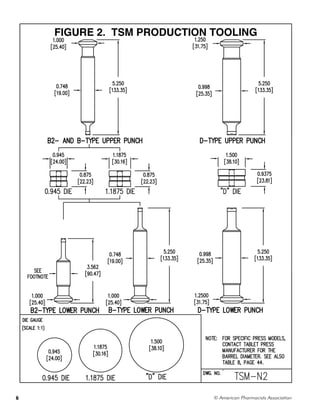
The punches most commonly used in production
presses are the B-type and D-type punches (see Figure
2, page 6). B2-type punches are used predominantly in
a few older models of presses that are no longer being
manufactured. During the research stage of a new tablet
design, F-type punches and dies (not pictured) and a
single-station laboratory press are used to determine
the approximate amount of compression force and
granulation needed to produce a tablet with the desired
physical characteristics.
B-Type Punches have a reference overall length of
5.250 inches [133.35 millimeters] and a head O.D. of
1 inch [25.40 millimeters]. These dimensions are the
same for the upper and lower punches. Although the
barrel diameter of a B-type punch is often said to be 3/4
inch [19.05 millimeters], the specified barrel diameter
for the upper—and now the lower—punch is 0.7480
inch [19.00 millimeters].
B2-Type Punches usually have a barrel diameter of 3/4
inch [19.05 millimeters]. Table 8 (pages 44–49) lists
barrel diameters of B2-type punches for specific press
models). This punch has a head O.D. of 1 inch [25.40
millimeters]; however, the overall lengths of the upper
and lower punches differ. The upper punch is 5.250
inches [133.35 millimeters] long, whereas the lower
punch is 3.562 inches [90.475 millimeters] long.
D-Type Punches have the same reference overall
length as B-type punches (5.250 inches [133.35
millimeters]), but the head O.D. of D-type punches
is 1.250 inches [31.75 millimeters]. Again, D-type
punches are often said to have a barrel diameter of 1
inch [25.40 millimeters]; however, the specified barrel
diameter for the upper—and now the lower—punch is
0.9980 inch [25.35 millimeters].
Dies
Dies are classified according to their outside diameters
(see Figure 2, page 6).
The 0.945 Die, as the name indicates, has an O.D. of
0.945 inch [24.00 millimeters]. This size die can be
used with B- and B2-type punches. The die is commonly
referred to as a “BB die.”
The 1.1875 Die, sometimes referred to as the “1 3/16
die,” has an O.D. of 1.1875 inches [30.16 millimeters]
and also can be used with B- and B2-type punches. This
die is commonly referred to as a “B die.”
The “D” Die, which has an O.D. of 1.500 inches [38.10
millimeters], is used with D-type punches.
Comparison of Shaped and Round Tooling
Not surprisingly, punches and dies used to manufacture
round tablets are often called “round tooling,” and
punches and dies used to manufacture shaped tablets
are called “shaped tooling.” After the geometric
configuration of a tablet has been determined by the
designer, the desired configuration is reproduced in the
punch tips and die bores.
The upper punch for a shaped tablet has a device
called a key that is inserted into a slot in the barrel and
projects above the barrel’s surface (see Figure 1, page
3). The key prevents the punch from rotating as it is
lifted vertically from the die bore so that the punch can
re-enter the die bore at the proper alignment. Because
round configurations are usually unaffected by rotation
of the upper punches, round punches seldom require
a key. However, if a round lower punch is embossed,
a key is sometimes used to prevent punch rotation
and possible distortion of the embossing during tablet
ejection.
Regardless of the tablet shape and the type of tooling
used, the basic press operations are the same.
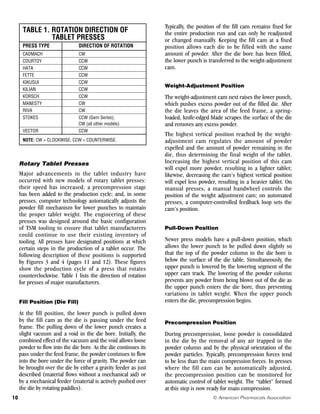
Typically, the position of the fill cam remains fixed for
the entire production run and can only be readjusted
or changed manually. Keeping the fill cam at a fixed
position allows each die to be filled with the same
amount of powder. After the die bore has been filled,
the lower punch is transferred to the weight-adjustment
cam.
Weight-Adjustment Position
The weight-adjustment cam next raises the lower punch,
which pushes excess powder out of the filled die. After
the die leaves the area of the feed frame, a spring-
loaded, knife-edged blade scrapes the surface of the die
and removes any excess powder.
The highest vertical position reached by the weight-
adjustment cam regulates the amount of powder
expelled and the amount of powder remaining in the
die, thus determining the final weight of the tablet.
Increasing the highest vertical position of this cam
will expel more powder, resulting in a lighter tablet;
likewise, decreasing the cam’s highest vertical position
will expel less powder, resulting in a heavier tablet. On
manual presses, a manual handwheel controls the
position of the weight adjustment cam; on automated
presses, a computer-controlled feedback loop sets the
cam’s position.
Pull-Down Position
Newer press models have a pull-down position, which
allows the lower punch to be pulled down slightly so
that the top of the powder column in the die bore is
below the surface of the die table. Simultaneously, the
upper punch is lowered by the lowering segment of the
upper cam track. The lowering of the powder column
prevents any powder from being blown out of the die as
the upper punch enters the die bore, thus preventing
variations in tablet weight. When the upper punch
enters the die, precompression begins.
Precompression Position
During precompression, loose powder is consolidated
in the die by the removal of any air trapped in the
powder column and by the physical orientation of the
powder particles. Typically, precompression forces tend
to be less than the main compression forces. In presses
where the fill cam can be automatically adjusted,
the precompression position can be monitored for
automatic control of tablet weight. The “tablet” formed
at this step is now ready for main compression.
© American Pharmacists Association
10
TABLE 1. ROTATION DIRECTION OF
TABLET PRESSES
PRESS TYPE DIRECTION OF ROTATION
CADMACH CW
COURTOY CCW
HATA CCW
FETTE CCW
KIKUSUI CCW
KILIAN CCW
KORSCH CCW
MANESTY CW
RIVA CW
STOKES CCW (Gem Series);
CW (all other models)
VECTOR CCW
NOTE: CW = CLOCKWISE; CCW = COUNTERWISE.
Rotary Tablet Presses
Major advancements in the tablet industry have
occurred with new models of rotary tablet presses:
their speed has increased; a precompression stage
has been added to the production cycle; and, in some
presses, computer technology automatically adjusts the
powder fill mechanism for lower punches to maintain
the proper tablet weight. The engineering of these
presses was designed around the basic configuration
of TSM tooling to ensure that tablet manufacturers
could continue to use their existing inventory of
tooling. All presses have designated positions at which
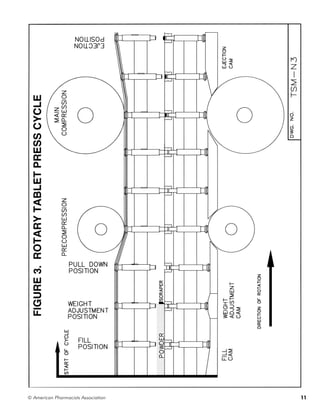
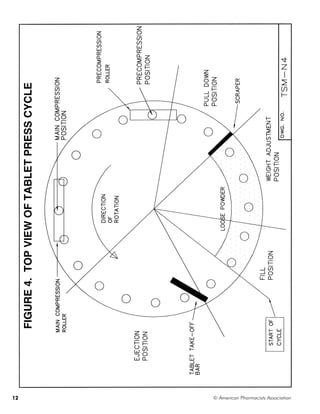
certain steps in the production of a tablet occur. The
following description of these positions is supported
by Figures 3 and 4 (pages 11 and 12). These figures
show the production cycle of a press that rotates
counterclockwise. Table 1 lists the direction of rotation
for presses of major manufacturers.
Fill Position (Die Fill)
At the fill position, the lower punch is pulled down
by the fill cam as the die is passing under the feed
frame. The pulling down of the lower punch creates a
slight vacuum and a void in the die bore. Initially, the
combined effect of the vacuum and the void allows loose
powder to flow into the die bore. As the die continues its
pass under the feed frame, the powder continues to flow
into the bore under the force of gravity. The powder can
be brought over the die by either a gravity feeder as just
described (material flows without a mechanical aid) or
by a mechanical feeder (material is actively pushed over
the die by rotating paddles).
11
© American Pharmacists Association
12
Main Compression Position
The main compression step gives a tablet its final
characteristics. The final tablet thickness is determined
by the distance between the punch rollers, which
determines the distance between the punch tips. Again,
in some presses, the main compression position can be
monitored for automatic weight control.
Tablet Ejection and Take-Off Position
Before reaching the full ejection position, the upper
punch is lifted out of the die bore while the lower punch
is being pushed up by the ejection cam, thereby pushing
the tablet out of the die. At the full ejection position, a
tablet take-off bar located above the die table guides the
tablet off the table.
The successful completion of each stage of tablet
production depends on how well the tablet tools
work with each other and within the tablet press.
Making sure that tooling and presses conform to TSM
specifications can eliminate many production problems.
Understanding specification drawings is critical in
determining if a tool conforms to TSM specifications.
Tooling Specifications
A tool that conforms to specifications has been
machined to meet specific dimensions within a
designated range called a tolerance range. Dimensions
have been specified for all components of the punches
and dies shown in Figure 1 (page 3). The specifications
drawings for standard punches and dies (Figures 8–11
and 14–16; pages 25–28, 31–33) list these dimensions
first in inches, followed by the equivalent millimeters
placed in brackets. For specifications of radii, an “R”
follows the measurement. If the specification is a
reference dimension, the abbreviation “REF.” follows the
measurement. An explanation of reference dimensions
follows the discussions of tolerances and clearances—
two other dimensional specifications that affect the
proper manufacturing and operation of tablet tooling.
Clearances
If tablet tools are to work properly, there must
be enough space between interacting parts to allow
them to function without making forced contact. This
working space is called clearance. For example, punch
tips must be allowed to enter and leave the die bore
without making forced contact with the die bore wall.
The amount of clearance between interacting parts is
affected by the tolerance range of tooling dimensions.
Tolerances
Producing tooling that match specifications exactly
would be accomplished only at great expense to tooling
manufacturers and ultimately to the companies that
purchase the tooling. For that reason, tolerances, or
allowable deviations, have been established for tooling
specifications. These permissible deviations from
specified dimensions, established in cooperation with
leading tooling and press manufacturers, ensure that
tools can be purchased at a reasonable price and that
they will operate properly in the press to produce good-
quality tablets.
Specifically, a tolerance is given as a range with an upper
limit that determines how much a dimension can be
exceeded and a lower limit that determines how much
a dimension can be reduced. For example, a tooling
dimension that has the specification 1 1/32 [26.19
millimeters] inches ±1/32 inch [0.794 millimeter]
can vary from a high value of 1 1/16 inches [26.99
millimeters] to a low value of 1 inch [25.40 millimeters]
and still be considered to meet specifications.
The tolerance range for a particular specification
immediately follows the dimensional value. The range is
given either as a number preceded by a plus and minus
sign (±) or a set of numbers, one of which is preceded
by a plus sign, the other by a minus sign. If a tolerance
range is not listed next to the dimensional value, the
appropriate tolerances can be found in the block located
in the lower right corner of each specification drawing.
For dimensions given as a fraction, the appropriate
tolerance range is the value labeled as “fractional.” The
same rule applies to dimensions given as decimals and
angles.
The tolerance block also lists the acceptable tolerances
for concentricity of die bores, punch tips, and punch
heads. Concentricity refers to the placement of one
tooling element in the center of another larger element
(i.e., the two tooling elements share the same axis).
The tolerance is given as a T.I.R., or total indicator
reading. Indicator readings measure the form or
location of one surface with respect to another. The
surface relationships of concern here are the die bore to
the O.D.; the punch head to the barrel; and the punch
tip to the barrel. The instrument used to measure
concentricity, called a comparator, has a readout
dial that indicates any deviations in concentricity as
measured by a pointer attached to the dial. The T.I.R. is
the difference between the highest and lowest readings
13
© American Pharmacists Association
recorded during one complete rotation of a punch or
die.
Reference Dimension
A reference dimension is derived from, or is the result
of, other toleranced dimensions that are machined
first. For example, the die groove diameter for a 0.945-
inch [24.00 millimeters] die is given as a reference
value of 27/32 inch [21.43 millimeters] ±.015 inch
[.381 millimeter] (see Figure 14, page 31). When
making this die, the die groove width (1/4 inch [6.35
millimeters] ±.015 inch [.381 millimeter]) and the
protection radius (3/16 inch [4.76 millimeters] ±.015
inch [.381 millimeter]) are machined, or “worked to,”
first. When these dimensions have been achieved within
their specified tolerance ranges, the resultant die groove
diameter should fall near its reference dimension.
Comparison of U.S. and International
Tooling Specifications
Presently, there are two major “standards” of tooling
on the international market: the U.S. TSM and the
EuroStandard. Figure 21, (page 50) shows the TSM flat-
head (angled) punch and the EU19, which has a domed
punch head. Besides the illustrated head configurations,
the most significant differences in punch specifications
are those for overall punch length and inner head angle.
Also shown for the two standards of B-type tools are the
correlating differences in die specifications.
As noted on Figures 8–11 (pages 25-28), domed heads
are preferred for new TSM punches. A large number
of flat-head TSM punches currently are being used
for existing products; these punches will continue
to be available. Figures 6 and 7 (pages 23 and 24)
give detailed illustrations of the dimensional and
configurational differences of flat-head and domed
punch heads. Flat-head punches have an outside head
angle, whereas domed heads have a radius. Domed
heads, which were developed by European tooling
manufacturers, increase the dwell time during the tablet
compression stage.
Standardization—Its Purpose
and Advantages
Since the first edition of the Tableting Specification
Manual was published almost a quarter of a century
ago, many U.S. tablet press manufacturers have
voluntarily redesigned their presses to conform with
the specifications. International press manufacturers
also are realizing the economic advantages of making
their presses compatible with TSM tooling. Tablet
manufacturers, especially those with international
production facilities, have compelling reasons for
preferring presses that meet TSM standards.
Advantages of Standardized Tooling
Standardizing tablet tooling offers the following
economic and procedural advantages:
• A uniform quality of tooling can be achieved.
• Tooling suppliers can produce tooling more economi-
cally by standardizing their fabrication equipment and
manufacturing procedures, and by producing batch
quantities of frequently ordered tooling.
• Tooling suppliers can fulfill orders faster by carrying
an inventory of standard sizes of round tooling.
• Procedures for purchasing tooling can be simplified.
• Tablet manufacturers can use tooling interchangeably
in presses purchased from different manufacturers.
• Tablet manufacturers can reduce their tooling inven-
tory.
• Tablet manufacturers can use standard inspection
equipment and validation procedures.
• Multinational pharmaceutical companies can inter-
change tools and discuss tooling technicalities on the
same level.
• Press manufacturers can be sure that their machines
will perform well with standard TSM tooling.
Problems of Nonconformance to
Specifications
Using tools that do not conform to dimensional
specifications can affect tablet quality, press
performance, and tablet production rate. Non-
conformance of tooling to specifications also can (1)
reduce the life of punches, (2) impair the efficient
operation of machinery, and (3) cause severe damage to
tools and presses.
The remaining sections of this manual provide the
necessary information to determine whether a new tool
conforms to TSM specifications. The reader also will find
detailed guidelines on tablet design, standard operating
procedures for procuring and inspecting tooling, and
step-by-step instructions for maintaining tools—an
important function in protecting tooling and presses.
© American Pharmacists Association
14

Tableting specifications manual

  • 1.
    Special Notice toReaders: Unless indicated other- wise, figures and text illustrations in the manual are not drawn to scale. Further, unless indicated other- wise, the dimensions listed in figures and tables are given first in inches, followed by the equivalent mil- limeters in brackets. The first step in learning any industry is mastering its terminology. With this in mind, the Steering Committee has adopted a list of standard, industry-accepted terms for tablet manufacturing. An understanding of these terms will provide a foundation on which persons new to the industry can build a working knowledge of the basic tablet categories, tooling types, press operations, and tooling specification drawings. For those who have industry experience, the information in this section could be a useful reference for ensuring clear communication between production staff, tablet designers, tooling suppliers, and press manufacturers. Tooling Terminology The following definitions of the standard terminology for tooling (punches and dies) are illustrated in Figure 1 (page 3). Abbreviations IPT: Industrial Pharmaceutical Technology (obsolete term replaced with TSM) TSM: Tableting Specification Manual APhA: American Pharmacists Association (publisher of the Tableting Specification Manual) EU: European union FEA: Finite element analysis kN: KiloNewton kp: Kilopond O.D.: Outside diameter I.D.: Inside diameter W.L.: Working length O.L.: Overall length General Terminology Abrasion: The act of wearing of contact surfaces. Alpha/Numeric Characters: A, B, C, etc./ 1, 2, 3, etc. Anneal: A process of heating a steel followed by slow air cooling to change the steel’s microstructure, usually to soften it. Angle: A figure that is formed by two lines diverging from a common point. Arc: A segment of a circle. Axis: A straight line serving to orient a geometric object. Barrel: The area between the neck and stem of a punch. Barrel-to-Stem Chamfer: The beveled area located between the barrel and barrel-to-stem radius. The chamfer allows for the proper insertion of the punches turret oil seals. Barrel-to-Stem Radius: The area at the junction of the barrel and stem, which provides a curved transition from the tip length to the barrel. Bevel: The angle of a line that meets another at any angle other than a right angle. Blend: To form a rounded surface at the point where two surfaces come together to form an angle. Bore: To form a hole through an object. Break (broken): To remove and round off a sharp edge. Burr: A rough or raised edge. Capping: A tablet defect in which air trapped during compression creates a layer of granulation with air between the granules, which in turn weakens the structure and allows a capping fracture (the tablet top and/or bottom curvature breaks off at or above the band). SECTION 1 Guidelines for Using This Manual © American Pharmacists Association 1
  • 2.
    Chamfer: A cutor bevel applied to an edge or corner. Chipping: A defect in the tablet in which a piece has broken off the edge. Clearance: The difference in size between interacting parts, which creates a working space between the parts and allows for their designed free movement. Concave: Having a surface that is curved like the inner surface of a sphere. Convex: Having a surface that is curved like the exterior surface of a sphere. Concentricity: The measurement from a common center point. Corrosion: A chemical reaction of contact surfaces, which causes pitting and discoloration. Delaminate: A defect in a layered tablet in which the layers split apart. Dimension: The numeric measured distance. Ductility: The ease that metal flows during the high pressures of compression. Finite Element Analysis (FEA): A sophisticated computer program that is capable of modeling complex shape configurations and performing accurate stress analyses to determine the maximum force loading that the punch tip can be subjected to and still permit infinite tableting cycles. Flashing: A slight imperfection in a tablet in which the material has been compressed above the land in the clearance between the punch tip and the die bore, causing a raised edge. Formulation: The result of bringing together all the ingredients in a recipe (see definition below) for a pharmaceutical, food, or nutritional product that is manufactured by blending (mixing) followed by compressing or molding the mixture of ingredients. Force Tip Ratings: Maximum force loading that a punch tip can withstand and permit infinite tableting cycles. The rating is derived from a mathematical equation. Granulation: Structure of the granules (particles) of the components of a pharmaceutical product after blending. Hardening: A process of heating steel at high temperatures, then cooling it to transform the steel from a soft (annealed) condition to a hard condition. Identification: The application of letters, numbers, and/or symbols to an object’s surface. Industrial Pharmaceutical Technology (IPT) section: The group who developed the first industry- wide tooling standards—the IPT standards—which were renamed the TSM standards. KiloNewton: The unit of force use in measurement of the loading applied or subjected to in order to compress the tablet to the specified weight and thickness. Kilopond: The unit of force used to measure the fracture point of a tablet. Lubricant: A substance applied to moving parts to decrease the friction generated between them. Milligrams: The unit of measurement used to determine tablet weight. Oil: A common lubricant used on a tablet press during manufacturing. Polishing Compound: Material that is used to assist in buffing the tip faces to remove built up residue. Product: The final blended material that is to be processed into its final dosage form (tablet, capsule, vial, etc.). Recipe: The formula and contents for the ingredients (active and inactive) and their quantities for a tablet. Relief (Undercut): The area of increased mechanical clearance. Tip Relief: The undercut between the punch stem and the tip. Bakelite Relief: A special, designed undercut to prevent material buildup in the die bore. European Dust Cup Relief: A special, designed undercut on the punch barrel that allows attachment of a standardized dust cup with a precut hole that is standardized to the groove seal. Rockwell Hardness: A measurement of the hardness of steel. The Rockwell C scale is customarily used for measuring tool steels. Score: An embedded line in the tablet that allows the tablet to break when force is applied adjacent to the area. This term includes bisect and quarter-scores. Sharp: Term used to describe a corner or edge that is not broken or rounded. Soft Zone: The area on a tip face that receives unequal © American Pharmacists Association 2
  • 3.
  • 4.
    force during thecompression cycle, which may result in a softer surface hardness of the tablet in the corresponding area. Sticking: A tablet defect in which material adheres to the smooth surface of the punch tip face. Surface Finish: The degree of smoothness required for a component, measured in microns. Tableting: The function of compressing a volume of granular material into a hard form. Tableting Specification Manual (TSM) Standards: Standard specifications for tooling developed by the pharmaceutical industry, tablet press manufacturers, and the American Pharmacists Association for the U.S. market. Tablet Specifications: The final parameters for weight, thickness, and hardness that are determined for any given tablet. Tablet Thickness: The combined height of the upper and lower punch tip cups and the band, along with the expansion of the materials after the compression of the tablet, determines the total thickness of a tablet. Tablet Weight: The amount of material specified for the tablet, which is determined by the final volume fill within the die. Tablet Hardness: The amount of force required to fracture a tablet, measured in kiloponds. Taper: A gradual increase in the size of the die bore that extends from the point of compaction to the chamfer of the bore. Tempering: A process of reheating and cooling steel that follows the hardening process. Tempering toughens the steel but reduces its hardness. T.I.R.: The Total Indicator Reading obtained when measuring certain tooling dimensions with an instrument. The T.I.R. is the difference between the highest and lowest readings noted on the indicator dial during one complete rotation. Tolerance: The authorized deviation from a tooling dimension measurement. The deviation allows for practicality of manufacturing tooling. Tooling: The collective term for the upper punch, lower punch, and a die. Tooling Compatibility: The ability to interchange tooling between different types of presses. Tooling Steels: Steels used to manufacture tablet tooling. Toughness: The ability to withstand great strain without breaking. Wear Resistance: The ability to withstand abrasion. Tablet Press Terminology Cam Track: The mechanical track that guides the punches (lifting and lowering them into the dies) during a rotation of the press turret. Compression: The function of pressing material together into a compact form. Precompression: The function during the tableting cycle in which the material is tamped to expel trapped air. Main Compression: The function during the tableting cycle in which the material is fully compressed to its specified form. Die Lock: The die-fixing screw that secures a die in the machine die table. Die Socket/Pocket: A recess (recesses) in the die table into which the die is secured. The recess allows positional location of the die. Die Table: A component of the press’s turret that contains recesses into which dies are placed. Dwell Time: The length of time that compression tools (punches and dies) are subject to maximum compression force from the compression or precompression roller. Ejection: The function of pushing the compressed tablet out of the die bore. Fill: The function of granular material entering the die bore during the tableting process. Punch Guides: The bores in the turret that hold the punches, allowing them to ride through the cam track. The guides control the punch barrel’s surface, thus ensuring the punch’s alignment with the die. Punch Tip Deflection: The total tip movement within the punch guide due to the clearance between the barrel and the punch guide bore at the point where the punch is about to enter the die bore. Punch Entry: The distance within the die at which the tablet is compressed. © American Pharmacists Association 4
  • 5.
    Scrape Off: Thefunction of removing excess granular material from top of the die bore to allow for the exact measure volume fill on the tablet press turret during the tableting process. Station: A punch guide position within the tablet press turret, which consists of an upper punch, a lower punch, and a die. Tableting Cycle: The process of compressing a tablet, which includes the fill, scrape off, compression, ejection, and take-off functions. Tablet Press: The equipment used to mechanically compress granular material into a hard form. Rotary Tablet Press: Equipment that uses a rotating turret to cycle the tooling through the tableting cycle. Single Stroke Press: Equipment that uses a stationary table and eccentric cam to cycle the tooling through the tableting cycle. Take-Off: The function of removing the compressed ejected tablet from the tablet press turret during the tableting process. Turret: The rotating device in a tablet press, composed of the cam track and die table, which holds and aligns the tooling through the tableting cycle. Punch Terminology Barrel: The area between the neck and stem of a punch. Barrel-to-Neck Chamfer: The beveled area located between the barrel and barrel-to-neck radius. The chamfer can reduce wear of punch guides. Barrel-to-Neck Radius: The area at the junction of the barrel and neck, which provides a smooth transition from the barrel to the neck. Barrel-to-Stem Chamfer: The beveled area located between the barrel and barrel-to-stem radius. The chamfer allows for the proper insertion of the upper or lower punch into the oil seal. Barrel-to-Stem Radius: The area at the junction of the barrel and stem, which provides a curved transition from the tip length to the barrel. Bellows: A pleated sealing device that contracts and expands upon application and removal of pressure. A bellows covers the extended portion of the punch barrel, providing a better seal and, thus, better protection from lubrication contaminating the product. Cup: The depression or cavity within the punch tip. Compound Cup: A cup design in which multiple arcs are generated from the cup’s center point across the cup’s diameter, minor or major axis. Standard Cup: A cup design in which a single arc is generated from the cup’s center point across the cup’s diameter, minor axis, or major axis. Flat-Faced Bevel-Edged (F.F.B.E.): A cup configuration consisting of an angle between the cup’s and the tablet’s flat face and a land. A 30° bevel is preferred to maximize the strength of punch edges. When the bevel is first applied, its contact area with the tablet face is a sharp beveled edge. Flat-Faced Radius-Edged (F.F.R.E.): A cup configuration similar to F.F.B.E. consisting of a radius between the cup’s and the tablet’s flat face and a land. The radius from the tablet’s periphery or land should not exceed the comparable 30° bevel used for the F.F.B.E. design to ensure the strength of punch edges. Cup Depth: The distance from the cup’s lowest point (usually the center point of the cup) to its highest point (usually the highest point of the land). This measurement does not include identification embossing and debossing. Cup Radius: A single arc generated from the tablet’s center point across the tablet’s diameter, minor axis, or major axis. Fluted Barrels: Punch barrels with machined grooves that prevent build up of material in the punch guides. Head: The end of the punch that guides and positions it through the tablet press’s cam track. Head Angle, Inside: The area of the head that is in contact with the work portion of the cam track—that is, the pull-down cam for lower punches and the lifting cam for the upper punches. Head Angle/Radius, Outside: The area of the head that is in contact with the tablet press cams and has the initial contact with pressure rollers. Head Flat: The flat area of the punch head. Head O.D.: The outside diameter of the punch head. The O.D. extends the effective area of contact between the cam and both the inside head angle and the outside head angle/radius. Hooked Tip: A defect of the punch tip caused by wear in which the edge curls inward toward the punch face. 5 © American Pharmacists Association
  • 6.
  • 7.
    Interchangeable Upper Punches:Keyed punches that can be inserted into any station in a press turret because of the precise positioning of the key in relation to the punch tip. Key: A device that is inserted into the punch barrel and protrudes into the turret guide, thus preventing the rotational movement of the punch, which allows for precise alignment of the punch tip to the die bore. Woodruff Key: A half-round key that is pressed into a broached machined groove in the punch barrel. Hi-Pro Woodruff Key: A half-round key with side tabs that is pressed into a broached machined groove in the punch barrel. Fixed Parallel Key: A standard flat key that is screwed into the broached machined groove in the punch barrel. Keying Angle: The relationship of the key and the punch tip shape to allow for proper ejection of the tablet. Land: Land, Tablet: A narrow plane perpendicular to the tablet’s band, which creates a junction between the band and the cup radius. Land, Tip: The area between the edge of the punch cup and the O.D. of the punch tip. Land, Blended: The broken edge between the land and the tip face. Length: Working Length (W.L.): The 1ength of the punch from the bottom of the cup to the head flat. The working lengths of the upper and lower punches control tablet thickness and weight. Overall Length (O.L.): The total punch length as measured from the head flat to the end of the tip. Neck: The relieved area between the head and barrel, which provides clearance for the cams. Oil Cups: A circular cup inserted onto the punch stem to collect excess lubrication and prevent it from dripping down the punch onto the tip. Oil Seals: Seals that are placed into the upper and lower punch guides to prevent lubrication from exiting the guides and material from entering them. Punch: A rod-shaped tool, usually made from steel, which is used in producing tablets and other hard products. The collective description for the device includes the head, neck, barrel, stem, and tip. The face of the tip forms the mold surface for producing detail (logo, company name, identification code, etc.) on the tablet face. (See “Tablet Terminology” in Section 3.) Lower Punch: The punch inserted into the turret below the die. Upper Punch: The punch inserted into the turret above the die. Radius: A line segment that joins the center point of a sphere with any point on its surface. Corner Radius: The curvature used to eliminate sharp corners on peripheral surfaces where two lines or curves meet. Barrel-to-Stem Radius: The corner radius located between the punch barrel and the stem. End Radius: The radius located at either end of an oval-shaped tablet. Neck-to-Barrel Radius: The corner radius located between the punch neck and the barrel. Neck-to-Head Radius: The corner radius located between the punch neck and the inside head angle. Seal Groove: A groove on the punch barrel that secures a sealing device, such as an oil/dust cup or bellows, which prevents possible contamination of the product during the precompression and compression phases. Stem: The area of the punch opposite the head, beginning at the tip and extending to the point where the full diameter of the barrel begins. If a chamfer is present, the barrel usually reaches its full diameter just above the chamfer. Tip: The end of the punch that is compatible with the die bore. The tip determines the size; shape, profile, and identification of the tablet Tip Engraving, Debossing: An engraving identification that is depressed into the tip face below its surface (see Section 3). Tip Engraving, Embossing: An engraving identification that protrudes above the surface of a tip face (see Section 3). Tip Face: The area within the cup’s periphery. Tip Land: The area between the edge of the punch cup and the O.D. of the punch tip. Tip Length: The straight portion of the stem that is effective inside the die bore. On lower punches, the tip length allows vertical movement within the 7 © American Pharmacists Association
  • 8.
    © American PharmacistsAssociation 8 die bore for the metering of volume, compression of granulation, and ejection of the tablet Tip Straight: The area of the tip length that extends from the end of the tip to the tip relief. Die Terminology Die: A tool that serves as the mold in which the product is compressed to form the desired peripheral (outer) size and shape of a tablet. Die, Lined (Insert): A die fitted with an insert made from a much harder, more wear-resistant material, such as tungsten carbide or a ceramic. Die, Tapered: A die in which the size of the bore gradually increases from the point of compaction of the granulation to the chamfer of the bore. Die Bore: The cavity within the die where the tablet is compressed. The cavity’s shape and size determine the same for the tablet. Die Chamfer: Entry angle on the die bore edge. Die Groove: The groove around the outer periphery of the center of the die, which allows the die to be fixed in the tablet press. Die Height: The overall height of the die, which is compatible with the height of the die sockets in the tablet press. Die O.D.: The outside diameter of the die, which is compatible with the diameter of the die sockets in the tablet press. Die Protection Radius: The undercut area between the die groove and O.D. Tablet Manufacturing Producing a tablet with a unique design often increases a product’s recognition among consumers. Although tablets can be produced in a variety of shapes and sizes, limitations as to their configuration do exist. The limiting factors are usually related to characteristics of the tooling and the press used to produce the tablets. Some categories of tablets are easier to manufacture and comprise the majority of tablets on store shelves. Tablet Categories Definitions of tablet terminology are based on the geometric properties of the most common tablet shapes; therefore, these definitions are placed in Section 3, “Tablet Design.” For the scope of this section, tablets are broadly categorized as either “rounds” or “shapes.” Figures 22–25 in Section 3 are cross-referenced in the following text to illustrate examples of the tablet categories. Round Tablets Round tablets include primarily convex and flat-faced tablets (see Figure 22, page 52). Frequently, industry people use the term concave to describe both the concave surface of a punch cup and the surface of the tablet produced. Technically, the punch cup is usually a concavity and therefore produces a tablet with a convex surface; however, convex cups that produce concave tablets do exist. Convex tablets can be further categorized according to their cup depth. Figure 23 (page 54) shows convex tablets with shallow, standard, deep, extra-deep, and modified-ball cup depths. Flat-faced tablets can be further categorized as flat-faced plain, flat-faced bevel- edged, and flat-faced radius-edged (see Figure 25, page 56). Shaped Tablets Tablets that have geometric configurations other than those listed for rounds are referred to as shapes (see Figure 25). Figure 24 (page 55) uses three common geometric configurations to illustrate the terminology for shaped tablets. To produce a tablet with a particular configuration, the tablet shape is reproduced in the tooling used to manufacture the tablets. Before the method of reproduction can be discussed, a thorough understanding of tablet tooling is required. Modern Tablet Tooling The function of tablet tooling is to produce tablets with predetermined physical characteristics, such as shape, thickness, weight, and hardness. To achieve this, the die cavity, or bore, is filled with a granulation or powder to a depth that is determined by the position of the lower punch. The lower punch’s position determines the amount of granulation used in each tablet. The upper punch tip is then guided into the bore and force is applied to the punch heads, thereby compressing the material into a tablet. The tablet’s shape is determined by the configuration of the die bore and the punch tips. The tablet’s thickness and hardness are determined by
  • 9.
    9 © American PharmacistsAssociation the amount of compression force applied to the punch heads, whereas its weight is determined by the amount of granulation loaded into the die before compression. The basic design of tablet punches and dies used in rotary tablet presses has changed very little since these presses were first marketed in the late 1800s. Only minor changes, such as refinements to the head and tip radius, tighter tolerances, and higher surface finishes, have been made. In the U.S. tablet industry, three types of punches and three types of dies are used predominantly in production presses to produce large quantities of tablets for market distribution. Punches Punches are classified according to their overall length, barrel diameter, and the O.D. of the punch head. These dimensions, as well as the other specifications for tablet tooling, are nominal: that is, each dimension has a specified measurement, but its actual measurement after the tool is produced may vary from its specification. The allowable variance from a nominal dimension, called its tolerance range, is discussed later in this section under “Tooling Specifications.” The punches most commonly used in production presses are the B-type and D-type punches (see Figure 2, page 6). B2-type punches are used predominantly in a few older models of presses that are no longer being manufactured. During the research stage of a new tablet design, F-type punches and dies (not pictured) and a single-station laboratory press are used to determine the approximate amount of compression force and granulation needed to produce a tablet with the desired physical characteristics. B-Type Punches have a reference overall length of 5.250 inches [133.35 millimeters] and a head O.D. of 1 inch [25.40 millimeters]. These dimensions are the same for the upper and lower punches. Although the barrel diameter of a B-type punch is often said to be 3/4 inch [19.05 millimeters], the specified barrel diameter for the upper—and now the lower—punch is 0.7480 inch [19.00 millimeters]. B2-Type Punches usually have a barrel diameter of 3/4 inch [19.05 millimeters]. Table 8 (pages 44–49) lists barrel diameters of B2-type punches for specific press models). This punch has a head O.D. of 1 inch [25.40 millimeters]; however, the overall lengths of the upper and lower punches differ. The upper punch is 5.250 inches [133.35 millimeters] long, whereas the lower punch is 3.562 inches [90.475 millimeters] long. D-Type Punches have the same reference overall length as B-type punches (5.250 inches [133.35 millimeters]), but the head O.D. of D-type punches is 1.250 inches [31.75 millimeters]. Again, D-type punches are often said to have a barrel diameter of 1 inch [25.40 millimeters]; however, the specified barrel diameter for the upper—and now the lower—punch is 0.9980 inch [25.35 millimeters]. Dies Dies are classified according to their outside diameters (see Figure 2, page 6). The 0.945 Die, as the name indicates, has an O.D. of 0.945 inch [24.00 millimeters]. This size die can be used with B- and B2-type punches. The die is commonly referred to as a “BB die.” The 1.1875 Die, sometimes referred to as the “1 3/16 die,” has an O.D. of 1.1875 inches [30.16 millimeters] and also can be used with B- and B2-type punches. This die is commonly referred to as a “B die.” The “D” Die, which has an O.D. of 1.500 inches [38.10 millimeters], is used with D-type punches. Comparison of Shaped and Round Tooling Not surprisingly, punches and dies used to manufacture round tablets are often called “round tooling,” and punches and dies used to manufacture shaped tablets are called “shaped tooling.” After the geometric configuration of a tablet has been determined by the designer, the desired configuration is reproduced in the punch tips and die bores. The upper punch for a shaped tablet has a device called a key that is inserted into a slot in the barrel and projects above the barrel’s surface (see Figure 1, page 3). The key prevents the punch from rotating as it is lifted vertically from the die bore so that the punch can re-enter the die bore at the proper alignment. Because round configurations are usually unaffected by rotation of the upper punches, round punches seldom require a key. However, if a round lower punch is embossed, a key is sometimes used to prevent punch rotation and possible distortion of the embossing during tablet ejection. Regardless of the tablet shape and the type of tooling used, the basic press operations are the same.
  • 10.
    Typically, the positionof the fill cam remains fixed for the entire production run and can only be readjusted or changed manually. Keeping the fill cam at a fixed position allows each die to be filled with the same amount of powder. After the die bore has been filled, the lower punch is transferred to the weight-adjustment cam. Weight-Adjustment Position The weight-adjustment cam next raises the lower punch, which pushes excess powder out of the filled die. After the die leaves the area of the feed frame, a spring- loaded, knife-edged blade scrapes the surface of the die and removes any excess powder. The highest vertical position reached by the weight- adjustment cam regulates the amount of powder expelled and the amount of powder remaining in the die, thus determining the final weight of the tablet. Increasing the highest vertical position of this cam will expel more powder, resulting in a lighter tablet; likewise, decreasing the cam’s highest vertical position will expel less powder, resulting in a heavier tablet. On manual presses, a manual handwheel controls the position of the weight adjustment cam; on automated presses, a computer-controlled feedback loop sets the cam’s position. Pull-Down Position Newer press models have a pull-down position, which allows the lower punch to be pulled down slightly so that the top of the powder column in the die bore is below the surface of the die table. Simultaneously, the upper punch is lowered by the lowering segment of the upper cam track. The lowering of the powder column prevents any powder from being blown out of the die as the upper punch enters the die bore, thus preventing variations in tablet weight. When the upper punch enters the die, precompression begins. Precompression Position During precompression, loose powder is consolidated in the die by the removal of any air trapped in the powder column and by the physical orientation of the powder particles. Typically, precompression forces tend to be less than the main compression forces. In presses where the fill cam can be automatically adjusted, the precompression position can be monitored for automatic control of tablet weight. The “tablet” formed at this step is now ready for main compression. © American Pharmacists Association 10 TABLE 1. ROTATION DIRECTION OF TABLET PRESSES PRESS TYPE DIRECTION OF ROTATION CADMACH CW COURTOY CCW HATA CCW FETTE CCW KIKUSUI CCW KILIAN CCW KORSCH CCW MANESTY CW RIVA CW STOKES CCW (Gem Series); CW (all other models) VECTOR CCW NOTE: CW = CLOCKWISE; CCW = COUNTERWISE. Rotary Tablet Presses Major advancements in the tablet industry have occurred with new models of rotary tablet presses: their speed has increased; a precompression stage has been added to the production cycle; and, in some presses, computer technology automatically adjusts the powder fill mechanism for lower punches to maintain the proper tablet weight. The engineering of these presses was designed around the basic configuration of TSM tooling to ensure that tablet manufacturers could continue to use their existing inventory of tooling. All presses have designated positions at which certain steps in the production of a tablet occur. The following description of these positions is supported by Figures 3 and 4 (pages 11 and 12). These figures show the production cycle of a press that rotates counterclockwise. Table 1 lists the direction of rotation for presses of major manufacturers. Fill Position (Die Fill) At the fill position, the lower punch is pulled down by the fill cam as the die is passing under the feed frame. The pulling down of the lower punch creates a slight vacuum and a void in the die bore. Initially, the combined effect of the vacuum and the void allows loose powder to flow into the die bore. As the die continues its pass under the feed frame, the powder continues to flow into the bore under the force of gravity. The powder can be brought over the die by either a gravity feeder as just described (material flows without a mechanical aid) or by a mechanical feeder (material is actively pushed over the die by rotating paddles).
  • 11.
  • 12.
  • 13.
    Main Compression Position Themain compression step gives a tablet its final characteristics. The final tablet thickness is determined by the distance between the punch rollers, which determines the distance between the punch tips. Again, in some presses, the main compression position can be monitored for automatic weight control. Tablet Ejection and Take-Off Position Before reaching the full ejection position, the upper punch is lifted out of the die bore while the lower punch is being pushed up by the ejection cam, thereby pushing the tablet out of the die. At the full ejection position, a tablet take-off bar located above the die table guides the tablet off the table. The successful completion of each stage of tablet production depends on how well the tablet tools work with each other and within the tablet press. Making sure that tooling and presses conform to TSM specifications can eliminate many production problems. Understanding specification drawings is critical in determining if a tool conforms to TSM specifications. Tooling Specifications A tool that conforms to specifications has been machined to meet specific dimensions within a designated range called a tolerance range. Dimensions have been specified for all components of the punches and dies shown in Figure 1 (page 3). The specifications drawings for standard punches and dies (Figures 8–11 and 14–16; pages 25–28, 31–33) list these dimensions first in inches, followed by the equivalent millimeters placed in brackets. For specifications of radii, an “R” follows the measurement. If the specification is a reference dimension, the abbreviation “REF.” follows the measurement. An explanation of reference dimensions follows the discussions of tolerances and clearances— two other dimensional specifications that affect the proper manufacturing and operation of tablet tooling. Clearances If tablet tools are to work properly, there must be enough space between interacting parts to allow them to function without making forced contact. This working space is called clearance. For example, punch tips must be allowed to enter and leave the die bore without making forced contact with the die bore wall. The amount of clearance between interacting parts is affected by the tolerance range of tooling dimensions. Tolerances Producing tooling that match specifications exactly would be accomplished only at great expense to tooling manufacturers and ultimately to the companies that purchase the tooling. For that reason, tolerances, or allowable deviations, have been established for tooling specifications. These permissible deviations from specified dimensions, established in cooperation with leading tooling and press manufacturers, ensure that tools can be purchased at a reasonable price and that they will operate properly in the press to produce good- quality tablets. Specifically, a tolerance is given as a range with an upper limit that determines how much a dimension can be exceeded and a lower limit that determines how much a dimension can be reduced. For example, a tooling dimension that has the specification 1 1/32 [26.19 millimeters] inches ±1/32 inch [0.794 millimeter] can vary from a high value of 1 1/16 inches [26.99 millimeters] to a low value of 1 inch [25.40 millimeters] and still be considered to meet specifications. The tolerance range for a particular specification immediately follows the dimensional value. The range is given either as a number preceded by a plus and minus sign (±) or a set of numbers, one of which is preceded by a plus sign, the other by a minus sign. If a tolerance range is not listed next to the dimensional value, the appropriate tolerances can be found in the block located in the lower right corner of each specification drawing. For dimensions given as a fraction, the appropriate tolerance range is the value labeled as “fractional.” The same rule applies to dimensions given as decimals and angles. The tolerance block also lists the acceptable tolerances for concentricity of die bores, punch tips, and punch heads. Concentricity refers to the placement of one tooling element in the center of another larger element (i.e., the two tooling elements share the same axis). The tolerance is given as a T.I.R., or total indicator reading. Indicator readings measure the form or location of one surface with respect to another. The surface relationships of concern here are the die bore to the O.D.; the punch head to the barrel; and the punch tip to the barrel. The instrument used to measure concentricity, called a comparator, has a readout dial that indicates any deviations in concentricity as measured by a pointer attached to the dial. The T.I.R. is the difference between the highest and lowest readings 13 © American Pharmacists Association
  • 14.
    recorded during onecomplete rotation of a punch or die. Reference Dimension A reference dimension is derived from, or is the result of, other toleranced dimensions that are machined first. For example, the die groove diameter for a 0.945- inch [24.00 millimeters] die is given as a reference value of 27/32 inch [21.43 millimeters] ±.015 inch [.381 millimeter] (see Figure 14, page 31). When making this die, the die groove width (1/4 inch [6.35 millimeters] ±.015 inch [.381 millimeter]) and the protection radius (3/16 inch [4.76 millimeters] ±.015 inch [.381 millimeter]) are machined, or “worked to,” first. When these dimensions have been achieved within their specified tolerance ranges, the resultant die groove diameter should fall near its reference dimension. Comparison of U.S. and International Tooling Specifications Presently, there are two major “standards” of tooling on the international market: the U.S. TSM and the EuroStandard. Figure 21, (page 50) shows the TSM flat- head (angled) punch and the EU19, which has a domed punch head. Besides the illustrated head configurations, the most significant differences in punch specifications are those for overall punch length and inner head angle. Also shown for the two standards of B-type tools are the correlating differences in die specifications. As noted on Figures 8–11 (pages 25-28), domed heads are preferred for new TSM punches. A large number of flat-head TSM punches currently are being used for existing products; these punches will continue to be available. Figures 6 and 7 (pages 23 and 24) give detailed illustrations of the dimensional and configurational differences of flat-head and domed punch heads. Flat-head punches have an outside head angle, whereas domed heads have a radius. Domed heads, which were developed by European tooling manufacturers, increase the dwell time during the tablet compression stage. Standardization—Its Purpose and Advantages Since the first edition of the Tableting Specification Manual was published almost a quarter of a century ago, many U.S. tablet press manufacturers have voluntarily redesigned their presses to conform with the specifications. International press manufacturers also are realizing the economic advantages of making their presses compatible with TSM tooling. Tablet manufacturers, especially those with international production facilities, have compelling reasons for preferring presses that meet TSM standards. Advantages of Standardized Tooling Standardizing tablet tooling offers the following economic and procedural advantages: • A uniform quality of tooling can be achieved. • Tooling suppliers can produce tooling more economi- cally by standardizing their fabrication equipment and manufacturing procedures, and by producing batch quantities of frequently ordered tooling. • Tooling suppliers can fulfill orders faster by carrying an inventory of standard sizes of round tooling. • Procedures for purchasing tooling can be simplified. • Tablet manufacturers can use tooling interchangeably in presses purchased from different manufacturers. • Tablet manufacturers can reduce their tooling inven- tory. • Tablet manufacturers can use standard inspection equipment and validation procedures. • Multinational pharmaceutical companies can inter- change tools and discuss tooling technicalities on the same level. • Press manufacturers can be sure that their machines will perform well with standard TSM tooling. Problems of Nonconformance to Specifications Using tools that do not conform to dimensional specifications can affect tablet quality, press performance, and tablet production rate. Non- conformance of tooling to specifications also can (1) reduce the life of punches, (2) impair the efficient operation of machinery, and (3) cause severe damage to tools and presses. The remaining sections of this manual provide the necessary information to determine whether a new tool conforms to TSM specifications. The reader also will find detailed guidelines on tablet design, standard operating procedures for procuring and inspecting tooling, and step-by-step instructions for maintaining tools—an important function in protecting tooling and presses. © American Pharmacists Association 14