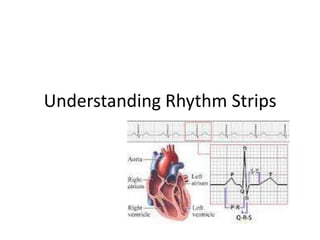
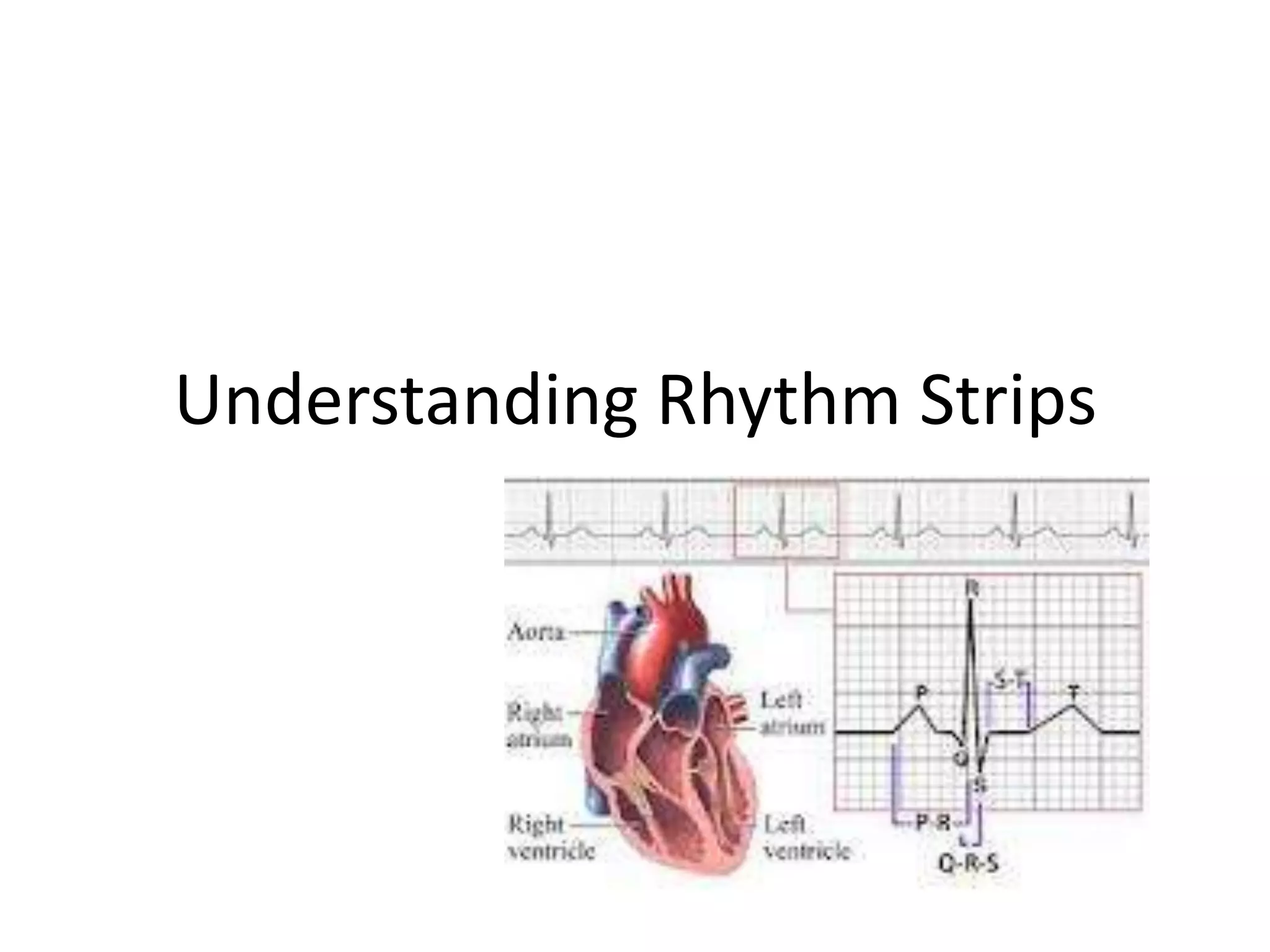
Understanding Rhythm Strips
Waveforms and Components of The
            ECG Pattern
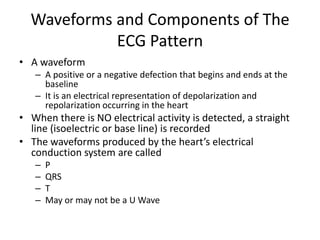
• A waveform
   – A positive or a negative defection that begins and ends at the
     baseline
   – It is an electrical representation of depolarization and
     repolarization occurring in the heart
• When there is NO electrical activity is detected, a straight
  line (isoelectric or base line) is recorded
• The waveforms produced by the heart’s electrical
  conduction system are called
   –   P
   –   QRS
   –   T
   –   May or may not be a U Wave
ECG Waveforms
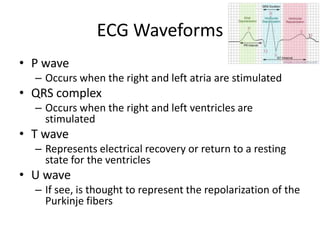
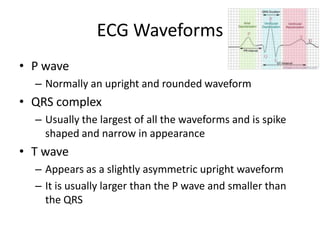
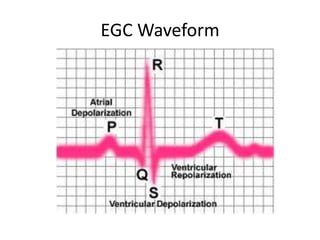
• P wave
  – Occurs when the right and left atria are stimulated
• QRS complex
  – Occurs when the right and left ventricles are
    stimulated
• T wave
  – Represents electrical recovery or return to a resting
    state for the ventricles
• U wave
  – If see, is thought to represent the repolarization of the
    Purkinje fibers
ECG Waveforms
• P wave
  – Normally an upright and rounded waveform
• QRS complex
  – Usually the largest of all the waveforms and is spike
    shaped and narrow in appearance
• T wave
  – Appears as a slightly asymmetric upright waveform
  – It is usually larger than the P wave and smaller than
    the QRS
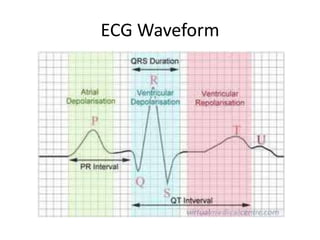
ECG Waveform
EGC Waveform
ECG Segments
• Segment
  – Length of baseline between two waves
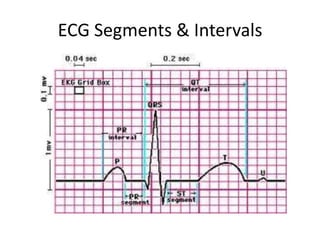
    • PR segment
       – Represents the delay of the impulse in the AV node
    • ST segment
       – Represents the early part of repolarization of the right and left
         ventricles
ECG Intervals
• Interval is defined as the combination of a
  wave or several waves and a segment
• By measuring time intervals on the ECG, it can
  be determined how long the electrical wave
  takes to pass through the heart
ECG Intervals
• PR interval
  – P wave & PR segment
  – Corresponds to the spread of the electrical
    impulse through the atria and the delay of the
    impulse in the AV node before it travels to the
    ventricular muscle tissue
• QT interval
  – QRS complex & ST segment & T wave
  – Represents electrical stimulation and recovery of
    the ventricles
ECG Segments & Intervals
ECG Paper and Measurements
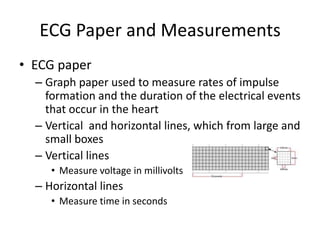
• ECG paper
  – Graph paper used to measure rates of impulse
    formation and the duration of the electrical events
    that occur in the heart
  – Vertical and horizontal lines, which from large and
    small boxes
  – Vertical lines
     • Measure voltage in millivolts
  – Horizontal lines
     • Measure time in seconds
ECG Paper and Measurements
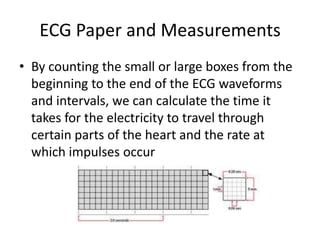
• By counting the small or large boxes from the
  beginning to the end of the ECG waveforms
  and intervals, we can calculate the time it
  takes for the electricity to travel through
  certain parts of the heart and the rate at
  which impulses occur
ECG Paper and Measurements
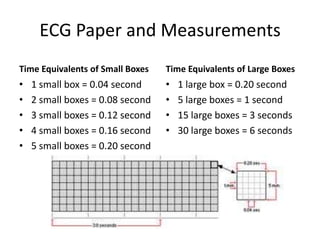
Time Equivalents of Small Boxes   Time Equivalents of Large Boxes
•   1 small box = 0.04 second     •   1 large box = 0.20 second
•   2 small boxes = 0.08 second   •   5 large boxes = 1 second
•   3 small boxes = 0.12 second   •   15 large boxes = 3 seconds
•   4 small boxes = 0.16 second   •   30 large boxes = 6 seconds
•   5 small boxes = 0.20 second
Normal ECG Pattern and
           Measurements
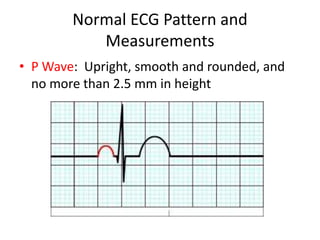
• P Wave: Upright, smooth and rounded, and
  no more than 2.5 mm in height
Normal ECG Pattern and
           Measurements
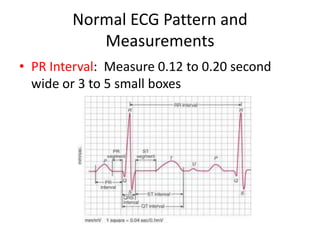
• PR Interval: Measure 0.12 to 0.20 second
  wide or 3 to 5 small boxes
Normal ECG Pattern and
           Measurements
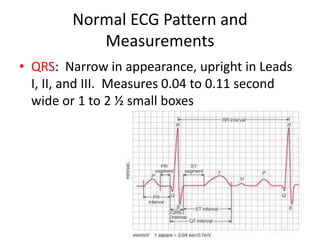
• QRS: Narrow in appearance, upright in Leads
  I, II, and III. Measures 0.04 to 0.11 second
  wide or 1 to 2 ½ small boxes
Normal ECG Pattern and
           Measurements
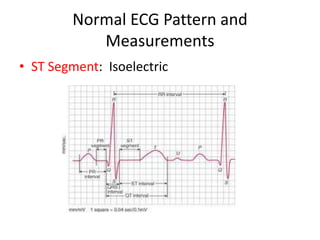
• ST Segment: Isoelectric
Normal ECG Pattern and
            Measurements
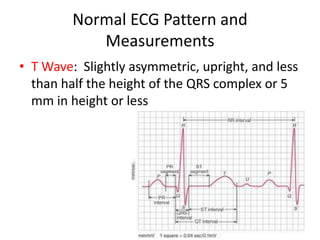
• T Wave: Slightly asymmetric, upright, and less
  than half the height of the QRS complex or 5
  mm in height or less
Normal ECG Pattern and
             Measurements
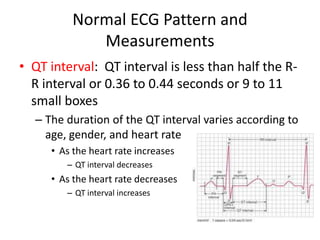
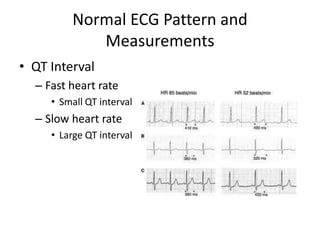
• QT interval: QT interval is less than half the R-
  R interval or 0.36 to 0.44 seconds or 9 to 11
  small boxes
  – The duration of the QT interval varies according to
    age, gender, and heart rate
     • As the heart rate increases
        – QT interval decreases
     • As the heart rate decreases
        – QT interval increases
Normal ECG Pattern and
            Measurements
• QT Interval
  – Fast heart rate
     • Small QT interval
  – Slow heart rate
     • Large QT interval
Normal ECG Pattern and
            Measurements
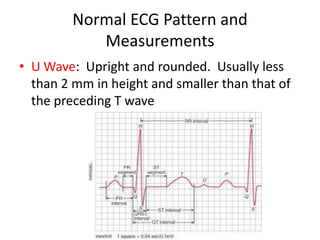
• U Wave: Upright and rounded. Usually less
  than 2 mm in height and smaller than that of
  the preceding T wave
Abnormal Characteristics of the ECG
             Pattern
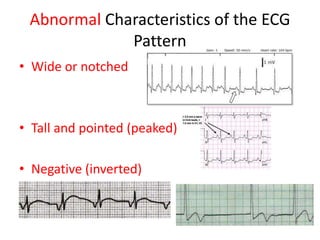
• Abnormal P wave
  – Wide or notched-Left atrial enlargement or
    ectopic impulse from atria
  – Tall and pointed (peaked) – Right atrial
    enlargement or ectopic impulse from atria
  – Negative (Inverted) - ectopic pacemaker in the AV
    junction
Abnormal Characteristics of the ECG
             Pattern
• Wide or notched


• Tall and pointed (peaked)

• Negative (inverted)
Abnormal Characteristics of the ECG
             Pattern
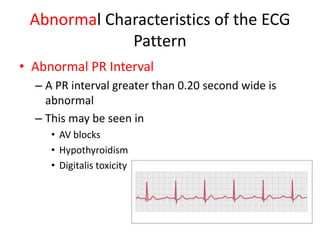
• Abnormal PR Interval
  – A PR interval greater than 0.20 second wide is
    abnormal
  – This may be seen in
     • AV blocks
     • Hypothyroidism
     • Digitalis toxicity
Abnormal Characteristics of the ECG
             Pattern
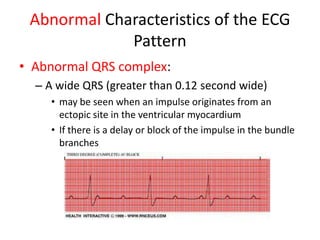
• Abnormal QRS complex:
  – A wide QRS (greater than 0.12 second wide)
     • may be seen when an impulse originates from an
       ectopic site in the ventricular myocardium
     • If there is a delay or block of the impulse in the bundle
       branches
Abnormal Characteristics of the ECG
             Pattern
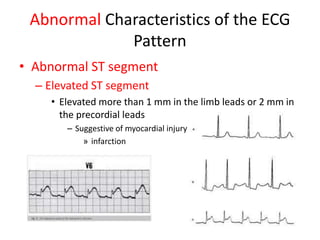
• Abnormal ST segment
  – Elevated ST segment
    • Elevated more than 1 mm in the limb leads or 2 mm in
      the precordial leads
       – Suggestive of myocardial injury
           » infarction
Abnormal Characteristics of the ECG
             Pattern
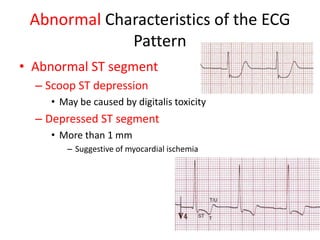
• Abnormal ST segment
  – Scoop ST depression
    • May be caused by digitalis toxicity
  – Depressed ST segment
    • More than 1 mm
       – Suggestive of myocardial ischemia
Abnormal Characteristics of the ECG
             Pattern
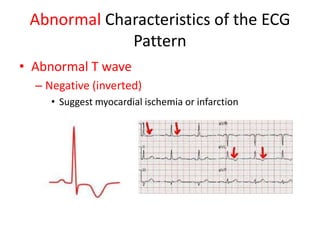
• Abnormal T wave
  – Negative (inverted)
     • Suggest myocardial ischemia or infarction
Abnormal Characteristics of the ECG
             Pattern
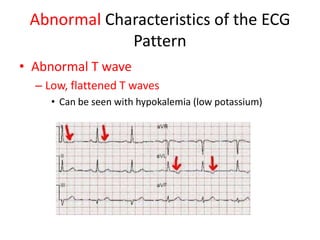
• Abnormal T wave
  – Low, flattened T waves
     • Can be seen with hypokalemia (low potassium)
Abnormal Characteristics of the ECG
             Pattern
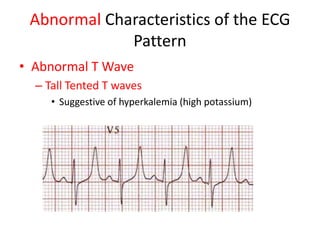
• Abnormal T Wave
  – Tall Tented T waves
     • Suggestive of hyperkalemia (high potassium)
Abnormal Characteristics of the ECG
             Pattern
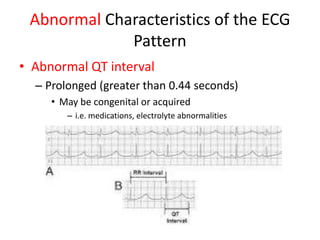
• Abnormal QT interval
  – Prolonged (greater than 0.44 seconds)
     • May be congenital or acquired
        – i.e. medications, electrolyte abnormalities
Abnormal Characteristics of the ECG
             Pattern
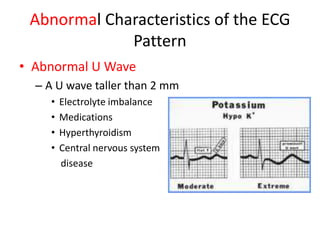
• Abnormal U Wave
  – A U wave taller than 2 mm
     •   Electrolyte imbalance
     •   Medications
     •   Hyperthyroidism
     •   Central nervous system
         disease
Steps for Analyzing a Rhythm Strip
• A quick method for analyzing a rhythm strip
  – There are several steps in analyzing a rhythm strip
  – When analyzing a rhythm strip, don’t forget to
    check the patient
Steps for Analyzing a Rhythm Strip
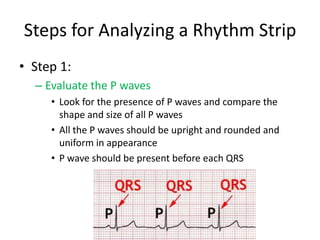
• Step 1:
  – Evaluate the P waves
     • Look for the presence of P waves and compare the
       shape and size of all P waves
     • All the P waves should be upright and rounded and
       uniform in appearance
     • P wave should be present before each QRS
Steps for Analyzing a Rhythm Strip
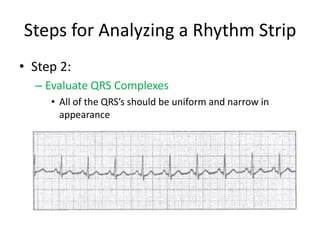
• Step 2:
  – Evaluate QRS Complexes
     • All of the QRS’s should be uniform and narrow in
       appearance
Steps for Analyzing a Rhythm Strip
• Step 2: continued
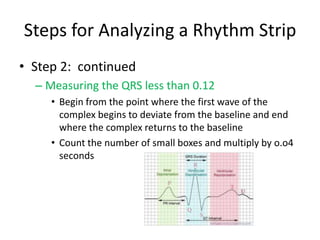
  – Measuring the QRS less than 0.12
     • Begin from the point where the first wave of the
       complex begins to deviate from the baseline and end
       where the complex returns to the baseline
     • Count the number of small boxes and multiply by o.o4
       seconds
Steps for Analyzing a Rhythm Strip
• Step 3:
  – Calculate the Atrial and Ventricular Heart Rates
     • There are a couple of methods to discuss
     • One will only be used by an MST
        – Six-Second Method
Steps for Analyzing a Rhythm Strip
• Step 3: continued
  – A normal heart rate in the resting adult is between
    60 and 100
  – A rate below 60
     • bradycardia
  – A rate above 100
     • tachycardia
  – The atrial rate should be the same as the
    ventricular rate
Steps for Analyzing a Rhythm Strip
• Step 3: continued
  – Six-Second Method (can be used for regular or
    irregular rhythm patterns)
     • Print off six seconds of ECG paper (use markers at the
       top or bottom of the paper
        – Atrial Rate
            » Count the number of P waves within a period of six
               seconds and multiply that number by 10
        – Ventricular Rate
            » Count the number of QRS complexes within six seconds
               and multiply by 10
Steps for Analyzing a Rhythm Strip
• Step 3: continued
  – Small Box Method (best used if the rhythm is
    regular, but may be used if the rhythm is irregular
    and a rate range is given)
     • Atrial rate
         – Count the number of small boxes between two P waves, and
           find the corresponding rate on the small box calculation chart
     • Ventricular rate
         – Count the number of small boxes between two QRS
           complexes and find the corresponding rate on the small box
           calculation chart
Steps for Analyzing a Rhythm Strip
• Step 4:
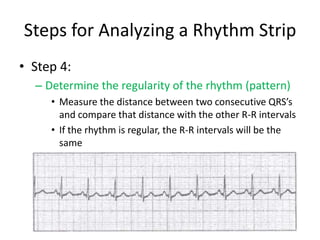
  – Determine the regularity of the rhythm (pattern)
     • Measure the distance between two consecutive QRS’s
       and compare that distance with the other R-R intervals
     • If the rhythm is regular, the R-R intervals will be the
       same
Steps for Analyzing a Rhythm Strip
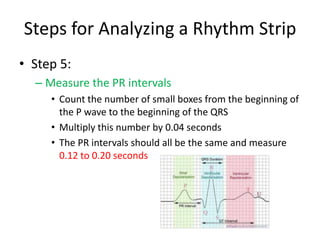
• Step 5:
  – Measure the PR intervals
     • Count the number of small boxes from the beginning of
       the P wave to the beginning of the QRS
     • Multiply this number by 0.04 seconds
     • The PR intervals should all be the same and measure
       0.12 to 0.20 seconds
Steps for Analyzing a Rhythm Strip
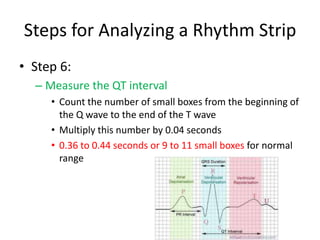
• Step 6:
  – Measure the QT interval
     • Count the number of small boxes from the beginning of
       the Q wave to the end of the T wave
     • Multiply this number by 0.04 seconds
     • 0.36 to 0.44 seconds or 9 to 11 small boxes for normal
       range
Steps for Analyzing a Rhythm Strip
• Step 7:
  – Compare your findings to what is normal for the
    patient

Understanding rhythm strips

  • 1.
  • 2.
    Waveforms and Componentsof The ECG Pattern • A waveform – A positive or a negative defection that begins and ends at the baseline – It is an electrical representation of depolarization and repolarization occurring in the heart • When there is NO electrical activity is detected, a straight line (isoelectric or base line) is recorded • The waveforms produced by the heart’s electrical conduction system are called – P – QRS – T – May or may not be a U Wave
  • 3.
    ECG Waveforms • Pwave – Occurs when the right and left atria are stimulated • QRS complex – Occurs when the right and left ventricles are stimulated • T wave – Represents electrical recovery or return to a resting state for the ventricles • U wave – If see, is thought to represent the repolarization of the Purkinje fibers
  • 4.
    ECG Waveforms • Pwave – Normally an upright and rounded waveform • QRS complex – Usually the largest of all the waveforms and is spike shaped and narrow in appearance • T wave – Appears as a slightly asymmetric upright waveform – It is usually larger than the P wave and smaller than the QRS
  • 5.
  • 6.
  • 7.
    ECG Segments • Segment – Length of baseline between two waves • PR segment – Represents the delay of the impulse in the AV node • ST segment – Represents the early part of repolarization of the right and left ventricles
  • 8.
    ECG Intervals • Intervalis defined as the combination of a wave or several waves and a segment • By measuring time intervals on the ECG, it can be determined how long the electrical wave takes to pass through the heart
  • 9.
    ECG Intervals • PRinterval – P wave & PR segment – Corresponds to the spread of the electrical impulse through the atria and the delay of the impulse in the AV node before it travels to the ventricular muscle tissue • QT interval – QRS complex & ST segment & T wave – Represents electrical stimulation and recovery of the ventricles
  • 10.
    ECG Segments &Intervals
  • 11.
    ECG Paper andMeasurements • ECG paper – Graph paper used to measure rates of impulse formation and the duration of the electrical events that occur in the heart – Vertical and horizontal lines, which from large and small boxes – Vertical lines • Measure voltage in millivolts – Horizontal lines • Measure time in seconds
  • 12.
    ECG Paper andMeasurements • By counting the small or large boxes from the beginning to the end of the ECG waveforms and intervals, we can calculate the time it takes for the electricity to travel through certain parts of the heart and the rate at which impulses occur
  • 13.
    ECG Paper andMeasurements Time Equivalents of Small Boxes Time Equivalents of Large Boxes • 1 small box = 0.04 second • 1 large box = 0.20 second • 2 small boxes = 0.08 second • 5 large boxes = 1 second • 3 small boxes = 0.12 second • 15 large boxes = 3 seconds • 4 small boxes = 0.16 second • 30 large boxes = 6 seconds • 5 small boxes = 0.20 second
  • 14.
    Normal ECG Patternand Measurements • P Wave: Upright, smooth and rounded, and no more than 2.5 mm in height
  • 15.
    Normal ECG Patternand Measurements • PR Interval: Measure 0.12 to 0.20 second wide or 3 to 5 small boxes
  • 16.
    Normal ECG Patternand Measurements • QRS: Narrow in appearance, upright in Leads I, II, and III. Measures 0.04 to 0.11 second wide or 1 to 2 ½ small boxes
  • 17.
    Normal ECG Patternand Measurements • ST Segment: Isoelectric
  • 18.
    Normal ECG Patternand Measurements • T Wave: Slightly asymmetric, upright, and less than half the height of the QRS complex or 5 mm in height or less
  • 19.
    Normal ECG Patternand Measurements • QT interval: QT interval is less than half the R- R interval or 0.36 to 0.44 seconds or 9 to 11 small boxes – The duration of the QT interval varies according to age, gender, and heart rate • As the heart rate increases – QT interval decreases • As the heart rate decreases – QT interval increases
  • 20.
    Normal ECG Patternand Measurements • QT Interval – Fast heart rate • Small QT interval – Slow heart rate • Large QT interval
  • 21.
    Normal ECG Patternand Measurements • U Wave: Upright and rounded. Usually less than 2 mm in height and smaller than that of the preceding T wave
  • 22.
    Abnormal Characteristics ofthe ECG Pattern • Abnormal P wave – Wide or notched-Left atrial enlargement or ectopic impulse from atria – Tall and pointed (peaked) – Right atrial enlargement or ectopic impulse from atria – Negative (Inverted) - ectopic pacemaker in the AV junction
  • 23.
    Abnormal Characteristics ofthe ECG Pattern • Wide or notched • Tall and pointed (peaked) • Negative (inverted)
  • 24.
    Abnormal Characteristics ofthe ECG Pattern • Abnormal PR Interval – A PR interval greater than 0.20 second wide is abnormal – This may be seen in • AV blocks • Hypothyroidism • Digitalis toxicity
  • 25.
    Abnormal Characteristics ofthe ECG Pattern • Abnormal QRS complex: – A wide QRS (greater than 0.12 second wide) • may be seen when an impulse originates from an ectopic site in the ventricular myocardium • If there is a delay or block of the impulse in the bundle branches
  • 26.
    Abnormal Characteristics ofthe ECG Pattern • Abnormal ST segment – Elevated ST segment • Elevated more than 1 mm in the limb leads or 2 mm in the precordial leads – Suggestive of myocardial injury » infarction
  • 27.
    Abnormal Characteristics ofthe ECG Pattern • Abnormal ST segment – Scoop ST depression • May be caused by digitalis toxicity – Depressed ST segment • More than 1 mm – Suggestive of myocardial ischemia
  • 28.
    Abnormal Characteristics ofthe ECG Pattern • Abnormal T wave – Negative (inverted) • Suggest myocardial ischemia or infarction
  • 29.
    Abnormal Characteristics ofthe ECG Pattern • Abnormal T wave – Low, flattened T waves • Can be seen with hypokalemia (low potassium)
  • 30.
    Abnormal Characteristics ofthe ECG Pattern • Abnormal T Wave – Tall Tented T waves • Suggestive of hyperkalemia (high potassium)
  • 31.
    Abnormal Characteristics ofthe ECG Pattern • Abnormal QT interval – Prolonged (greater than 0.44 seconds) • May be congenital or acquired – i.e. medications, electrolyte abnormalities
  • 32.
    Abnormal Characteristics ofthe ECG Pattern • Abnormal U Wave – A U wave taller than 2 mm • Electrolyte imbalance • Medications • Hyperthyroidism • Central nervous system disease
  • 33.
    Steps for Analyzinga Rhythm Strip • A quick method for analyzing a rhythm strip – There are several steps in analyzing a rhythm strip – When analyzing a rhythm strip, don’t forget to check the patient
  • 34.
    Steps for Analyzinga Rhythm Strip • Step 1: – Evaluate the P waves • Look for the presence of P waves and compare the shape and size of all P waves • All the P waves should be upright and rounded and uniform in appearance • P wave should be present before each QRS
  • 35.
    Steps for Analyzinga Rhythm Strip • Step 2: – Evaluate QRS Complexes • All of the QRS’s should be uniform and narrow in appearance
  • 36.
    Steps for Analyzinga Rhythm Strip • Step 2: continued – Measuring the QRS less than 0.12 • Begin from the point where the first wave of the complex begins to deviate from the baseline and end where the complex returns to the baseline • Count the number of small boxes and multiply by o.o4 seconds
  • 37.
    Steps for Analyzinga Rhythm Strip • Step 3: – Calculate the Atrial and Ventricular Heart Rates • There are a couple of methods to discuss • One will only be used by an MST – Six-Second Method
  • 38.
    Steps for Analyzinga Rhythm Strip • Step 3: continued – A normal heart rate in the resting adult is between 60 and 100 – A rate below 60 • bradycardia – A rate above 100 • tachycardia – The atrial rate should be the same as the ventricular rate
  • 39.
    Steps for Analyzinga Rhythm Strip • Step 3: continued – Six-Second Method (can be used for regular or irregular rhythm patterns) • Print off six seconds of ECG paper (use markers at the top or bottom of the paper – Atrial Rate » Count the number of P waves within a period of six seconds and multiply that number by 10 – Ventricular Rate » Count the number of QRS complexes within six seconds and multiply by 10
  • 40.
    Steps for Analyzinga Rhythm Strip • Step 3: continued – Small Box Method (best used if the rhythm is regular, but may be used if the rhythm is irregular and a rate range is given) • Atrial rate – Count the number of small boxes between two P waves, and find the corresponding rate on the small box calculation chart • Ventricular rate – Count the number of small boxes between two QRS complexes and find the corresponding rate on the small box calculation chart
  • 41.
    Steps for Analyzinga Rhythm Strip • Step 4: – Determine the regularity of the rhythm (pattern) • Measure the distance between two consecutive QRS’s and compare that distance with the other R-R intervals • If the rhythm is regular, the R-R intervals will be the same
  • 42.
    Steps for Analyzinga Rhythm Strip • Step 5: – Measure the PR intervals • Count the number of small boxes from the beginning of the P wave to the beginning of the QRS • Multiply this number by 0.04 seconds • The PR intervals should all be the same and measure 0.12 to 0.20 seconds
  • 43.
    Steps for Analyzinga Rhythm Strip • Step 6: – Measure the QT interval • Count the number of small boxes from the beginning of the Q wave to the end of the T wave • Multiply this number by 0.04 seconds • 0.36 to 0.44 seconds or 9 to 11 small boxes for normal range
  • 44.
    Steps for Analyzinga Rhythm Strip • Step 7: – Compare your findings to what is normal for the patient