The Pharmacy
  Technician 4E
     Chapter 11
Factors Affecting Drug
       Activity
Chapter Outline


   Human Variability
   Disease States
   Adverse Drug Reactions
   Drug-Drug Interactions
   Drug-Diet Interactions
Human Variability – Age

   Overall, metabolism declines with age.
   Neonates and infants
      Drug distribution, metabolism, and excretion slower.

   Children (age range from 1-12 yrs old.)
      Metabolize certain drugs more rapidly, e.g clindamycin,

       valproid acid, theophylline, ethosuximde and theophylline.
   The elderly
      Consume more drugs.

      Changes in gastric emptying, slow circulation, decline in liver

       and kidney functions.
Human Variability
   Gender
      Women and men handle drugs differently.

   Pregnancy
      Delayed gastric emptying.

   Genetics
      Determines type and amounts of proteins

       produced in the body.
Human Variability
   Pharmacognetics
      Defines the hereditary basis of individual
       differences in the ADME process.
   Body weight
      Important in dosing medication to children.

   Psychological factors
      Influences patients responses to drugs, e.g.
       placebo effect.
Diseases that affect drug disposition

   The disposition and effect of some drugs can be influenced
    by the presence of disease.
   Cirrhosis
      A chronic diseases that occurs with long term alcohol

        abuse.
   Acute viral hepatitis
      An inflammation condition of the liver caused by viruses.

   Obstructive jaundice
      Obstruction of the bile duct causing hepatic waste

        products and bile to accumulate in the liver.
Renal Diseases

   Reduced renal function can affect the elimination of
    many drugs.
   Nephro (of kidney): As renal function decreases, the
    dosage of a drug that is eliminated by the kidney
    should be reduced.
   Decrease in renal function is measured by the amount
    of creatinine in the blood.
Thyroid Disease
   Changes in thyroid function affects the disposition of
    many drugs.
      E.g. hypothyroidism (under active thyroid) increases

       the bioavailability of digoxin, riboflavin.
      E.g. hyperthyroidism (overactive thyroid) causes

       increased metabolism of theophylline, propranolol,
       propylthiouriacil, & methimazole.
Adverse Drug Reactions
   Drugs have a mixture of two effects .
        Therapeutic (desired)
        Adverse effects (undesired effects)
   Side effects
       Adverse Drug Event
           Harm caused by the drug.
       Adverse Drug Reaction
       Harm directly caused by the drug at normal doses.
       Medication Error
           Inappropriate use of a drug.
Common Adverse Drug Reactions
   Central Nervous System Effects
      CNS stimulation: agitation, confusion,
       disorientation.
      CNS Depression: dizziness, drowsiness, sedation,
       coma.
   Idiosyncrasy -Unexpected reaction to a drug.
   Hepatotoxicity
      Occurs with acetaminophen, isoniazide,
       nitrofurantoin.
   Nephrotoxicity
      Occurs with aminoglycosides, nonsteroidal anti-
       inflammatory drugs.
Hypersensitive or Allergy
   Any drug can produce an allergic reaction.
   Involves
      Antibodies antigen reaction

      Previous sensitization with a drug or a similar drug
       required.
   The reaction causes the release of histamine that
    leads to rash, itching, and in severe cases difficulty of
    breathing and even death.
   Anaphylactic shock - potentially fatal type of reaction
    and can occur within minutes.
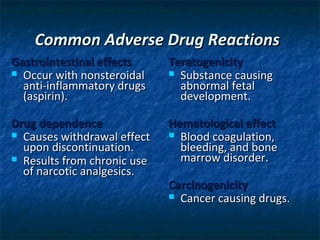
Common Adverse Drug Reactions
Gastrointestinal effects     Teratogenicity
 Occur with nonsteroidal     Substance causing
  anti-inflammatory drugs      abnormal fetal
  (aspirin).                   development.

Drug dependence              Hematological effect
 Causes withdrawal effect    Blood coagulation,
  upon discontinuation.        bleeding, and bone
 Results from chronic use     marrow disorder.
  of narcotic analgesics.
                             Carcinogenicity
                              Cancer causing drugs.
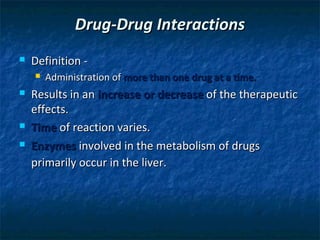
Drug-Drug Interactions
   Definition -
       Administration of more than one drug at a time.
   Results in an increase or decrease of the therapeutic
    effects.
   Time of reaction varies.
   Enzymes involved in the metabolism of drugs
    primarily occur in the liver.
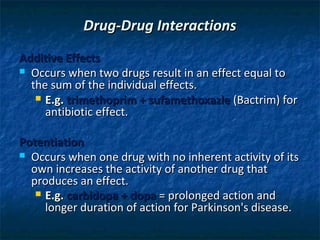
Drug-Drug Interactions
Additive Effects
 Occurs when two drugs result in an effect equal to
  the sum of the individual effects.
    E.g. trimethoprim + sufamethoxazle (Bactrim) for
     antibiotic effect.

Potentiation
 Occurs when one drug with no inherent activity of its
  own increases the activity of another drug that
  produces an effect.
    E.g. carbidopa + dopa = prolonged action and
     longer duration of action for Parkinson's disease.
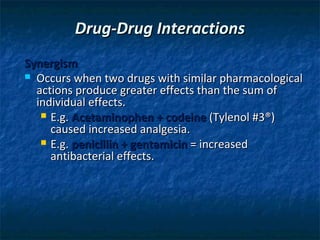
Drug-Drug Interactions
Synergism
 Occurs when two drugs with similar pharmacological
  actions produce greater effects than the sum of
  individual effects.
    E.g. Acetaminophen + codeine (Tylenol #3®)
     caused increased analgesia.
    E.g. penicillin + gentamicin = increased
     antibacterial effects.
Drug-Drug Interactions
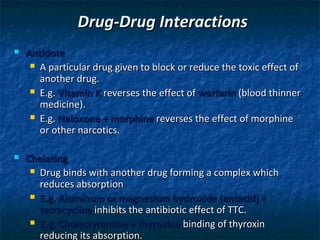
   Antidote
      A particular drug given to block or reduce the toxic effect of
       another drug.
      E.g. Vitamin K reverses the effect of warfarin (blood thinner
       medicine).
      E.g. Naloxone + morphine reverses the effect of morphine
       or other narcotics.

   Chelating
      Drug binds with another drug forming a complex which
       reduces absorption
      E.g. Aluminum or magnesium hydroxide (antacid) +
       tetracycline inhibits the antibiotic effect of TTC.
      E.g. Cholestyramine + thyroxine binding of thyroxin
       reducing its absorption.
Drug-Drug Interactions
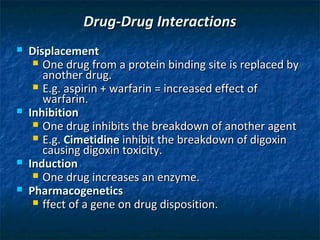
   Displacement
      One drug from a protein binding site is replaced by
       another drug.
      E.g. aspirin + warfarin = increased effect of
       warfarin.
   Inhibition
      One drug inhibits the breakdown of another agent
      E.g. Cimetidine inhibit the breakdown of digoxin
       causing digoxin toxicity.
   Induction
      One drug increases an enzyme.
   Pharmacogenetics
      ffect of a gene on drug disposition.
Drug-Drug Interaction
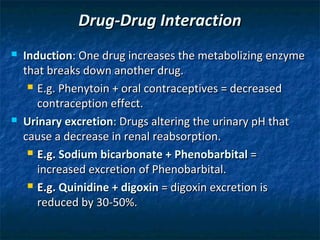
   Induction: One drug increases the metabolizing enzyme
    that breaks down another drug.
      E.g. Phenytoin + oral contraceptives = decreased

       contraception effect.
   Urinary excretion: Drugs altering the urinary pH that
    cause a decrease in renal reabsorption.
      E.g. Sodium bicarbonate + Phenobarbital =

       increased excretion of Phenobarbital.
      E.g. Quinidine + digoxin = digoxin excretion is

       reduced by 30-50%.
Drug-Diet Interaction
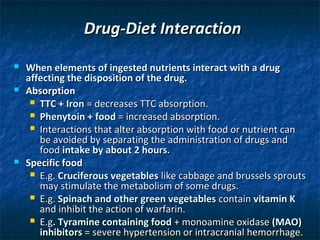
   When elements of ingested nutrients interact with a drug
    affecting the disposition of the drug.
   Absorption
      TTC + Iron = decreases TTC absorption.
      Phenytoin + food = increased absorption.
      Interactions that alter absorption with food or nutrient can
       be avoided by separating the administration of drugs and
       food intake by about 2 hours.
   Specific food
      E.g. Cruciferous vegetables like cabbage and brussels sprouts
       may stimulate the metabolism of some drugs.
      E.g. Spinach and other green vegetables contain vitamin K
       and inhibit the action of warfarin.
      E.g. Tyramine containing food + monoamine oxidase (MAO)
       inhibitors = severe hypertension or intracranial hemorrhage.
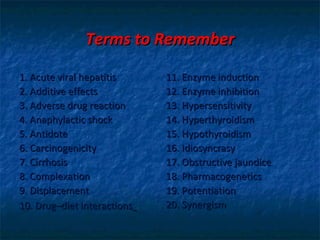
Terms to Remember

1. Acute viral hepatitis     11. Enzyme induction
2. Additive effects          12. Enzyme inhibition
3. Adverse drug reaction     13. Hypersensitivity
4. Anaphylactic shock        14. Hyperthyroidism
5. Antidote                  15. Hypothyroidism
6. Carcinogenicity           16. Idiosyncrasy
7. Cirrhosis                 17. Obstructive jaundice
8. Complexation              18. Pharmacogenetics
9. Displacement              19. Potentiation
10. Drug–diet interactions   20. Synergism

Chapter 11 human variability

  • 1.
    The Pharmacy Technician 4E Chapter 11 Factors Affecting Drug Activity
  • 2.
    Chapter Outline  Human Variability  Disease States  Adverse Drug Reactions  Drug-Drug Interactions  Drug-Diet Interactions
  • 3.
    Human Variability –Age  Overall, metabolism declines with age.  Neonates and infants  Drug distribution, metabolism, and excretion slower.  Children (age range from 1-12 yrs old.)  Metabolize certain drugs more rapidly, e.g clindamycin, valproid acid, theophylline, ethosuximde and theophylline.  The elderly  Consume more drugs.  Changes in gastric emptying, slow circulation, decline in liver and kidney functions.
  • 4.
    Human Variability  Gender  Women and men handle drugs differently.  Pregnancy  Delayed gastric emptying.  Genetics  Determines type and amounts of proteins produced in the body.
  • 5.
    Human Variability  Pharmacognetics  Defines the hereditary basis of individual differences in the ADME process.  Body weight  Important in dosing medication to children.  Psychological factors  Influences patients responses to drugs, e.g. placebo effect.
  • 6.
    Diseases that affectdrug disposition  The disposition and effect of some drugs can be influenced by the presence of disease.  Cirrhosis  A chronic diseases that occurs with long term alcohol abuse.  Acute viral hepatitis  An inflammation condition of the liver caused by viruses.  Obstructive jaundice  Obstruction of the bile duct causing hepatic waste products and bile to accumulate in the liver.
  • 7.
    Renal Diseases  Reduced renal function can affect the elimination of many drugs.  Nephro (of kidney): As renal function decreases, the dosage of a drug that is eliminated by the kidney should be reduced.  Decrease in renal function is measured by the amount of creatinine in the blood.
  • 8.
    Thyroid Disease  Changes in thyroid function affects the disposition of many drugs.  E.g. hypothyroidism (under active thyroid) increases the bioavailability of digoxin, riboflavin.  E.g. hyperthyroidism (overactive thyroid) causes increased metabolism of theophylline, propranolol, propylthiouriacil, & methimazole.
  • 9.
    Adverse Drug Reactions  Drugs have a mixture of two effects .  Therapeutic (desired)  Adverse effects (undesired effects)  Side effects  Adverse Drug Event  Harm caused by the drug.  Adverse Drug Reaction  Harm directly caused by the drug at normal doses.  Medication Error  Inappropriate use of a drug.
  • 10.
    Common Adverse DrugReactions  Central Nervous System Effects  CNS stimulation: agitation, confusion, disorientation.  CNS Depression: dizziness, drowsiness, sedation, coma.  Idiosyncrasy -Unexpected reaction to a drug.  Hepatotoxicity  Occurs with acetaminophen, isoniazide, nitrofurantoin.  Nephrotoxicity  Occurs with aminoglycosides, nonsteroidal anti- inflammatory drugs.
  • 11.
    Hypersensitive or Allergy  Any drug can produce an allergic reaction.  Involves  Antibodies antigen reaction  Previous sensitization with a drug or a similar drug required.  The reaction causes the release of histamine that leads to rash, itching, and in severe cases difficulty of breathing and even death.  Anaphylactic shock - potentially fatal type of reaction and can occur within minutes.
  • 12.
    Common Adverse DrugReactions Gastrointestinal effects Teratogenicity  Occur with nonsteroidal  Substance causing anti-inflammatory drugs abnormal fetal (aspirin). development. Drug dependence Hematological effect  Causes withdrawal effect  Blood coagulation, upon discontinuation. bleeding, and bone  Results from chronic use marrow disorder. of narcotic analgesics. Carcinogenicity  Cancer causing drugs.
  • 13.
    Drug-Drug Interactions  Definition -  Administration of more than one drug at a time.  Results in an increase or decrease of the therapeutic effects.  Time of reaction varies.  Enzymes involved in the metabolism of drugs primarily occur in the liver.
  • 14.
    Drug-Drug Interactions Additive Effects Occurs when two drugs result in an effect equal to the sum of the individual effects.  E.g. trimethoprim + sufamethoxazle (Bactrim) for antibiotic effect. Potentiation  Occurs when one drug with no inherent activity of its own increases the activity of another drug that produces an effect.  E.g. carbidopa + dopa = prolonged action and longer duration of action for Parkinson's disease.
  • 15.
    Drug-Drug Interactions Synergism  Occurswhen two drugs with similar pharmacological actions produce greater effects than the sum of individual effects.  E.g. Acetaminophen + codeine (Tylenol #3®) caused increased analgesia.  E.g. penicillin + gentamicin = increased antibacterial effects.
  • 16.
    Drug-Drug Interactions  Antidote  A particular drug given to block or reduce the toxic effect of another drug.  E.g. Vitamin K reverses the effect of warfarin (blood thinner medicine).  E.g. Naloxone + morphine reverses the effect of morphine or other narcotics.  Chelating  Drug binds with another drug forming a complex which reduces absorption  E.g. Aluminum or magnesium hydroxide (antacid) + tetracycline inhibits the antibiotic effect of TTC.  E.g. Cholestyramine + thyroxine binding of thyroxin reducing its absorption.
  • 17.
    Drug-Drug Interactions  Displacement  One drug from a protein binding site is replaced by another drug.  E.g. aspirin + warfarin = increased effect of warfarin.  Inhibition  One drug inhibits the breakdown of another agent  E.g. Cimetidine inhibit the breakdown of digoxin causing digoxin toxicity.  Induction  One drug increases an enzyme.  Pharmacogenetics  ffect of a gene on drug disposition.
  • 18.
    Drug-Drug Interaction  Induction: One drug increases the metabolizing enzyme that breaks down another drug.  E.g. Phenytoin + oral contraceptives = decreased contraception effect.  Urinary excretion: Drugs altering the urinary pH that cause a decrease in renal reabsorption.  E.g. Sodium bicarbonate + Phenobarbital = increased excretion of Phenobarbital.  E.g. Quinidine + digoxin = digoxin excretion is reduced by 30-50%.
  • 19.
    Drug-Diet Interaction  When elements of ingested nutrients interact with a drug affecting the disposition of the drug.  Absorption  TTC + Iron = decreases TTC absorption.  Phenytoin + food = increased absorption.  Interactions that alter absorption with food or nutrient can be avoided by separating the administration of drugs and food intake by about 2 hours.  Specific food  E.g. Cruciferous vegetables like cabbage and brussels sprouts may stimulate the metabolism of some drugs.  E.g. Spinach and other green vegetables contain vitamin K and inhibit the action of warfarin.  E.g. Tyramine containing food + monoamine oxidase (MAO) inhibitors = severe hypertension or intracranial hemorrhage.
  • 20.
    Terms to Remember 1.Acute viral hepatitis 11. Enzyme induction 2. Additive effects 12. Enzyme inhibition 3. Adverse drug reaction 13. Hypersensitivity 4. Anaphylactic shock 14. Hyperthyroidism 5. Antidote 15. Hypothyroidism 6. Carcinogenicity 16. Idiosyncrasy 7. Cirrhosis 17. Obstructive jaundice 8. Complexation 18. Pharmacogenetics 9. Displacement 19. Potentiation 10. Drug–diet interactions 20. Synergism