The Pharmacy
Technician 4E
 Chapter 5
Prescriptions
Chapter Outline
• Prescriptions
• Pharmacy Abbreviations
• Prescription Information
• The Fill Process
• Labels
• HIPPA
Prescriptions
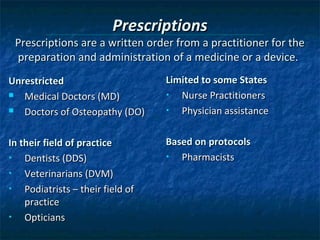
 Prescriptions are a written order from a practitioner for the
 preparation and administration of a medicine or a device.
Unrestricted                       Limited to some States
  Medical Doctors (MD)            •  Nurse Practitioners
  Doctors of Osteopathy (DO)      •  Physician assistance

In their field of practice         Based on protocols
•   Dentists (DDS)                 •  Pharmacists
•   Veterinarians (DVM)
•   Podiatrists – their field of
    practice
•   Opticians
Dispensing Prescriptions

   Community Pharmacists
      Dispense directly to the patient.

      The patient is expected to administer the

       medication according to the pharmacist direction.
   Institutional Pharmacy
      Nursing staff generally get the medications mostly

       from the pharmacists and administers to patients.
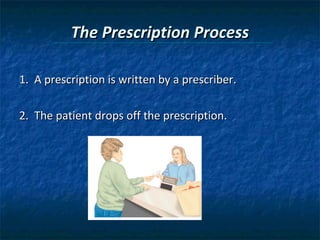
The Prescription Process

1. A prescription is written by a prescriber.

2. The patient drops off the prescription.
The Prescription Process

3. The pharmacy technician checks the prescription to
    make certain it is complete and authentic.
    Verify that the patient is in the pharmacy

      database.
    If the patient is not in the pharmacy database,

      the technician obtains necessary demographic,
      insurance, and allergy information from the
      patient.
    Enters the information into the computer.
Guidelines For Receiving And Reviewing
             Prescriptions
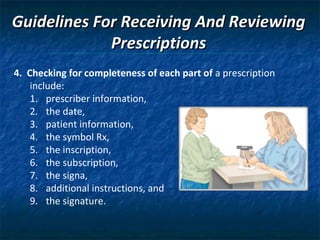
4. Checking for completeness of each part of a prescription
    include:
    1. prescriber information,
    2. the date,
    3. patient information,
    4. the symbol Rx,
    5. the inscription,
    6. the subscription,
    7. the signa,
    8. additional instructions, and
    9. the signature.
The Prescription Process
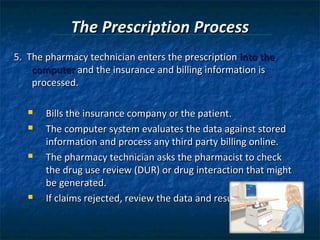
5. The pharmacy technician enters the prescription into the
    computer and the insurance and billing information is
    processed.

      Bills the insurance company or the patient.
      The computer system evaluates the data against stored
       information and process any third party billing online.
      The pharmacy technician asks the pharmacist to check
       the drug use review (DUR) or drug interaction that might
       be generated.
      If claims rejected, review the data and resubmit claim.
The Prescription Process
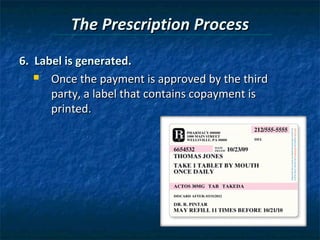
6. Label is generated.
    Once the payment is approved by the third

      party, a label that contains copayment is
      printed.
The Prescription Process
7. Prescription is prepared.
      The pharmacy technician selects the appropriate medication
       and verifies the National Drug Code (NDC) number on the
       computer-generated medication label.
      Prepares the medication(s).
        E.g., the prescribed number of tablets is counted or the

         liquid measured..
      Packages the medication in the appropriate container.
      Labels the prescription container with the computer-
       generated medication label. In some states the law requires
       the pharmacist to affix the label to the container.
The Prescription Process
8. The pharmacy technician prepares the filled
    prescription for the pharmacist to check.
    THE PHARMACIST CHECKS the prescription(s)

       and may initial it.
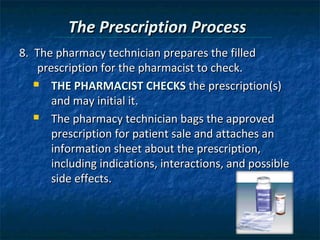
    The pharmacy technician bags the approved

       prescription for patient sale and attaches an
       information sheet about the prescription,
       including indications, interactions, and possible
       side effects.
The Prescription Process
9. Patient receives the prescription.
     The pharmacy technician returns the bulk
      product container to the shelf.
     Delivers the packaged prescription to the cash
      register area for PATIENT PICKUP .
     The patient or a representative signs the
      insurance log.
     If the patient has not signed the pharmacy’s
      notice of HIPAA compliance, they are given a
      copy and asked to sign the log.
The Prescription Process

10. Pharmacists provide counseling.
   OBRA ‘90 and other state or provincial

      statures, require the pharmacist to be
      called to the counter to provide
      counseling on all prescriptions.
Pharmacy Abbreviations

  Most common abbreviations:
     Route

     Form

     Time

     Measurement
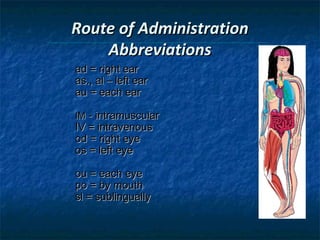
Route of Administration
    Abbreviations
ad = right ear
as., al – left ear
au = each ear

IM - intramuscular
IV = intravenous
od = right eye
os = left eye

ou = each eye
po = by mouth
sl = sublingually
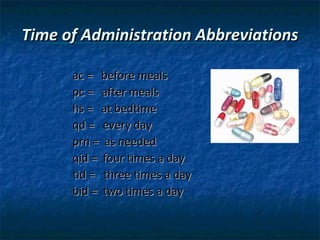
Time of Administration Abbreviations

      ac = before meals
      pc = after meals
      hs = at bedtime
      qd = every day
      prn = as needed
      qid = four times a day
      tid = three times a day
      bid = two times a day
Dosage Form Abbreviations
      elix = elixir
      supp = suppository
      ung = ointment
      tab = tablet
      cap = capsule
      SR, XR, XL = slow/extended release
      sol = solution
      susp = suspension
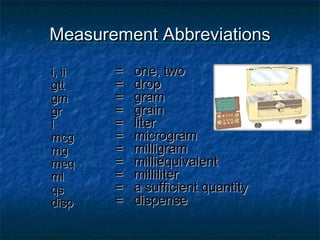
Measurement Abbreviations

i, ii   =   one, two
gtt     =   drop
gm      =   gram
gr      =   grain
l       =   liter
mcg     =   microgram
mg      =   milligram
meq     =   milliequivalent
ml      =   milliliter
qs      =   a sufficient quantity
disp    =   dispense
Others Abbreviations

  Stat = now
      NR = no refill
      UD = as directed
      qs = a sufficient quantity
      disp
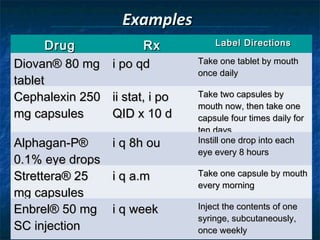
Examples
       Drug            Rx            Label Directions

Diovan® 80 mg    i po qd         Take one tablet by mouth
                                 once daily
tablet
Cephalexin 250   ii stat, i po   Take two capsules by
                                 mouth now, then take one
mg capsules      QID x 10 d      capsule four times daily for
                                 ten days
Alphagan-P®      i q 8h ou       Instill one drop into each
                                 eye every 8 hours
0.1% eye drops
Strettera® 25    i q a.m         Take one capsule by mouth
                                 every morning
mg capsules
Enbrel® 50 mg    i q week        Inject the contents of one
                                 syringe, subcutaneously,
SC injection                     once weekly
Elements Of The Prescription
                 Information
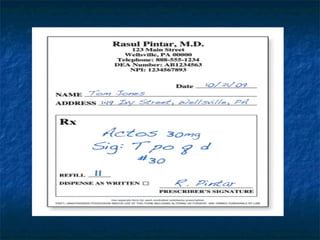
   Prescriber information - Name, title, office address,
    and telephone number.
   Date: The date the prescription is written.
   Inscription: Name (brand or generic), strength of
    medication and quantity.
   Name and address of patient
   Signa: Sig or S and indicate the directions for use and
    the administration route (e.g., p.o., p.r., sc).
   Refill instructions
Elements Of The Prescription
               Information
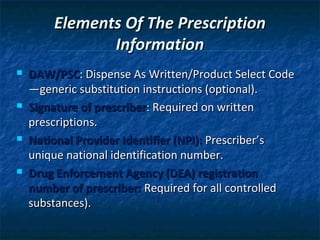
   DAW/PSC: Dispense As Written/Product Select Code
    —generic substitution instructions (optional).
   Signature of prescriber: Required on written
    prescriptions.
   National Provider Identifier (NPI): Prescriber’s
    unique national identification number.
   Drug Enforcement Agency (DEA) registration
    number of prescriber: Required for all controlled
    substances).
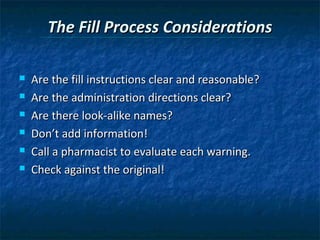
The Fill Process Considerations

   Are the fill instructions clear and reasonable?
   Are the administration directions clear?
   Are there look-alike names?
   Don’t add information!
   Call a pharmacist to evaluate each warning.
   Check against the original!
The Pharmacy Technician's Role
   Assisting the pharmacist in routine, technical aspects
    of prescription filling.
   Treating each patient, their personal information, and
    their medications with respect.
   Accepting new prescriptions from patients, obtaining
    all necessary information, and keying it into the
    computer.
   Requesting the advice of a pharmacist whenever a
    warning screen appears while filling a prescription.
   Faxing or telephoning refills and clarification requests
    to prescribers.
The Pharmacy Technician's Role
   Consulting formularies and responding appropriately
    to third-party adjudication messaging such as: non-
    preferred drug, prior authorization or step-edit
    required.
   Quickly locating the correct medication for dispensing,
    calculating quantities, repackaging medication, and
    locating the corresponding patient medication guide.
   Compounding a prescription under supervision.
   Recording the dispensing of controlled drugs.
The Pharmacy Technician's Role
   Checking the work of other technicians, as instructed
    by a pharmacist.
    Referring patients to a pharmacist for counseling on
    the use of prescription and over-the-counter
    medications, or any other question requiring
    judgment as per your job description.
   ALWAYS ensuring the accuracy and safety of the
    prescription by incorporating Quality control checks
    into every step in the process.
Caution!
   Are the fill instructions clear and reasonable?
      Is it q.i.d. or q.d; 4 ml or .4 ml.

   Are the administration directions clear?
      Are these the same? “Take two tablets daily” vs.

       “Take one tablet twice daily” vs. “Take two tablets
       once daily.”
   Are there look-alike names?
      Is it Metadate® 10 mg or Methadone 10 mg;

       Lamictal® or Lamisil®?
Caution!
   Don’t add information!
      Never add information based on what you assume

       the prescriber meant. The prescriber has knowledge
       of the patient’s condition that you don’t.
   Pay attention to warnings!
      When warning screens appear, call a pharmacist to

       evaluate each warning.
   Check against the original!
      During the fill process, always refer to the original

       prescription first and then refer to the label.
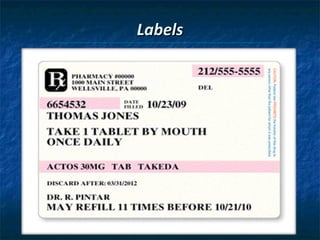
Labels
Label Preparation
   The name, address, and telephone number of the pharmacy.
   A prescription number.
   The date dispensed.
   The name of the patient.
   Directions for use .
   The medication dispensed.
   Expiration date of the medication.
   The name of the prescriber.
   The pharmacist initials.
   Refill information.
Rule When Writing Directions For Use
   START WITH A VERB
      Take, instill, inhale, insert, or apply

   Indicate ROUTE of ADMINISTRATION
      Apply to affected area.

      Take one tablet by mouth.

      Insert rectally.

      Place one tablet under the tongue.

   NO ABBREVIATIONS
   Use familiar words
      Teaspoonfuls or 10 ml
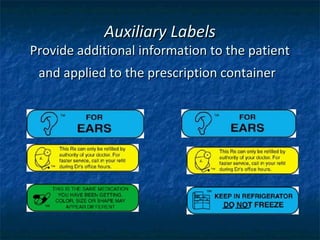
Auxiliary Labels
Provide additional information to the patient
 and applied to the prescription container
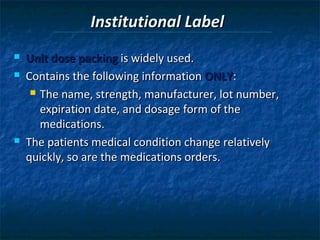
Institutional Label
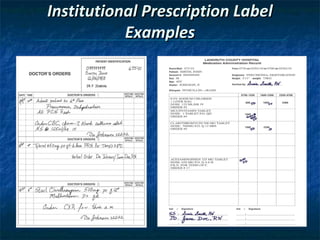
   Unit dose packing is widely used.
   Contains the following information ONLY:
      The name, strength, manufacturer, lot number,

       expiration date, and dosage form of the
       medications.
   The patients medical condition change relatively
    quickly, so are the medications orders.
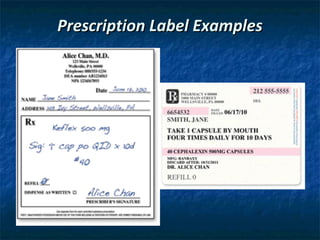
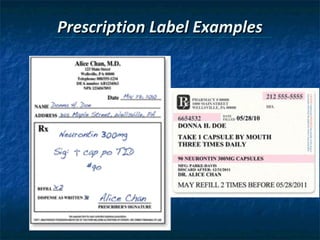
Prescription Label Examples
Institutional Prescription Label
           Examples
What is HIPAA?

HIPAA is a federal law enacted to:
   • Ensure the privacy of an individual’s protected

     health information (PHI).
   • Provide security for electronic and physical

     exchange of PHI.
   • Provide for individual rights regarding PHI.


                                                       38
Personal Identifiers under HIPAA
   Patient name, all types of addresses including email, URL,
    home.
   Identifying numbers, including Social Security, medical
    records, insurance numbers, account numbers.
   Full facial photos.
   Dates, including birth date, dates of admission and
    discharge, or death.
   Personal identifiers coupled with a broad range of
    health, health care or health care payment information
    creates PHI.

                                                          39
Terms to Remember
1. DAW
2. DEA number
3. Extemporaneous compounding
4. HIPAA
5. National Provider Identifier (NPI)
6. OTC drugs
7. Prescription
8. Schedule II drugs
9. Signa, sig

Chapter 5 prescriptions

  • 1.
    The Pharmacy Technician 4E Chapter 5 Prescriptions
  • 2.
    Chapter Outline • Prescriptions •Pharmacy Abbreviations • Prescription Information • The Fill Process • Labels • HIPPA
  • 3.
    Prescriptions Prescriptions area written order from a practitioner for the preparation and administration of a medicine or a device. Unrestricted Limited to some States  Medical Doctors (MD) • Nurse Practitioners  Doctors of Osteopathy (DO) • Physician assistance In their field of practice Based on protocols • Dentists (DDS) • Pharmacists • Veterinarians (DVM) • Podiatrists – their field of practice • Opticians
  • 4.
    Dispensing Prescriptions  Community Pharmacists  Dispense directly to the patient.  The patient is expected to administer the medication according to the pharmacist direction.  Institutional Pharmacy  Nursing staff generally get the medications mostly from the pharmacists and administers to patients.
  • 5.
    The Prescription Process 1.A prescription is written by a prescriber. 2. The patient drops off the prescription.
  • 6.
    The Prescription Process 3.The pharmacy technician checks the prescription to make certain it is complete and authentic.  Verify that the patient is in the pharmacy database.  If the patient is not in the pharmacy database, the technician obtains necessary demographic, insurance, and allergy information from the patient.  Enters the information into the computer.
  • 7.
    Guidelines For ReceivingAnd Reviewing Prescriptions 4. Checking for completeness of each part of a prescription include: 1. prescriber information, 2. the date, 3. patient information, 4. the symbol Rx, 5. the inscription, 6. the subscription, 7. the signa, 8. additional instructions, and 9. the signature.
  • 8.
    The Prescription Process 5.The pharmacy technician enters the prescription into the computer and the insurance and billing information is processed.  Bills the insurance company or the patient.  The computer system evaluates the data against stored information and process any third party billing online.  The pharmacy technician asks the pharmacist to check the drug use review (DUR) or drug interaction that might be generated.  If claims rejected, review the data and resubmit claim.
  • 9.
    The Prescription Process 6.Label is generated.  Once the payment is approved by the third party, a label that contains copayment is printed.
  • 10.
    The Prescription Process 7.Prescription is prepared.  The pharmacy technician selects the appropriate medication and verifies the National Drug Code (NDC) number on the computer-generated medication label.  Prepares the medication(s).  E.g., the prescribed number of tablets is counted or the liquid measured..  Packages the medication in the appropriate container.  Labels the prescription container with the computer- generated medication label. In some states the law requires the pharmacist to affix the label to the container.
  • 11.
    The Prescription Process 8.The pharmacy technician prepares the filled prescription for the pharmacist to check.  THE PHARMACIST CHECKS the prescription(s) and may initial it.  The pharmacy technician bags the approved prescription for patient sale and attaches an information sheet about the prescription, including indications, interactions, and possible side effects.
  • 12.
    The Prescription Process 9.Patient receives the prescription.  The pharmacy technician returns the bulk product container to the shelf.  Delivers the packaged prescription to the cash register area for PATIENT PICKUP .  The patient or a representative signs the insurance log.  If the patient has not signed the pharmacy’s notice of HIPAA compliance, they are given a copy and asked to sign the log.
  • 13.
    The Prescription Process 10.Pharmacists provide counseling.  OBRA ‘90 and other state or provincial statures, require the pharmacist to be called to the counter to provide counseling on all prescriptions.
  • 14.
    Pharmacy Abbreviations Most common abbreviations:  Route  Form  Time  Measurement
  • 15.
    Route of Administration Abbreviations ad = right ear as., al – left ear au = each ear IM - intramuscular IV = intravenous od = right eye os = left eye ou = each eye po = by mouth sl = sublingually
  • 16.
    Time of AdministrationAbbreviations ac = before meals pc = after meals hs = at bedtime qd = every day prn = as needed qid = four times a day tid = three times a day bid = two times a day
  • 17.
    Dosage Form Abbreviations elix = elixir supp = suppository ung = ointment tab = tablet cap = capsule SR, XR, XL = slow/extended release sol = solution susp = suspension
  • 18.
    Measurement Abbreviations i, ii = one, two gtt = drop gm = gram gr = grain l = liter mcg = microgram mg = milligram meq = milliequivalent ml = milliliter qs = a sufficient quantity disp = dispense
  • 19.
    Others Abbreviations Stat = now NR = no refill UD = as directed qs = a sufficient quantity disp
  • 20.
    Examples Drug Rx Label Directions Diovan® 80 mg i po qd Take one tablet by mouth once daily tablet Cephalexin 250 ii stat, i po Take two capsules by mouth now, then take one mg capsules QID x 10 d capsule four times daily for ten days Alphagan-P® i q 8h ou Instill one drop into each eye every 8 hours 0.1% eye drops Strettera® 25 i q a.m Take one capsule by mouth every morning mg capsules Enbrel® 50 mg i q week Inject the contents of one syringe, subcutaneously, SC injection once weekly
  • 22.
    Elements Of ThePrescription Information  Prescriber information - Name, title, office address, and telephone number.  Date: The date the prescription is written.  Inscription: Name (brand or generic), strength of medication and quantity.  Name and address of patient  Signa: Sig or S and indicate the directions for use and the administration route (e.g., p.o., p.r., sc).  Refill instructions
  • 23.
    Elements Of ThePrescription Information  DAW/PSC: Dispense As Written/Product Select Code —generic substitution instructions (optional).  Signature of prescriber: Required on written prescriptions.  National Provider Identifier (NPI): Prescriber’s unique national identification number.  Drug Enforcement Agency (DEA) registration number of prescriber: Required for all controlled substances).
  • 24.
    The Fill ProcessConsiderations  Are the fill instructions clear and reasonable?  Are the administration directions clear?  Are there look-alike names?  Don’t add information!  Call a pharmacist to evaluate each warning.  Check against the original!
  • 25.
    The Pharmacy Technician'sRole  Assisting the pharmacist in routine, technical aspects of prescription filling.  Treating each patient, their personal information, and their medications with respect.  Accepting new prescriptions from patients, obtaining all necessary information, and keying it into the computer.  Requesting the advice of a pharmacist whenever a warning screen appears while filling a prescription.  Faxing or telephoning refills and clarification requests to prescribers.
  • 26.
    The Pharmacy Technician'sRole  Consulting formularies and responding appropriately to third-party adjudication messaging such as: non- preferred drug, prior authorization or step-edit required.  Quickly locating the correct medication for dispensing, calculating quantities, repackaging medication, and locating the corresponding patient medication guide.  Compounding a prescription under supervision.  Recording the dispensing of controlled drugs.
  • 27.
    The Pharmacy Technician'sRole  Checking the work of other technicians, as instructed by a pharmacist.  Referring patients to a pharmacist for counseling on the use of prescription and over-the-counter medications, or any other question requiring judgment as per your job description.  ALWAYS ensuring the accuracy and safety of the prescription by incorporating Quality control checks into every step in the process.
  • 28.
    Caution!  Are the fill instructions clear and reasonable?  Is it q.i.d. or q.d; 4 ml or .4 ml.  Are the administration directions clear?  Are these the same? “Take two tablets daily” vs. “Take one tablet twice daily” vs. “Take two tablets once daily.”  Are there look-alike names?  Is it Metadate® 10 mg or Methadone 10 mg; Lamictal® or Lamisil®?
  • 29.
    Caution!  Don’t add information!  Never add information based on what you assume the prescriber meant. The prescriber has knowledge of the patient’s condition that you don’t.  Pay attention to warnings!  When warning screens appear, call a pharmacist to evaluate each warning.  Check against the original!  During the fill process, always refer to the original prescription first and then refer to the label.
  • 30.
  • 31.
    Label Preparation  The name, address, and telephone number of the pharmacy.  A prescription number.  The date dispensed.  The name of the patient.  Directions for use .  The medication dispensed.  Expiration date of the medication.  The name of the prescriber.  The pharmacist initials.  Refill information.
  • 32.
    Rule When WritingDirections For Use  START WITH A VERB  Take, instill, inhale, insert, or apply  Indicate ROUTE of ADMINISTRATION  Apply to affected area.  Take one tablet by mouth.  Insert rectally.  Place one tablet under the tongue.  NO ABBREVIATIONS  Use familiar words  Teaspoonfuls or 10 ml
  • 33.
    Auxiliary Labels Provide additionalinformation to the patient and applied to the prescription container
  • 34.
    Institutional Label  Unit dose packing is widely used.  Contains the following information ONLY:  The name, strength, manufacturer, lot number, expiration date, and dosage form of the medications.  The patients medical condition change relatively quickly, so are the medications orders.
  • 35.
  • 36.
  • 37.
  • 38.
    What is HIPAA? HIPAAis a federal law enacted to: • Ensure the privacy of an individual’s protected health information (PHI). • Provide security for electronic and physical exchange of PHI. • Provide for individual rights regarding PHI. 38
  • 39.
    Personal Identifiers underHIPAA  Patient name, all types of addresses including email, URL, home.  Identifying numbers, including Social Security, medical records, insurance numbers, account numbers.  Full facial photos.  Dates, including birth date, dates of admission and discharge, or death.  Personal identifiers coupled with a broad range of health, health care or health care payment information creates PHI. 39
  • 40.
    Terms to Remember 1.DAW 2. DEA number 3. Extemporaneous compounding 4. HIPAA 5. National Provider Identifier (NPI) 6. OTC drugs 7. Prescription 8. Schedule II drugs 9. Signa, sig

Editor's Notes

  • #15 Go over all abbreviations and give quizzes to students to keep reinforcing the importance of knowing all of them.