The Pharmacy
  Technician 4E
       Chapter 2
The Pharmacy Technician
Chapter Outline

   The Pharmacy Technician
   Personal Standards
   Training & Competency
   Certification
Pharmacy Technician
   A pharmacy technician, also called the pharmacy
    assistant.
      Works in a pharmacy.
      Works under the direct supervision of a licensed
       pharmacist.
      Assists in pharmacy activities that do not require
       the professional judgment of a pharmacist.
Pharmacist
   The pharmacist provides
      The final check on the original prescription with
       the medication bottle and label.
      Patient counseling - has the regal responsibility.
Pharmacy Technicians Role
   Originally, many pharmacy techs were trained as
    medics in the military.
   Returned after service to take positions in
    hospitals.
   In community pharmacy, the pharmacy tech
    evolved from clerk or cashier to a pharmacist’s
    assistant.
   A pharmacy technician assists the pharmacist with
    routine functions.
      Leaves professional decision making and
       judgment calls to the pharmacist.
Pharmacy Technicians Role
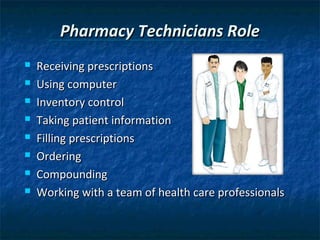
   Receiving prescriptions
   Using computer
   Inventory control
   Taking patient information
   Filling prescriptions
   Ordering
   Compounding
   Working with a team of health care professionals
Evolution of the Pharmacy Technician’s
                  Role
   Without pharmacy technicians, pharmacists would not have
    sufficient time for the duties involved in “pharmaceutical care.”
      Pharmacy technicians do not have the skill or the training or

       the legal accountability to do them.

   Pharmaceutical Care functions include:
      Counseling patients and reviewing medication profiles.

      Monitoring for side effects and adverse reactions.

      Screening patients for disease.

      Discussing cost-effective drug therapy options with the

       prescriber.
Pharmacy Technicians


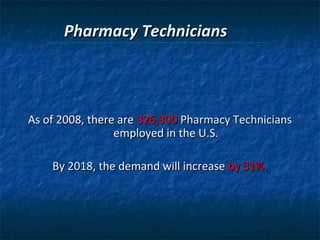
As of 2008, there are 326,300 Pharmacy Technicians
                 employed in the U.S.

    By 2018, the demand will increase by 31%.
Work Environments and Conditions
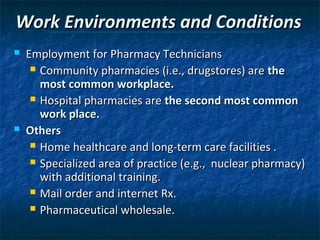
   Employment for Pharmacy Technicians
      Community pharmacies (i.e., drugstores) are the
       most common workplace.
      Hospital pharmacies are the second most common
       work place.
   Others
      Home healthcare and long-term care facilities .

      Specialized area of practice (e.g., nuclear pharmacy)
       with additional training.
      Mail order and internet Rx.

      Pharmaceutical wholesale.
The Pharmacy Technicians
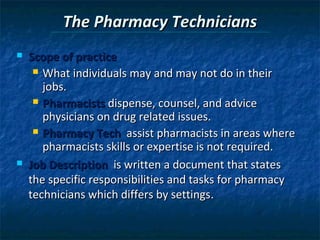
   Scope of practice
      What individuals may and may not do in their
       jobs.
      Pharmacists dispense, counsel, and advice
       physicians on drug related issues.
      Pharmacy Tech assist pharmacists in areas where
       pharmacists skills or expertise is not required.
   Job Description is written a document that states
    the specific responsibilities and tasks for pharmacy
    technicians which differs by settings.
Personal Standards
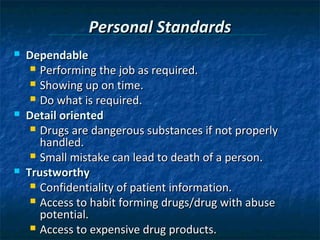
   Dependable
      Performing the job as required.
      Showing up on time.
      Do what is required.
   Detail oriented
      Drugs are dangerous substances if not properly
       handled.
      Small mistake can lead to death of a person.
   Trustworthy
      Confidentiality of patient information.
      Access to habit forming drugs/drug with abuse
       potential.
      Access to expensive drug products.
Personal Standards
   Health
      Has to be in good health or ease of making mistakes,

       contracting diseases.
   Hygiene
      Deals with several people, patients and customers

      Professional image.

   Appearance
      White lab jacket, grooming, badge, etc.
Characteristics
A successful pharmacy technician must possess a wide
  range of skills, knowledge, and aptitudes.
Broad knowledge of pharmacy practice that includes:
 Good Mathematics and problem solving skills

 Language and medical terminology - excellent
  communication skills
 Computer skills

 Interpersonal skills - dedication to providing a critical
  healthcare service to customers and patients
    high ethical standards, willingness to follow
     instructions
    eagerness to learn
Characteristics
A successful pharmacy technician must possess
  a wide range of skills, knowledge, and
  aptitudes.

   Good research skills.
   Ability to perform accurately and calmly in hectic
    or stressful situations.
   Ability to multi-task or work on several projects at
    the same time.
Health Insurance Portability &
     Accountability Act (HIP AA) - 1996
   Refers to privacy and security of patient health
    related data.
      Made health care providers responsible for the
       privacy and security of all identifiable patient
       health information
      Called Protected Health Information – PHI.

   Apply to various formats including
      Electronic data, computer files, electronic
       transmission.
      Paper and hard copy documents.

      Oral communication, or billing and claims.
Health Insurance Portability &
    Accountability Act (HIP AA)- 1996
   NO casual discussion with anyone about a patient
    data.
      Includes patient’s family member, Patient’s
       friends, etc. without the patient’s permission/
       after signing a waiver.
   NO discussion regarding topics including Medications
    and Health issues.
      Making sure files and documents are securely
       stored where no unauthorized person can access
       them.
Education and Licensing Requirements
   In the past, on-the-job training (training in the
    workplace) was sufficient for the tech working in a
    pharmacy.
   Now, formal technician training programs train
    pharmacy technicians for their expanded roles.
      Initially centered in hospitals, now many programs

       are offered by community colleges and vocational
       and technical schools.
Education and Licensing Requirements
   ASHP (American Society of Health-System Pharmacists)
      Developed a model curriculum to meet the needs of all

       practice settings.
      In some states pharmacy technicians must be certified to

       practice.
      250 accredited schools and institutions by ASHP.


   Performance review
      A performance review by an employer based on the job

       description.
      An employer is legally responsible for pharmacy tech

       performance and competency.
Evolution of the Pharmacy Technician’s Role
    The essential differences in the duties of a
     pharmacist and a technician involve:
       Accountability and legal responsibility.

       Making decisions about the patient’s healthcare.

    Most state boards of pharmacy recognize the
     existence and importance of the pharmacy
     technician.
    Each state board of pharmacy regulates:
       The activities of pharmacy technicians.

       The ratio of pharmacy techs to pharmacists .
Competency
Being qualified and capable and done in various ways.
 Testing – written test or/and practical demonstration

  to show competency.
 Performance is evaluated by an employer.

    Includes performance reviews, comments by your

     supervisor, and complaints.
Competency
   Continuing Education
      An instructional program on new drugs and other

       pharmacy practice to keep knowledge updated.
   Probation Period
      The time the pharmacy tech is expected to learn

       certain skills sets and is usually 6 months.
      Leads to either permanent employee or dismissal

       from the job.
Certification
   A legal proof or a document that an individual meets
    certain standards provided by a neutral professional
    organization.
   Two certification bodies:
     1. PTCB (Pharmacy Technician Certification Board)
        offers a National Examination to become a CPhT
        (Certified Pharmacy Technician).
     2. ICPT (Certification of Pharmacy Technicians) offers
        a National Examination to become ExCPT.
As of 2010,
PTCB certified 363,000 pharmacy
           technicians.
Certification
   Certification must be renewed:
      Every 2 years just like the pharmacist license
      Certifications require “continuing Education”, 20
       contact hours
      Of these, one hour in pharmacy law every 2 years.
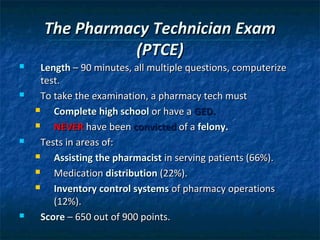
The Pharmacy Technician Exam
                (PTCE)
     Length – 90 minutes, all multiple questions, computerize
      test.
     To take the examination, a pharmacy tech must
        Complete high school or have a GED.
        NEVER have been convicted of a felony.
     Tests in areas of:
        Assisting the pharmacist in serving patients (66%).
        Medication distribution (22%).
        Inventory control systems of pharmacy operations
         (12%).
     Score – 650 out of 900 points.
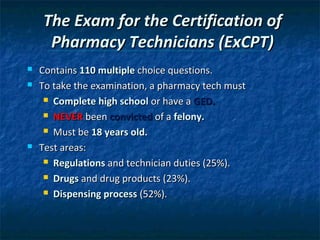
The Exam for the Certification of
     Pharmacy Technicians (ExCPT)
   Contains 110 multiple choice questions.
   To take the examination, a pharmacy tech must
      Complete high school or have a GED.

      NEVER been convicted of a felony.

      Must be 18 years old.

   Test areas:
      Regulations and technician duties (25%).

      Drugs and drug products (23%).

      Dispensing process (52%).
Pharmacy Technician Examination
      Contact Information

        PTCE                      ExCPT
                            2536 S Old Hwy 94, Suite
2215 Constitution Ave, NW               224
  Washington, DC 20037       St. Charles, MO 63303
     (202) 429-7596              (314) 442-6775
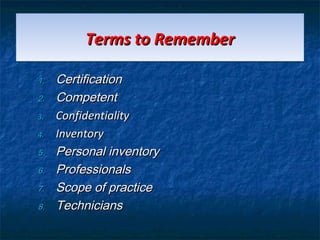
Terms to Remember

1.   Certification
2.   Competent
3.   Confidentiality
4.   Inventory
5.   Personal inventory
6.   Professionals
7.   Scope of practice
8.   Technicians

Chapter 2 the pharmacy technician

  • 1.
    The Pharmacy Technician 4E Chapter 2 The Pharmacy Technician
  • 2.
    Chapter Outline  The Pharmacy Technician  Personal Standards  Training & Competency  Certification
  • 3.
    Pharmacy Technician  A pharmacy technician, also called the pharmacy assistant.  Works in a pharmacy.  Works under the direct supervision of a licensed pharmacist.  Assists in pharmacy activities that do not require the professional judgment of a pharmacist.
  • 4.
    Pharmacist  The pharmacist provides  The final check on the original prescription with the medication bottle and label.  Patient counseling - has the regal responsibility.
  • 5.
    Pharmacy Technicians Role  Originally, many pharmacy techs were trained as medics in the military.  Returned after service to take positions in hospitals.  In community pharmacy, the pharmacy tech evolved from clerk or cashier to a pharmacist’s assistant.  A pharmacy technician assists the pharmacist with routine functions.  Leaves professional decision making and judgment calls to the pharmacist.
  • 6.
    Pharmacy Technicians Role  Receiving prescriptions  Using computer  Inventory control  Taking patient information  Filling prescriptions  Ordering  Compounding  Working with a team of health care professionals
  • 7.
    Evolution of thePharmacy Technician’s Role  Without pharmacy technicians, pharmacists would not have sufficient time for the duties involved in “pharmaceutical care.”  Pharmacy technicians do not have the skill or the training or the legal accountability to do them.  Pharmaceutical Care functions include:  Counseling patients and reviewing medication profiles.  Monitoring for side effects and adverse reactions.  Screening patients for disease.  Discussing cost-effective drug therapy options with the prescriber.
  • 8.
    Pharmacy Technicians As of2008, there are 326,300 Pharmacy Technicians employed in the U.S. By 2018, the demand will increase by 31%.
  • 9.
    Work Environments andConditions  Employment for Pharmacy Technicians  Community pharmacies (i.e., drugstores) are the most common workplace.  Hospital pharmacies are the second most common work place.  Others  Home healthcare and long-term care facilities .  Specialized area of practice (e.g., nuclear pharmacy) with additional training.  Mail order and internet Rx.  Pharmaceutical wholesale.
  • 10.
    The Pharmacy Technicians  Scope of practice  What individuals may and may not do in their jobs.  Pharmacists dispense, counsel, and advice physicians on drug related issues.  Pharmacy Tech assist pharmacists in areas where pharmacists skills or expertise is not required.  Job Description is written a document that states the specific responsibilities and tasks for pharmacy technicians which differs by settings.
  • 11.
    Personal Standards  Dependable  Performing the job as required.  Showing up on time.  Do what is required.  Detail oriented  Drugs are dangerous substances if not properly handled.  Small mistake can lead to death of a person.  Trustworthy  Confidentiality of patient information.  Access to habit forming drugs/drug with abuse potential.  Access to expensive drug products.
  • 12.
    Personal Standards  Health  Has to be in good health or ease of making mistakes, contracting diseases.  Hygiene  Deals with several people, patients and customers  Professional image.  Appearance  White lab jacket, grooming, badge, etc.
  • 13.
    Characteristics A successful pharmacytechnician must possess a wide range of skills, knowledge, and aptitudes. Broad knowledge of pharmacy practice that includes:  Good Mathematics and problem solving skills  Language and medical terminology - excellent communication skills  Computer skills  Interpersonal skills - dedication to providing a critical healthcare service to customers and patients  high ethical standards, willingness to follow instructions  eagerness to learn
  • 14.
    Characteristics A successful pharmacytechnician must possess a wide range of skills, knowledge, and aptitudes.  Good research skills.  Ability to perform accurately and calmly in hectic or stressful situations.  Ability to multi-task or work on several projects at the same time.
  • 15.
    Health Insurance Portability& Accountability Act (HIP AA) - 1996  Refers to privacy and security of patient health related data.  Made health care providers responsible for the privacy and security of all identifiable patient health information  Called Protected Health Information – PHI.  Apply to various formats including  Electronic data, computer files, electronic transmission.  Paper and hard copy documents.  Oral communication, or billing and claims.
  • 16.
    Health Insurance Portability& Accountability Act (HIP AA)- 1996  NO casual discussion with anyone about a patient data.  Includes patient’s family member, Patient’s friends, etc. without the patient’s permission/ after signing a waiver.  NO discussion regarding topics including Medications and Health issues.  Making sure files and documents are securely stored where no unauthorized person can access them.
  • 17.
    Education and LicensingRequirements  In the past, on-the-job training (training in the workplace) was sufficient for the tech working in a pharmacy.  Now, formal technician training programs train pharmacy technicians for their expanded roles.  Initially centered in hospitals, now many programs are offered by community colleges and vocational and technical schools.
  • 18.
    Education and LicensingRequirements  ASHP (American Society of Health-System Pharmacists)  Developed a model curriculum to meet the needs of all practice settings.  In some states pharmacy technicians must be certified to practice.  250 accredited schools and institutions by ASHP.  Performance review  A performance review by an employer based on the job description.  An employer is legally responsible for pharmacy tech performance and competency.
  • 19.
    Evolution of thePharmacy Technician’s Role  The essential differences in the duties of a pharmacist and a technician involve:  Accountability and legal responsibility.  Making decisions about the patient’s healthcare.  Most state boards of pharmacy recognize the existence and importance of the pharmacy technician.  Each state board of pharmacy regulates:  The activities of pharmacy technicians.  The ratio of pharmacy techs to pharmacists .
  • 20.
    Competency Being qualified andcapable and done in various ways.  Testing – written test or/and practical demonstration to show competency.  Performance is evaluated by an employer.  Includes performance reviews, comments by your supervisor, and complaints.
  • 21.
    Competency  Continuing Education  An instructional program on new drugs and other pharmacy practice to keep knowledge updated.  Probation Period  The time the pharmacy tech is expected to learn certain skills sets and is usually 6 months.  Leads to either permanent employee or dismissal from the job.
  • 22.
    Certification  A legal proof or a document that an individual meets certain standards provided by a neutral professional organization.  Two certification bodies: 1. PTCB (Pharmacy Technician Certification Board) offers a National Examination to become a CPhT (Certified Pharmacy Technician). 2. ICPT (Certification of Pharmacy Technicians) offers a National Examination to become ExCPT.
  • 23.
    As of 2010, PTCBcertified 363,000 pharmacy technicians.
  • 24.
    Certification  Certification must be renewed:  Every 2 years just like the pharmacist license  Certifications require “continuing Education”, 20 contact hours  Of these, one hour in pharmacy law every 2 years.
  • 25.
    The Pharmacy TechnicianExam (PTCE)  Length – 90 minutes, all multiple questions, computerize test.  To take the examination, a pharmacy tech must  Complete high school or have a GED.  NEVER have been convicted of a felony.  Tests in areas of:  Assisting the pharmacist in serving patients (66%).  Medication distribution (22%).  Inventory control systems of pharmacy operations (12%).  Score – 650 out of 900 points.
  • 26.
    The Exam forthe Certification of Pharmacy Technicians (ExCPT)  Contains 110 multiple choice questions.  To take the examination, a pharmacy tech must  Complete high school or have a GED.  NEVER been convicted of a felony.  Must be 18 years old.  Test areas:  Regulations and technician duties (25%).  Drugs and drug products (23%).  Dispensing process (52%).
  • 27.
    Pharmacy Technician Examination Contact Information PTCE ExCPT 2536 S Old Hwy 94, Suite 2215 Constitution Ave, NW 224 Washington, DC 20037 St. Charles, MO 63303 (202) 429-7596 (314) 442-6775
  • 28.
    Terms to Remember 1. Certification 2. Competent 3. Confidentiality 4. Inventory 5. Personal inventory 6. Professionals 7. Scope of practice 8. Technicians

Editor's Notes

  • #23 Give students the PTCB examination application and explain the process of filling it out.