The Pharmacy
  Technician 4E
       Chapter 6
 Basic Pharmaceutical
Measurement Calculation
Topic Outline

   Numbers                    Percents & Solutions
   Fractions                  Alligation
   Decimal Numbers            Powder Volume
   Significant Figures        Children’s Doses
   Measurement                Calculations for
   Equations & Variables       Business
   Ratio & Proportion
Comparison of Roman and Arabic
          Numerals
Example:
   xxx = 30 or 10 plus 10 plus 10
   DC = 600 or 500 plus 100
   LXVI = 66 or 50 plus 10 plus 5 plus 1

    When the second of two letters has a value greater
    than that of the first, the smaller is to be subtracted
    from the larger.
Fractions
• When something is divided into parts, each part is
  considered a fraction of the whole.
• If a pie is cut into 8 slices, one slice can be
  expressed as 1/8, or one piece (1) of the whole
  (8).
       If we have a 1000 mg tablet,
       • ½ tablet = 500 mg
       • ¼ tablet = 250 mg
Fractions

Fractions have two parts:         1
• Numerator (the top part)

                                  8
• Denominator (the bottom part)
                                  1
                                  8
Fractions

A fraction with the same numerator and the same
denominator has a value equivalent to 1.
In other words, if you have 8 pieces of a pie that has
been cut into 8 pieces, you have 1 pie.

                       8
                         =1
                       8
Terminology
Proper fraction
• A fraction with a value of less than 1.              1
• A fraction with a numerator value smaller than the     <1
  denominator’s value.                                 4

Improper fraction
• A fraction with a value larger than 1.
• A fraction with a numerator value larger than the    6
  denominator’s value.
                                                         >1
                                                       5
Adding or Subtracting Fractions

• When adding or subtracting fractions with unlike
denominators, it is necessary to create a common
denominator.
   •This is like making both fractions into the same kind
   of “pie.”
• Common denominator is a number that each of the
unlike denominators of two or more fractions can be
divided evenly.
Remember
Multiplying a number by 1 does not change
the value of the number.

             5 ×1 = 5
Therefore, if you multiply a fraction by a
fraction that equals 1 (such as 5/5), you do
not change the value of a fraction.

            5× 5 = 5
                5
Guidelines for Finding a Common
          Denominator

1. Examine each denominator in the given
   fractions for its divisors, or factors.
2. See what factors any of the denominators
   have in common.
3. Form a common denominator by multiplying
   all the factors that occur in all of the
   denominators. If a factor occurs more than
   once, use it the largest number of times it
   occurs in any denominator.
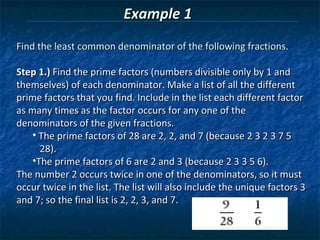
Example 1
Find the least common denominator of the following fractions.

Step 1.) Find the prime factors (numbers divisible only by 1 and
themselves) of each denominator. Make a list of all the different
prime factors that you find. Include in the list each different factor
as many times as the factor occurs for any one of the
denominators of the given fractions.
    • The prime factors of 28 are 2, 2, and 7 (because 2 3 2 3 7 5
      28).
    •The prime factors of 6 are 2 and 3 (because 2 3 3 5 6).
The number 2 occurs twice in one of the denominators, so it must
occur twice in the list. The list will also include the unique factors 3
and 7; so the final list is 2, 2, 3, and 7.
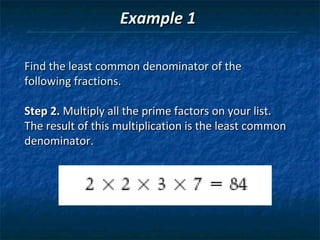
Example 1

Find the least common denominator of the
following fractions.

Step 2. Multiply all the prime factors on your list.
The result of this multiplication is the least common
denominator.
Example 1
Find the least common denominator of the following fractions.

Step 3. To convert a fraction to an equivalent fraction with the
common denominator, first divide the least common
denominator by the denominator of the fraction, then multiply
both the numerator and denominator by the result (the
quotient).
   •The least common denominator of 9⁄28 and 1⁄6 is 84. In the
   first fraction, 84 divided by 28 is 3, so multiply both the
   numerator and the denominator by 3.
Example 1

Find the least common denominator of the following
fractions.

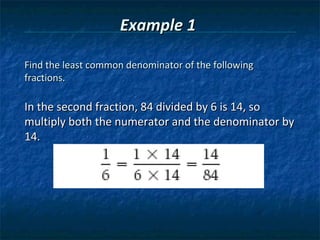
In the second fraction, 84 divided by 6 is 14, so
multiply both the numerator and the denominator by
14.
Example 1

Find the least common denominator of the following
fractions.

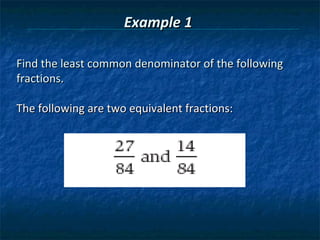
The following are two equivalent fractions:
Example 1
Find the least common denominator of the following
fractions.

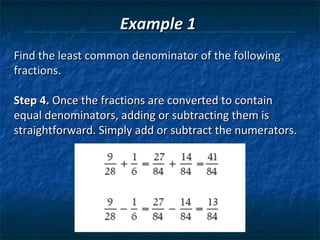
Step 4. Once the fractions are converted to contain
equal denominators, adding or subtracting them is
straightforward. Simply add or subtract the numerators.
Multiplying Fractions

• When multiplying fractions, multiply the
 numerators by numerators and denominators
by
denominators.

• In other words, multiply all numbers above the
 line; then multiply all numbers below the line.

• Cancel if possible and reduce to lowest terms.
Multiplying Fractions

Dividing the denominator by a number is the
same as multiplying the numerator by that
number.

                 3 × 5 15 3
                      =   =
                  20    20 4
Multiplying Fractions

Dividing the numerator by a number is the same
as multiplying the denominator by that number.


                   6    6 1
                      =  =
                 4 × 3 12 2
Dividing Fractions


To divide by a fraction, multiply by its reciprocal,
and then reduce it if necessary.


                 1 1× 3 3
                     =   = =3
                1/ 3   1  1
Reciprocals
   Reciprocals are two different fractions that equal 1 when
    multiplied together.
   Every fraction has a reciprocal (except those fractions
    with zero in the numerator). The easiest way to find the
    reciprocal of a fraction is to switch the numerator and
    denominator, or just turn the fraction over.
   To find the reciprocal of a whole number, just put 1 over
    the whole number.
   EXAMPLE:
      The reciprocal of 2 is 1/2.
Example 2
Multiply the two given fractions
Decimal Places


  1000         500           50
                                           5          0.5
   mg          mg            mg            mg
                                                      mg


Whole    0.5           0.05           0.005          0.0005
         tenths        hundredths     thousands      ten thousands

         (1 place to   (2 places to   (3 places to   (4 places to
         the right)    the right)     the right)     the right)
Decimals
Adding or Subtracting Decimals
• Place the numbers in columns so that the decimal points are
  aligned directly under each other.
• Add or subtract from the right column to the left column.
Multiplying Decimals
• Multiply two decimals as whole numbers.
• Add the total number of decimal places that are in the two
  numbers being multiplied.
• Count that number of places from right to left in the answer,
  and insert a decimal point.
Decimals
Dividing Decimals
1. Change both the divisor and dividend to whole numbers
    by moving their decimal points the same number of
    places to the right.
    • divisor: number doing the dividing, the denominator
    • dividend: number being divided, the numerator

2. If the divisor and the dividend have a different number of
   digits after the decimal point, choose the one that has
   more digits and move its decimal point a sufficient
   number of places to make it a whole number.
Decimals
Dividing Decimals
3. Move the decimal point in the other number the same number
    of places, adding zeros at the end if necessary.
4. Move the decimal point in the dividend the same number of
    places, adding a zero at the end.

                      1.45 ÷ 3.625 = 0.4


                     1.45 1450
                          =     = 0. 4
                     3.625 3625
Decimals
Rounding to the Nearest Tenth
1. Carry the division out to the hundredth place
2. If the hundredth place number ≥ 5, + 1 to the
   tenth place
3. If the hundredth place number ≤ 5, round the
   number down by omitting the digit in the
   hundredth place:

       5.65 becomes 5.7 4.24 becomes 4.2
Decimals

Rounding to the Nearest Hundredth or
         Thousandth Place

            3.8421 = 3.84
          41.2674 = 41.27
           0.3928 = 0.393
           4.1111 = 4.111
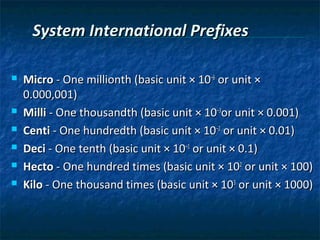
System International Prefixes

   Micro - One millionth (basic unit × 10–6 or unit ×
    0.000,001)
   Milli - One thousandth (basic unit × 10–3or unit × 0.001)
   Centi - One hundredth (basic unit × 10–2 or unit × 0.01)
   Deci - One tenth (basic unit × 10–1 or unit × 0.1)
   Hecto - One hundred times (basic unit × 102 or unit × 100)
   Kilo - One thousand times (basic unit × 103 or unit × 1000)
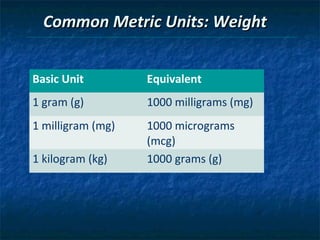
Common Metric Units: Weight


Basic Unit         Equivalent
1 gram (g)         1000 milligrams (mg)
1 milligram (mg)   1000 micrograms
                   (mcg)
1 kilogram (kg)    1000 grams (g)
Common Metric Conversions
   kilograms (kg) to grams (g)
      Multiply by 1000 (move decimal point three places to the
        right).
      Example: 6.25 kg = 6250 g

   grams (g) to milligrams (mg)
      Multiply by 1000 (move decimal point three places to the

        right).
      Example: 3.56 g = 3560 mg

   milligrams (mg) to grams (g)
      Multiply by 0.001 (move decimal point three places to the

        left).
      Example: 120 mg = 0.120 g
Common Metric Conversions
   Liters (L) to milliliters (mL)
      Multiply by 1000 (move decimal point three

       places to the right).
      Exmaple: 2.5 L = 2500 mL

   Milliliters (mL) to liters (L)
      Multiply by 0.001 (move decimal point three

       places to the left).
      Example: 238 mL = 0.238 L
Avoirdupois System


   1 gr (grain)   - 65 mg
   1 oz (ounce)   - 437.5 gr or 30 g (28.35 g)
   1 lb (pound)   - 16 oz or 7000 gr or 1.3 g
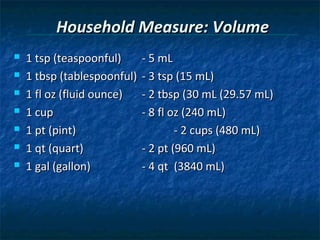
Household Measure: Volume
   1 tsp (teaspoonful)      - 5 mL
   1 tbsp (tablespoonful)   - 3 tsp (15 mL)
   1 fl oz (fluid ounce)    - 2 tbsp (30 mL (29.57 mL)
   1 cup                    - 8 fl oz (240 mL)
   1 pt (pint)                      - 2 cups (480 mL)
   1 qt (quart)             - 2 pt (960 mL)
   1 gal (gallon)           - 4 qt (3840 mL)
Household Measure: Weight

   1 oz (ounce)   - 30 g
   1 lb (pound)   - 16 oz (454 g)
   2.2 lb         - 1 kg
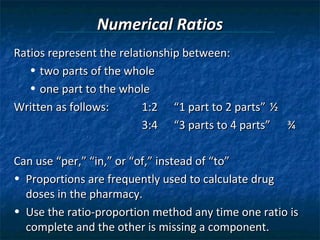
Numerical Ratios
Ratios represent the relationship between:
   • two parts of the whole
   • one part to the whole
Written as follows:       1:2 “1 part to 2 parts” ½
                          3:4 “3 parts to 4 parts” ¾

Can use “per,” “in,” or “of,” instead of “to”
• Proportions are frequently used to calculate drug
  doses in the pharmacy.
• Use the ratio-proportion method any time one ratio is
  complete and the other is missing a component.
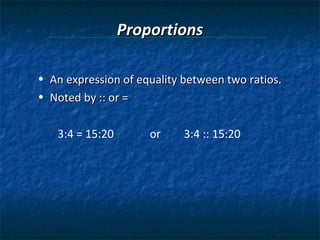
Proportions

• An expression of equality between two ratios.
• Noted by :: or =

   3:4 = 15:20       or     3:4 :: 15:20
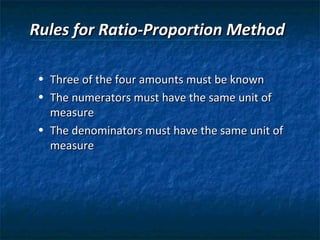
Rules for Ratio-Proportion Method

 • Three of the four amounts must be known
 • The numerators must have the same unit of
   measure
 • The denominators must have the same unit of
   measure
Steps for Solving for X
1. Calculate the proportion by placing the ratios in
   fraction form so that the x is in the upper-left corner.
2. Check that the unit of measurement in the
   numerators is the same and the unit of measurement
   in the denominators is the same.
3. Solve for x by multiplying both sides of the proportion
   by the denominator of the ratio containing the
   unknown, and cancel.
4. Check your answer by seeing if the product of the
   means equals the product of the extremes.
Remember
When setting up a proportion to solve a
conversion, the units in the numerators must
match, and the units in the denominators must
match.
Example 3 Solve for X
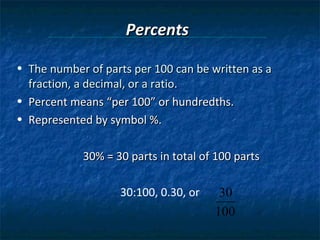
Percents

• The number of parts per 100 can be written as a
  fraction, a decimal, or a ratio.
• Percent means “per 100” or hundredths.
• Represented by symbol %.

            30% = 30 parts in total of 100 parts

                   30:100, 0.30, or    30
                                      100
Percents in the Pharmacy
• Percent strengths are used to describe IV
  solutions and topically applied drugs.

• The higher the % of dissolved substances, the
  greater the strength.

• A 1% solution contains
   • 1 g of drug per 100 mL of fluid
   • Expressed as 1:100, 1/100, or 0.01
Equivalent Values


     45
    100

    0.5
    100
Converting a Ratio to a Percent

1. Designate the first number of the ratio as the
   numerator and the second number as the
   denominator.
2. Multiply the fraction by 100%, and simplify as
   needed.
3. Multiplying a number or a fraction by 100%
   does not change the value.
Converting a Ratio to a Percent

5:1 = 5/1 × 100% = 5 × 100% = 500%

1:5 = 1/5 × 100% = 100%/5 = 20%

1:2 = 1/2 × 100% = 100%/2 = 50%
Converting a Percent to a Ratio

1. Change the percent to a fraction by dividing it
   by 100.
2. Reduce the fraction to its lowest terms.
3. Express this as a ratio by making the
   numerator the first number of the ratio and
   the denominator the second number.
Converting a Percent to a Ratio

 2% = 2 ÷ 100 = 2/100 = 1/50 = 1:50
 10% = 10 ÷ 100 = 10/100 = 1/10 = 1:10
 75% = 75 ÷ 100 = 75/100 = 3/4 = 3:4
Converting a Percent to a Decimal

1. Divide by 100% or insert a decimal point two
   places to the left of the last number, inserting
   zeros if necessary.

2. Drop the % symbol.
Converting a Decimal to a Percent

1. Multiply by 100% or insert a decimal point
   two places to the right of the last number,
   inserting zeros if necessary.

2. Add the the % symbol.
                 symbol
Percent to Decimal
4% = 0.04        4 ÷ 100% = 0.04
15% = 0.15       15 ÷ 100% = 0.15
200% = 2         200 ÷ 100% = 2


          Decimal to Percent
0.25 = 25%       0.25 × 100% = 25%
1.35 = 135%      1.35 × 100% = 135%
0.015 = 1.5%     0.015 × 100% = 1.5%
Example 4

How many milliliters are there in 1 gal, 12 fl oz?

According to the values in Table 5.7, 3840 mL are found in
1 gal. Because 1 fl oz contains 30 mL, you can use the ratio-
proportion method to calculate the amount of milliliters in
12 fl oz as follows:
Example 4
How many milliliters are there in 1 gal, 12 fl oz?
Example
  A solution is to be used to fill hypodermic syringes,
   each containing 60 mL, and 3 L of the solution is
available. How many hypodermic syringes can be filled
                 with the 3 L of solution?

1 L is 1000 mL. The available supply of solution is therefore


Determine the number of syringes by using the ratio-proportion
method:
Example
How many hypodermic syringes can be filled with the 3
                 L of solution?
Example
You are to dispense 300 mL of a liquid preparation. If
the dose is 2 tsp, how many doses will there be in the
                   final preparation?


 Begin solving this problem by converting to a
 common unit of measure using conversion values.
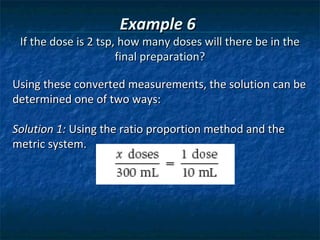
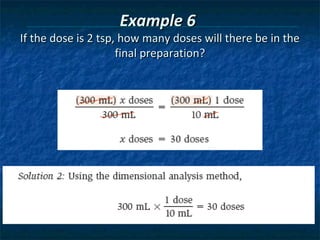
Example 6
 If the dose is 2 tsp, how many doses will there be in the
                      final preparation?

Using these converted measurements, the solution can be
determined one of two ways:

Solution 1: Using the ratio proportion method and the
metric system.
Example 6
If the dose is 2 tsp, how many doses will there be in the
                     final preparation?
Example 7
        How many grains of acetaminophen
 should be used in a Rx for 400 mg acetaminophen?

Solve this problem by using the ratio-proportion method.
The unknown number of grains and the requested
number of milligrams go on the left side, and the ratio of
1 gr 65 mg goes on the right side, per Table 5.5.
Example 7
How many grains of acetaminophen
should be used in the prescription?
Example 8
    A physician wants a patient to be given 0.8 mg of
      nitroglycerin. On hand are tablets containing
  nitroglycerin 1/150 gr. How many tablets should the
                     patient be given?


Begin solving this problem by determining the number of
grains in a dose by setting up a proportion and solving
for the unknown.
Example 8
How many tablets should the patient be given?
Common Calculations in the
          Pharmacy


• Calculations of Doses
Active ingredient (to be administered)/solution
(needed)
                   =
Active ingredient (available)/solution
(available)
Example 9
You have a stock solution that contains 10 mg of active
ingredient per 5 mL of solution. The physician orders a
dose of 4 mg. How many milliliters of the stock solution
            will have to be administered?
Example 9
How many milliliters of the stock solution will have to
                  be administered?
Example 10
An order calls for Demerol 75 mg IM q4h prn pain. The
 supply available is in Demerol 100 mg/mL syringes.
   How many milliliters will the nurse give for one
                       injection?
Example 10
How many milliliters will the nurse give for one
                  injection?
Example 11

An average adult has a BSA of 1.72 m2 and requires
an adult dose of 12 mg of a given medication. A child
has a BSA of 0.60 m2.
If the proper dose for pediatric and adult patients is a
linear function of the BSA, what is the proper
pediatric dose? Round off the final answer.
Example 11
What is the proper pediatric dose?
Example 11
What is the proper pediatric dose?
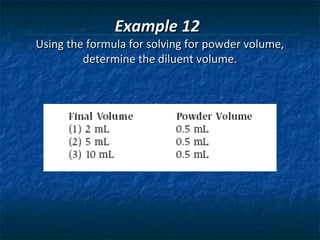
Example 12

A dry powder antibiotic must be reconstituted for
use. The label states that the dry powder occupies
0.5 mL. Using the formula for solving for powder
volume, determine the diluent volume (the amount
of solvent added). You are given the final volume for
three different examples with the same powder
volume.
Example 12
Using the formula for solving for powder volume,
         determine the diluent volume.
Example 12
Using the formula for solving for powder volume,
         determine the diluent volume.
Example 13

You are to reconstitute 1 g of dry powder. The label
states that you are to add 9.3 mL of diluent to make
a final solution of 100 mg/mL. What is the powder
volume?
Example 13
               What is the powder volume?

Step 1. Calculate the final
volume. The strength of the
final solution will be 100
mg/mL.
mg/mL
Example 13
What is the powder volume?
Example 14

Dexamethasone is available as a 4 mg/mL
preparation. An infant is to receive 0.35 mg. Prepare
a dilution so that the final concentration is 1 mg/mL.
How much diluent will you need if the original
product is in a 1 mL vial and you dilute the entire
vial?
Example 14
How much diluent will you need if the original product is in a 1 mL vial
                  and you dilute the entire vial?
Example 14
How much diluent will you need if the original product
   is in a 1 mL vial and you dilute the entire vial?
Example 15


Prepare 250 mL of dextrose 7.5% weight in volume
(w/v) using dextrose 5% (D5W) w/v and dextrose
50% (D50W) w/v. How many milliliters of each will
be needed?
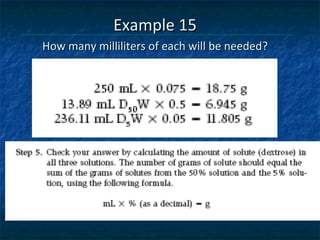
Example 15
      How many milliliters of each will be needed?


Step 1. Set up a box arrangement and at the upper-left
corner, write the percent of the highest concentration
(50%) as a whole number.
Example 15
      How many milliliters of each will be needed?


Step 2. Subtract the center number from the upper-left
number (i.e., the smaller from the larger) and put it at
the lower-right corner. Now subtract the lower-left
number from the center number (i.e., the smaller from
the larger), and put it at the upper-right corner.
Example 15
     How many milliliters of each will be needed?

50                       2.5 mL parts D50W


           7.5


5                     42.5 mL parts D5W
                      45 mL total parts D7.5W
Example 15
How many milliliters of each will be needed?
Example 15
How many milliliters of each will be needed?
Example 15
How many milliliters of each will be needed?
Example 15
How many milliliters of each will be needed?
Example 15
How many milliliters of each will be needed?
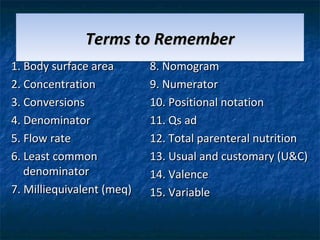
Terms to Remember
1. Body surface area       8. Nomogram
2. Concentration           9. Numerator
3. Conversions             10. Positional notation
4. Denominator             11. Qs ad
5. Flow rate               12. Total parenteral nutrition
6. Least common            13. Usual and customary (U&C)
   denominator             14. Valence
7. Milliequivalent (meq)   15. Variable

Chapter 6 pharmacy calculation

  • 1.
    The Pharmacy Technician 4E Chapter 6 Basic Pharmaceutical Measurement Calculation
  • 2.
    Topic Outline  Numbers  Percents & Solutions  Fractions  Alligation  Decimal Numbers  Powder Volume  Significant Figures  Children’s Doses  Measurement  Calculations for  Equations & Variables Business  Ratio & Proportion
  • 3.
    Comparison of Romanand Arabic Numerals
  • 4.
    Example:  xxx = 30 or 10 plus 10 plus 10  DC = 600 or 500 plus 100  LXVI = 66 or 50 plus 10 plus 5 plus 1 When the second of two letters has a value greater than that of the first, the smaller is to be subtracted from the larger.
  • 5.
    Fractions • When somethingis divided into parts, each part is considered a fraction of the whole. • If a pie is cut into 8 slices, one slice can be expressed as 1/8, or one piece (1) of the whole (8). If we have a 1000 mg tablet, • ½ tablet = 500 mg • ¼ tablet = 250 mg
  • 6.
    Fractions Fractions have twoparts: 1 • Numerator (the top part) 8 • Denominator (the bottom part) 1 8
  • 7.
    Fractions A fraction withthe same numerator and the same denominator has a value equivalent to 1. In other words, if you have 8 pieces of a pie that has been cut into 8 pieces, you have 1 pie. 8 =1 8
  • 8.
    Terminology Proper fraction • Afraction with a value of less than 1. 1 • A fraction with a numerator value smaller than the <1 denominator’s value. 4 Improper fraction • A fraction with a value larger than 1. • A fraction with a numerator value larger than the 6 denominator’s value. >1 5
  • 9.
    Adding or SubtractingFractions • When adding or subtracting fractions with unlike denominators, it is necessary to create a common denominator. •This is like making both fractions into the same kind of “pie.” • Common denominator is a number that each of the unlike denominators of two or more fractions can be divided evenly.
  • 10.
    Remember Multiplying a numberby 1 does not change the value of the number. 5 ×1 = 5 Therefore, if you multiply a fraction by a fraction that equals 1 (such as 5/5), you do not change the value of a fraction. 5× 5 = 5 5
  • 11.
    Guidelines for Findinga Common Denominator 1. Examine each denominator in the given fractions for its divisors, or factors. 2. See what factors any of the denominators have in common. 3. Form a common denominator by multiplying all the factors that occur in all of the denominators. If a factor occurs more than once, use it the largest number of times it occurs in any denominator.
  • 12.
    Example 1 Find theleast common denominator of the following fractions. Step 1.) Find the prime factors (numbers divisible only by 1 and themselves) of each denominator. Make a list of all the different prime factors that you find. Include in the list each different factor as many times as the factor occurs for any one of the denominators of the given fractions. • The prime factors of 28 are 2, 2, and 7 (because 2 3 2 3 7 5 28). •The prime factors of 6 are 2 and 3 (because 2 3 3 5 6). The number 2 occurs twice in one of the denominators, so it must occur twice in the list. The list will also include the unique factors 3 and 7; so the final list is 2, 2, 3, and 7.
  • 13.
    Example 1 Find theleast common denominator of the following fractions. Step 2. Multiply all the prime factors on your list. The result of this multiplication is the least common denominator.
  • 14.
    Example 1 Find theleast common denominator of the following fractions. Step 3. To convert a fraction to an equivalent fraction with the common denominator, first divide the least common denominator by the denominator of the fraction, then multiply both the numerator and denominator by the result (the quotient). •The least common denominator of 9⁄28 and 1⁄6 is 84. In the first fraction, 84 divided by 28 is 3, so multiply both the numerator and the denominator by 3.
  • 15.
    Example 1 Find theleast common denominator of the following fractions. In the second fraction, 84 divided by 6 is 14, so multiply both the numerator and the denominator by 14.
  • 16.
    Example 1 Find theleast common denominator of the following fractions. The following are two equivalent fractions:
  • 17.
    Example 1 Find theleast common denominator of the following fractions. Step 4. Once the fractions are converted to contain equal denominators, adding or subtracting them is straightforward. Simply add or subtract the numerators.
  • 18.
    Multiplying Fractions • Whenmultiplying fractions, multiply the numerators by numerators and denominators by denominators. • In other words, multiply all numbers above the line; then multiply all numbers below the line. • Cancel if possible and reduce to lowest terms.
  • 19.
    Multiplying Fractions Dividing thedenominator by a number is the same as multiplying the numerator by that number. 3 × 5 15 3 = = 20 20 4
  • 20.
    Multiplying Fractions Dividing thenumerator by a number is the same as multiplying the denominator by that number. 6 6 1 = = 4 × 3 12 2
  • 21.
    Dividing Fractions To divideby a fraction, multiply by its reciprocal, and then reduce it if necessary. 1 1× 3 3 = = =3 1/ 3 1 1
  • 22.
    Reciprocals  Reciprocals are two different fractions that equal 1 when multiplied together.  Every fraction has a reciprocal (except those fractions with zero in the numerator). The easiest way to find the reciprocal of a fraction is to switch the numerator and denominator, or just turn the fraction over.  To find the reciprocal of a whole number, just put 1 over the whole number.  EXAMPLE:  The reciprocal of 2 is 1/2.
  • 23.
    Example 2 Multiply thetwo given fractions
  • 24.
    Decimal Places 1000 500 50 5 0.5 mg mg mg mg mg Whole 0.5 0.05 0.005 0.0005 tenths hundredths thousands ten thousands (1 place to (2 places to (3 places to (4 places to the right) the right) the right) the right)
  • 25.
    Decimals Adding or SubtractingDecimals • Place the numbers in columns so that the decimal points are aligned directly under each other. • Add or subtract from the right column to the left column. Multiplying Decimals • Multiply two decimals as whole numbers. • Add the total number of decimal places that are in the two numbers being multiplied. • Count that number of places from right to left in the answer, and insert a decimal point.
  • 26.
    Decimals Dividing Decimals 1. Changeboth the divisor and dividend to whole numbers by moving their decimal points the same number of places to the right. • divisor: number doing the dividing, the denominator • dividend: number being divided, the numerator 2. If the divisor and the dividend have a different number of digits after the decimal point, choose the one that has more digits and move its decimal point a sufficient number of places to make it a whole number.
  • 27.
    Decimals Dividing Decimals 3. Movethe decimal point in the other number the same number of places, adding zeros at the end if necessary. 4. Move the decimal point in the dividend the same number of places, adding a zero at the end. 1.45 ÷ 3.625 = 0.4 1.45 1450 = = 0. 4 3.625 3625
  • 28.
    Decimals Rounding to theNearest Tenth 1. Carry the division out to the hundredth place 2. If the hundredth place number ≥ 5, + 1 to the tenth place 3. If the hundredth place number ≤ 5, round the number down by omitting the digit in the hundredth place: 5.65 becomes 5.7 4.24 becomes 4.2
  • 29.
    Decimals Rounding to theNearest Hundredth or Thousandth Place 3.8421 = 3.84 41.2674 = 41.27 0.3928 = 0.393 4.1111 = 4.111
  • 30.
    System International Prefixes  Micro - One millionth (basic unit × 10–6 or unit × 0.000,001)  Milli - One thousandth (basic unit × 10–3or unit × 0.001)  Centi - One hundredth (basic unit × 10–2 or unit × 0.01)  Deci - One tenth (basic unit × 10–1 or unit × 0.1)  Hecto - One hundred times (basic unit × 102 or unit × 100)  Kilo - One thousand times (basic unit × 103 or unit × 1000)
  • 31.
    Common Metric Units:Weight Basic Unit Equivalent 1 gram (g) 1000 milligrams (mg) 1 milligram (mg) 1000 micrograms (mcg) 1 kilogram (kg) 1000 grams (g)
  • 32.
    Common Metric Conversions  kilograms (kg) to grams (g)  Multiply by 1000 (move decimal point three places to the right).  Example: 6.25 kg = 6250 g  grams (g) to milligrams (mg)  Multiply by 1000 (move decimal point three places to the right).  Example: 3.56 g = 3560 mg  milligrams (mg) to grams (g)  Multiply by 0.001 (move decimal point three places to the left).  Example: 120 mg = 0.120 g
  • 33.
    Common Metric Conversions  Liters (L) to milliliters (mL)  Multiply by 1000 (move decimal point three places to the right).  Exmaple: 2.5 L = 2500 mL  Milliliters (mL) to liters (L)  Multiply by 0.001 (move decimal point three places to the left).  Example: 238 mL = 0.238 L
  • 34.
    Avoirdupois System  1 gr (grain) - 65 mg  1 oz (ounce) - 437.5 gr or 30 g (28.35 g)  1 lb (pound) - 16 oz or 7000 gr or 1.3 g
  • 35.
    Household Measure: Volume  1 tsp (teaspoonful) - 5 mL  1 tbsp (tablespoonful) - 3 tsp (15 mL)  1 fl oz (fluid ounce) - 2 tbsp (30 mL (29.57 mL)  1 cup - 8 fl oz (240 mL)  1 pt (pint) - 2 cups (480 mL)  1 qt (quart) - 2 pt (960 mL)  1 gal (gallon) - 4 qt (3840 mL)
  • 36.
    Household Measure: Weight  1 oz (ounce) - 30 g  1 lb (pound) - 16 oz (454 g)  2.2 lb - 1 kg
  • 37.
    Numerical Ratios Ratios representthe relationship between: • two parts of the whole • one part to the whole Written as follows: 1:2 “1 part to 2 parts” ½ 3:4 “3 parts to 4 parts” ¾ Can use “per,” “in,” or “of,” instead of “to” • Proportions are frequently used to calculate drug doses in the pharmacy. • Use the ratio-proportion method any time one ratio is complete and the other is missing a component.
  • 38.
    Proportions • An expressionof equality between two ratios. • Noted by :: or = 3:4 = 15:20 or 3:4 :: 15:20
  • 39.
    Rules for Ratio-ProportionMethod • Three of the four amounts must be known • The numerators must have the same unit of measure • The denominators must have the same unit of measure
  • 40.
    Steps for Solvingfor X 1. Calculate the proportion by placing the ratios in fraction form so that the x is in the upper-left corner. 2. Check that the unit of measurement in the numerators is the same and the unit of measurement in the denominators is the same. 3. Solve for x by multiplying both sides of the proportion by the denominator of the ratio containing the unknown, and cancel. 4. Check your answer by seeing if the product of the means equals the product of the extremes.
  • 41.
    Remember When setting upa proportion to solve a conversion, the units in the numerators must match, and the units in the denominators must match.
  • 42.
  • 43.
    Percents • The numberof parts per 100 can be written as a fraction, a decimal, or a ratio. • Percent means “per 100” or hundredths. • Represented by symbol %. 30% = 30 parts in total of 100 parts 30:100, 0.30, or 30 100
  • 44.
    Percents in thePharmacy • Percent strengths are used to describe IV solutions and topically applied drugs. • The higher the % of dissolved substances, the greater the strength. • A 1% solution contains • 1 g of drug per 100 mL of fluid • Expressed as 1:100, 1/100, or 0.01
  • 45.
    Equivalent Values 45 100 0.5 100
  • 46.
    Converting a Ratioto a Percent 1. Designate the first number of the ratio as the numerator and the second number as the denominator. 2. Multiply the fraction by 100%, and simplify as needed. 3. Multiplying a number or a fraction by 100% does not change the value.
  • 47.
    Converting a Ratioto a Percent 5:1 = 5/1 × 100% = 5 × 100% = 500% 1:5 = 1/5 × 100% = 100%/5 = 20% 1:2 = 1/2 × 100% = 100%/2 = 50%
  • 48.
    Converting a Percentto a Ratio 1. Change the percent to a fraction by dividing it by 100. 2. Reduce the fraction to its lowest terms. 3. Express this as a ratio by making the numerator the first number of the ratio and the denominator the second number.
  • 49.
    Converting a Percentto a Ratio 2% = 2 ÷ 100 = 2/100 = 1/50 = 1:50 10% = 10 ÷ 100 = 10/100 = 1/10 = 1:10 75% = 75 ÷ 100 = 75/100 = 3/4 = 3:4
  • 50.
    Converting a Percentto a Decimal 1. Divide by 100% or insert a decimal point two places to the left of the last number, inserting zeros if necessary. 2. Drop the % symbol.
  • 51.
    Converting a Decimalto a Percent 1. Multiply by 100% or insert a decimal point two places to the right of the last number, inserting zeros if necessary. 2. Add the the % symbol. symbol
  • 52.
    Percent to Decimal 4%= 0.04 4 ÷ 100% = 0.04 15% = 0.15 15 ÷ 100% = 0.15 200% = 2 200 ÷ 100% = 2 Decimal to Percent 0.25 = 25% 0.25 × 100% = 25% 1.35 = 135% 1.35 × 100% = 135% 0.015 = 1.5% 0.015 × 100% = 1.5%
  • 53.
    Example 4 How manymilliliters are there in 1 gal, 12 fl oz? According to the values in Table 5.7, 3840 mL are found in 1 gal. Because 1 fl oz contains 30 mL, you can use the ratio- proportion method to calculate the amount of milliliters in 12 fl oz as follows:
  • 54.
    Example 4 How manymilliliters are there in 1 gal, 12 fl oz?
  • 55.
    Example Asolution is to be used to fill hypodermic syringes, each containing 60 mL, and 3 L of the solution is available. How many hypodermic syringes can be filled with the 3 L of solution? 1 L is 1000 mL. The available supply of solution is therefore Determine the number of syringes by using the ratio-proportion method:
  • 56.
    Example How many hypodermicsyringes can be filled with the 3 L of solution?
  • 57.
    Example You are todispense 300 mL of a liquid preparation. If the dose is 2 tsp, how many doses will there be in the final preparation? Begin solving this problem by converting to a common unit of measure using conversion values.
  • 58.
    Example 6 Ifthe dose is 2 tsp, how many doses will there be in the final preparation? Using these converted measurements, the solution can be determined one of two ways: Solution 1: Using the ratio proportion method and the metric system.
  • 59.
    Example 6 If thedose is 2 tsp, how many doses will there be in the final preparation?
  • 60.
    Example 7 How many grains of acetaminophen should be used in a Rx for 400 mg acetaminophen? Solve this problem by using the ratio-proportion method. The unknown number of grains and the requested number of milligrams go on the left side, and the ratio of 1 gr 65 mg goes on the right side, per Table 5.5.
  • 61.
    Example 7 How manygrains of acetaminophen should be used in the prescription?
  • 62.
    Example 8 A physician wants a patient to be given 0.8 mg of nitroglycerin. On hand are tablets containing nitroglycerin 1/150 gr. How many tablets should the patient be given? Begin solving this problem by determining the number of grains in a dose by setting up a proportion and solving for the unknown.
  • 63.
    Example 8 How manytablets should the patient be given?
  • 64.
    Common Calculations inthe Pharmacy • Calculations of Doses Active ingredient (to be administered)/solution (needed) = Active ingredient (available)/solution (available)
  • 65.
    Example 9 You havea stock solution that contains 10 mg of active ingredient per 5 mL of solution. The physician orders a dose of 4 mg. How many milliliters of the stock solution will have to be administered?
  • 66.
    Example 9 How manymilliliters of the stock solution will have to be administered?
  • 67.
    Example 10 An ordercalls for Demerol 75 mg IM q4h prn pain. The supply available is in Demerol 100 mg/mL syringes. How many milliliters will the nurse give for one injection?
  • 68.
    Example 10 How manymilliliters will the nurse give for one injection?
  • 69.
    Example 11 An averageadult has a BSA of 1.72 m2 and requires an adult dose of 12 mg of a given medication. A child has a BSA of 0.60 m2. If the proper dose for pediatric and adult patients is a linear function of the BSA, what is the proper pediatric dose? Round off the final answer.
  • 70.
    Example 11 What isthe proper pediatric dose?
  • 71.
    Example 11 What isthe proper pediatric dose?
  • 72.
    Example 12 A drypowder antibiotic must be reconstituted for use. The label states that the dry powder occupies 0.5 mL. Using the formula for solving for powder volume, determine the diluent volume (the amount of solvent added). You are given the final volume for three different examples with the same powder volume.
  • 73.
    Example 12 Using theformula for solving for powder volume, determine the diluent volume.
  • 74.
    Example 12 Using theformula for solving for powder volume, determine the diluent volume.
  • 75.
    Example 13 You areto reconstitute 1 g of dry powder. The label states that you are to add 9.3 mL of diluent to make a final solution of 100 mg/mL. What is the powder volume?
  • 76.
    Example 13 What is the powder volume? Step 1. Calculate the final volume. The strength of the final solution will be 100 mg/mL. mg/mL
  • 77.
    Example 13 What isthe powder volume?
  • 78.
    Example 14 Dexamethasone isavailable as a 4 mg/mL preparation. An infant is to receive 0.35 mg. Prepare a dilution so that the final concentration is 1 mg/mL. How much diluent will you need if the original product is in a 1 mL vial and you dilute the entire vial?
  • 79.
    Example 14 How muchdiluent will you need if the original product is in a 1 mL vial and you dilute the entire vial?
  • 80.
    Example 14 How muchdiluent will you need if the original product is in a 1 mL vial and you dilute the entire vial?
  • 81.
    Example 15 Prepare 250mL of dextrose 7.5% weight in volume (w/v) using dextrose 5% (D5W) w/v and dextrose 50% (D50W) w/v. How many milliliters of each will be needed?
  • 82.
    Example 15 How many milliliters of each will be needed? Step 1. Set up a box arrangement and at the upper-left corner, write the percent of the highest concentration (50%) as a whole number.
  • 83.
    Example 15 How many milliliters of each will be needed? Step 2. Subtract the center number from the upper-left number (i.e., the smaller from the larger) and put it at the lower-right corner. Now subtract the lower-left number from the center number (i.e., the smaller from the larger), and put it at the upper-right corner.
  • 84.
    Example 15 How many milliliters of each will be needed? 50 2.5 mL parts D50W 7.5 5 42.5 mL parts D5W 45 mL total parts D7.5W
  • 85.
    Example 15 How manymilliliters of each will be needed?
  • 86.
    Example 15 How manymilliliters of each will be needed?
  • 87.
    Example 15 How manymilliliters of each will be needed?
  • 88.
    Example 15 How manymilliliters of each will be needed?
  • 89.
    Example 15 How manymilliliters of each will be needed?
  • 90.
    Terms to Remember 1.Body surface area 8. Nomogram 2. Concentration 9. Numerator 3. Conversions 10. Positional notation 4. Denominator 11. Qs ad 5. Flow rate 12. Total parenteral nutrition 6. Least common 13. Usual and customary (U&C) denominator 14. Valence 7. Milliequivalent (meq) 15. Variable