The Pharmacy
Technician 4E
Chapter 13
 Inventory
Management
Chapter Outline

   Inventory Management
   Inventory Systems
   Computer & Inventory
   Ordering
   Forms
   Stocking & Storing
Inventory Management
• Inventory
   • A listing of medication of the goods or items that a
     business will use in its normal operation.
   • Inventory management is an integral part of the
     technician’s job responsibility.
• The goal of inventory management
   • To ensure that drugs are available when they are
     needed (usually are often urgently needed).
• Purchasing/inventory technician
   • A name given to those who are responsible for
     ordering and maintaining inventory.
Wholesalers
•   Purchasing
     • Usually carried out by either an independent or

       group process. The Controlled Substances Act (CSA)
       defines procedures for purchasing.
     • Most drugs are bought from wholesalers or

       distributors.
     • More than three-quarters of pharmaceutical

       manufacturers sales are sold to wholesalers.
Wholesalers

•   Thousands of manufactures produce medications and
    it would difficult to deal with each of them (ordering,
    shipping, payment arraignments, paperwork
    requirement, etc.).
•   Stock inventories of the most used medications and
    make frequent deliveries, often on a daily basis.
•   Provide system for ordering, automated purchasing
    systems, emergency delivery, etc.
The Formulary
   The Formulary
      A list of medications that are approved for use in the hospital
       or an institution.
   Open formulary
      Allows purchase of any medication that is prescribed.
   Closed formulary
      A limited list of approved medications.
      A physician must receive permission to use a medication that
       is not on the list.
      Generally used as a cost savings tool, in which less expensive
       substitutes are stocked.
      A Therapeutic equivalent that is chemically different but with
       similar actions and effects may be substituted for a drug not
       on the formulary.
Inventory Management
• The Drug Enforcement Administration (DEA)
   • Regulates the distribution of controlled substance and has
      various distribution, inventory, record keeping, and
      ordering requirements.
• The DEA requires that a complete inventory of all controlled
  substances must be taken every 2 years.
   • Some states have more stringent requirements such as a
      yearly inventory.
• The complete inventory must include an inventory record and
  an extemporaneous compounding record.
   • Schedule II substances must be stocked separately in a
      secure place and require a special order form for
      reordering.
Safe Purchasing
   It is important to deal only with well-known or
    established wholesalers and suppliers who can
    document the pedigree or path of a drug from
    manufacturer to consumer.
   Unscrupulous manufacturers can made counterfeit
    medications, which may look like an established
    drug, but have little or no active ingredients. They
    can sell them to lesser known wholesalers or
    suppliers.
Inventory Systems
   Track inventory, forecast needs, and generate
    reorders to maintain adequate inventory.
      Too many drugs on hand involves unnecessary cost

       and maintenance and may result in spoilage.
      Too few drugs means that medications won’t be

       available when needed.
   To maintain an adequate supply of medication,
    pharmacies use a perpetual inventory system.
      This is a requirement for Schedule II substances.
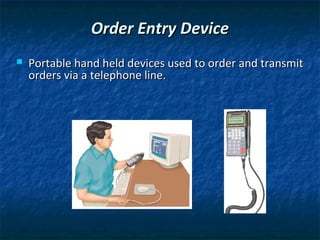
Order Entry Device
   Portable hand held devices used to order and transmit
    orders via a telephone line.
The Turnover Rate
   The Turnover Rate
      The number of days it takes to use the complete
       stock of an item.
      Besides quality and spoilage issues, there is also a
       financial consideration.
   “Thirty days net“
      The supplier must be paid by the day #30 from
       the date of delivery.
      Lower the cost of the stock.

          When stock turnover averages less than thirty
           days, the stock is be sold before the supplier
           must be paid.
Inventory Spoilage
   Time or storage conditions may cause chemical
    compounds to break down.
   Use of such medications may be dangerous.
   Check all stock for their expiration date.
   DO NOT dispense drugs whose expiration date is
    approaching.
   Expired drugs must be appropriately disposed of or
    returned to the supplier for credit.
Fast Movers and Slow Movers
   A general rule is that 20% of your stock will account
    for 80% of your orders or prescriptions.

   To keep inventory dollars low, focus on keeping a 1–
    2 week supply of fast moving drugs and a month’s
    supply of slower moving drugs.
Tools for Perpetual Inventory
   Point of sale system (POS)
      An inventory system in which the item is deducted from
       inventory as it is sold or dispensed.
   Reorder points
      The minimum and maximum stock levels which determine
       when a reorder is placed and for how much.
   Automated Reports
      As the minimum reorder point of a medication is reached,
       most computer systems will generate an automatic
       purchase order.
   Order Entry Devices
      Portable hand-held devices used to enter ordering data.
Computer and Inventory
   Computer inventory systems
      Automatically adjusts inventory and generates
       orders based on maintaining set inventory levels.
   Entering correct information
      Reports are printed out and reviewed for any
       errors.
   User passwords
      Protect against possible abuses. Users are given
       passwords to access different features of the
       system.
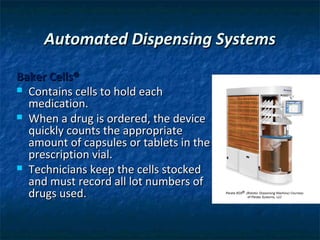
Automated Dispensing Systems

Baker Cells®
 Contains cells to hold each
  medication.
 When a drug is ordered, the device
  quickly counts the appropriate
  amount of capsules or tablets in the a
  prescription vial.
 Technicians keep the cells stocked
  and must record all lot numbers of
  drugs used.
Pyxis Supply Station®

   Example of an automated point-of-use storage
    system for making floor stock items available to
    nurses in the hospital setting.
   The system keeps record of inventory and tracks
    patient medication.
Homerus® Robotic Device
   Individually packages and stores large amounts of
    medications from bulk supplies.
   Delivers bar-coded medication to 24 hours patient
    specific medication bins.
   Returns medication to storage after a patient is
    discharged.
   Some hospitals have mobile robots that travel
    throughout the facility delivering drugs to various
    nursing units and departments.
Automated Ordering

   Orders can be generated using a order entry device or
    automatically generated by the system based on stock
    levels and reorder points.
   When the order is ready, the ordering system is sent
    over the pone lines to the wholesaler.
   If the order can be filled as ordered, a message will
    automatically confirm the order to the ordering
    system.
   Material Safety Data Sheet (MSDS) is sent for
    hazardous substances such as chemotherapeutic
    agents.
Ordering
   Each supplier has a policy and procedure for credits
    and returns that must be followed in order to receive
    the credit.

   There are companies that specialize in returns to the
    manufacturer of expired drugs and drugs removed
    from a formulary.

   The documentation must be carefully checked item by
    item to make sure the order is accurate.

   A printed copy and any electronic version must be kept
    on file.
Forms
   Online Order Screen
      The system automatically assigns a purchase order number.

   The confirmation printout
      A hard copy print out of a confirmed online purchase by the supplier.

      Indicates which items will be shipped, which will not (due to

        unavailability) and what the cost of the items.
   Shipping Invoice
      The list of items in the shipment and the cost of items provided by the

        supplier.
      Any inconsistencies from suppliers must be notified immediately.

   Return form
      A preprinted multipart form. It contains purchase order number, item

        number, quantity and reason for return.
Stocking and Storing
   Most of medications are received from the supplier in
    bulk “stock bottles” that contains a large amount
    (usually 30 or 100 tablets). In hospitals, some drugs
    come in individual doses called Unit dose packaging.

   Technicians prepare unit-dose packaging under the
    supervision of a pharmacist.

   Most pharmacies shelve drugs by their generic names
    along with the brand names.
      If generic cimetidine is on the shelf, Tagamet which a
       brand name may be placed there along with the
       generic..

   Point of use stations are supply stations, med-stations,
    or dispensing machines that stock medication.
Community Pharmacy
        Inventory Management
• Prescription vials returned by the patient CAN
  NOT be returned to stock, even if they are
  unopened.
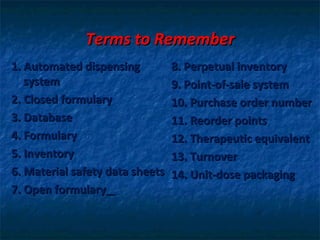
Terms to Remember
1. Automated dispensing          8. Perpetual inventory
   system                        9. Point-of-sale system
2. Closed formulary              10. Purchase order number
3. Database                      11. Reorder points
4. Formulary                     12. Therapeutic equivalent
5. Inventory                     13. Turnover
6. Material safety data sheets   14. Unit-dose packaging
7. Open formulary

Chapter 13 inventory management

  • 1.
    The Pharmacy Technician 4E Chapter13 Inventory Management
  • 2.
    Chapter Outline  Inventory Management  Inventory Systems  Computer & Inventory  Ordering  Forms  Stocking & Storing
  • 3.
    Inventory Management • Inventory • A listing of medication of the goods or items that a business will use in its normal operation. • Inventory management is an integral part of the technician’s job responsibility. • The goal of inventory management • To ensure that drugs are available when they are needed (usually are often urgently needed). • Purchasing/inventory technician • A name given to those who are responsible for ordering and maintaining inventory.
  • 4.
    Wholesalers • Purchasing • Usually carried out by either an independent or group process. The Controlled Substances Act (CSA) defines procedures for purchasing. • Most drugs are bought from wholesalers or distributors. • More than three-quarters of pharmaceutical manufacturers sales are sold to wholesalers.
  • 5.
    Wholesalers • Thousands of manufactures produce medications and it would difficult to deal with each of them (ordering, shipping, payment arraignments, paperwork requirement, etc.). • Stock inventories of the most used medications and make frequent deliveries, often on a daily basis. • Provide system for ordering, automated purchasing systems, emergency delivery, etc.
  • 6.
    The Formulary  The Formulary  A list of medications that are approved for use in the hospital or an institution.  Open formulary  Allows purchase of any medication that is prescribed.  Closed formulary  A limited list of approved medications.  A physician must receive permission to use a medication that is not on the list.  Generally used as a cost savings tool, in which less expensive substitutes are stocked.  A Therapeutic equivalent that is chemically different but with similar actions and effects may be substituted for a drug not on the formulary.
  • 7.
    Inventory Management • TheDrug Enforcement Administration (DEA) • Regulates the distribution of controlled substance and has various distribution, inventory, record keeping, and ordering requirements. • The DEA requires that a complete inventory of all controlled substances must be taken every 2 years. • Some states have more stringent requirements such as a yearly inventory. • The complete inventory must include an inventory record and an extemporaneous compounding record. • Schedule II substances must be stocked separately in a secure place and require a special order form for reordering.
  • 8.
    Safe Purchasing  It is important to deal only with well-known or established wholesalers and suppliers who can document the pedigree or path of a drug from manufacturer to consumer.  Unscrupulous manufacturers can made counterfeit medications, which may look like an established drug, but have little or no active ingredients. They can sell them to lesser known wholesalers or suppliers.
  • 9.
    Inventory Systems  Track inventory, forecast needs, and generate reorders to maintain adequate inventory.  Too many drugs on hand involves unnecessary cost and maintenance and may result in spoilage.  Too few drugs means that medications won’t be available when needed.  To maintain an adequate supply of medication, pharmacies use a perpetual inventory system.  This is a requirement for Schedule II substances.
  • 10.
    Order Entry Device  Portable hand held devices used to order and transmit orders via a telephone line.
  • 11.
    The Turnover Rate  The Turnover Rate  The number of days it takes to use the complete stock of an item.  Besides quality and spoilage issues, there is also a financial consideration.  “Thirty days net“  The supplier must be paid by the day #30 from the date of delivery.  Lower the cost of the stock.  When stock turnover averages less than thirty days, the stock is be sold before the supplier must be paid.
  • 12.
    Inventory Spoilage  Time or storage conditions may cause chemical compounds to break down.  Use of such medications may be dangerous.  Check all stock for their expiration date.  DO NOT dispense drugs whose expiration date is approaching.  Expired drugs must be appropriately disposed of or returned to the supplier for credit.
  • 13.
    Fast Movers andSlow Movers  A general rule is that 20% of your stock will account for 80% of your orders or prescriptions.  To keep inventory dollars low, focus on keeping a 1– 2 week supply of fast moving drugs and a month’s supply of slower moving drugs.
  • 14.
    Tools for PerpetualInventory  Point of sale system (POS)  An inventory system in which the item is deducted from inventory as it is sold or dispensed.  Reorder points  The minimum and maximum stock levels which determine when a reorder is placed and for how much.  Automated Reports  As the minimum reorder point of a medication is reached, most computer systems will generate an automatic purchase order.  Order Entry Devices  Portable hand-held devices used to enter ordering data.
  • 15.
    Computer and Inventory  Computer inventory systems  Automatically adjusts inventory and generates orders based on maintaining set inventory levels.  Entering correct information  Reports are printed out and reviewed for any errors.  User passwords  Protect against possible abuses. Users are given passwords to access different features of the system.
  • 16.
    Automated Dispensing Systems BakerCells®  Contains cells to hold each medication.  When a drug is ordered, the device quickly counts the appropriate amount of capsules or tablets in the a prescription vial.  Technicians keep the cells stocked and must record all lot numbers of drugs used.
  • 17.
    Pyxis Supply Station®  Example of an automated point-of-use storage system for making floor stock items available to nurses in the hospital setting.  The system keeps record of inventory and tracks patient medication.
  • 18.
    Homerus® Robotic Device  Individually packages and stores large amounts of medications from bulk supplies.  Delivers bar-coded medication to 24 hours patient specific medication bins.  Returns medication to storage after a patient is discharged.  Some hospitals have mobile robots that travel throughout the facility delivering drugs to various nursing units and departments.
  • 19.
    Automated Ordering  Orders can be generated using a order entry device or automatically generated by the system based on stock levels and reorder points.  When the order is ready, the ordering system is sent over the pone lines to the wholesaler.  If the order can be filled as ordered, a message will automatically confirm the order to the ordering system.  Material Safety Data Sheet (MSDS) is sent for hazardous substances such as chemotherapeutic agents.
  • 20.
    Ordering  Each supplier has a policy and procedure for credits and returns that must be followed in order to receive the credit.  There are companies that specialize in returns to the manufacturer of expired drugs and drugs removed from a formulary.  The documentation must be carefully checked item by item to make sure the order is accurate.  A printed copy and any electronic version must be kept on file.
  • 21.
    Forms  Online Order Screen  The system automatically assigns a purchase order number.  The confirmation printout  A hard copy print out of a confirmed online purchase by the supplier.  Indicates which items will be shipped, which will not (due to unavailability) and what the cost of the items.  Shipping Invoice  The list of items in the shipment and the cost of items provided by the supplier.  Any inconsistencies from suppliers must be notified immediately.  Return form  A preprinted multipart form. It contains purchase order number, item number, quantity and reason for return.
  • 22.
    Stocking and Storing  Most of medications are received from the supplier in bulk “stock bottles” that contains a large amount (usually 30 or 100 tablets). In hospitals, some drugs come in individual doses called Unit dose packaging.  Technicians prepare unit-dose packaging under the supervision of a pharmacist.  Most pharmacies shelve drugs by their generic names along with the brand names.  If generic cimetidine is on the shelf, Tagamet which a brand name may be placed there along with the generic..  Point of use stations are supply stations, med-stations, or dispensing machines that stock medication.
  • 23.
    Community Pharmacy Inventory Management • Prescription vials returned by the patient CAN NOT be returned to stock, even if they are unopened.
  • 24.
    Terms to Remember 1.Automated dispensing 8. Perpetual inventory system 9. Point-of-sale system 2. Closed formulary 10. Purchase order number 3. Database 11. Reorder points 4. Formulary 12. Therapeutic equivalent 5. Inventory 13. Turnover 6. Material safety data sheets 14. Unit-dose packaging 7. Open formulary