How to read ECG
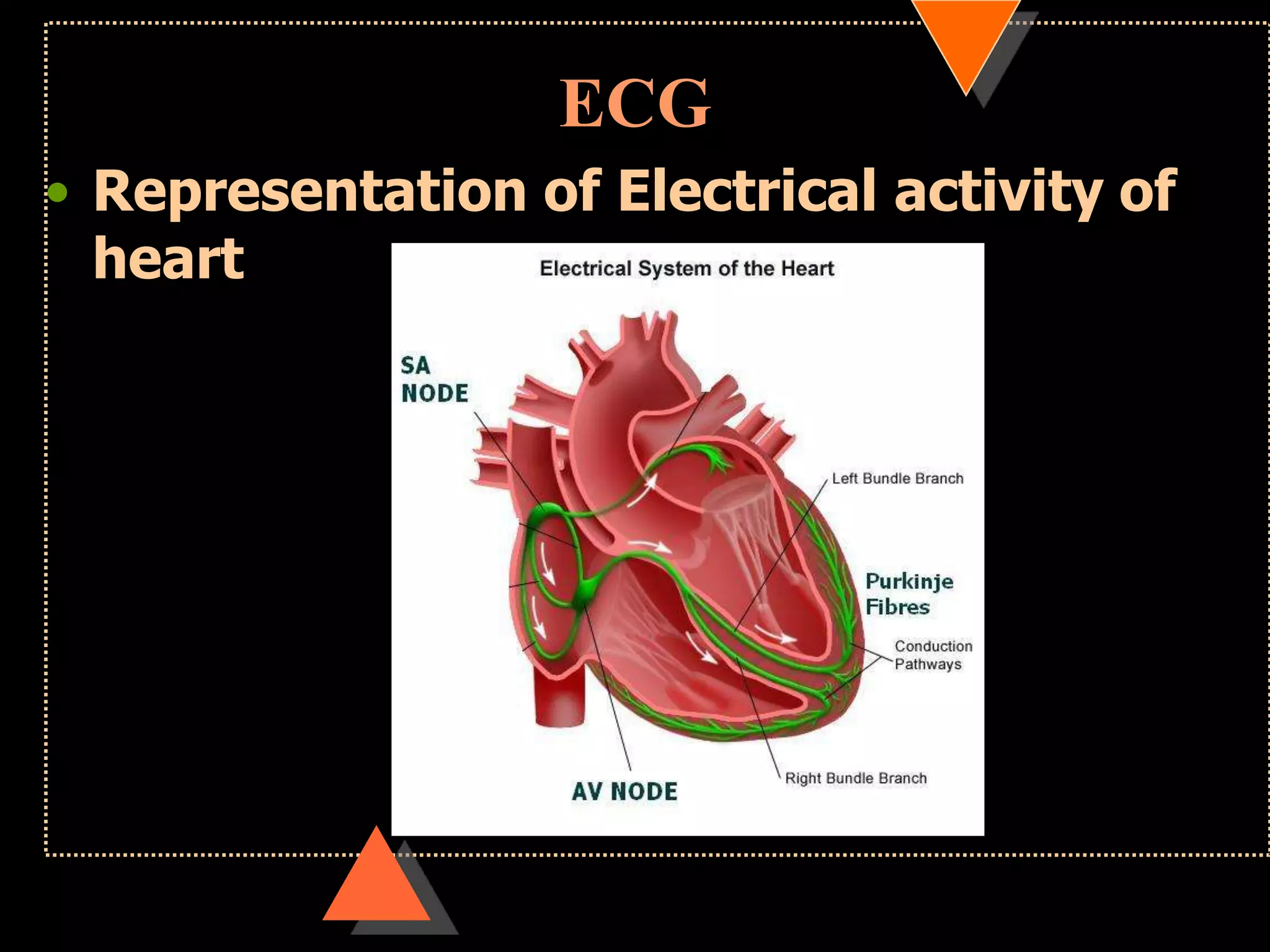
ECG
• Representation of Electrical activity of
heart
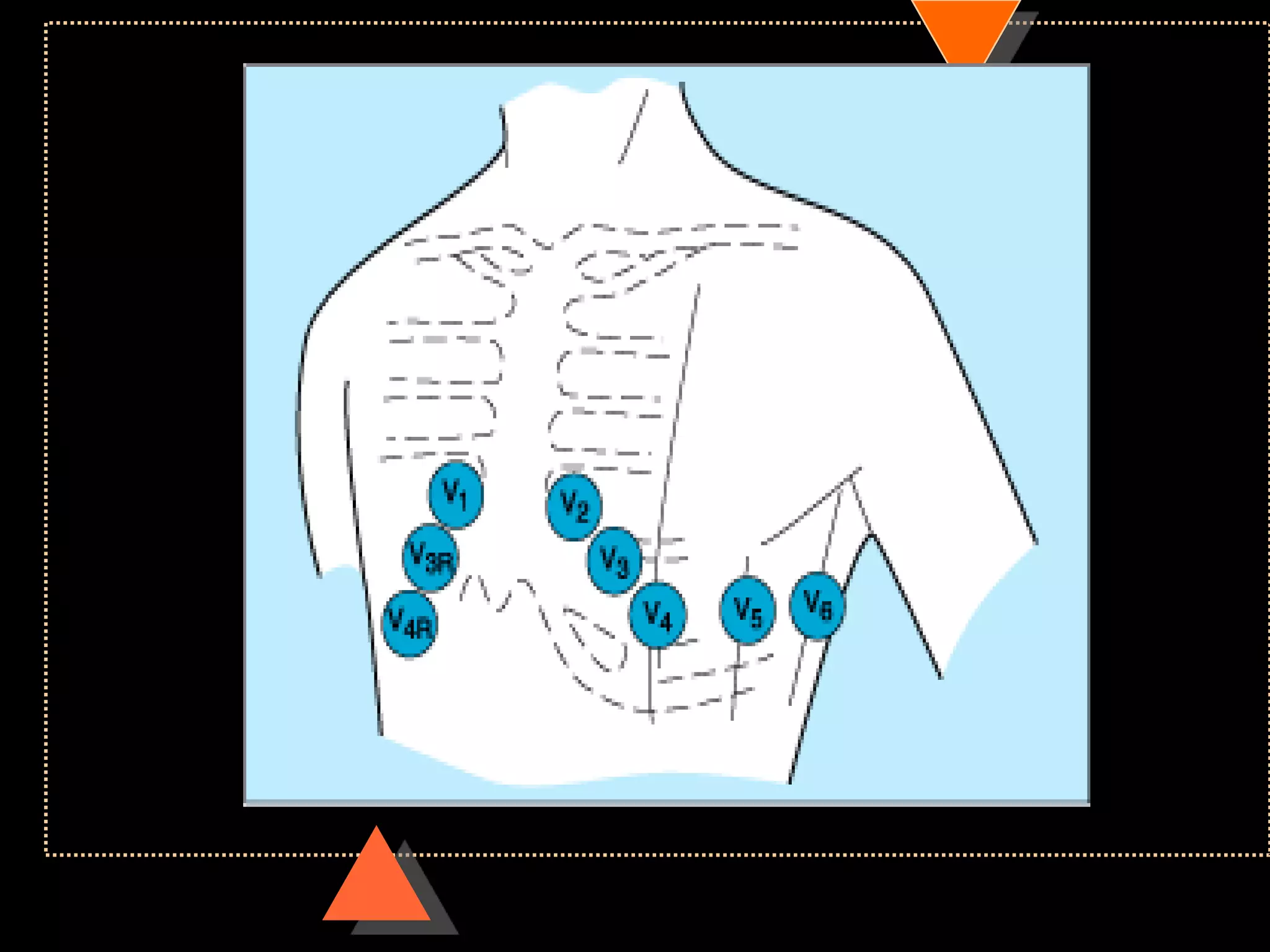
ECG Leads
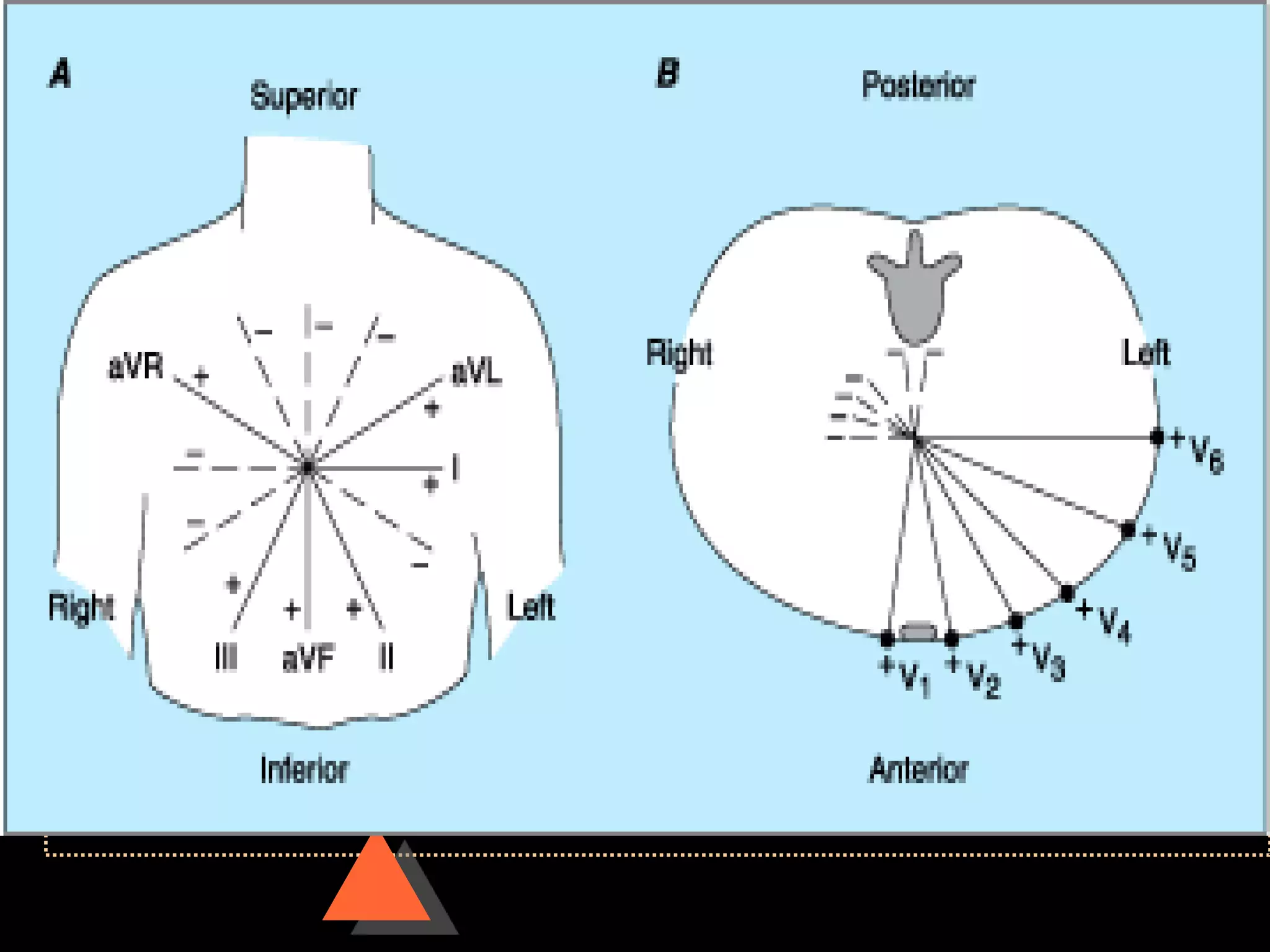
• 12 lead ECG
• 6 limb leads: Lead I, II, III
aVL, aVR, aVF
• 6 Chest Leads: V1, V2,V3, V4, V5, V6
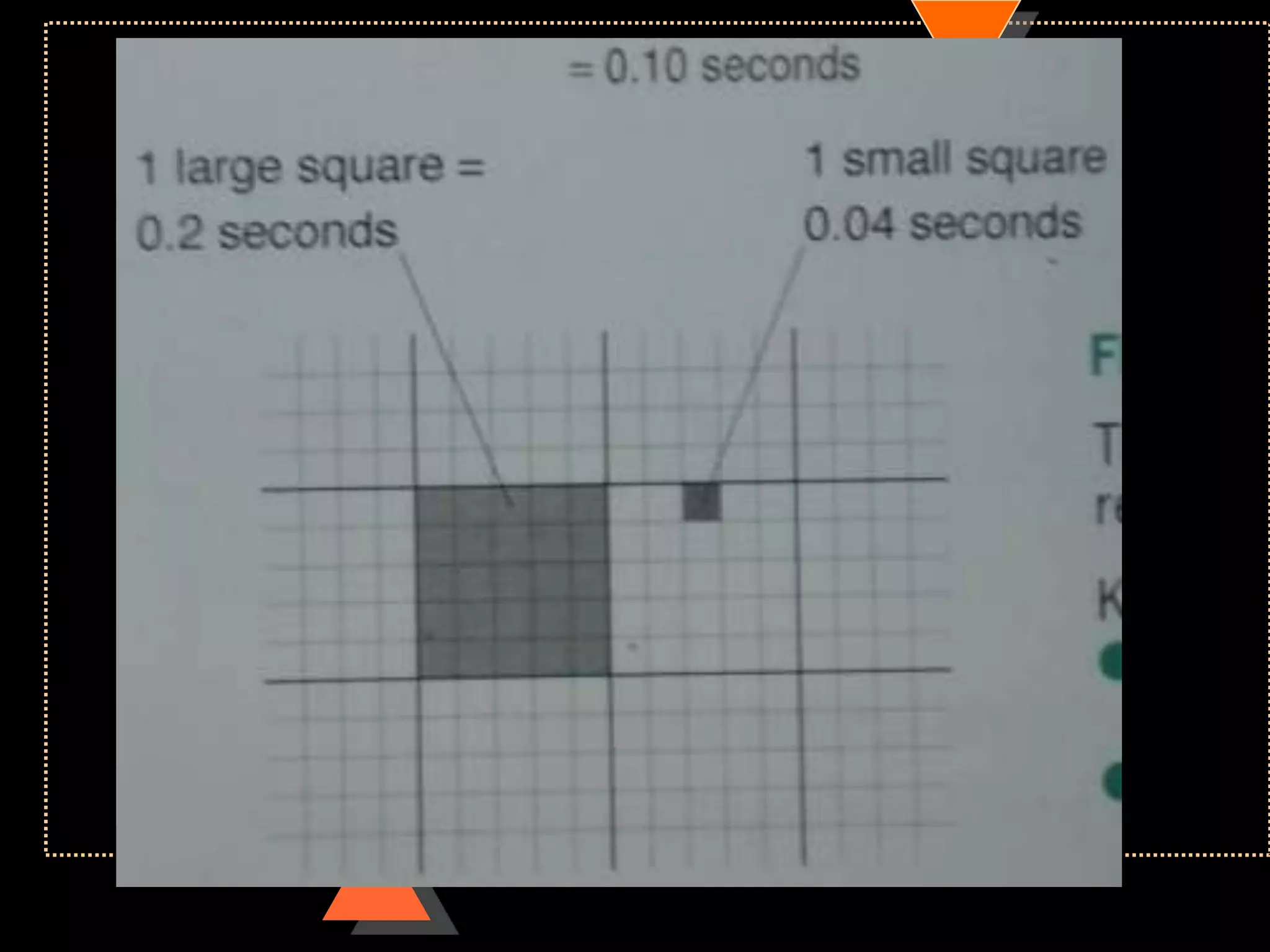
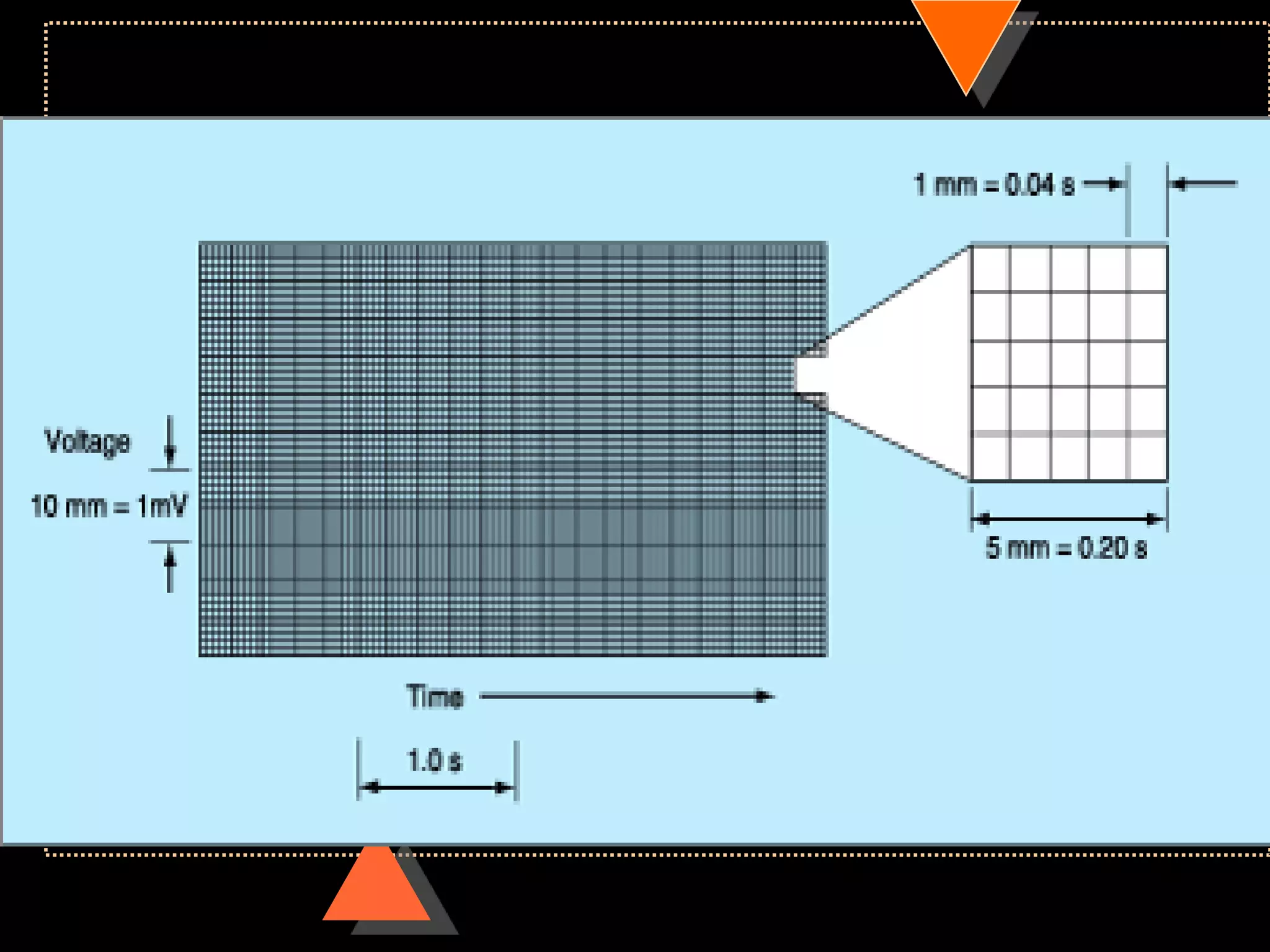
ECG paper
Speed 25mm/s
• 1 large square= 5 small square [5mm]
Voltage
• 10mm =1mV
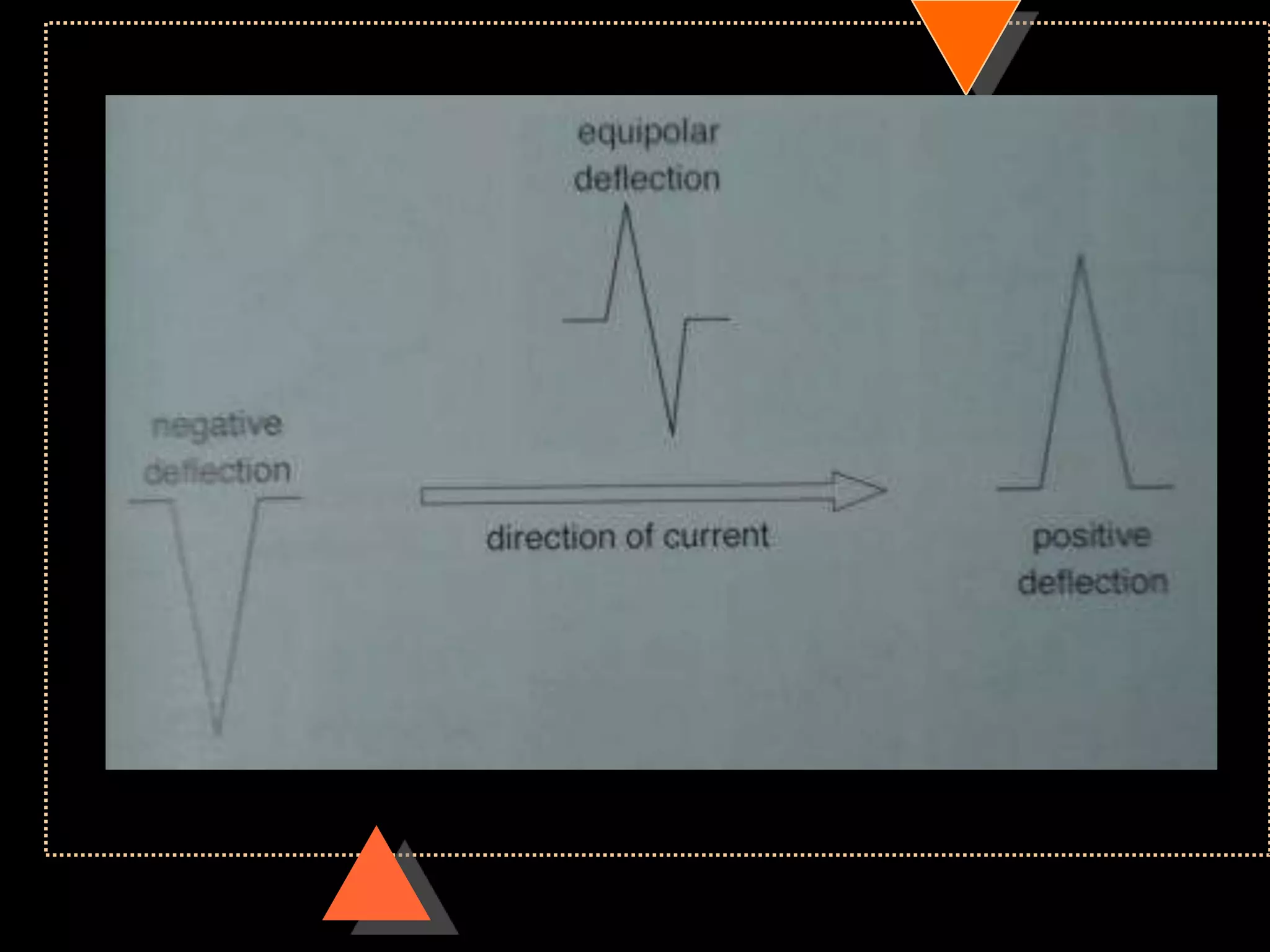
Appearance of waves
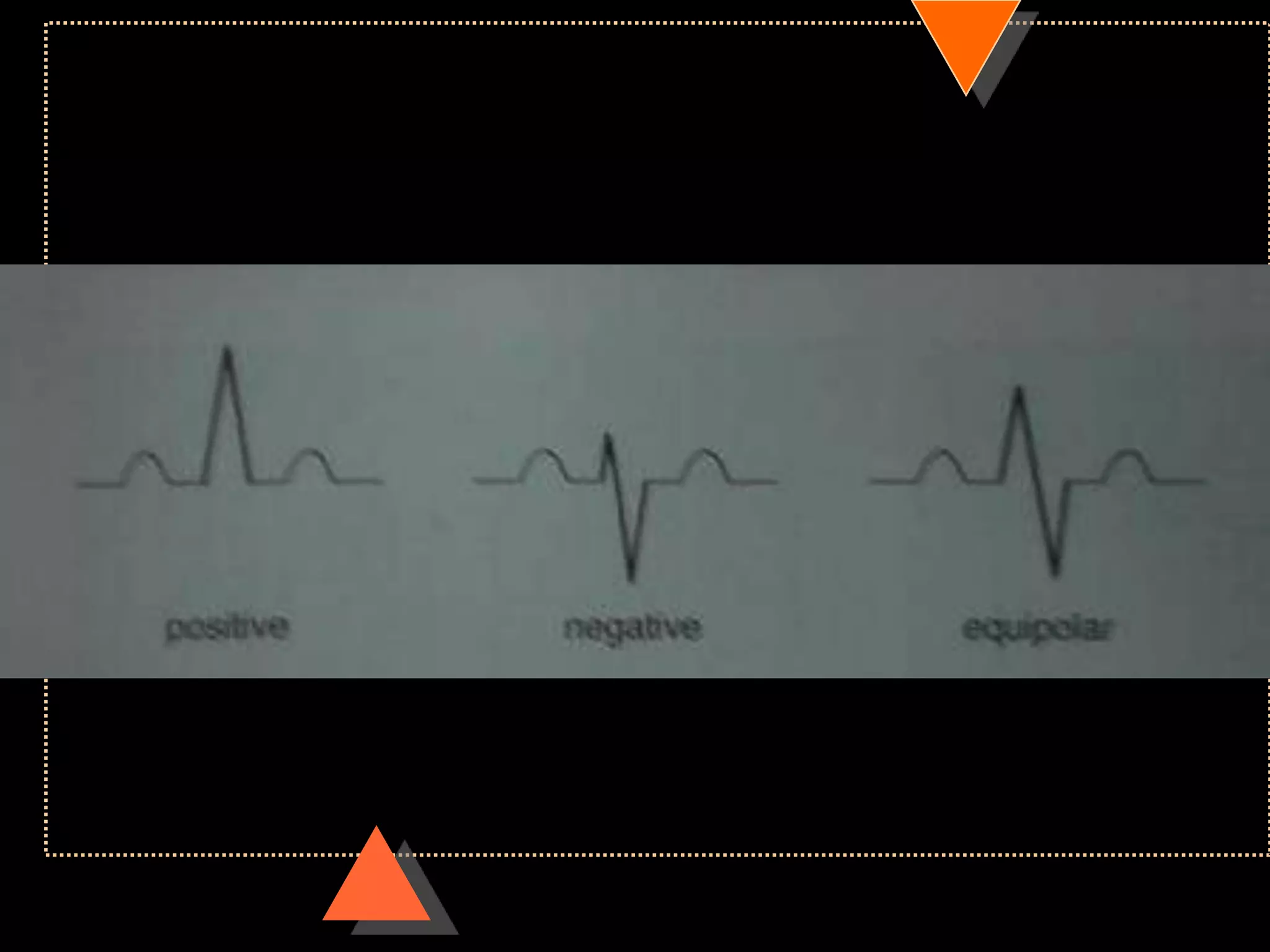
• Positive deflection [upward]
• If electrical impulses flowing towards
that lead
• Negative deflection [downward]
• If electrical impulses flowing away from
that lead
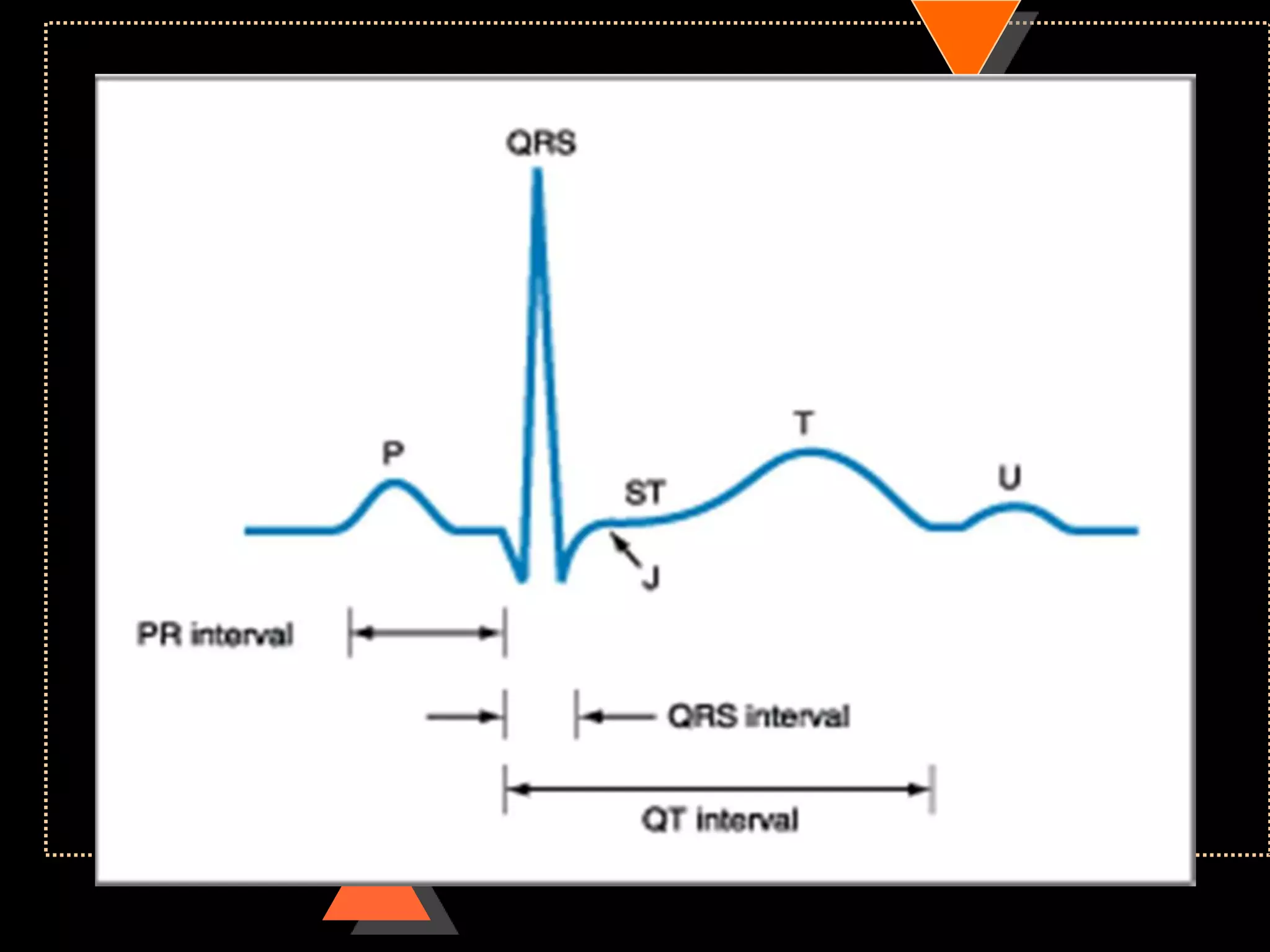
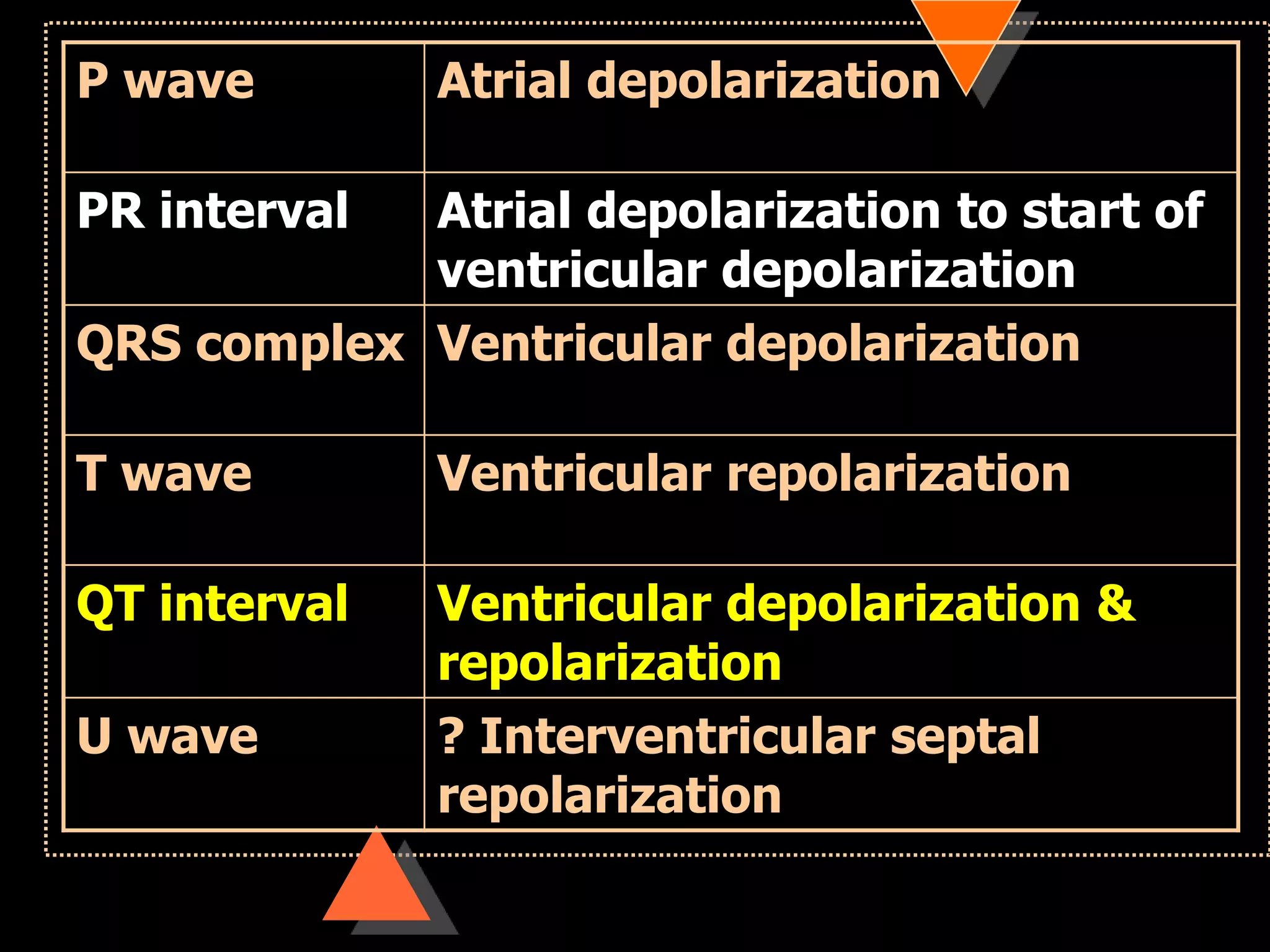
Origin of waves
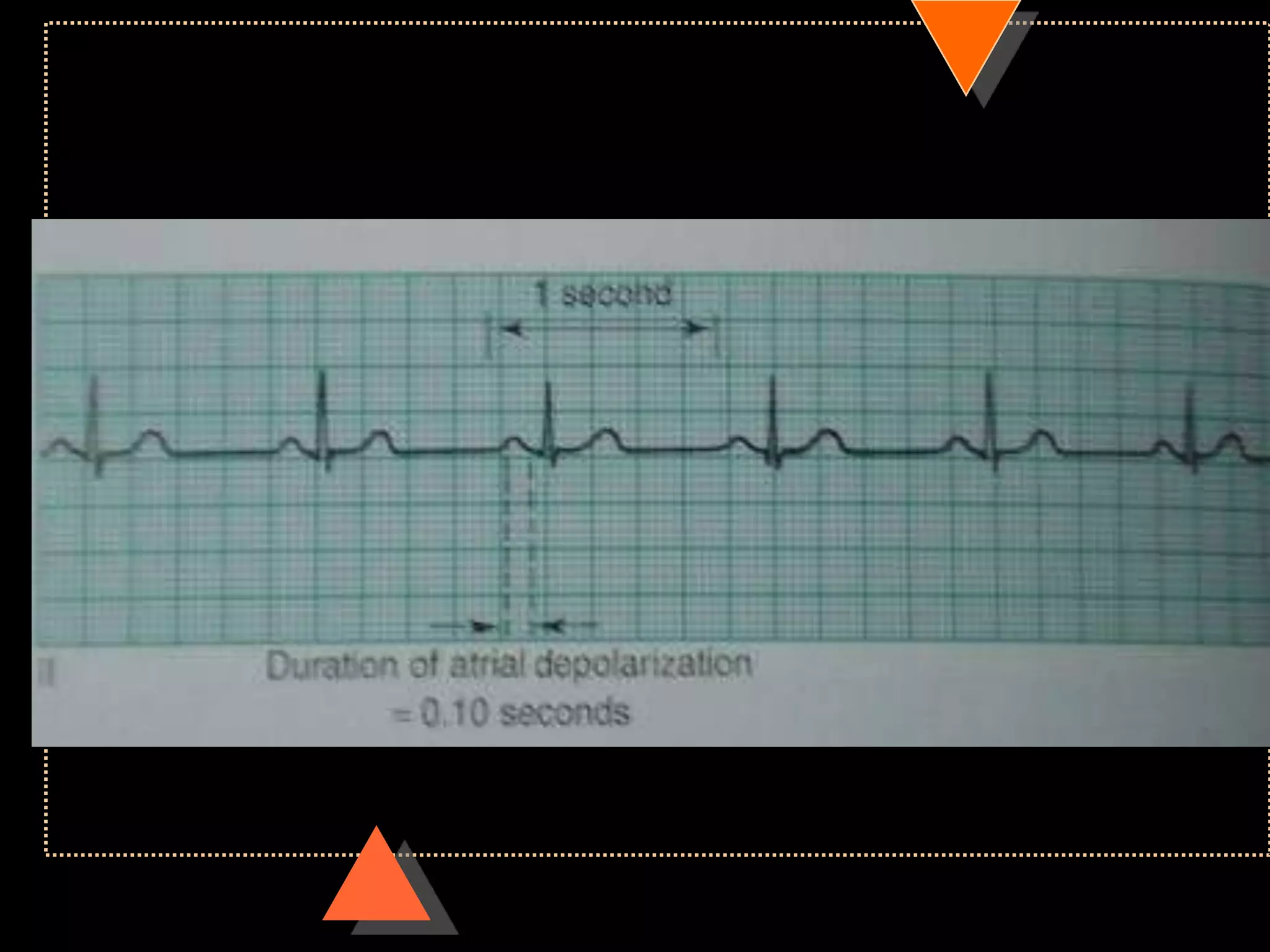
P wave Atrial depolarization
PR interval Atrial depolarization to start of
ventricular depolarization
QRS complex Ventricular depolarization
T wave Ventricular repolarization
QT interval Ventricular depolarization &
repolarization
U wave ? Interventricular septal
repolarization
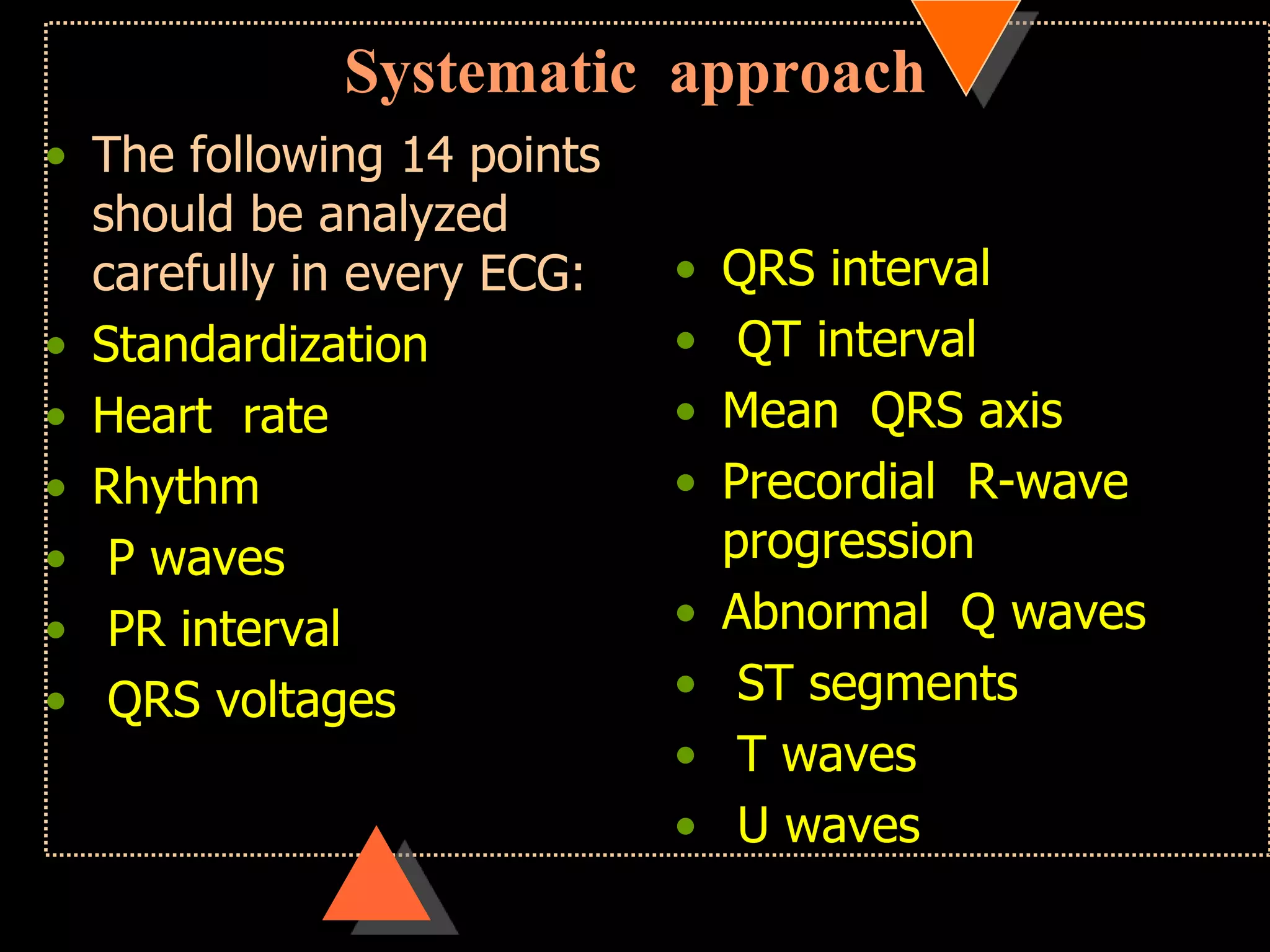
Systematic approach
• The following 14 points
should be analyzed
carefully in every ECG:
• Standardization
• Heart rate
• Rhythm
• P waves
• PR interval
• QRS voltages
• QRS interval
• QT interval
• Mean QRS axis
• Precordial R-wave
progression
• Abnormal Q waves
• ST segments
• T waves
• U waves
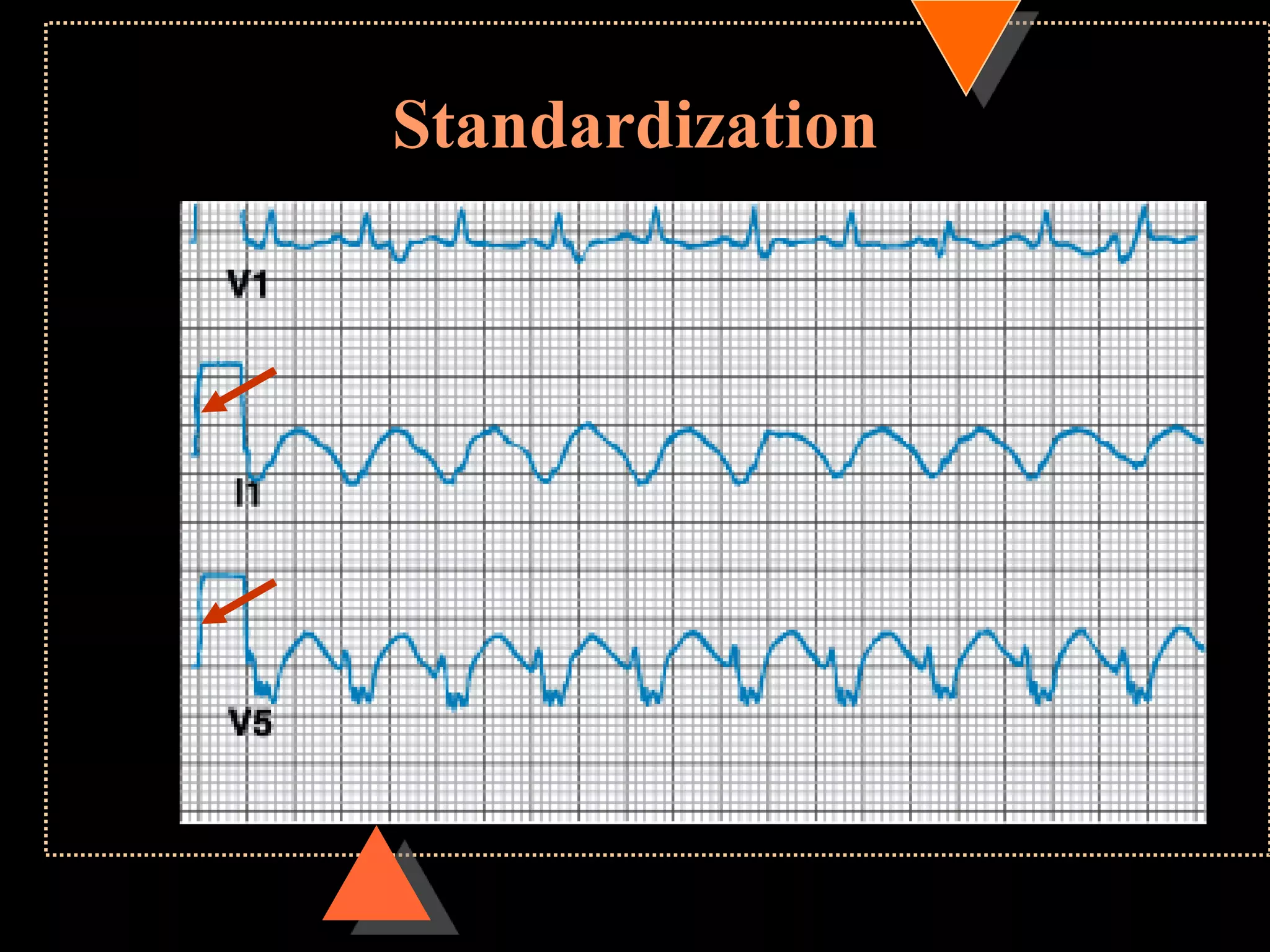
Standardization
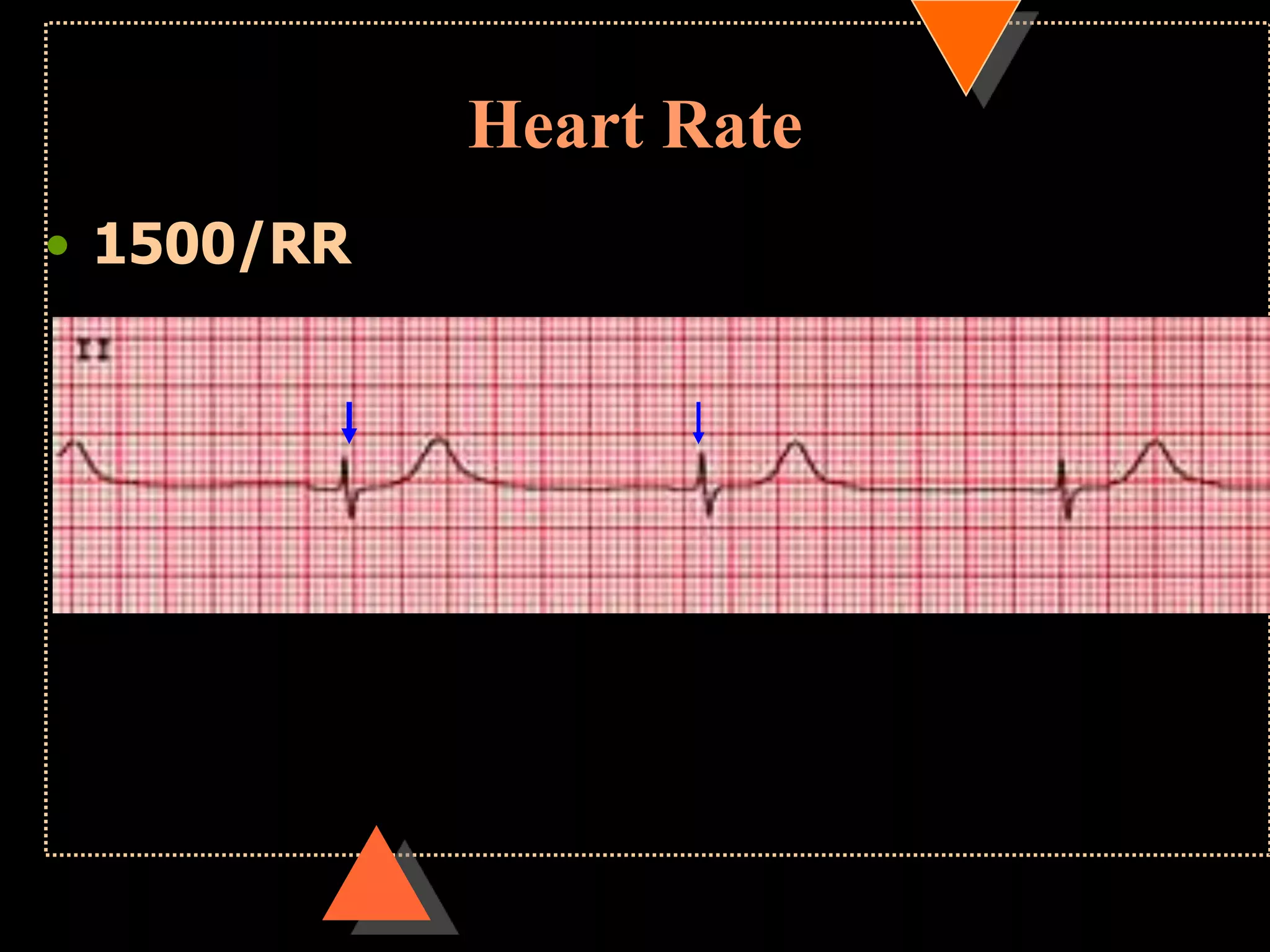
Heart Rate
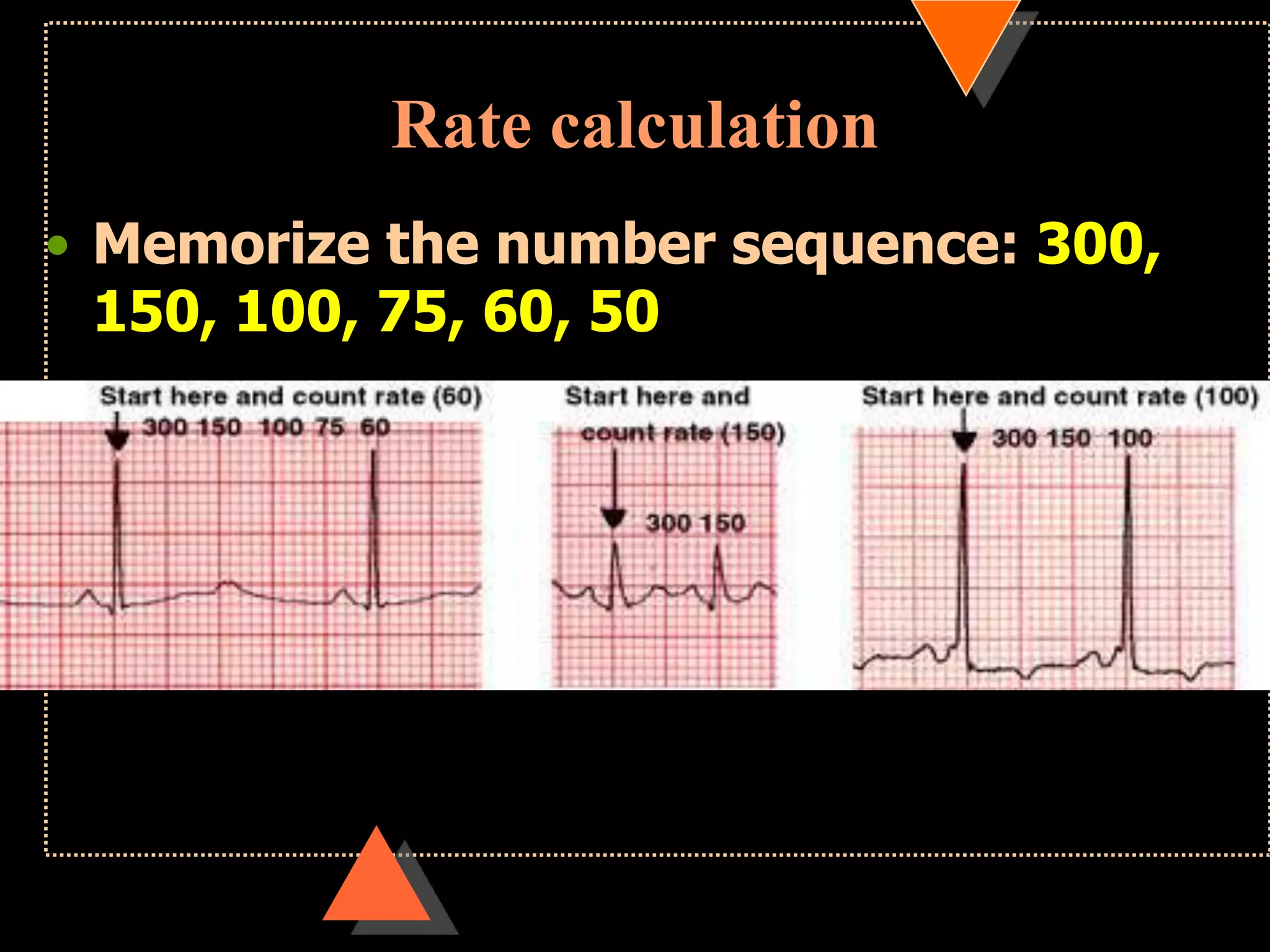
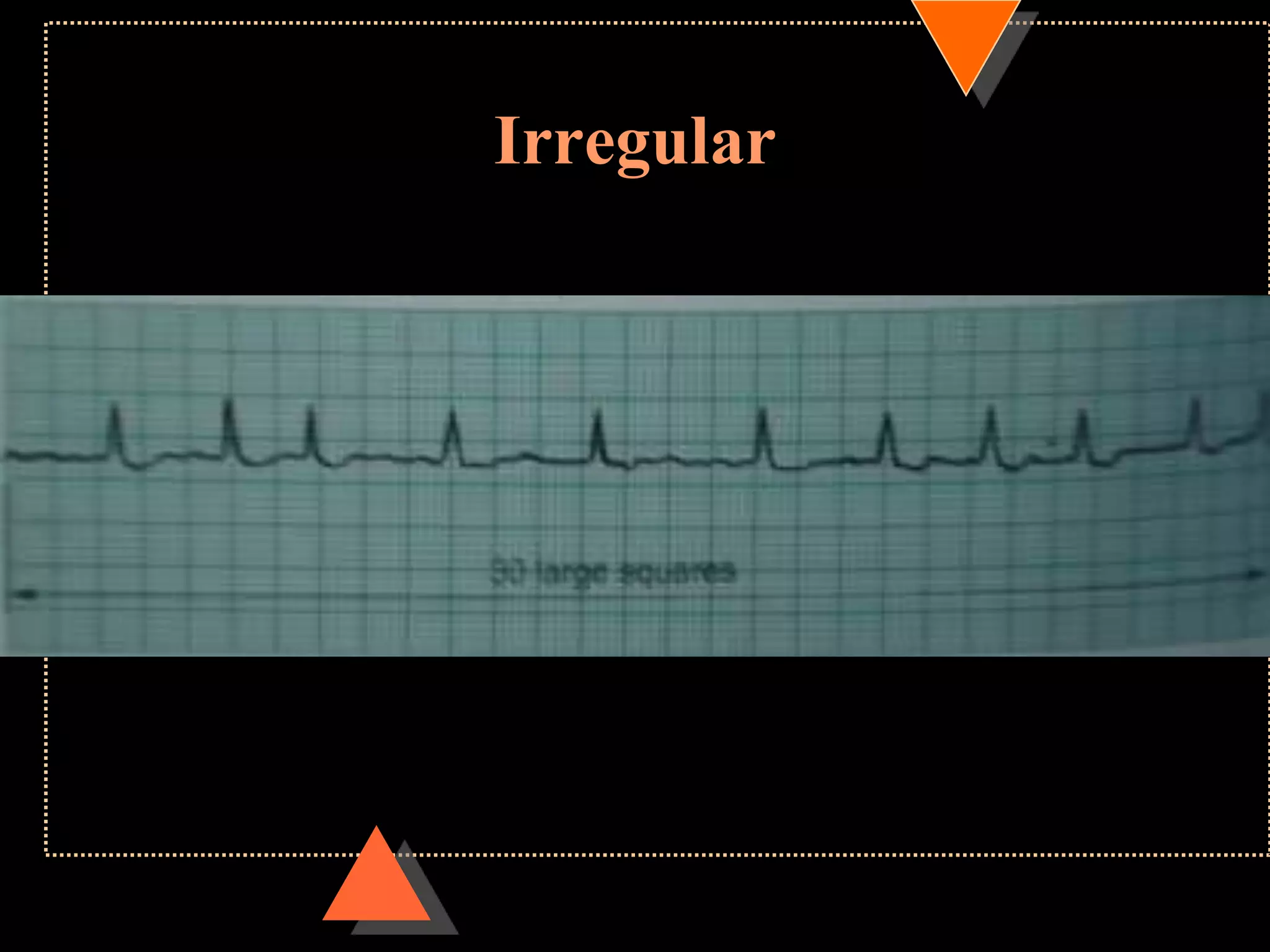
• 1500/RR
•If HR is irregular
Count no. of QRS complexes in 30 large squares=
6 sec
Multiply it with 10
HR [per min]
Rate calculation
• Memorize the number sequence: 300,
150, 100, 75, 60, 50
• ECG machines: print out HR
• DO NOT RELY ON IT!!!!
• Always Calculate yourself.
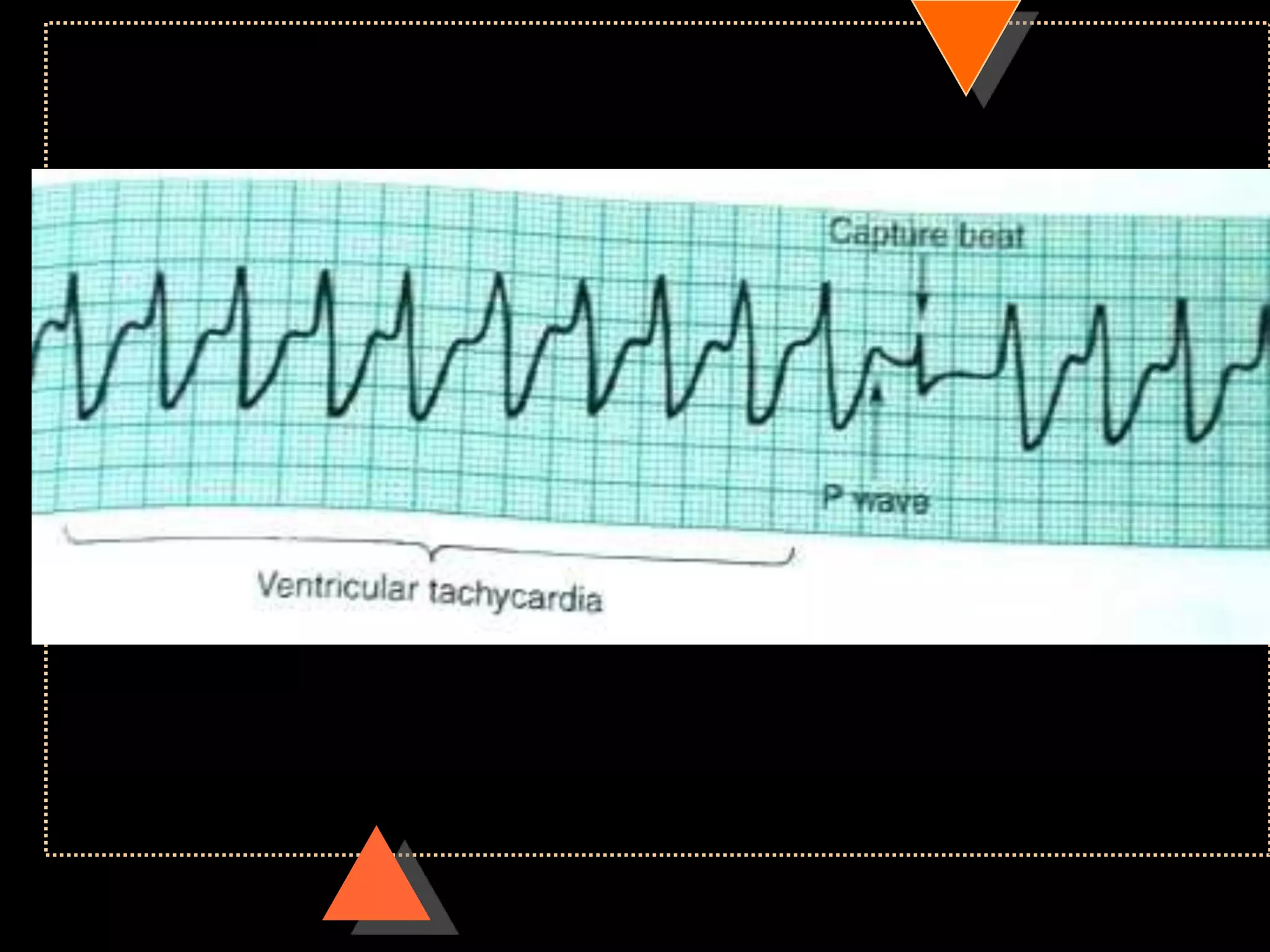
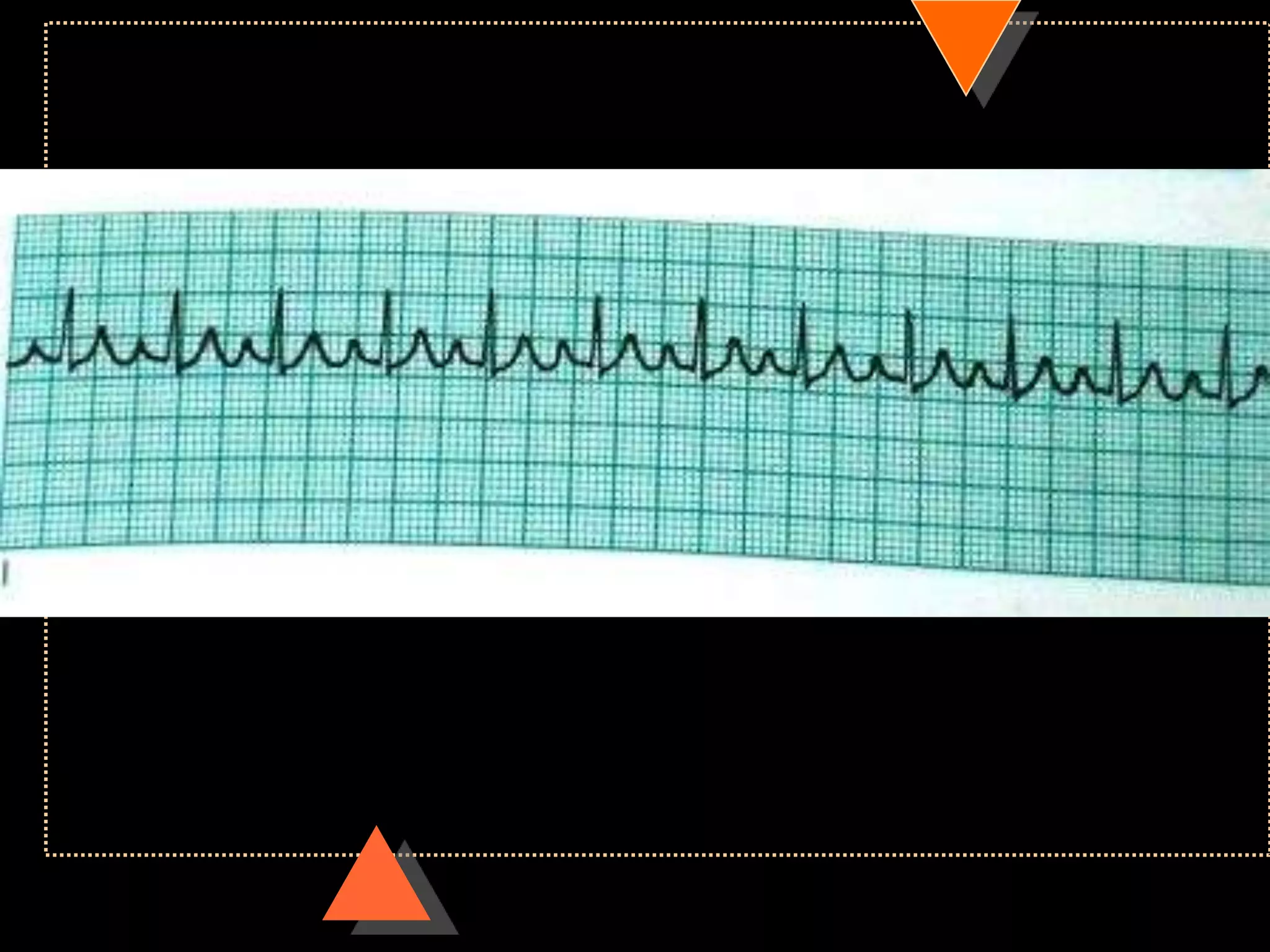
• Bradycardia: <60/min
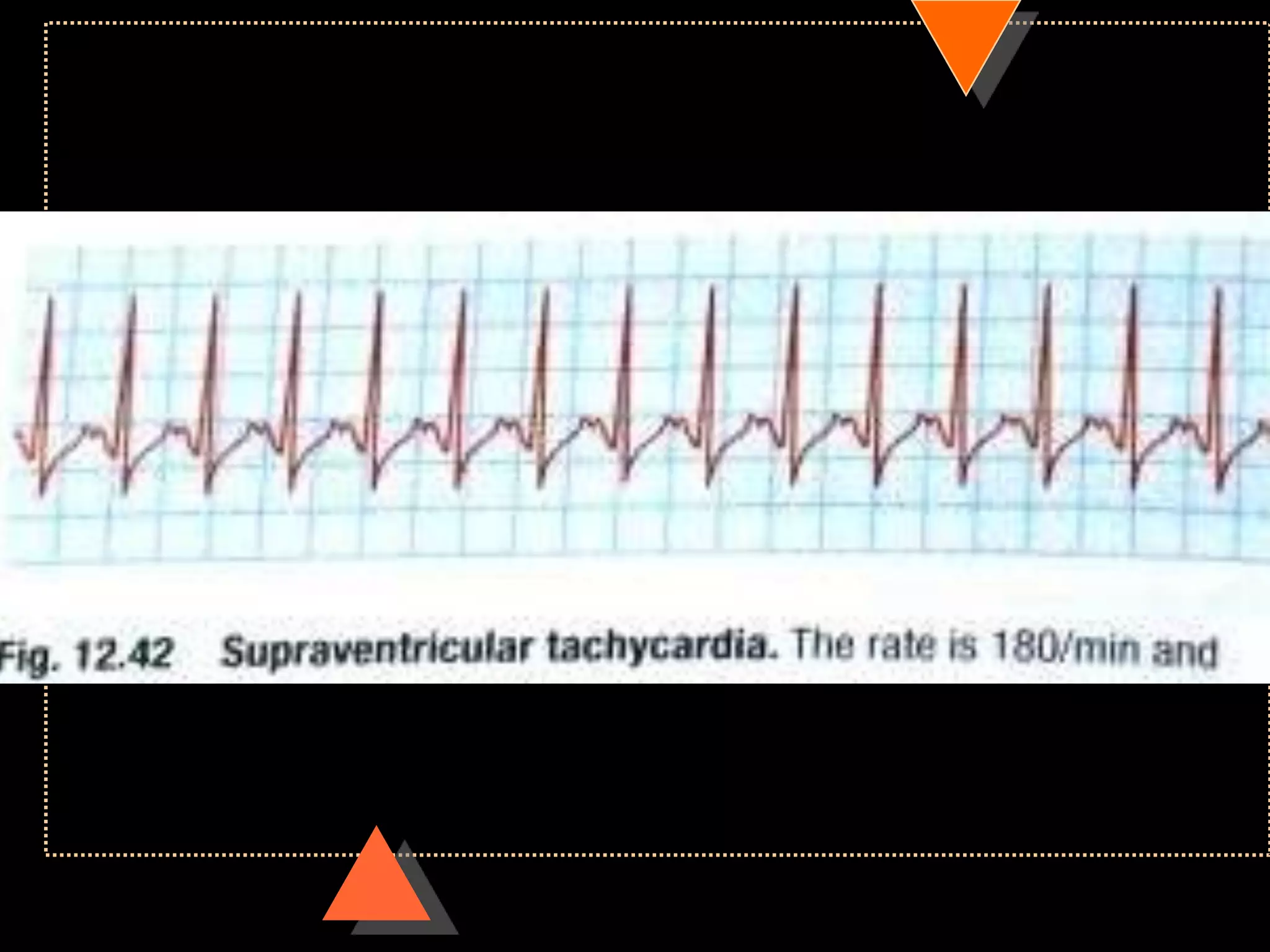
• Tachycardia: >100/min
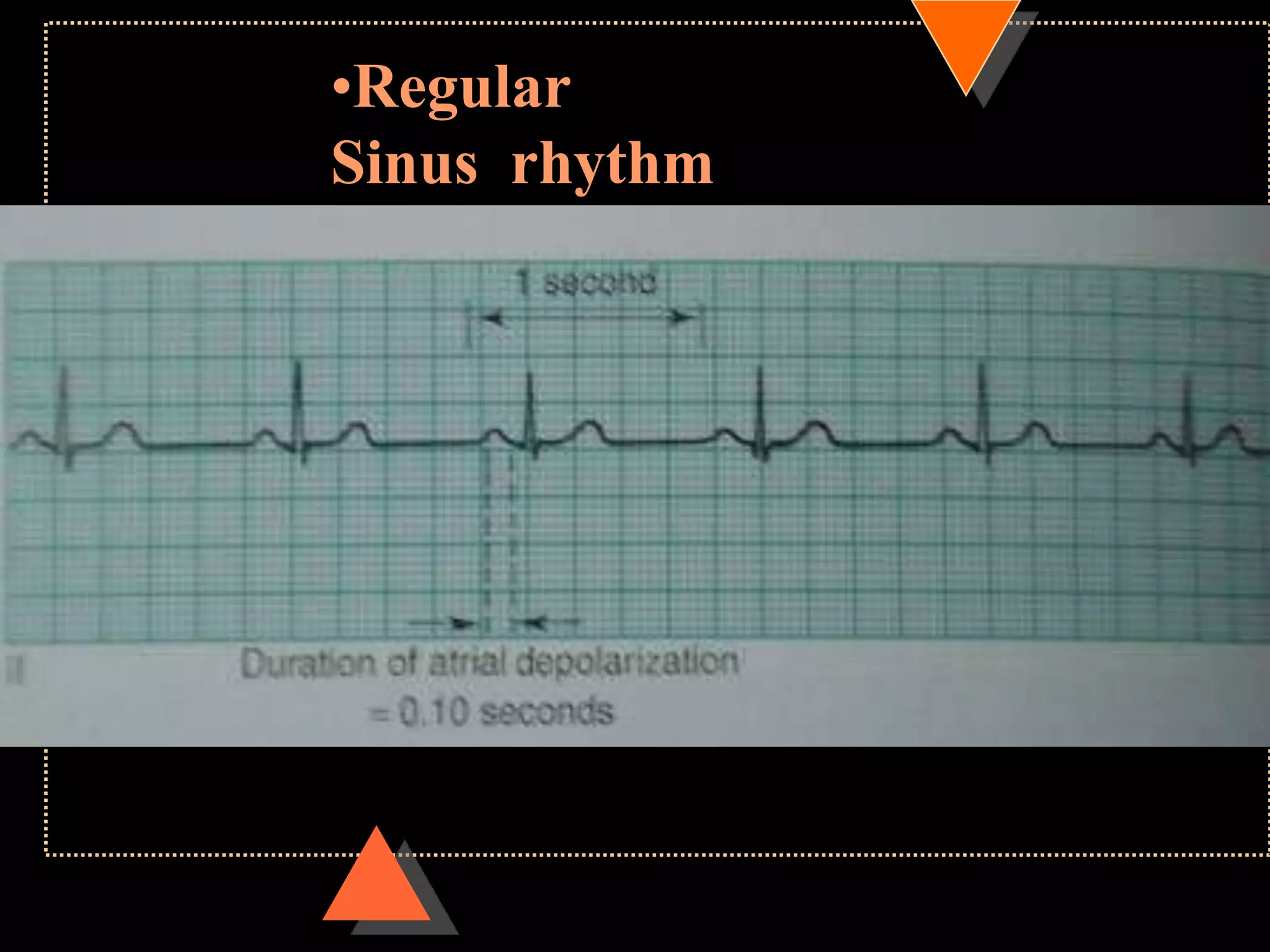
Rhythm
• Rhythm strip: prolonged recording of
Lead II
• Sinus rhythm ?
• Each QRS complex preceded by P wave
• Regular/ irregular?
•Regular
Sinus rhythm
Irregular
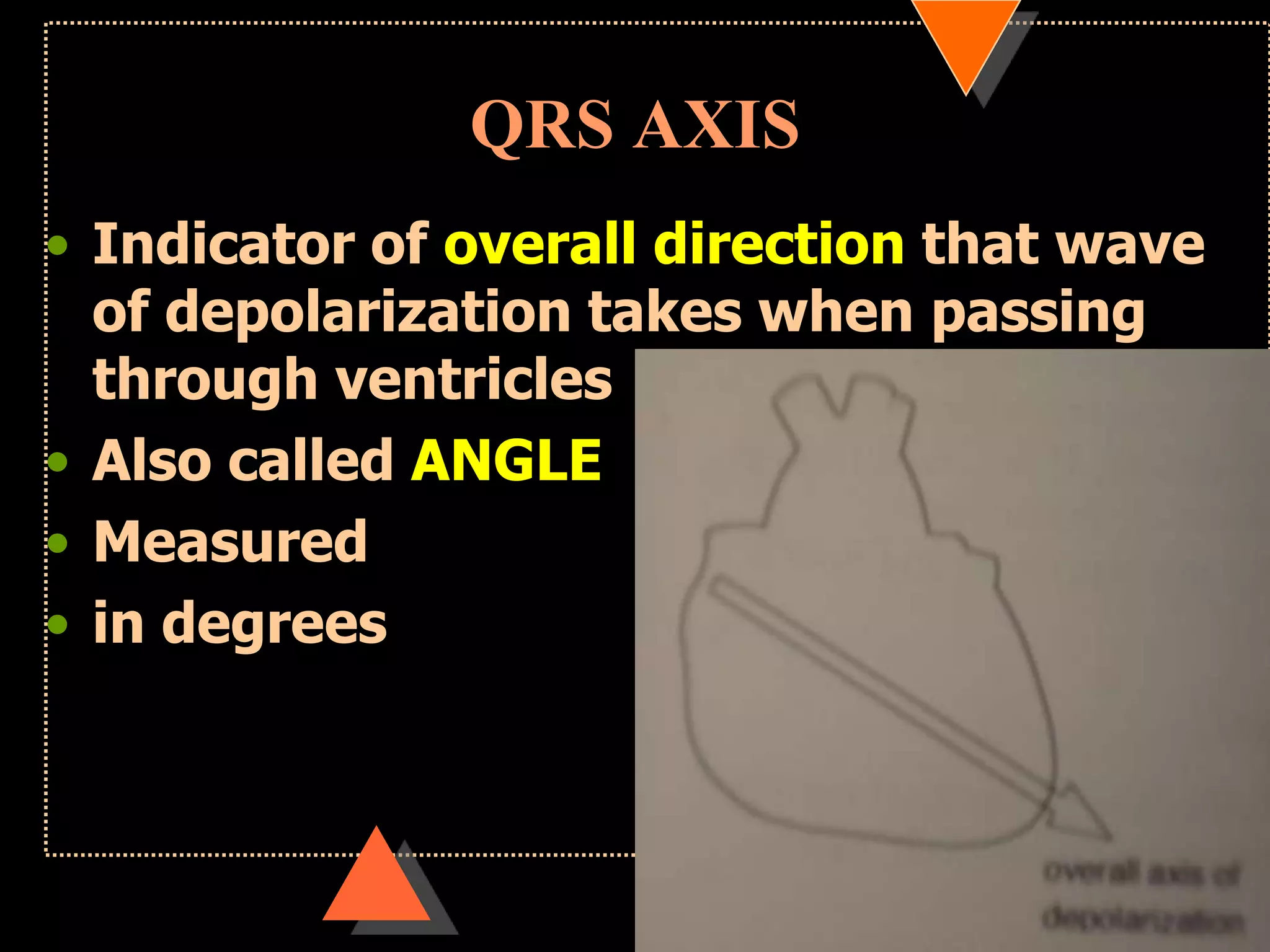
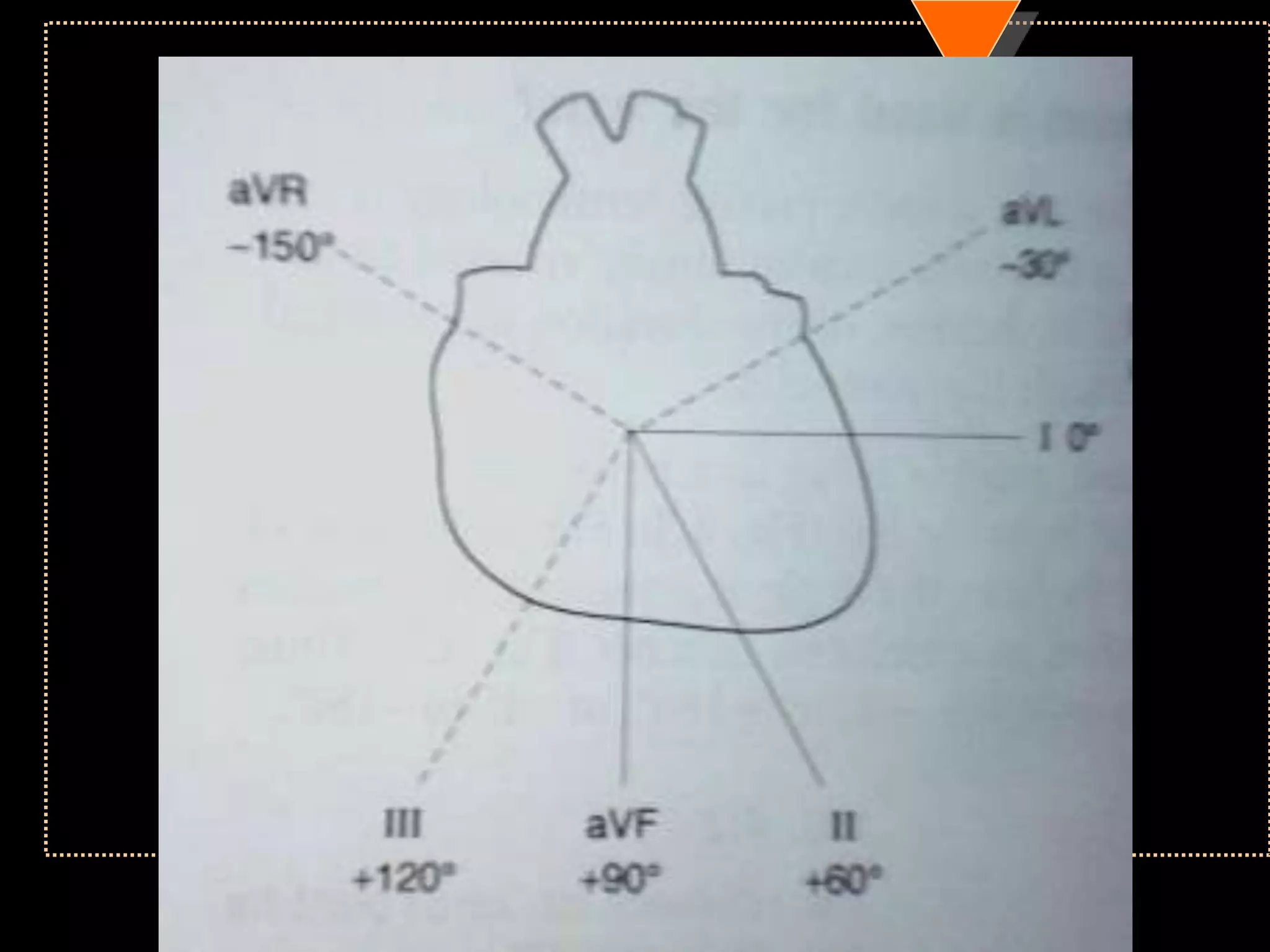
QRS AXIS
• Indicator of overall direction that wave
of depolarization takes when passing
through ventricles
• Also called ANGLE
• Measured
• in degrees
• Photo
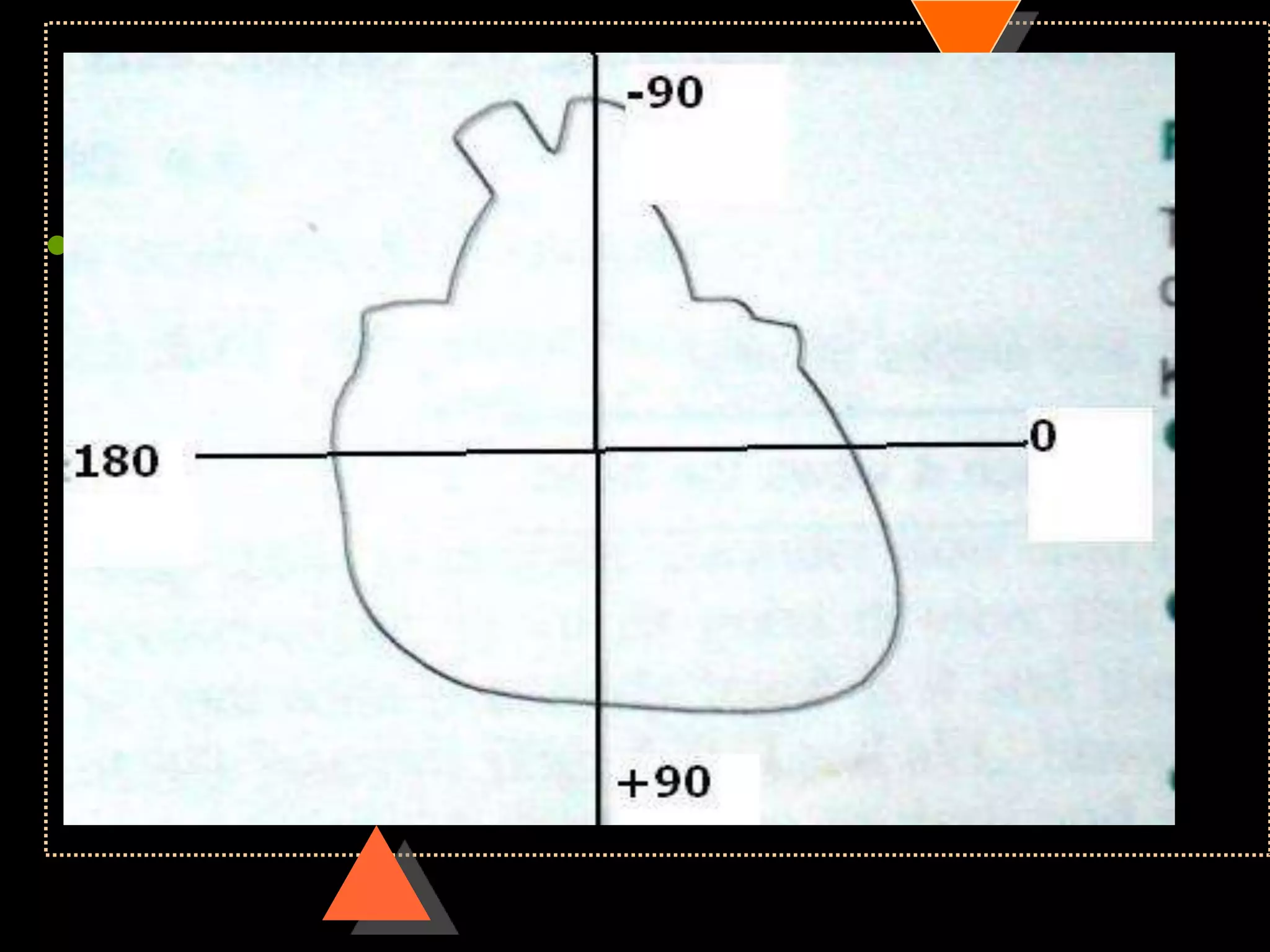
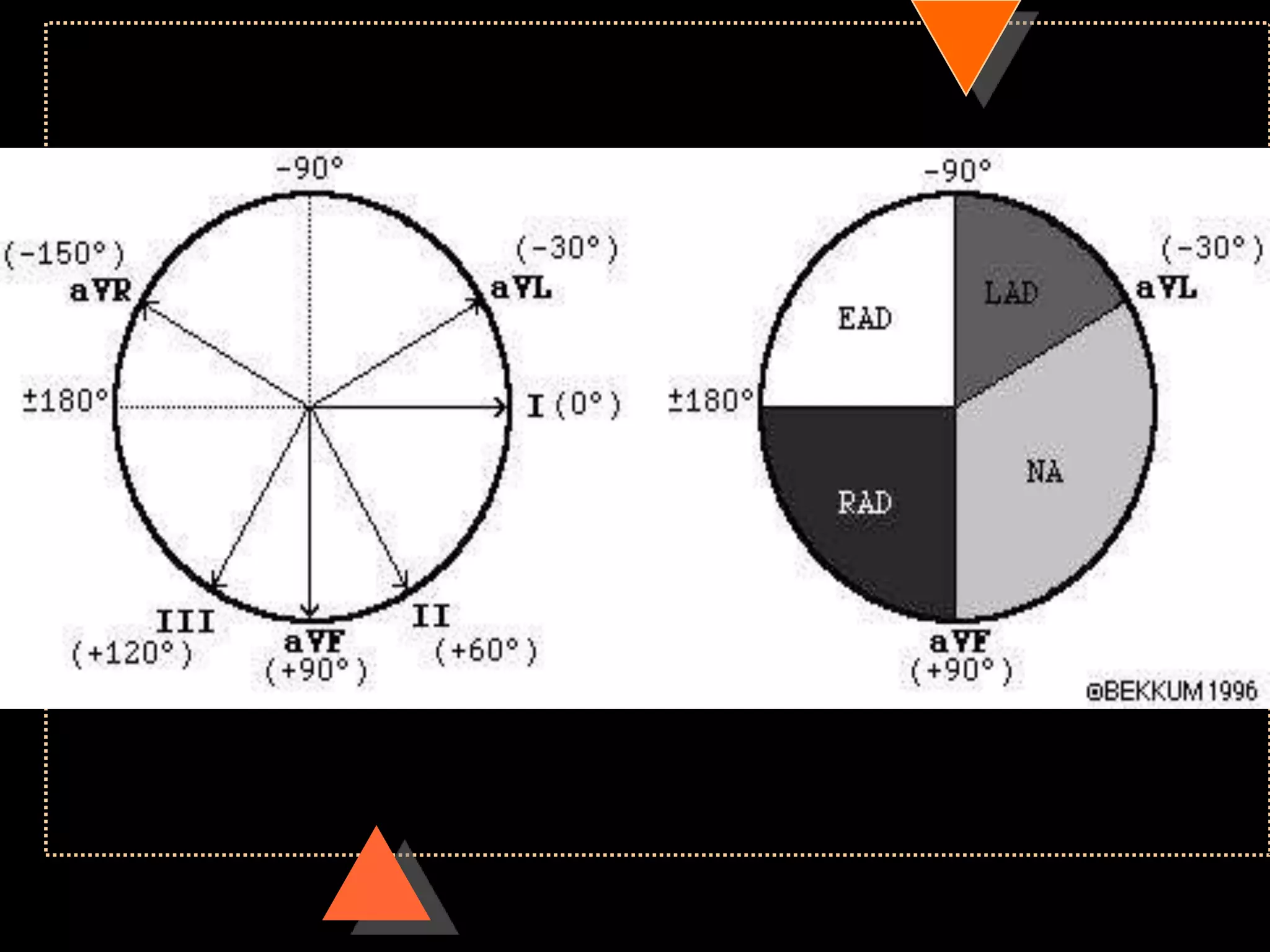
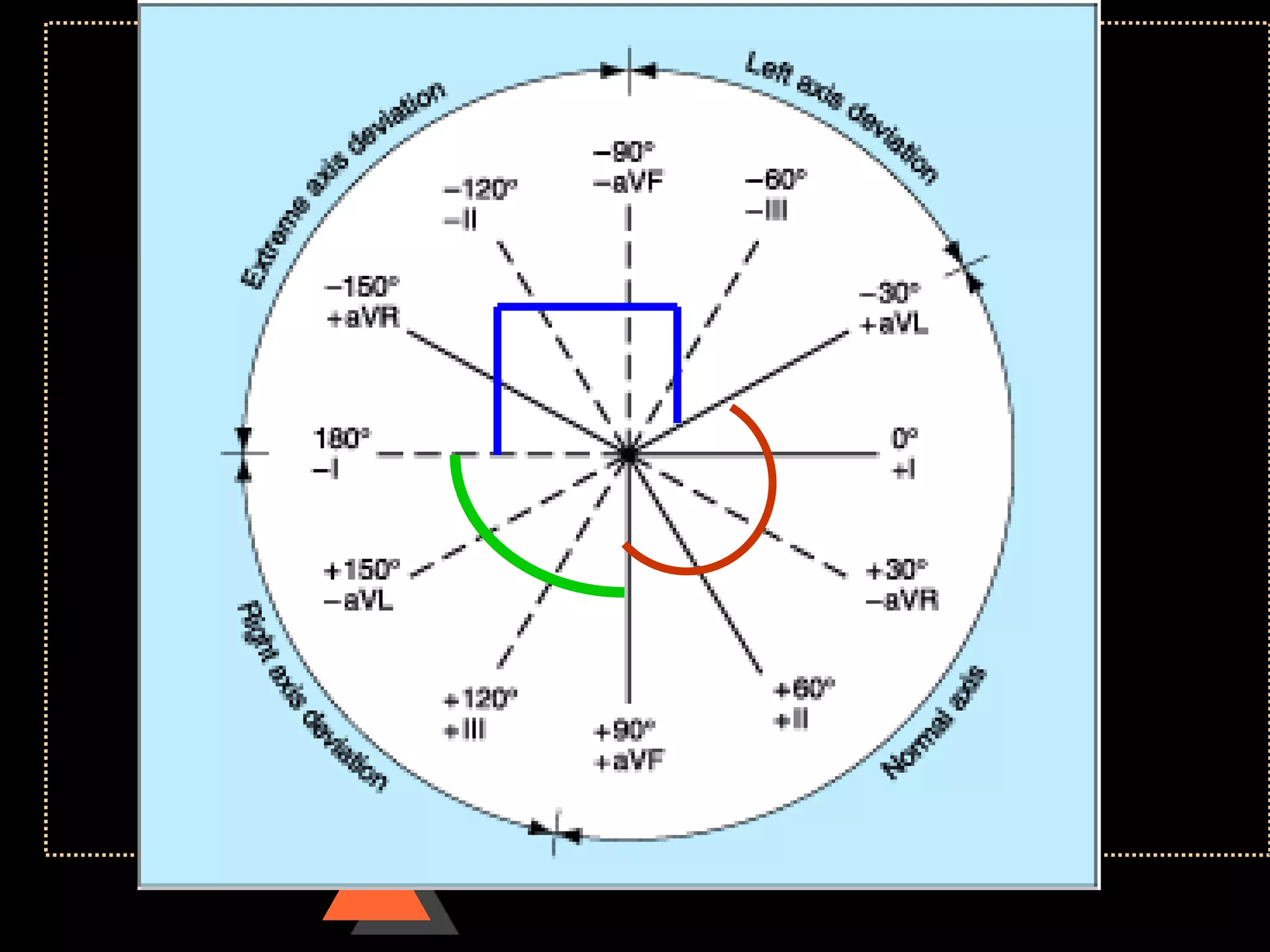
• Right axis deviation [RAD]
• Beyond +90°
• Left Axis Deviation [LAD]
• Beyond -30°
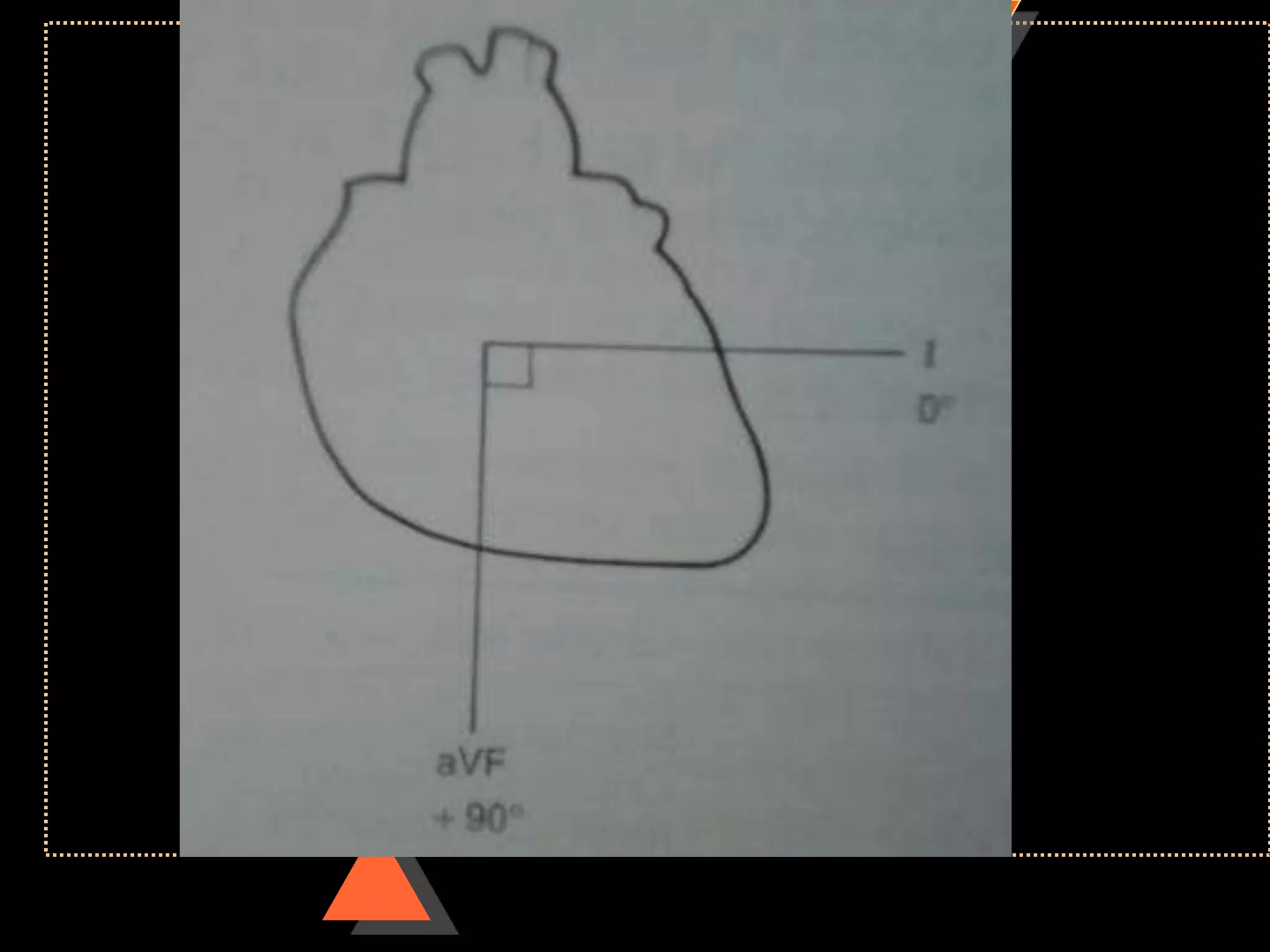
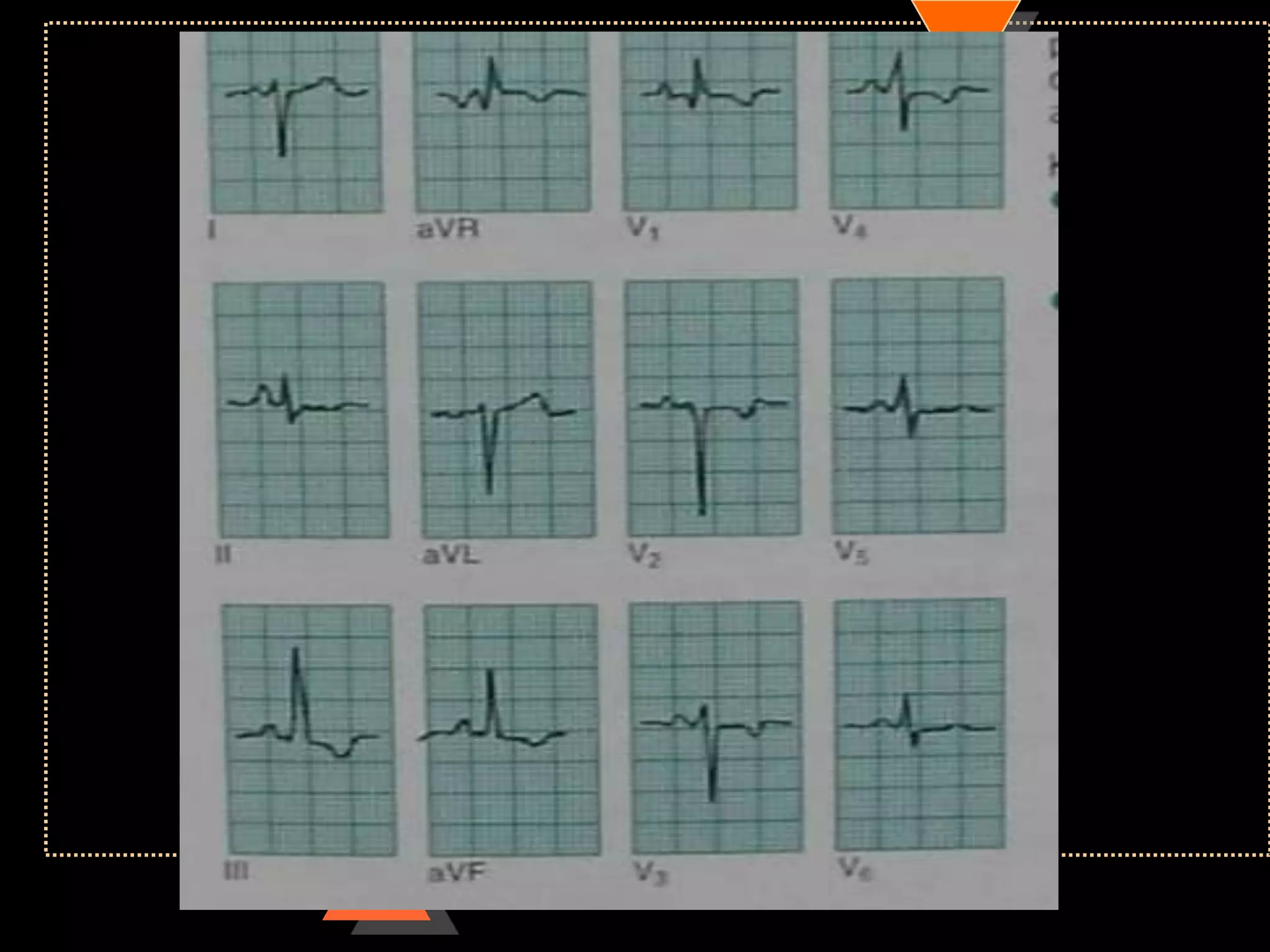
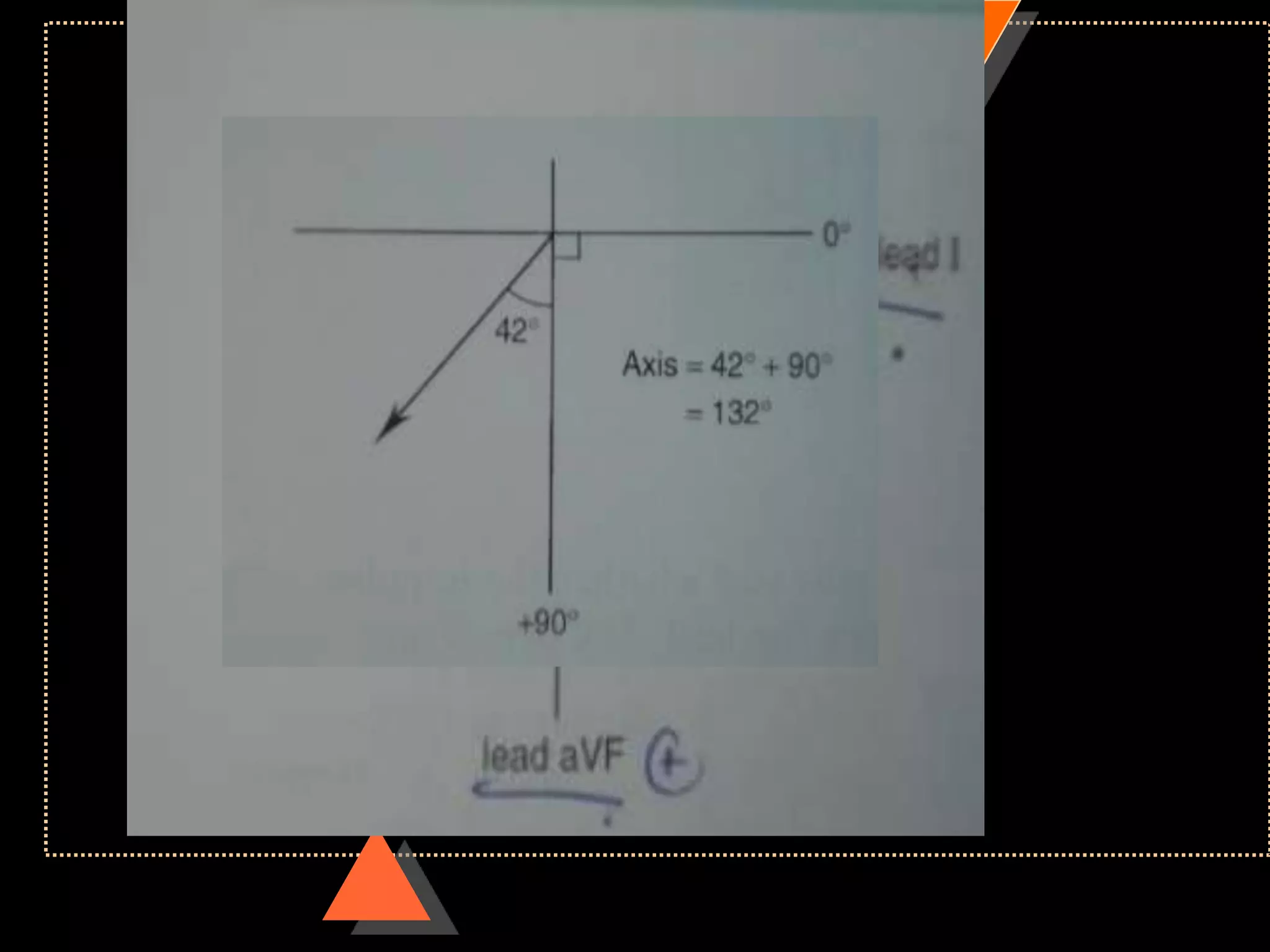
Method 1
• Most precise method
• Use of vectors
• Measure overall height of QRS in lead I
& aVF
• Plot in graph paper
• Measure the ANGLE of vector
Method 2
• Quick method
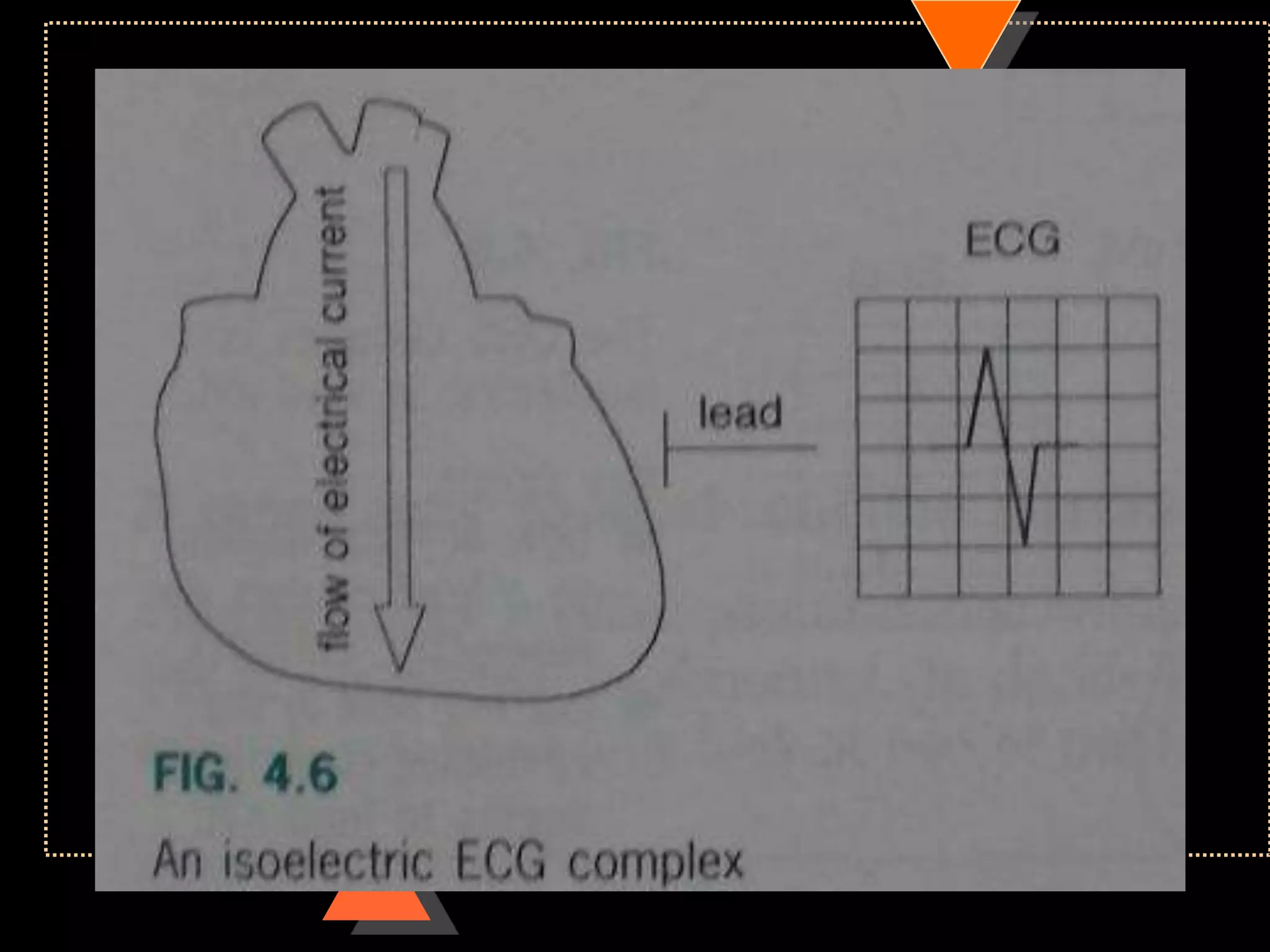
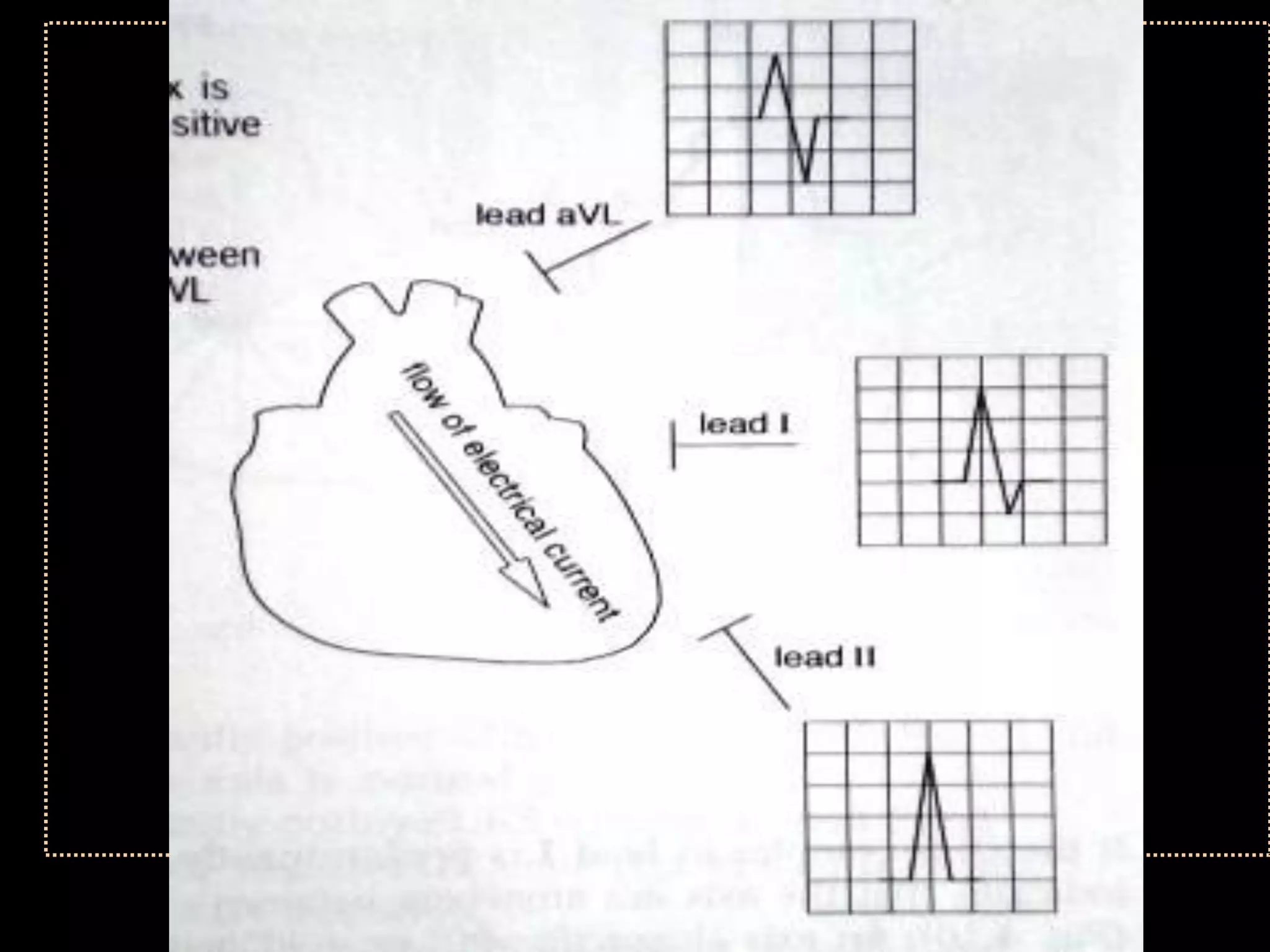
• Identify limb lead in which QRS complex
is isoelectric
• [with equal positive & negative
deflection]
• Implies: electric flow is at Right angle to
this lead
Method 3
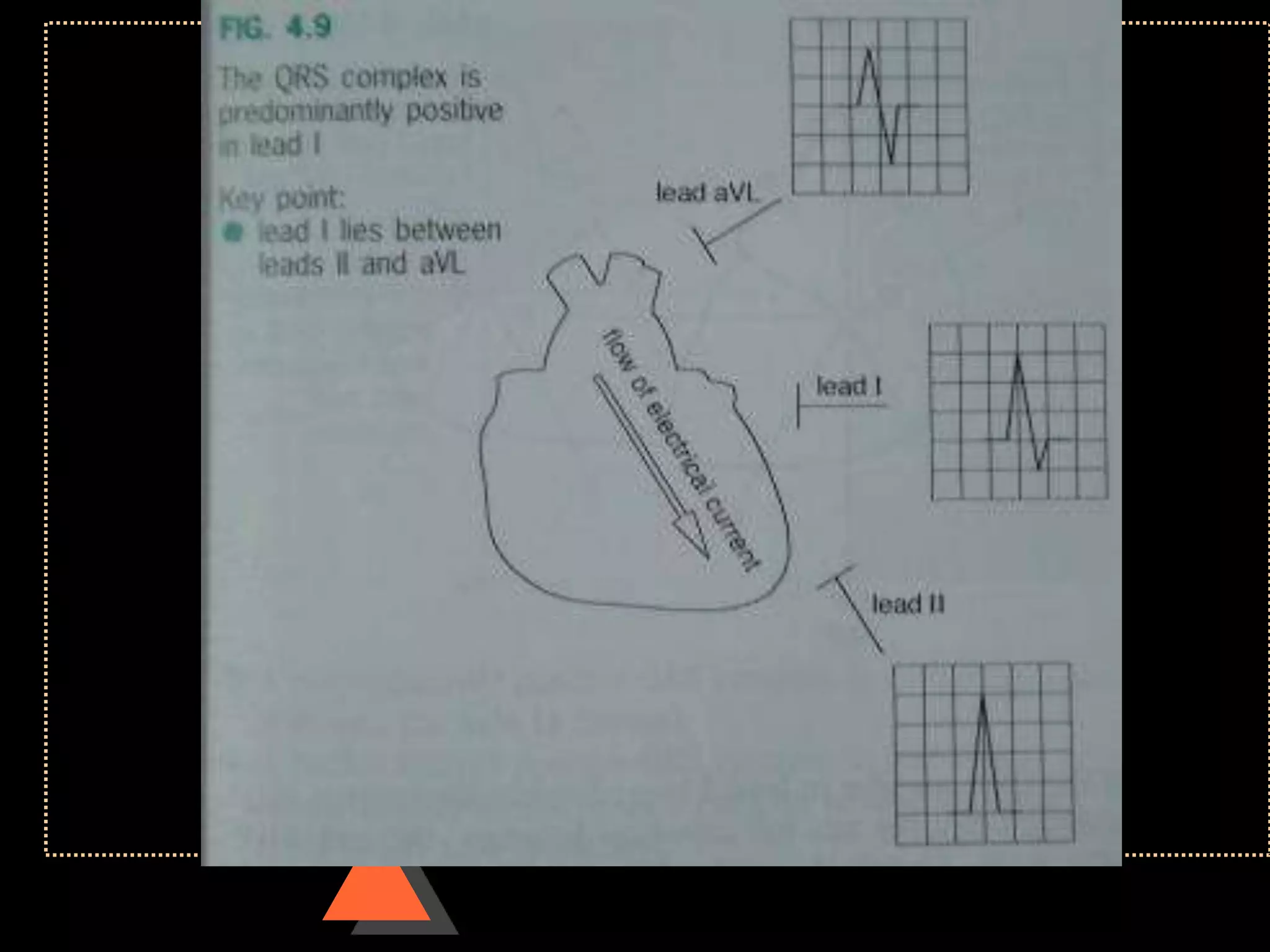
• For quick assessment
• Look at QRS complexes in lead I & II
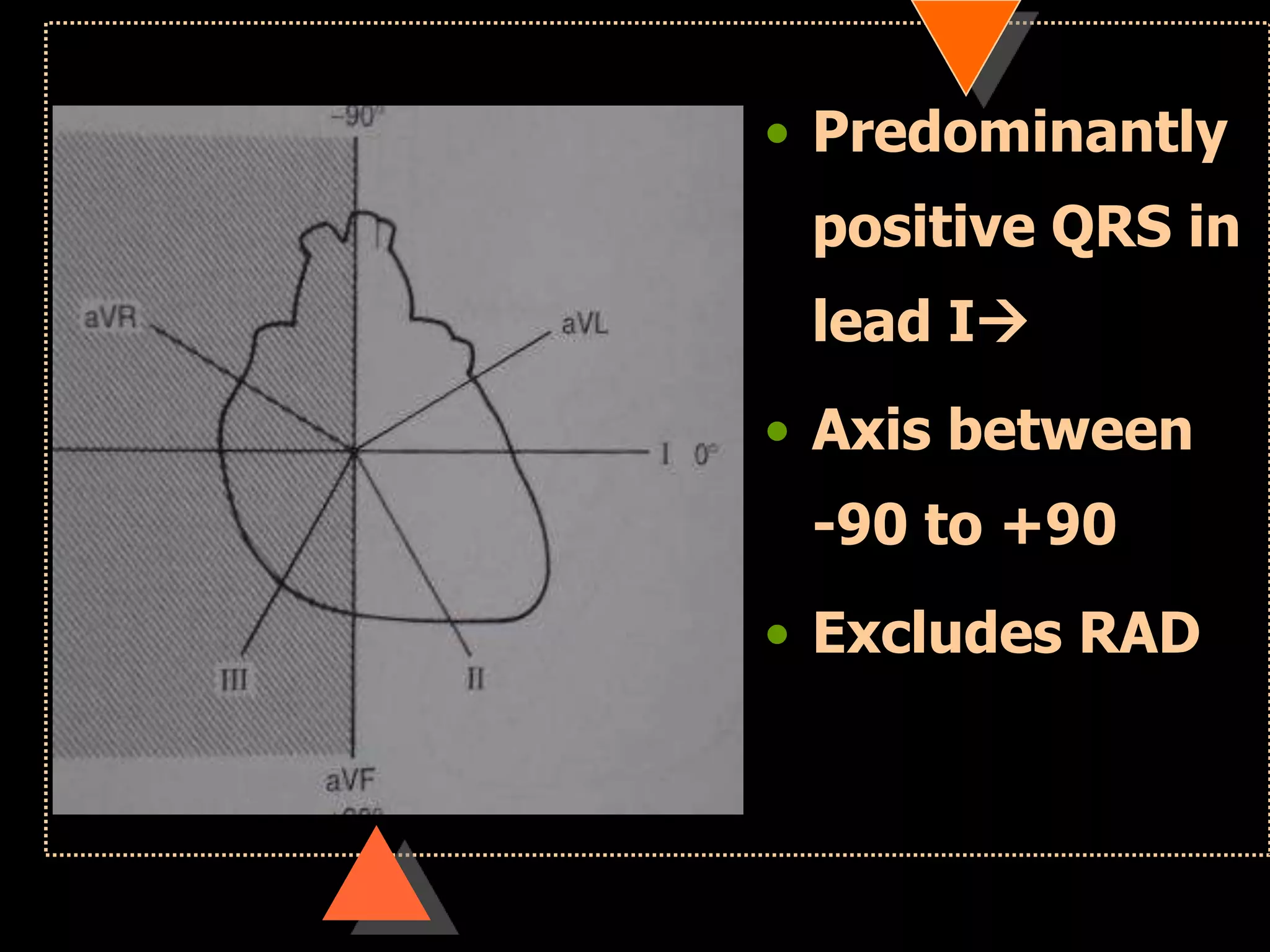
• Predominantly
positive QRS in
lead I
• Axis between
-90 to +90
• Excludes RAD
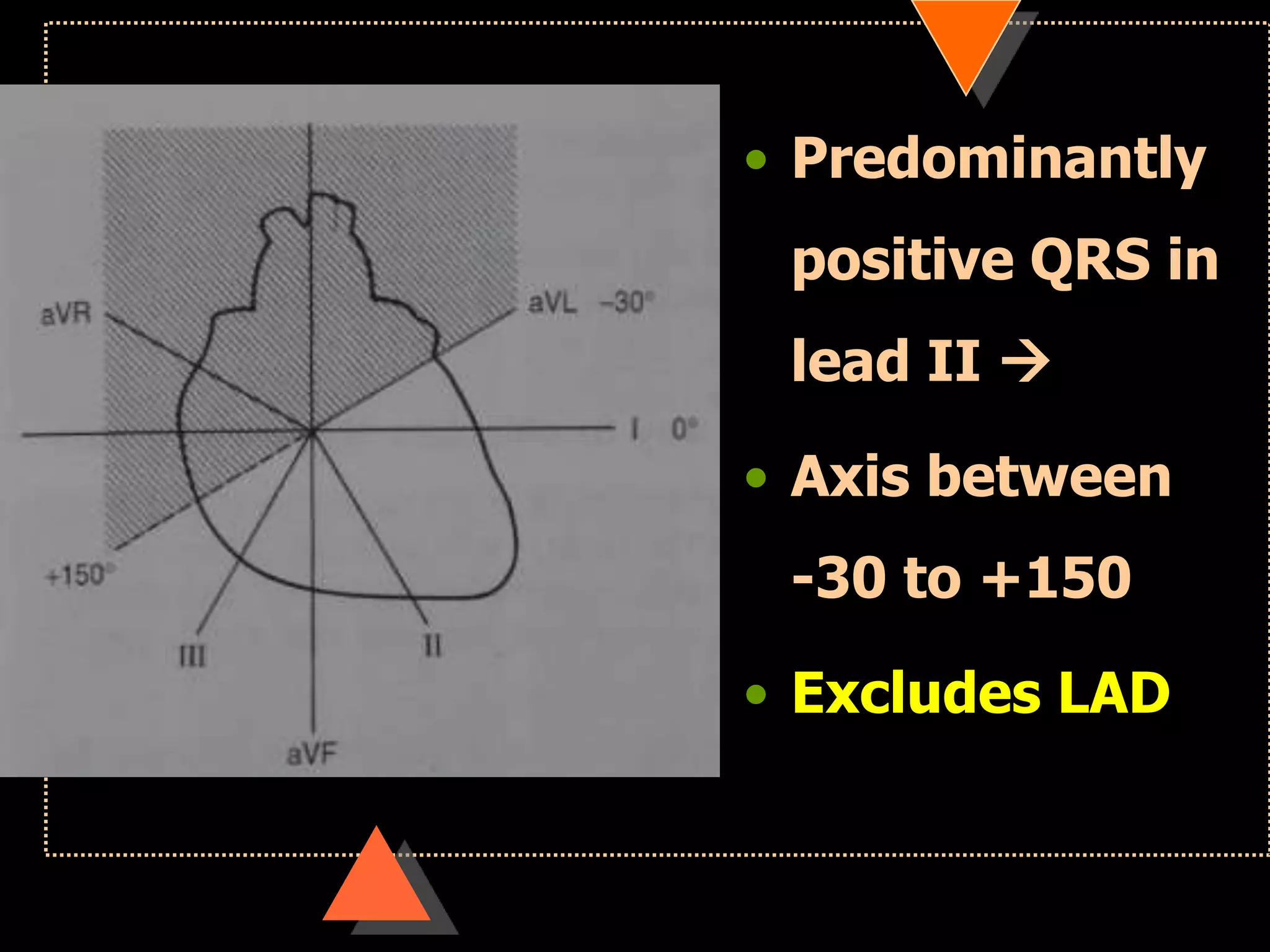
• Predominantly
positive QRS in
lead II 
• Axis between
-30 to +150
• Excludes LAD
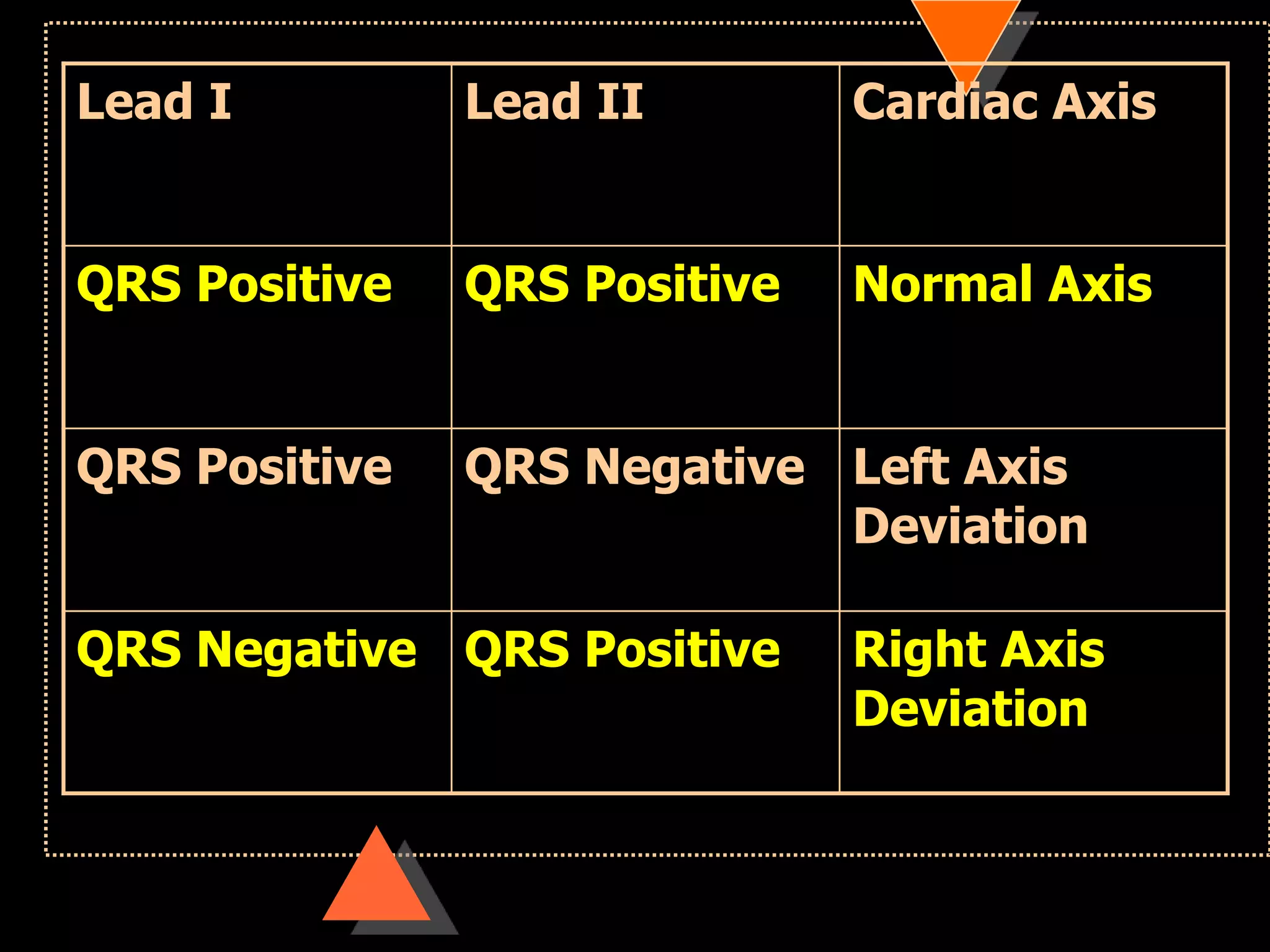
Lead I Lead II Cardiac Axis
QRS Positive QRS Positive Normal Axis
QRS Positive QRS Negative Left Axis
Deviation
QRS Negative QRS Positive Right Axis
Deviation
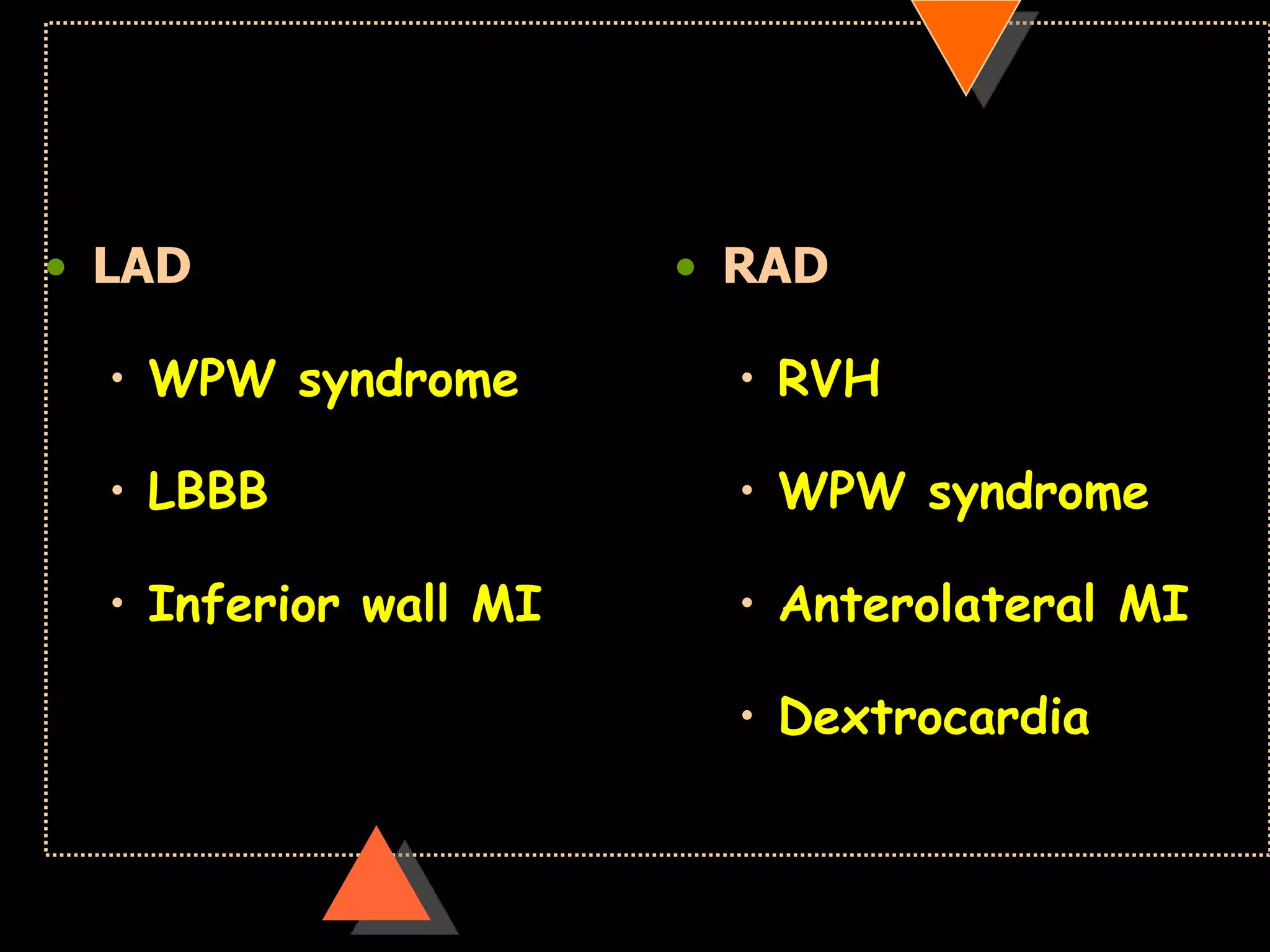
• LAD
• WPW syndrome
• LBBB
• Inferior wall MI
• RAD
• RVH
• WPW syndrome
• Anterolateral MI
• Dextrocardia
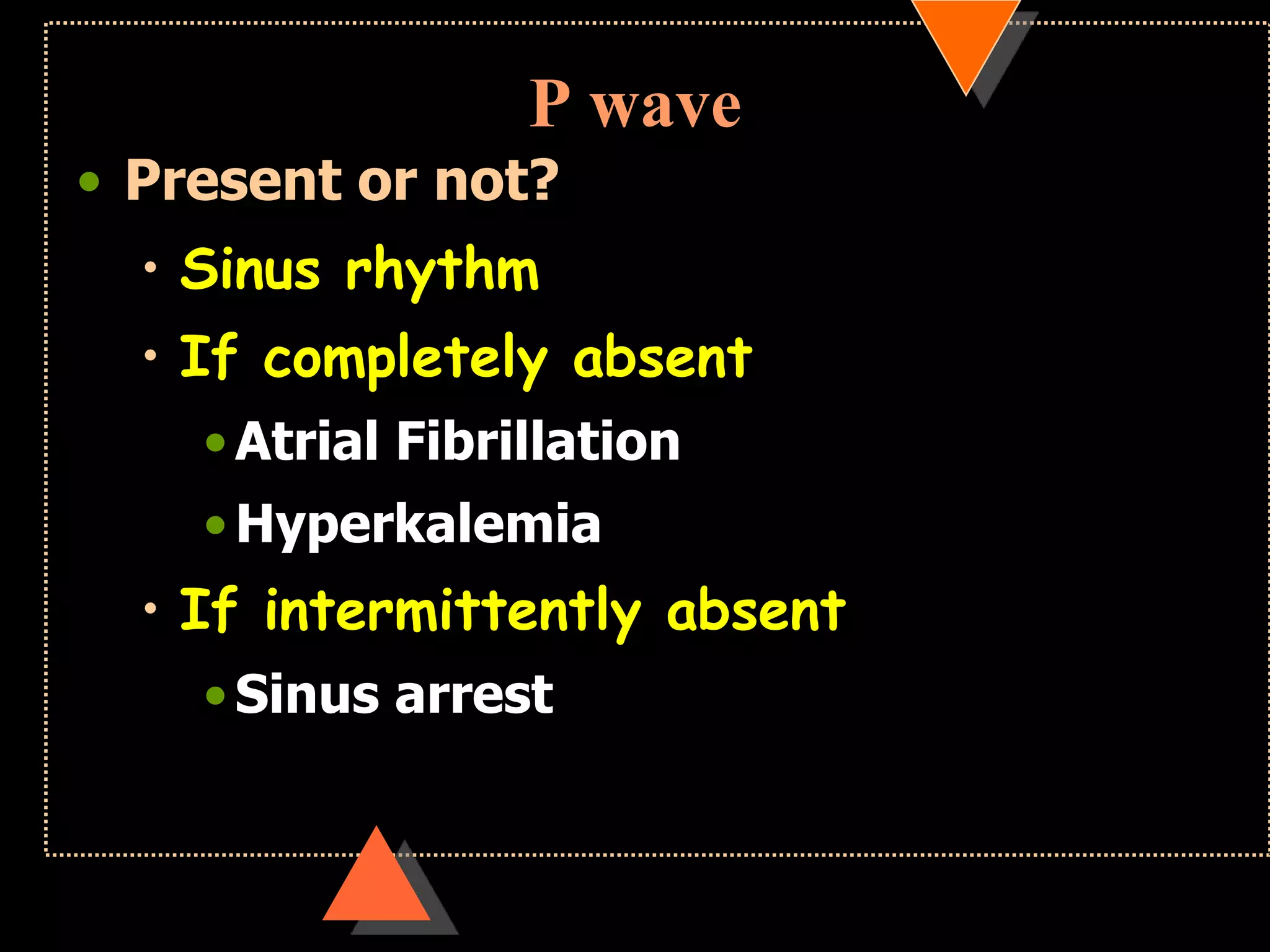
P wave
• Present or not?
• Sinus rhythm
• If completely absent
•Atrial Fibrillation
•Hyperkalemia
• If intermittently absent
•Sinus arrest
• Inverted P waves?
• Incorrect positioned electrodes
• Dextrocardia
• Abnormal atrial depolarization
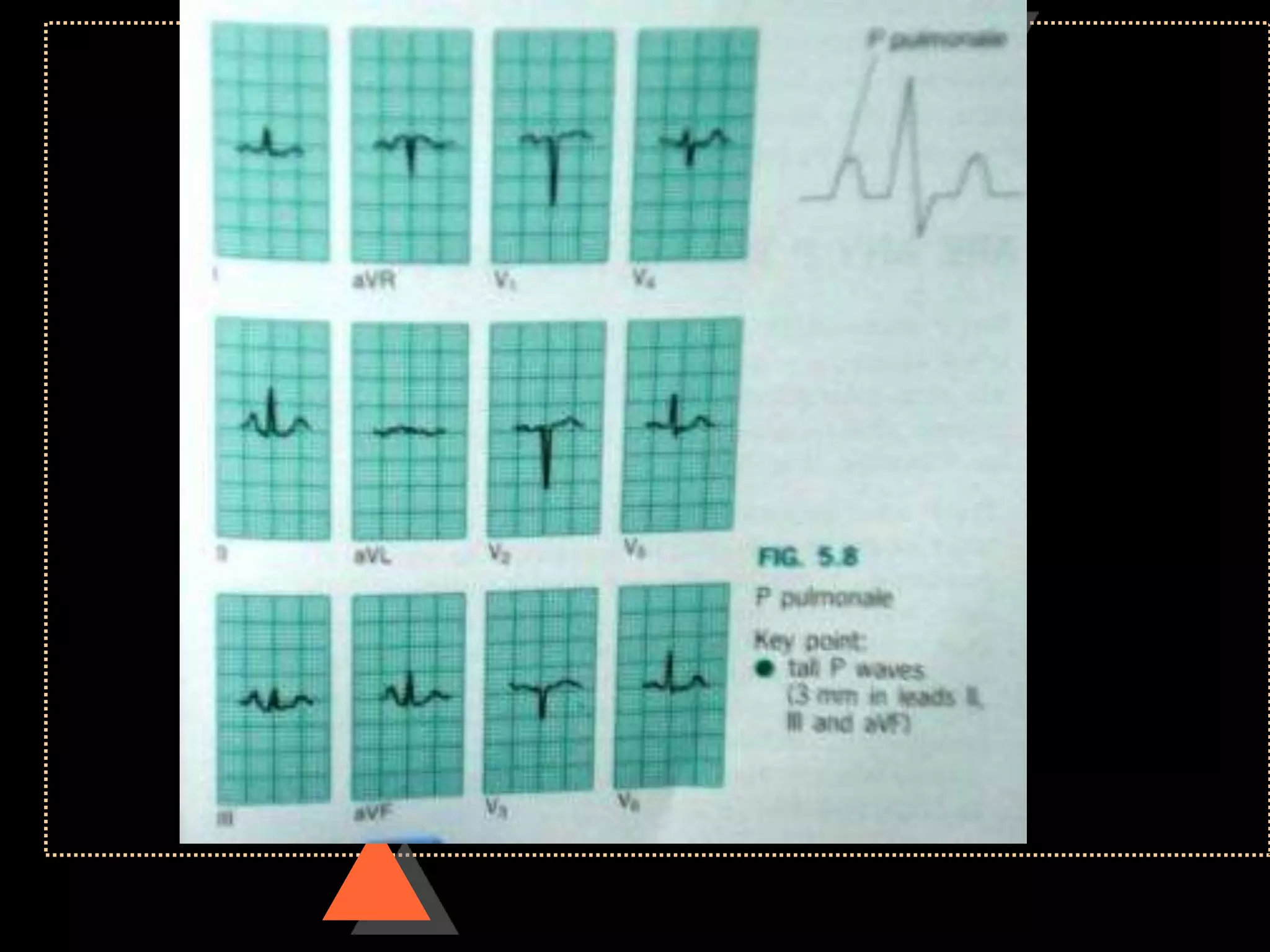
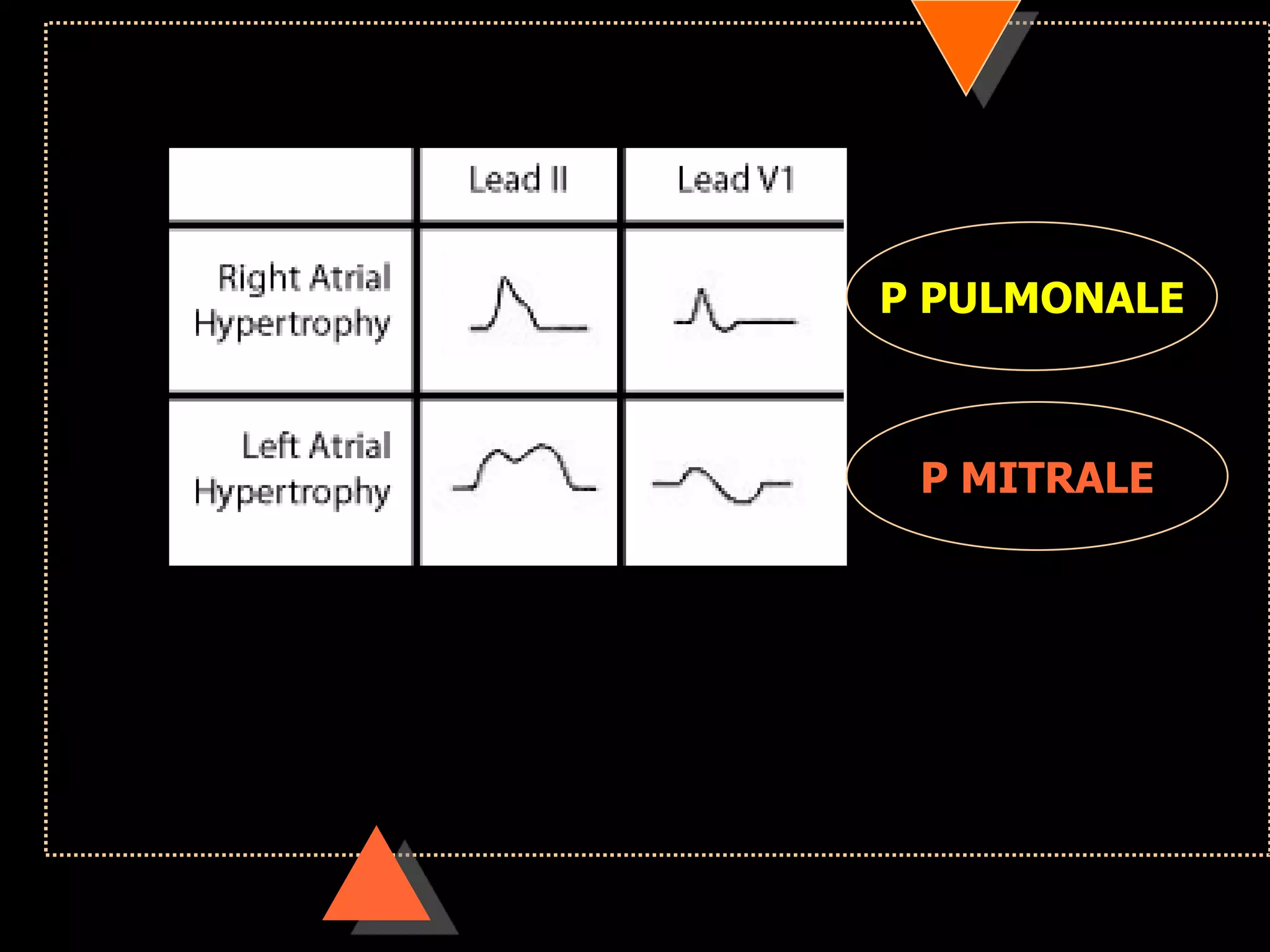
• Height of P waves
• > 2.5 mm: tall
• Indicative of Right Atrial enlargement
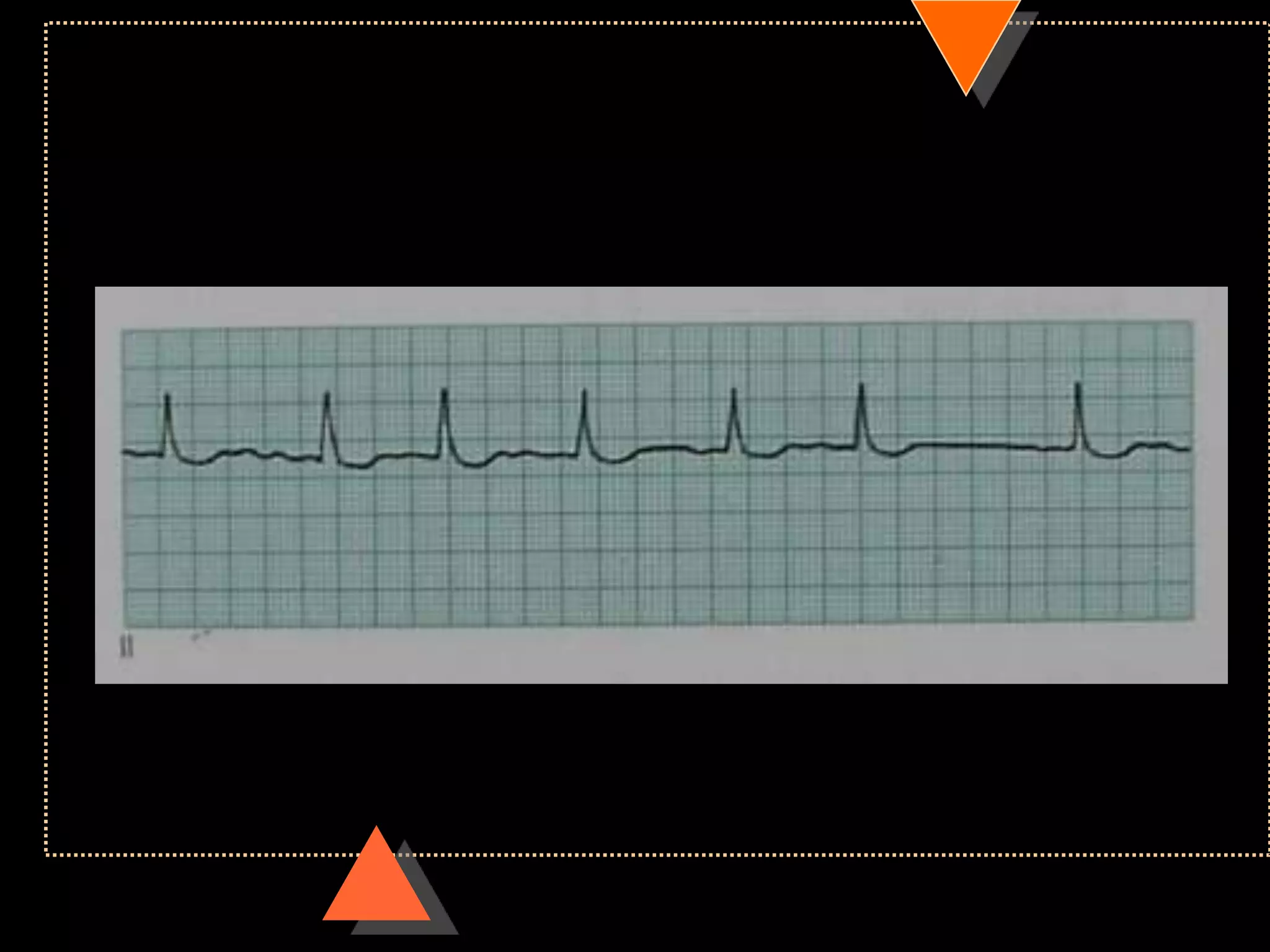
• P Pulmonale
P PULMONALE
P MITRALE
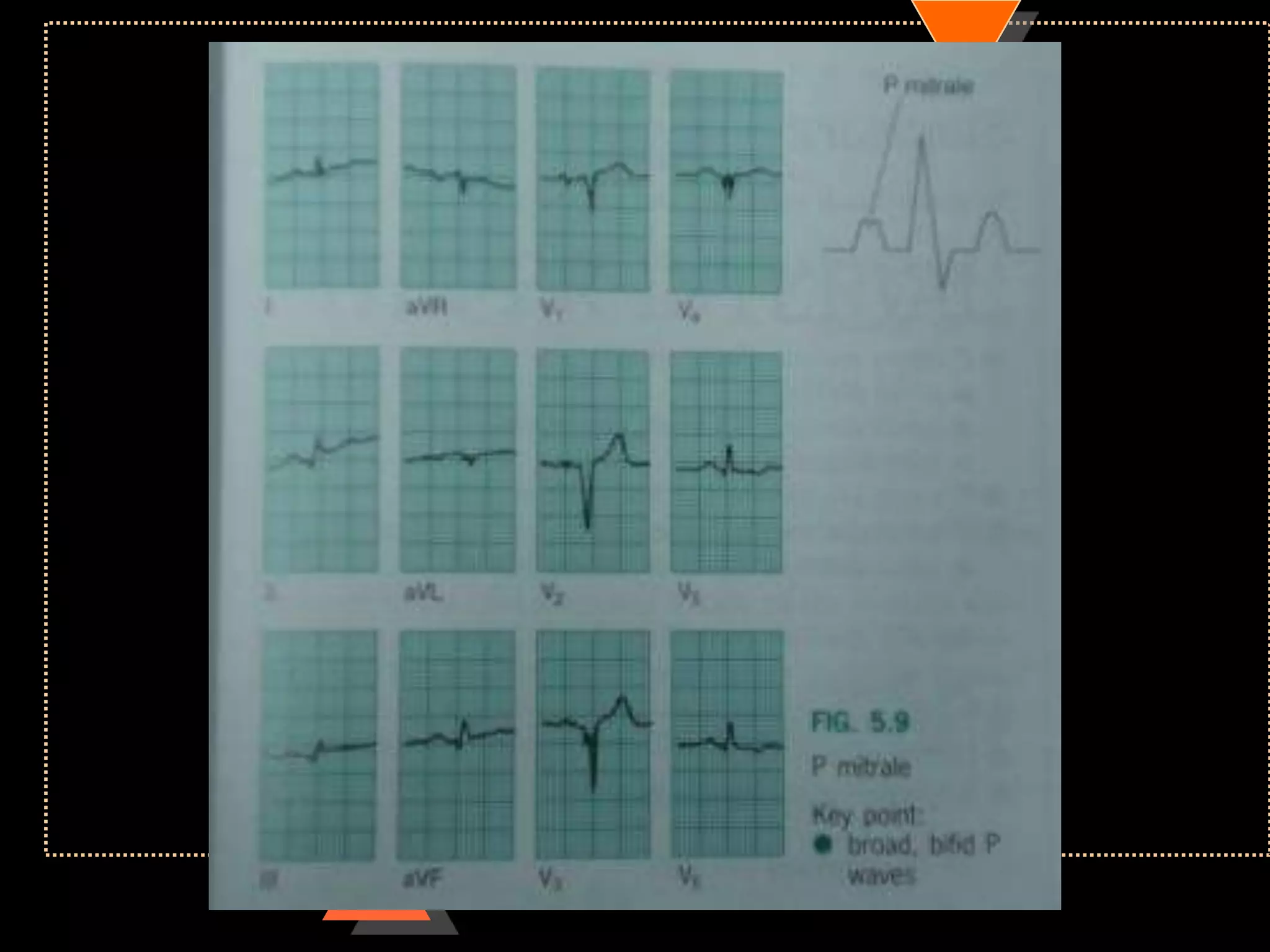
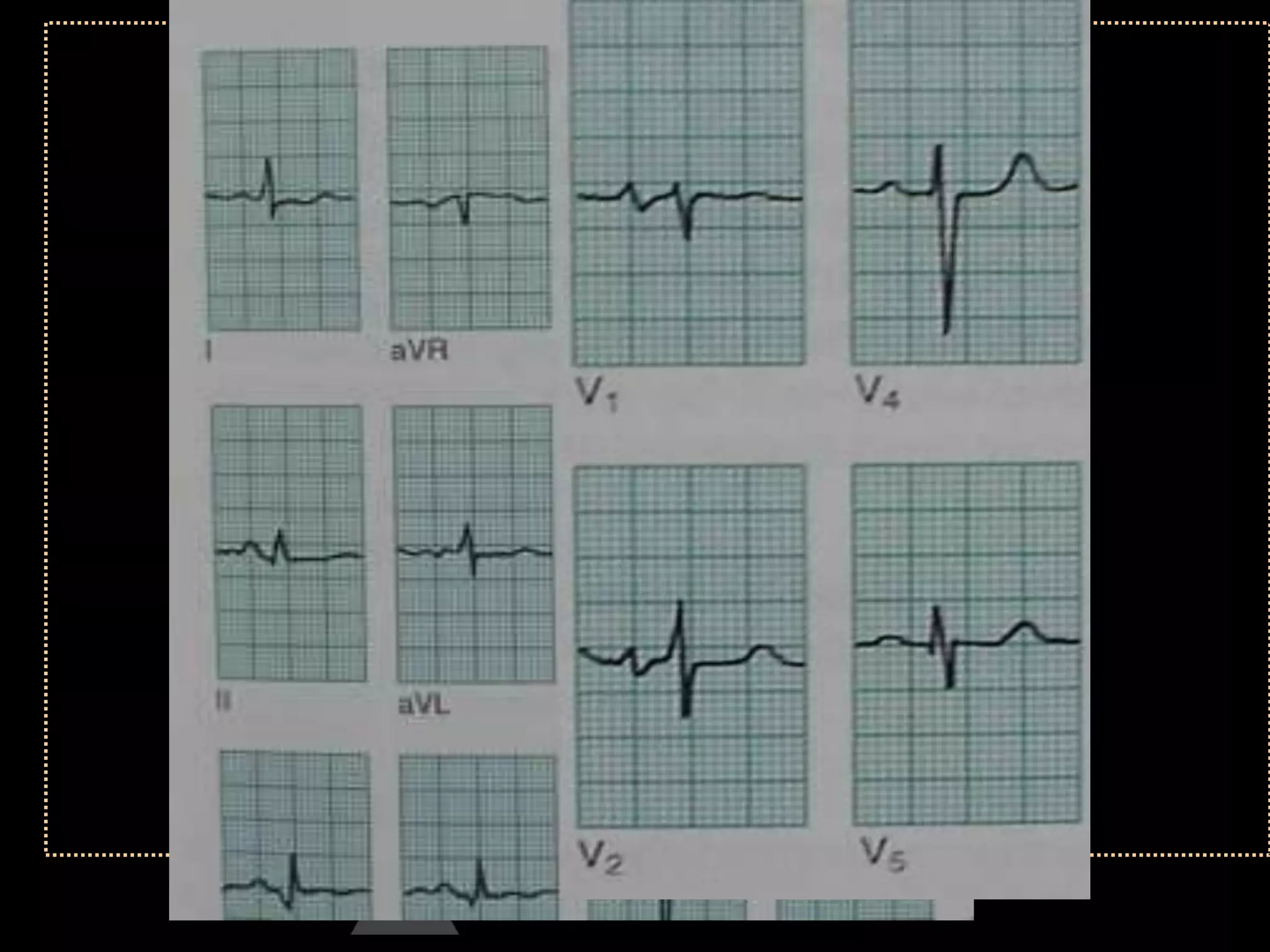
• Width of P waves
• >2mm width: abnormal
• Bifid P wave
• Indicates Left Atrial enlargement
• P Mitrale
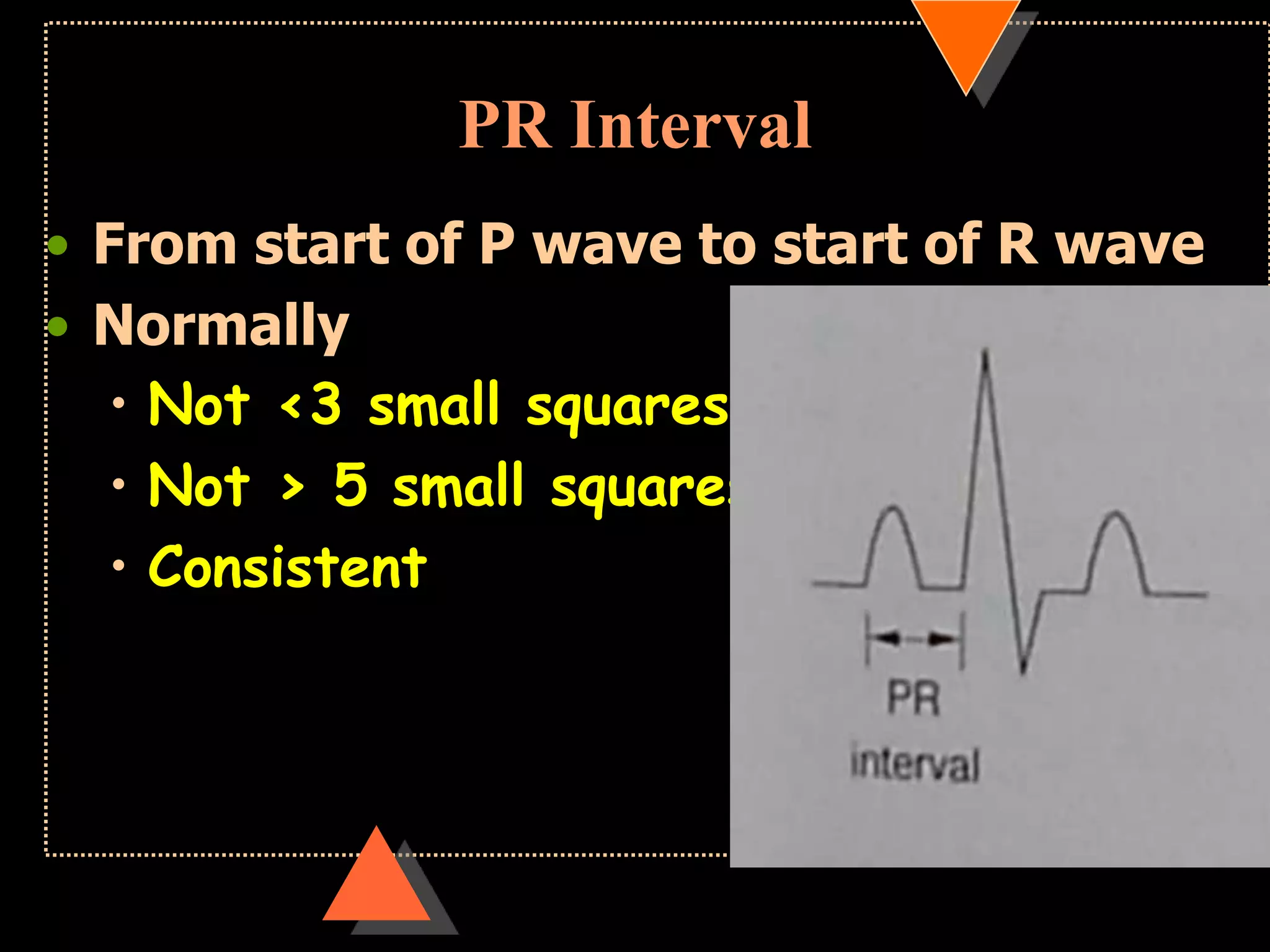
PR Interval
• From start of P wave to start of R wave
• Normally
• Not <3 small squares
• Not > 5 small squares
• Consistent
Short PR Interval
• AV junctional rhythm
• WPW syndrome
• Lown –Ganong-Levine syndrome
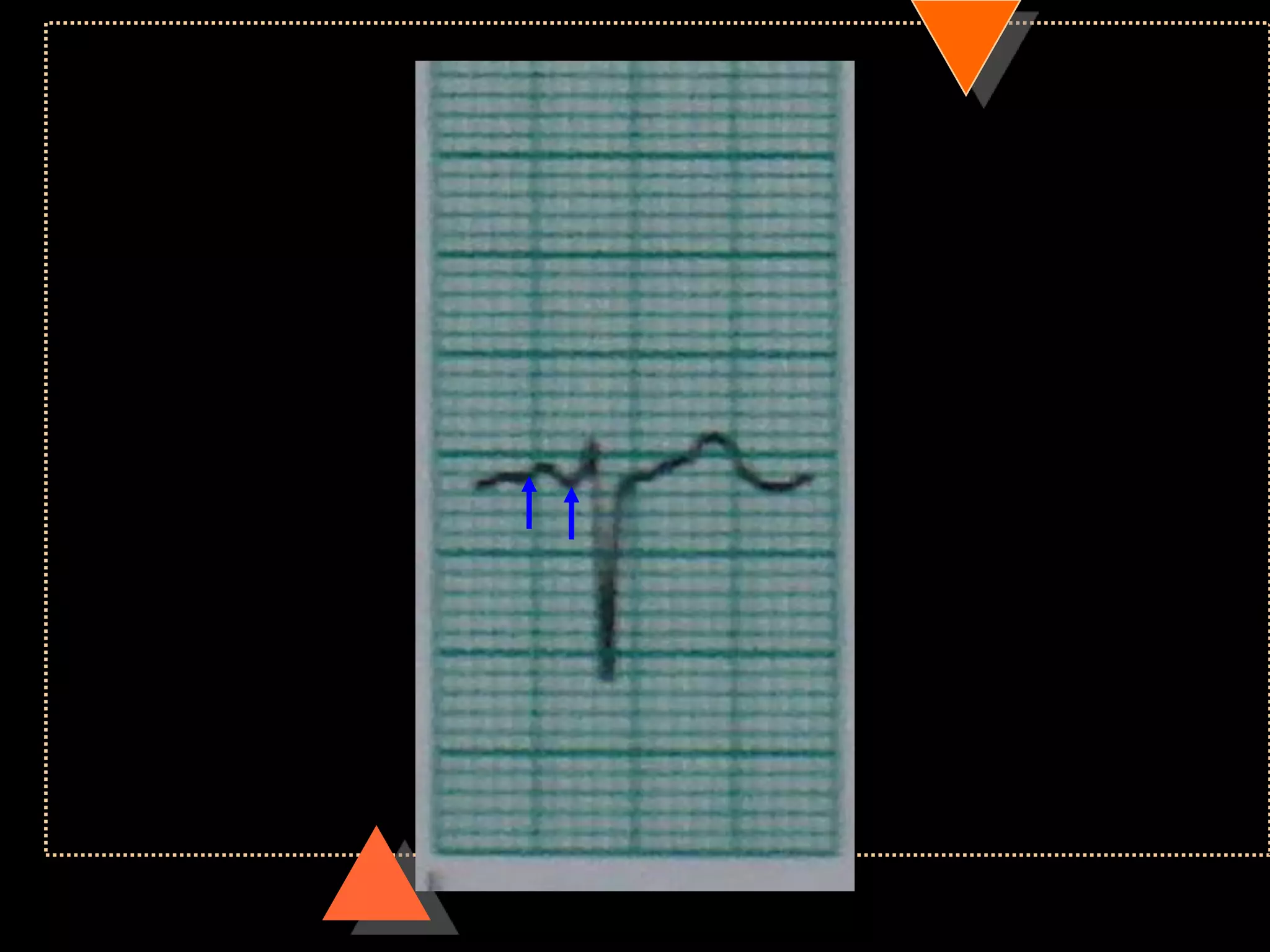
Long PR Interval
• Denotes delay in conduction through AV
node
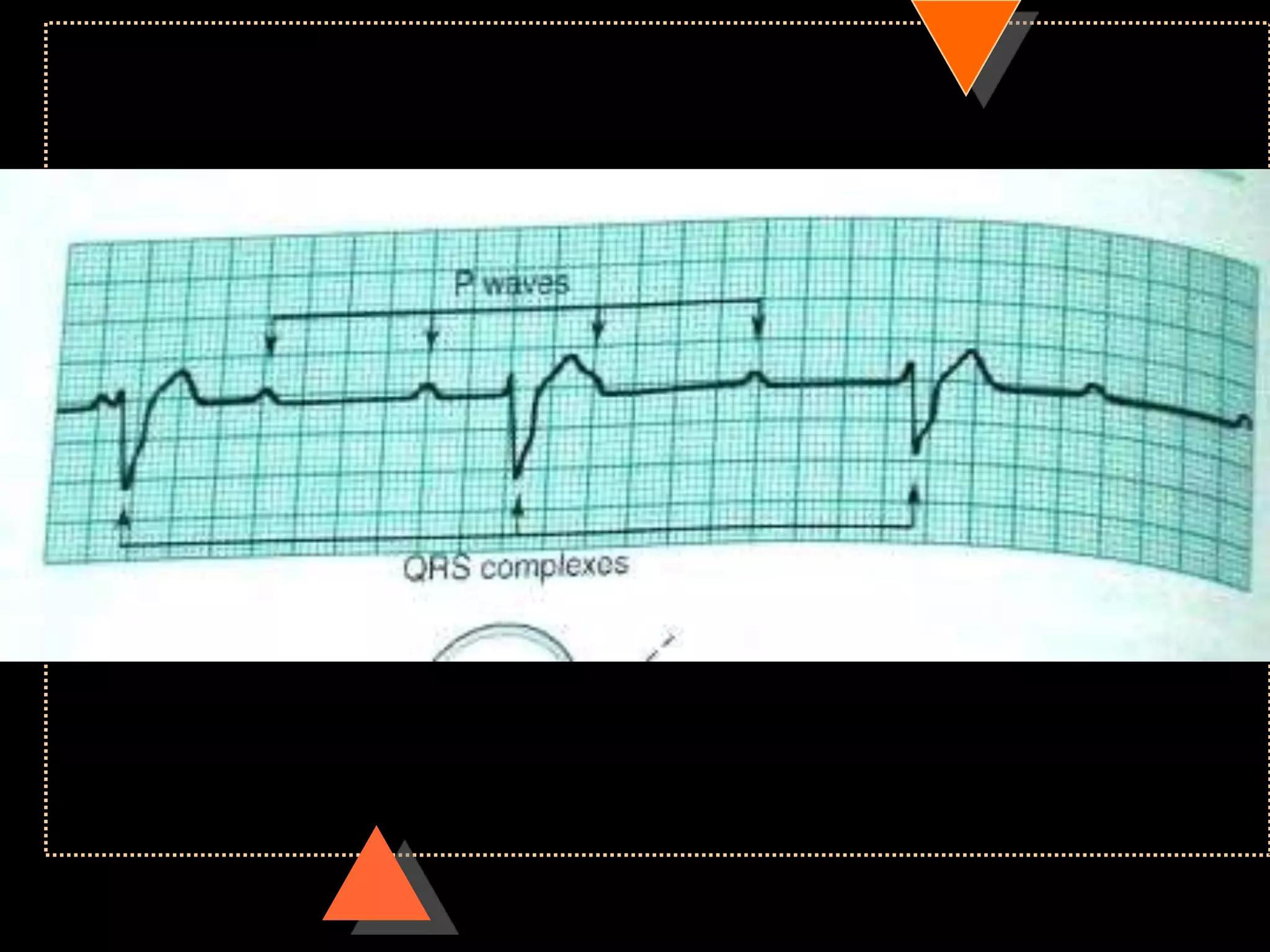
• First Degree Block
• PR prolonged, constant
Second degree Block
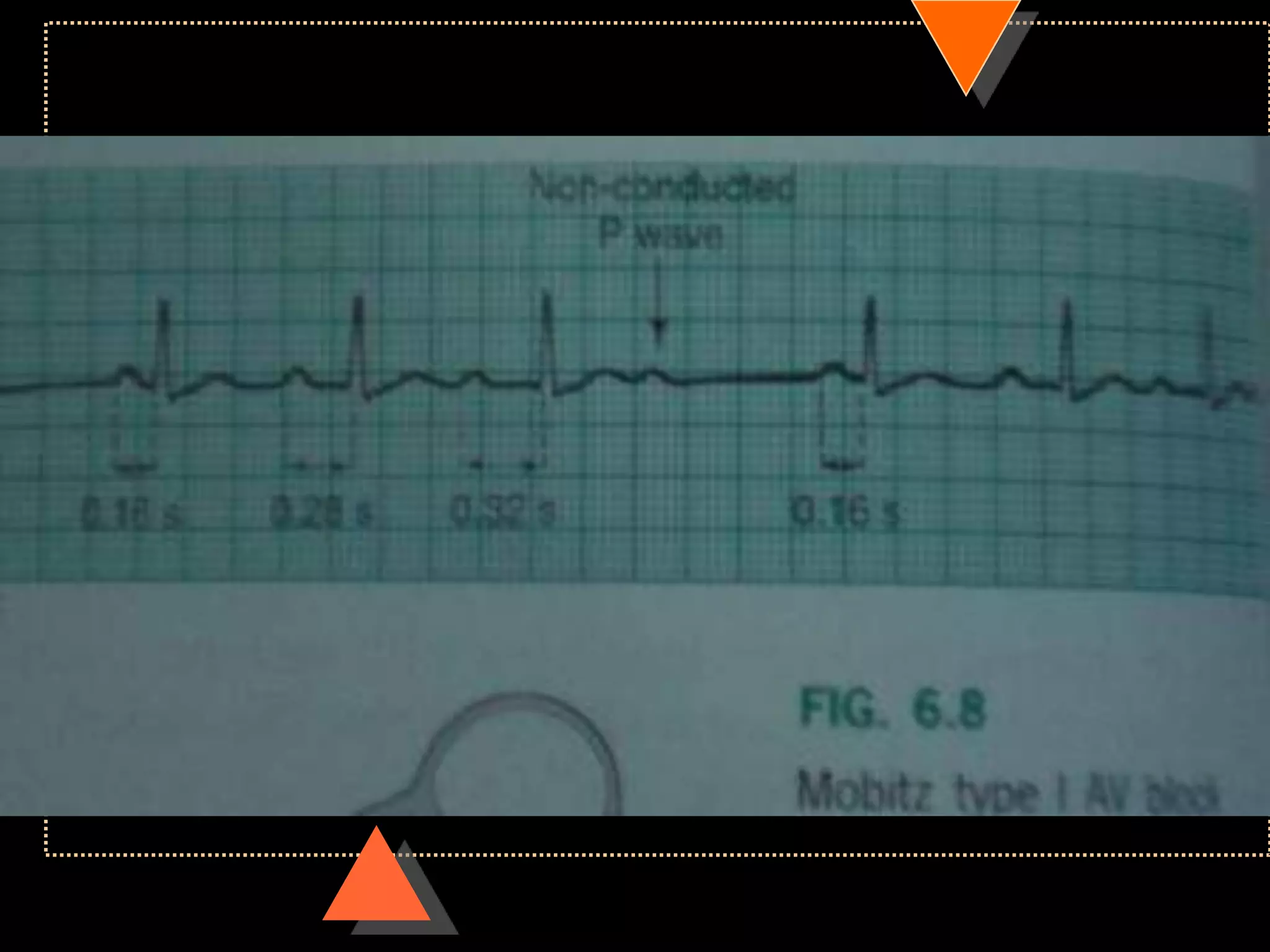
• Mobitz Type I
• PR progressively increase until one P
wave fails to produce QRS complex
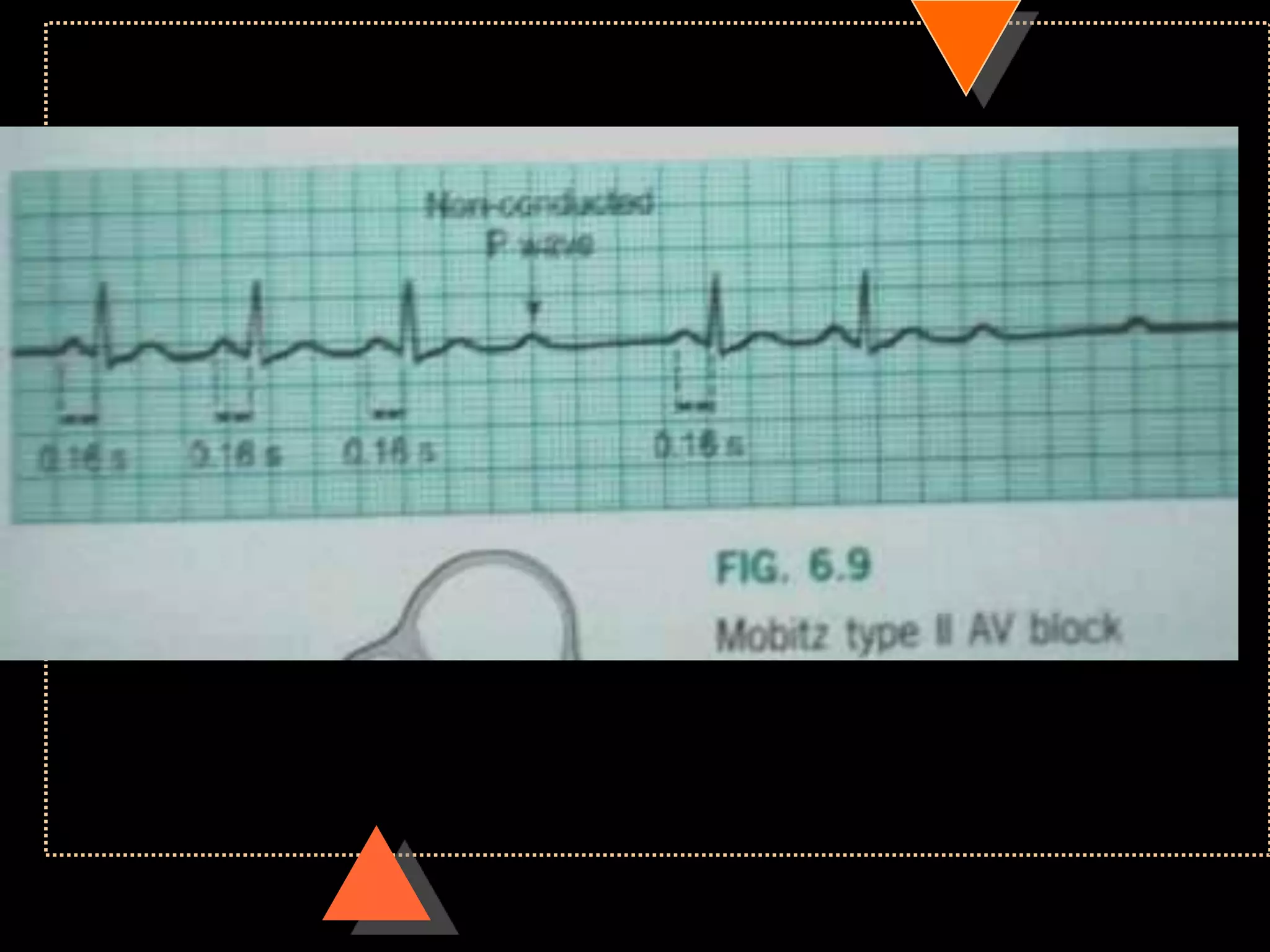
• Mobitz Type II
• PR interval normal & fixed,
• But occasional P waves fail to produce
QRS
• Third Degree Block [Complete AV Block]
• No relationship between P waves & QRS
complex
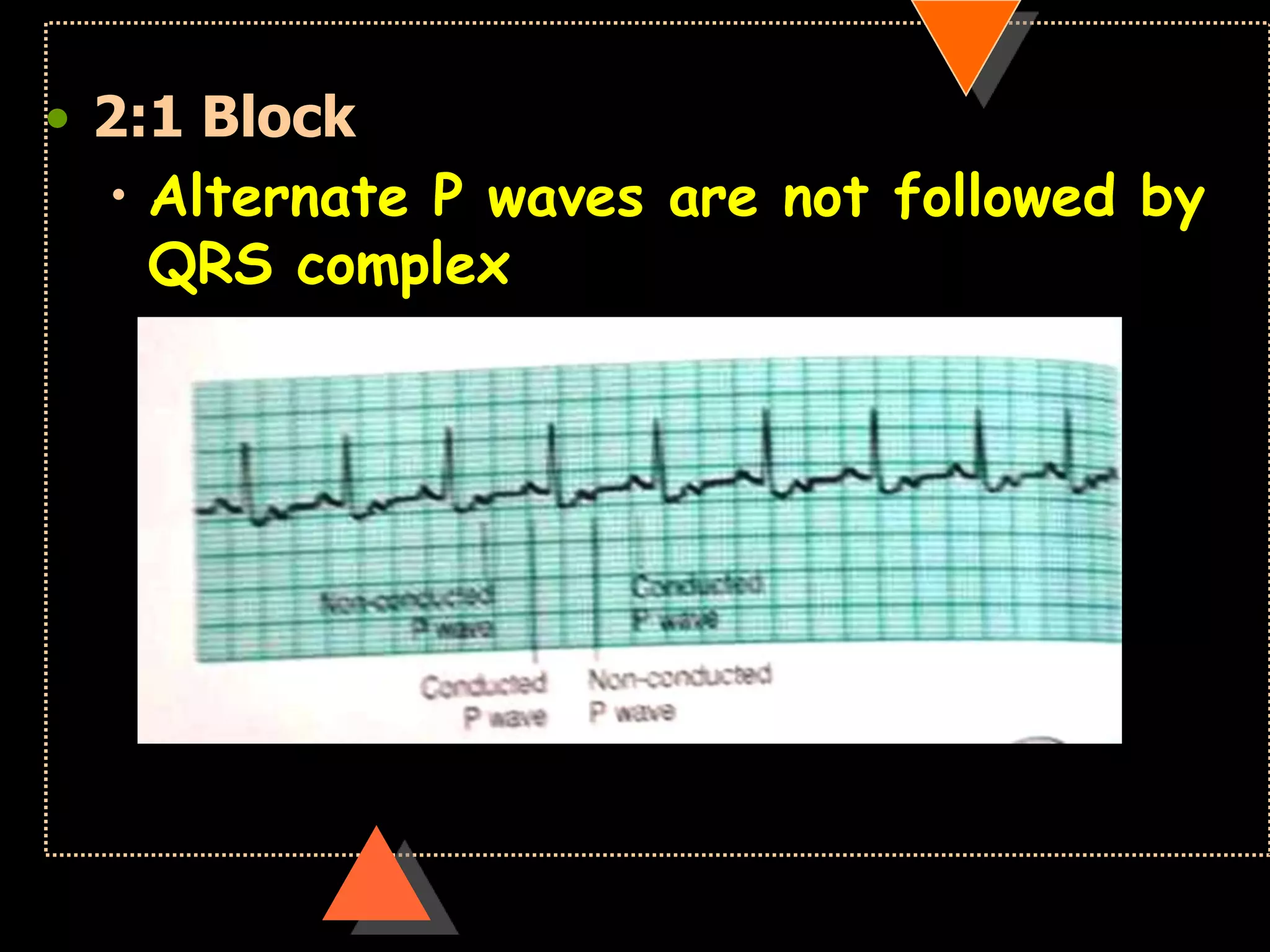
• 2:1 Block
• Alternate P waves are not followed by
QRS complex
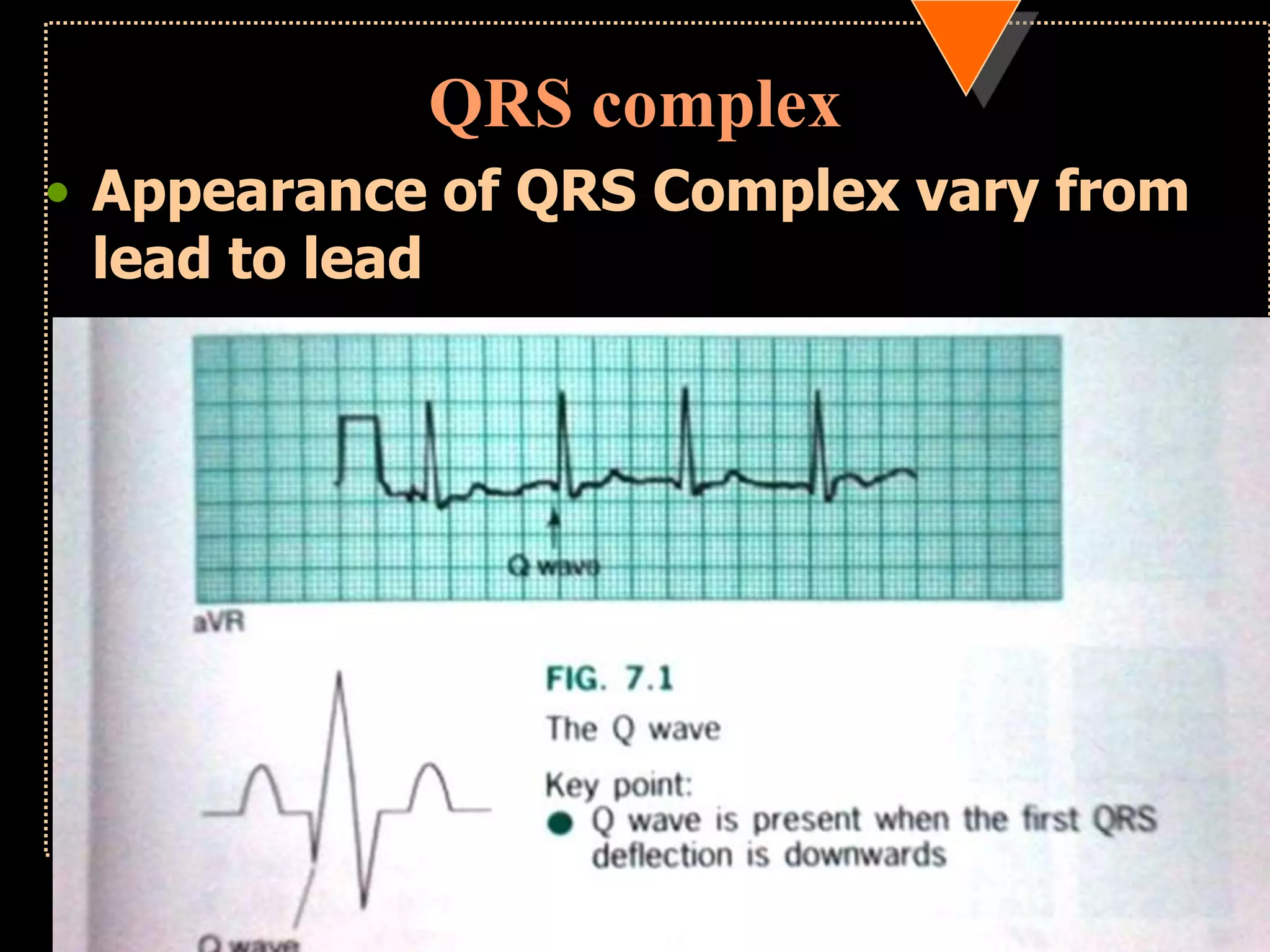
Q WAVE
• First negative deflection in QRS complex
• ? Pathological Q waves
• If
• >2 small squares deep
• >1 small square wide
• >25% of height of the following R wave
in depth
QRS complex
• Appearance of QRS Complex vary from
lead to lead
• Width: Narrow/ wide
• Wide QRS:
• > 3 small squares
• Bundle branch block
• Ventricular arrhythmia
• Size of QRS complex
• Small:
• Pericardial effusion
• ?incorrect calibration
• Big QRS complex
• Ventricular hypertrophy: R/L
• WPW syndrome
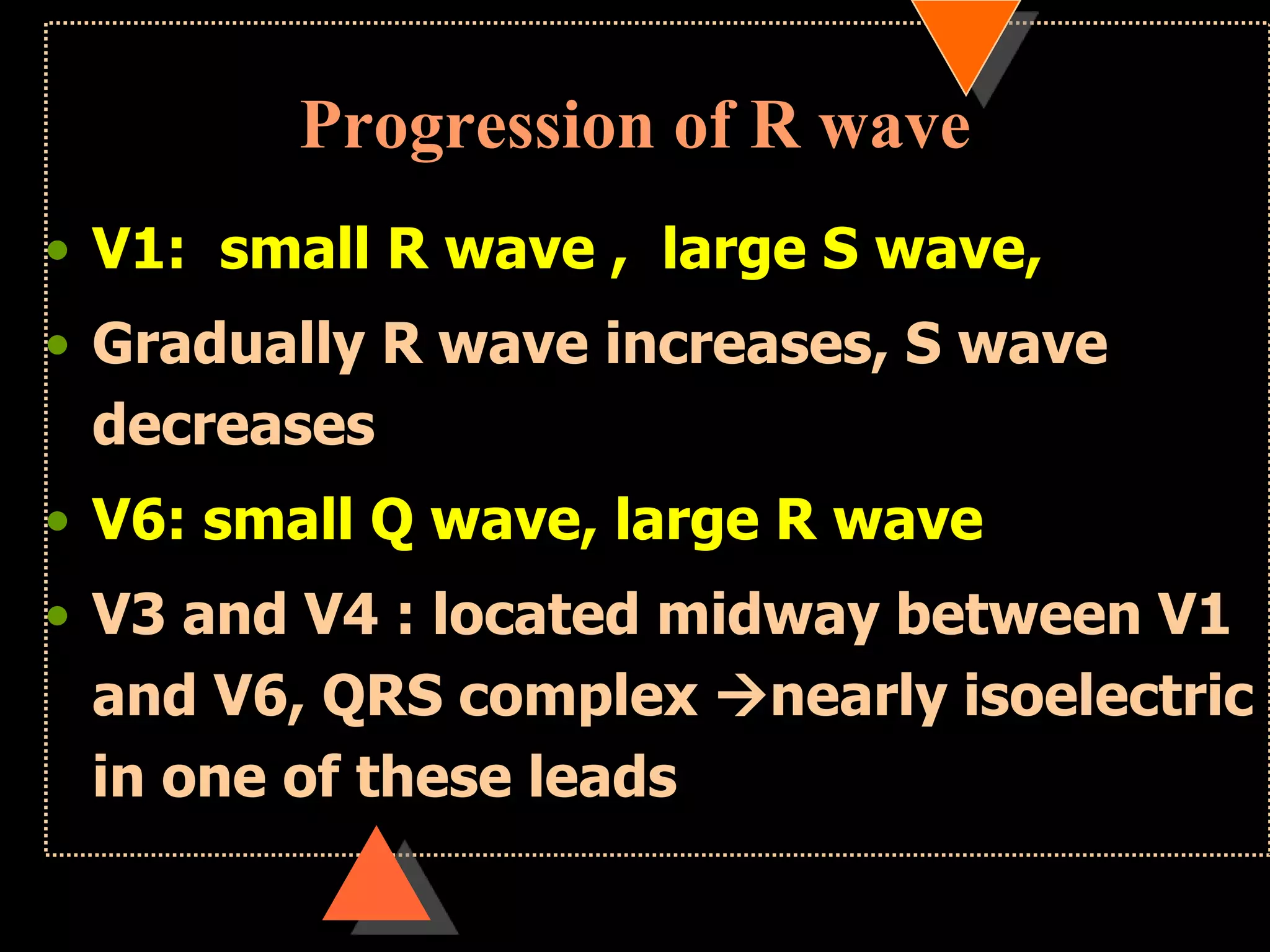
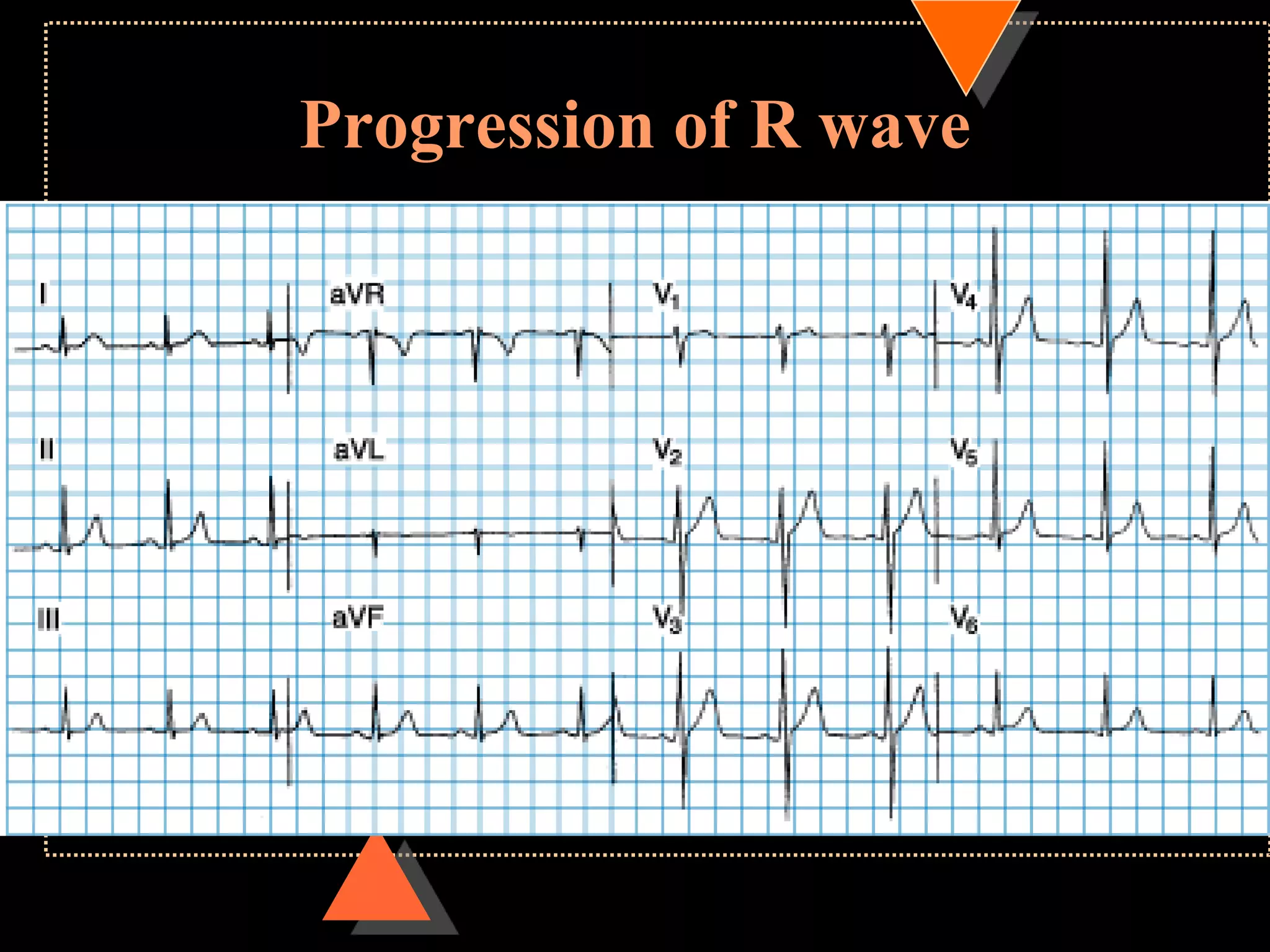
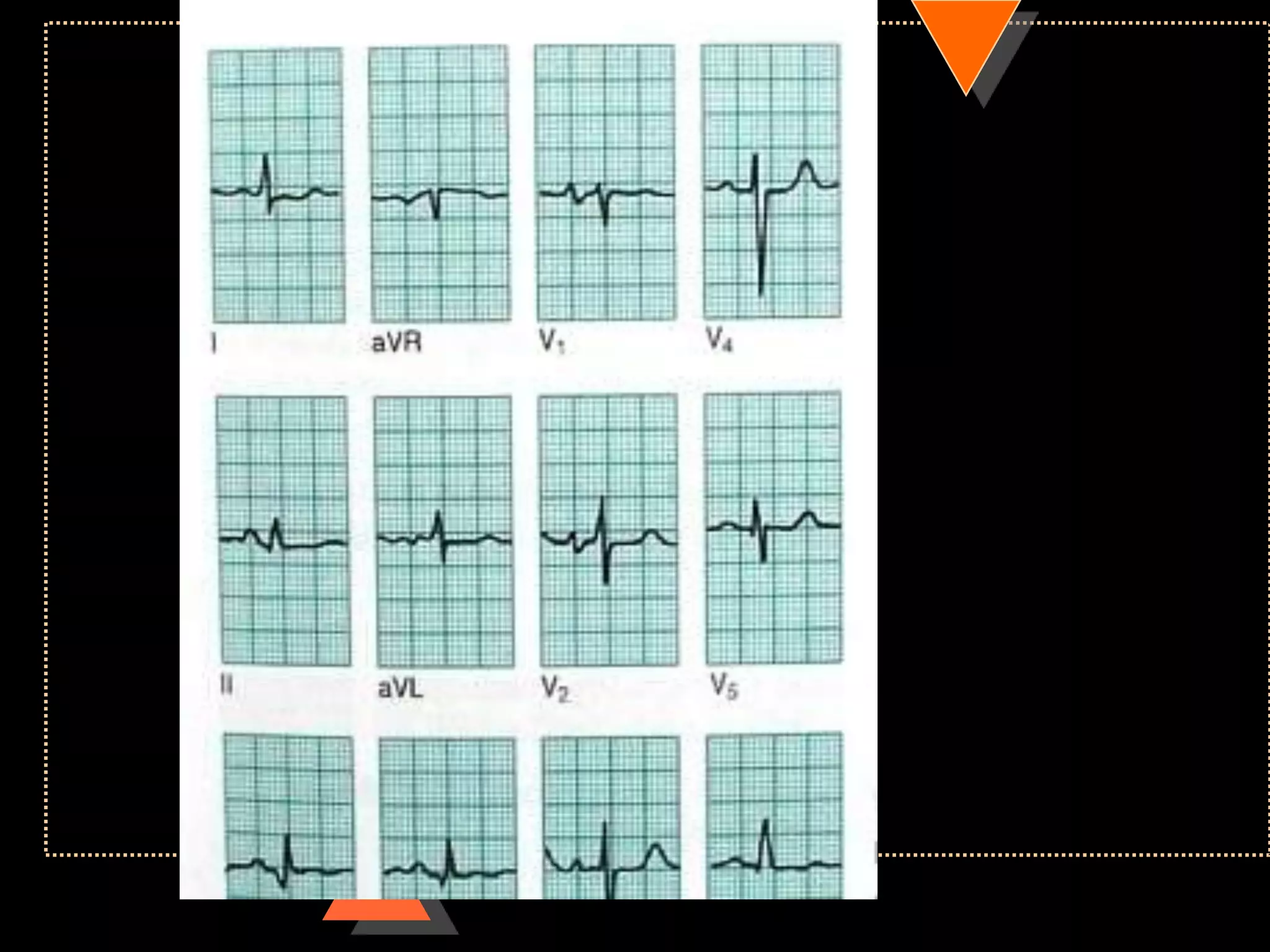
Progression of R wave
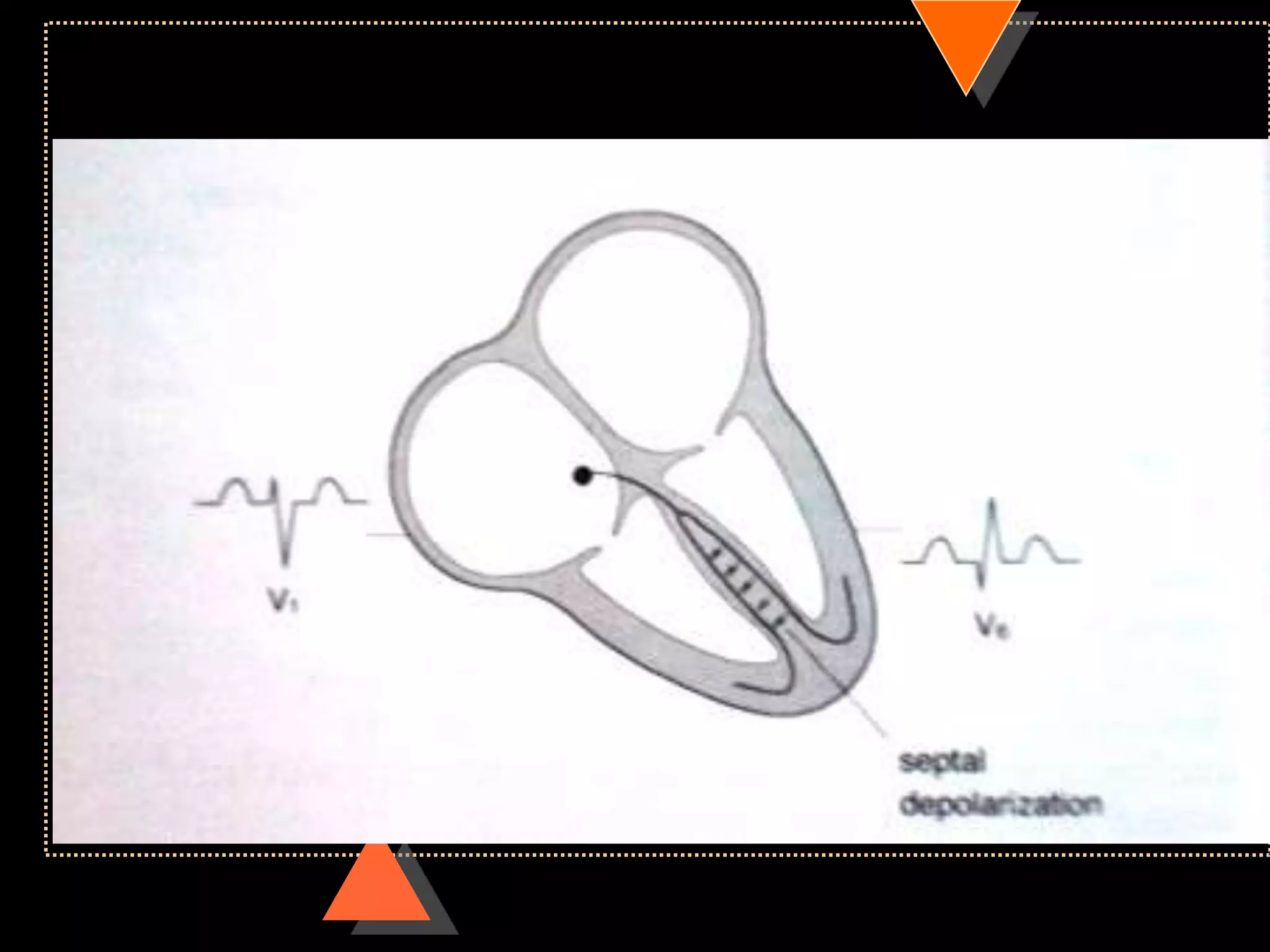
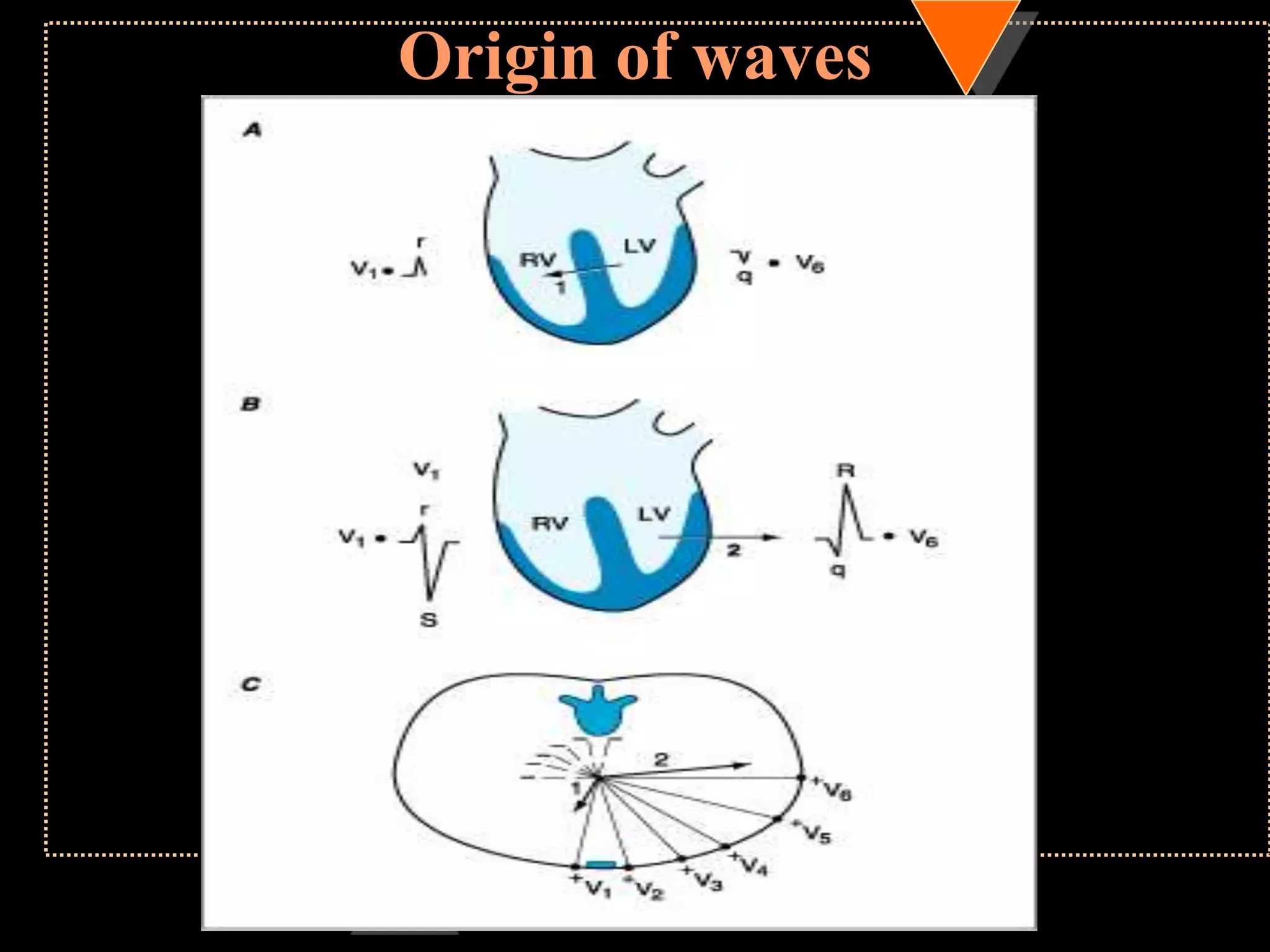
• V1: small R wave , large S wave,
• Gradually R wave increases, S wave
decreases
• V6: small Q wave, large R wave
• V3 and V4 : located midway between V1
and V6, QRS complex nearly isoelectric
in one of these leads
Progression of R wave
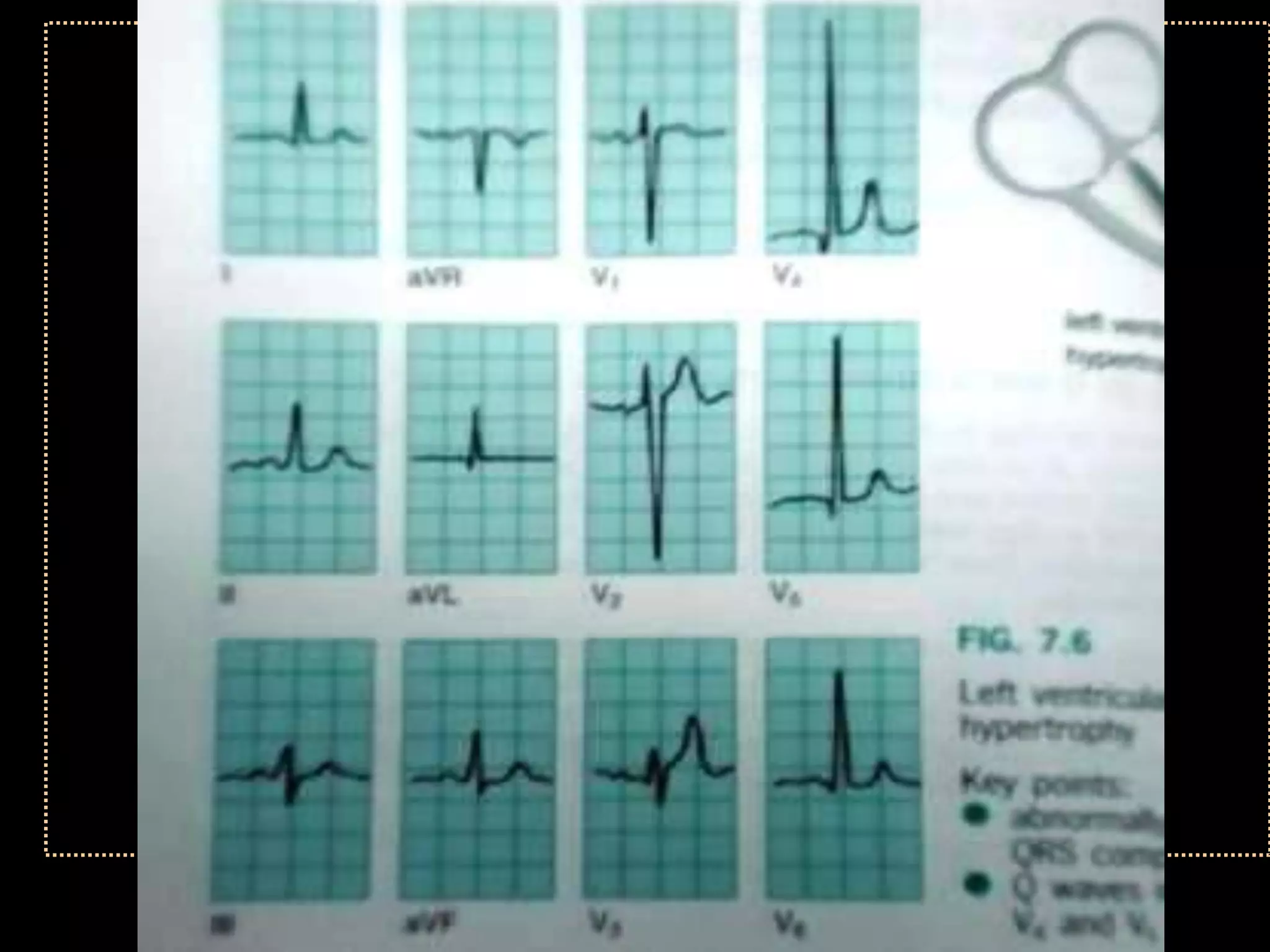
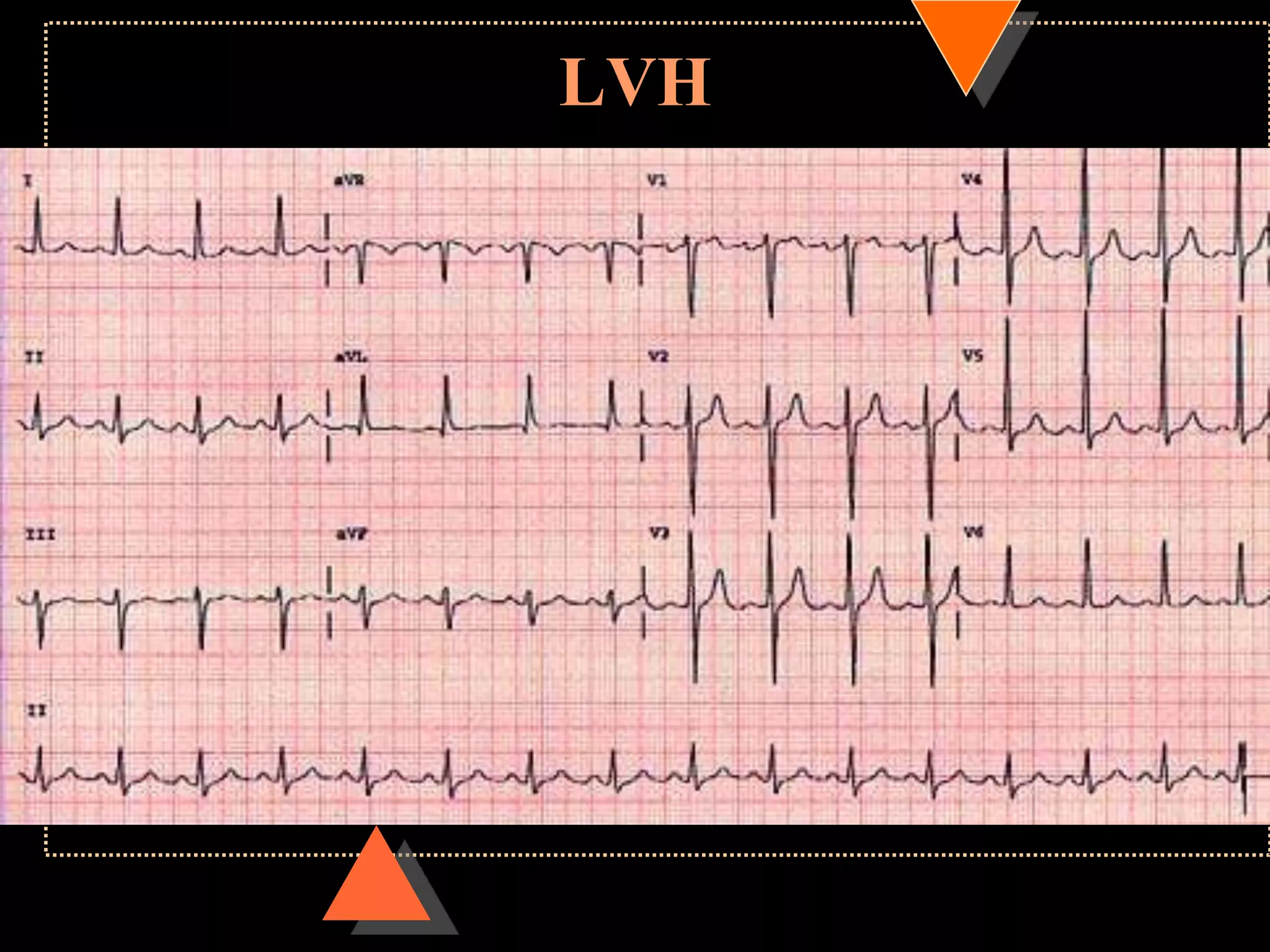
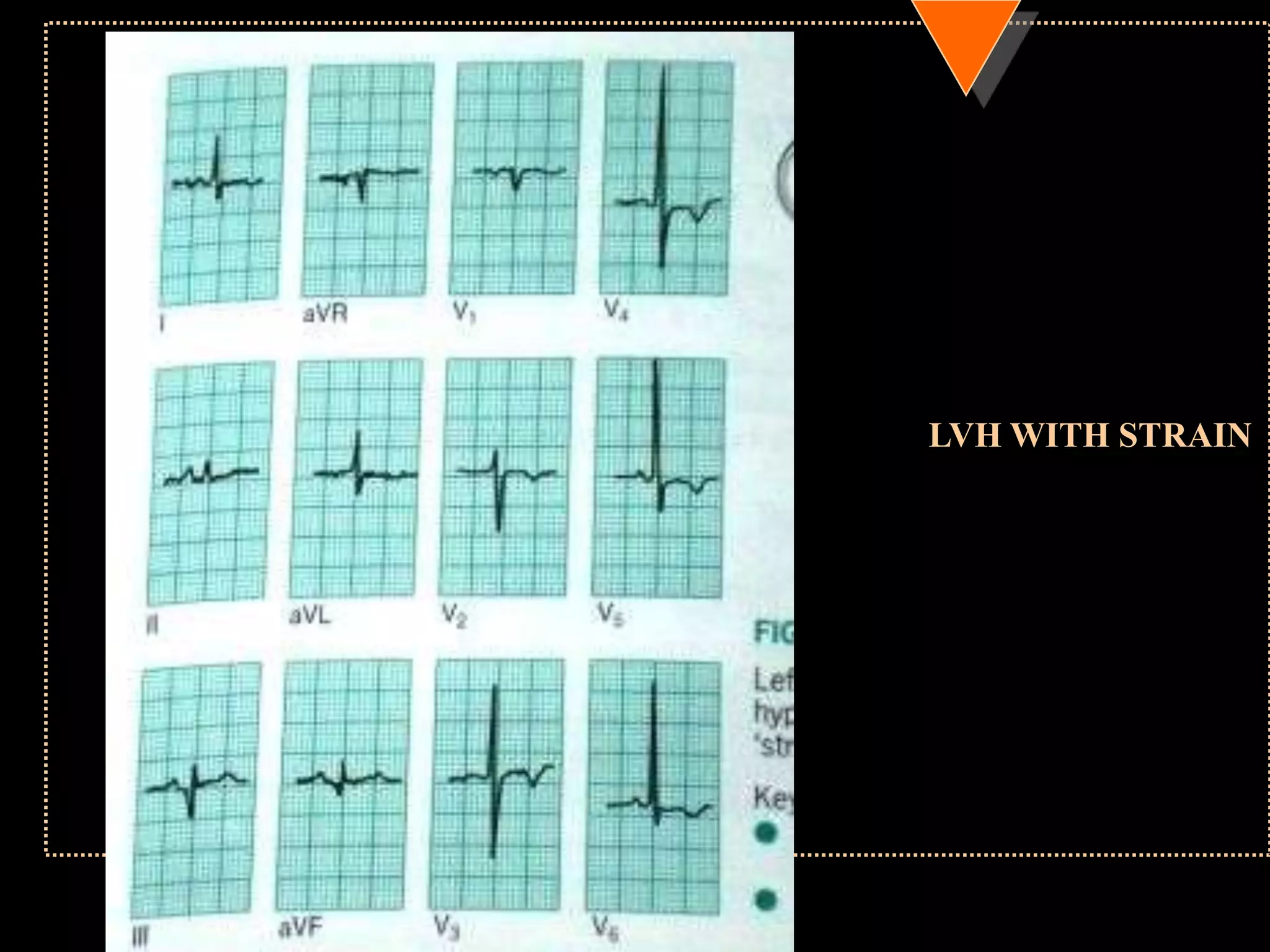
Left ventricular Hypertrophy
• R Wave in V5 or V6 >25mm
• S Wave in V1 or V2 > 25mm
• Sum of R wave in V5 Or V6 & S wave in
V1 or V2 >35mm
LVH
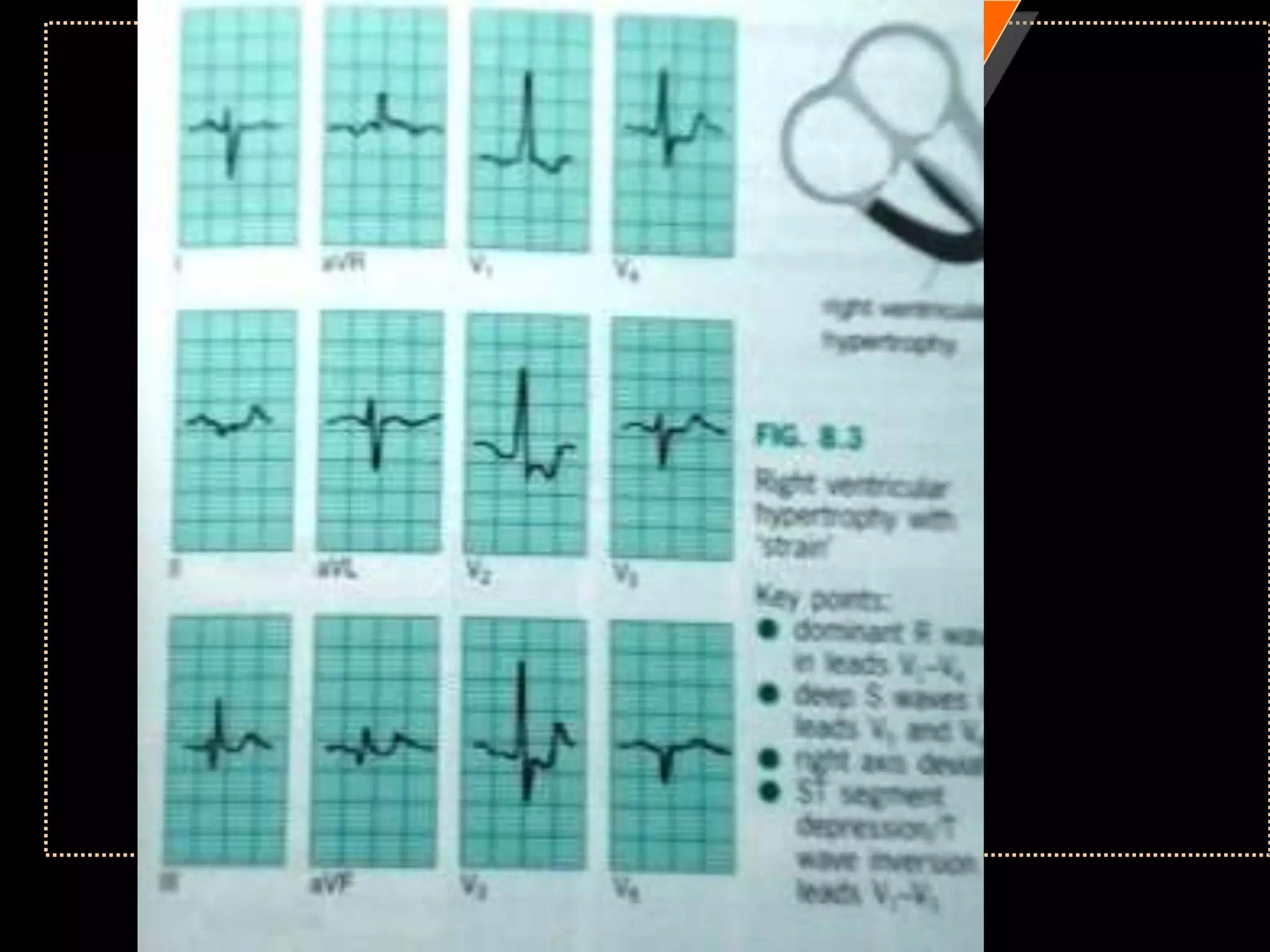
Right Ventricular Hypertrophy
• Right axis deviation
• Deep S Waves in leads V5 & V6
• R>S in V1
• RBBB
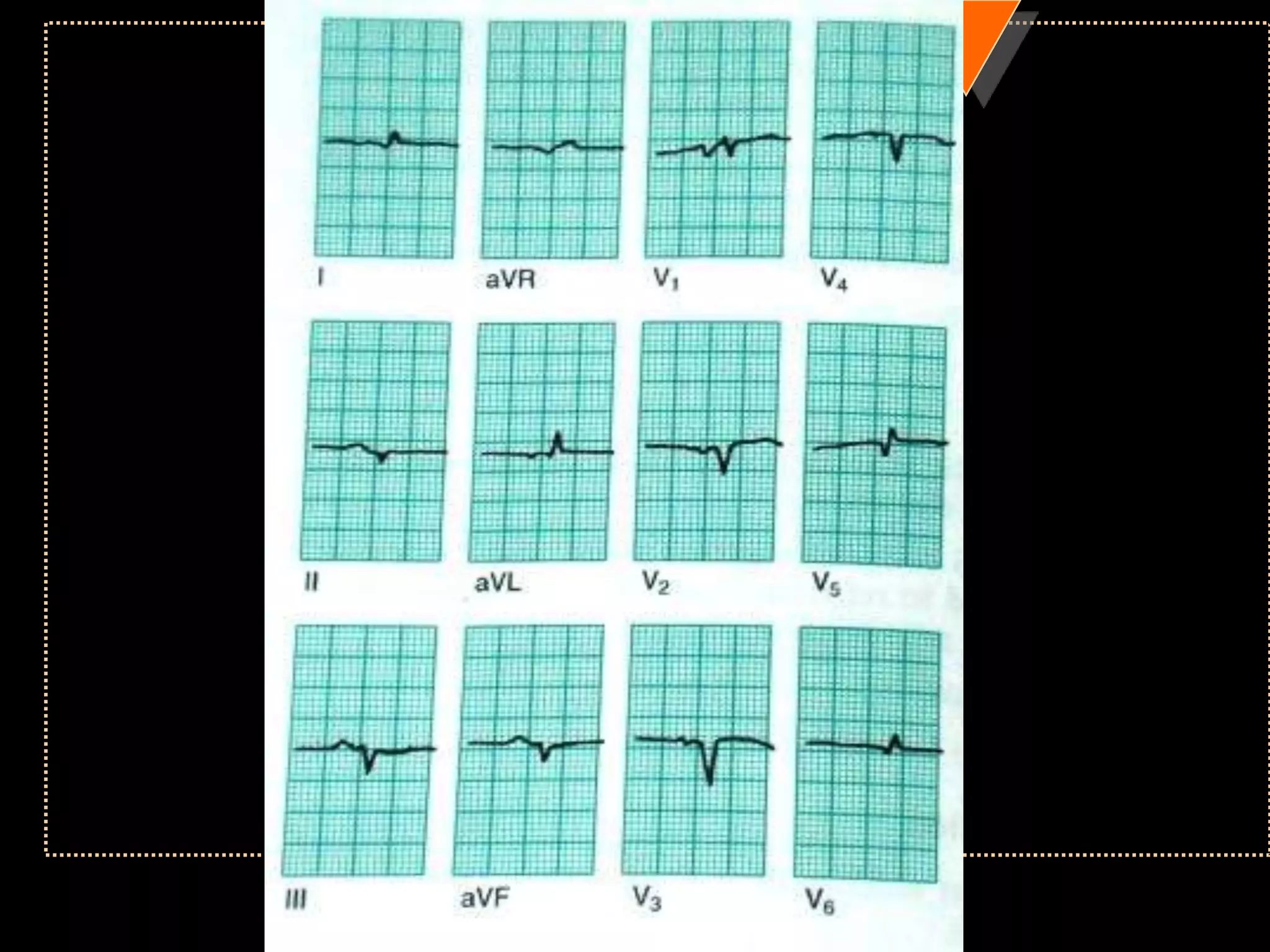
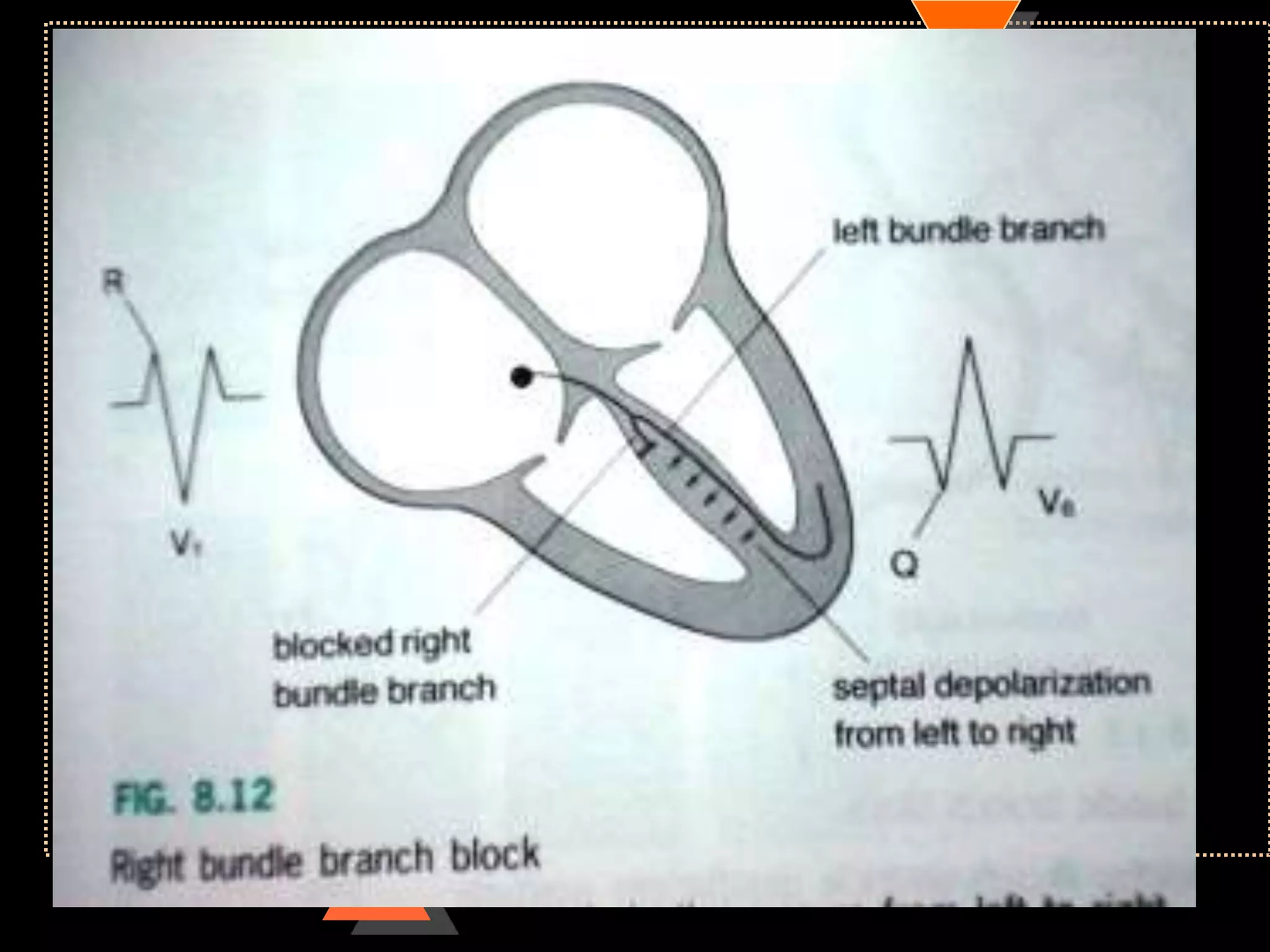
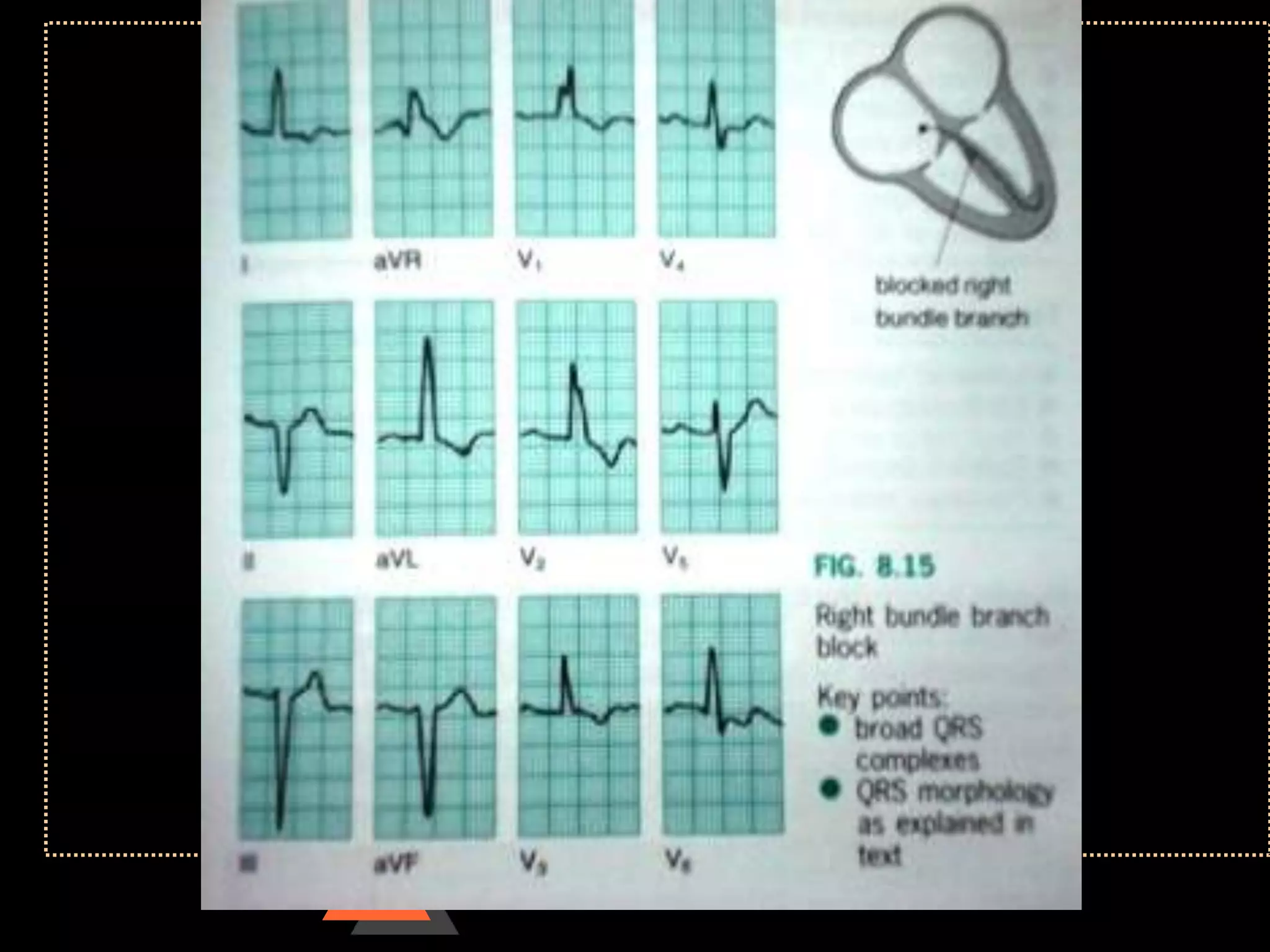
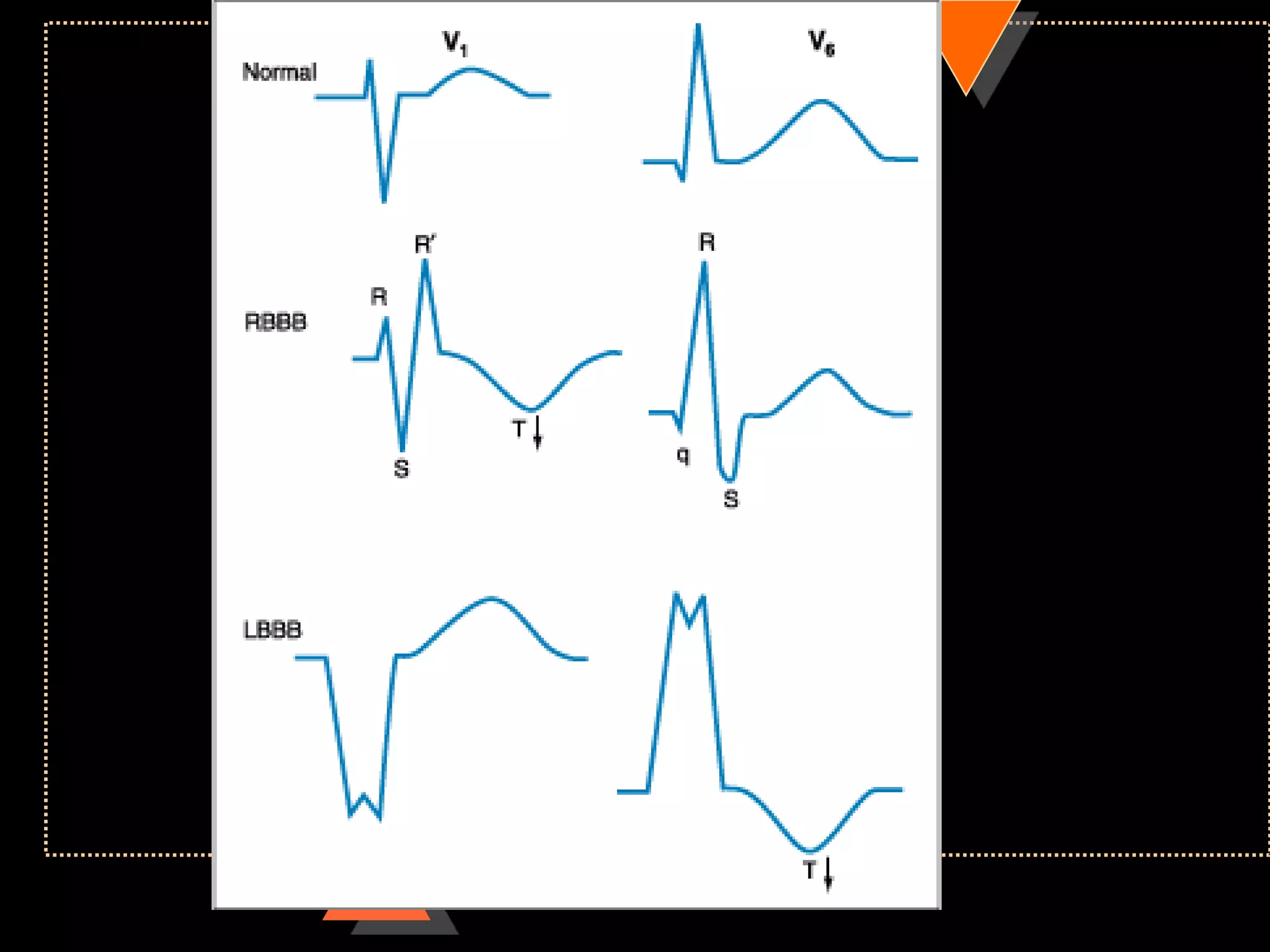
RBBB
• Right Bundle Branch Block
• Broad QRS complex
• Small r wave in V1, small Q wave in V6
• S wave in V1, R wave in V6
• R‟ wave in V1, S wave in V6
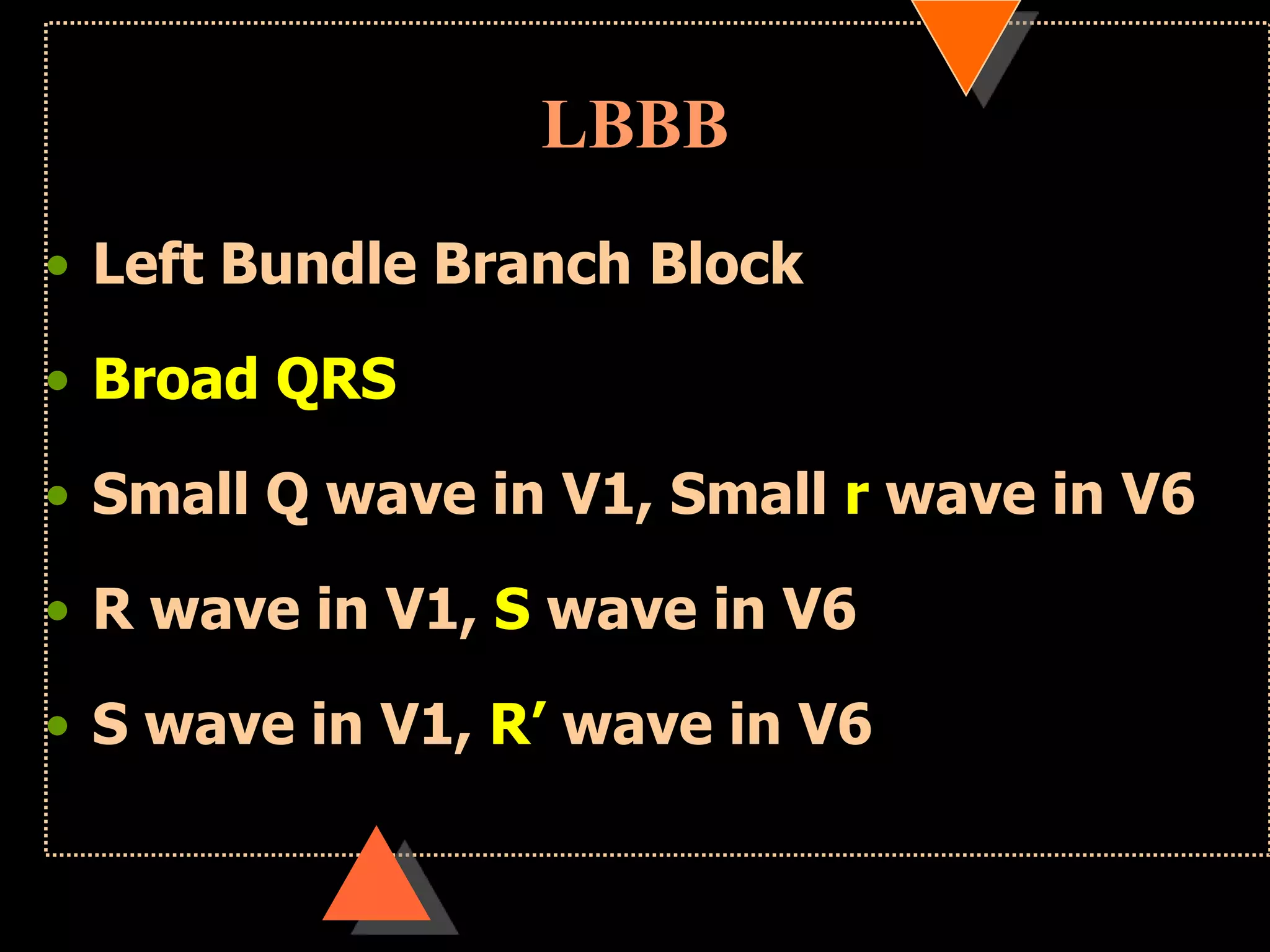
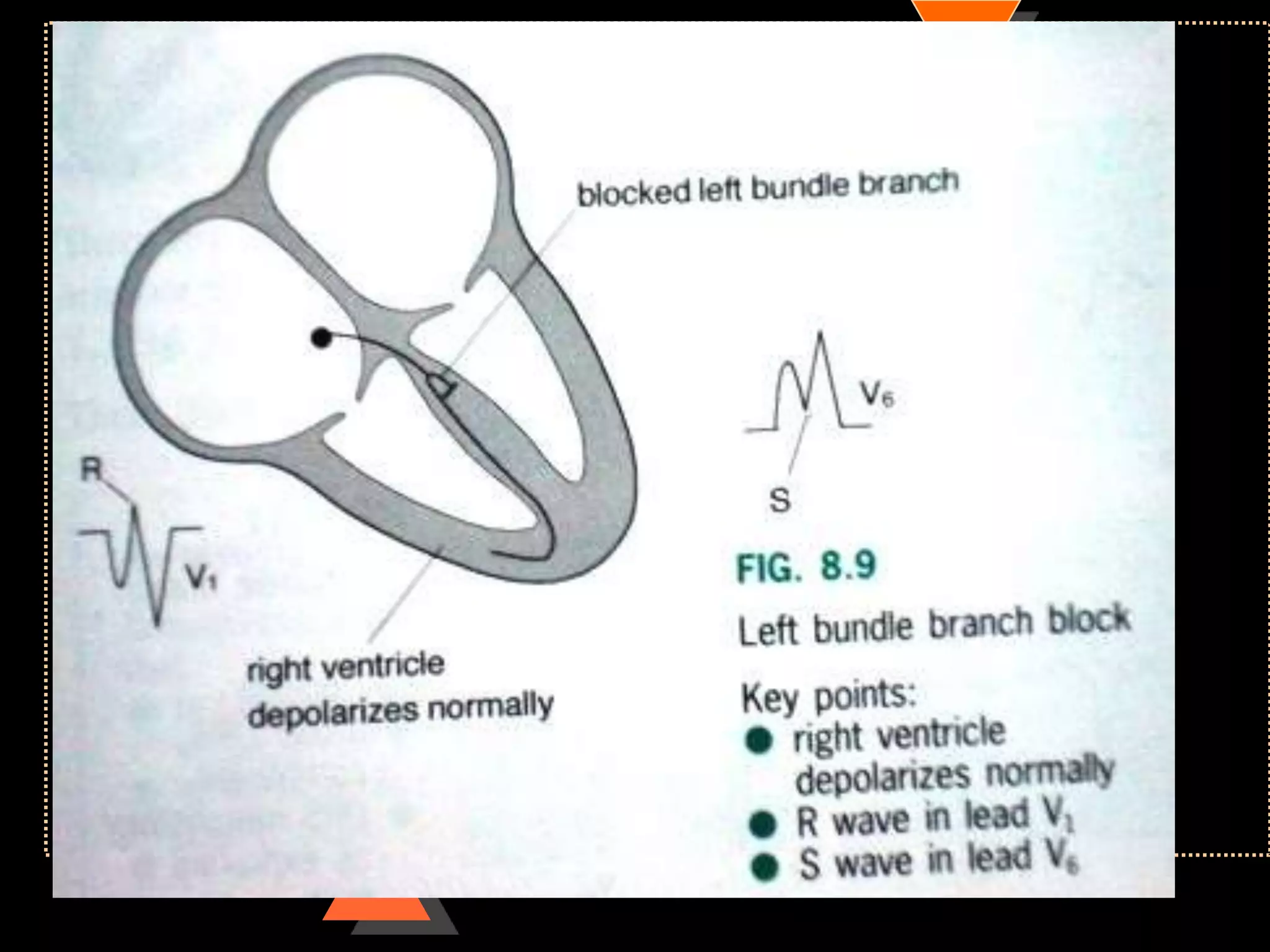
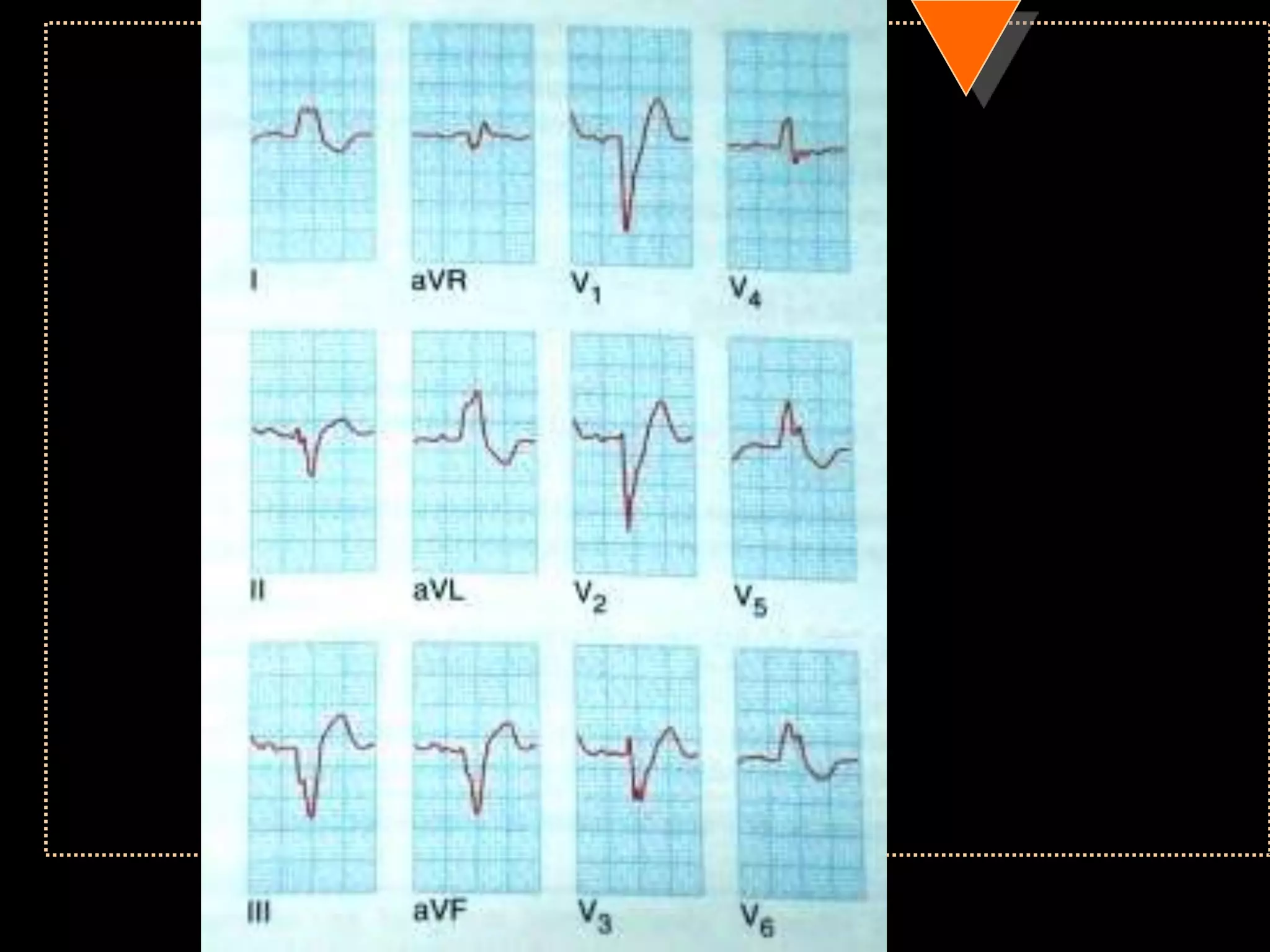
LBBB
• Left Bundle Branch Block
• Broad QRS
• Small Q wave in V1, Small r wave in V6
• R wave in V1, S wave in V6
• S wave in V1, R‟ wave in V6
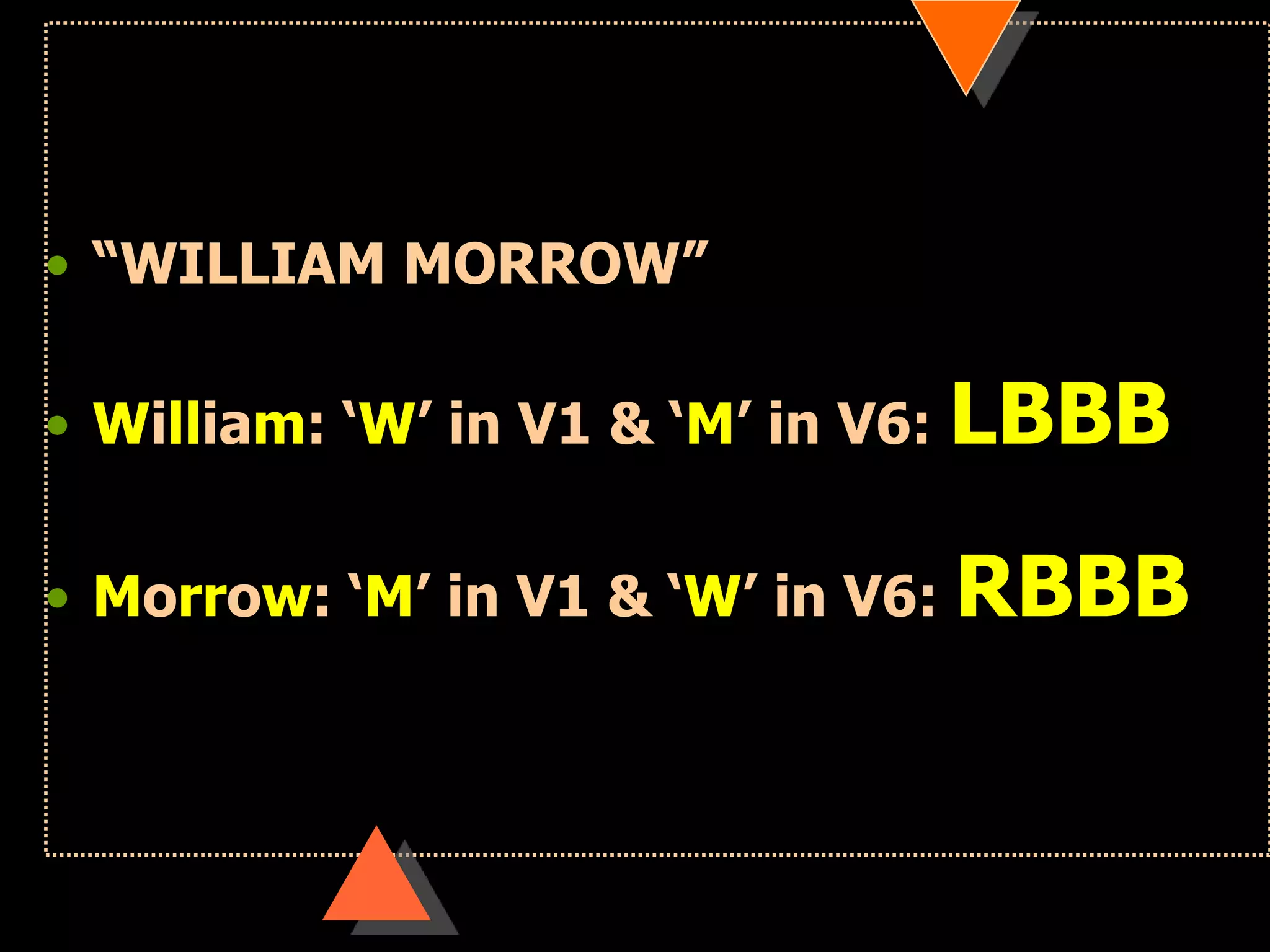
• “WILLIAM MORROW”
• William: „W‟ in V1 & „M‟ in V6: LBBB
• Morrow: „M‟ in V1 & „W‟ in V6: RBBB
• LBBB
• Ischemic Heart
Disease
• Cardiomyopathy
• LVH
• Fibrosis
• RBBB
• Ischemic heart
disease
• Cardiomyopathy
• ASD
• Massive pulmonary
embolism
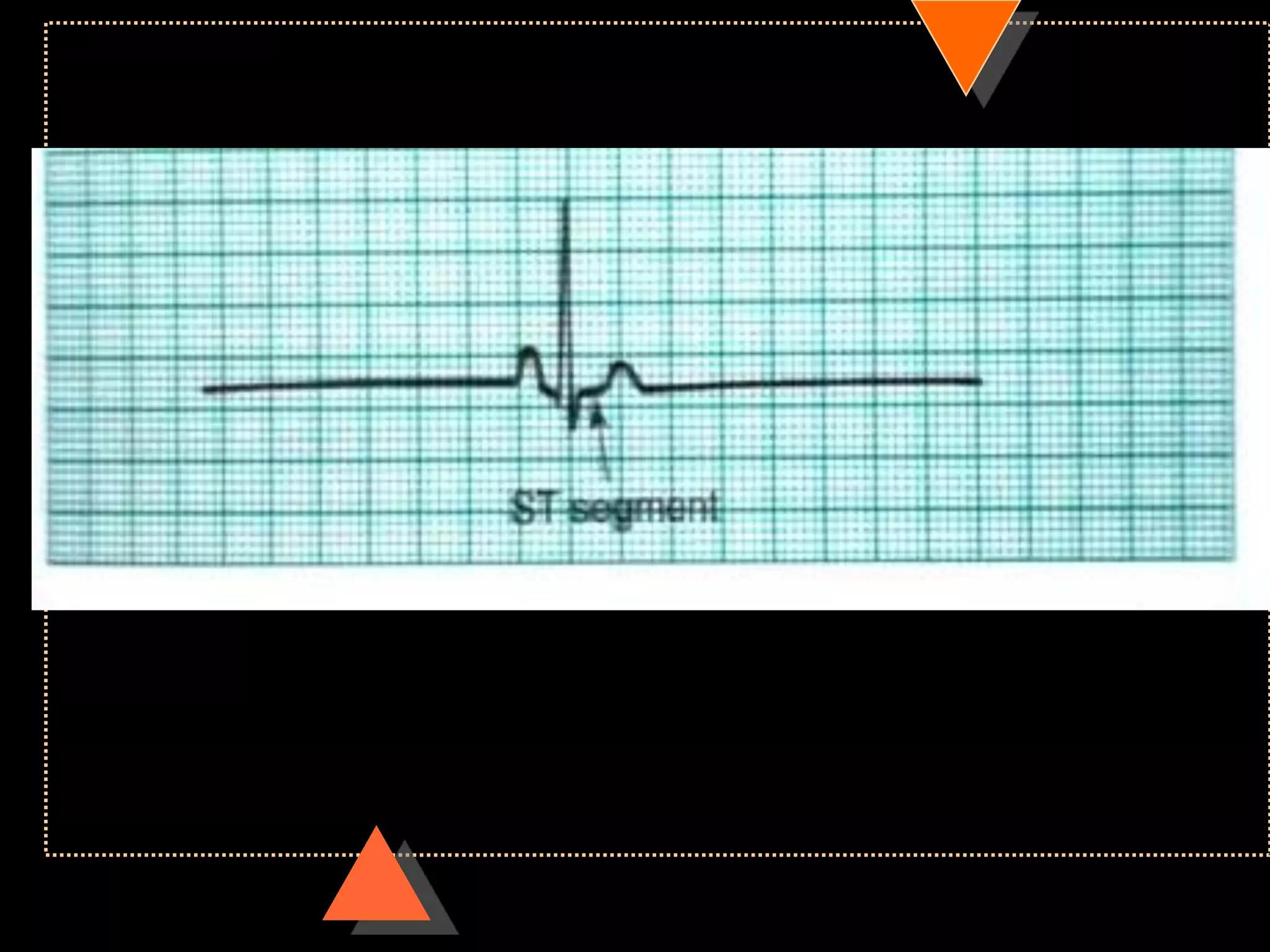
ST Segment
• From end of S wave to start of T Wave
• Normally: Isoelectric
• ? Depressed/ elevated
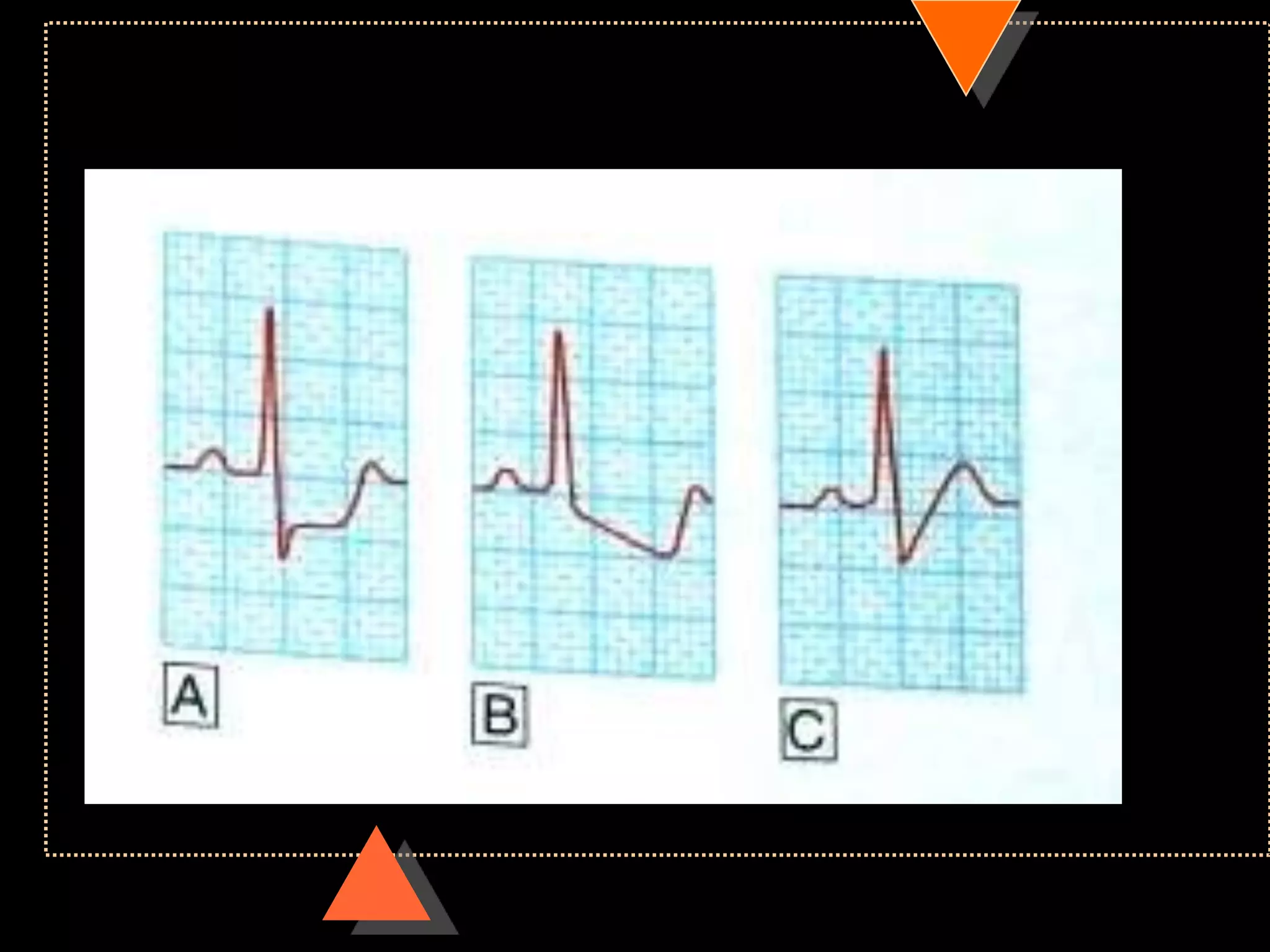
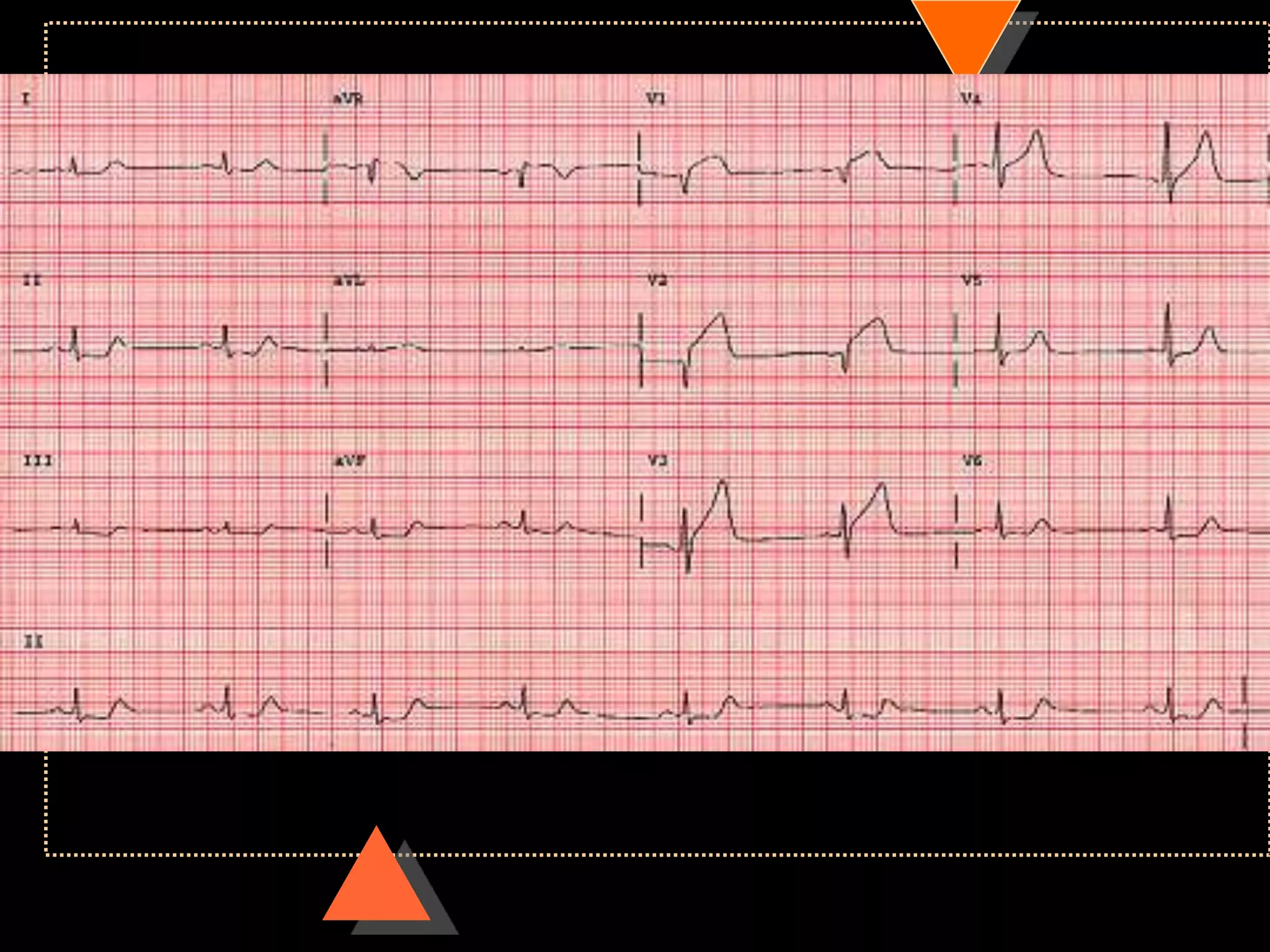
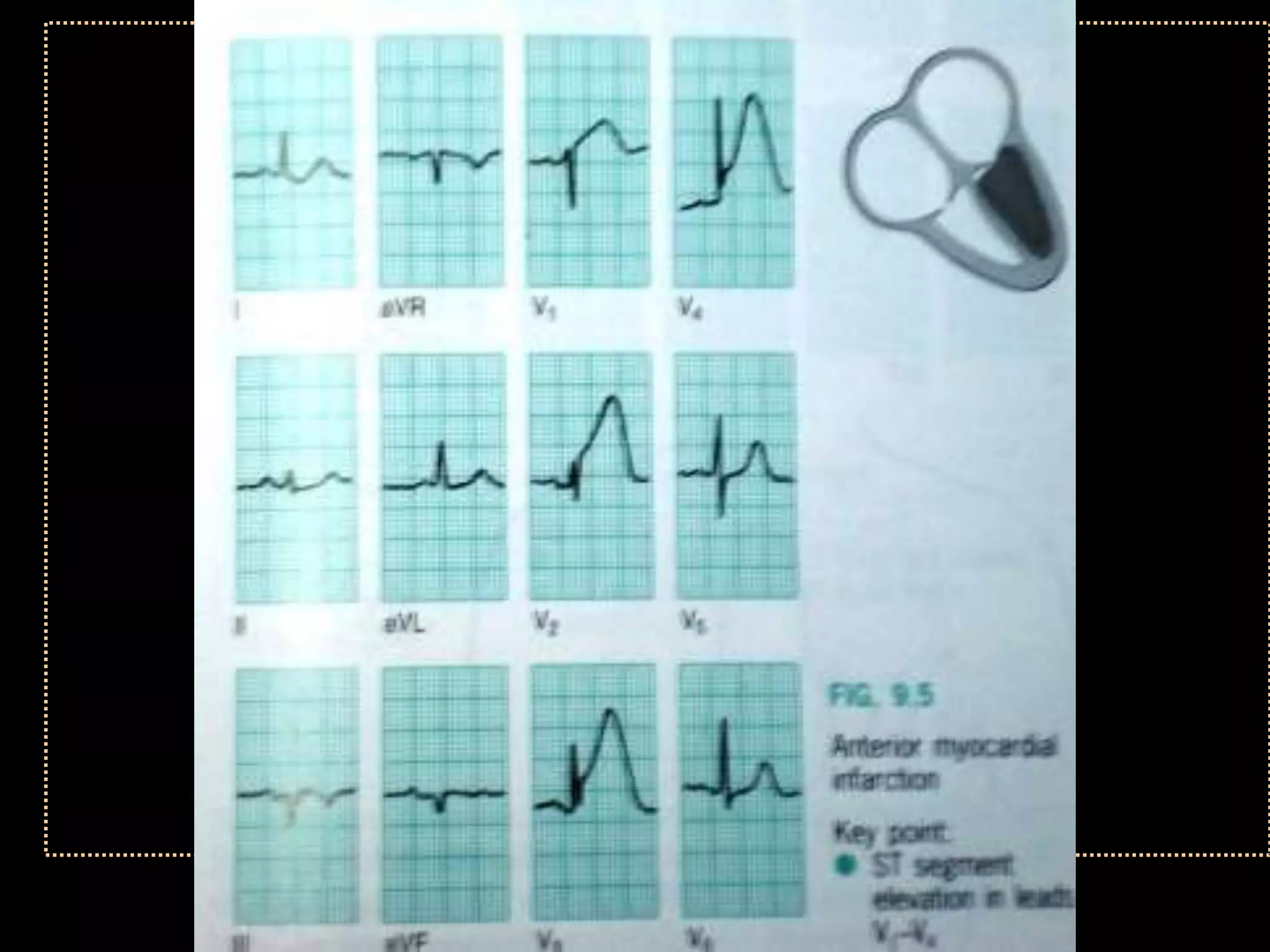
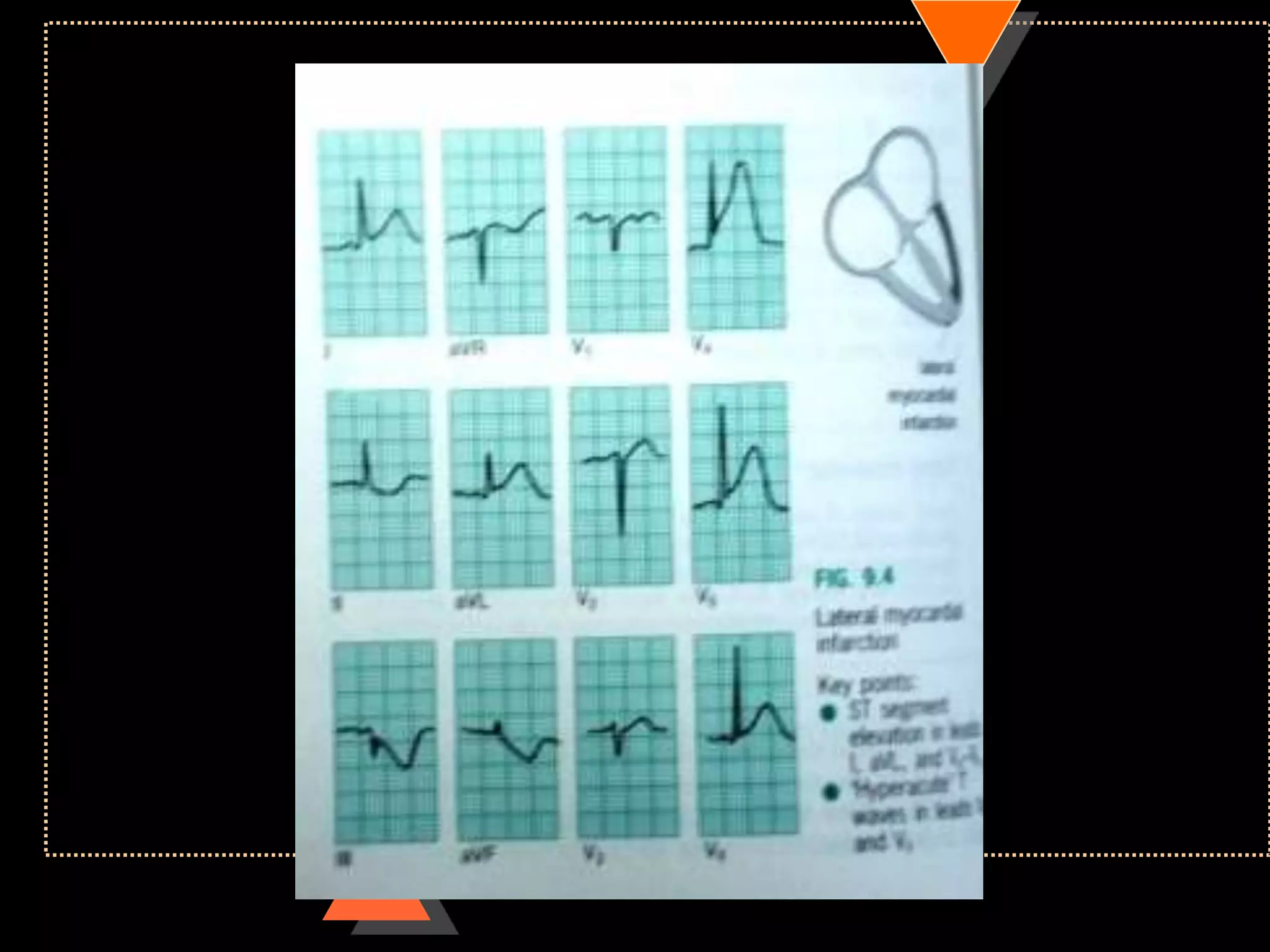
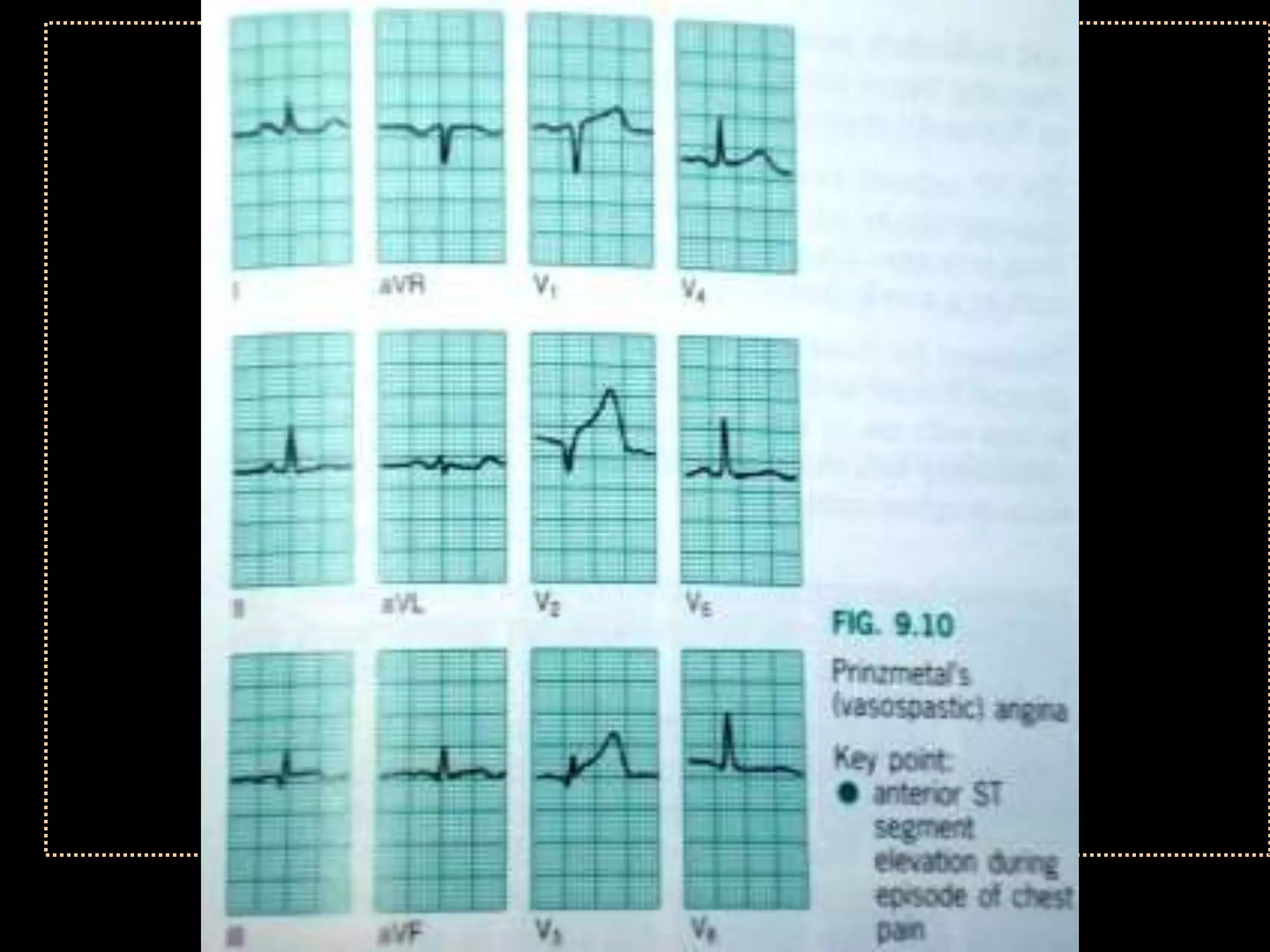
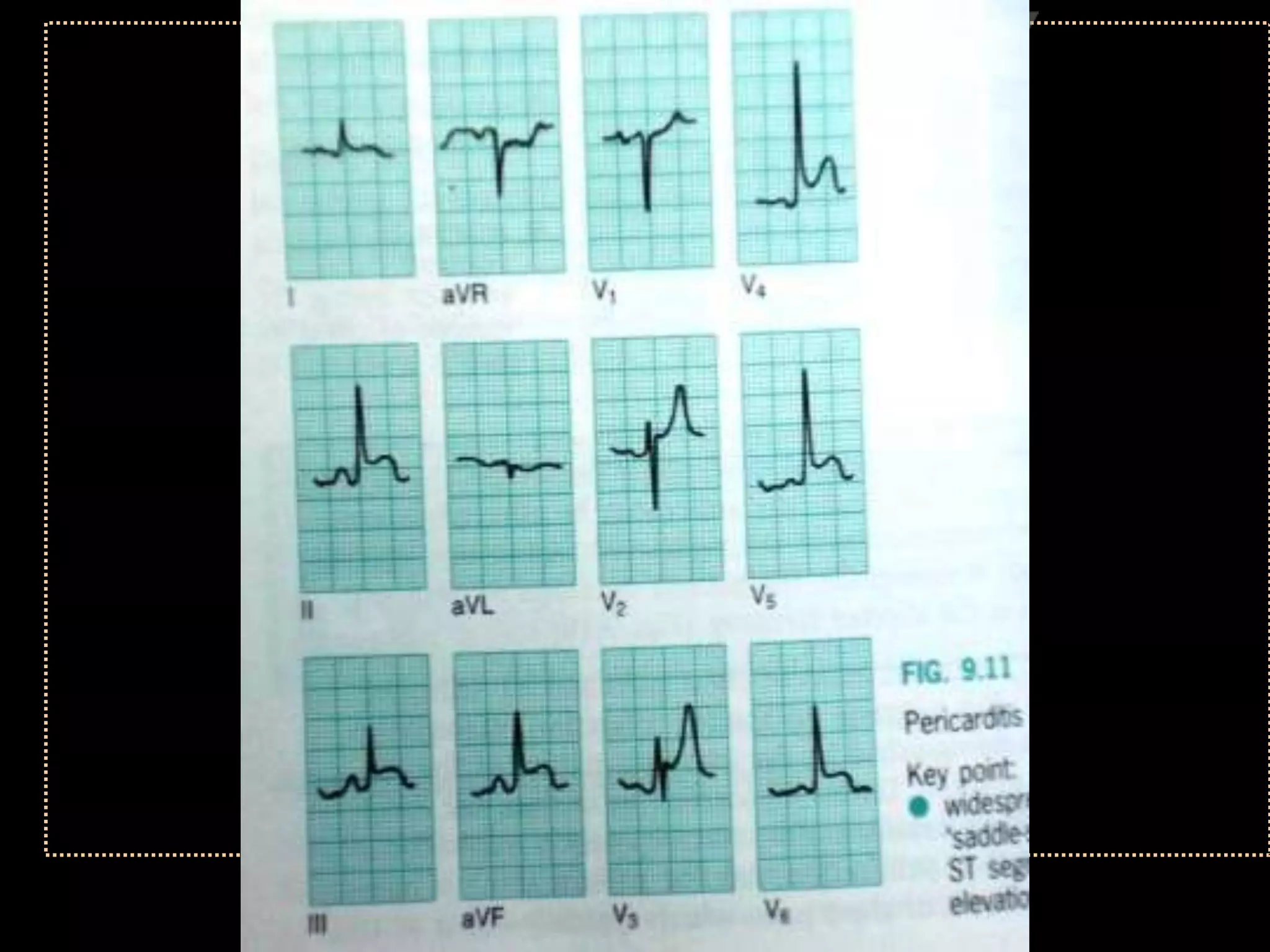
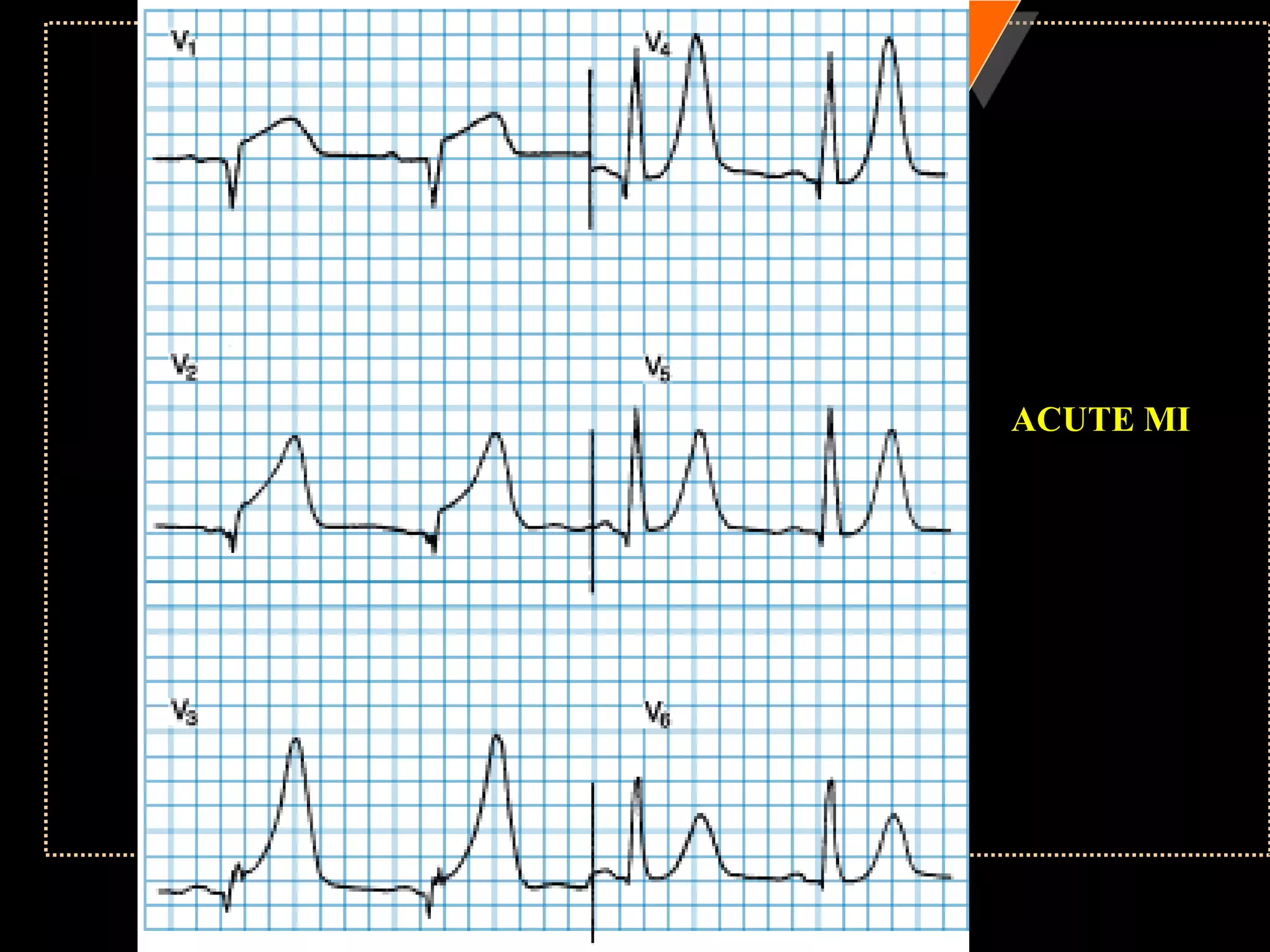
• Elevated ST segment
• Acute MI
• Prinzmetal’s angina
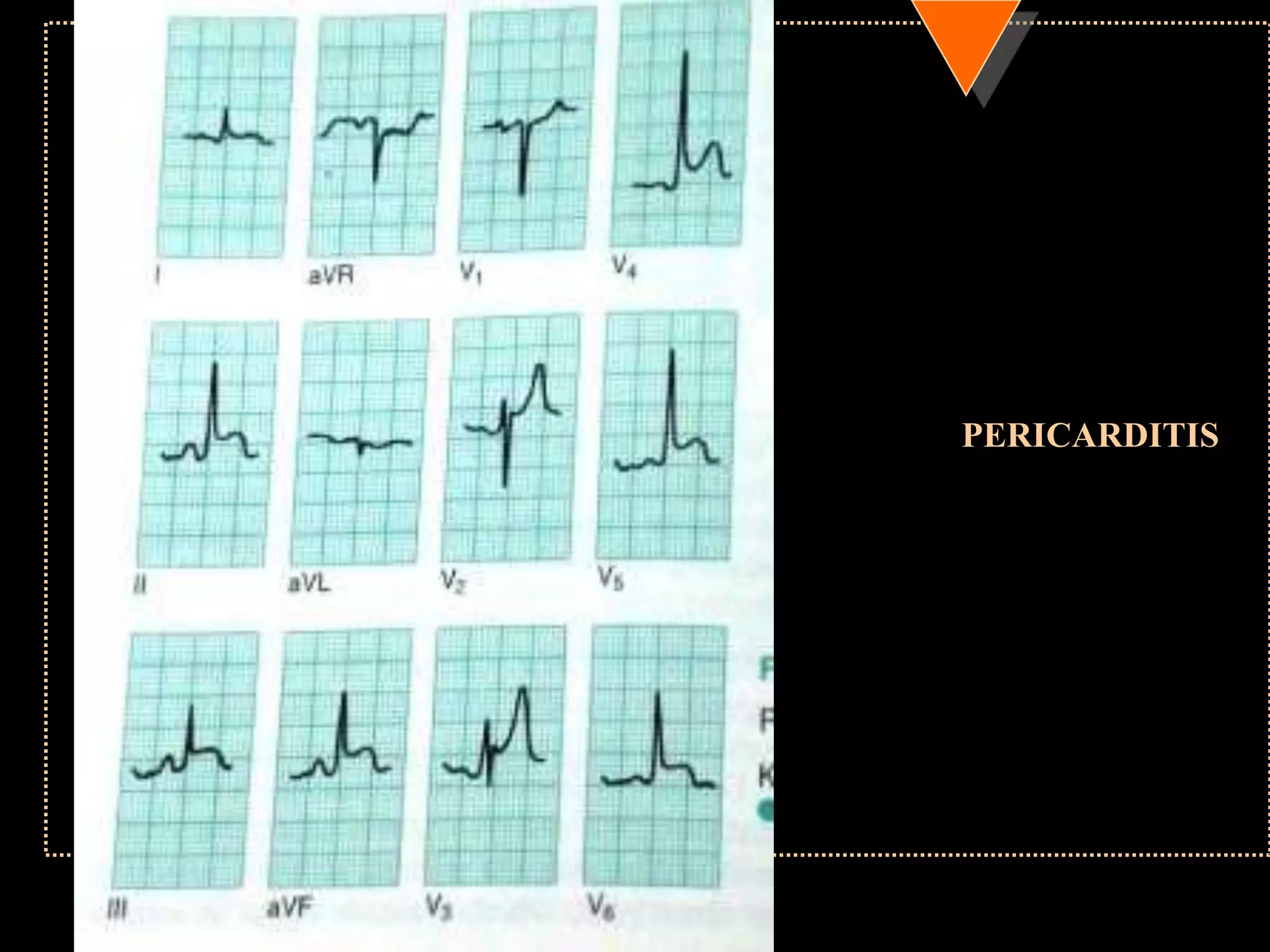
• Pericarditis
• LV aneurysm
• High take off
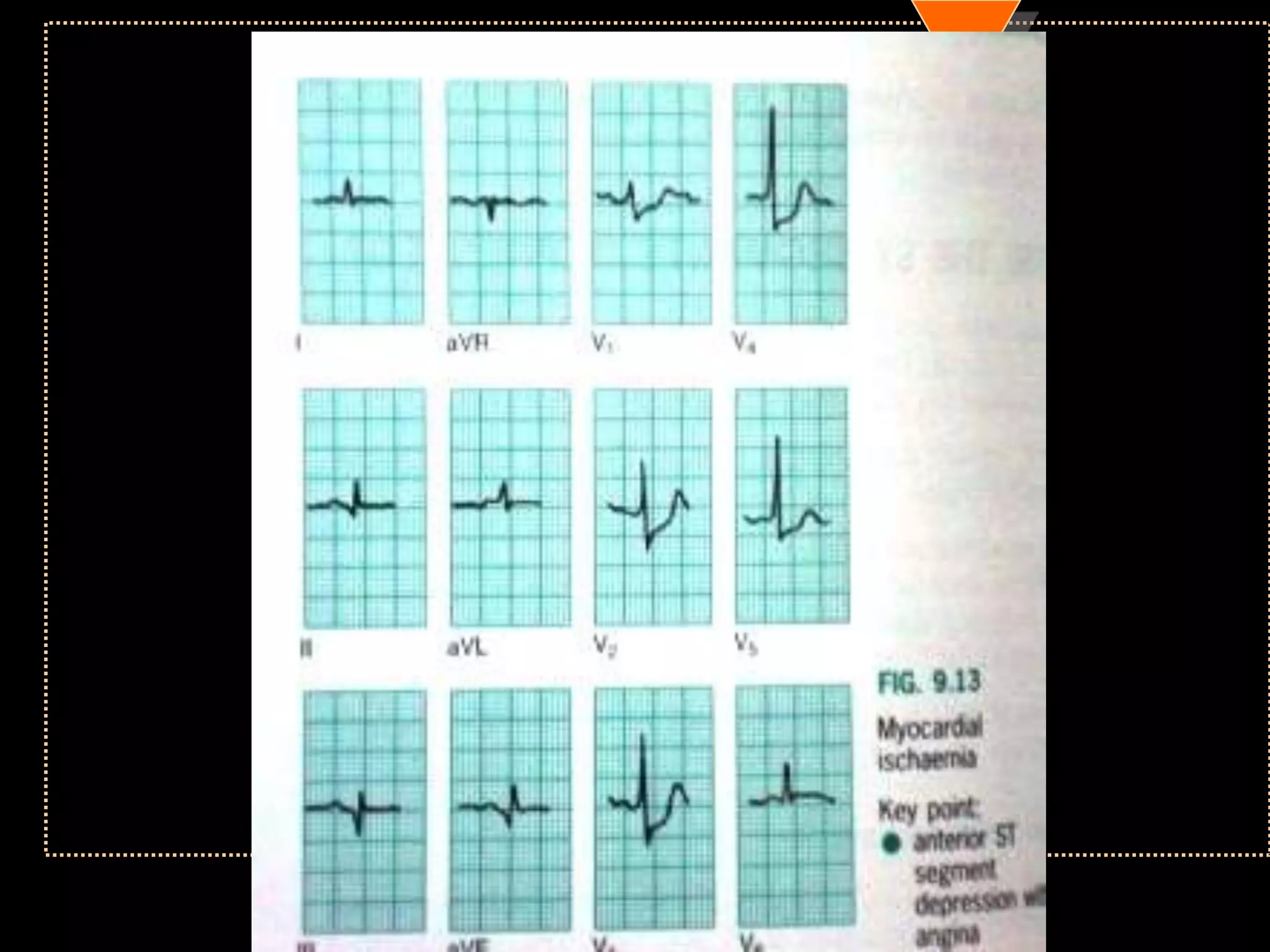
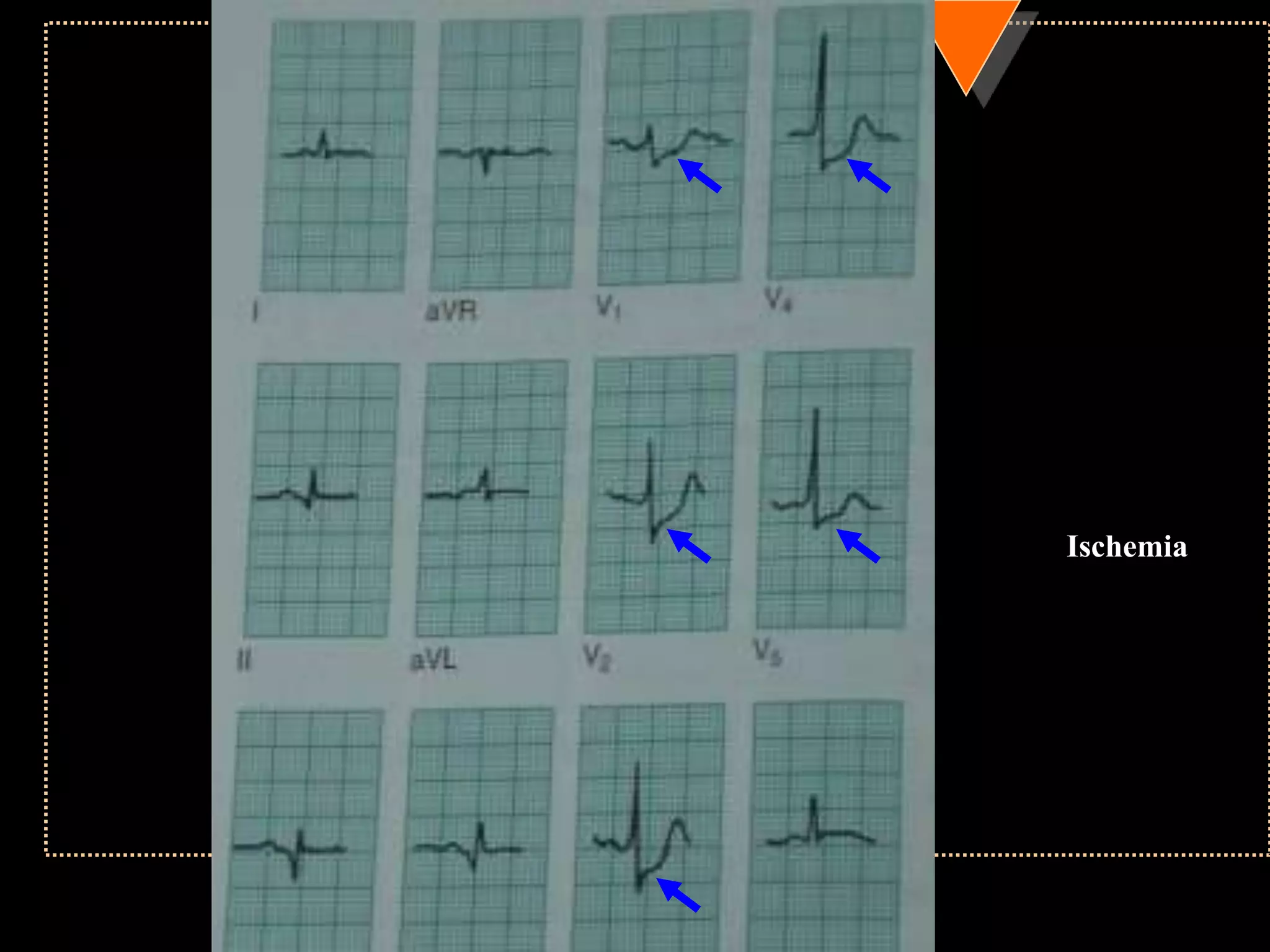
• Depressed ST segment
• Myocardial ischemia
• Posterior MI
• Ventricular hypertrophy with ‘Strain’
• Drugs: Digoxin
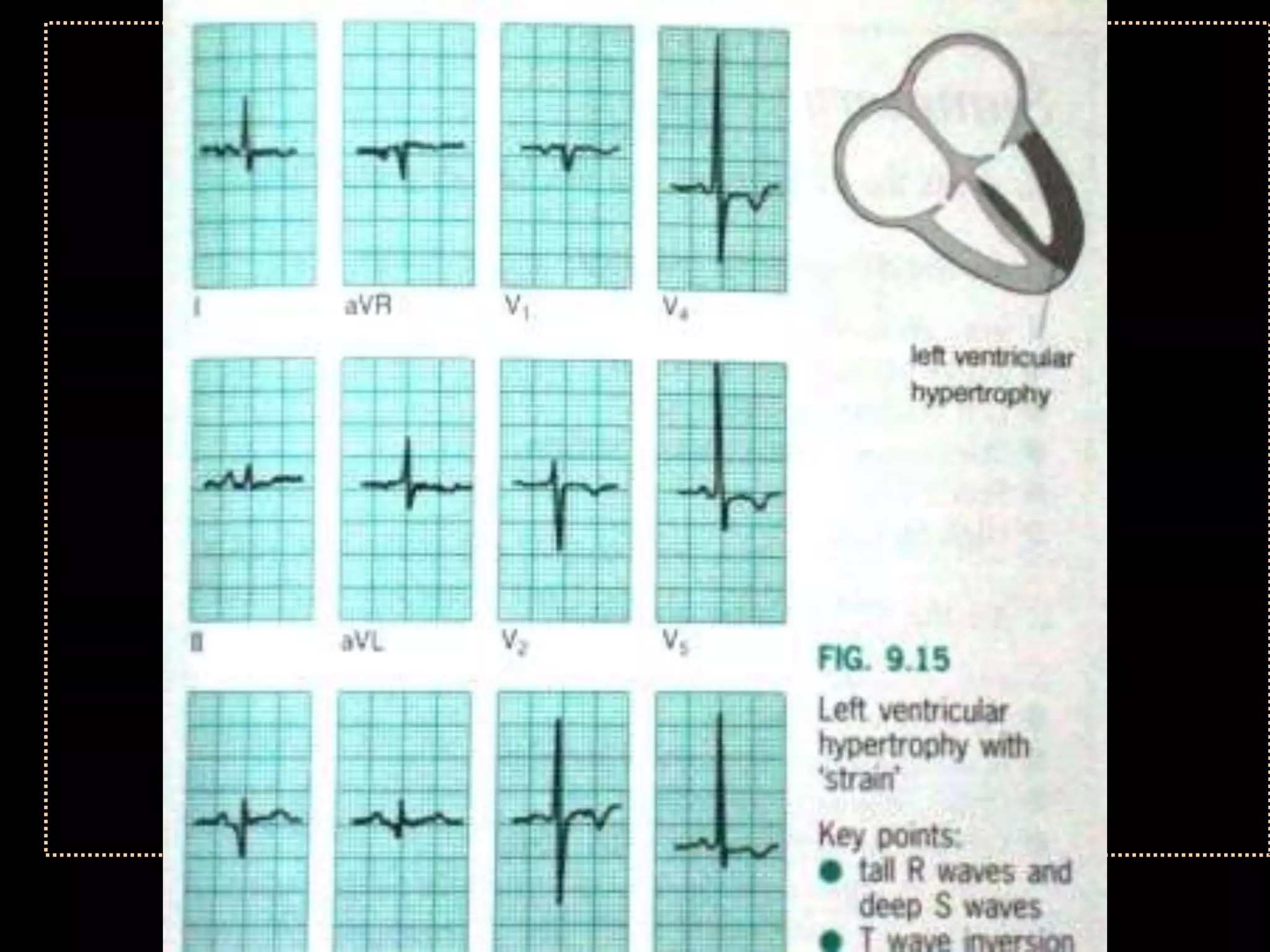
Ventricular Hypertrophy with
“strain” pattern
• Tall R waves
• Deep S waves
• ST segment depression
• T wave inversion
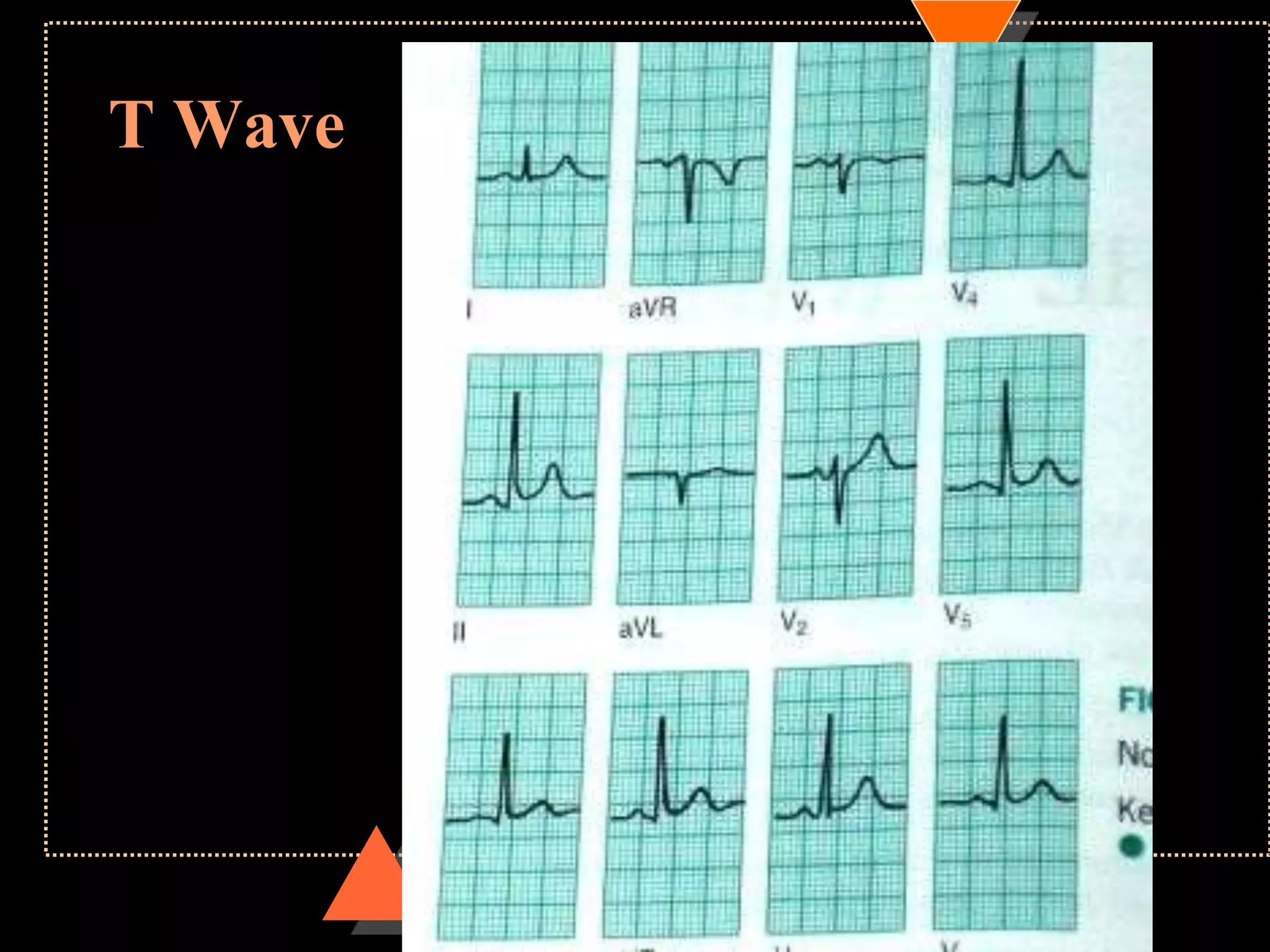
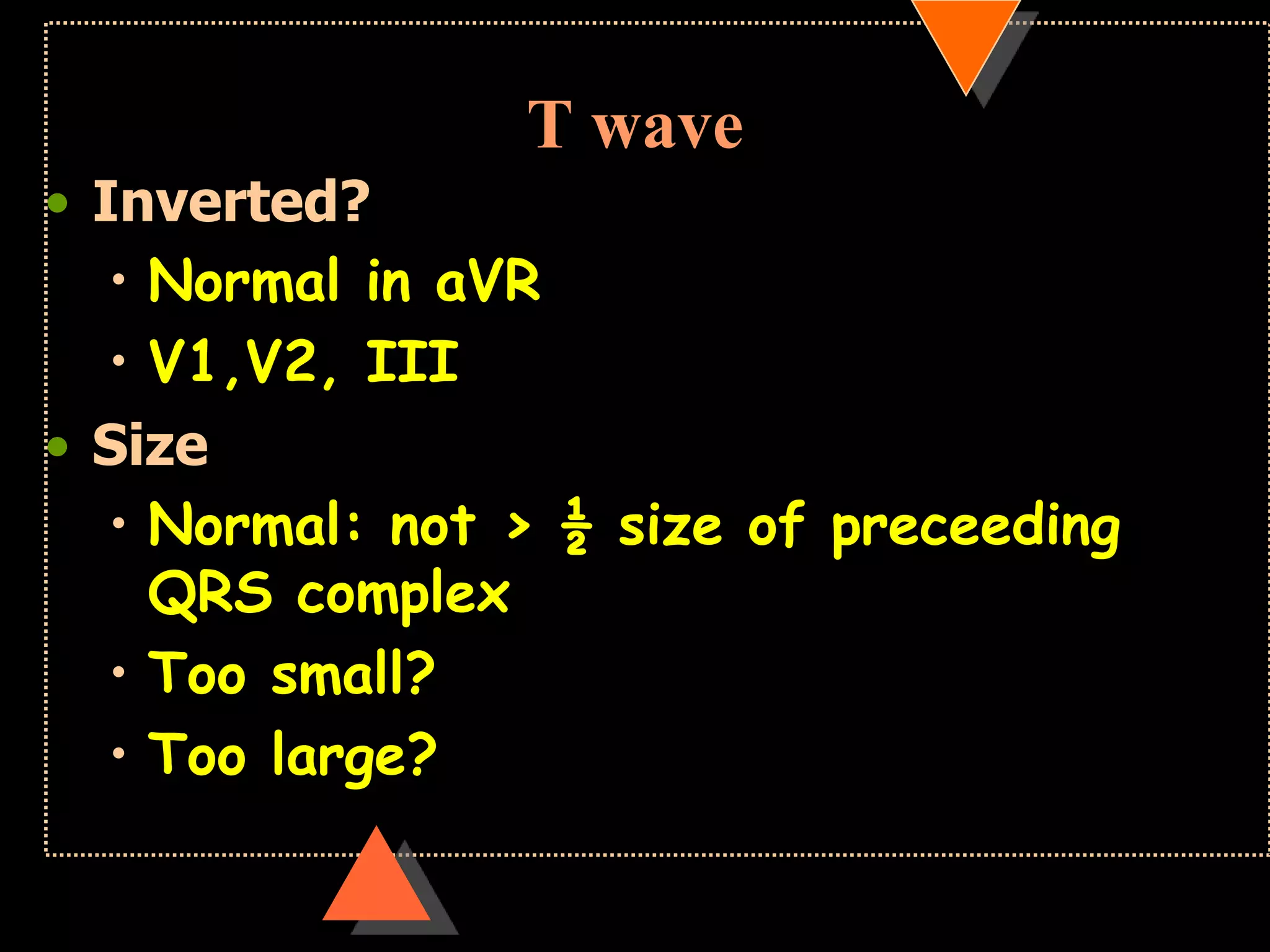
T Wave
T wave
• Inverted?
• Normal in aVR
• V1,V2, III
• Size
• Normal: not > ½ size of preceeding
QRS complex
• Too small?
• Too large?
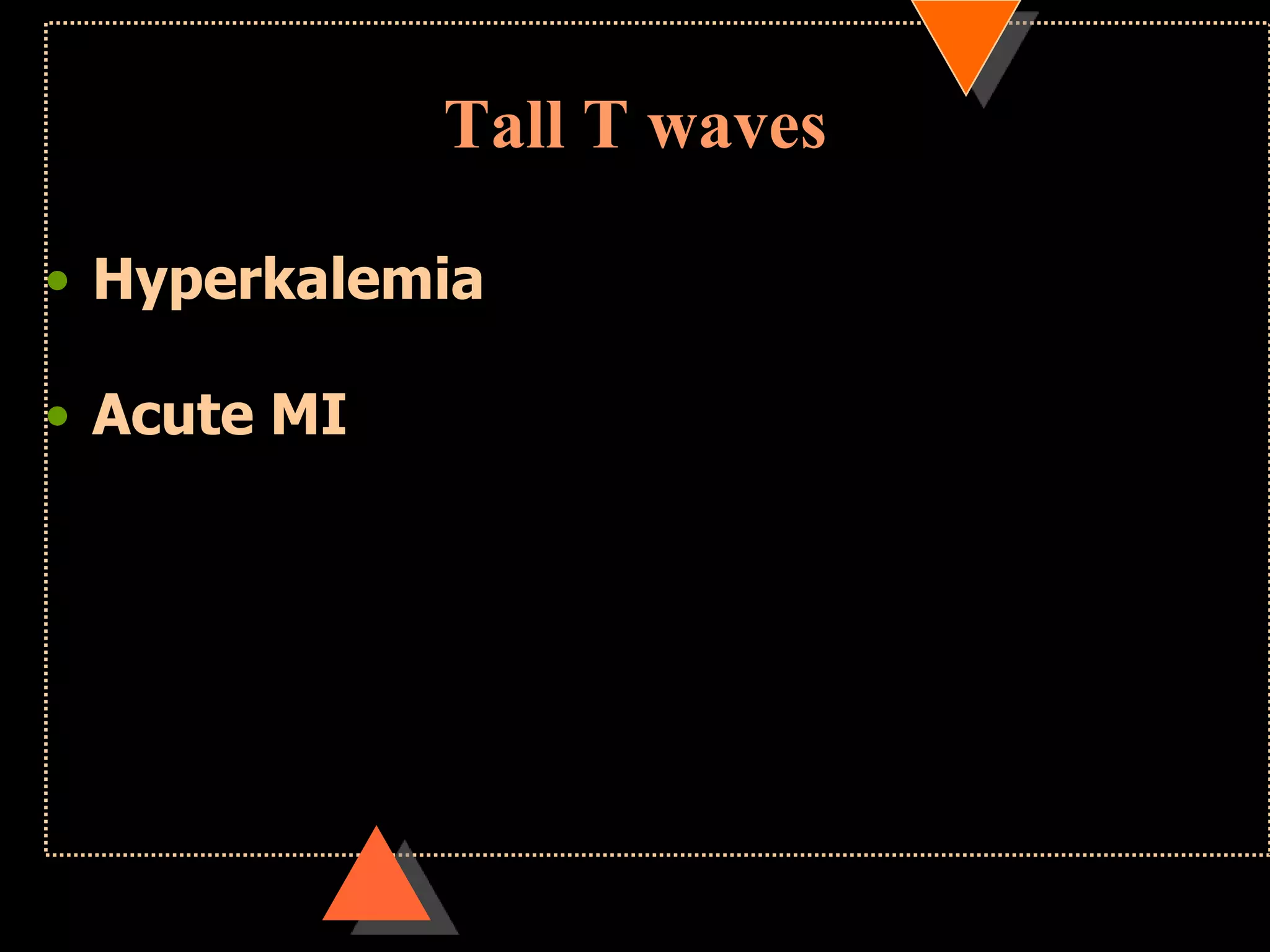
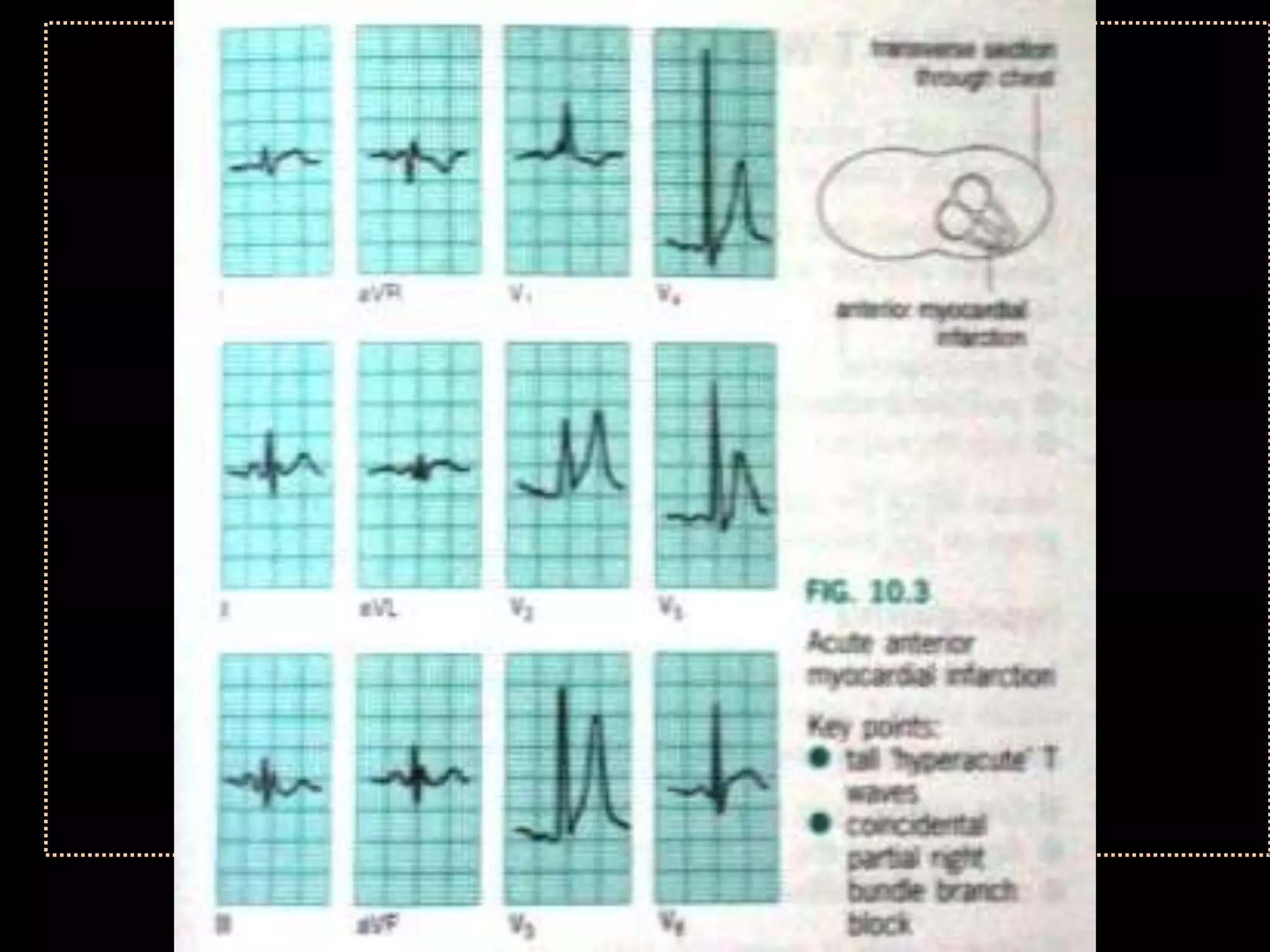
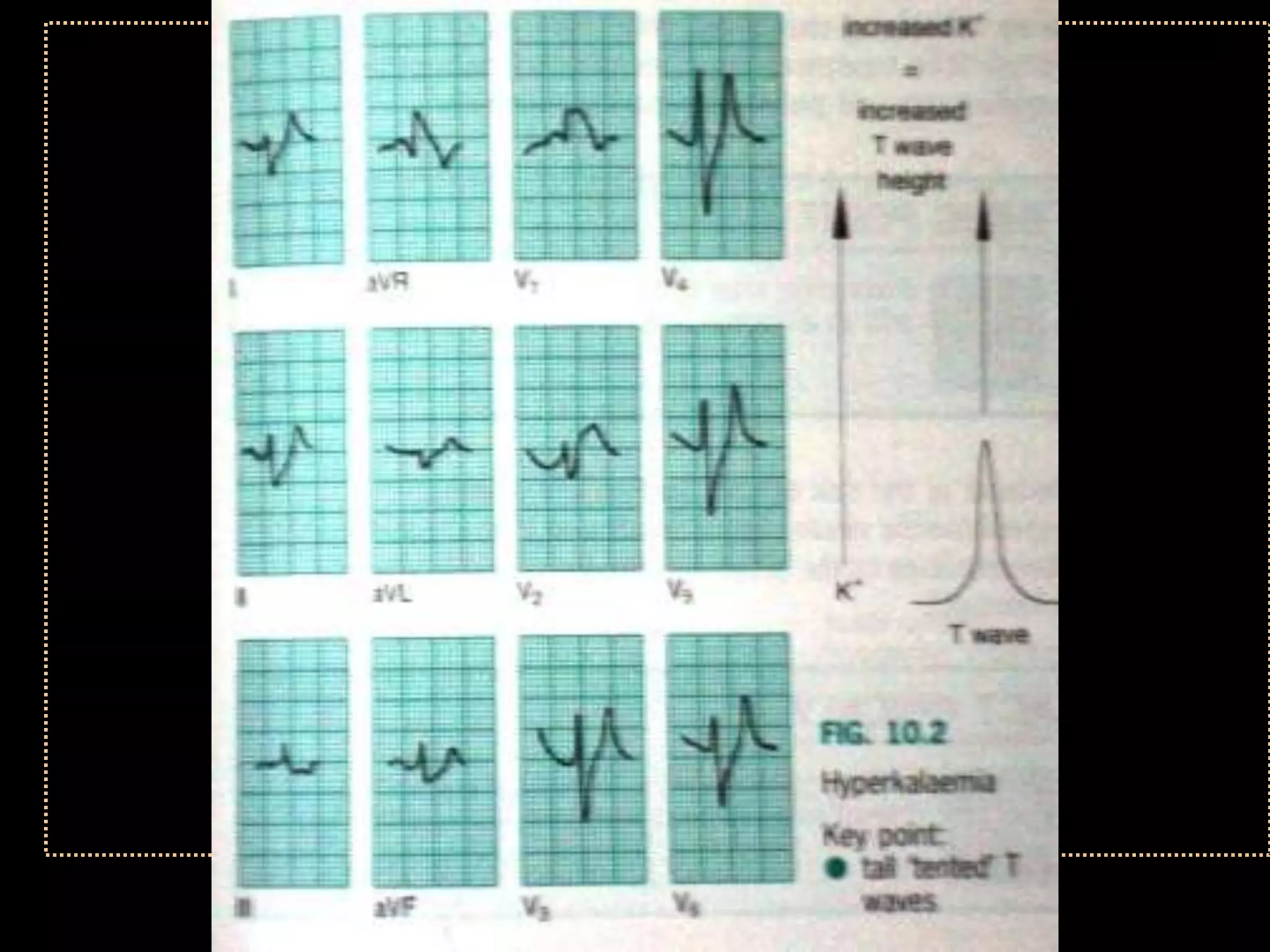
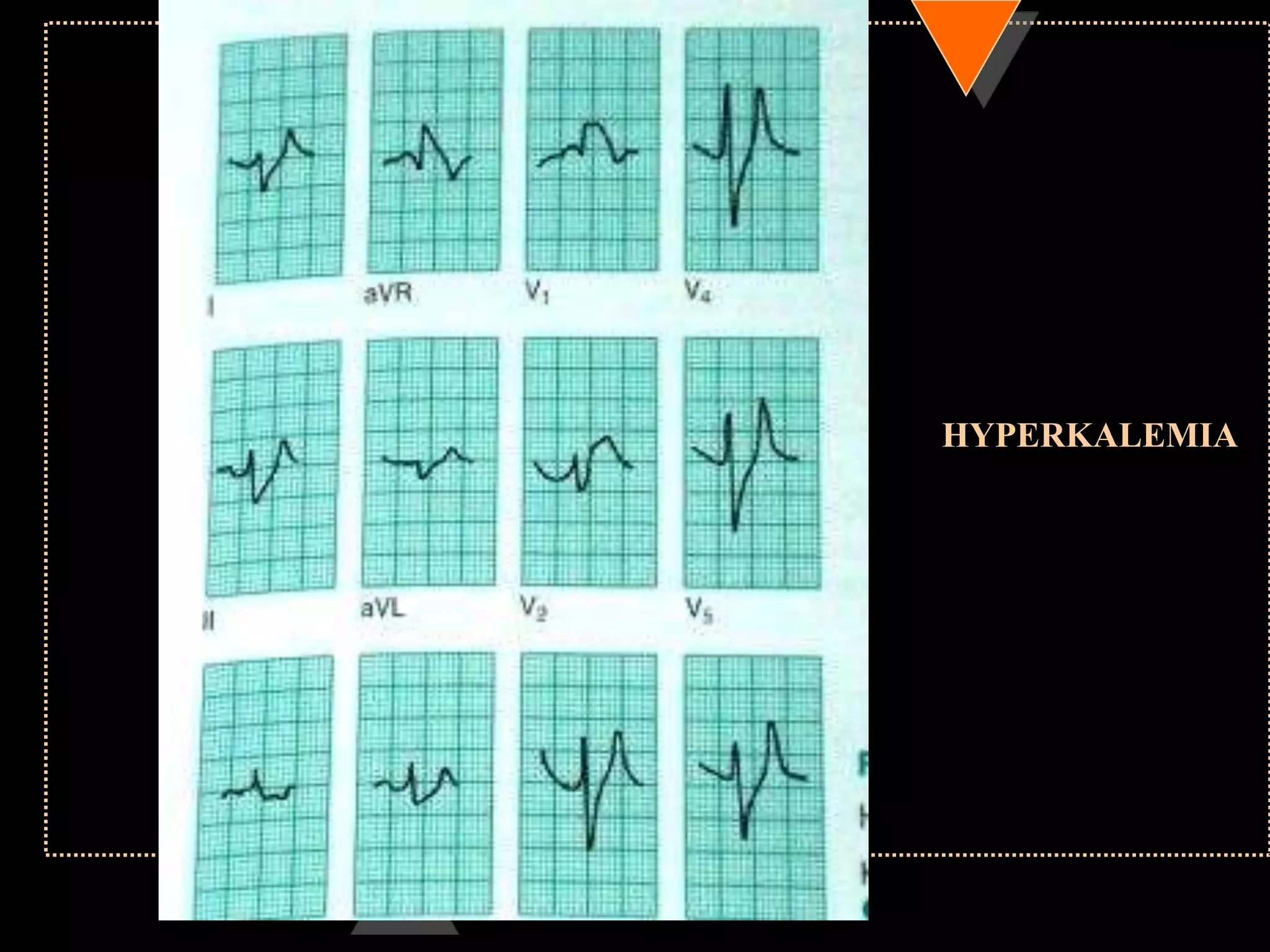
Tall T waves
• Hyperkalemia
• Acute MI
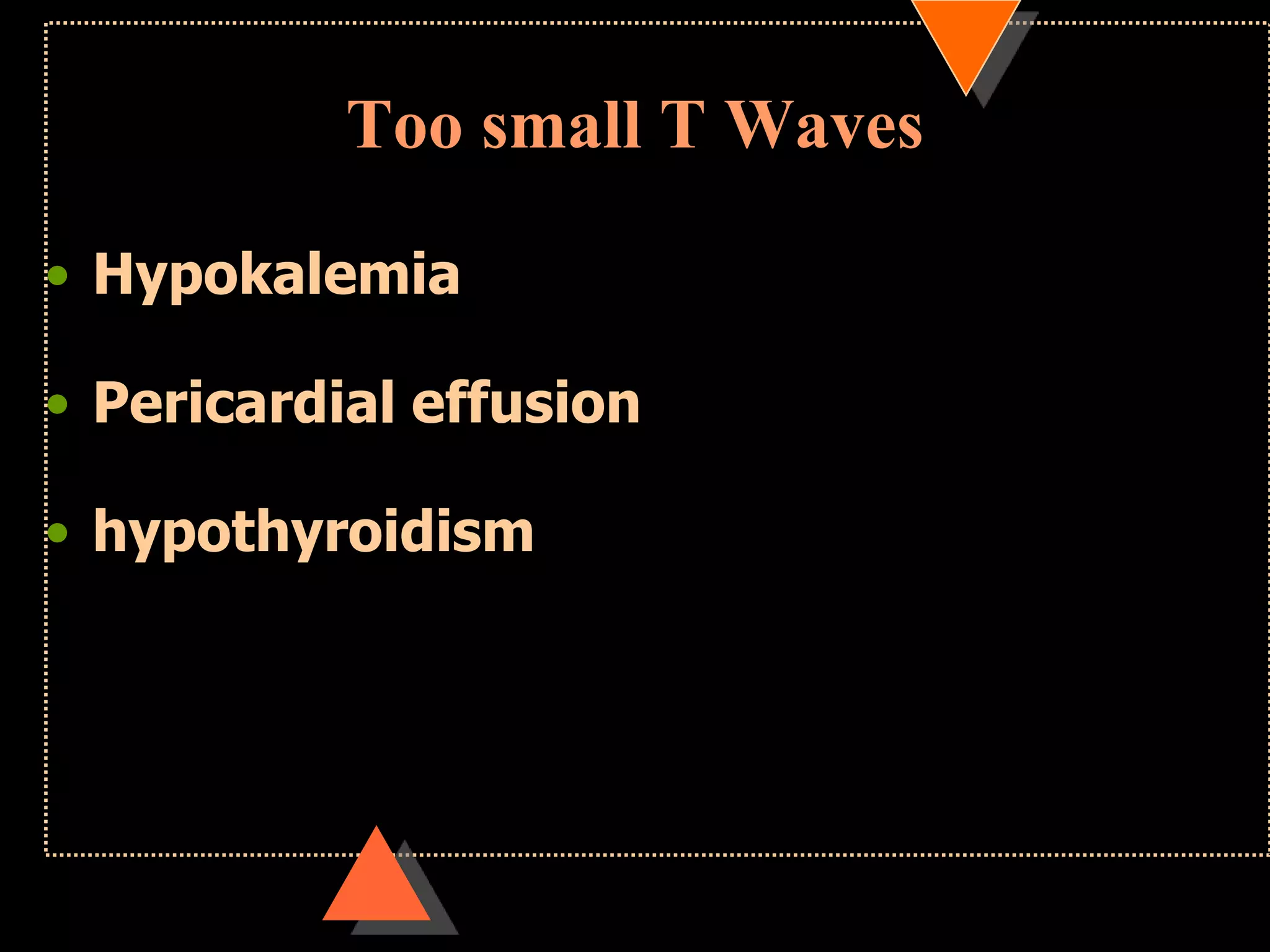
Too small T Waves
• Hypokalemia
• Pericardial effusion
• hypothyroidism
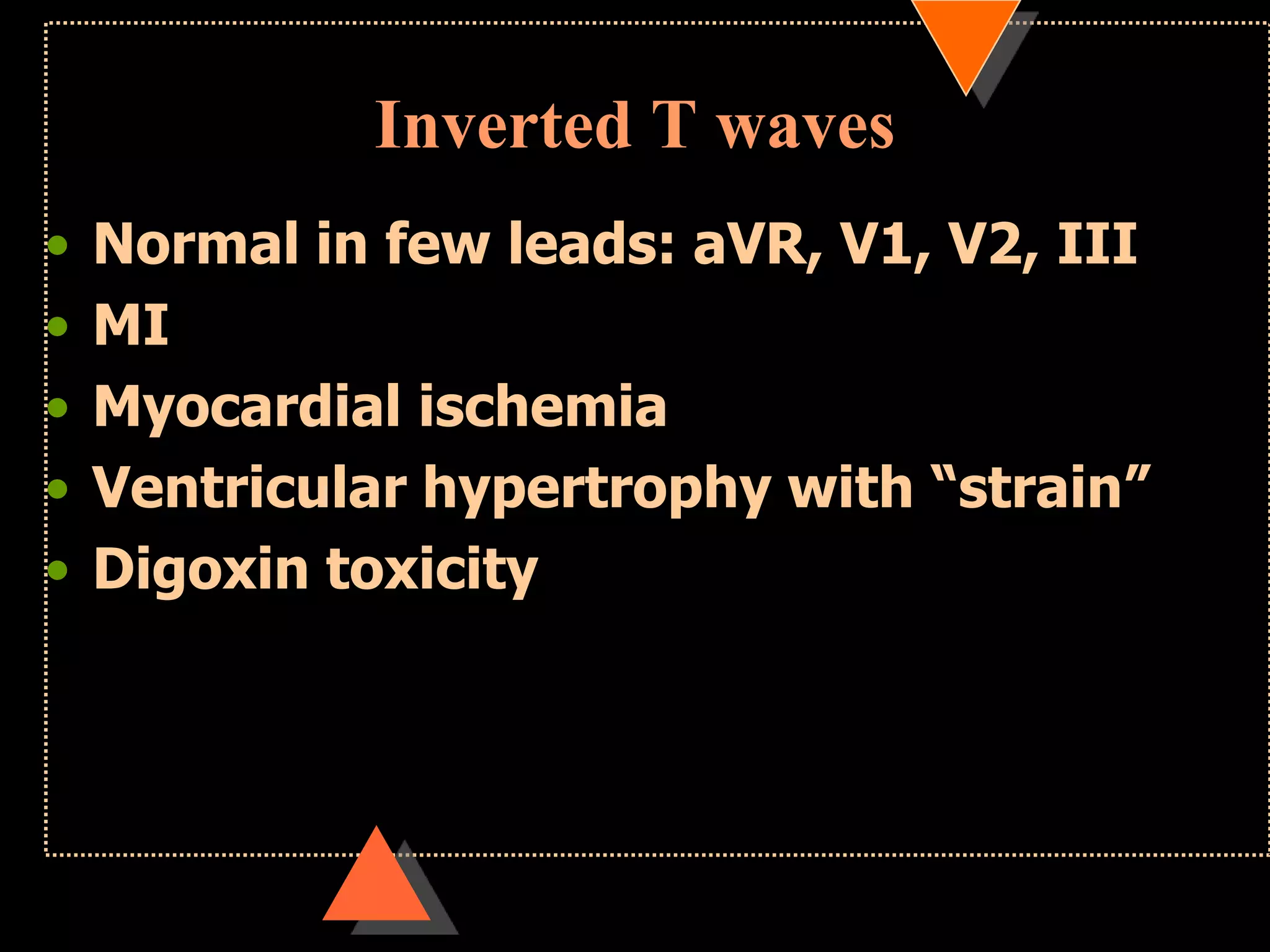
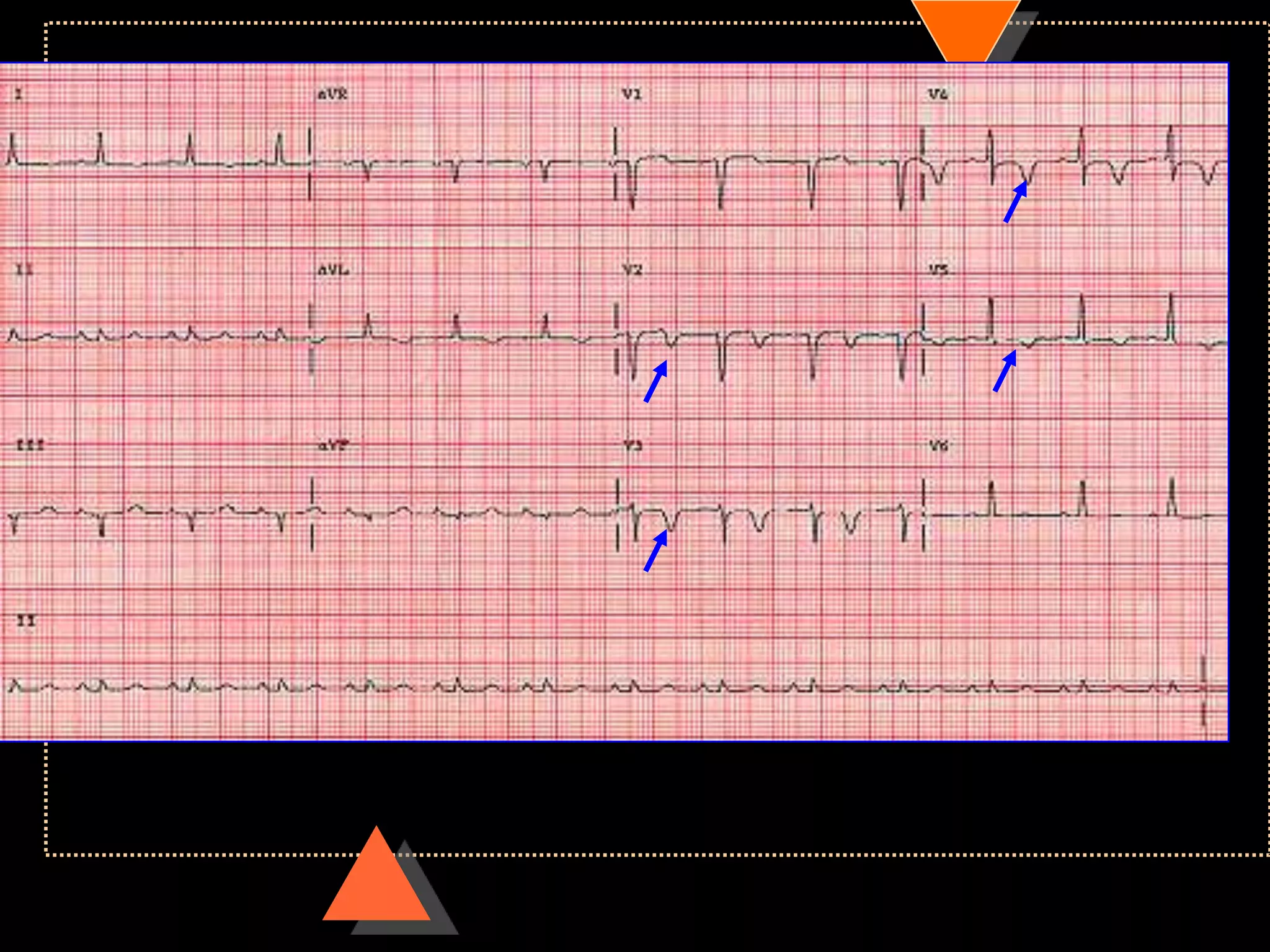
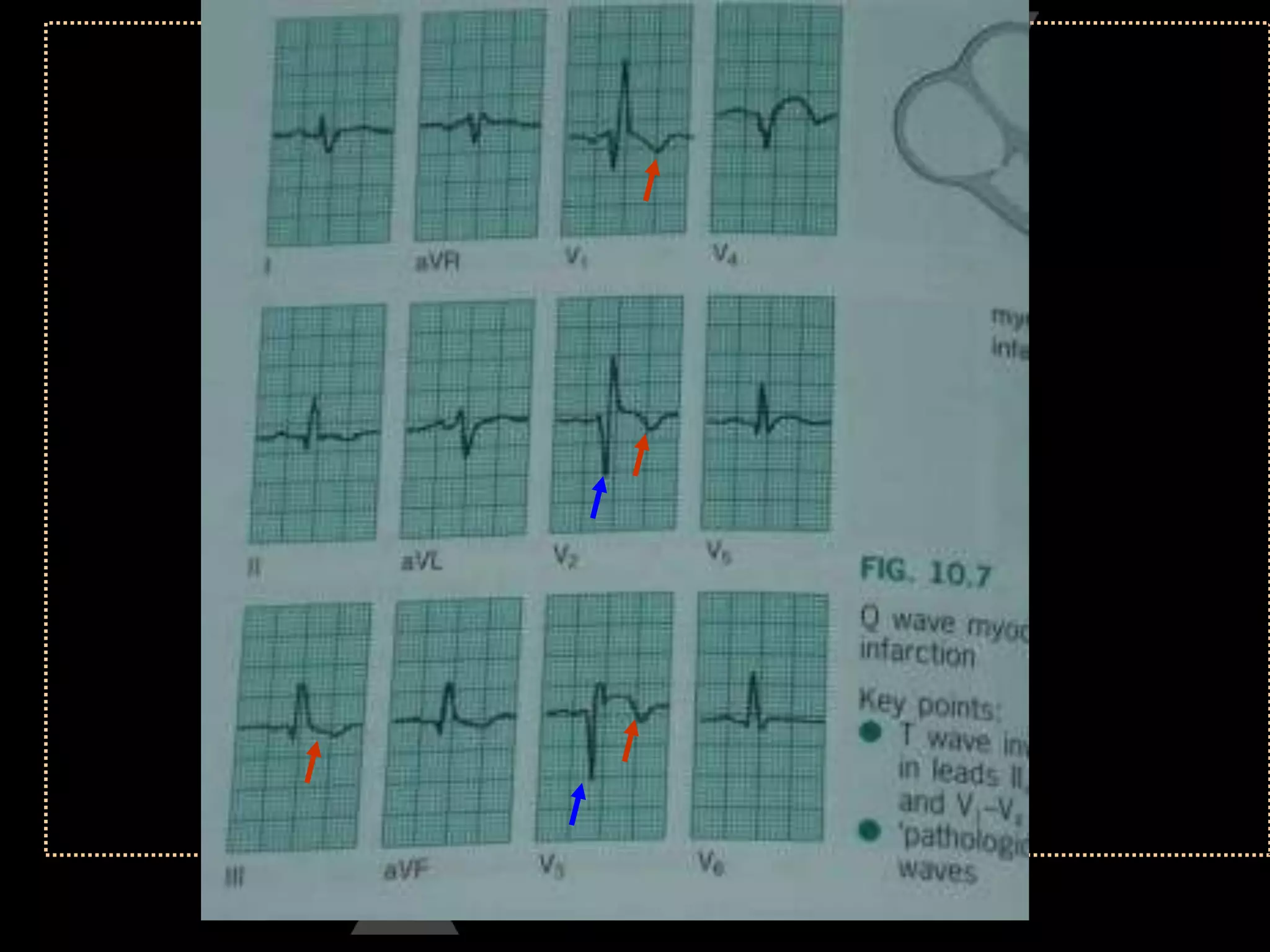
Inverted T waves
• Normal in few leads: aVR, V1, V2, III
• MI
• Myocardial ischemia
• Ventricular hypertrophy with “strain”
• Digoxin toxicity
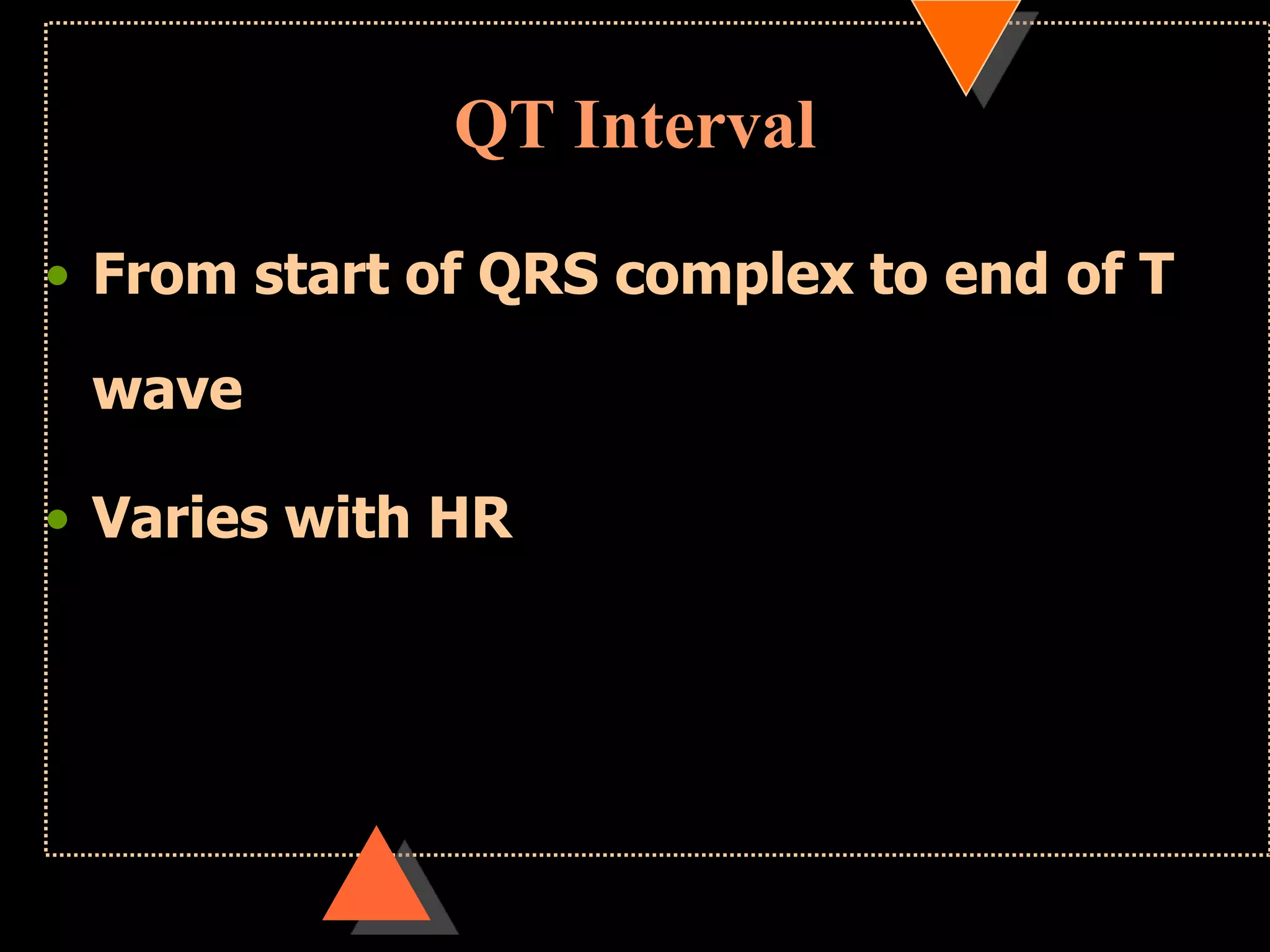
QT Interval
• From start of QRS complex to end of T
wave
• Varies with HR
Corrected QT interval
• QTC
• QTC =QT/√RR
• Normal: 0.35-0.43 sec
Prolonged QTc
• If ≥0.44 sec
• Hypocalcemia
• Acute myocarditis
• Torsades de pointes
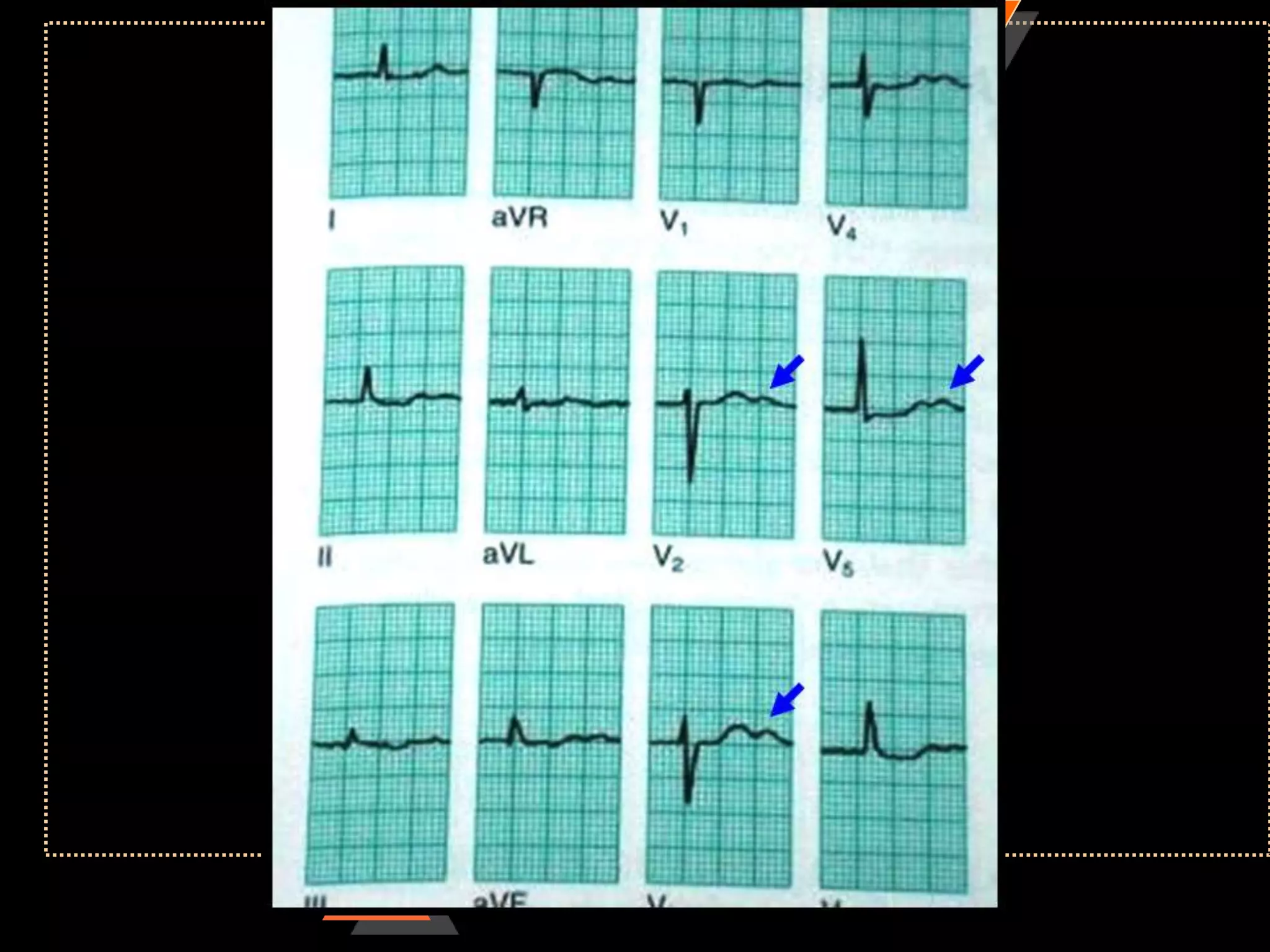
U waves
• Mostly in anterior chest leads
• Difficult to identify clearly
• Prominent U Waves
• Hypoklemia
• Hypercalcemia
• Hyperthyroidism
Common ECG Problems
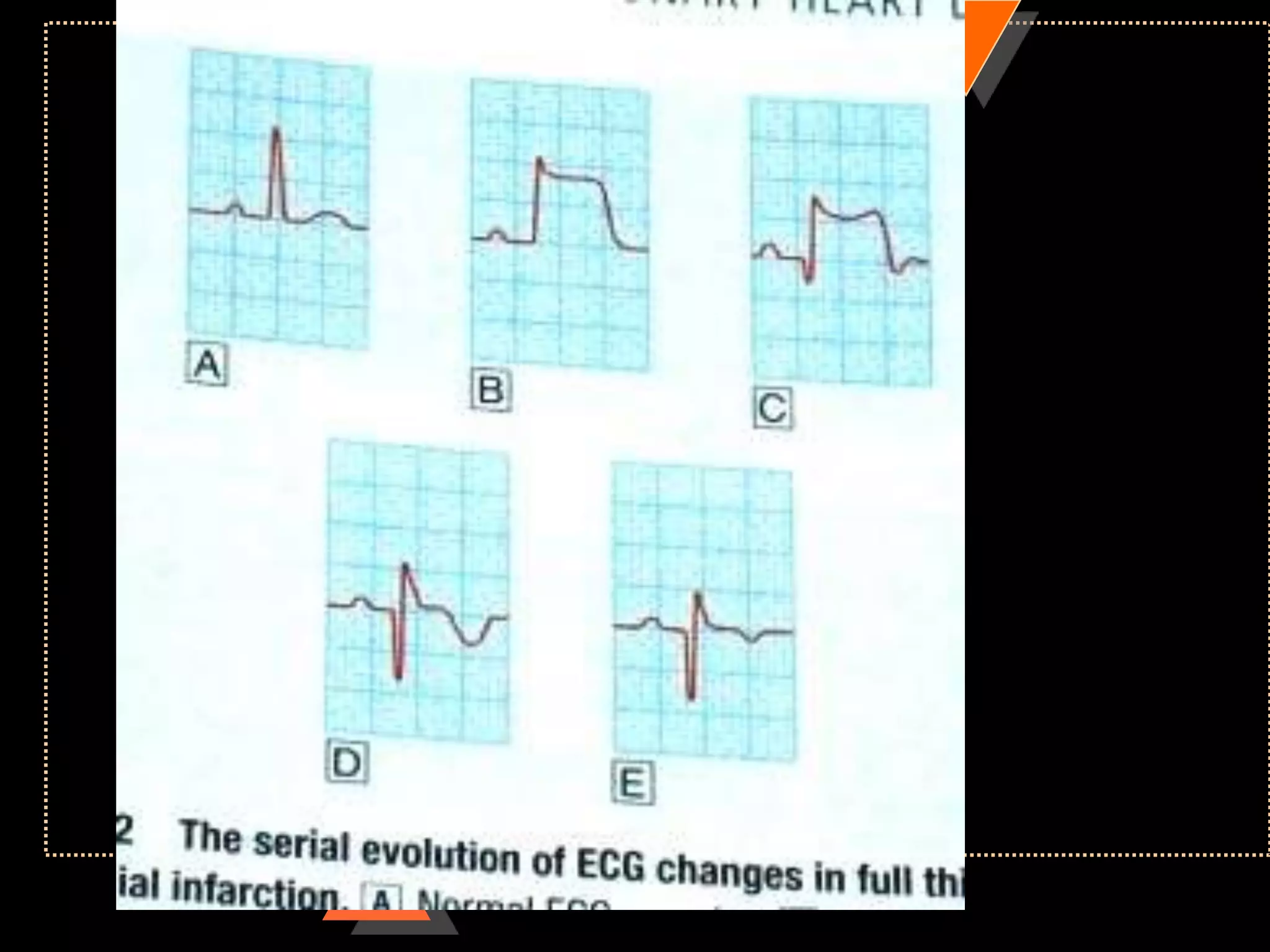
ACUTE MI
Ischemia
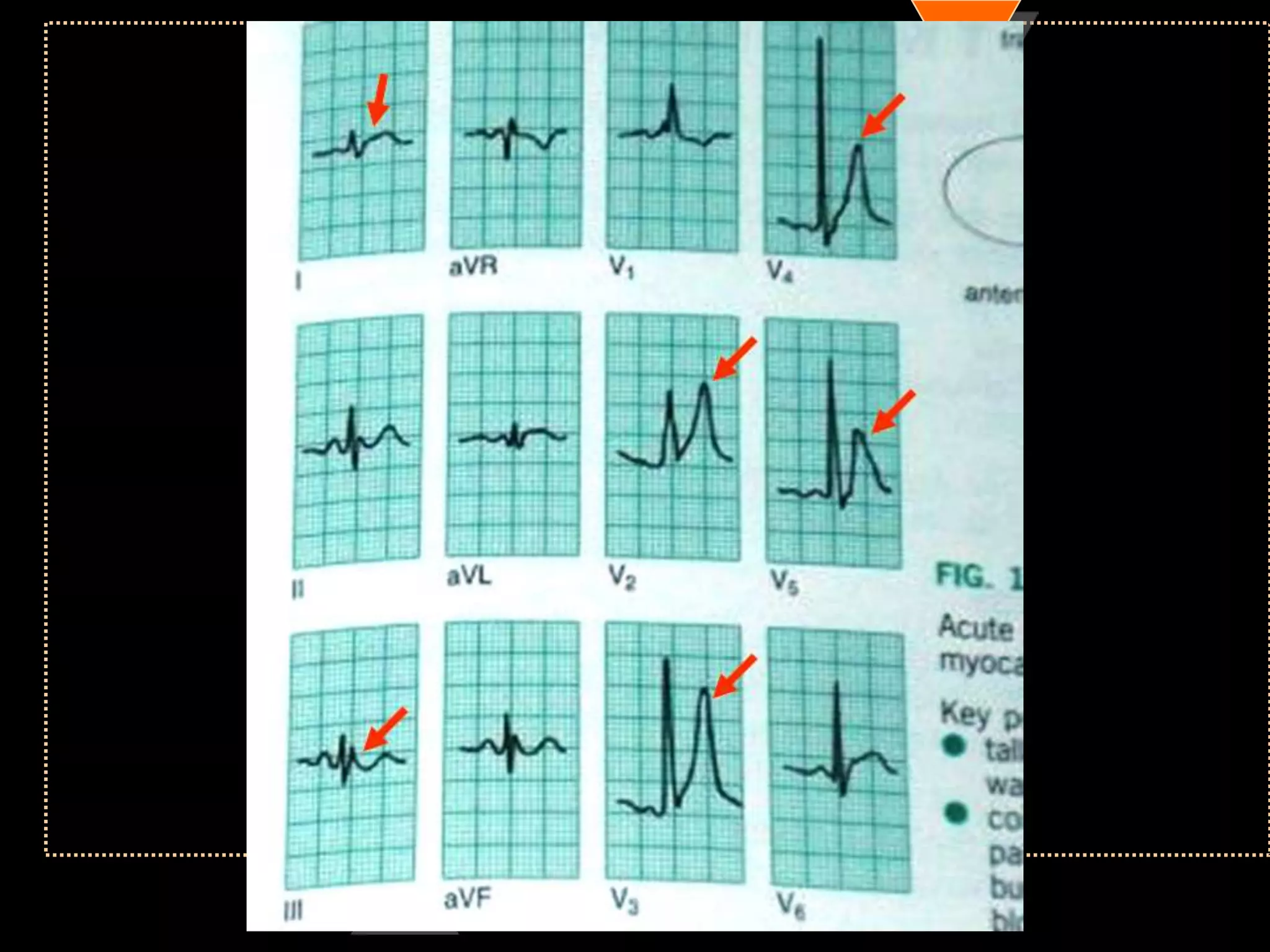
HYPERKALEMIA
LVH WITH STRAIN
PERICARDITIS
How to read ECG
How to read ECG
How to read ECG
How to read ECG
How to read ECG
How to read ECG

How to read ECG

  • 1.
  • 2.
    ECG • Representation ofElectrical activity of heart
  • 4.
    ECG Leads • 12lead ECG • 6 limb leads: Lead I, II, III aVL, aVR, aVF • 6 Chest Leads: V1, V2,V3, V4, V5, V6
  • 6.
    ECG paper Speed 25mm/s •1 large square= 5 small square [5mm] Voltage • 10mm =1mV
  • 9.
    Appearance of waves •Positive deflection [upward] • If electrical impulses flowing towards that lead • Negative deflection [downward] • If electrical impulses flowing away from that lead
  • 15.
  • 16.
    P wave Atrialdepolarization PR interval Atrial depolarization to start of ventricular depolarization QRS complex Ventricular depolarization T wave Ventricular repolarization QT interval Ventricular depolarization & repolarization U wave ? Interventricular septal repolarization
  • 17.
    Systematic approach • Thefollowing 14 points should be analyzed carefully in every ECG: • Standardization • Heart rate • Rhythm • P waves • PR interval • QRS voltages • QRS interval • QT interval • Mean QRS axis • Precordial R-wave progression • Abnormal Q waves • ST segments • T waves • U waves
  • 18.
  • 19.
  • 21.
    •If HR isirregular Count no. of QRS complexes in 30 large squares= 6 sec Multiply it with 10 HR [per min]
  • 22.
    Rate calculation • Memorizethe number sequence: 300, 150, 100, 75, 60, 50
  • 23.
    • ECG machines:print out HR • DO NOT RELY ON IT!!!! • Always Calculate yourself. • Bradycardia: <60/min • Tachycardia: >100/min
  • 24.
    Rhythm • Rhythm strip:prolonged recording of Lead II • Sinus rhythm ? • Each QRS complex preceded by P wave • Regular/ irregular?
  • 25.
  • 26.
  • 27.
    QRS AXIS • Indicatorof overall direction that wave of depolarization takes when passing through ventricles • Also called ANGLE • Measured • in degrees
  • 28.
  • 31.
    • Right axisdeviation [RAD] • Beyond +90° • Left Axis Deviation [LAD] • Beyond -30°
  • 34.
    Method 1 • Mostprecise method • Use of vectors • Measure overall height of QRS in lead I & aVF • Plot in graph paper • Measure the ANGLE of vector
  • 38.
    Method 2 • Quickmethod • Identify limb lead in which QRS complex is isoelectric • [with equal positive & negative deflection] • Implies: electric flow is at Right angle to this lead
  • 40.
    Method 3 • Forquick assessment • Look at QRS complexes in lead I & II
  • 41.
    • Predominantly positive QRSin lead I • Axis between -90 to +90 • Excludes RAD
  • 42.
    • Predominantly positive QRSin lead II  • Axis between -30 to +150 • Excludes LAD
  • 43.
    Lead I LeadII Cardiac Axis QRS Positive QRS Positive Normal Axis QRS Positive QRS Negative Left Axis Deviation QRS Negative QRS Positive Right Axis Deviation
  • 44.
    • LAD • WPWsyndrome • LBBB • Inferior wall MI • RAD • RVH • WPW syndrome • Anterolateral MI • Dextrocardia
  • 45.
    P wave • Presentor not? • Sinus rhythm • If completely absent •Atrial Fibrillation •Hyperkalemia • If intermittently absent •Sinus arrest
  • 48.
    • Inverted Pwaves? • Incorrect positioned electrodes • Dextrocardia • Abnormal atrial depolarization
  • 49.
    • Height ofP waves • > 2.5 mm: tall • Indicative of Right Atrial enlargement • P Pulmonale
  • 51.
  • 52.
    • Width ofP waves • >2mm width: abnormal • Bifid P wave • Indicates Left Atrial enlargement • P Mitrale
  • 55.
    PR Interval • Fromstart of P wave to start of R wave • Normally • Not <3 small squares • Not > 5 small squares • Consistent
  • 56.
    Short PR Interval •AV junctional rhythm • WPW syndrome • Lown –Ganong-Levine syndrome
  • 57.
    Long PR Interval •Denotes delay in conduction through AV node • First Degree Block • PR prolonged, constant
  • 59.
    Second degree Block •Mobitz Type I • PR progressively increase until one P wave fails to produce QRS complex
  • 61.
    • Mobitz TypeII • PR interval normal & fixed, • But occasional P waves fail to produce QRS
  • 63.
    • Third DegreeBlock [Complete AV Block] • No relationship between P waves & QRS complex
  • 64.
    • 2:1 Block •Alternate P waves are not followed by QRS complex
  • 65.
    Q WAVE • Firstnegative deflection in QRS complex • ? Pathological Q waves • If • >2 small squares deep • >1 small square wide • >25% of height of the following R wave in depth
  • 66.
    QRS complex • Appearanceof QRS Complex vary from lead to lead
  • 67.
    • Width: Narrow/wide • Wide QRS: • > 3 small squares • Bundle branch block • Ventricular arrhythmia
  • 68.
    • Size ofQRS complex • Small: • Pericardial effusion • ?incorrect calibration
  • 69.
    • Big QRScomplex • Ventricular hypertrophy: R/L • WPW syndrome
  • 70.
    Progression of Rwave • V1: small R wave , large S wave, • Gradually R wave increases, S wave decreases • V6: small Q wave, large R wave • V3 and V4 : located midway between V1 and V6, QRS complex nearly isoelectric in one of these leads
  • 71.
  • 72.
    Left ventricular Hypertrophy •R Wave in V5 or V6 >25mm • S Wave in V1 or V2 > 25mm • Sum of R wave in V5 Or V6 & S wave in V1 or V2 >35mm
  • 74.
  • 75.
    Right Ventricular Hypertrophy •Right axis deviation • Deep S Waves in leads V5 & V6 • R>S in V1 • RBBB
  • 78.
    RBBB • Right BundleBranch Block • Broad QRS complex • Small r wave in V1, small Q wave in V6 • S wave in V1, R wave in V6 • R‟ wave in V1, S wave in V6
  • 81.
    LBBB • Left BundleBranch Block • Broad QRS • Small Q wave in V1, Small r wave in V6 • R wave in V1, S wave in V6 • S wave in V1, R‟ wave in V6
  • 84.
    • “WILLIAM MORROW” •William: „W‟ in V1 & „M‟ in V6: LBBB • Morrow: „M‟ in V1 & „W‟ in V6: RBBB
  • 86.
    • LBBB • IschemicHeart Disease • Cardiomyopathy • LVH • Fibrosis • RBBB • Ischemic heart disease • Cardiomyopathy • ASD • Massive pulmonary embolism
  • 87.
    ST Segment • Fromend of S wave to start of T Wave • Normally: Isoelectric • ? Depressed/ elevated
  • 90.
    • Elevated STsegment • Acute MI • Prinzmetal’s angina • Pericarditis • LV aneurysm • High take off
  • 96.
    • Depressed STsegment • Myocardial ischemia • Posterior MI • Ventricular hypertrophy with ‘Strain’ • Drugs: Digoxin
  • 98.
    Ventricular Hypertrophy with “strain”pattern • Tall R waves • Deep S waves • ST segment depression • T wave inversion
  • 100.
  • 101.
    T wave • Inverted? •Normal in aVR • V1,V2, III • Size • Normal: not > ½ size of preceeding QRS complex • Too small? • Too large?
  • 102.
    Tall T waves •Hyperkalemia • Acute MI
  • 105.
    Too small TWaves • Hypokalemia • Pericardial effusion • hypothyroidism
  • 106.
    Inverted T waves •Normal in few leads: aVR, V1, V2, III • MI • Myocardial ischemia • Ventricular hypertrophy with “strain” • Digoxin toxicity
  • 108.
    QT Interval • Fromstart of QRS complex to end of T wave • Varies with HR
  • 109.
    Corrected QT interval •QTC • QTC =QT/√RR • Normal: 0.35-0.43 sec
  • 110.
    Prolonged QTc • If≥0.44 sec • Hypocalcemia • Acute myocarditis • Torsades de pointes
  • 111.
    U waves • Mostlyin anterior chest leads • Difficult to identify clearly
  • 113.
    • Prominent UWaves • Hypoklemia • Hypercalcemia • Hyperthyroidism
  • 114.
  • 117.
  • 119.
  • 120.
  • 121.
  • 122.