An Overview of
Paediatric
Electrocardiogram
Sid Kaithakkoden
MBBS,DCH,DipNB,MD.MRCPCH,FCPS
sidkaithakkoden@nhs.net
2
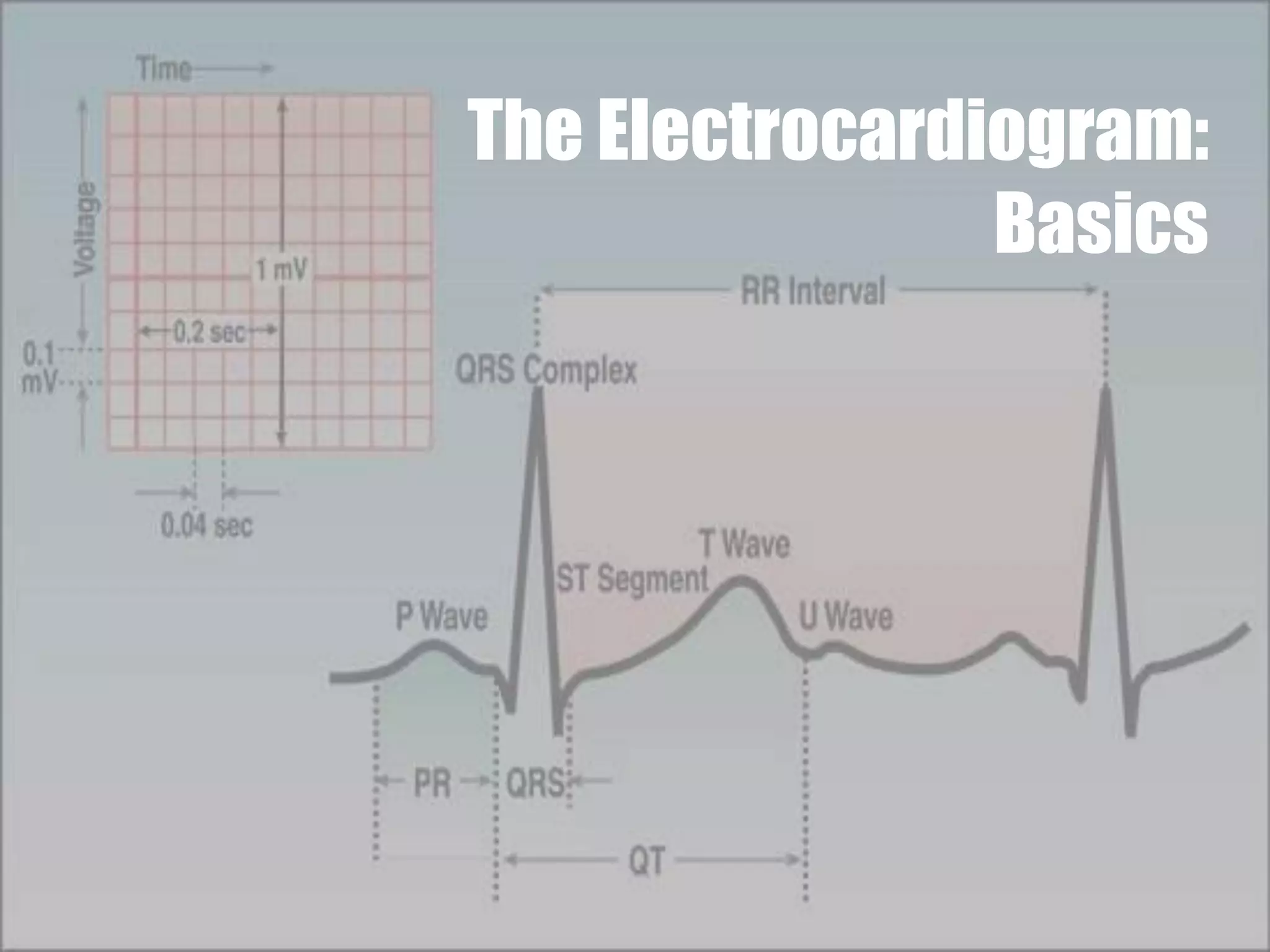
The Electrocardiogram:
Basics
3
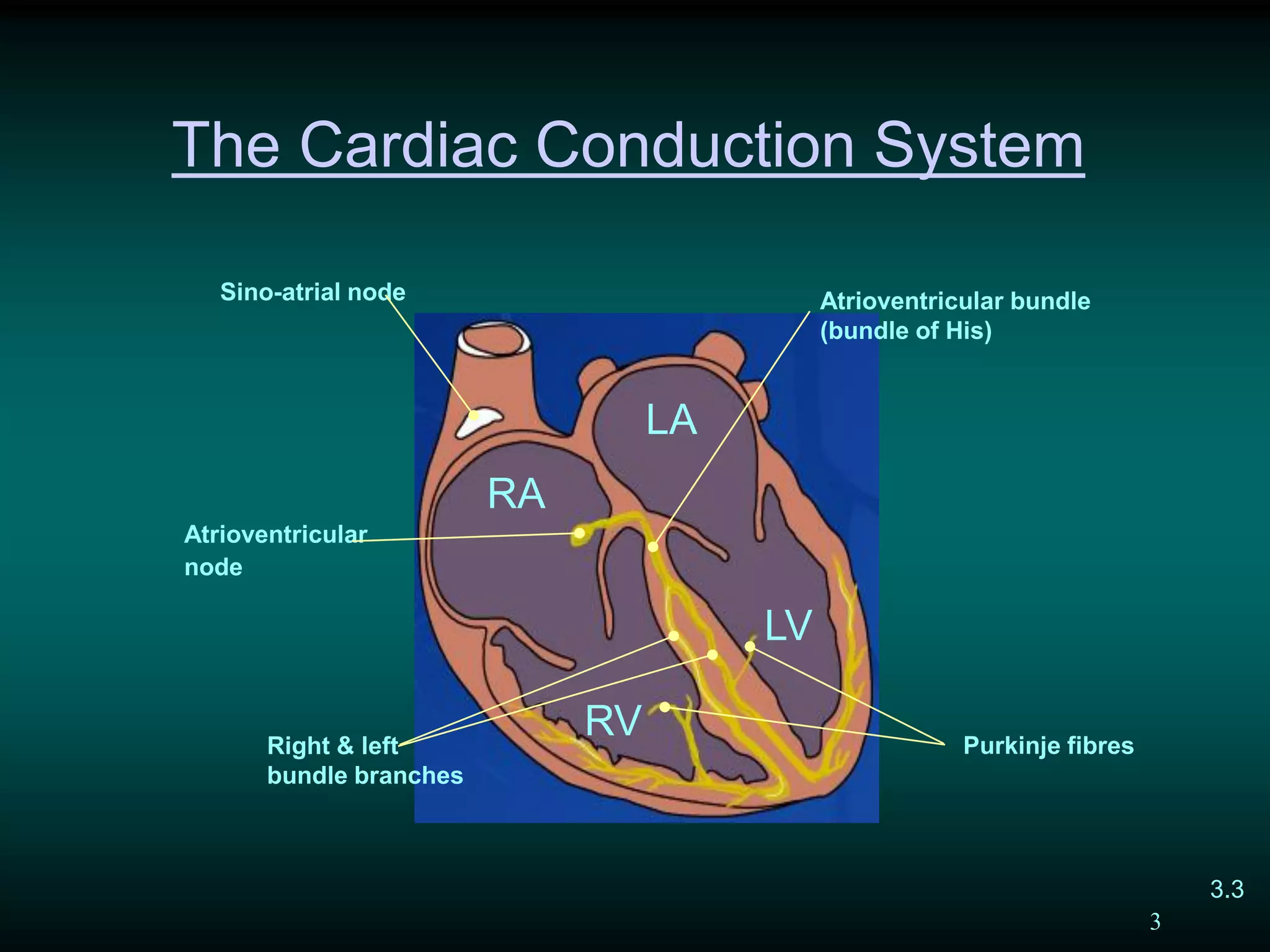
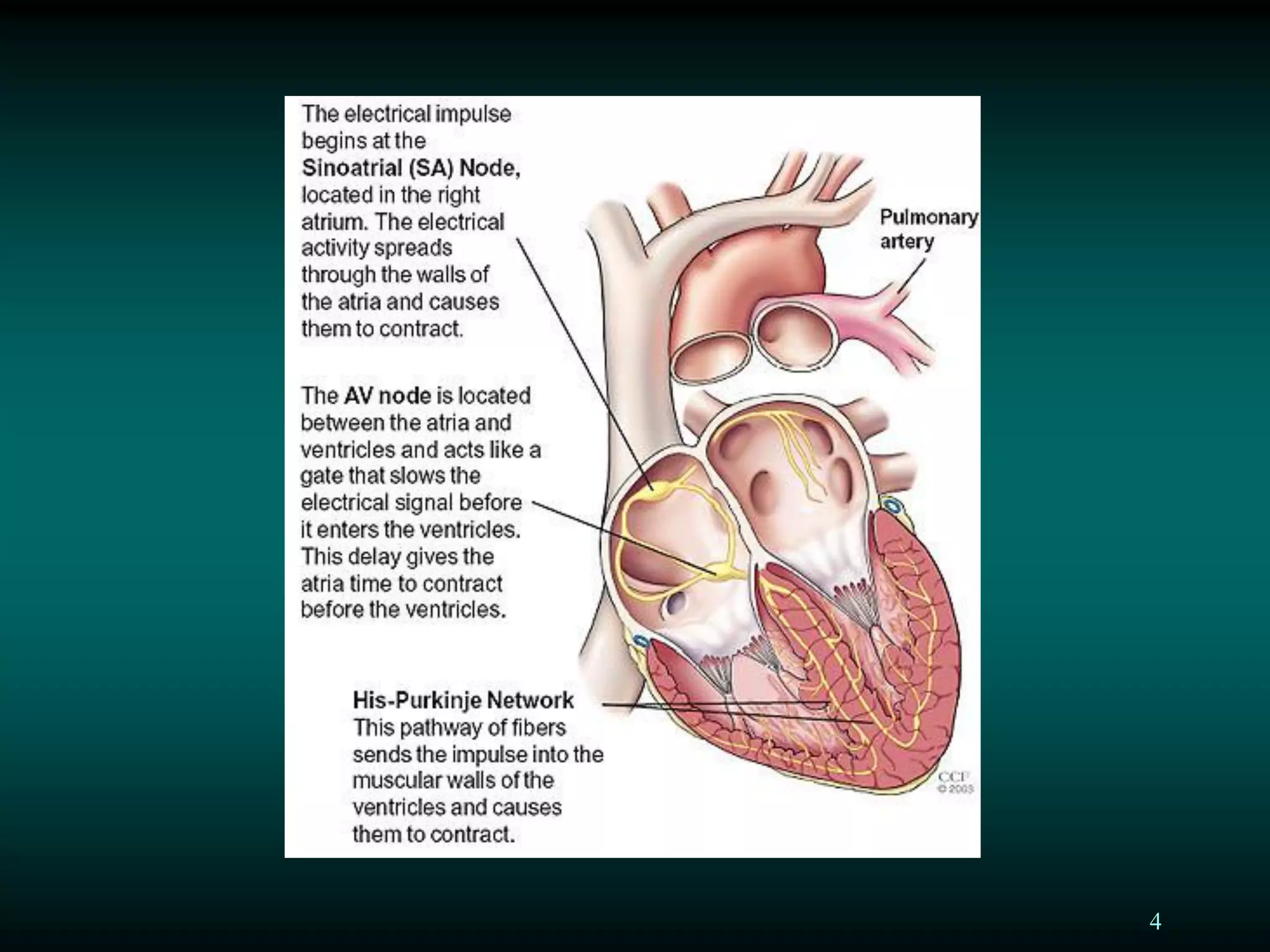
The Cardiac Conduction System
Sino-atrial node
Purkinje fibresRight & left
bundle branches
Atrioventricular bundle
(bundle of His)
Atrioventricular
node
3.3
RA
LA
RV
LV
4
5
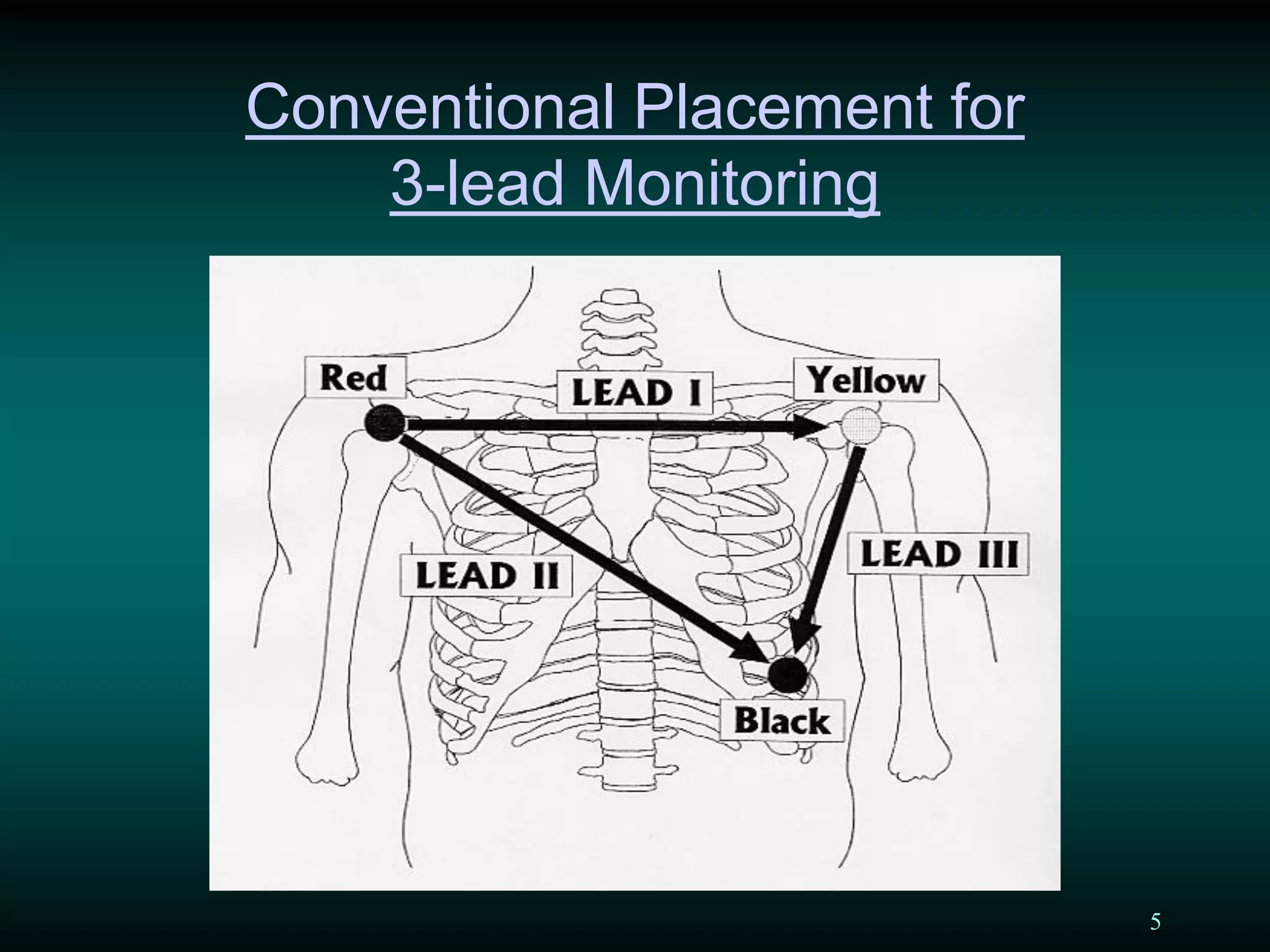
Conventional Placement for
3-lead Monitoring
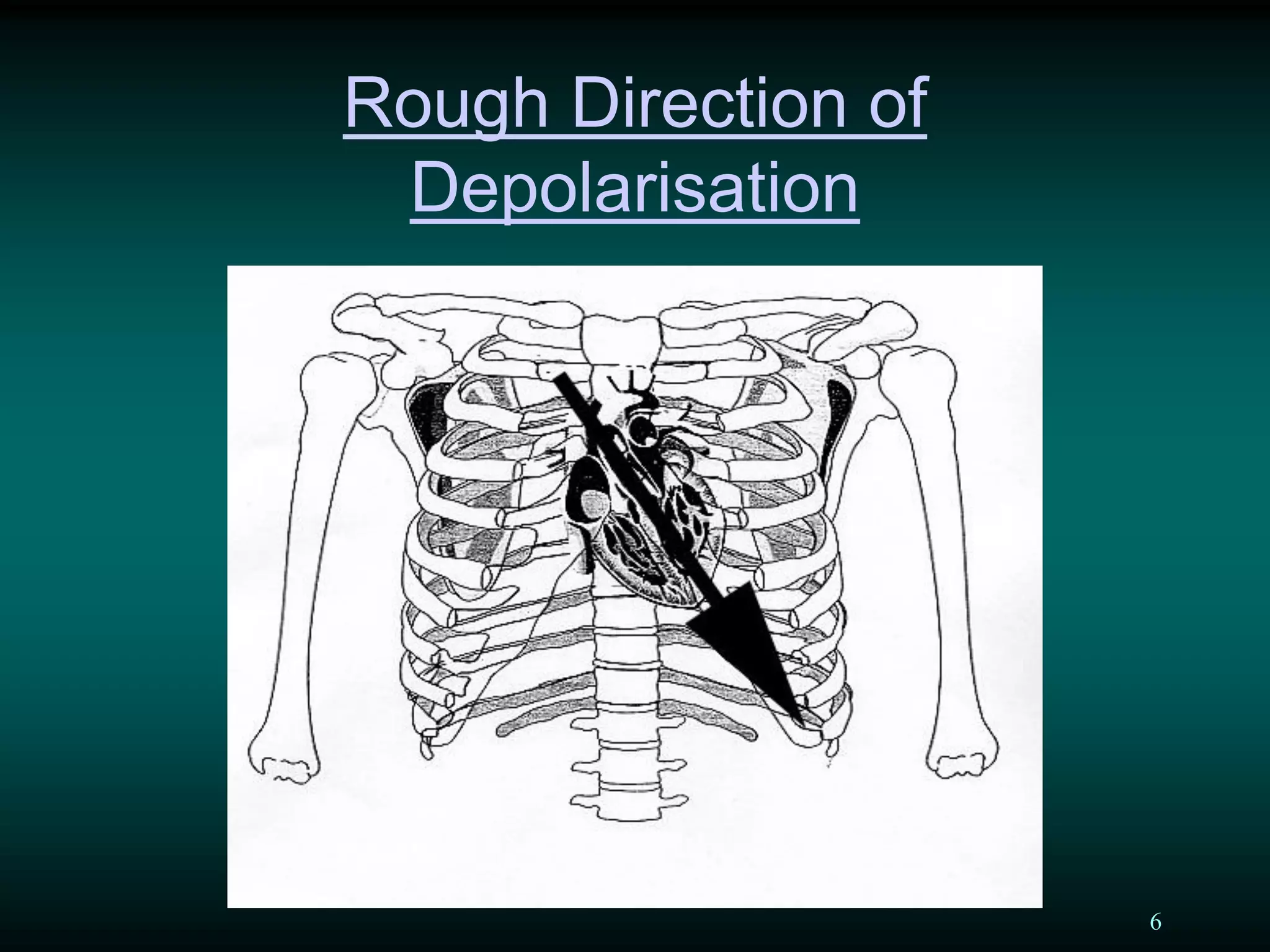
6
Rough Direction of
Depolarisation
7
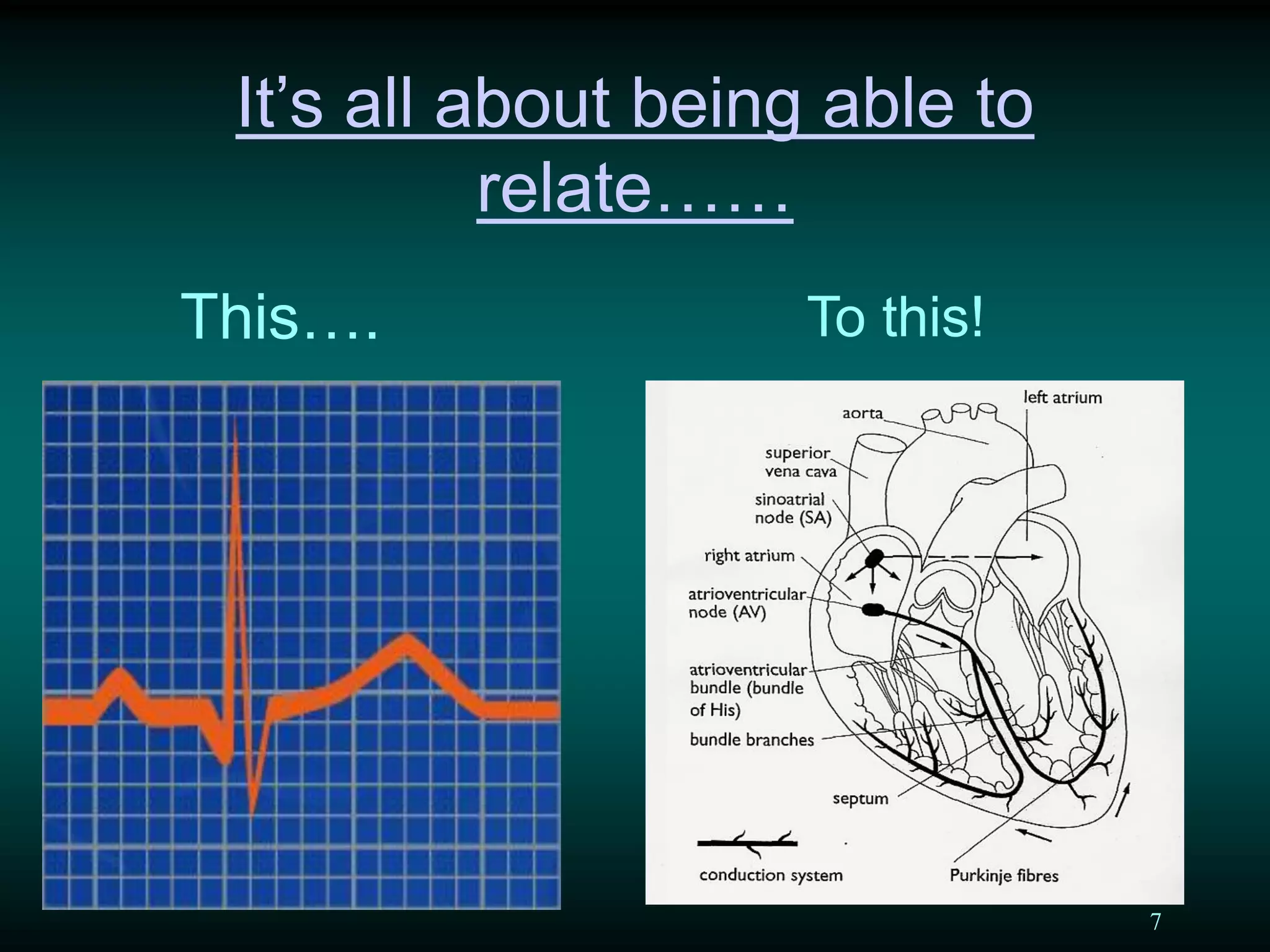
It’s all about being able to
relate……
This…. To this!
8
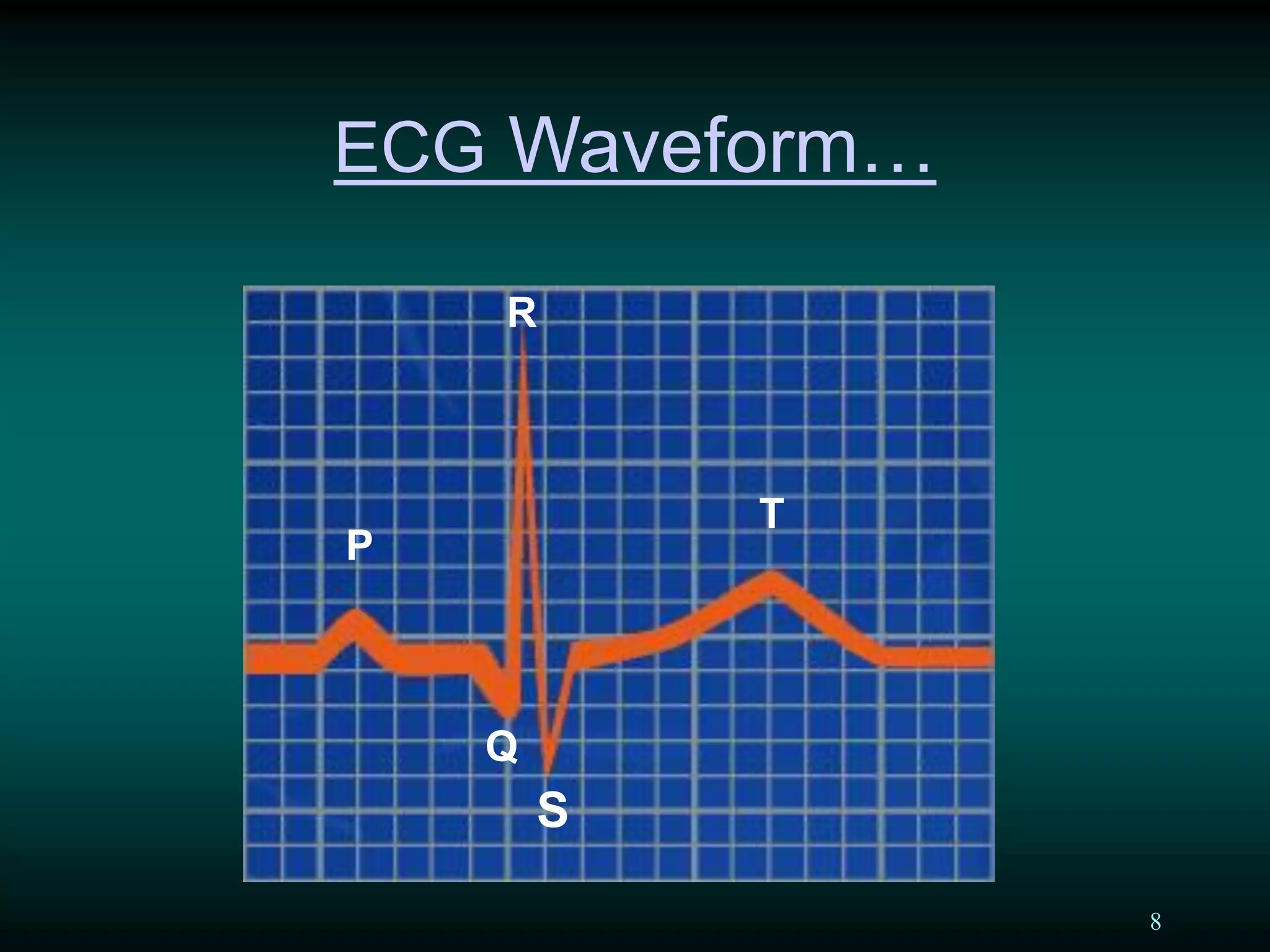
ECG Waveform…
P
R
Q
S
T
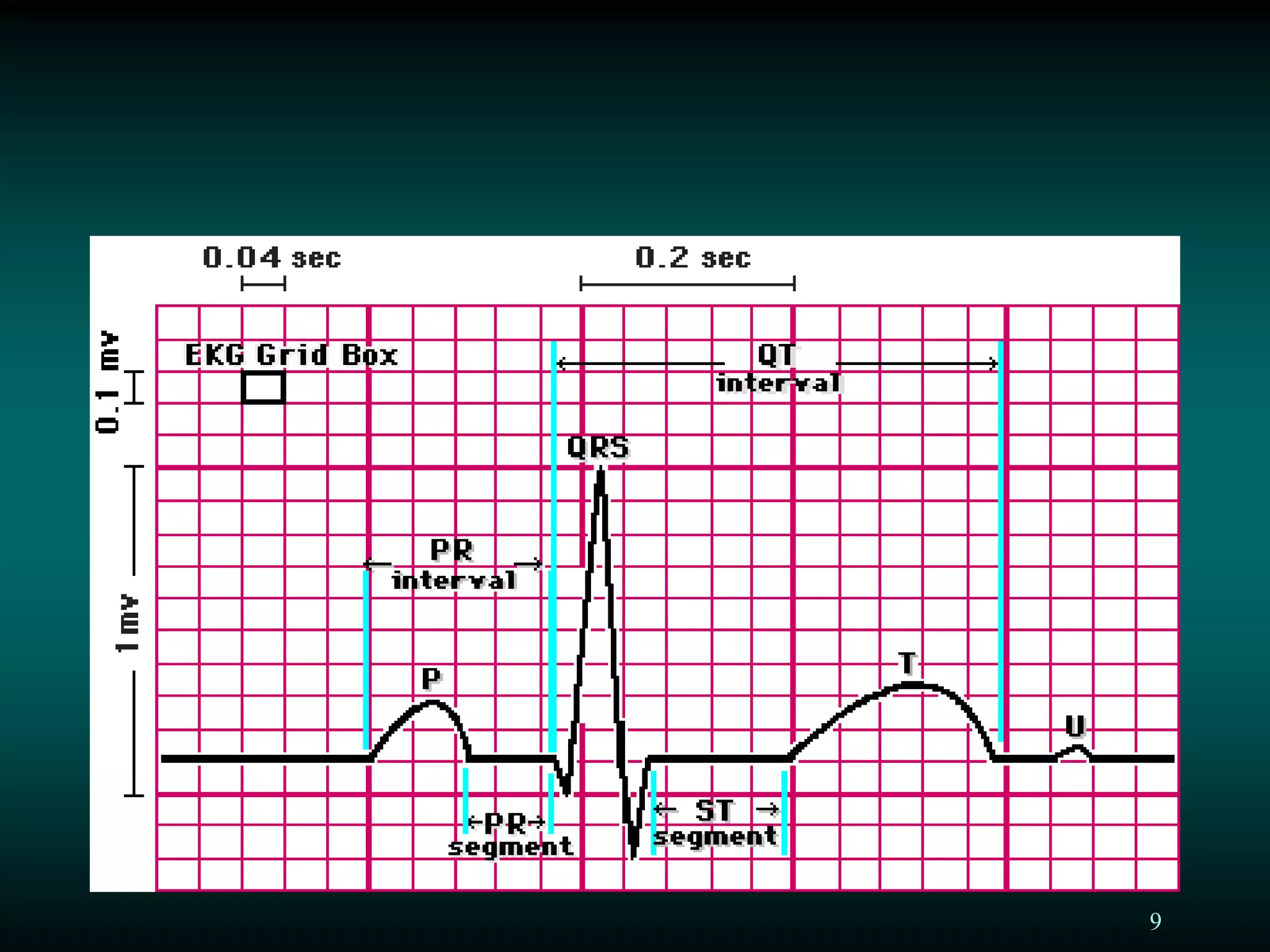
9
10
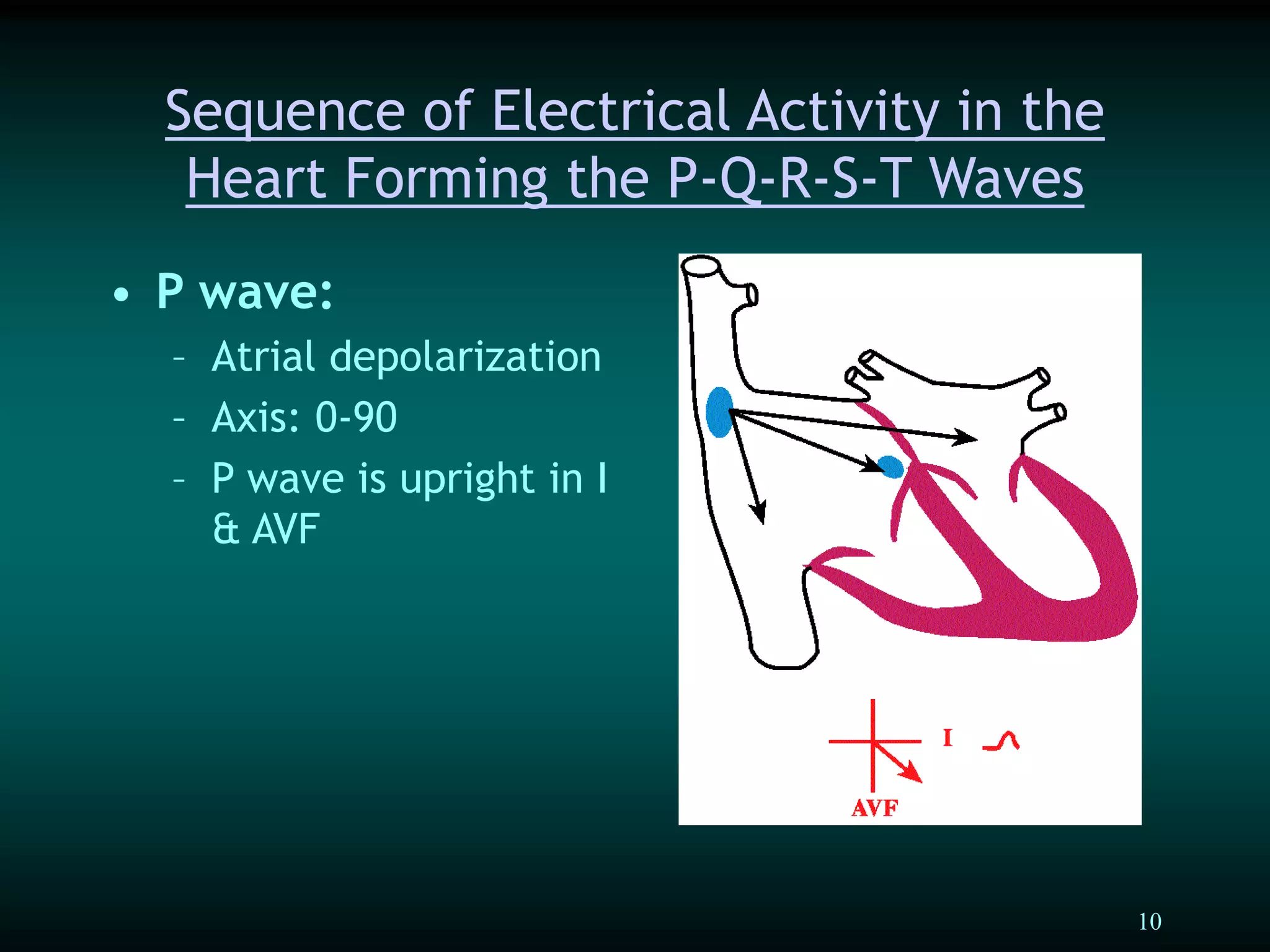
Sequence of Electrical Activity in the
Heart Forming the P-Q-R-S-T Waves
• P wave:
– Atrial depolarization
– Axis: 0-90
– P wave is upright in I
& AVF
11
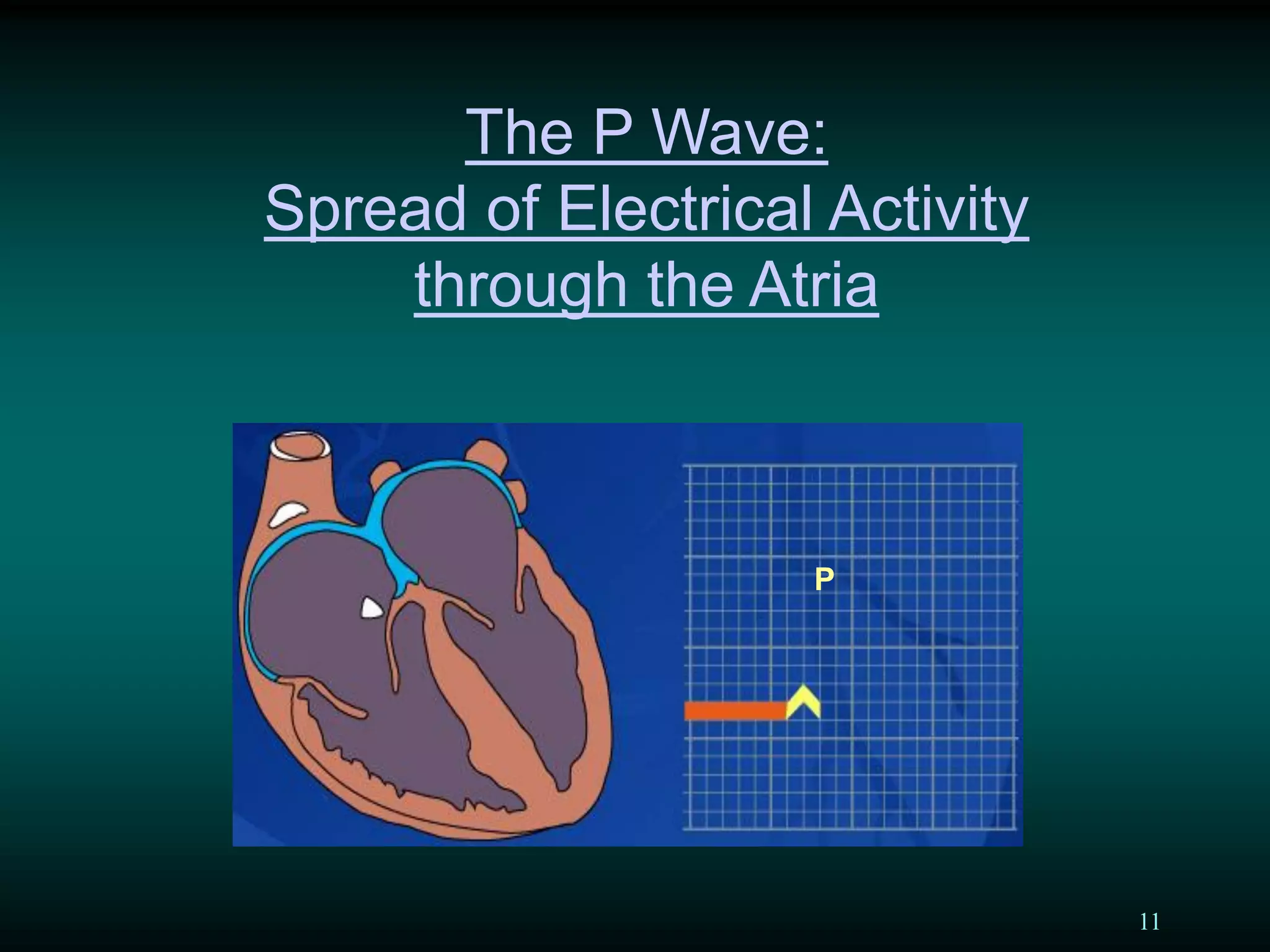
The P Wave:
Spread of Electrical Activity
through the Atria
P
12
The P Wave
• Represents atrial depolarisation and
activation
– Either from the SA node (sinus rhythm)
– Or from somewhere else in atria (ectopic)
• In sinus rhythm P wave rate is regular
• The only normal exception where P
wave rate varies is sinus arrhythmia –
usually only seen in people under 40
13
The P Wave: Characteristics
• P waves should be present!
• If absent, atrial activity may be:
– Truly absent (No coordinated atrial activity)
– Present but not visible on ECG
• No more than 0.12 secs duration
• No more than 2.5 mm high in lead II
• Upright in lead II (usually upright in all
leads except aVR)
14
Analysis of P waves:
• Are the P waves regular?
• Is there one P wave for every QRS?
• Is the P wave normal and upright in
Lead II?
• Are there more P waves than QRS
complexes?
• Do all of the P waves look alike?
15
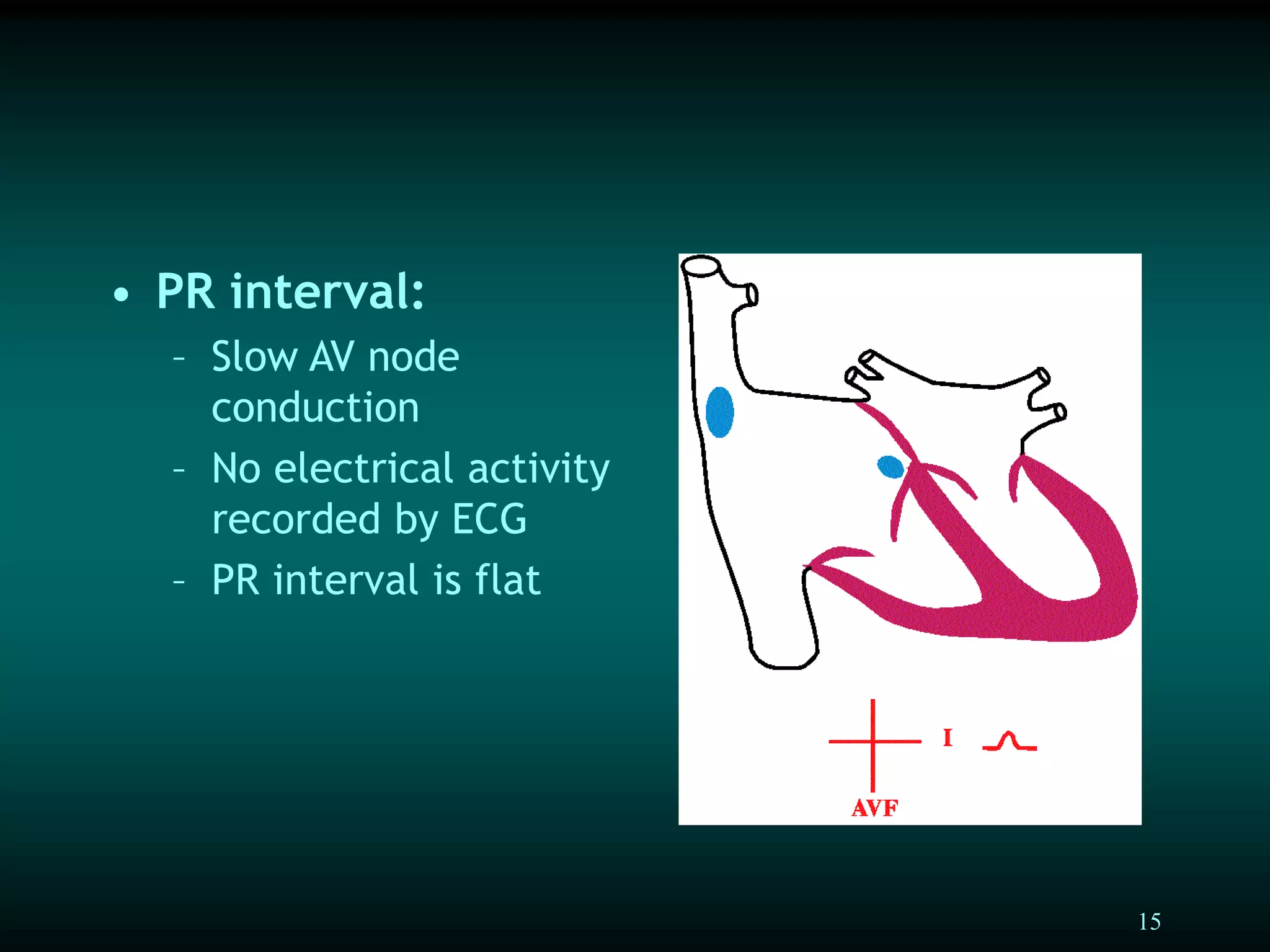
• PR interval:
– Slow AV node
conduction
– No electrical activity
recorded by ECG
– PR interval is flat
16
The PR Interval
• Measures the time from the beginning of
atrial depolarisation to the beginning of
ventricular depolarisation
– i.e. from beginning of P wave to beginning of QRS
complex
• A major portion of the PR interval is the slow
conduction through the AV node
• AV nodal conduction under autonomic control
17
PR interval analysis:
• Normal PR interval (PRI) is 0.12 - 0.2
secs in adults (age dependant in
children)
• Is the PRI measurement within the
normal range?
• Are all of the PRI’s the same?
• If the PRI varies, is there a pattern to
the changing measurements?
18
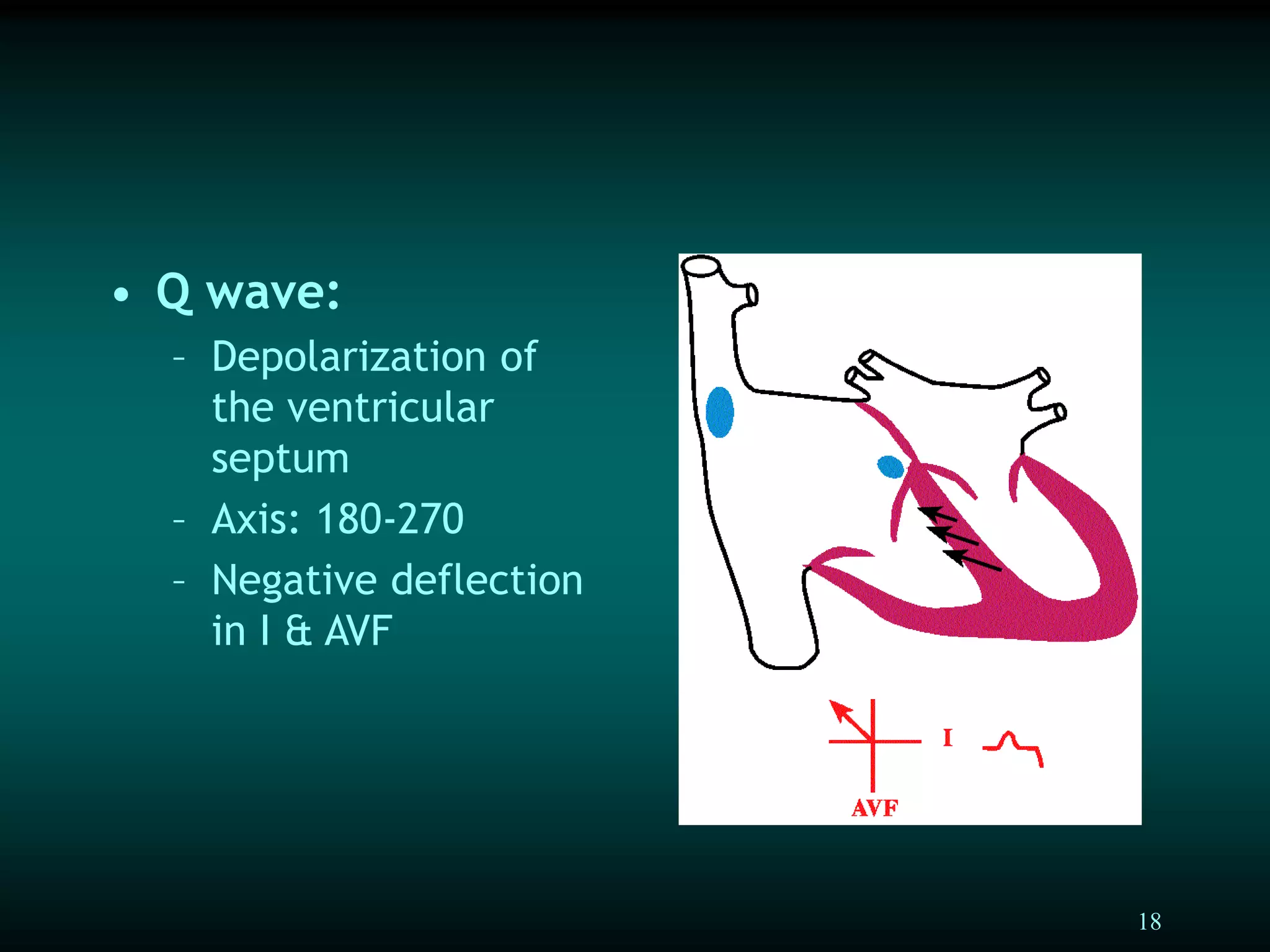
• Q wave:
– Depolarization of
the ventricular
septum
– Axis: 180-270
– Negative deflection
in I & AVF
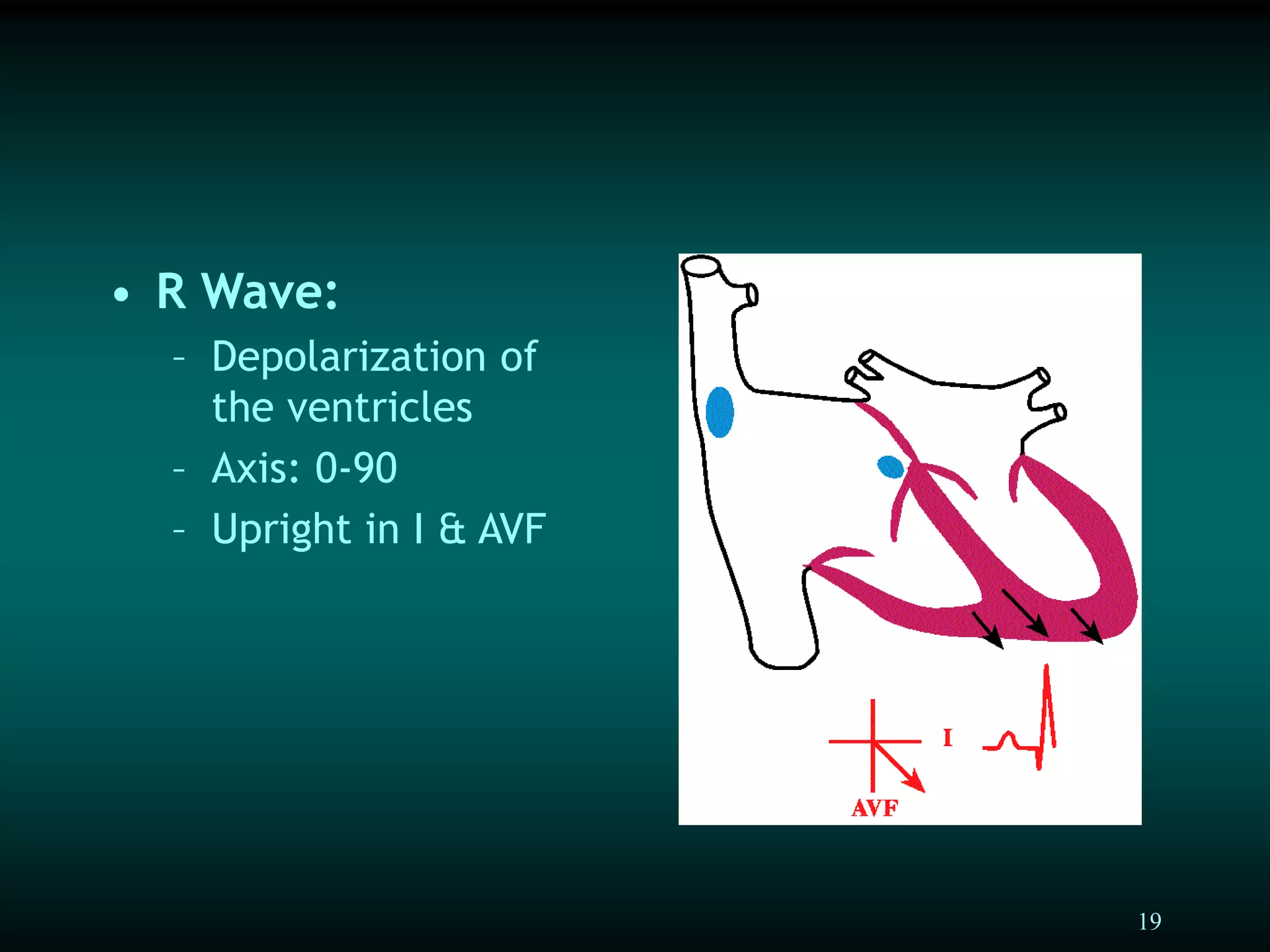
19
• R Wave:
– Depolarization of
the ventricles
– Axis: 0-90
– Upright in I & AVF
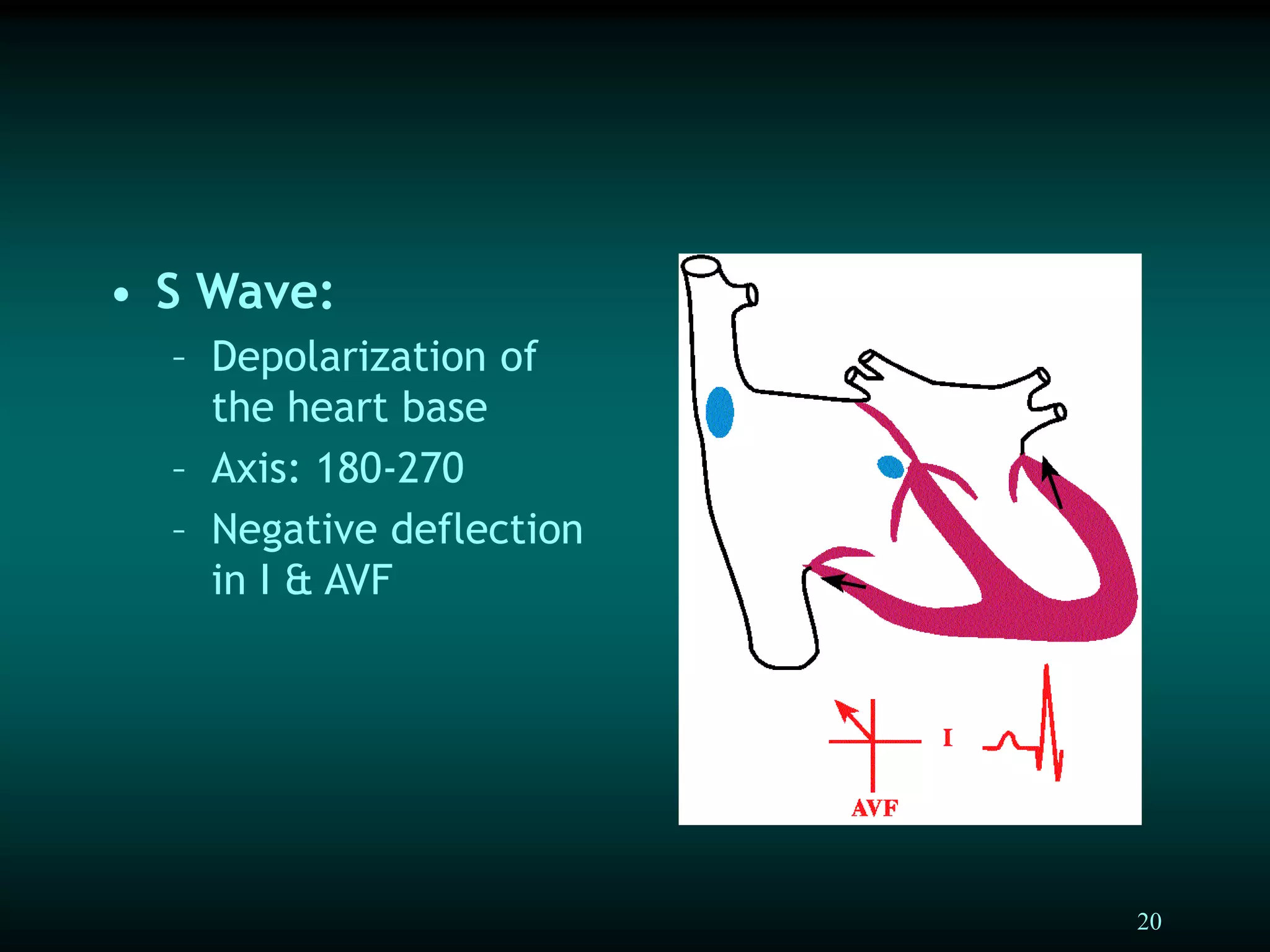
20
• S Wave:
– Depolarization of
the heart base
– Axis: 180-270
– Negative deflection
in I & AVF
21
The QRS Complex
• Represents ventricular depolarisation
and activation
• Usually much bigger than P and T wave
as much larger muscle mass
• NB. The QRS complex may comprise of
a Q, R and S wave – but often not all
three in same complex!
22
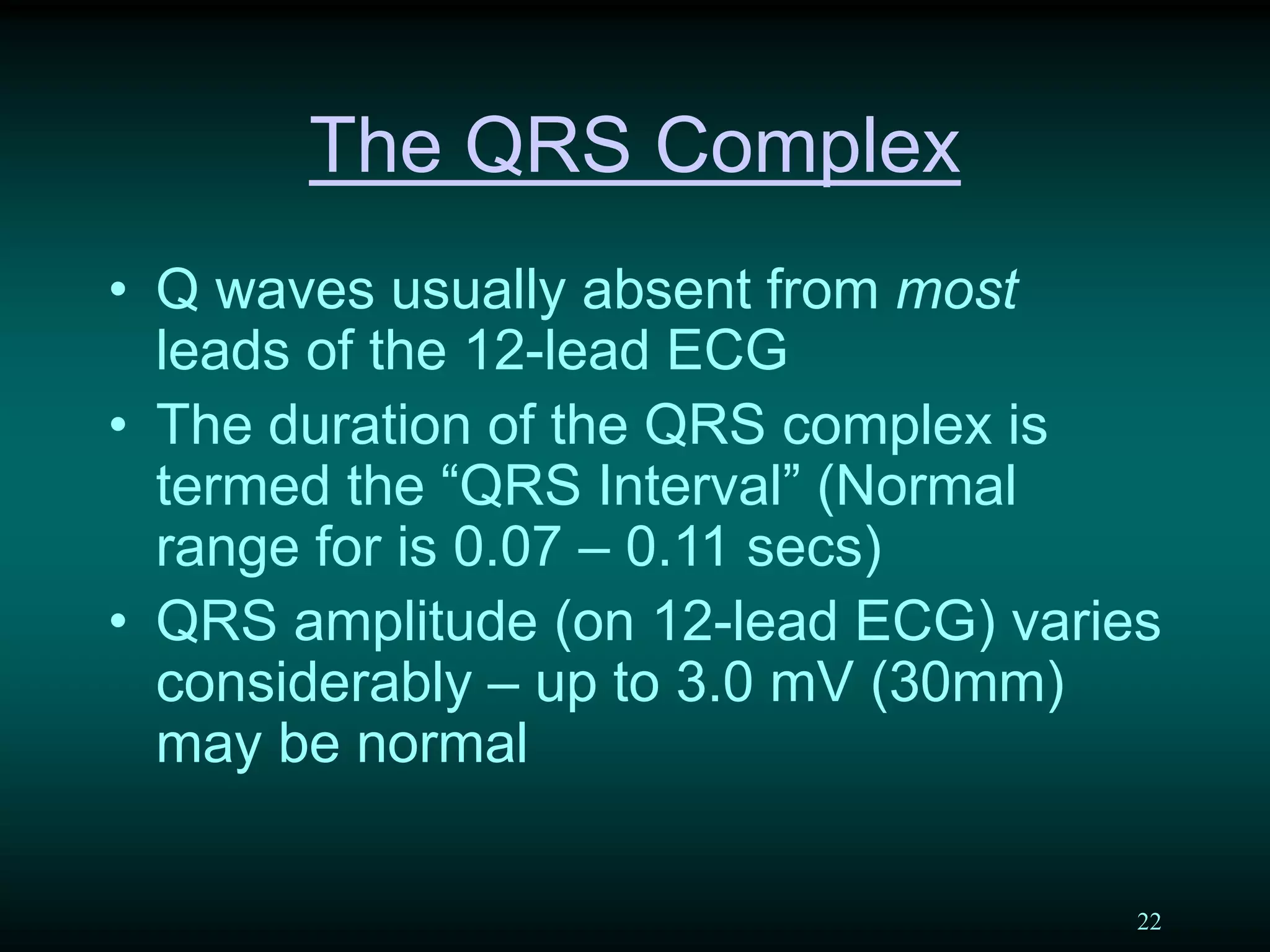
The QRS Complex
• Q waves usually absent from most
leads of the 12-lead ECG
• The duration of the QRS complex is
termed the “QRS Interval” (Normal
range for is 0.07 – 0.11 secs)
• QRS amplitude (on 12-lead ECG) varies
considerably – up to 3.0 mV (30mm)
may be normal
23
QRS Waveform Nomenclature
R r qR qRs Qrs QS
Qr Rs rS qs rSr’ rSR’
7.1
24
Analysis of QRS Complex
• What is the duration of the QRS complex?
• Are all of the QRS complexes of equal
duration?
• Do all of the QRS look alike?
• Are the unusual QRS complexes associated
with ectopic beats?
• Is the QRS complex preceded by a P wave?
25
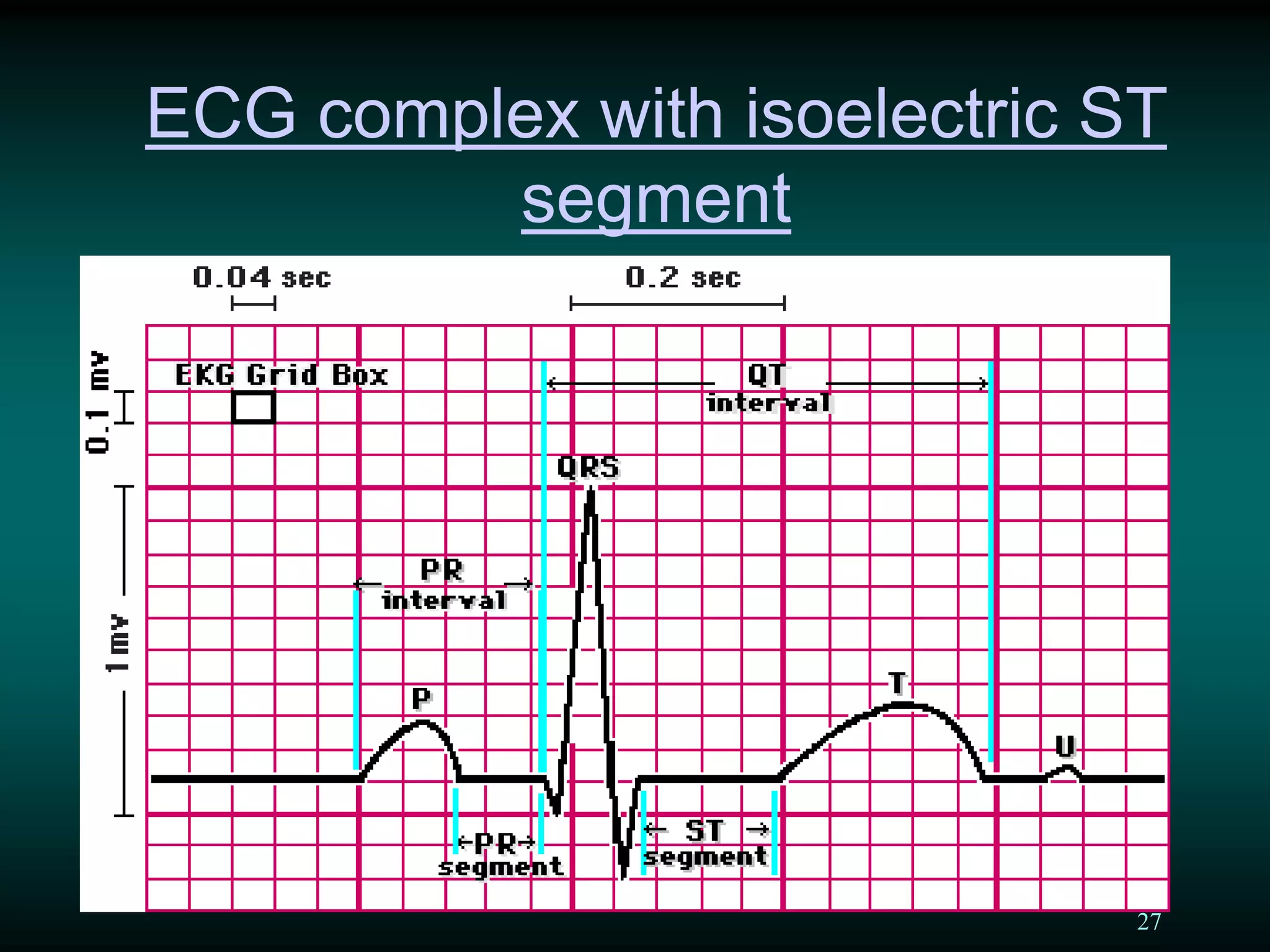
The ST Segment
• The ST segment lies between the end
of the S wave and the start of the T
wave
• It represents the time between end of
depolarisation and beginning of
repolarisation
26
Analysis of the ST Segment
• The ST segment is normally
isoelectric
• Can be abnormal in two ways:
–Are the ST segments elevated?
• May indicate myocardial infarction
–Are the ST segments depressed?
• May indicate myocardial ischaemia
27
ECG complex with isoelectric ST
segment
28
12-lead ECG showing ST
Segment Depression
29
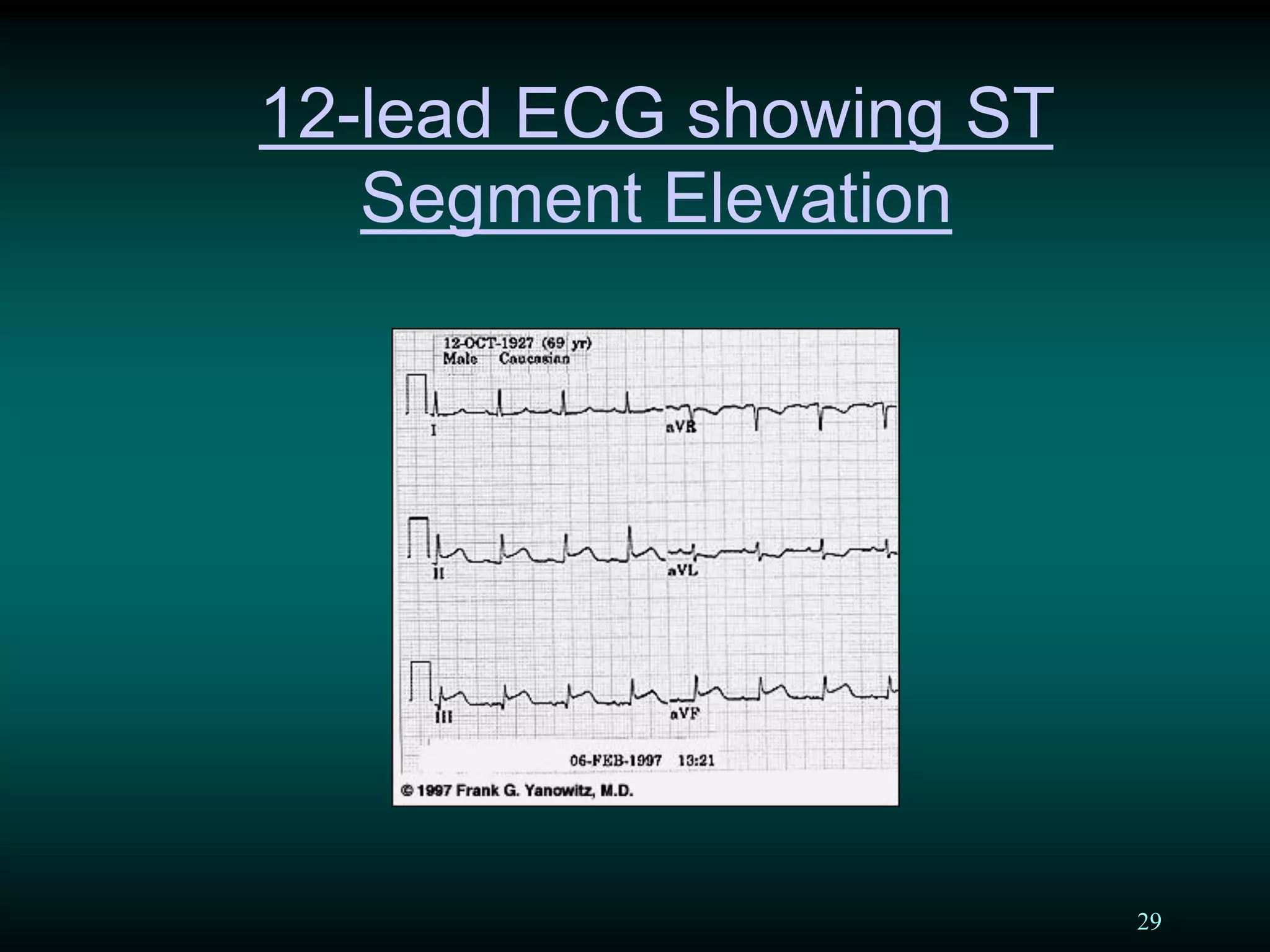
12-lead ECG showing ST
Segment Elevation
30
• T Wave:
– Repolarization of the
Ventricles
– upright deflection in
I & AVF
31
The T Wave
• Represents repolarisation (“recharging”)
of the ventricular muscle to its resting
electrical state
• Analysis of the T wave would examine:
– Its direction
– Its shape
– Its height
32
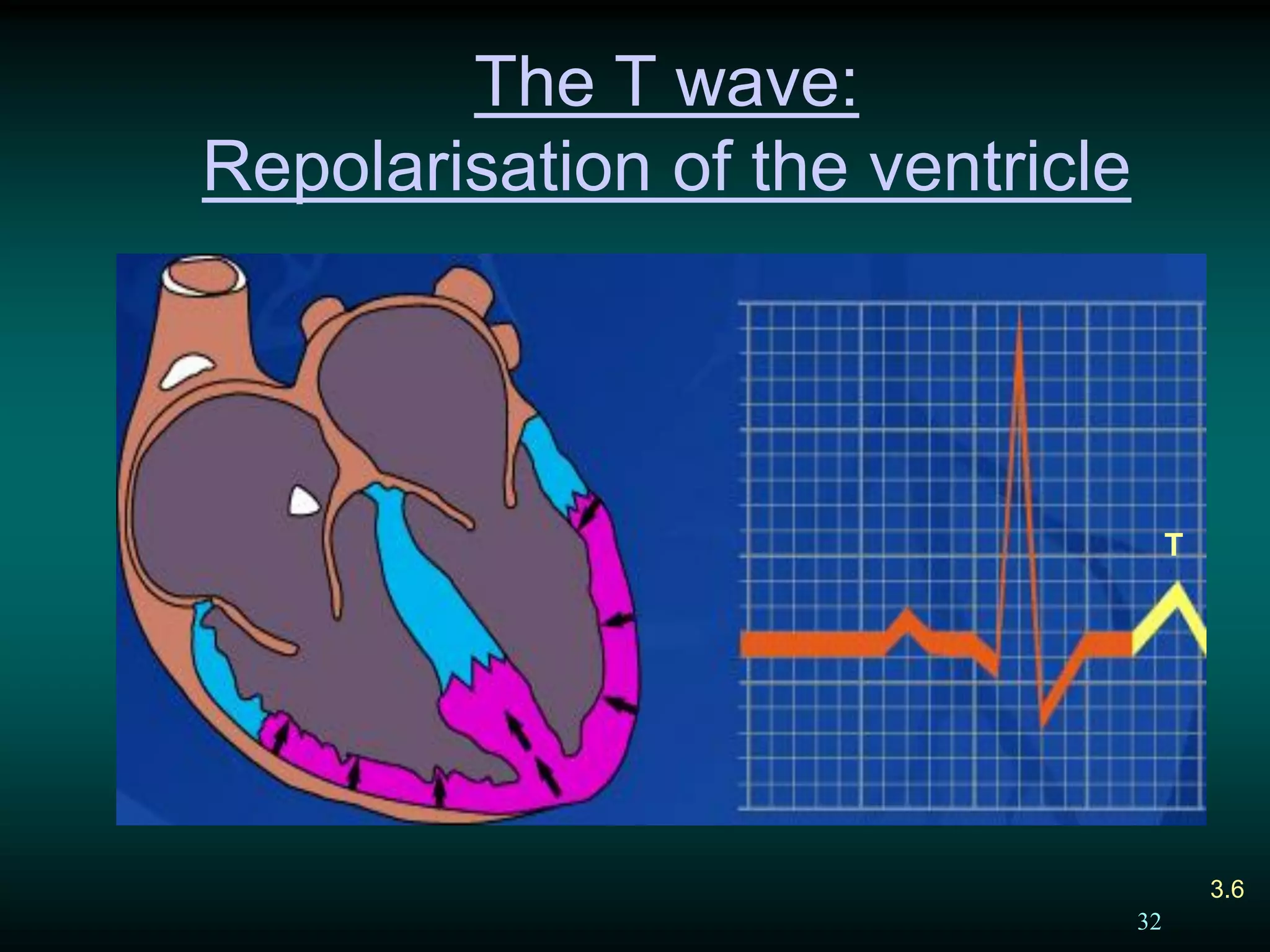
Repolarisation of Ventricle
The T wave:
Repolarisation of the ventricle
T
3.6
33
The QT Interval
• The QT interval measures the total time
taken for depolarisation and
repolarisation of the ventricles
– Beginning of the QRS complex to the end
of the T wave
• Usually measured rather than the
duration of the T wave alone
• Varies with heart rate, age and sex
34
The U Wave
• The U wave is normally either absent or
present as a small rounded wave
following the T wave
• Normally oriented in the same direction
as T wave
• Origin of U wave is uncertain
• More prominent in hypokalaemia,
hypercalcaemia or hyperthyroidism
35
Age HR
bpm
QRS
Axis
degrees
PR
interval
seconds
QRS
interval
seconds
R
in V1
mm
S
in V1
mm
R
in V6
mm
S
in V6
mm
1st week 90-160 60-180 0.08-0.15 0.03-0.08 5-26 0-23 0-12 0-10
1-3wks 100-180 45-160 0.08-0.15 0.03-0.08 3-21 0-16 2-16 0-10
1-2 mo 120-180 30-135 0.08-0.15 0.03-0.08 3-18 0-15 5-21 0-10
3-5 mo 105-185 0-135 0.08-0.15 0.03-0.08 3-20 0-15 6-22 0-10
6-11 mo 110-170 0-135 0.07-0.16 0.03-0.08 2-20 0.5-20 6-23 0-7
1-2 yr 90-165 0-110 0.08-0.16 0.03-0.08 2-18 0.5-21 6-23 0-7
3-4 yr 70-140 0-110 0.09-0.17 0.04-0.08 1-18 0.5-21 4-24 0-5
5-7 yr 65-140 0-110 0.09-0.17 0.04-0.08 0.5-14 0.5-24 4-26 0-4
8-11 yr 60-130 -15-110 0.09-0.17 0.04-0.09 0-14 0.5-25 4-25 0-4
12-15 yr 65-130 -15-110 0.09-0.18 0.04-0.09 0-14 0.5-21 4-25 0-4
> 16 yr 50-120 -15-110 0.12-0.20 0.05-0.10 0-14 0.5-23 4-21 0-4
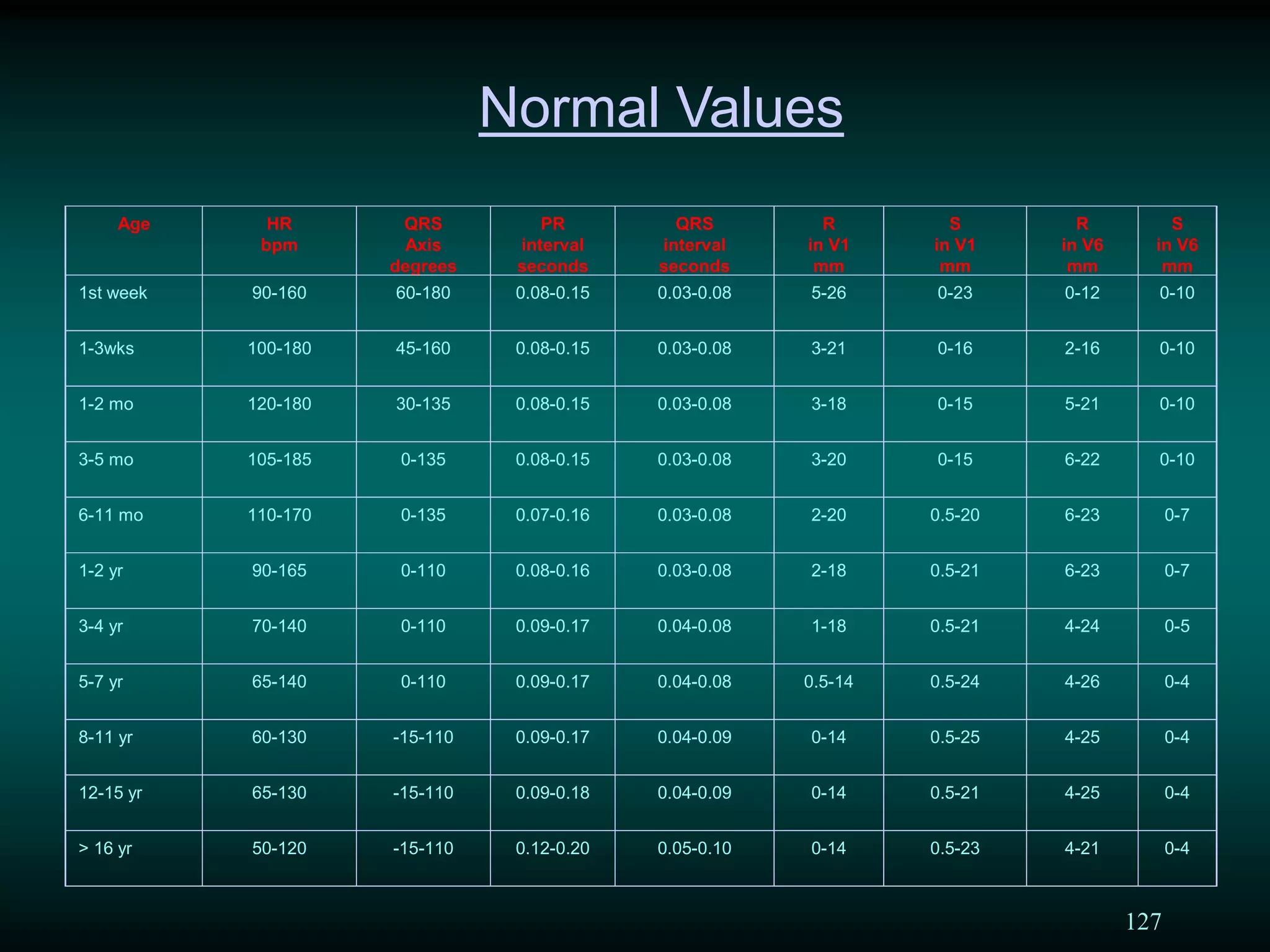
Normal Values
36
QT interval:
• the duration from the beginning of the
QRS complex to the end of the T wave
• count the number of small squares,
then multiply by 0.04 seconds, that the
QT in seconds
• Corrected QT interval
– Normal QT is determined by the HR
– QTc = QT / square root of RR interval
37
38
Reading and Interpreting
Electrocardiograms
• Age: unless the patient’s age is known, the
paediatric ECG cannot be interpreted
• Is the ECG "full standard"?
• Is the ECG "standard speed"?
• The standard speed of paper is 25 mm/sec
• Occasionally it is made to run at a double speed (50
mm/sec) in cases of tachyarrhythmia to enable the
visualization of an otherwise hidden p waves
• Additional clinical information :
• Indication
• Clinical diagnosis: cardiac and other
• Medications: cardiovascular drugs, others eg. cisapride,
tricyclics
• Electrolytes
39
Systematic reading of ECG:
1. Heart rate
2. P wave axis
3. Rhythm
4. QRS axis
5. Intervals PR, QRS, QT/QTc
6. P wave amplitude and duration
7. QRS amplitude, R/S ratio, Q waves
8. ST segments and T wave
40
Heart Rate
41
Heart Rate - Basics
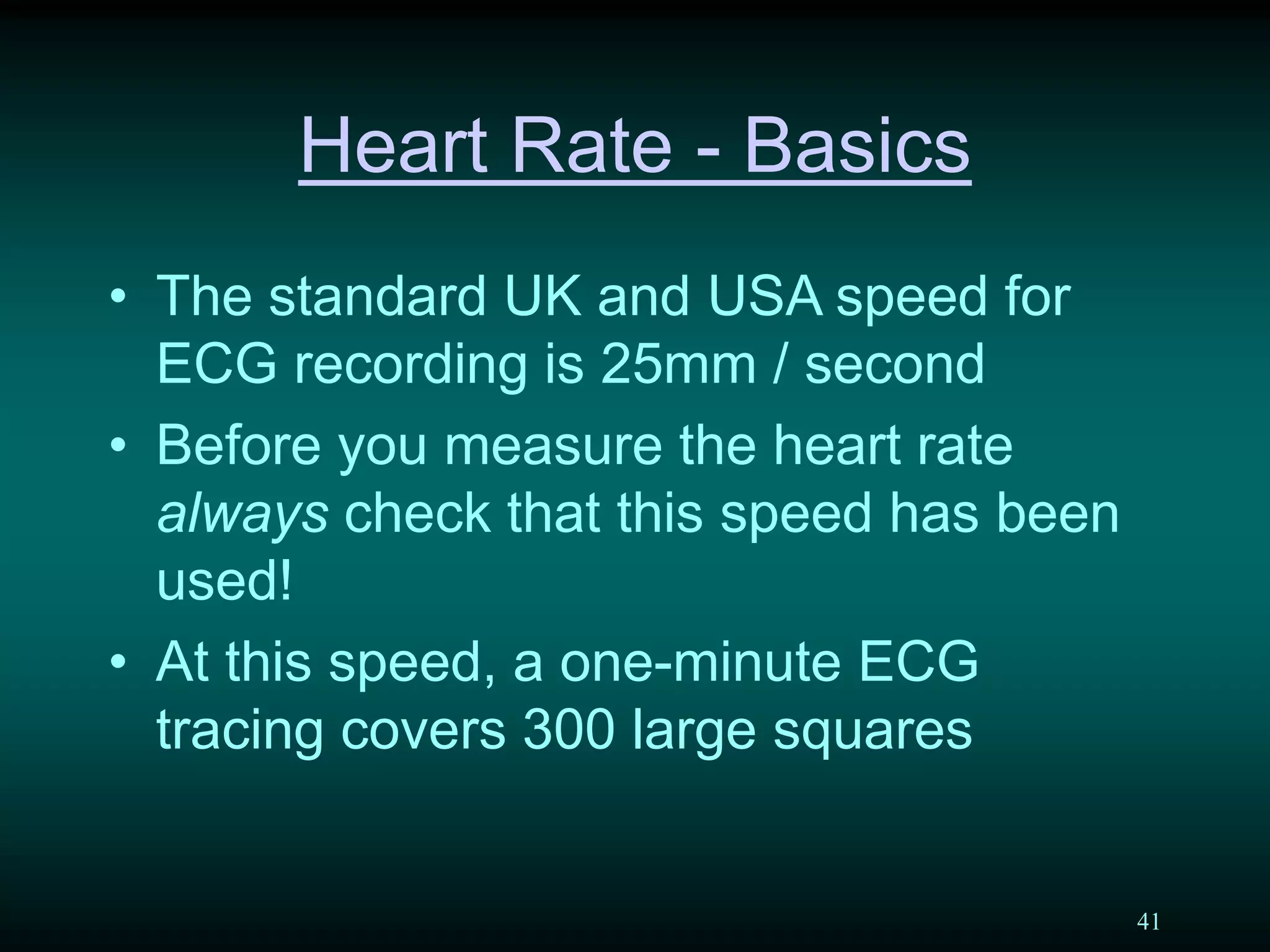
• The standard UK and USA speed for
ECG recording is 25mm / second
• Before you measure the heart rate
always check that this speed has been
used!
• At this speed, a one-minute ECG
tracing covers 300 large squares
42
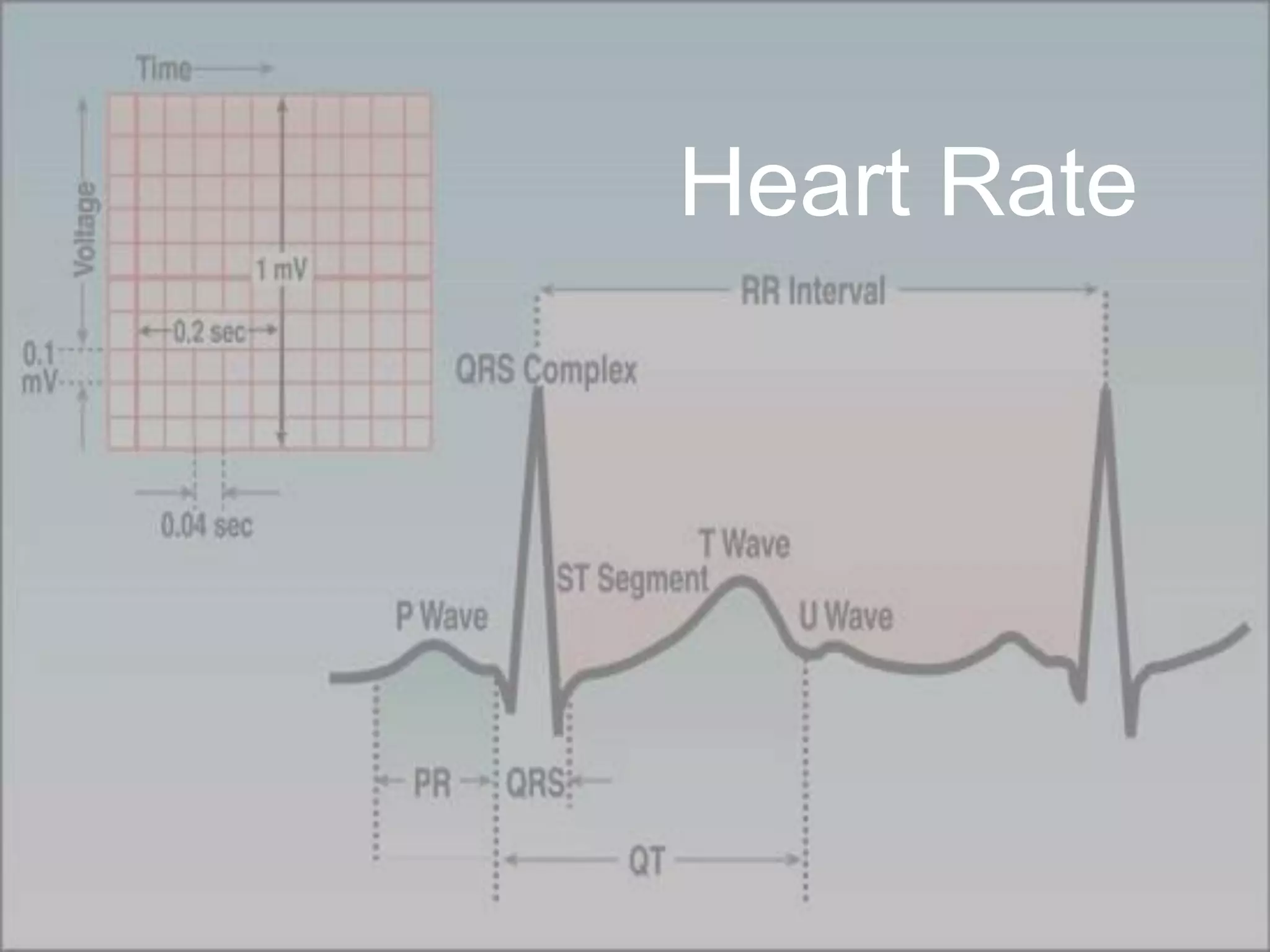
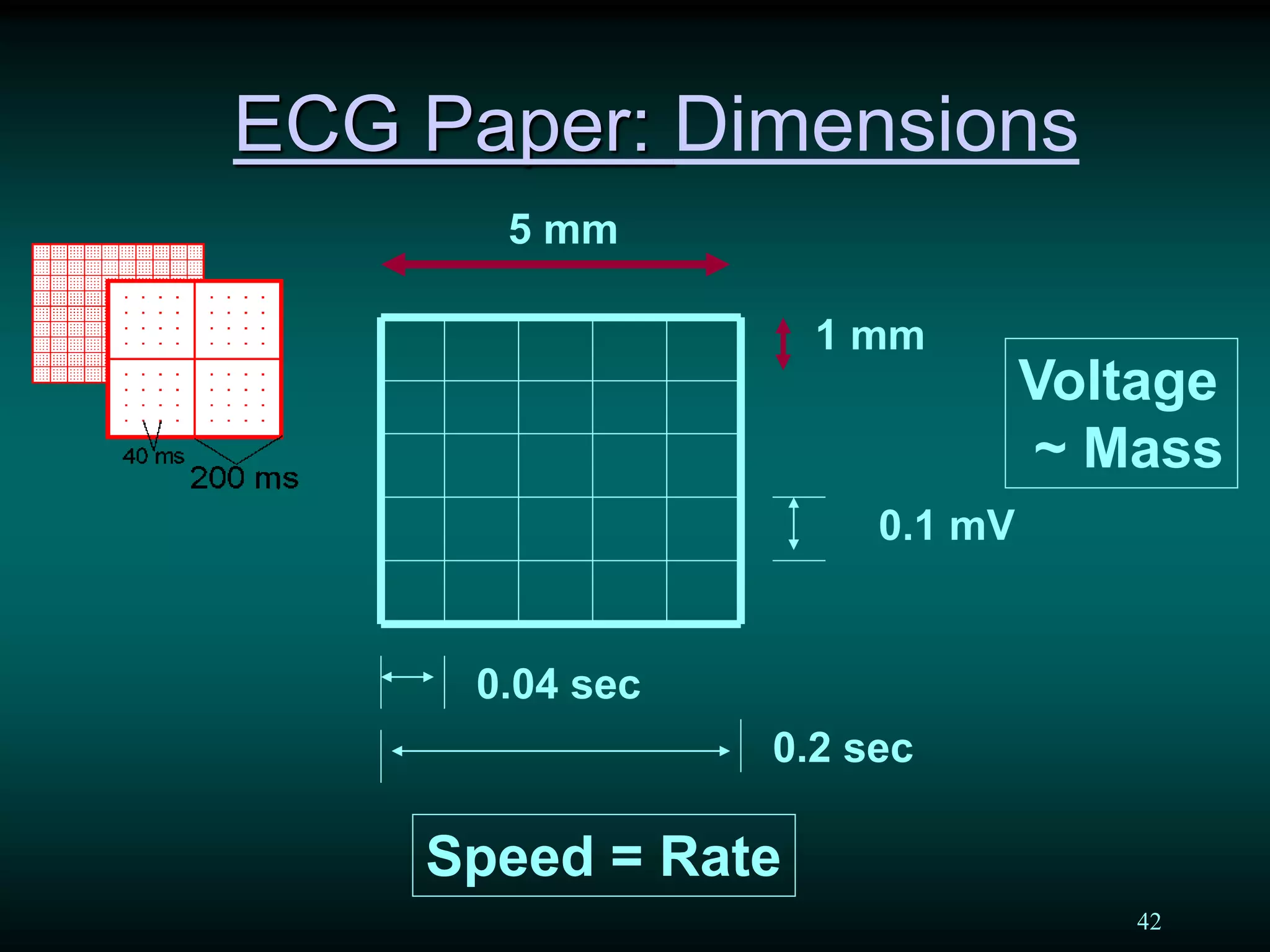
ECG Paper: Dimensions
5 mm
1 mm
0.1 mV
0.04 sec
0.2 sec
Speed = Rate
Voltage
~ Mass
43
Method 1
• Count the number of large squares
between two consecutive R waves and
divide into 300.
– Quick
– Not very accurate with fast rates
– Used ONLY with regular rhythms
44
Method 2
• Count the number of small squares
between two consecutive R waves and
divide into 1500.
– The most accurate method
– Time-consuming
– Used only with regular rhythms
45
Rhythms Arising From
the Sinoatrial Node
46
Rhythms Arising From
the Sinoatrial Node
• (Normal) sinus rhythm
• Sinus tachycardia
• Sinus bradycardia
• Sinus arrhythmia
• Sick sinus syndrome
47
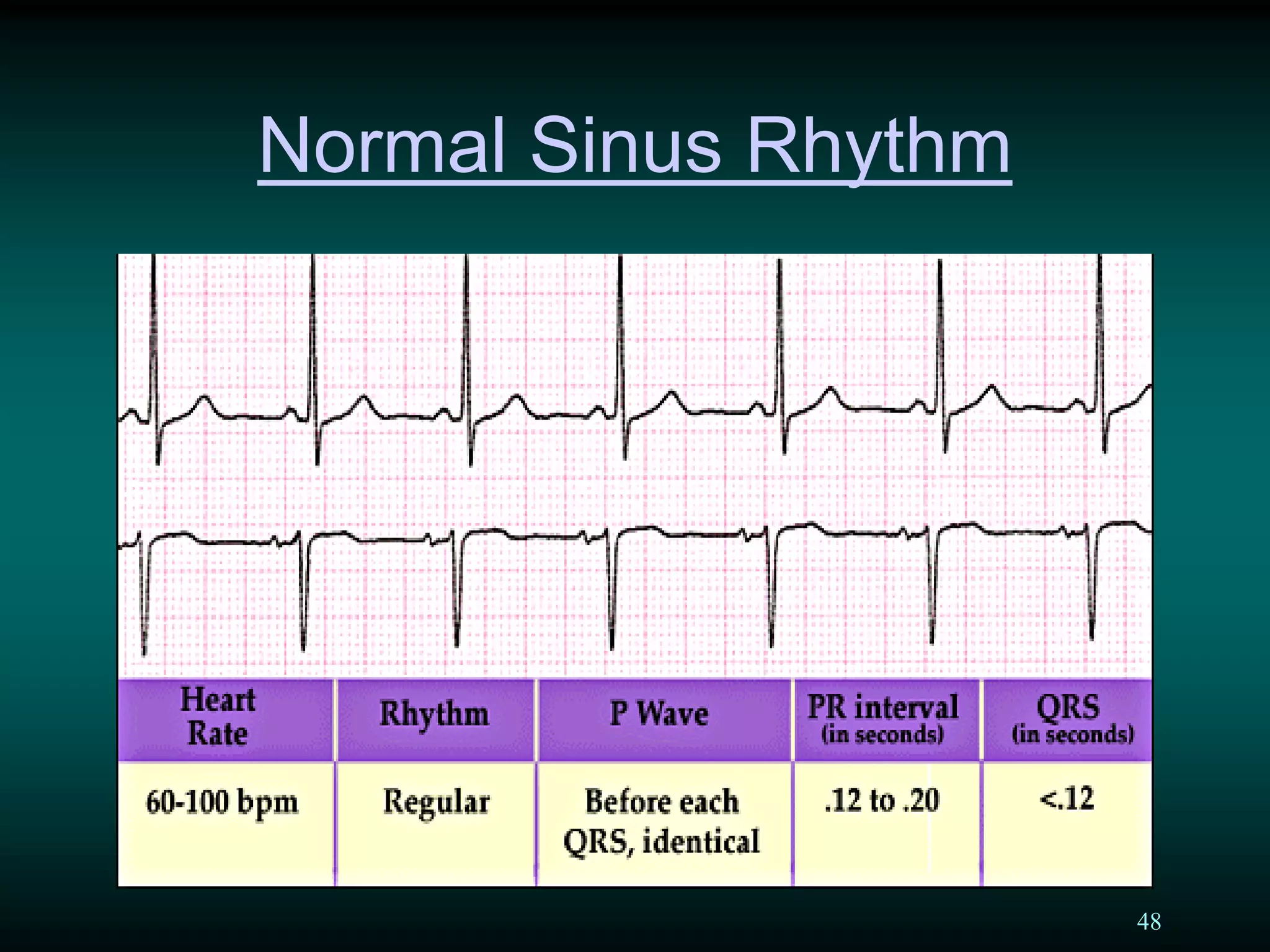
Normal Sinus Rhythm
• Sinus rhythm is the normal cardiac
rhythm
• The sinoatrial node is acting as the
natural pacemaker
• Heart rate is between 60-100 / min
• P wave upright in lead II
• PR interval 0.12 – 0.2 secs
• Each P wave followed by QRS complex
48
Normal Sinus Rhythm
49
Sinus Bradycardia
• Sinus bradycardia is sinus rhythm with a
heart rate of less than 60 / min
• P wave upright in lead II
• PR interval 0.12 – 0.2 secs
• Each P wave followed by QRS complex
• It is unusual for sinus bradycardia to be
slower than 40 / min
– Consider alternative e.g. Heart block
50
Sinus Bradycardia
51
Sinus Bradycardia & Escape
Beats
• If sinus bradycardia is severe, escape
beats or rhythms may occur
• While these beats and rhythms may
look abnormal, they are protective
mechanisms
52
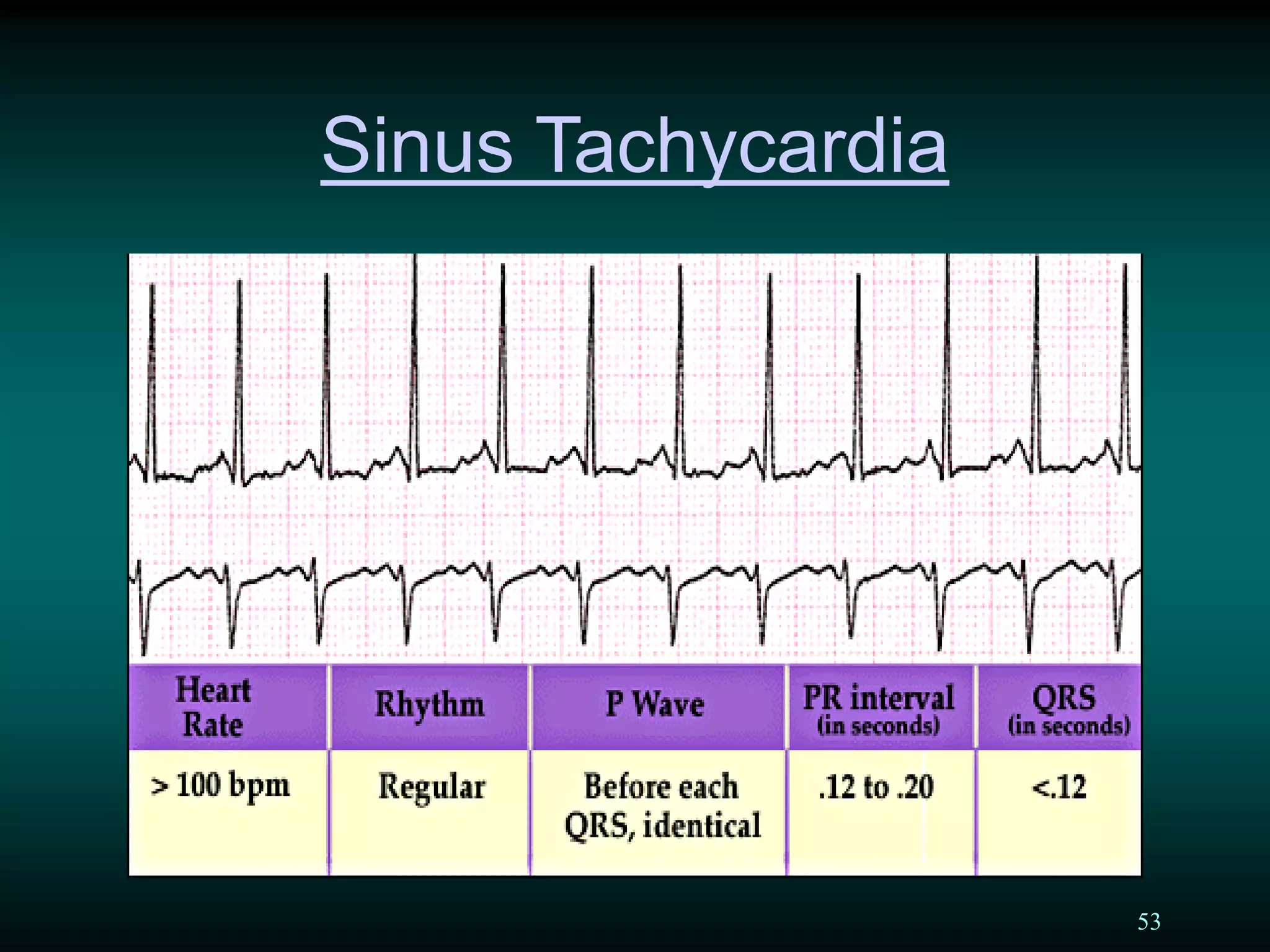
Sinus Tachycardia
• Sinus tachycardia is sinus rhythm with a heart
rate of more than 100 / min
• P wave upright in lead II
• PR interval 0.12 – 0.2 secs
• Each P wave followed by QRS complex
• Unusual for sinus tachycardia to be faster
than 180 beats / min, except in fit athletes
– Consider alternative eg. Nodal tachycardia
53
Sinus Tachycardia
54
Sinus Arrhythmia
• Sinus arrythmia is the variation of heart
rate seen with inspiration & expiration
• Each P wave followed by QRS complex
• Uncommon in age over 40 years
• Harmless
• Cause: heart rate increases during
inspiration as reflex response to more
blood returning to heart
55
Sinus Arrhythmia
56
Sick Sinus Syndrome
• This refers to a collection of impulse
generation and conduction problems related
to the sinus node
• Any or all of the following may be seen:
– Sinus bradycardia
– Sinus arrest
– Sinoatrial block
• May be associated with paroxysmal
tachycardias (“tachy–brady syndrome”)
57
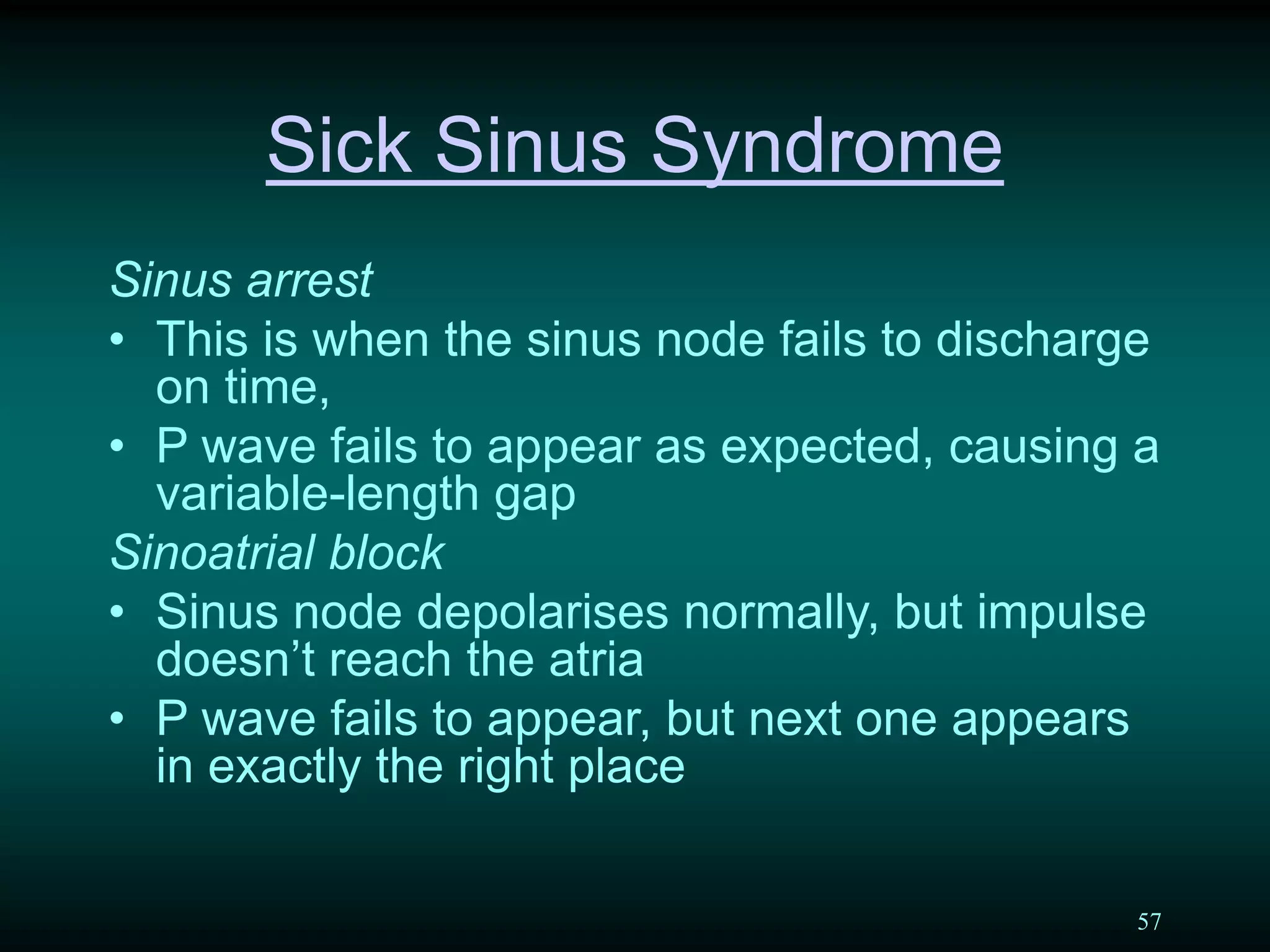
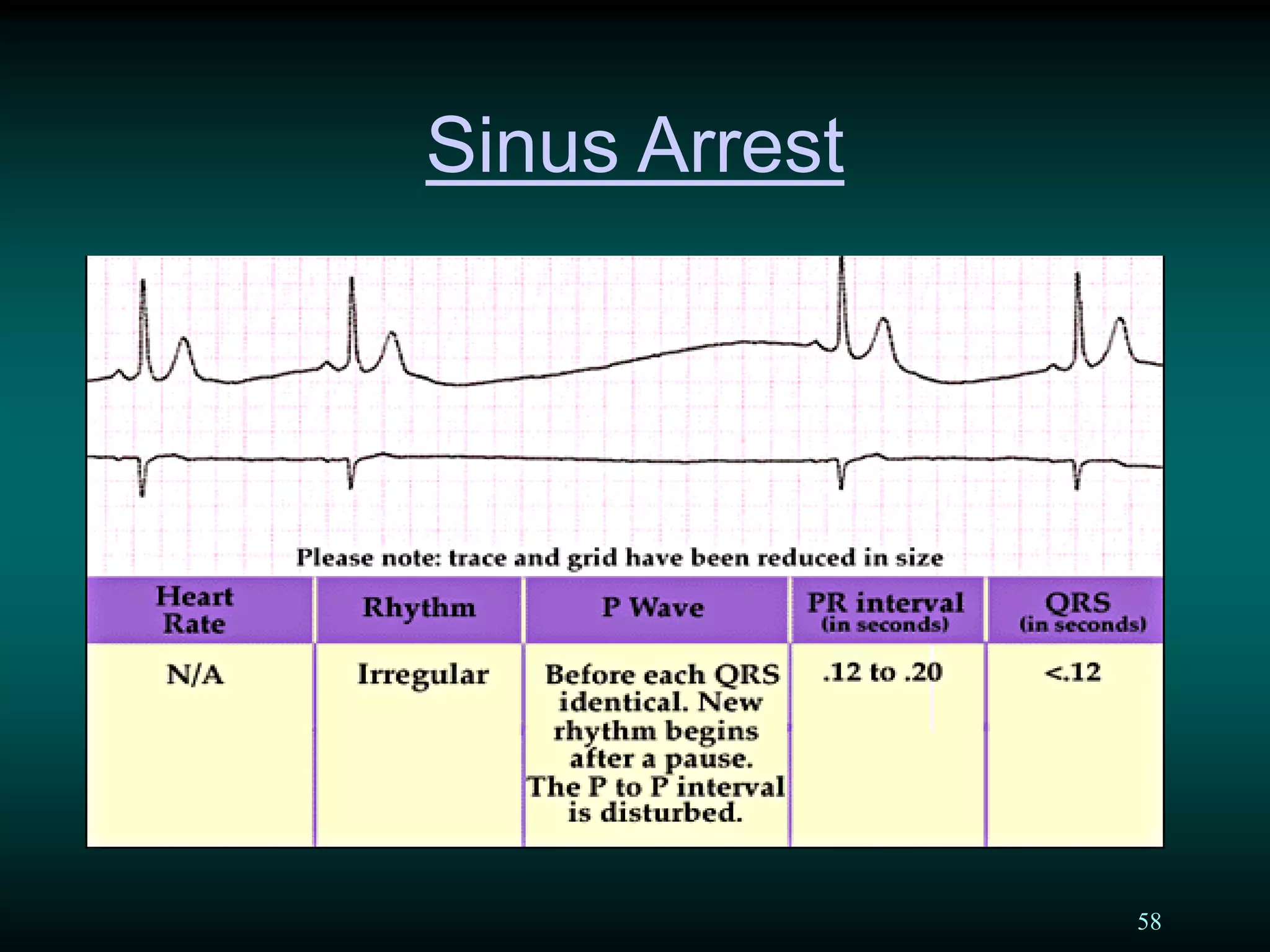
Sick Sinus Syndrome
Sinus arrest
• This is when the sinus node fails to discharge
on time,
• P wave fails to appear as expected, causing a
variable-length gap
Sinoatrial block
• Sinus node depolarises normally, but impulse
doesn’t reach the atria
• P wave fails to appear, but next one appears
in exactly the right place
58
Sinus Arrest
Ectopics & Escape Beats:
60
Ectopics
• The word “ectopic” implies “outside”
– (eg. ectopic pregnancy outside the uterus)
• Ectopic beats therefore could be defined as
beats arising from outside the normal cardiac
conduction pathway ie. not starting at the
sinoatrial node
• Ectopic beats are also called:
– Extrasystoles
– Premature beats (or complexes)
61
Ectopics
• Ectopic beats appear earlier than the
next expected beat
• They can arise from any region of the
heart, but are normally classified into:
– Atrial
– AV junctional
– Ventricular
62
Ectopics
• Ectopic beats may occur as:
– Isolated single beats
– Multiple beats
– The dominant rhythm (usually defined as
three or more successive ectopic beats)
having “taken over” from the SA node
63
Cardiac Conduction System:
Inherent Rates
Sino-Atrial (SA) Node:
• 60-100 / min
Atrioventricular (AV) Node:
• 40-60 / min.
Ventricles:
• 20-40 / min.
Escape rhythms generated by the AV node and
ventricles will therefore be at the above
respective rates
64
Beats & Rhythms Arising From
the Atria
• Atrial ectopics
• Atrial tachycardia
• Atrial flutter
• Atrial fibrillation
65
Atrial Ectopics
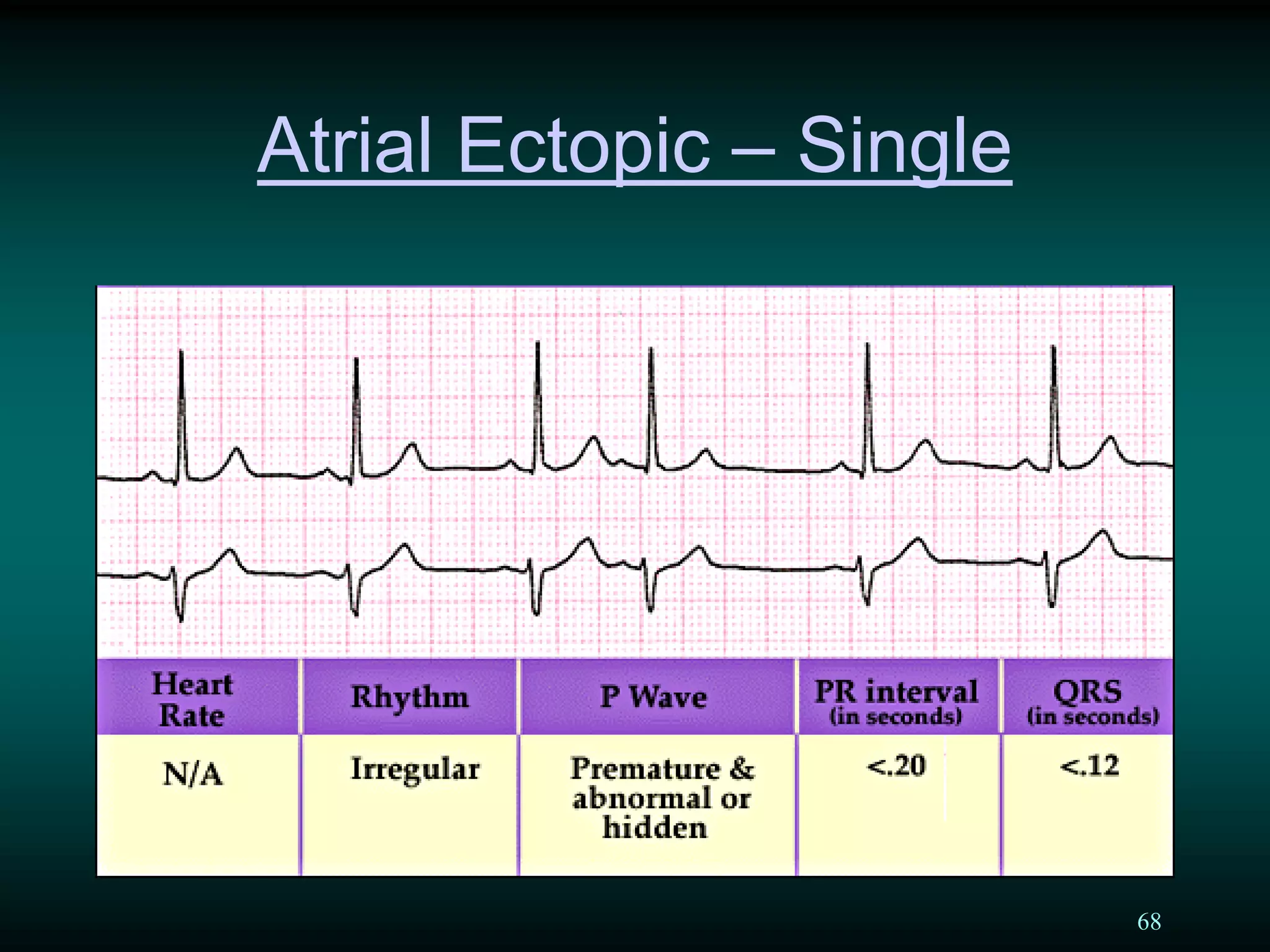
• Atrial ectopics are identified by a P wave
which appears earlier than expected and has
an abnormal shape
• They will usually be conducted through to the
ventricles giving a QRS complex
– A normal QRS complex meaning normal
ventricular conduction
– Wide (>0.12 sec or 3 small squares) QRS
complex indicating aberrant ventricular conduction
66
Atrial Ectopics
• Atrial ectopics are also known as:
– Premature atrial complexes (PAC’s)
– Atrial extrasystoles
• They may occur as:
– Isolated single beats
– Two beats together (a pair or couplet)
– As a run of ectopics (ie. more than 3) becoming a
tachycardia
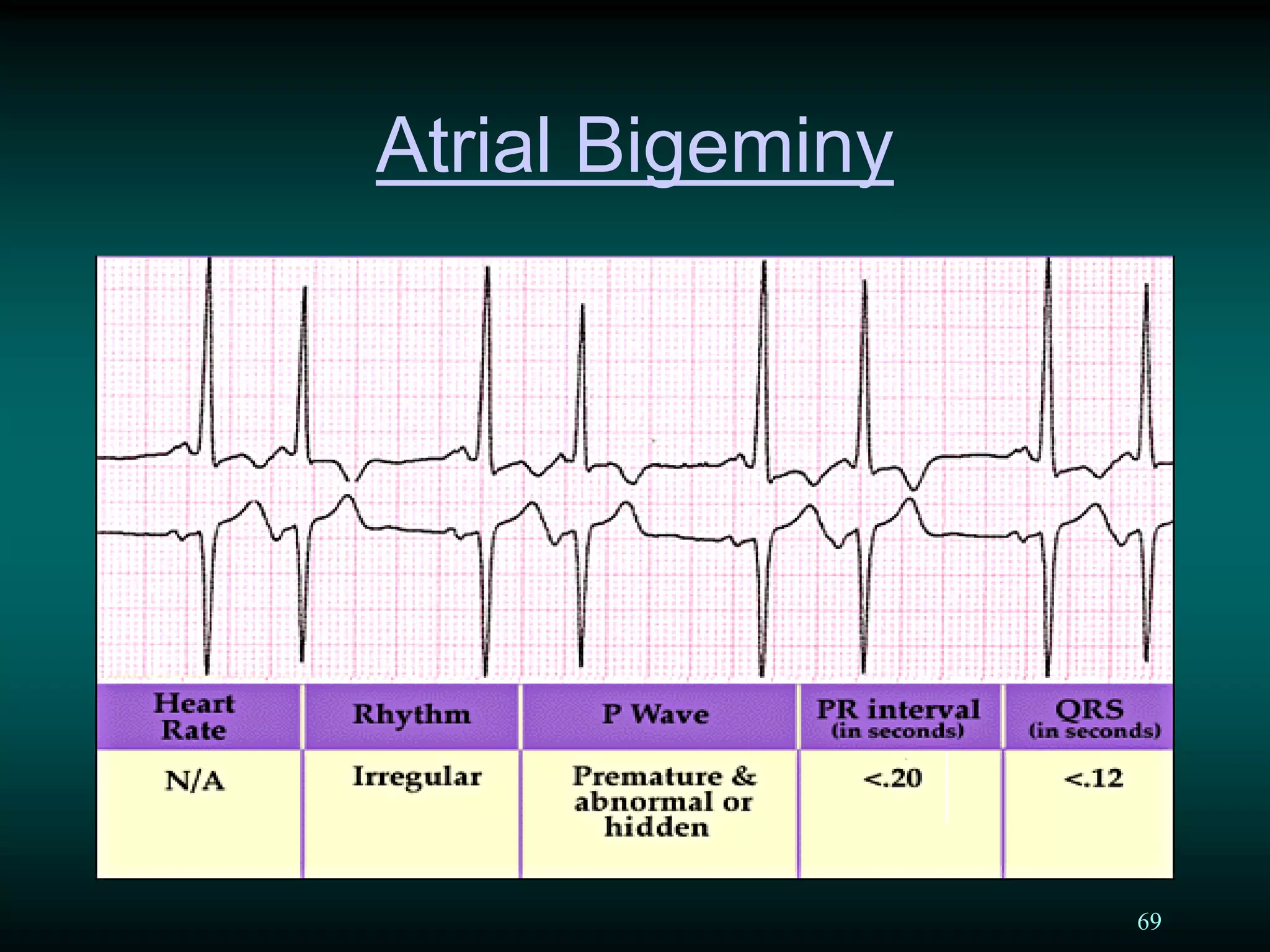
– One ectopic for every sinus beat (bigeminy)
67
Atrial Ectopics
• Atrial ectopics may all arise from the
same focus in the atria (unifocal)
– All the abnormal P waves would look the
same
• Atrial ectopics may arise from different
foci in the atria (multifocal)
– Abnormal P waves would vary in shape
68
Atrial Ectopic – Single
69
Atrial Bigeminy
70
Atrial Tachycardia
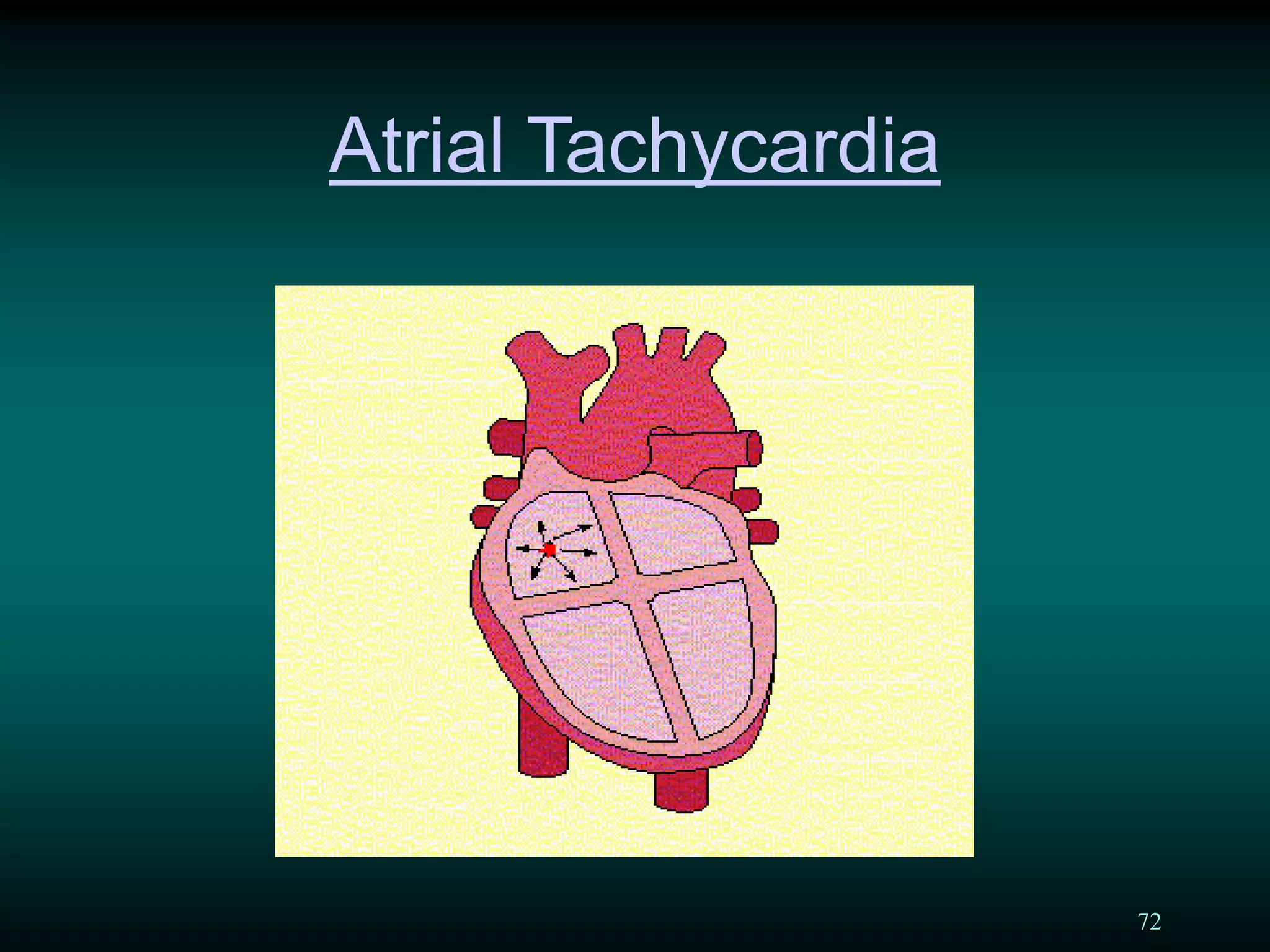
• Atrial tachycardia is a tachycardia
originating from impulses generated in
the atrial myocardium
– From an ectopic focus
– Via a “re-entry” mechanism
• Characteristics:
– Heart rate greater than 100 / min
– Abnormally shaped P waves
71
Atrial Tachycardia
• Atrial (P wave) rate is usually 120-250 /
min
• Above atrial rates of 200 / min, the AV
node struggles to keep up with
conduction so AV block may occur
72
Atrial Tachycardia
73
Atrial Flutter
• Differs from atrial tachycardia in that the atrial
(P wave) rate is higher
• Results from:
– Either an ectopic focus
– Or depolarization circling the atrium (“Circus
Movement”)
• Atrial rate is usually 250-350 / min, but often
almost exactly 300 / min
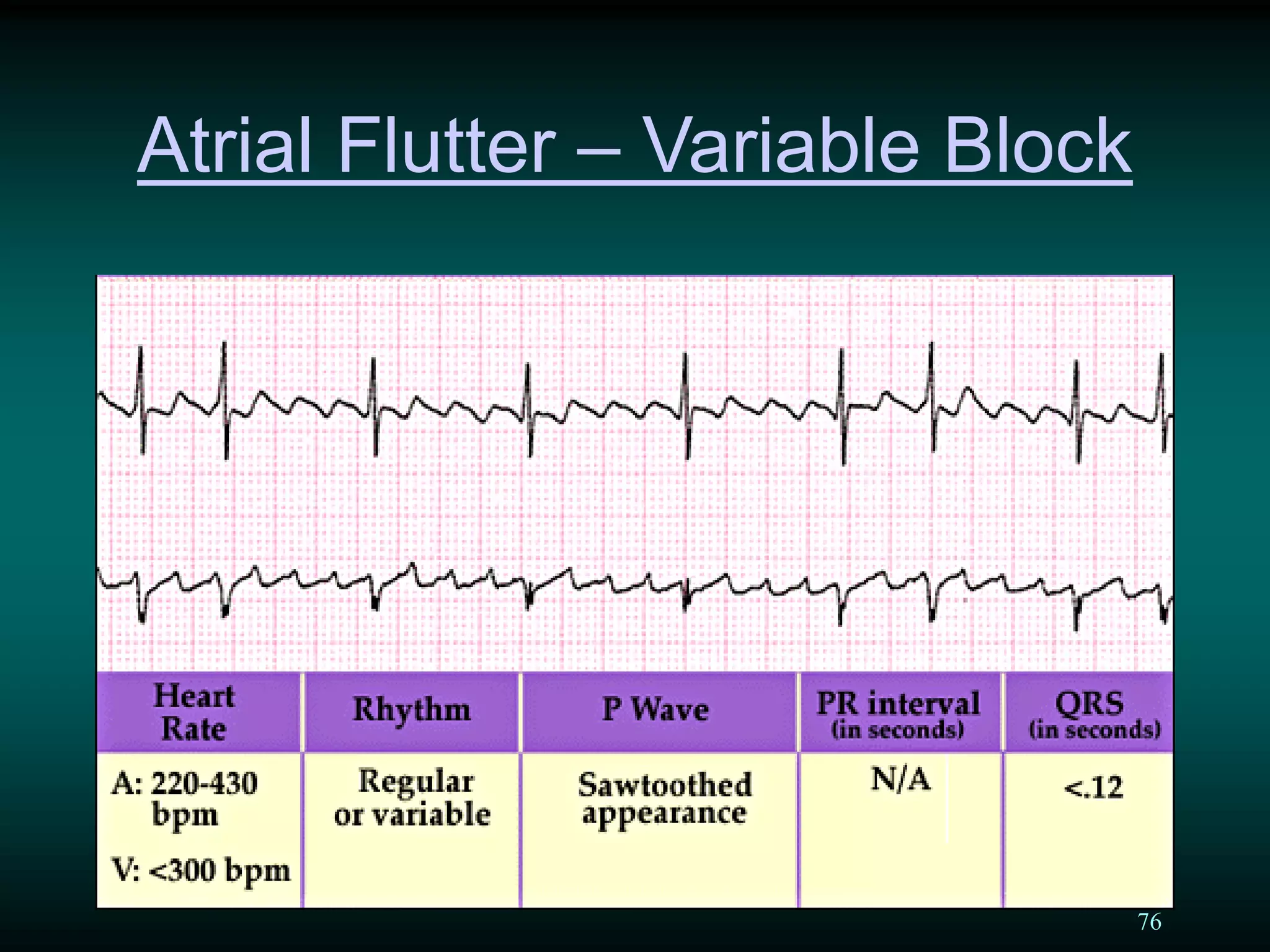
• The rapid rate gives it a classic “sawtooth”
appearance
74
Atrial Flutter
• AV node cannot keep up with that rate,
so AV block occurs
• Most common is 2:1 block, giving
ventricular rate of around 150 / min
• 3:1 = ventricular rate of 100 / min
• 4:1 = ventricular rate of  75 / min
• AV block may also be variable
75
Atrial Flutter
76
Atrial Flutter – Variable Block
77
Atrial Fibrillation
• Much more common than atrial flutter
• Affects 5-10% of elderly people
• Can be permanent
• May be transient or paroxysmal –
particularly in younger people
• Caused by rapid, chaotic depolarisation
of the atria (350 - 650 impulses / min)
78
Atrial Fibrillation
• Characteristics:
– No P waves seen
– Baseline consists of high frequency, low amplitude
oscillations (fibrillation or “f” waves)
– Conduction through AV node is erratic, therefore
ventricular (QRS) rate is irregular (often described
as “irregularly irregular”)
– Ventricular rate usually  120 – 180 / min
• Unless patient medicated eg. digoxin
79
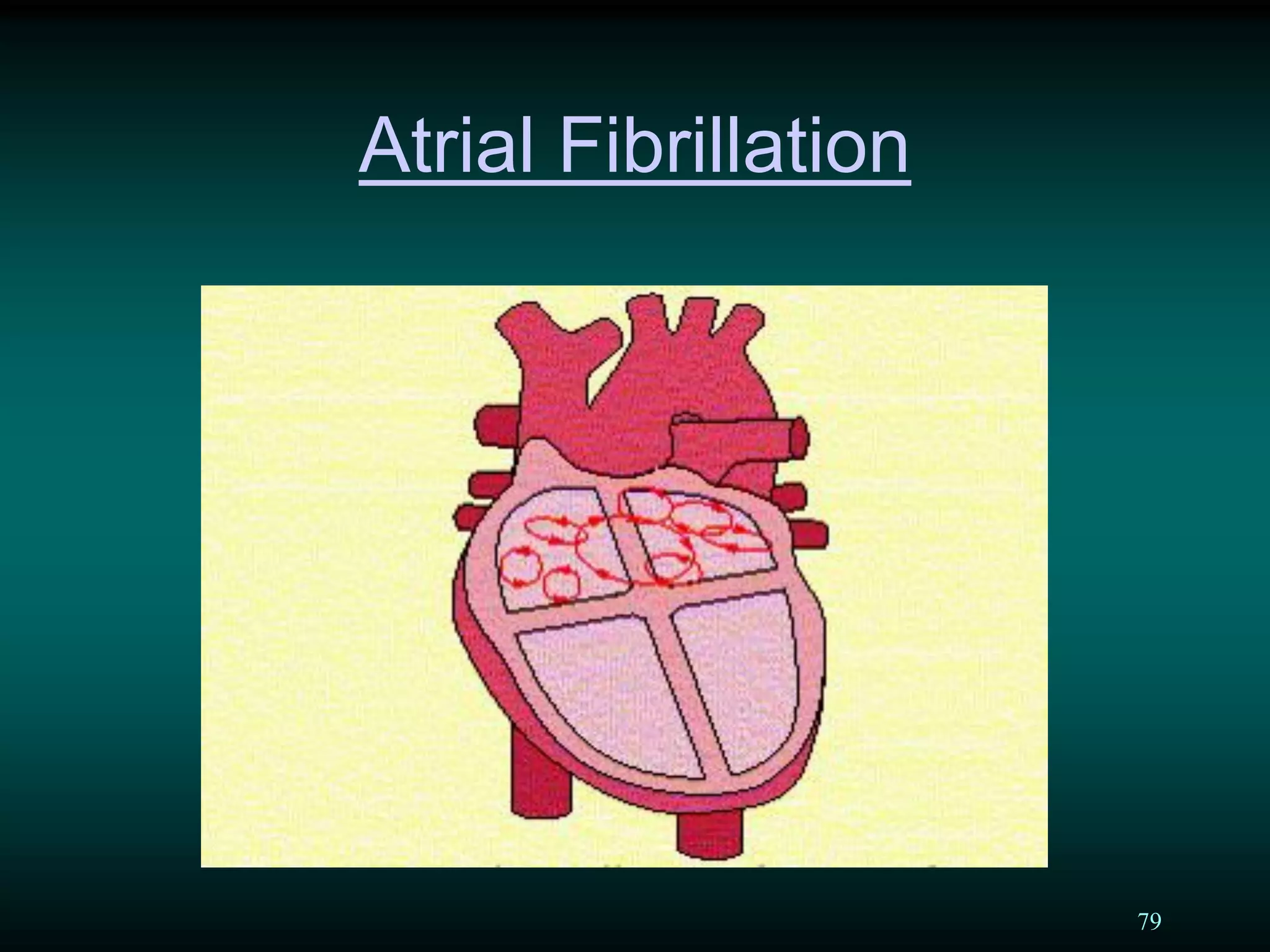
Atrial Fibrillation
80
Atrial Fibrillation
81
• The term “supraventricular tachycardia”
(SVT) is frequently misused
• Literally, it refers to any heart rhythm over
over 100 / min that originates above the
ventricles, including:
– Sinus tachycardia
– Atrial fibrillation
– Atrial tachycardia
– AV re-entry tachycardia
Supraventricular Tachycardia
(SVT)
82
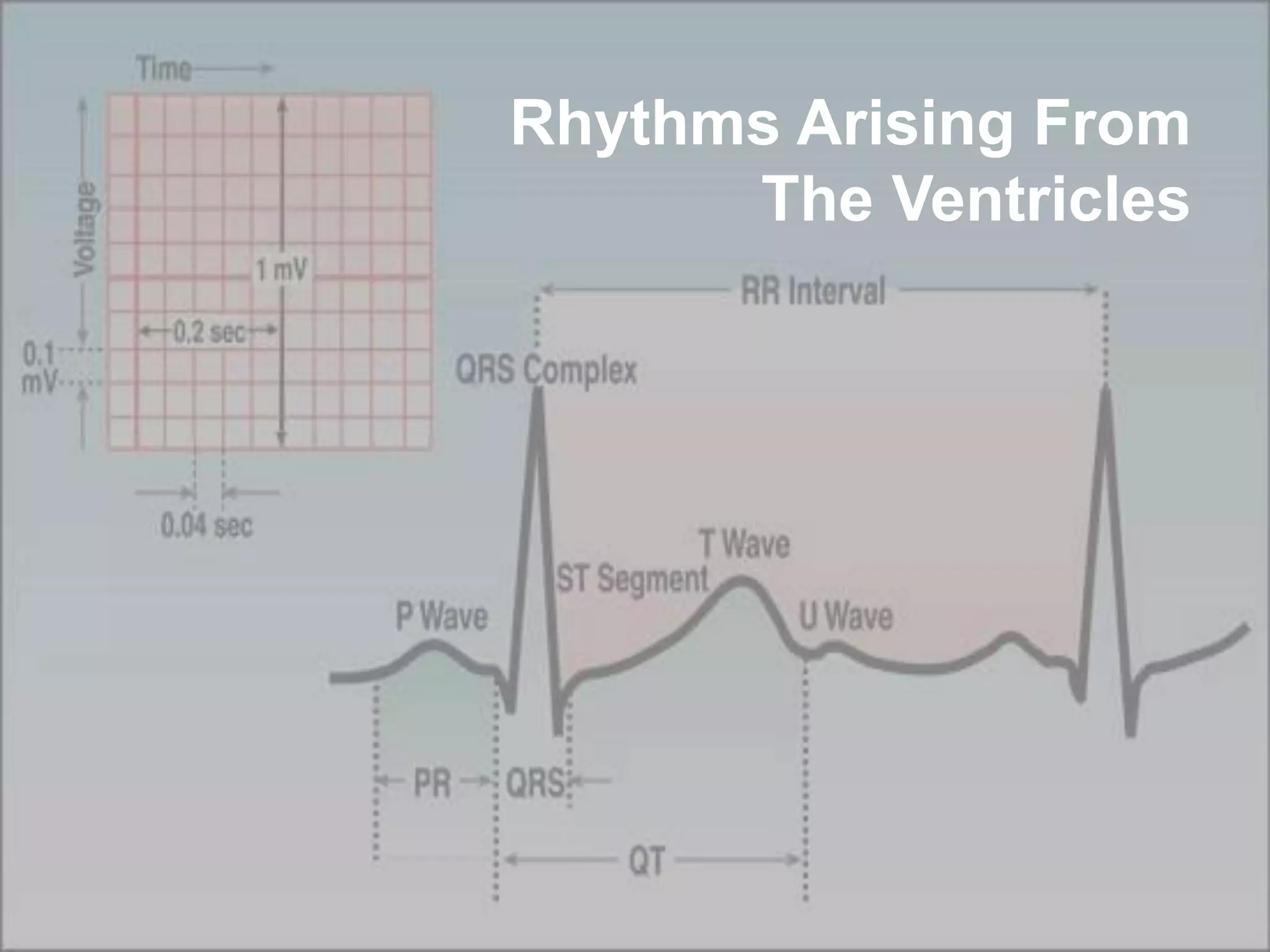
Rhythms Arising From
The Ventricles
83
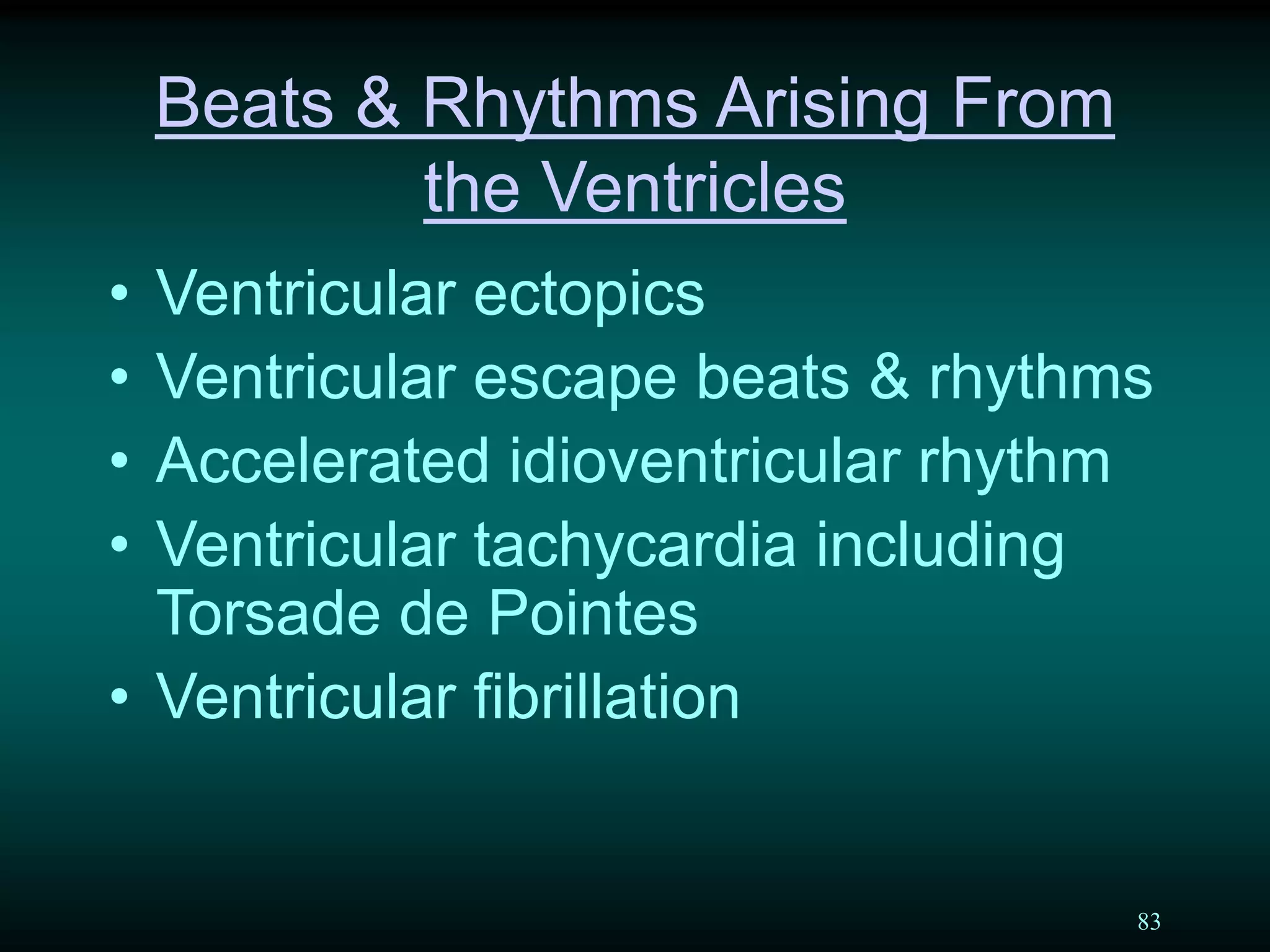
Beats & Rhythms Arising From
the Ventricles
• Ventricular ectopics
• Ventricular escape beats & rhythms
• Accelerated idioventricular rhythm
• Ventricular tachycardia including
Torsade de Pointes
• Ventricular fibrillation
84
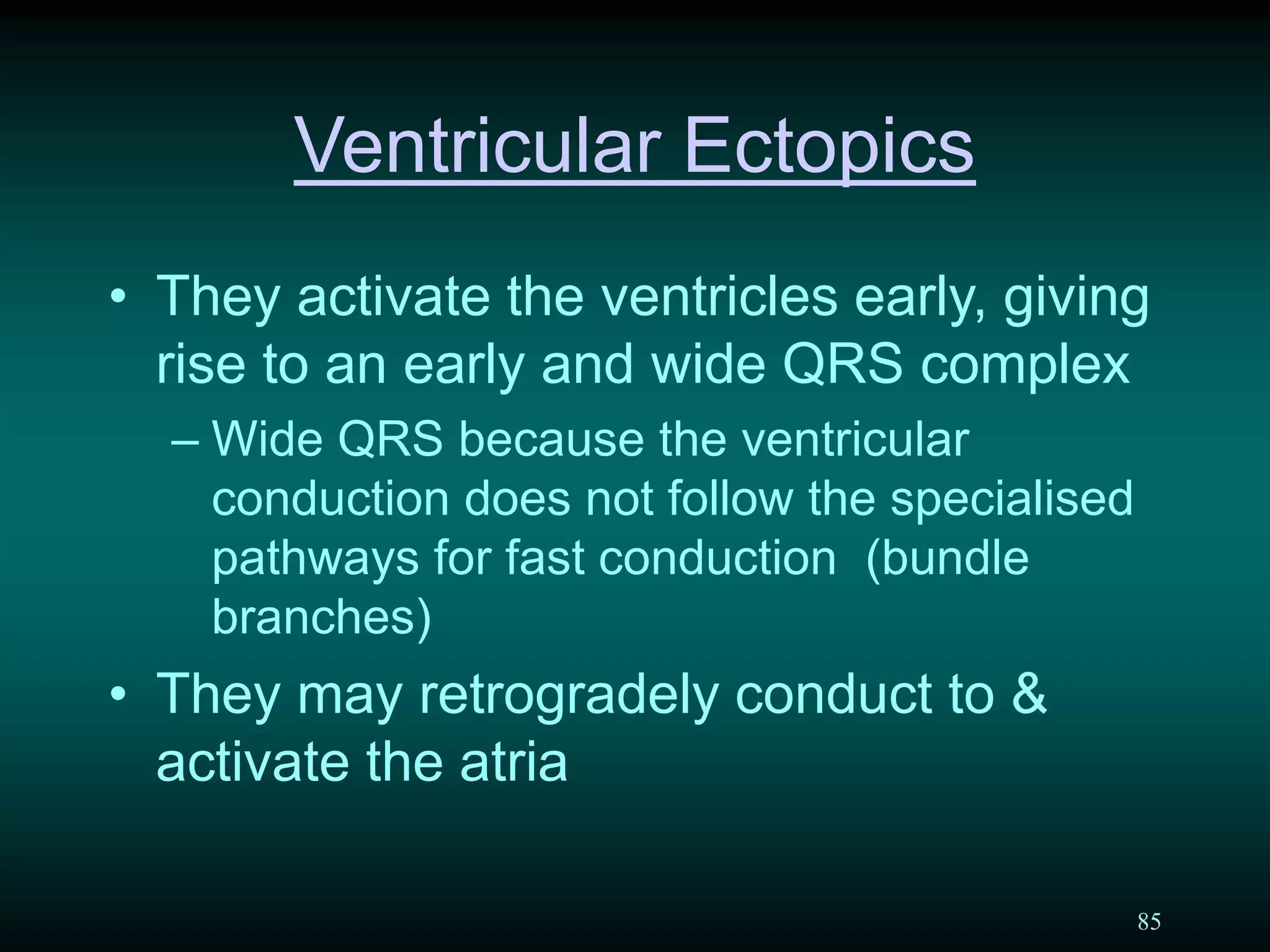
Ventricular Ectopics
• Ventricular ectopics are also known as:
– Premature ventricular complexes (PVC’s)
– Ventricular extrasystoles
• They may occur as:
– Isolated single beats
– Two beats together (a pair or couplet)
– As a run of ectopics (ie. more than 3) becoming a
tachycardia
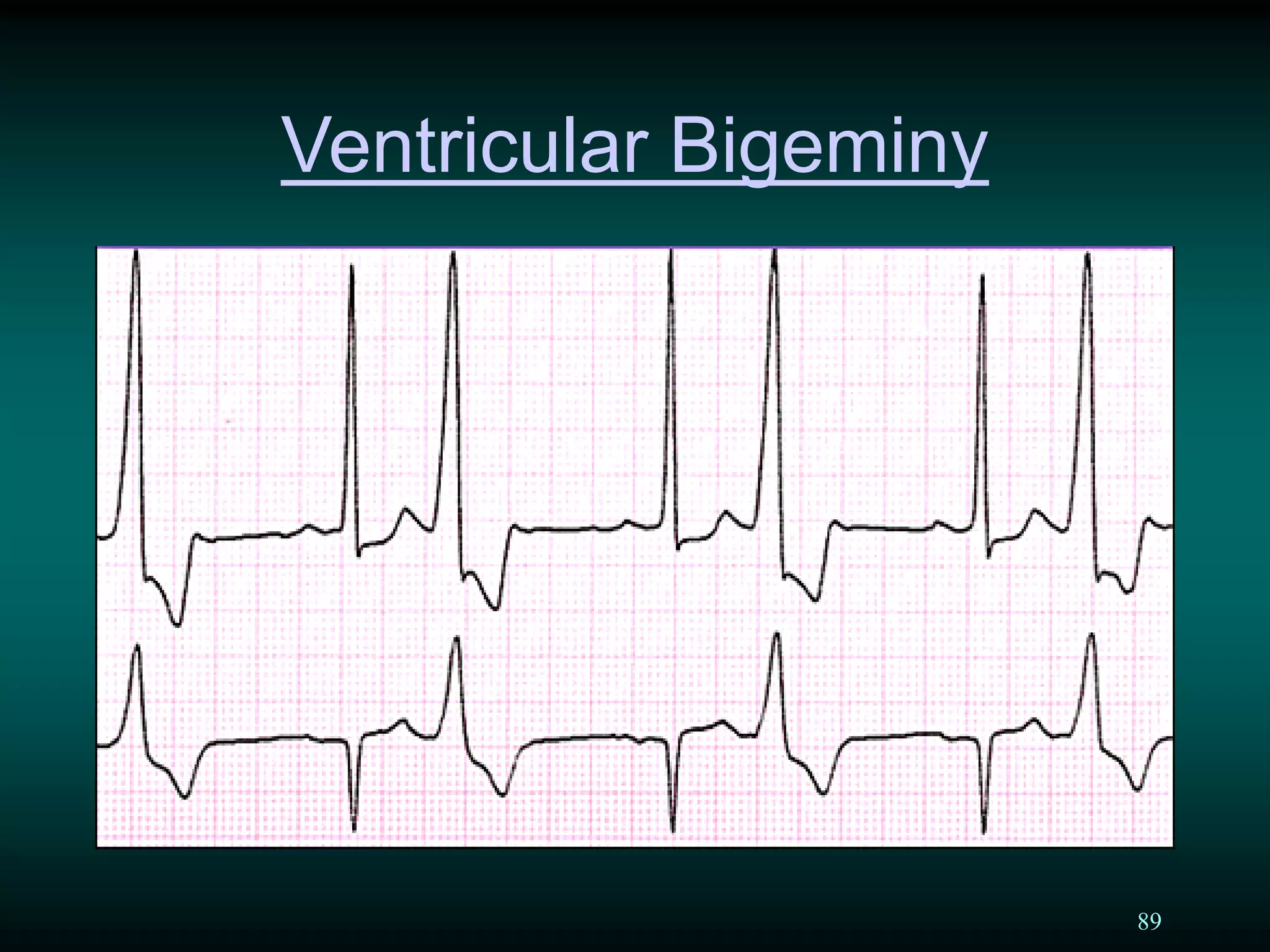
– One ectopic for every sinus beat (bigeminy)
85
Ventricular Ectopics
• They activate the ventricles early, giving
rise to an early and wide QRS complex
– Wide QRS because the ventricular
conduction does not follow the specialised
pathways for fast conduction (bundle
branches)
• They may retrogradely conduct to &
activate the atria
86
Ventricular Ectopics
• Characteristics:
– Early & wide QRS complex
– Compensatory pause
– No P wave (or inverted P wave)
• Ventricular ectopics may:
– All look the same if there is just one ectopic
focus (unifocal)
– Vary in morphology if there is more than
one ectopic focus (multifocal)
87
Ventricular Ectopics - Unifocal
88
Ventricular Ectopics - Multifocal
89
Ventricular Bigeminy
90
Ventricular Ectopics:
The “R-on-T” Phenomenon
91
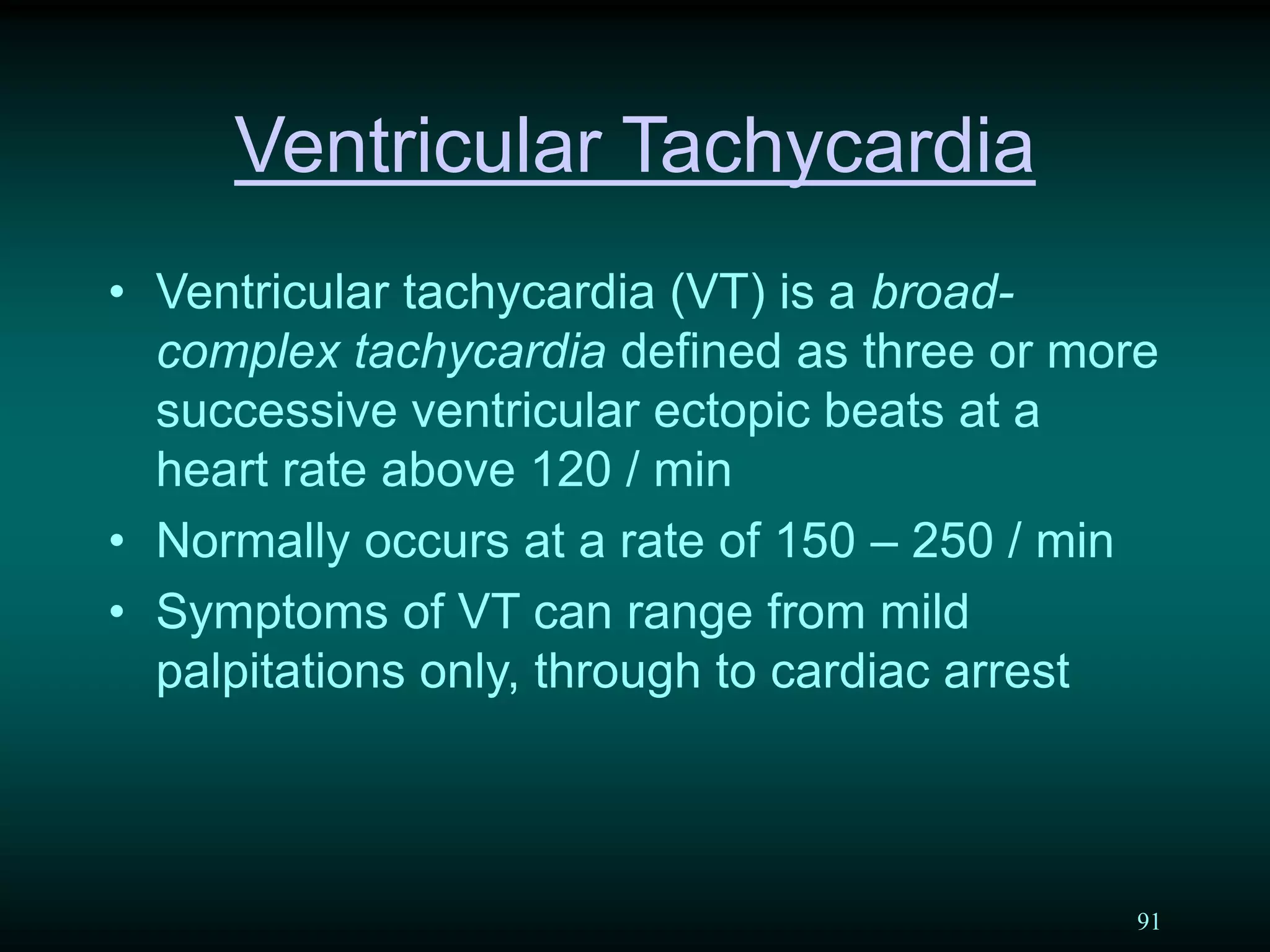
Ventricular Tachycardia
• Ventricular tachycardia (VT) is a broad-
complex tachycardia defined as three or more
successive ventricular ectopic beats at a
heart rate above 120 / min
• Normally occurs at a rate of 150 – 250 / min
• Symptoms of VT can range from mild
palpitations only, through to cardiac arrest
92
Ventricular Tachycardia
Ventricular tachycardia may be described
as:
• Monomorphic
– Where all the ventricular complexes look
the same
• Polymorphic
– Where the ventricular complexes vary in
morphology (eg. Torsade de Pointes)
93
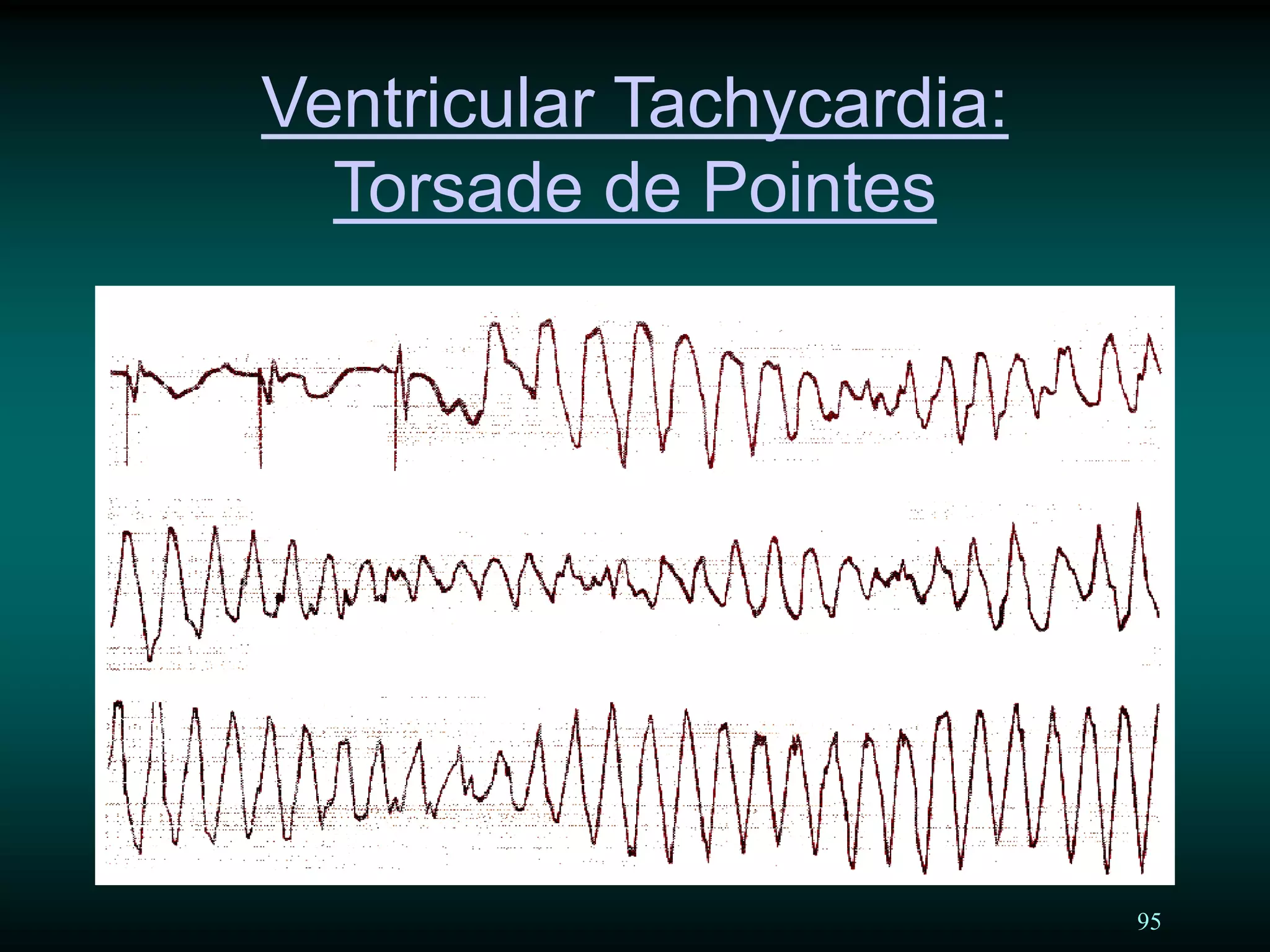
Ventricular Tachycardia:
Torsade de Pointes
• Torsade de Pointes is a polymorphic
variant of VT associated with a long QT
interval
• Can cause significant haemodynamic
disturbance, and can also precipitate
ventricular fibrillation
• Establishing the cause of the long QT
interval is very important in its treatment
94
Ventricular Tachycardia:
Monomorphic
95
Ventricular Tachycardia:
Torsade de Pointes
96
“Broad Complex Tachycardias”
(Not everything that looks like
VT is VT!)
97
“Broad Complex
Tachycardias”
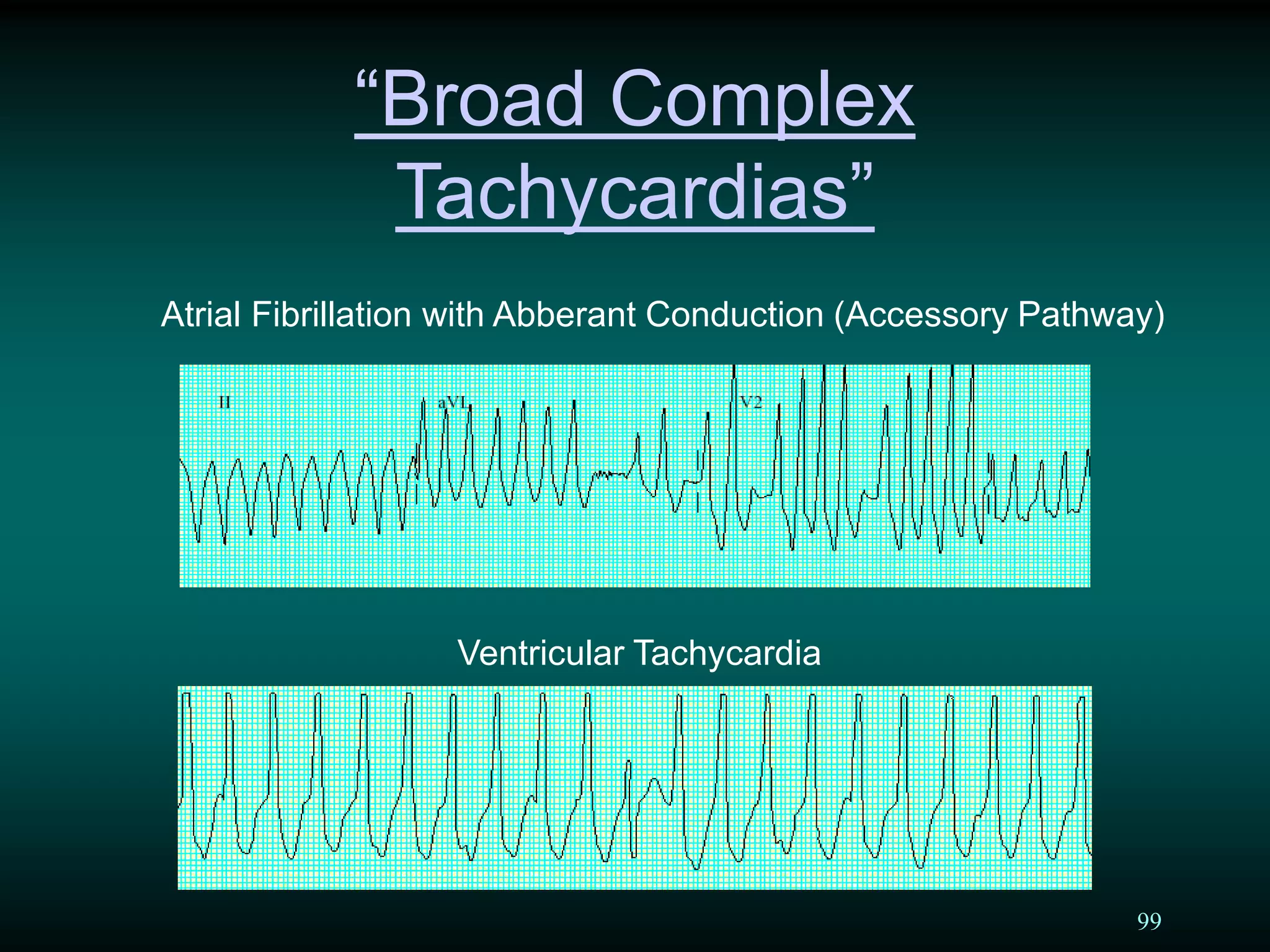
• Broad complex tachycardias are often
ventricular tachycardia
• However, sometimes supraventricular (ie
arising from above the ventricles) rhythms
can produce broad complexes if there is
abberant conduction (e.g. bundle branch
block or an accessory pathway)
98
“Broad Complex
Tachycardias”
• Distinguishing between VT and SVT
with abberant conduction is not always
easy (even if you are a cardiologist!)
• It is important, however, to tell the
difference for correct management
• Luckily, in an emergency – both can be
treated with DC shock!
99
“Broad Complex
Tachycardias”
Atrial Fibrillation with Abberant Conduction (Accessory Pathway)
Ventricular Tachycardia
100
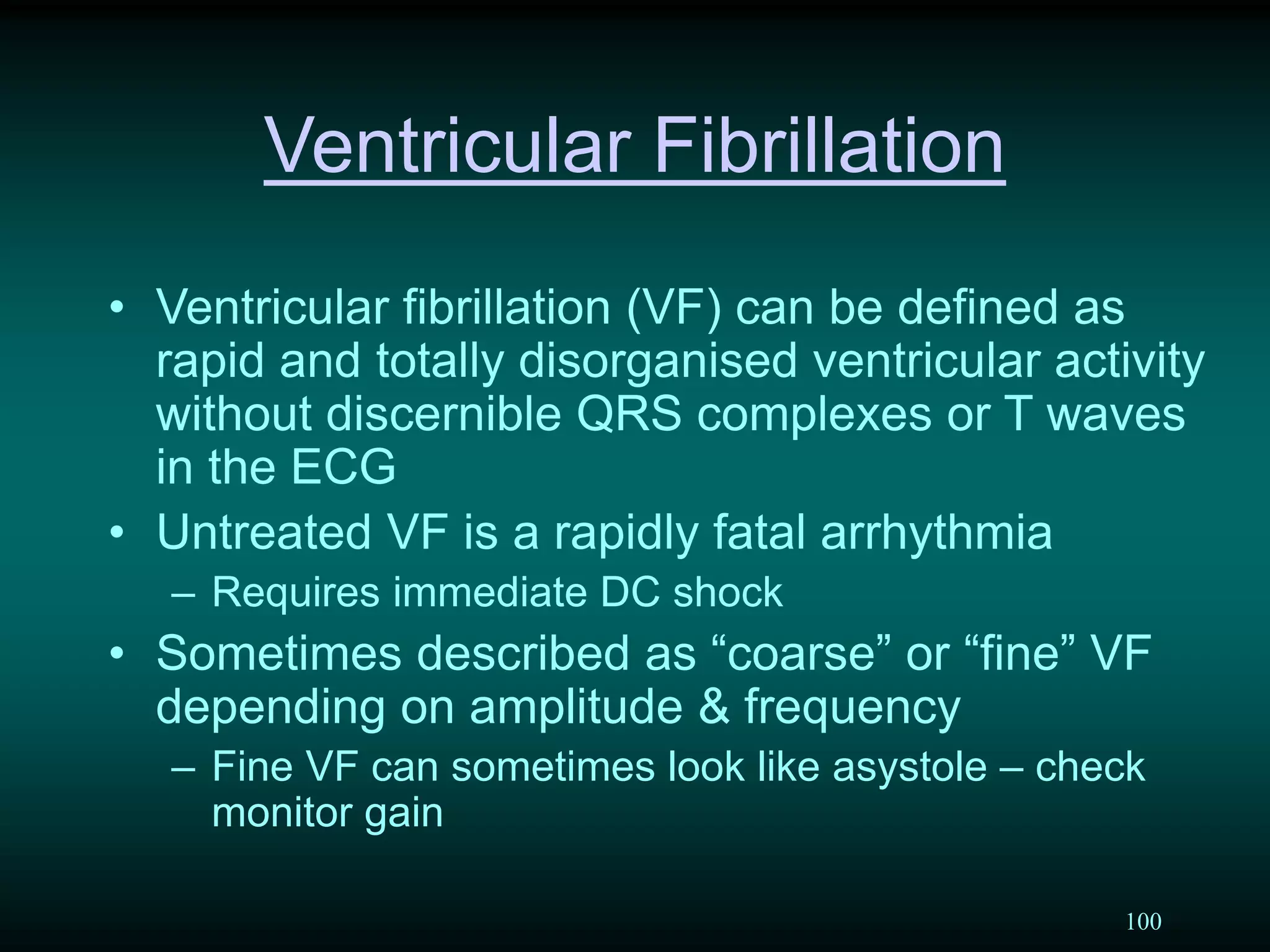
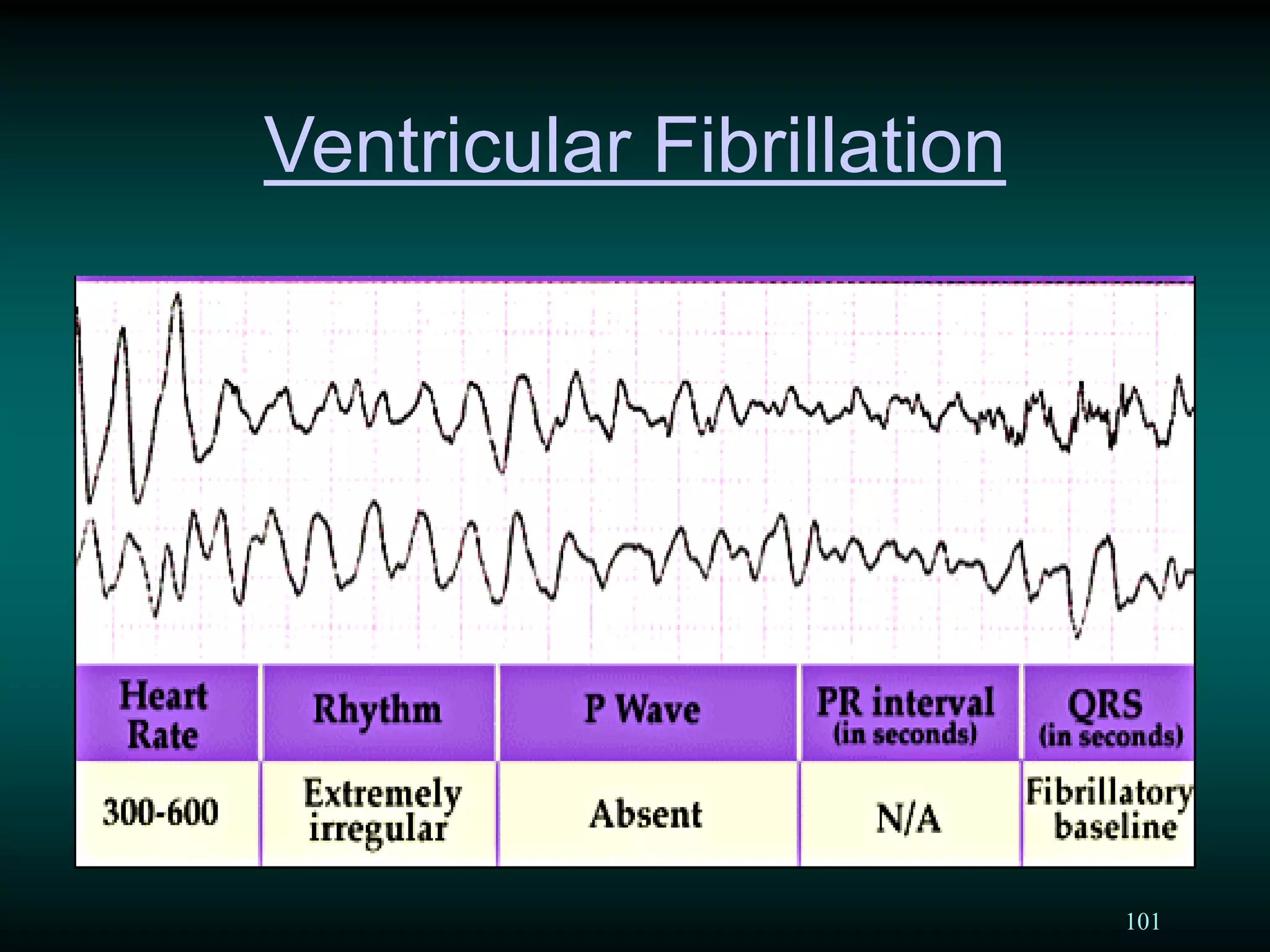
Ventricular Fibrillation
• Ventricular fibrillation (VF) can be defined as
rapid and totally disorganised ventricular activity
without discernible QRS complexes or T waves
in the ECG
• Untreated VF is a rapidly fatal arrhythmia
– Requires immediate DC shock
• Sometimes described as “coarse” or “fine” VF
depending on amplitude & frequency
– Fine VF can sometimes look like asystole – check
monitor gain
101
Ventricular Fibrillation
102
Asystole
• Asystole implies the absence of
ventricular activity
• P waves may still be seen (P wave
asystole or “ventricular standstill”)
• Characterised by a flat(tish) line
– Don’t forget a completely straight line is
often a loose lead
– Clue – check the patient!!
103
Asystole
104
“Heart Block”
(Or to be more correct Atrioventricular Block!)
105
Atrioventricular (AV) Block
• Atrioventricular (AV) block refers to an
abnormality in electrical conduction
between the atria and the ventricles
• Caused by conduction abnormality in
one or more of the below:
– The AV node
– Bundle of His
– Both the right and left bundle branch
106
Atrioventricular (AV) Block
The term degree is used to describe the
severity of AV block:
• First degree (minor):
– All impulses conducted with delay
• Second degree (moderate):
– Some impulses are not conducted
• Third degree (complete):
– No impulses conducted
107
First-Degree AV Block
• First-degree AV block is defined as a
prolongation of AV conduction to longer
than 0.2 secs (5 small squares)
– ie. PR interval is greater than 0.2 secs
• Can be:
– A normal variant
– Pathological due to cardiac problem or
drug interaction (eg beta blockers)
108
First-Degree AV Block
109
Second-Degree AV Block
• Second degree AV block is when one or
more, but not all, atrial impulses reach
the ventricles
• It may be intermittent or continuous
• Commonly described as two types:
– Mobitz Type 1 AV block (or Wenkebach
phenomenon)
– Mobitz Type 2 block
110
Mobitz Type 1 AV block
(Wenkebach phenomenon)
Characteristics of this type of second
degree AV block are:
• Progressive lengthening of the PR
interval until one P wave fails to be
conducted and fails to produce a QRS
complex
• The PR interval then “resets” to normal
and the cycle repeats
111
Mobitz Type 1 AV block
(Wenkebach phenomenon)
112
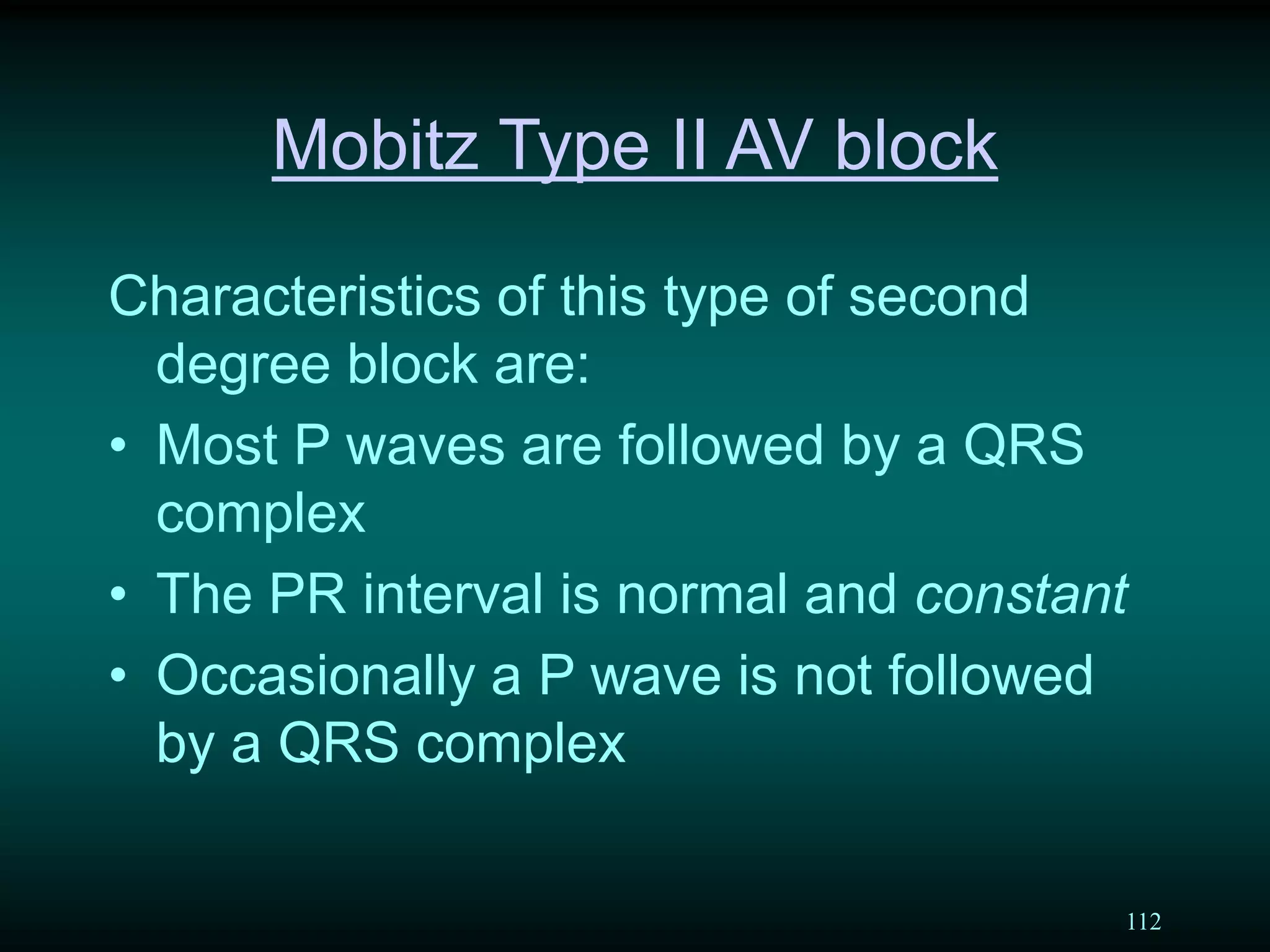
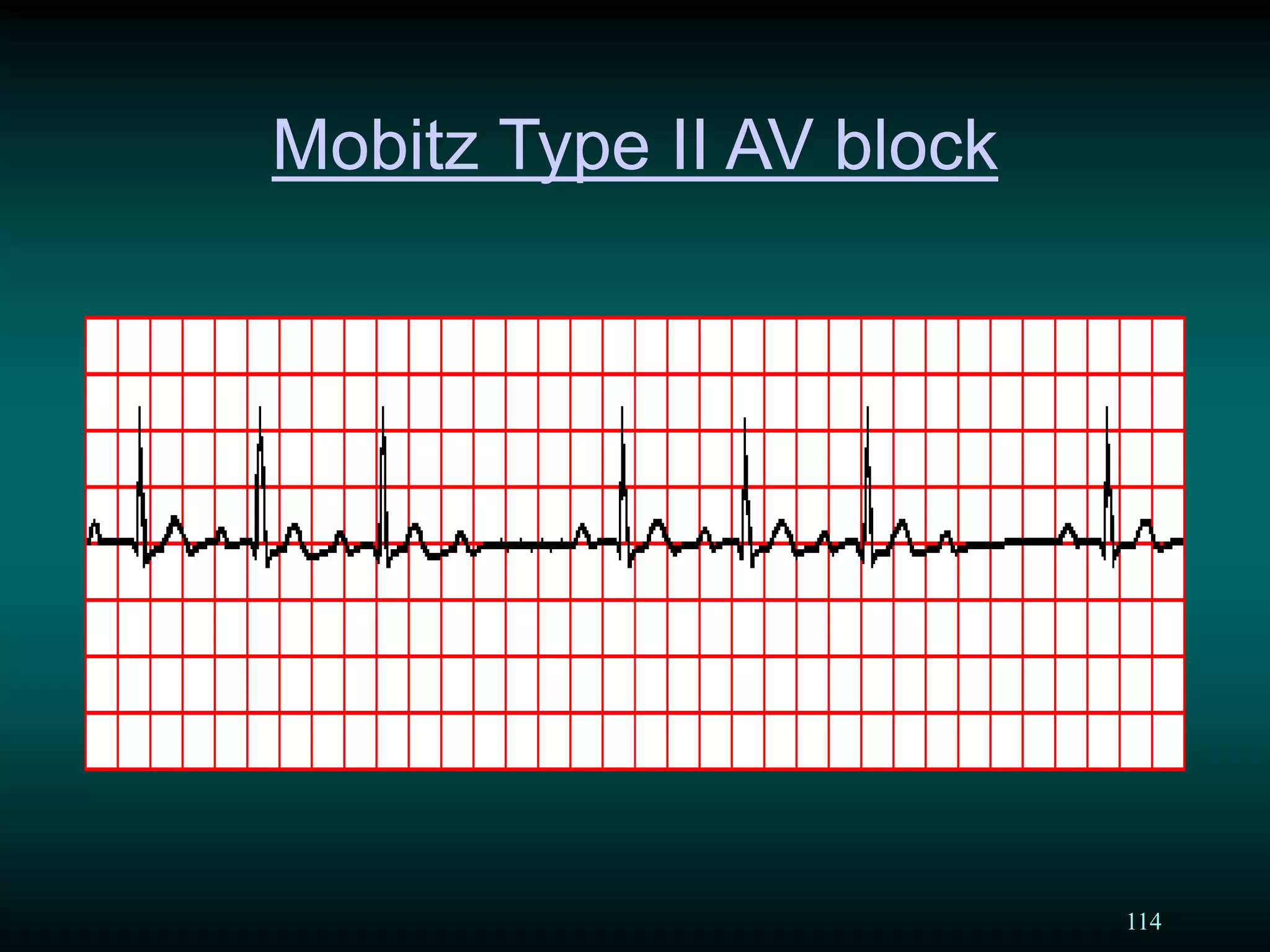
Mobitz Type II AV block
Characteristics of this type of second
degree block are:
• Most P waves are followed by a QRS
complex
• The PR interval is normal and constant
• Occasionally a P wave is not followed
by a QRS complex
113
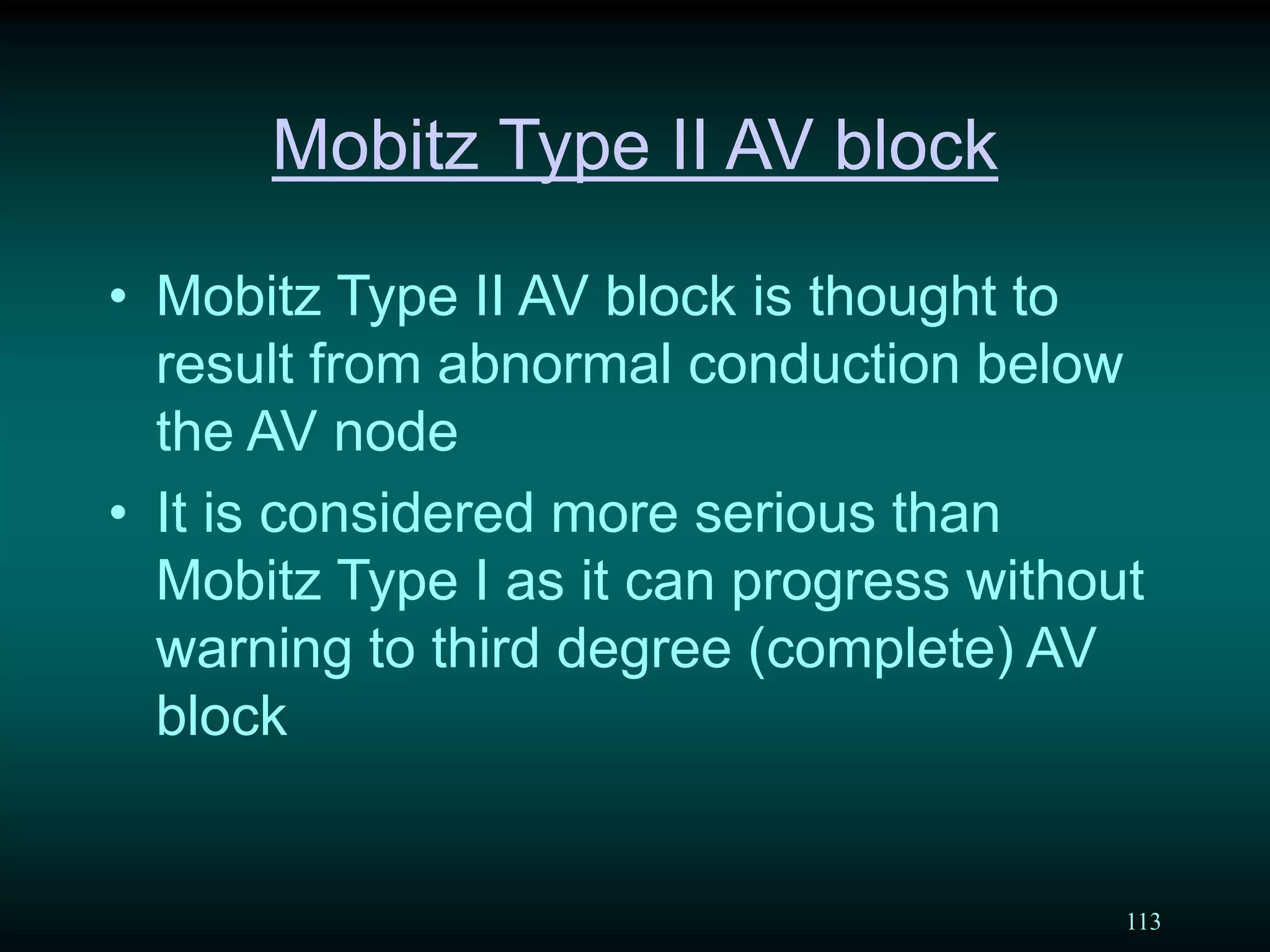
Mobitz Type II AV block
• Mobitz Type II AV block is thought to
result from abnormal conduction below
the AV node
• It is considered more serious than
Mobitz Type I as it can progress without
warning to third degree (complete) AV
block
114
Mobitz Type II AV block
115
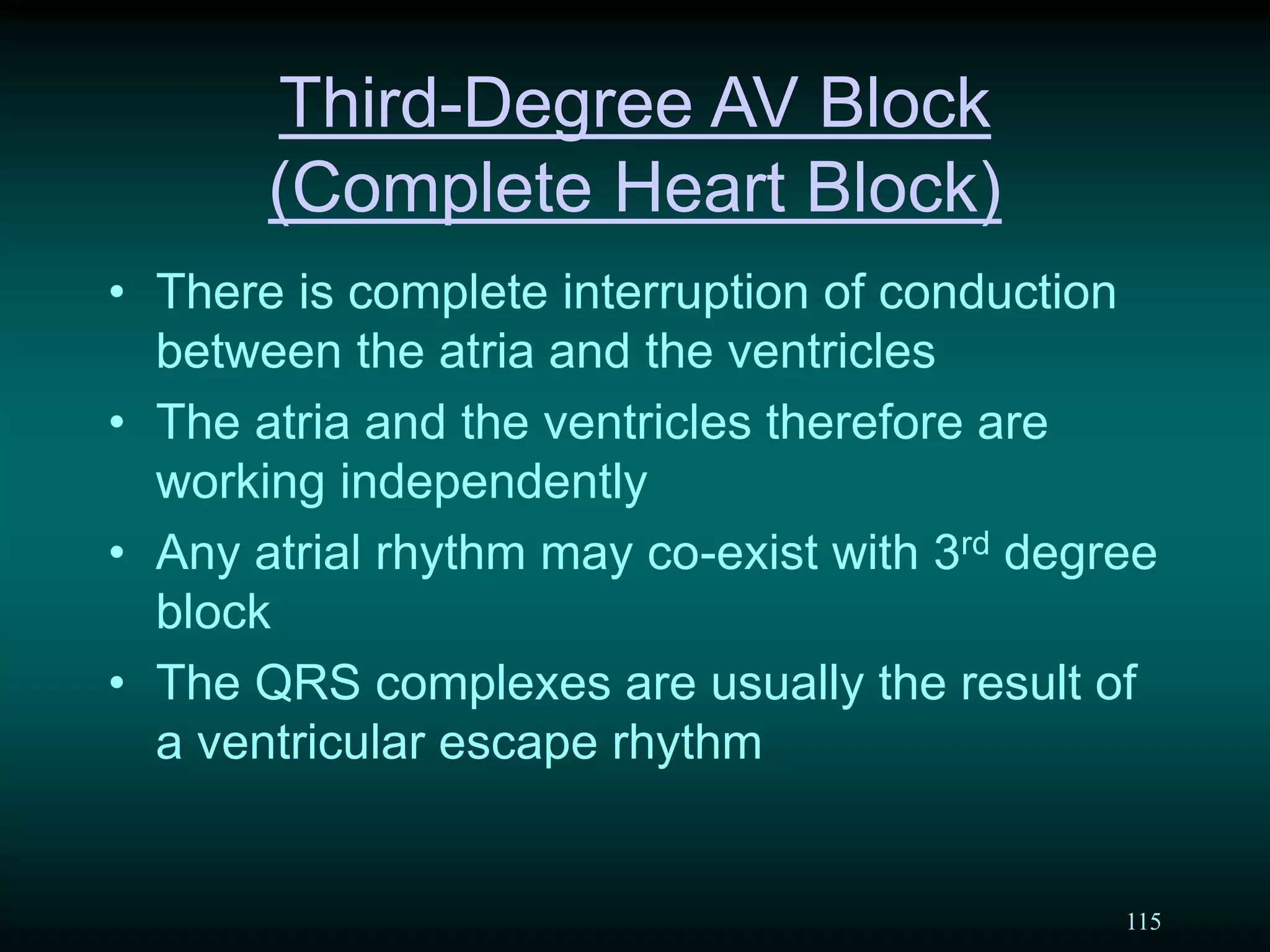
Third-Degree AV Block
(Complete Heart Block)
• There is complete interruption of conduction
between the atria and the ventricles
• The atria and the ventricles therefore are
working independently
• Any atrial rhythm may co-exist with 3rd degree
block
• The QRS complexes are usually the result of
a ventricular escape rhythm
116
Third-Degree AV Block
(Complete Heart Block)
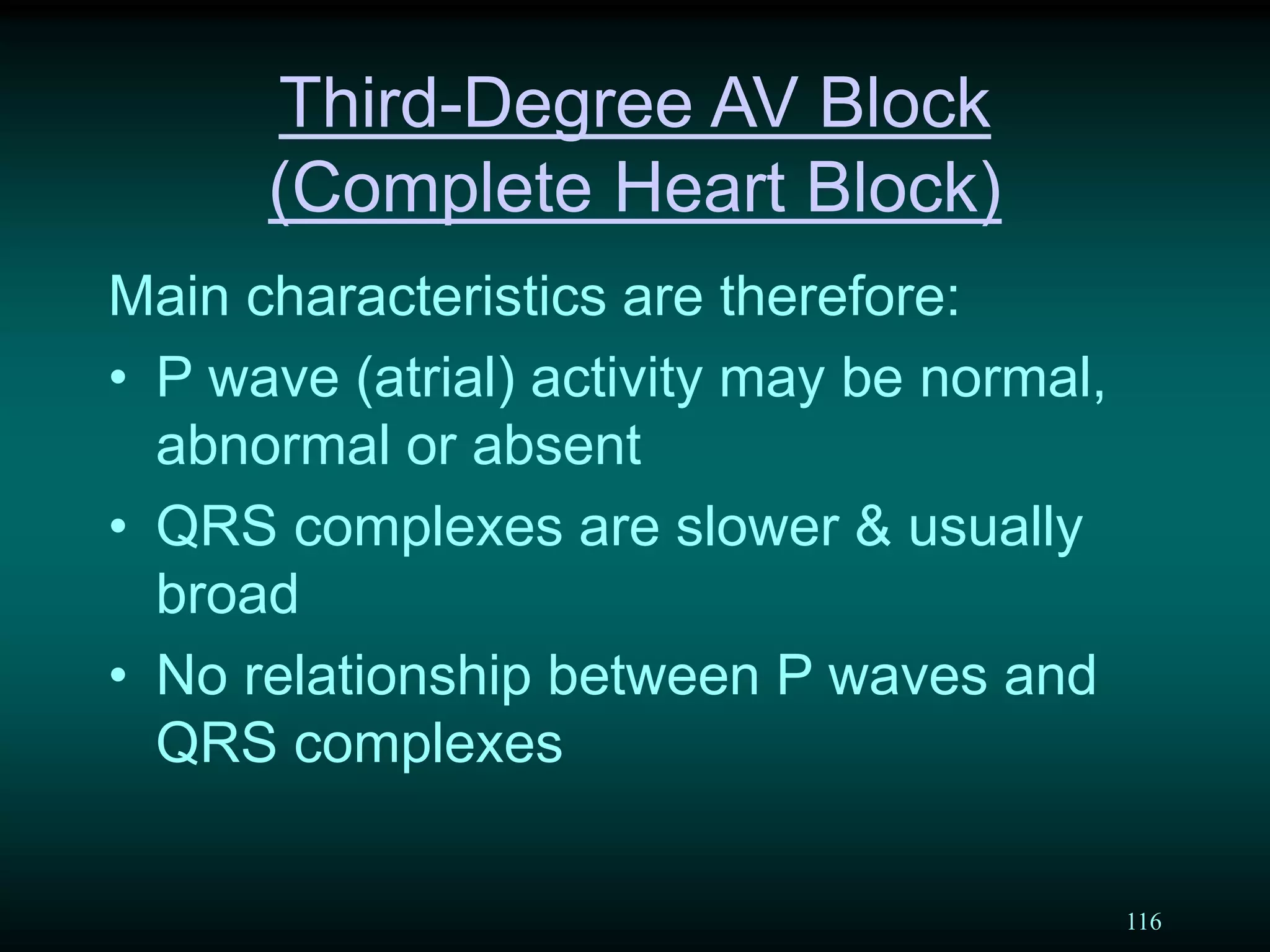
Main characteristics are therefore:
• P wave (atrial) activity may be normal,
abnormal or absent
• QRS complexes are slower & usually
broad
• No relationship between P waves and
QRS complexes
117
3rd Degree AV block
(Complete Heart Block)
Axis Determination
119
• Axis is perpendicular
to a lead where QRS
complex is isoelectric
( equal parts positive
& negative)
120
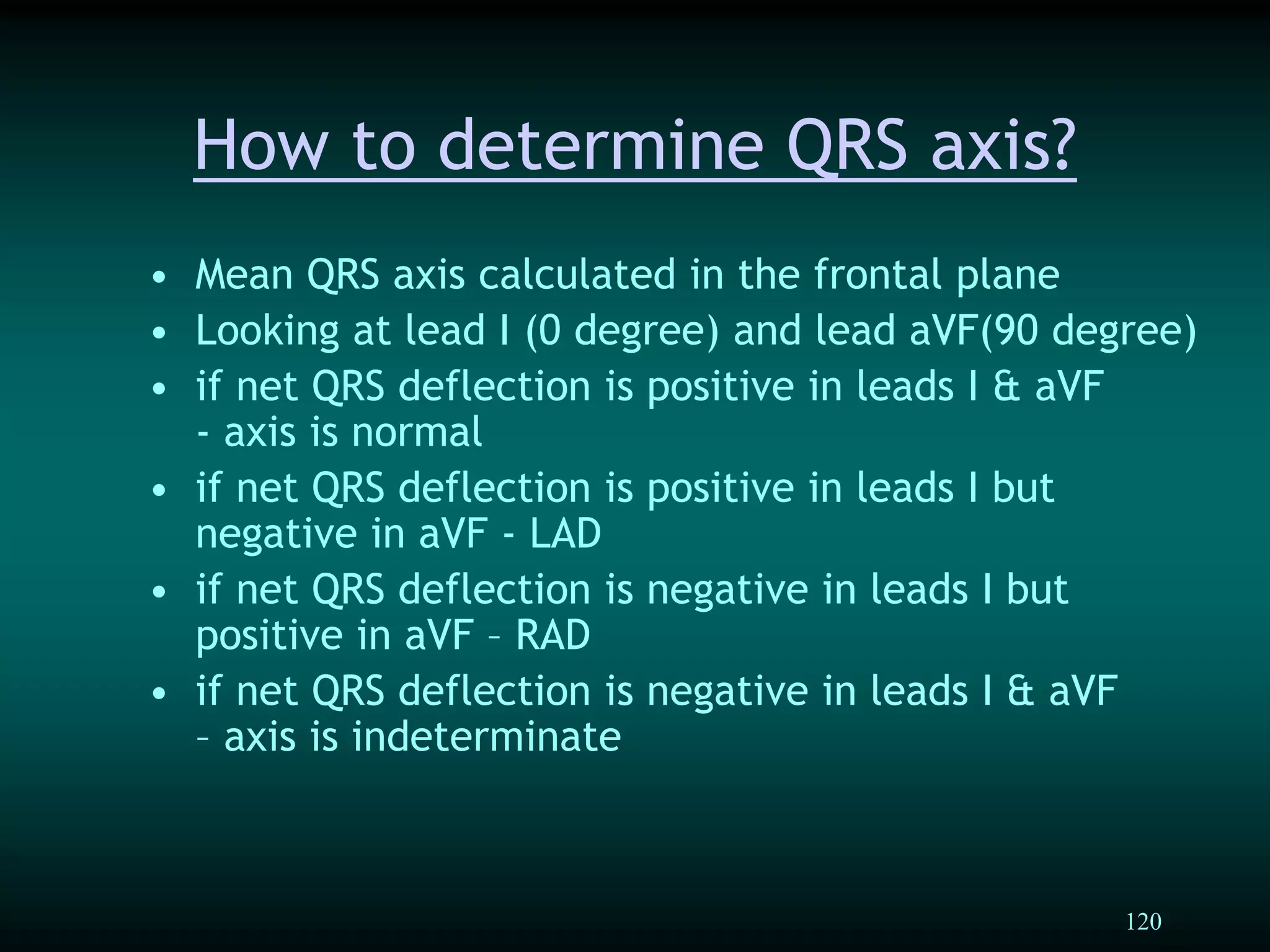
• Mean QRS axis calculated in the frontal plane
• Looking at lead I (0 degree) and lead aVF(90 degree)
• if net QRS deflection is positive in leads I & aVF
- axis is normal
• if net QRS deflection is positive in leads I but
negative in aVF - LAD
• if net QRS deflection is negative in leads I but
positive in aVF – RAD
• if net QRS deflection is negative in leads I & aVF
– axis is indeterminate
How to determine QRS axis?
121
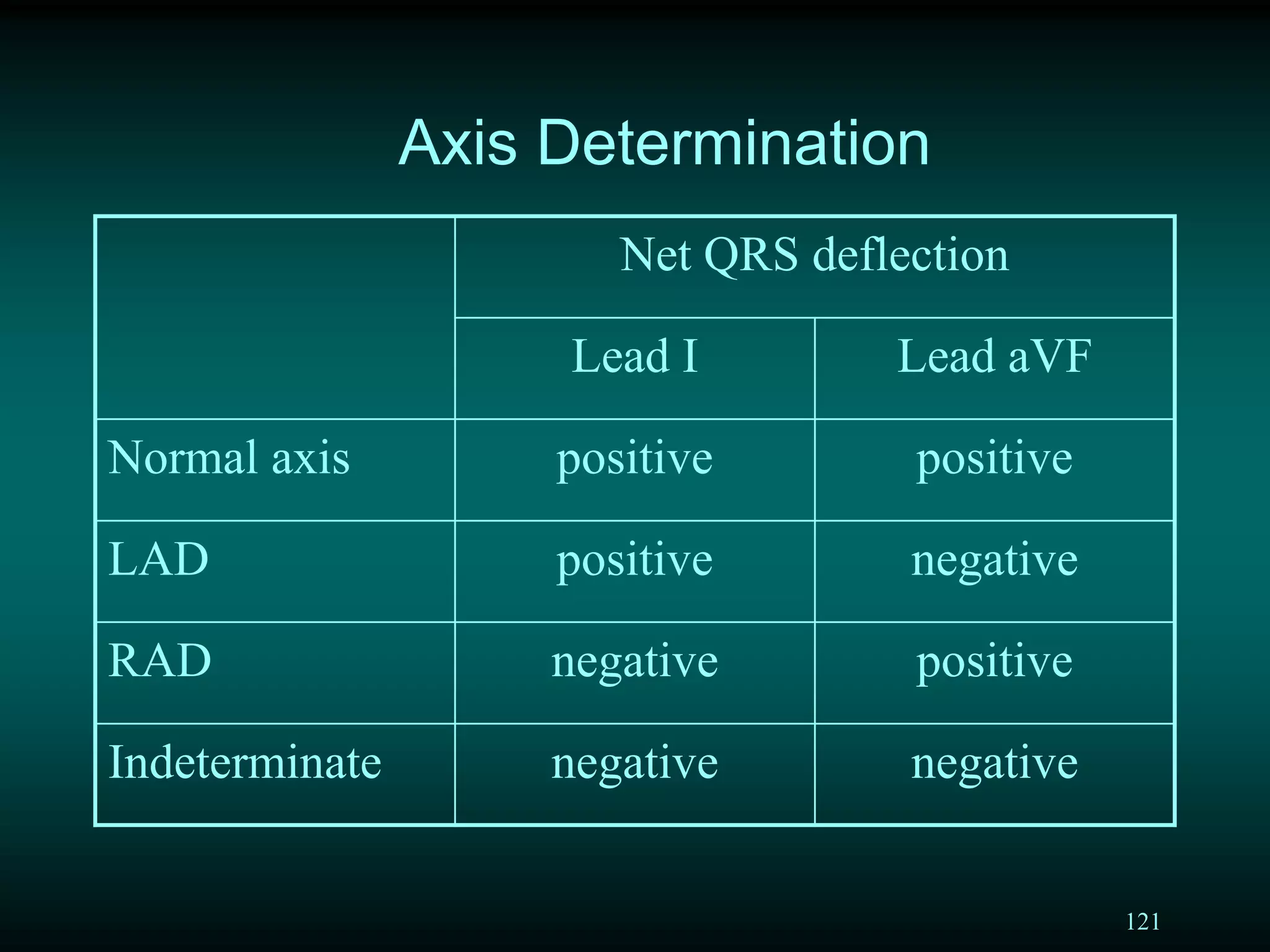
Net QRS deflection
Lead I Lead aVF
Normal axis positive positive
LAD positive negative
RAD negative positive
Indeterminate negative negative
Axis Determination
Atrial Enlargement
123
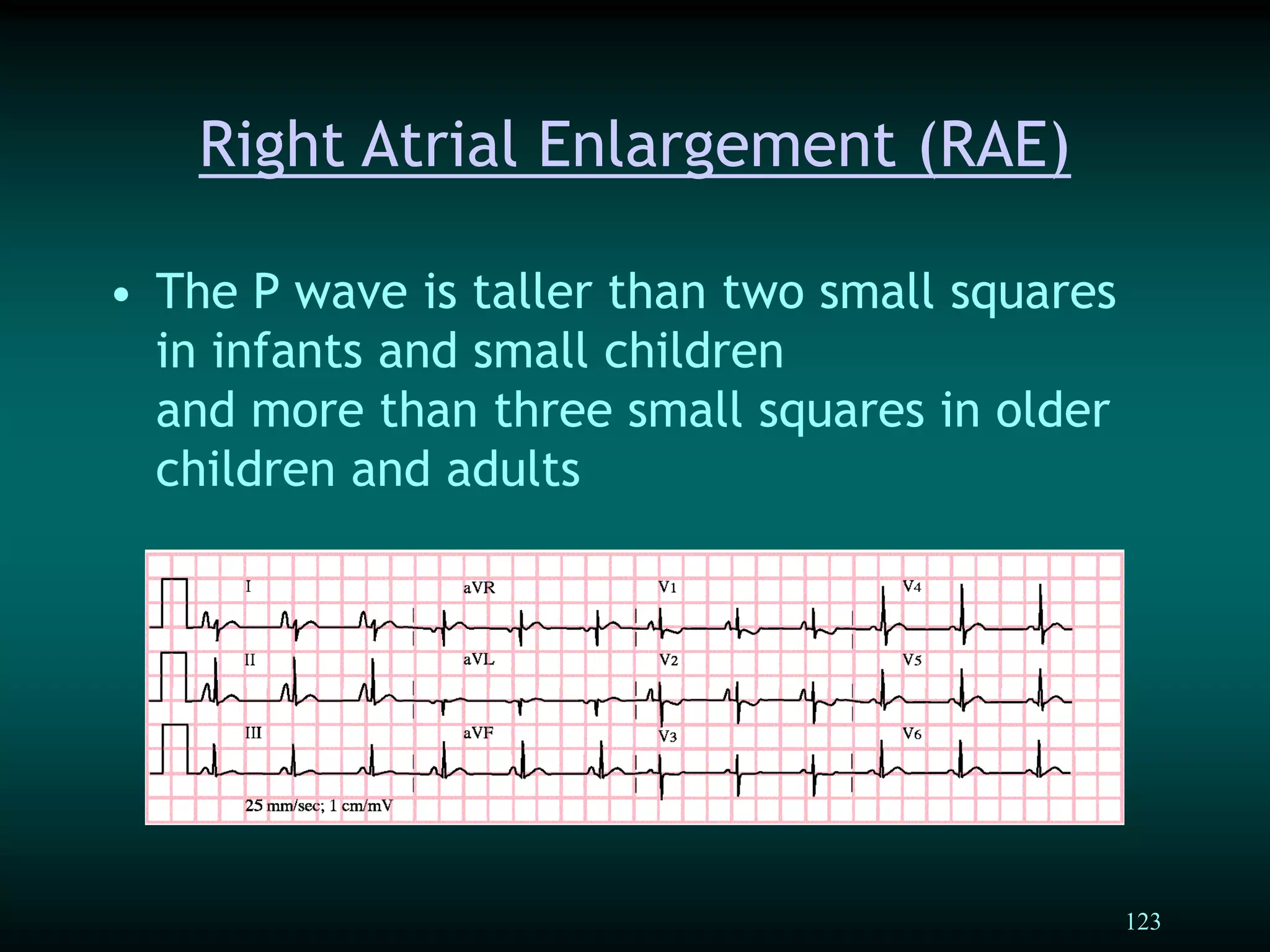
Right Atrial Enlargement (RAE)
• The P wave is taller than two small squares
in infants and small children
and more than three small squares in older
children and adults
124
Left Atrial Enlargement (LAE)
• The P waves are wide, more than two small
squares (> 0.08 sec) in infants and small
children and more than three small squares
(> 0.12 sec) in older children and adults
Chamber Hypertrophy
126
LVH
• R in V6 taller than 95% of normal and S in V1
deeper than 95%
127
Age HR
bpm
QRS
Axis
degrees
PR
interval
seconds
QRS
interval
seconds
R
in V1
mm
S
in V1
mm
R
in V6
mm
S
in V6
mm
1st week 90-160 60-180 0.08-0.15 0.03-0.08 5-26 0-23 0-12 0-10
1-3wks 100-180 45-160 0.08-0.15 0.03-0.08 3-21 0-16 2-16 0-10
1-2 mo 120-180 30-135 0.08-0.15 0.03-0.08 3-18 0-15 5-21 0-10
3-5 mo 105-185 0-135 0.08-0.15 0.03-0.08 3-20 0-15 6-22 0-10
6-11 mo 110-170 0-135 0.07-0.16 0.03-0.08 2-20 0.5-20 6-23 0-7
1-2 yr 90-165 0-110 0.08-0.16 0.03-0.08 2-18 0.5-21 6-23 0-7
3-4 yr 70-140 0-110 0.09-0.17 0.04-0.08 1-18 0.5-21 4-24 0-5
5-7 yr 65-140 0-110 0.09-0.17 0.04-0.08 0.5-14 0.5-24 4-26 0-4
8-11 yr 60-130 -15-110 0.09-0.17 0.04-0.09 0-14 0.5-25 4-25 0-4
12-15 yr 65-130 -15-110 0.09-0.18 0.04-0.09 0-14 0.5-21 4-25 0-4
> 16 yr 50-120 -15-110 0.12-0.20 0.05-0.10 0-14 0.5-23 4-21 0-4
Normal Values
128
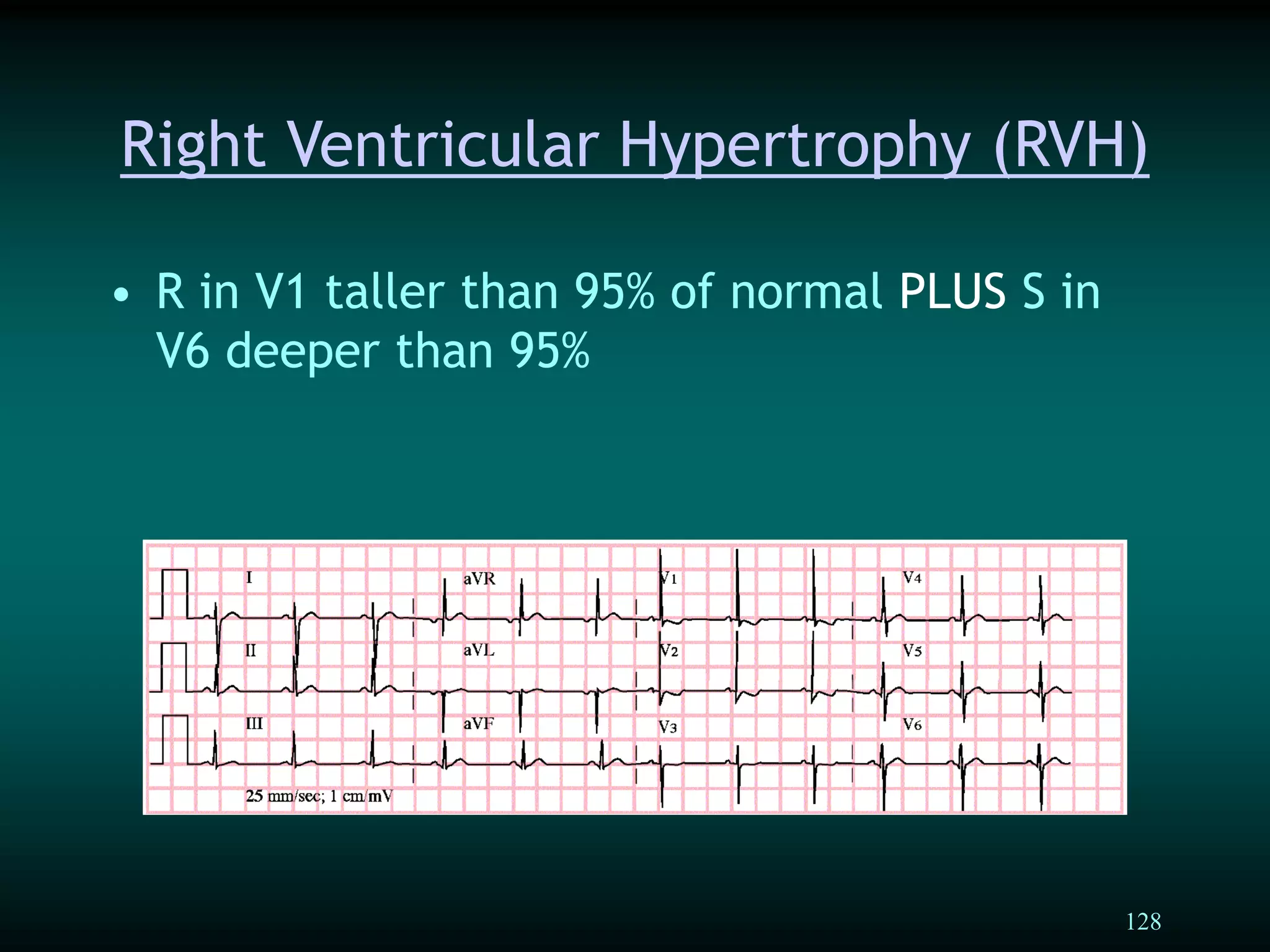
Right Ventricular Hypertrophy (RVH)
• R in V1 taller than 95% of normal PLUS S in
V6 deeper than 95%
129
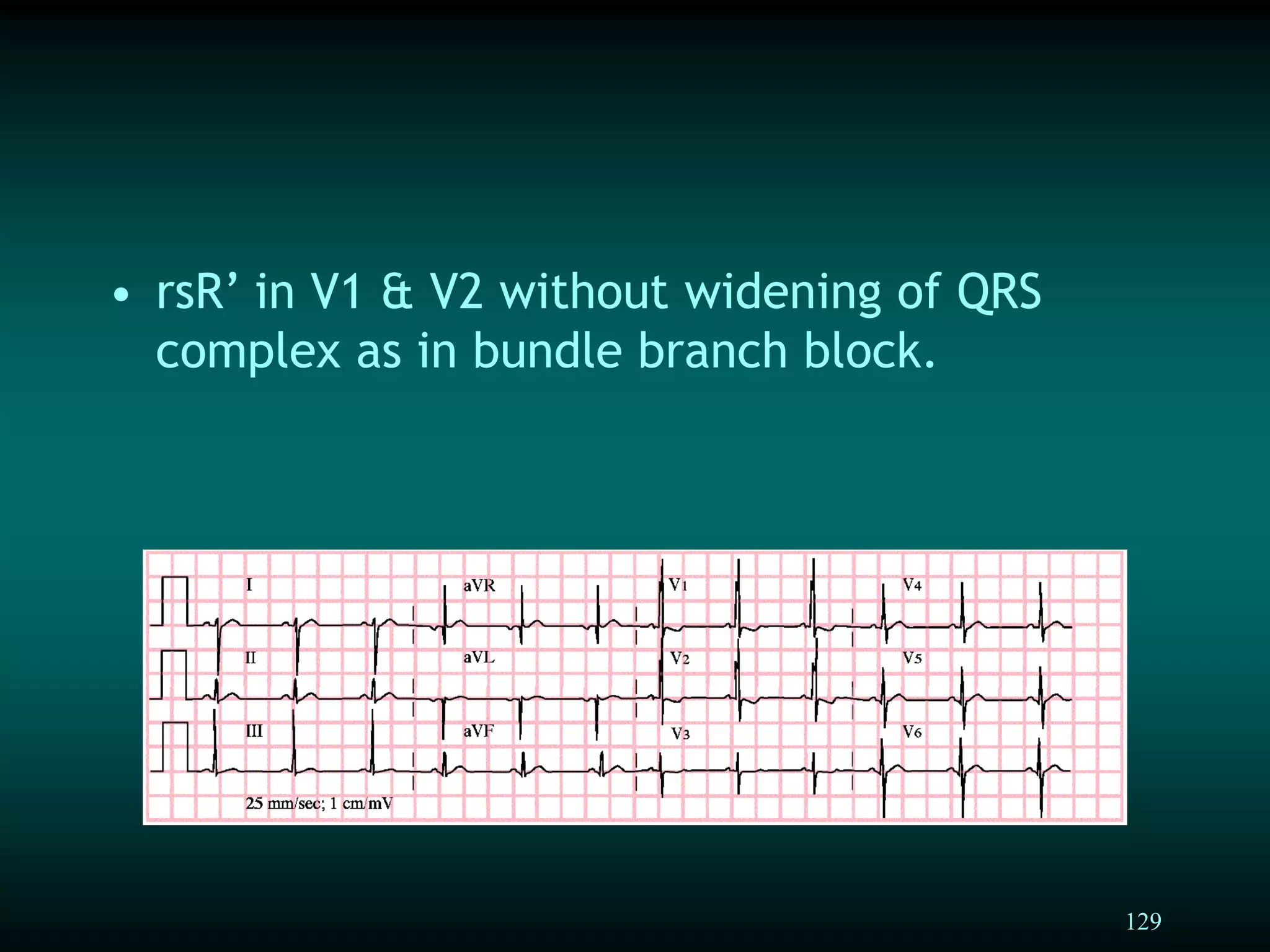
• rsR’ in V1 & V2 without widening of QRS
complex as in bundle branch block.
130
• qR in V1 & V2
131
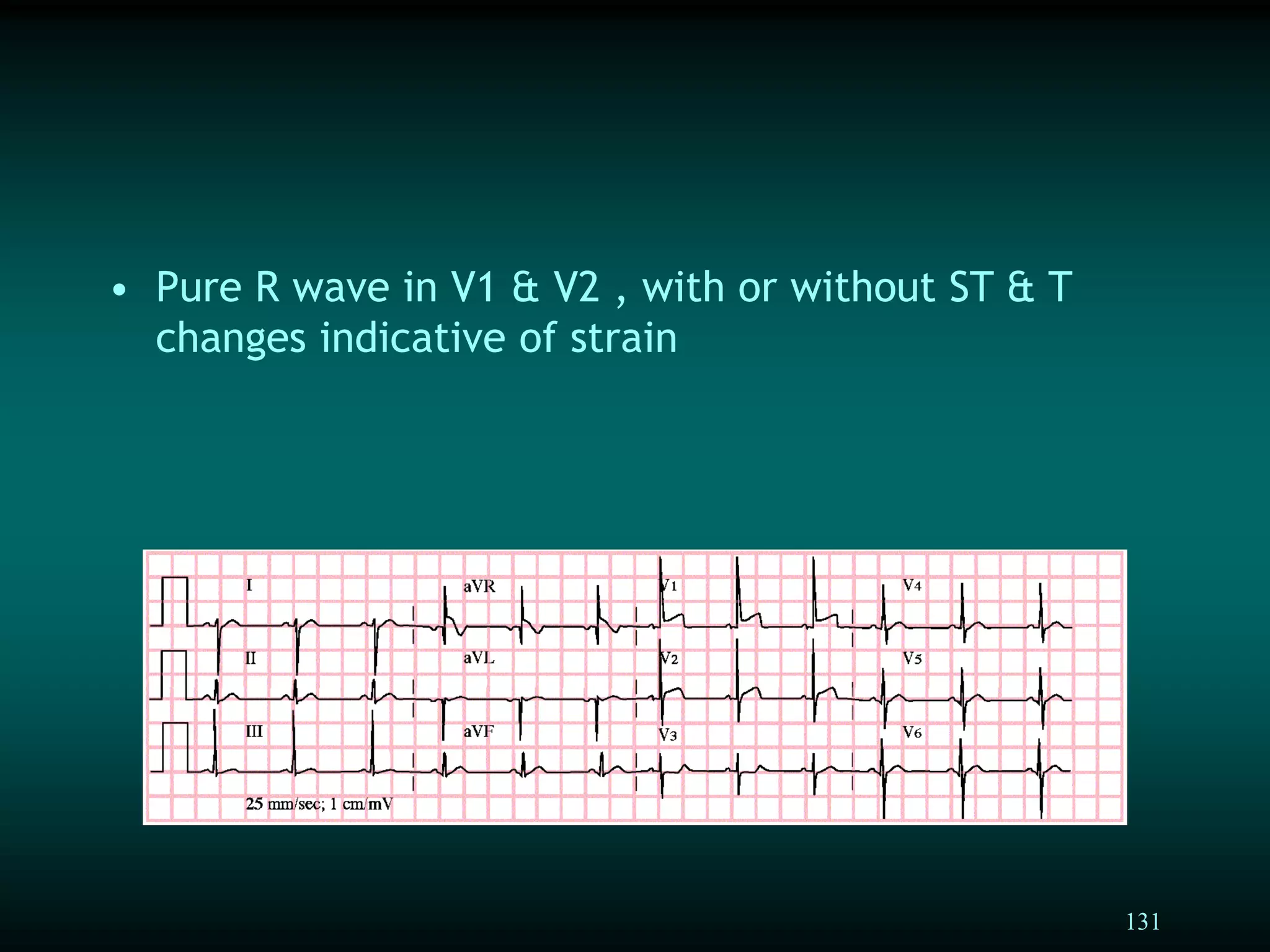
• Pure R wave in V1 & V2 , with or without ST & T
changes indicative of strain
Age related ECG progression
133
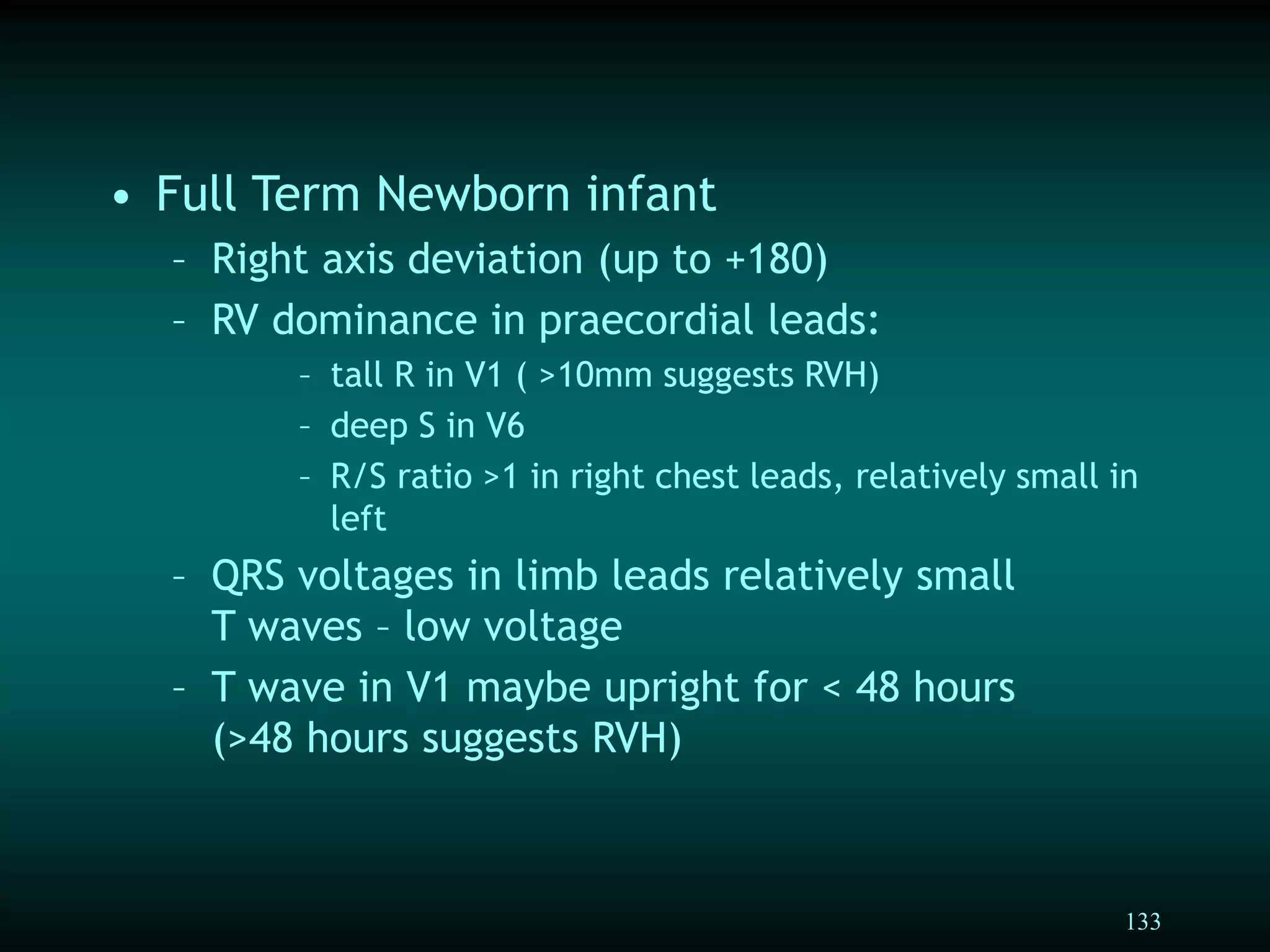
• Full Term Newborn infant
– Right axis deviation (up to +180)
– RV dominance in praecordial leads:
– tall R in V1 ( >10mm suggests RVH)
– deep S in V6
– R/S ratio >1 in right chest leads, relatively small in
left
– QRS voltages in limb leads relatively small
T waves – low voltage
– T wave in V1 maybe upright for < 48 hours
(>48 hours suggests RVH)
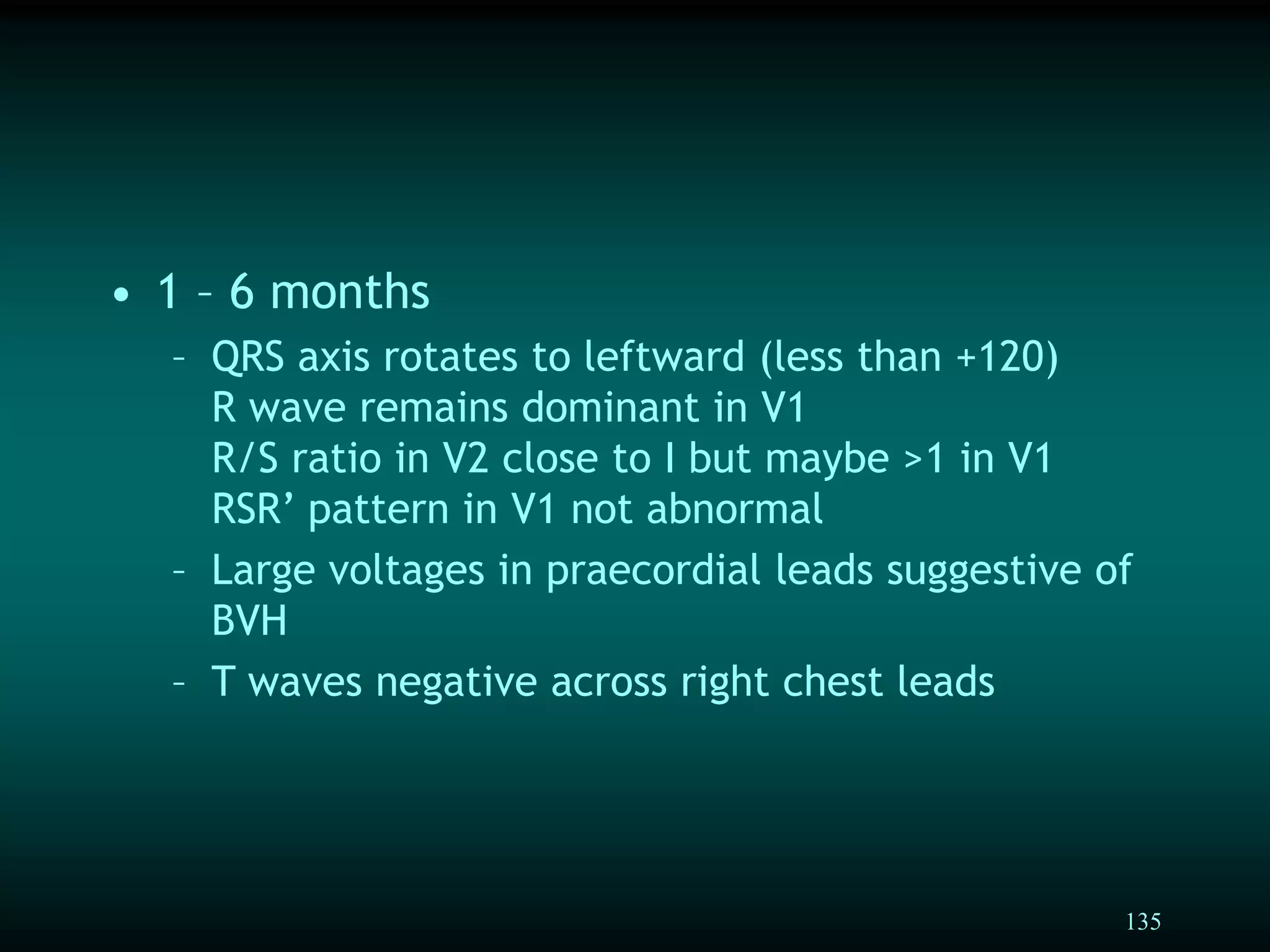
134
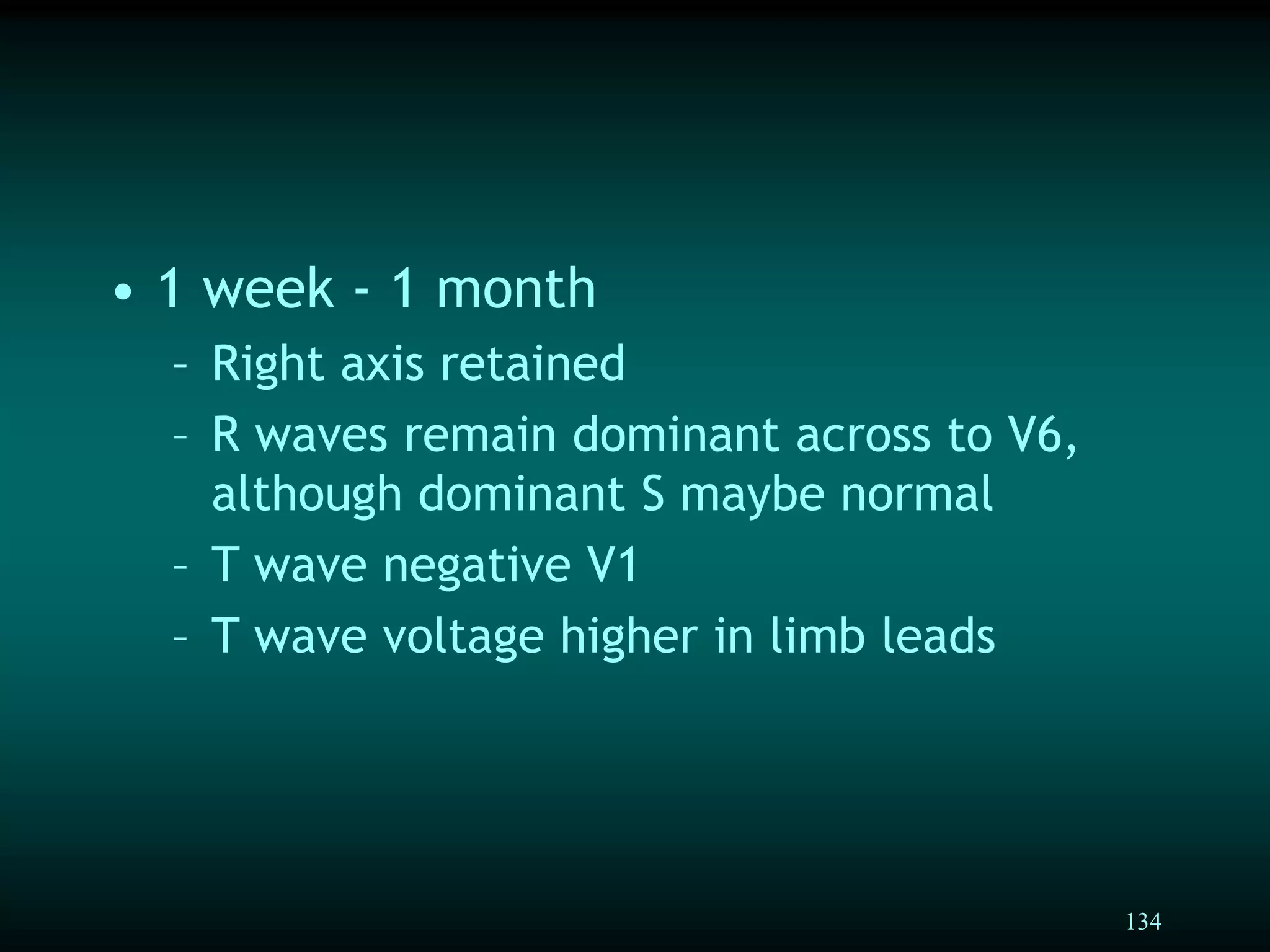
• 1 week - 1 month
– Right axis retained
– R waves remain dominant across to V6,
although dominant S maybe normal
– T wave negative V1
– T wave voltage higher in limb leads
135
• 1 – 6 months
– QRS axis rotates to leftward (less than +120)
R wave remains dominant in V1
R/S ratio in V2 close to I but maybe >1 in V1
RSR’ pattern in V1 not abnormal
– Large voltages in praecordial leads suggestive of
BVH
– T waves negative across right chest leads
136
• 6 months – 3 years
– QRS axis usually < +90
– R wave dominant in V6
– R/S ratio in V1 close to or less than 1
Large voltages in praecordial leads persist
137
• 3 - 8 years
– Adult QRS progression in praecordial
leads:
• dominant S in V1
• dominant R in V6
• Large praecordial voltages persist
q waves in left chest leads may be large (<
5mm)
• T waves remain negative in right praecordial
leads
Normal Variants
139
Normal variants
• T wave inversion:
– Infants older than 48 hours of age should have inverted T
waves in the right praecordial leads
– T inversion persist throughout childhood with inversion to
V4 being accepted as normal
– There is a progressive change to an upright T wave across
the praecordial leads from left to right as the child grows
older
– Until 8 years of age an upright T wave in V1 is considered
a sign of right ventricular hypertrophy
– Many children will show persistence of an inverted T
wave in V1 until their late teens
140
References
• Houghton A.R., Gray D. Making Sense of the ECG. A Hands-on
Guide. Arnold. London. 1999. (If you only buy one book on
ECGs make it this one! Simple to read but still comprehensive,
pocket-size, not too expensive)
• Hampton J.R. 1992. The ECG Made Easy. 4th Ed. Churchill
Livingstone. Edinburgh.
• Hampton J.R. 1992. The ECG in Practice. 2nd Ed. Churchill
Livingstone. Edinburgh
• Wagner G.S. Marriott’s Practical Electrocardiography. 10th Ed.
Lippincott. Philadelphia. 2001. (Very good book for those
wanting to study ECGs in more depth)
• Hatchett R., Thompson D. Cardiac Nursing. A Comprehensive
Guide. Churchill Livingstone. Edinburgh
• “ECG Learning Centre”: http://medlib.med.utah.edu/kw/ecg/
(Excellent website - loads of example ECGs)
An overview of paediatric ECG

An overview of paediatric ECG

  • 1.
    An Overview of Paediatric Electrocardiogram SidKaithakkoden MBBS,DCH,DipNB,MD.MRCPCH,FCPS sidkaithakkoden@nhs.net
  • 2.
  • 3.
    3 The Cardiac ConductionSystem Sino-atrial node Purkinje fibresRight & left bundle branches Atrioventricular bundle (bundle of His) Atrioventricular node 3.3 RA LA RV LV
  • 4.
  • 5.
  • 6.
  • 7.
    7 It’s all aboutbeing able to relate…… This…. To this!
  • 8.
  • 9.
  • 10.
    10 Sequence of ElectricalActivity in the Heart Forming the P-Q-R-S-T Waves • P wave: – Atrial depolarization – Axis: 0-90 – P wave is upright in I & AVF
  • 11.
    11 The P Wave: Spreadof Electrical Activity through the Atria P
  • 12.
    12 The P Wave •Represents atrial depolarisation and activation – Either from the SA node (sinus rhythm) – Or from somewhere else in atria (ectopic) • In sinus rhythm P wave rate is regular • The only normal exception where P wave rate varies is sinus arrhythmia – usually only seen in people under 40
  • 13.
    13 The P Wave:Characteristics • P waves should be present! • If absent, atrial activity may be: – Truly absent (No coordinated atrial activity) – Present but not visible on ECG • No more than 0.12 secs duration • No more than 2.5 mm high in lead II • Upright in lead II (usually upright in all leads except aVR)
  • 14.
    14 Analysis of Pwaves: • Are the P waves regular? • Is there one P wave for every QRS? • Is the P wave normal and upright in Lead II? • Are there more P waves than QRS complexes? • Do all of the P waves look alike?
  • 15.
    15 • PR interval: –Slow AV node conduction – No electrical activity recorded by ECG – PR interval is flat
  • 16.
    16 The PR Interval •Measures the time from the beginning of atrial depolarisation to the beginning of ventricular depolarisation – i.e. from beginning of P wave to beginning of QRS complex • A major portion of the PR interval is the slow conduction through the AV node • AV nodal conduction under autonomic control
  • 17.
    17 PR interval analysis: •Normal PR interval (PRI) is 0.12 - 0.2 secs in adults (age dependant in children) • Is the PRI measurement within the normal range? • Are all of the PRI’s the same? • If the PRI varies, is there a pattern to the changing measurements?
  • 18.
    18 • Q wave: –Depolarization of the ventricular septum – Axis: 180-270 – Negative deflection in I & AVF
  • 19.
    19 • R Wave: –Depolarization of the ventricles – Axis: 0-90 – Upright in I & AVF
  • 20.
    20 • S Wave: –Depolarization of the heart base – Axis: 180-270 – Negative deflection in I & AVF
  • 21.
    21 The QRS Complex •Represents ventricular depolarisation and activation • Usually much bigger than P and T wave as much larger muscle mass • NB. The QRS complex may comprise of a Q, R and S wave – but often not all three in same complex!
  • 22.
    22 The QRS Complex •Q waves usually absent from most leads of the 12-lead ECG • The duration of the QRS complex is termed the “QRS Interval” (Normal range for is 0.07 – 0.11 secs) • QRS amplitude (on 12-lead ECG) varies considerably – up to 3.0 mV (30mm) may be normal
  • 23.
    23 QRS Waveform Nomenclature Rr qR qRs Qrs QS Qr Rs rS qs rSr’ rSR’ 7.1
  • 24.
    24 Analysis of QRSComplex • What is the duration of the QRS complex? • Are all of the QRS complexes of equal duration? • Do all of the QRS look alike? • Are the unusual QRS complexes associated with ectopic beats? • Is the QRS complex preceded by a P wave?
  • 25.
    25 The ST Segment •The ST segment lies between the end of the S wave and the start of the T wave • It represents the time between end of depolarisation and beginning of repolarisation
  • 26.
    26 Analysis of theST Segment • The ST segment is normally isoelectric • Can be abnormal in two ways: –Are the ST segments elevated? • May indicate myocardial infarction –Are the ST segments depressed? • May indicate myocardial ischaemia
  • 27.
    27 ECG complex withisoelectric ST segment
  • 28.
    28 12-lead ECG showingST Segment Depression
  • 29.
    29 12-lead ECG showingST Segment Elevation
  • 30.
    30 • T Wave: –Repolarization of the Ventricles – upright deflection in I & AVF
  • 31.
    31 The T Wave •Represents repolarisation (“recharging”) of the ventricular muscle to its resting electrical state • Analysis of the T wave would examine: – Its direction – Its shape – Its height
  • 32.
    32 Repolarisation of Ventricle TheT wave: Repolarisation of the ventricle T 3.6
  • 33.
    33 The QT Interval •The QT interval measures the total time taken for depolarisation and repolarisation of the ventricles – Beginning of the QRS complex to the end of the T wave • Usually measured rather than the duration of the T wave alone • Varies with heart rate, age and sex
  • 34.
    34 The U Wave •The U wave is normally either absent or present as a small rounded wave following the T wave • Normally oriented in the same direction as T wave • Origin of U wave is uncertain • More prominent in hypokalaemia, hypercalcaemia or hyperthyroidism
  • 35.
    35 Age HR bpm QRS Axis degrees PR interval seconds QRS interval seconds R in V1 mm S inV1 mm R in V6 mm S in V6 mm 1st week 90-160 60-180 0.08-0.15 0.03-0.08 5-26 0-23 0-12 0-10 1-3wks 100-180 45-160 0.08-0.15 0.03-0.08 3-21 0-16 2-16 0-10 1-2 mo 120-180 30-135 0.08-0.15 0.03-0.08 3-18 0-15 5-21 0-10 3-5 mo 105-185 0-135 0.08-0.15 0.03-0.08 3-20 0-15 6-22 0-10 6-11 mo 110-170 0-135 0.07-0.16 0.03-0.08 2-20 0.5-20 6-23 0-7 1-2 yr 90-165 0-110 0.08-0.16 0.03-0.08 2-18 0.5-21 6-23 0-7 3-4 yr 70-140 0-110 0.09-0.17 0.04-0.08 1-18 0.5-21 4-24 0-5 5-7 yr 65-140 0-110 0.09-0.17 0.04-0.08 0.5-14 0.5-24 4-26 0-4 8-11 yr 60-130 -15-110 0.09-0.17 0.04-0.09 0-14 0.5-25 4-25 0-4 12-15 yr 65-130 -15-110 0.09-0.18 0.04-0.09 0-14 0.5-21 4-25 0-4 > 16 yr 50-120 -15-110 0.12-0.20 0.05-0.10 0-14 0.5-23 4-21 0-4 Normal Values
  • 36.
    36 QT interval: • theduration from the beginning of the QRS complex to the end of the T wave • count the number of small squares, then multiply by 0.04 seconds, that the QT in seconds • Corrected QT interval – Normal QT is determined by the HR – QTc = QT / square root of RR interval
  • 37.
  • 38.
    38 Reading and Interpreting Electrocardiograms •Age: unless the patient’s age is known, the paediatric ECG cannot be interpreted • Is the ECG "full standard"? • Is the ECG "standard speed"? • The standard speed of paper is 25 mm/sec • Occasionally it is made to run at a double speed (50 mm/sec) in cases of tachyarrhythmia to enable the visualization of an otherwise hidden p waves • Additional clinical information : • Indication • Clinical diagnosis: cardiac and other • Medications: cardiovascular drugs, others eg. cisapride, tricyclics • Electrolytes
  • 39.
    39 Systematic reading ofECG: 1. Heart rate 2. P wave axis 3. Rhythm 4. QRS axis 5. Intervals PR, QRS, QT/QTc 6. P wave amplitude and duration 7. QRS amplitude, R/S ratio, Q waves 8. ST segments and T wave
  • 40.
  • 41.
    41 Heart Rate -Basics • The standard UK and USA speed for ECG recording is 25mm / second • Before you measure the heart rate always check that this speed has been used! • At this speed, a one-minute ECG tracing covers 300 large squares
  • 42.
    42 ECG Paper: Dimensions 5mm 1 mm 0.1 mV 0.04 sec 0.2 sec Speed = Rate Voltage ~ Mass
  • 43.
    43 Method 1 • Countthe number of large squares between two consecutive R waves and divide into 300. – Quick – Not very accurate with fast rates – Used ONLY with regular rhythms
  • 44.
    44 Method 2 • Countthe number of small squares between two consecutive R waves and divide into 1500. – The most accurate method – Time-consuming – Used only with regular rhythms
  • 45.
  • 46.
    46 Rhythms Arising From theSinoatrial Node • (Normal) sinus rhythm • Sinus tachycardia • Sinus bradycardia • Sinus arrhythmia • Sick sinus syndrome
  • 47.
    47 Normal Sinus Rhythm •Sinus rhythm is the normal cardiac rhythm • The sinoatrial node is acting as the natural pacemaker • Heart rate is between 60-100 / min • P wave upright in lead II • PR interval 0.12 – 0.2 secs • Each P wave followed by QRS complex
  • 48.
  • 49.
    49 Sinus Bradycardia • Sinusbradycardia is sinus rhythm with a heart rate of less than 60 / min • P wave upright in lead II • PR interval 0.12 – 0.2 secs • Each P wave followed by QRS complex • It is unusual for sinus bradycardia to be slower than 40 / min – Consider alternative e.g. Heart block
  • 50.
  • 51.
    51 Sinus Bradycardia &Escape Beats • If sinus bradycardia is severe, escape beats or rhythms may occur • While these beats and rhythms may look abnormal, they are protective mechanisms
  • 52.
    52 Sinus Tachycardia • Sinustachycardia is sinus rhythm with a heart rate of more than 100 / min • P wave upright in lead II • PR interval 0.12 – 0.2 secs • Each P wave followed by QRS complex • Unusual for sinus tachycardia to be faster than 180 beats / min, except in fit athletes – Consider alternative eg. Nodal tachycardia
  • 53.
  • 54.
    54 Sinus Arrhythmia • Sinusarrythmia is the variation of heart rate seen with inspiration & expiration • Each P wave followed by QRS complex • Uncommon in age over 40 years • Harmless • Cause: heart rate increases during inspiration as reflex response to more blood returning to heart
  • 55.
  • 56.
    56 Sick Sinus Syndrome •This refers to a collection of impulse generation and conduction problems related to the sinus node • Any or all of the following may be seen: – Sinus bradycardia – Sinus arrest – Sinoatrial block • May be associated with paroxysmal tachycardias (“tachy–brady syndrome”)
  • 57.
    57 Sick Sinus Syndrome Sinusarrest • This is when the sinus node fails to discharge on time, • P wave fails to appear as expected, causing a variable-length gap Sinoatrial block • Sinus node depolarises normally, but impulse doesn’t reach the atria • P wave fails to appear, but next one appears in exactly the right place
  • 58.
  • 59.
  • 60.
    60 Ectopics • The word“ectopic” implies “outside” – (eg. ectopic pregnancy outside the uterus) • Ectopic beats therefore could be defined as beats arising from outside the normal cardiac conduction pathway ie. not starting at the sinoatrial node • Ectopic beats are also called: – Extrasystoles – Premature beats (or complexes)
  • 61.
    61 Ectopics • Ectopic beatsappear earlier than the next expected beat • They can arise from any region of the heart, but are normally classified into: – Atrial – AV junctional – Ventricular
  • 62.
    62 Ectopics • Ectopic beatsmay occur as: – Isolated single beats – Multiple beats – The dominant rhythm (usually defined as three or more successive ectopic beats) having “taken over” from the SA node
  • 63.
    63 Cardiac Conduction System: InherentRates Sino-Atrial (SA) Node: • 60-100 / min Atrioventricular (AV) Node: • 40-60 / min. Ventricles: • 20-40 / min. Escape rhythms generated by the AV node and ventricles will therefore be at the above respective rates
  • 64.
    64 Beats & RhythmsArising From the Atria • Atrial ectopics • Atrial tachycardia • Atrial flutter • Atrial fibrillation
  • 65.
    65 Atrial Ectopics • Atrialectopics are identified by a P wave which appears earlier than expected and has an abnormal shape • They will usually be conducted through to the ventricles giving a QRS complex – A normal QRS complex meaning normal ventricular conduction – Wide (>0.12 sec or 3 small squares) QRS complex indicating aberrant ventricular conduction
  • 66.
    66 Atrial Ectopics • Atrialectopics are also known as: – Premature atrial complexes (PAC’s) – Atrial extrasystoles • They may occur as: – Isolated single beats – Two beats together (a pair or couplet) – As a run of ectopics (ie. more than 3) becoming a tachycardia – One ectopic for every sinus beat (bigeminy)
  • 67.
    67 Atrial Ectopics • Atrialectopics may all arise from the same focus in the atria (unifocal) – All the abnormal P waves would look the same • Atrial ectopics may arise from different foci in the atria (multifocal) – Abnormal P waves would vary in shape
  • 68.
  • 69.
  • 70.
    70 Atrial Tachycardia • Atrialtachycardia is a tachycardia originating from impulses generated in the atrial myocardium – From an ectopic focus – Via a “re-entry” mechanism • Characteristics: – Heart rate greater than 100 / min – Abnormally shaped P waves
  • 71.
    71 Atrial Tachycardia • Atrial(P wave) rate is usually 120-250 / min • Above atrial rates of 200 / min, the AV node struggles to keep up with conduction so AV block may occur
  • 72.
  • 73.
    73 Atrial Flutter • Differsfrom atrial tachycardia in that the atrial (P wave) rate is higher • Results from: – Either an ectopic focus – Or depolarization circling the atrium (“Circus Movement”) • Atrial rate is usually 250-350 / min, but often almost exactly 300 / min • The rapid rate gives it a classic “sawtooth” appearance
  • 74.
    74 Atrial Flutter • AVnode cannot keep up with that rate, so AV block occurs • Most common is 2:1 block, giving ventricular rate of around 150 / min • 3:1 = ventricular rate of 100 / min • 4:1 = ventricular rate of  75 / min • AV block may also be variable
  • 75.
  • 76.
    76 Atrial Flutter –Variable Block
  • 77.
    77 Atrial Fibrillation • Muchmore common than atrial flutter • Affects 5-10% of elderly people • Can be permanent • May be transient or paroxysmal – particularly in younger people • Caused by rapid, chaotic depolarisation of the atria (350 - 650 impulses / min)
  • 78.
    78 Atrial Fibrillation • Characteristics: –No P waves seen – Baseline consists of high frequency, low amplitude oscillations (fibrillation or “f” waves) – Conduction through AV node is erratic, therefore ventricular (QRS) rate is irregular (often described as “irregularly irregular”) – Ventricular rate usually  120 – 180 / min • Unless patient medicated eg. digoxin
  • 79.
  • 80.
  • 81.
    81 • The term“supraventricular tachycardia” (SVT) is frequently misused • Literally, it refers to any heart rhythm over over 100 / min that originates above the ventricles, including: – Sinus tachycardia – Atrial fibrillation – Atrial tachycardia – AV re-entry tachycardia Supraventricular Tachycardia (SVT)
  • 82.
  • 83.
    83 Beats & RhythmsArising From the Ventricles • Ventricular ectopics • Ventricular escape beats & rhythms • Accelerated idioventricular rhythm • Ventricular tachycardia including Torsade de Pointes • Ventricular fibrillation
  • 84.
    84 Ventricular Ectopics • Ventricularectopics are also known as: – Premature ventricular complexes (PVC’s) – Ventricular extrasystoles • They may occur as: – Isolated single beats – Two beats together (a pair or couplet) – As a run of ectopics (ie. more than 3) becoming a tachycardia – One ectopic for every sinus beat (bigeminy)
  • 85.
    85 Ventricular Ectopics • Theyactivate the ventricles early, giving rise to an early and wide QRS complex – Wide QRS because the ventricular conduction does not follow the specialised pathways for fast conduction (bundle branches) • They may retrogradely conduct to & activate the atria
  • 86.
    86 Ventricular Ectopics • Characteristics: –Early & wide QRS complex – Compensatory pause – No P wave (or inverted P wave) • Ventricular ectopics may: – All look the same if there is just one ectopic focus (unifocal) – Vary in morphology if there is more than one ectopic focus (multifocal)
  • 87.
  • 88.
  • 89.
  • 90.
  • 91.
    91 Ventricular Tachycardia • Ventriculartachycardia (VT) is a broad- complex tachycardia defined as three or more successive ventricular ectopic beats at a heart rate above 120 / min • Normally occurs at a rate of 150 – 250 / min • Symptoms of VT can range from mild palpitations only, through to cardiac arrest
  • 92.
    92 Ventricular Tachycardia Ventricular tachycardiamay be described as: • Monomorphic – Where all the ventricular complexes look the same • Polymorphic – Where the ventricular complexes vary in morphology (eg. Torsade de Pointes)
  • 93.
    93 Ventricular Tachycardia: Torsade dePointes • Torsade de Pointes is a polymorphic variant of VT associated with a long QT interval • Can cause significant haemodynamic disturbance, and can also precipitate ventricular fibrillation • Establishing the cause of the long QT interval is very important in its treatment
  • 94.
  • 95.
  • 96.
    96 “Broad Complex Tachycardias” (Noteverything that looks like VT is VT!)
  • 97.
    97 “Broad Complex Tachycardias” • Broadcomplex tachycardias are often ventricular tachycardia • However, sometimes supraventricular (ie arising from above the ventricles) rhythms can produce broad complexes if there is abberant conduction (e.g. bundle branch block or an accessory pathway)
  • 98.
    98 “Broad Complex Tachycardias” • Distinguishingbetween VT and SVT with abberant conduction is not always easy (even if you are a cardiologist!) • It is important, however, to tell the difference for correct management • Luckily, in an emergency – both can be treated with DC shock!
  • 99.
    99 “Broad Complex Tachycardias” Atrial Fibrillationwith Abberant Conduction (Accessory Pathway) Ventricular Tachycardia
  • 100.
    100 Ventricular Fibrillation • Ventricularfibrillation (VF) can be defined as rapid and totally disorganised ventricular activity without discernible QRS complexes or T waves in the ECG • Untreated VF is a rapidly fatal arrhythmia – Requires immediate DC shock • Sometimes described as “coarse” or “fine” VF depending on amplitude & frequency – Fine VF can sometimes look like asystole – check monitor gain
  • 101.
  • 102.
    102 Asystole • Asystole impliesthe absence of ventricular activity • P waves may still be seen (P wave asystole or “ventricular standstill”) • Characterised by a flat(tish) line – Don’t forget a completely straight line is often a loose lead – Clue – check the patient!!
  • 103.
  • 104.
    104 “Heart Block” (Or tobe more correct Atrioventricular Block!)
  • 105.
    105 Atrioventricular (AV) Block •Atrioventricular (AV) block refers to an abnormality in electrical conduction between the atria and the ventricles • Caused by conduction abnormality in one or more of the below: – The AV node – Bundle of His – Both the right and left bundle branch
  • 106.
    106 Atrioventricular (AV) Block Theterm degree is used to describe the severity of AV block: • First degree (minor): – All impulses conducted with delay • Second degree (moderate): – Some impulses are not conducted • Third degree (complete): – No impulses conducted
  • 107.
    107 First-Degree AV Block •First-degree AV block is defined as a prolongation of AV conduction to longer than 0.2 secs (5 small squares) – ie. PR interval is greater than 0.2 secs • Can be: – A normal variant – Pathological due to cardiac problem or drug interaction (eg beta blockers)
  • 108.
  • 109.
    109 Second-Degree AV Block •Second degree AV block is when one or more, but not all, atrial impulses reach the ventricles • It may be intermittent or continuous • Commonly described as two types: – Mobitz Type 1 AV block (or Wenkebach phenomenon) – Mobitz Type 2 block
  • 110.
    110 Mobitz Type 1AV block (Wenkebach phenomenon) Characteristics of this type of second degree AV block are: • Progressive lengthening of the PR interval until one P wave fails to be conducted and fails to produce a QRS complex • The PR interval then “resets” to normal and the cycle repeats
  • 111.
    111 Mobitz Type 1AV block (Wenkebach phenomenon)
  • 112.
    112 Mobitz Type IIAV block Characteristics of this type of second degree block are: • Most P waves are followed by a QRS complex • The PR interval is normal and constant • Occasionally a P wave is not followed by a QRS complex
  • 113.
    113 Mobitz Type IIAV block • Mobitz Type II AV block is thought to result from abnormal conduction below the AV node • It is considered more serious than Mobitz Type I as it can progress without warning to third degree (complete) AV block
  • 114.
  • 115.
    115 Third-Degree AV Block (CompleteHeart Block) • There is complete interruption of conduction between the atria and the ventricles • The atria and the ventricles therefore are working independently • Any atrial rhythm may co-exist with 3rd degree block • The QRS complexes are usually the result of a ventricular escape rhythm
  • 116.
    116 Third-Degree AV Block (CompleteHeart Block) Main characteristics are therefore: • P wave (atrial) activity may be normal, abnormal or absent • QRS complexes are slower & usually broad • No relationship between P waves and QRS complexes
  • 117.
    117 3rd Degree AVblock (Complete Heart Block)
  • 118.
  • 119.
    119 • Axis isperpendicular to a lead where QRS complex is isoelectric ( equal parts positive & negative)
  • 120.
    120 • Mean QRSaxis calculated in the frontal plane • Looking at lead I (0 degree) and lead aVF(90 degree) • if net QRS deflection is positive in leads I & aVF - axis is normal • if net QRS deflection is positive in leads I but negative in aVF - LAD • if net QRS deflection is negative in leads I but positive in aVF – RAD • if net QRS deflection is negative in leads I & aVF – axis is indeterminate How to determine QRS axis?
  • 121.
    121 Net QRS deflection LeadI Lead aVF Normal axis positive positive LAD positive negative RAD negative positive Indeterminate negative negative Axis Determination
  • 122.
  • 123.
    123 Right Atrial Enlargement(RAE) • The P wave is taller than two small squares in infants and small children and more than three small squares in older children and adults
  • 124.
    124 Left Atrial Enlargement(LAE) • The P waves are wide, more than two small squares (> 0.08 sec) in infants and small children and more than three small squares (> 0.12 sec) in older children and adults
  • 125.
  • 126.
    126 LVH • R inV6 taller than 95% of normal and S in V1 deeper than 95%
  • 127.
    127 Age HR bpm QRS Axis degrees PR interval seconds QRS interval seconds R in V1 mm S inV1 mm R in V6 mm S in V6 mm 1st week 90-160 60-180 0.08-0.15 0.03-0.08 5-26 0-23 0-12 0-10 1-3wks 100-180 45-160 0.08-0.15 0.03-0.08 3-21 0-16 2-16 0-10 1-2 mo 120-180 30-135 0.08-0.15 0.03-0.08 3-18 0-15 5-21 0-10 3-5 mo 105-185 0-135 0.08-0.15 0.03-0.08 3-20 0-15 6-22 0-10 6-11 mo 110-170 0-135 0.07-0.16 0.03-0.08 2-20 0.5-20 6-23 0-7 1-2 yr 90-165 0-110 0.08-0.16 0.03-0.08 2-18 0.5-21 6-23 0-7 3-4 yr 70-140 0-110 0.09-0.17 0.04-0.08 1-18 0.5-21 4-24 0-5 5-7 yr 65-140 0-110 0.09-0.17 0.04-0.08 0.5-14 0.5-24 4-26 0-4 8-11 yr 60-130 -15-110 0.09-0.17 0.04-0.09 0-14 0.5-25 4-25 0-4 12-15 yr 65-130 -15-110 0.09-0.18 0.04-0.09 0-14 0.5-21 4-25 0-4 > 16 yr 50-120 -15-110 0.12-0.20 0.05-0.10 0-14 0.5-23 4-21 0-4 Normal Values
  • 128.
    128 Right Ventricular Hypertrophy(RVH) • R in V1 taller than 95% of normal PLUS S in V6 deeper than 95%
  • 129.
    129 • rsR’ inV1 & V2 without widening of QRS complex as in bundle branch block.
  • 130.
  • 131.
    131 • Pure Rwave in V1 & V2 , with or without ST & T changes indicative of strain
  • 132.
    Age related ECGprogression
  • 133.
    133 • Full TermNewborn infant – Right axis deviation (up to +180) – RV dominance in praecordial leads: – tall R in V1 ( >10mm suggests RVH) – deep S in V6 – R/S ratio >1 in right chest leads, relatively small in left – QRS voltages in limb leads relatively small T waves – low voltage – T wave in V1 maybe upright for < 48 hours (>48 hours suggests RVH)
  • 134.
    134 • 1 week- 1 month – Right axis retained – R waves remain dominant across to V6, although dominant S maybe normal – T wave negative V1 – T wave voltage higher in limb leads
  • 135.
    135 • 1 –6 months – QRS axis rotates to leftward (less than +120) R wave remains dominant in V1 R/S ratio in V2 close to I but maybe >1 in V1 RSR’ pattern in V1 not abnormal – Large voltages in praecordial leads suggestive of BVH – T waves negative across right chest leads
  • 136.
    136 • 6 months– 3 years – QRS axis usually < +90 – R wave dominant in V6 – R/S ratio in V1 close to or less than 1 Large voltages in praecordial leads persist
  • 137.
    137 • 3 -8 years – Adult QRS progression in praecordial leads: • dominant S in V1 • dominant R in V6 • Large praecordial voltages persist q waves in left chest leads may be large (< 5mm) • T waves remain negative in right praecordial leads
  • 138.
  • 139.
    139 Normal variants • Twave inversion: – Infants older than 48 hours of age should have inverted T waves in the right praecordial leads – T inversion persist throughout childhood with inversion to V4 being accepted as normal – There is a progressive change to an upright T wave across the praecordial leads from left to right as the child grows older – Until 8 years of age an upright T wave in V1 is considered a sign of right ventricular hypertrophy – Many children will show persistence of an inverted T wave in V1 until their late teens
  • 140.
    140 References • Houghton A.R.,Gray D. Making Sense of the ECG. A Hands-on Guide. Arnold. London. 1999. (If you only buy one book on ECGs make it this one! Simple to read but still comprehensive, pocket-size, not too expensive) • Hampton J.R. 1992. The ECG Made Easy. 4th Ed. Churchill Livingstone. Edinburgh. • Hampton J.R. 1992. The ECG in Practice. 2nd Ed. Churchill Livingstone. Edinburgh • Wagner G.S. Marriott’s Practical Electrocardiography. 10th Ed. Lippincott. Philadelphia. 2001. (Very good book for those wanting to study ECGs in more depth) • Hatchett R., Thompson D. Cardiac Nursing. A Comprehensive Guide. Churchill Livingstone. Edinburgh • “ECG Learning Centre”: http://medlib.med.utah.edu/kw/ecg/ (Excellent website - loads of example ECGs)