Introduction to
Vibration
Qualification
Testing
David Common
©2013 ASQ & Presentation Common
http://reliabilitycalendar.org/webina
rs/
ASQ Reliability Division
English Webinar Series
One of the monthly webinars
on topics of interest to
reliability engineers.
To view recorded webinar (available to ASQ Reliability
Division members only) visit asq.org/reliability
To sign up for the free and available to anyone live
webinars visit reliabilitycalendar.org and select English
Webinars to find links to register for upcoming events
http://reliabilitycalendar.org/webina
rs/
Engineering, Testing, Consulting and
Inspection Services
David Common
Dynamics Testing Manager
Applied Technical Services, Inc.
Marietta, GA
dcommon@atslab.com
(678) 444-2905
May 09, 2013
Introduction to Vibration Qualification Testing
Agenda
• Why should we care about vibrations ?
• Where do vibrations come from ?
• What are the types of vibration and how are they
analyzed from a test lab perspective ?
• How are vibrations replicated in the lab ?
• In Practice
• Questions?
Why should we care about vibrations ?
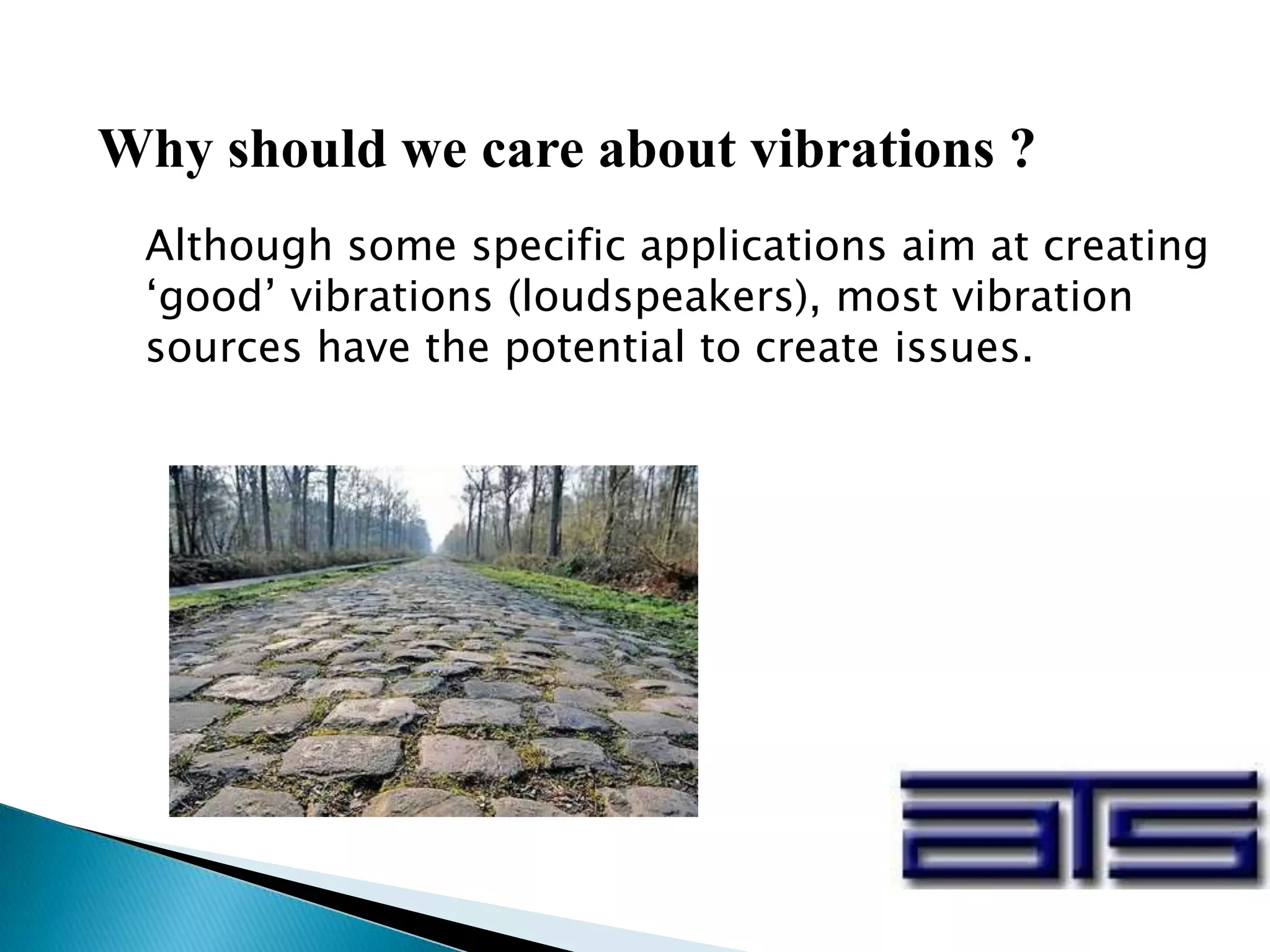
Although some specific applications aim at creating
‘good’ vibrations (loudspeakers), most vibration
sources have the potential to create issues.
Why should we care about vibrations ?
(cont.)
Issues can be of different kinds:
• Functional (CD skip)
• Comfort (squeak, rattle)
• Structural
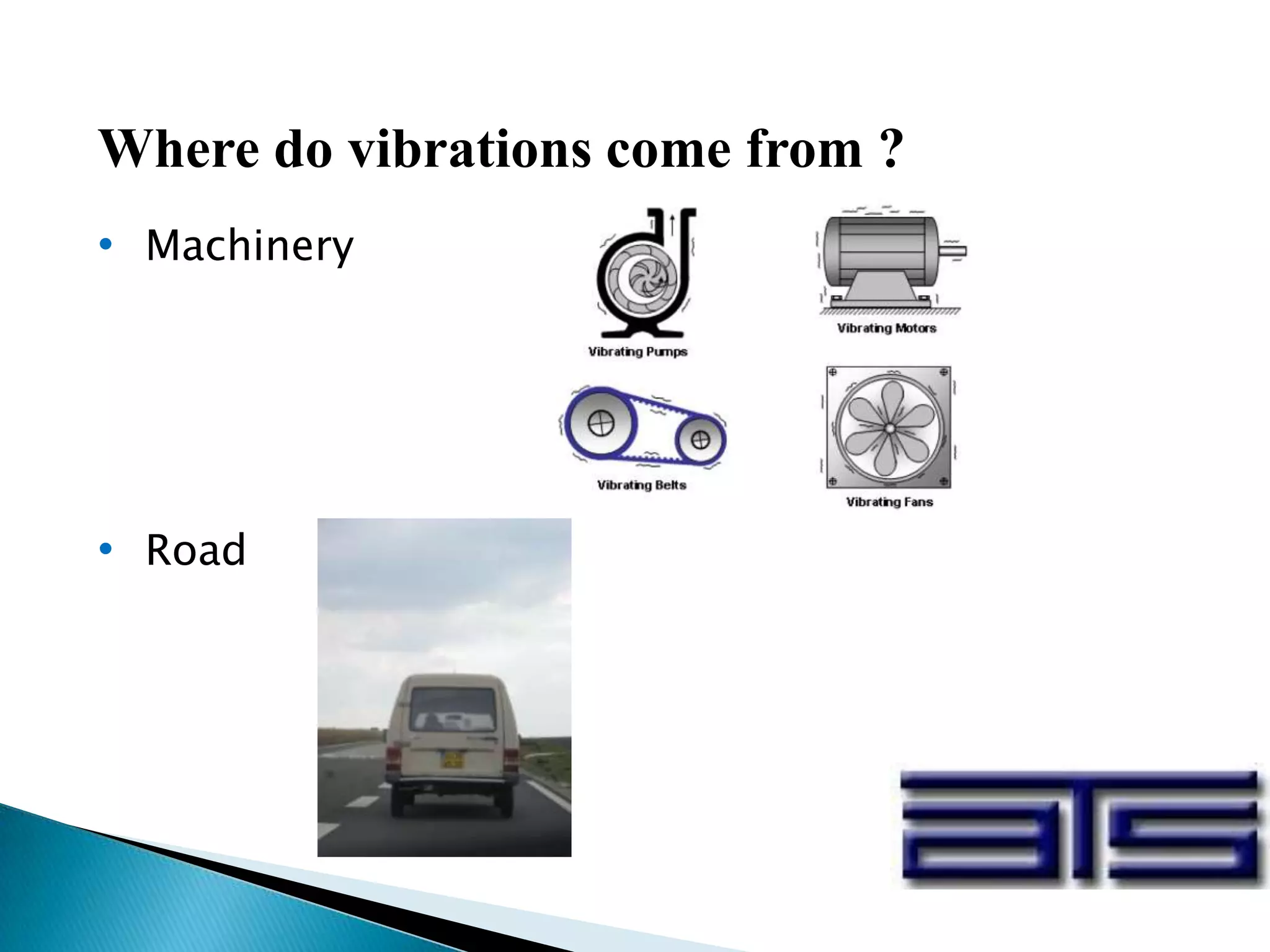
Where do vibrations come from ?
• Machinery
• Road
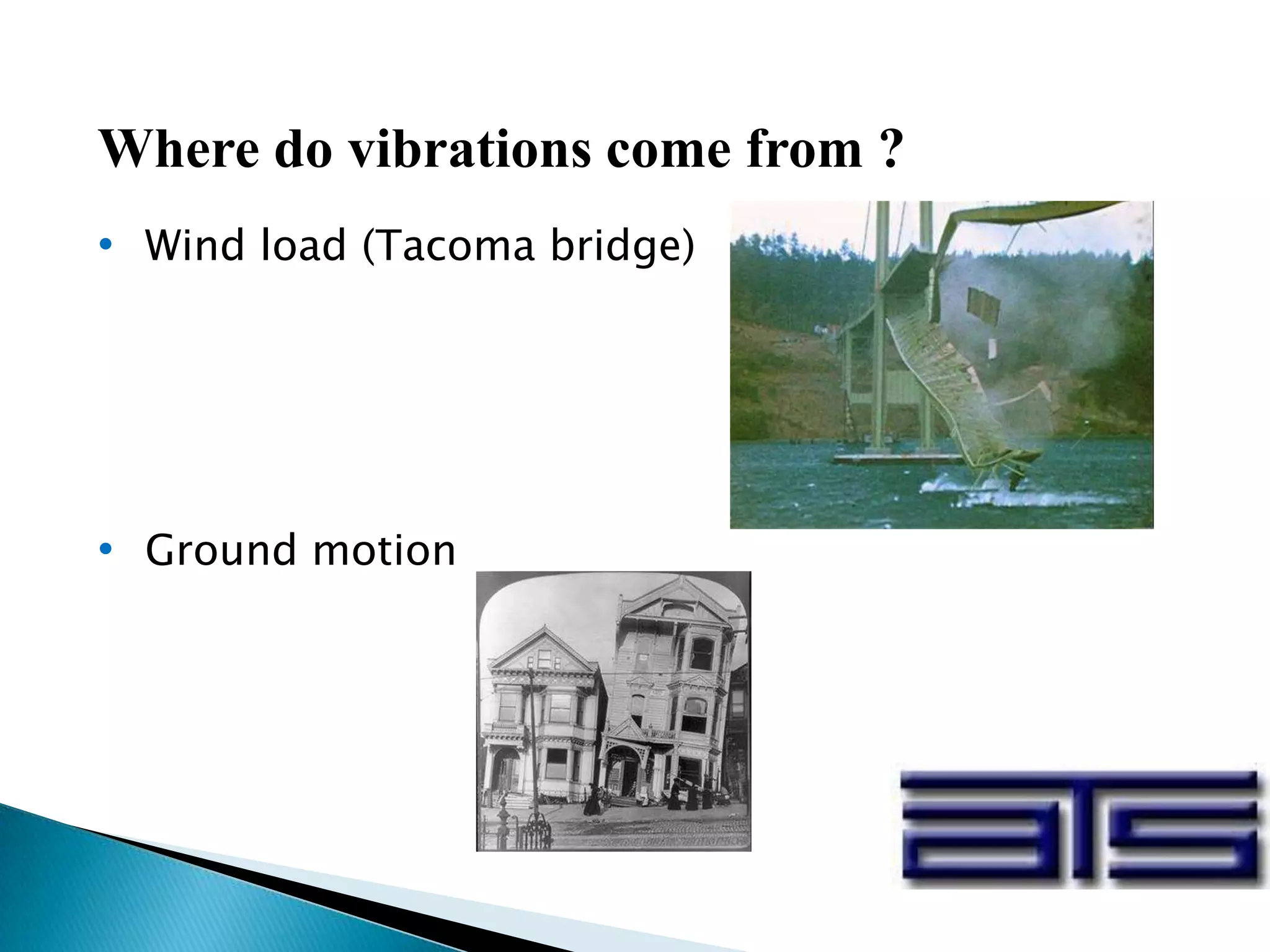
Where do vibrations come from ?
• Wind load (Tacoma bridge)
• Ground motion
What are the different types of vibrations?
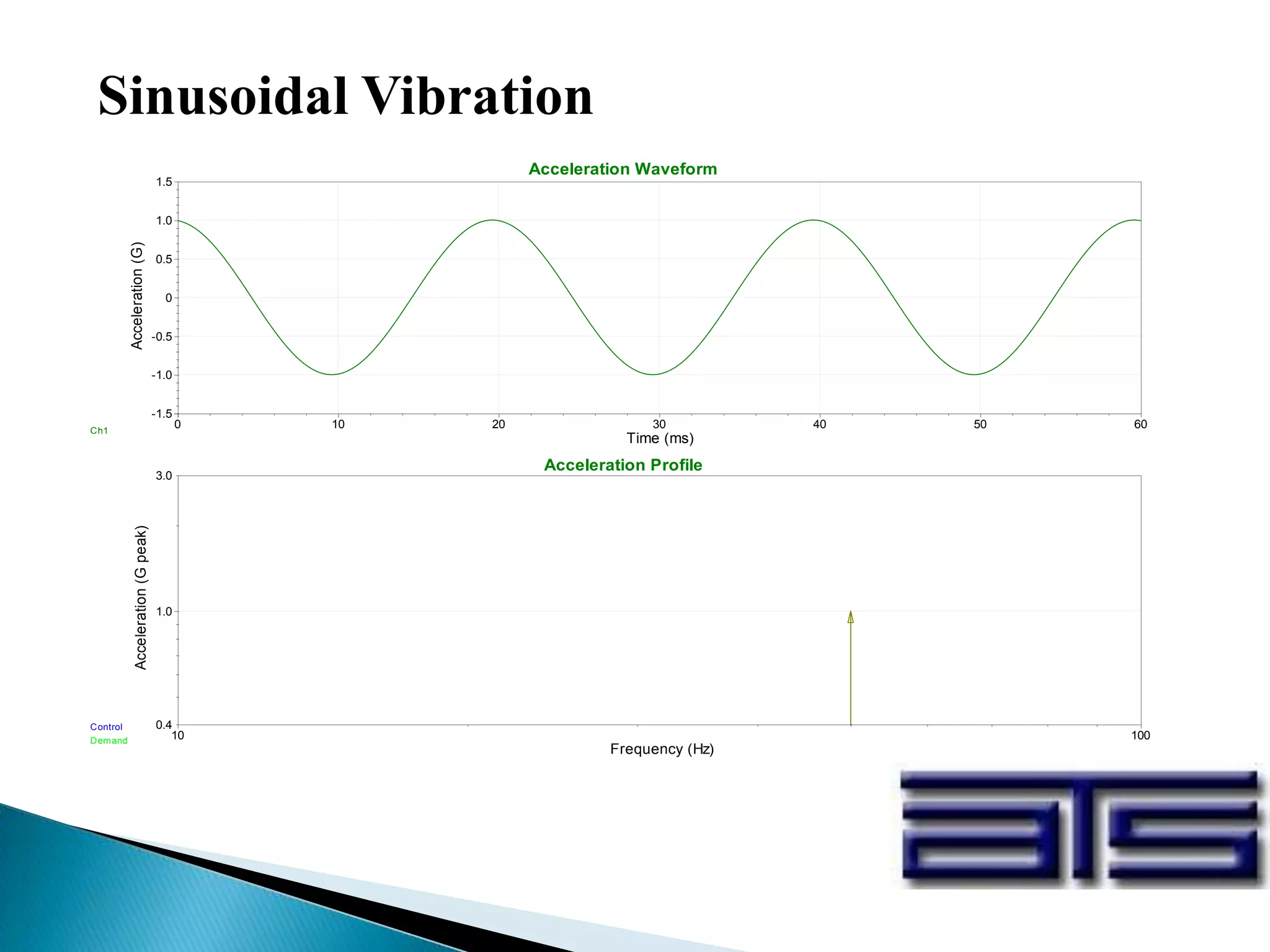
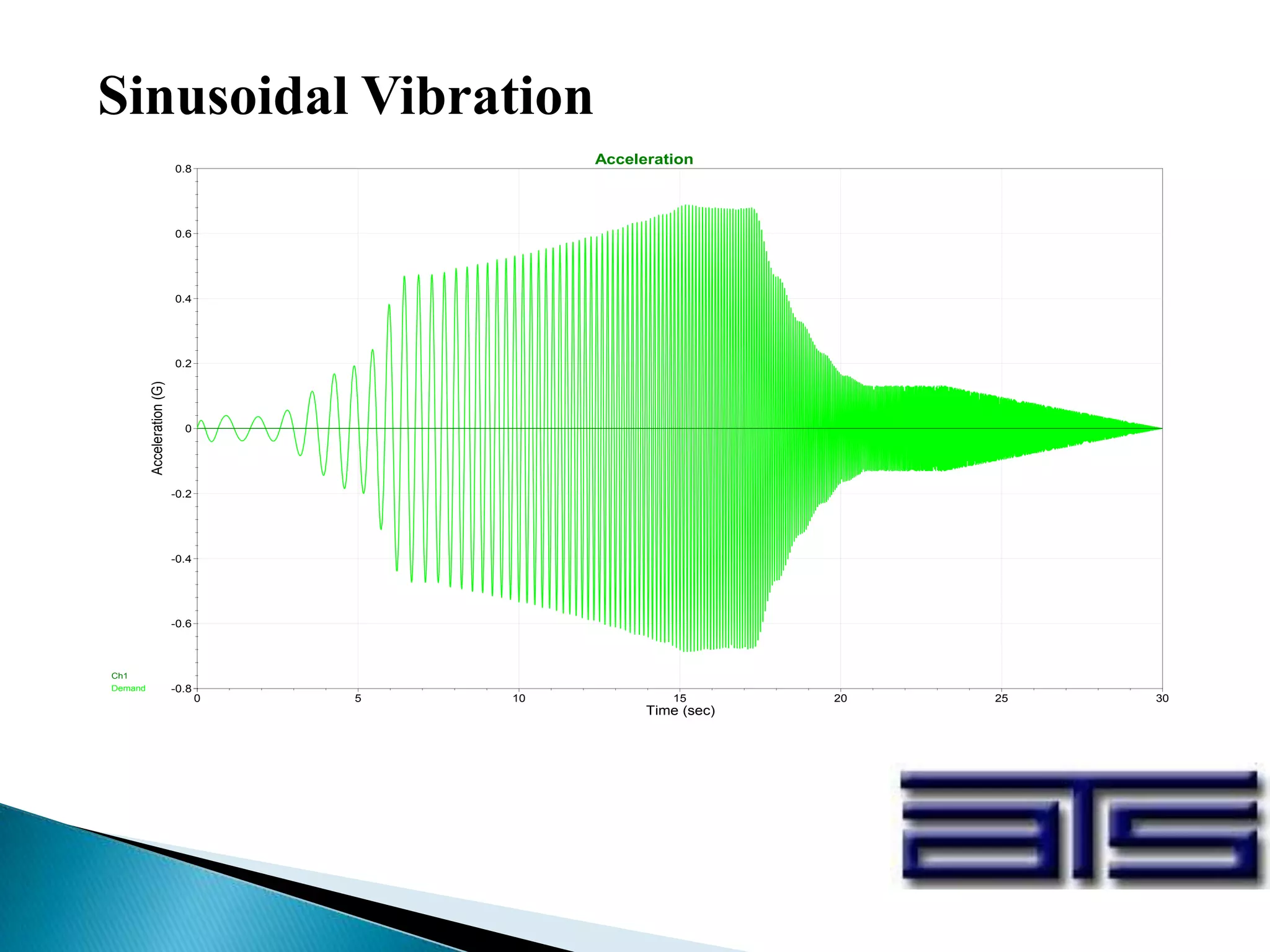
• Sinusoidal vibration
• Most basic
• Simple motion
• One (1) frequency present at any given time
Sinusoidal Vibration
0 10 20 30 40 50 60
-1.5
-1.0
-0.5
0
0.5
1.0
1.5
Time (ms)
Acceleration(G)
Acceleration Waveform
Ch1
10 100
0.4
3.0
1.0
Frequency (Hz)
Acceleration(Gpeak)
Acceleration Profile
Demand
Control
Sinusoidal Vibration
0 5 10 15 20 25 30
-0.8
-0.6
-0.4
-0.2
0
0.2
0.4
0.6
0.8
Time (sec)
Acceleration(G) Acceleration
Demand
Ch1
Sinusoidal Vibration
Sinusoidal Vibration - Quantification
• Typically expressed as:
• Acceleration vs. frequency
• Velocity vs. frequency
• Displacement vs. frequency
• Any combination of the above vs. frequency
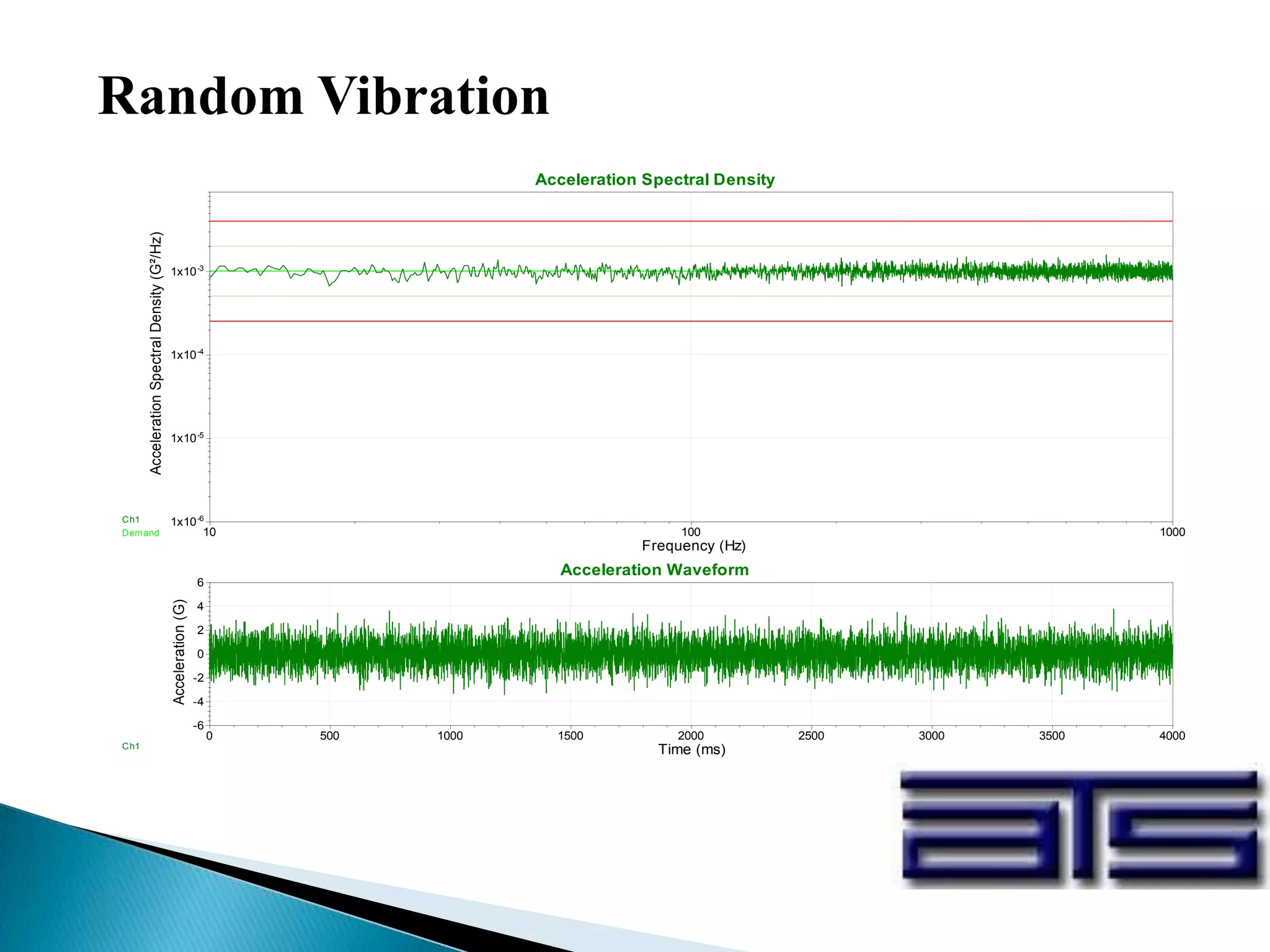
• Random vibration
• ‘Random’ nature due to incapacity to predict
precise vibration level at any given time
• Quantified using statistical tools
• Broadband, multi-frequency content
• More closely match real-world excitations
What are the different types of vibrations?
Random Vibration
10 100 1000
-6
1x10
-5
1x10
-4
1x10
-3
1x10
Frequency (Hz)
AccelerationSpectralDensity(G²/Hz)
Acceleration Spectral Density
Demand
Ch1
0 500 1000 1500 2000 2500 3000 3500 4000
-6
-4
-2
0
2
4
6
Time (ms)
Acceleration(G)
Acceleration Waveform
Ch1
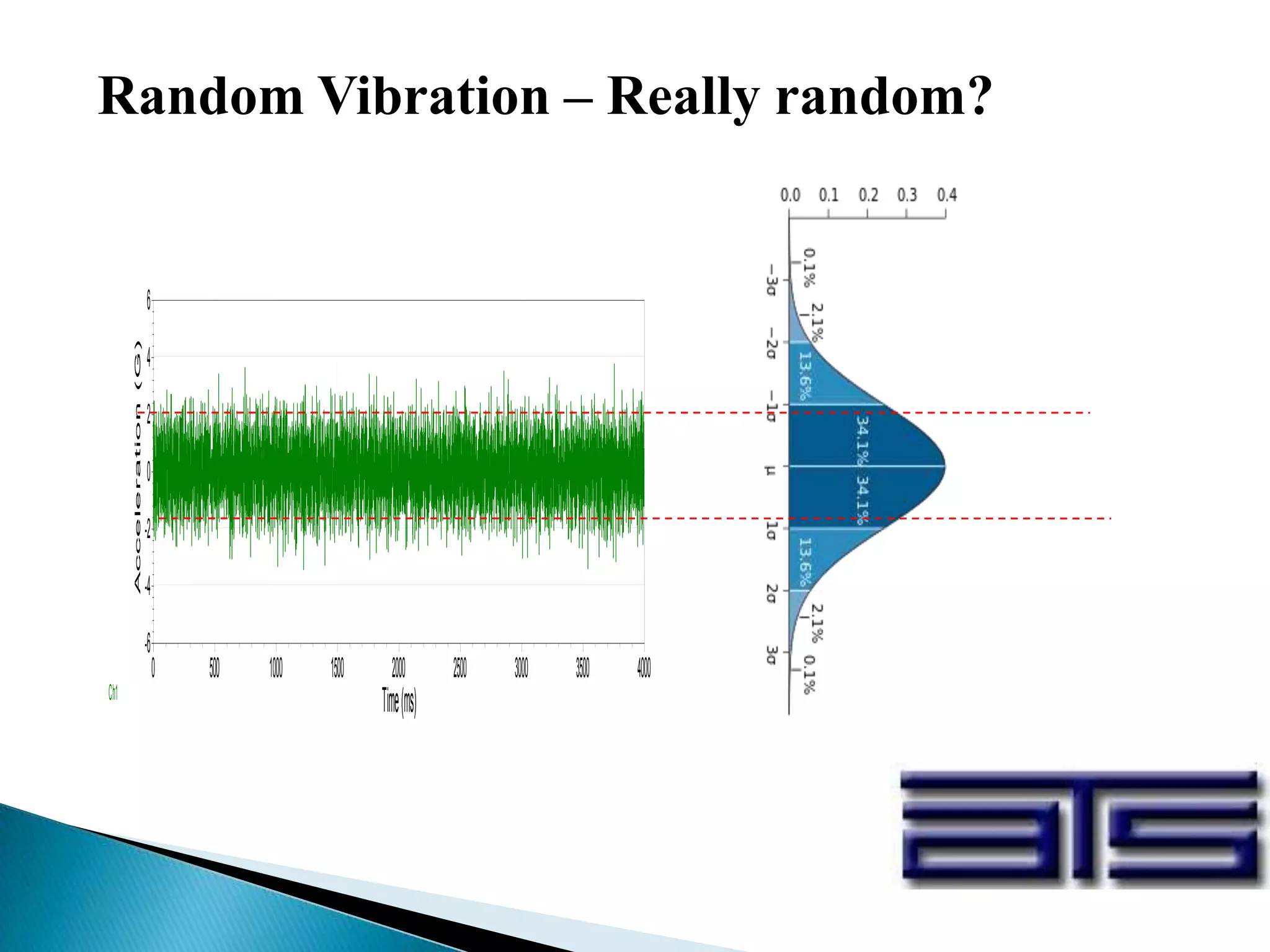
Random Vibration – Really random?
10 100 1000
-6
1x10
Frequency(Hz)
Ac
Demand
Ch1
0 500 1000 1500 2000 2500 3000 3500 4000
-6
-4
-2
0
2
4
6
Time(ms)
Acceleration(G)
AccelerationWaveform
Ch1
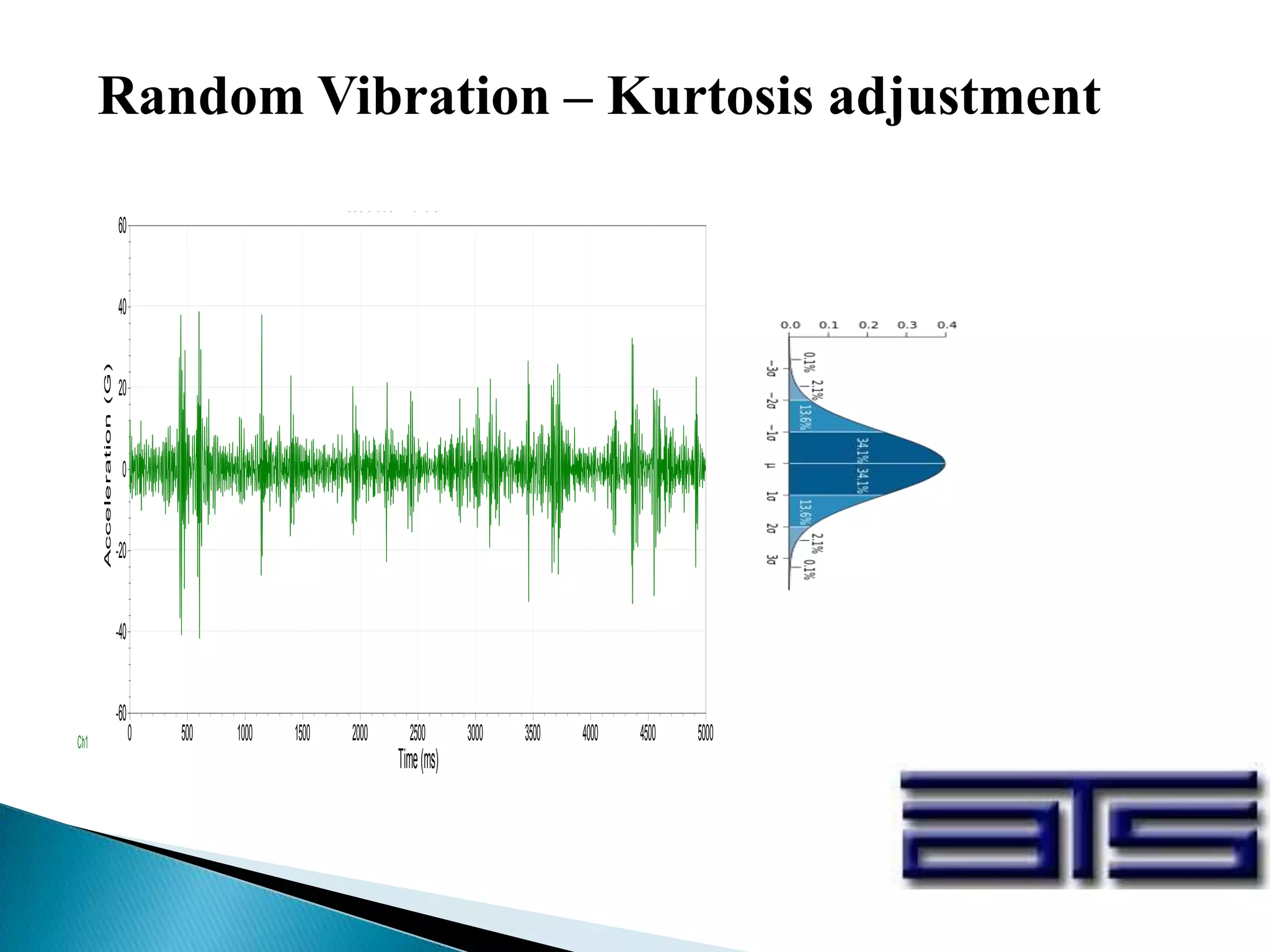
Random Vibration – Kurtosis adjustment50 100
-2
6x10
-1
1x10
Frequency(Hz)
Accelerati
Ch1
0 500 1000 1500 2000 2500 3000 3500 4000 4500 5000
-60
-40
-20
0
20
40
60
Time(ms)
Acceleration(G)
AccelerationWaveform
Ch1
Random Vibration – Quantification
• Expressed as PSD (‘Power Spectral Density’) or ASD
(‘Acceleration Spectral Density’) vs. frequency
• Dimension is g2/Hz (or (m/s2)2xs)
• PSD is the random vibration level, normalized with respect to
the bandwidth of analysis (since dealing with a broadband
excitation)
• Tabulated values will sometimes have a ‘gRMS’ value added:
• This is the overall energy introduced by the random
vibration profile (integrates PSD vs. frequency)
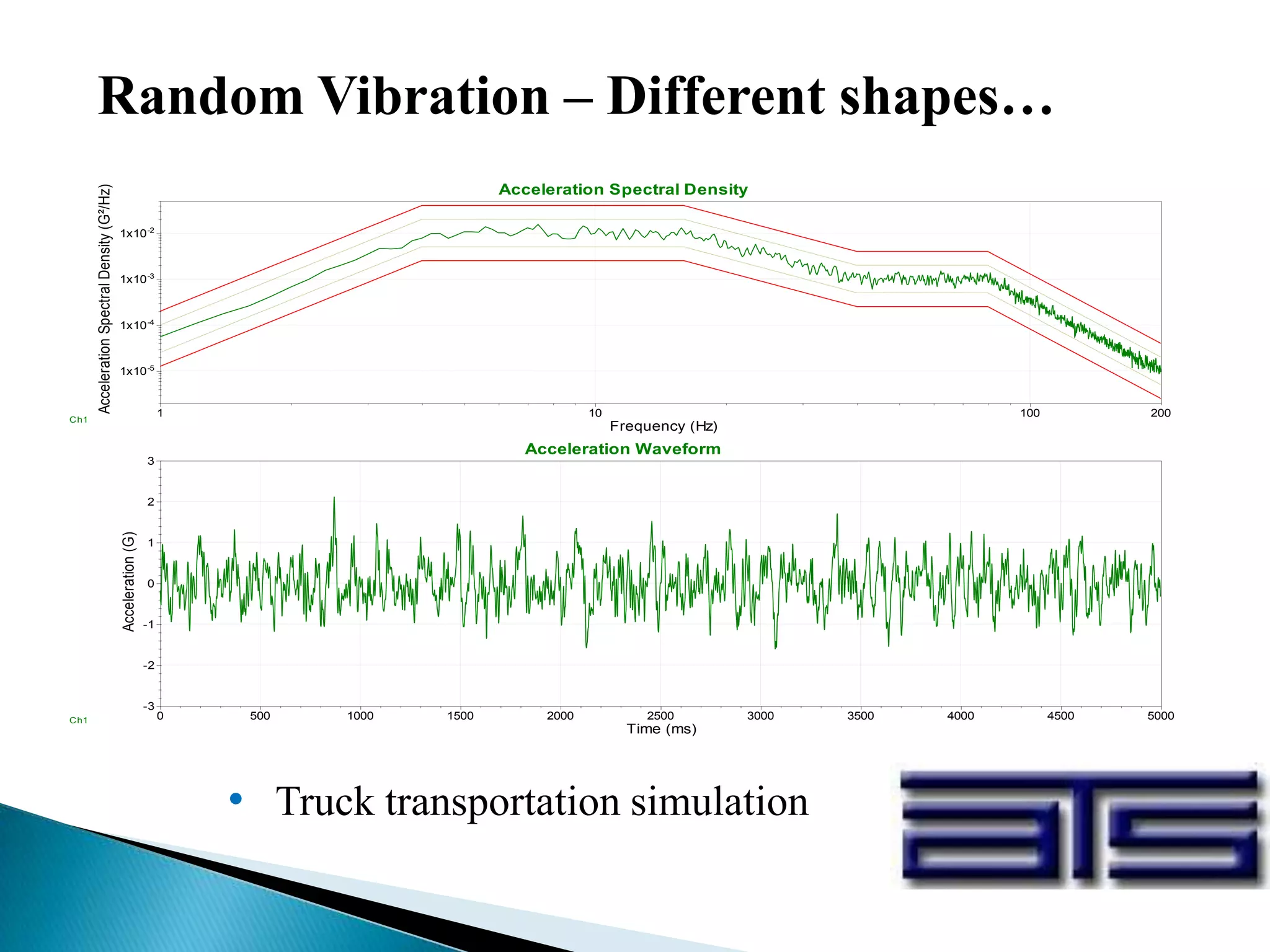
Random Vibration – Different shapes…
2001 10 100
-5
1x10
-4
1x10
-3
1x10
-2
1x10
Frequency (Hz)
AccelerationSpectralDensity(G²/Hz)
Acceleration Spectral Density
Ch1
0 500 1000 1500 2000 2500 3000 3500 4000 4500 5000
-3
-2
-1
0
1
2
3
Time (ms)
Acceleration(G)
Acceleration Waveform
Ch1
• Truck transportation simulation
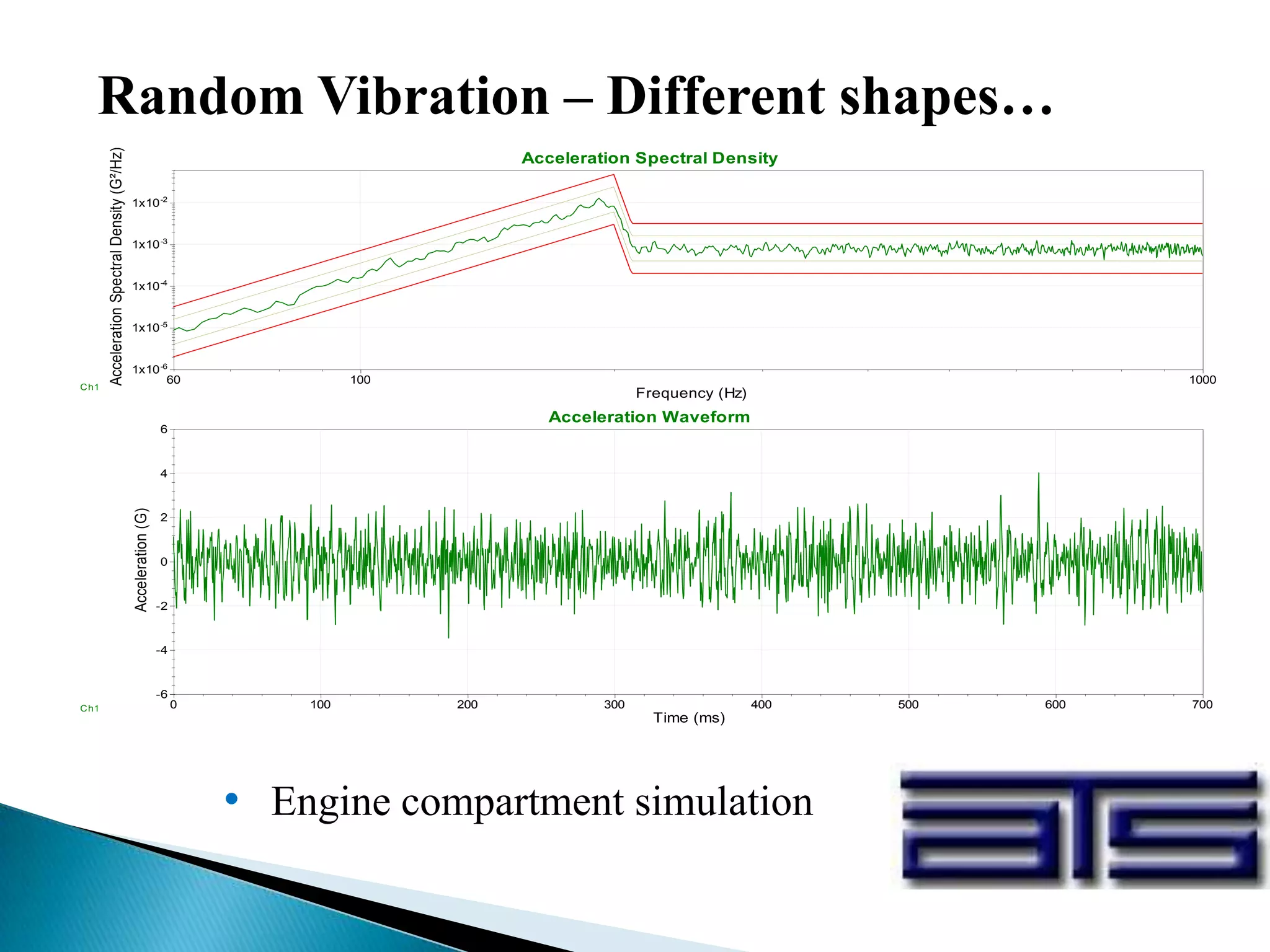
Random Vibration – Different shapes…
• Engine compartment simulation
60 100 1000
-6
1x10
-5
1x10
-4
1x10
-3
1x10
-2
1x10
Frequency (Hz)
AccelerationSpectralDensity(G²/Hz)
Acceleration Spectral Density
Ch1
0 100 200 300 400 500 600 700
-6
-4
-2
0
2
4
6
Time (ms)
Acceleration(G)
Acceleration Waveform
Ch1
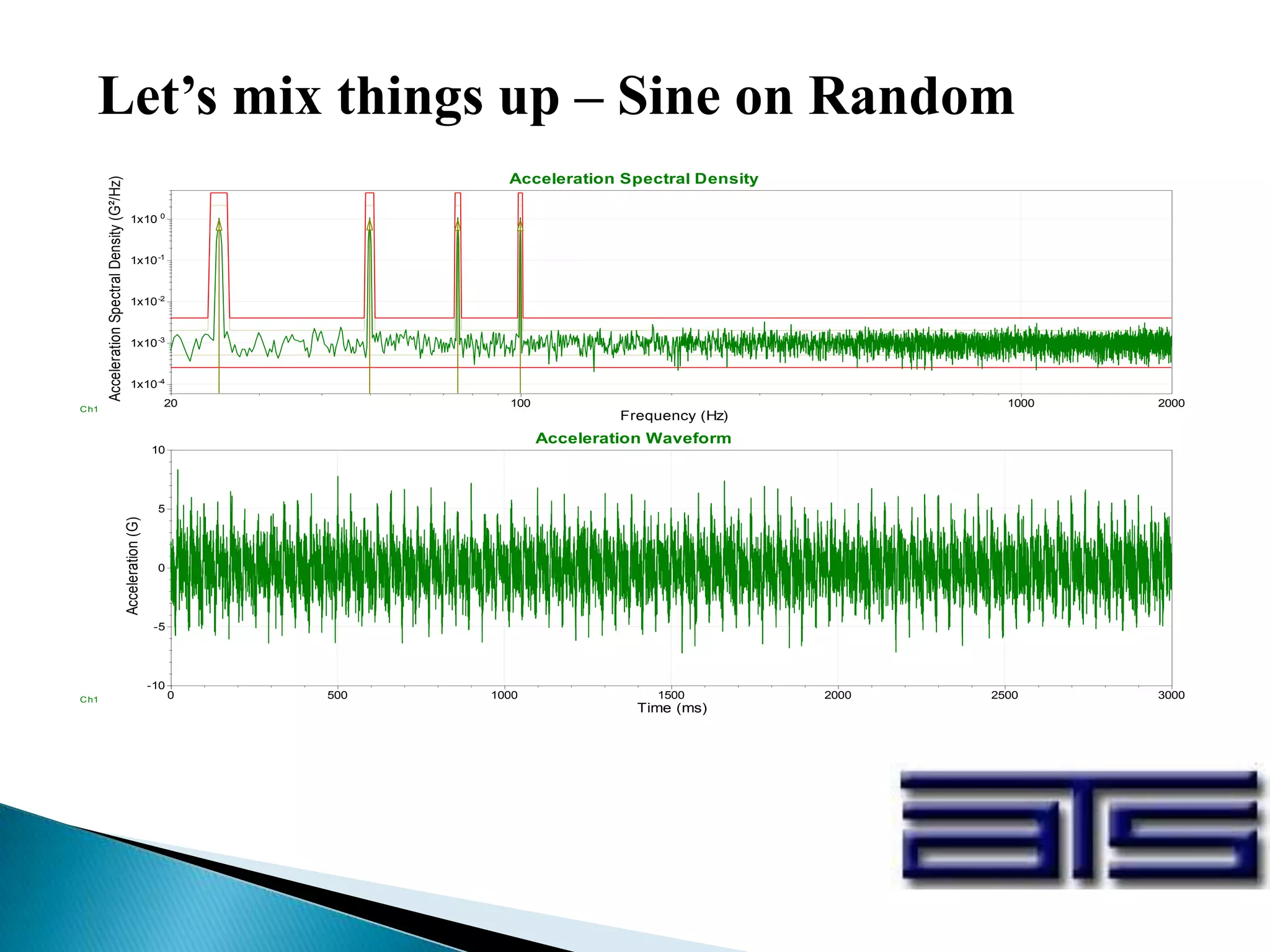
Let’s mix things up – Sine on Random
• Add discreet sinusoidal vibration tones to a broadband
random vibration background
• Typical of helicopter and propeller aircraft applications
(known blade passing frequencies on a random
background)
Let’s mix things up – Sine on Random
20 2000100 1000
-4
1x10
-3
1x10
-2
1x10
-1
1x10
0
1x10
Frequency (Hz)
AccelerationSpectralDensity(G²/Hz)
Acceleration Spectral Density
Ch1
0 500 1000 1500 2000 2500 3000
-10
-5
0
5
10
Time (ms)
Acceleration(G)
Acceleration Waveform
Ch1
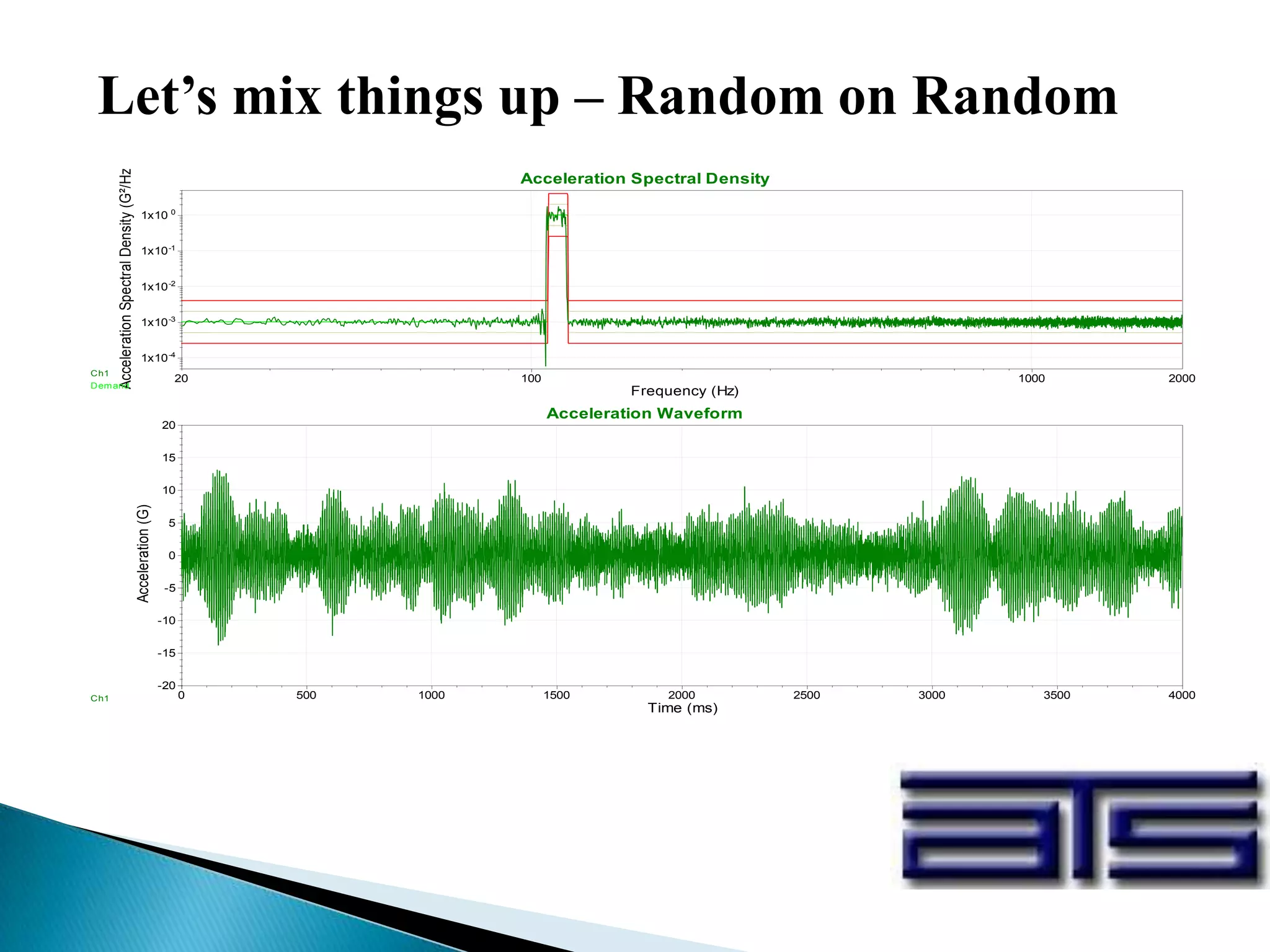
Let’s mix things up – Random on Random
• Add narrowband random content onto a broadband
random background
• Typical of tracked vehicles (military)
• Narrowband content is swept across a frequency range
to reflect speed changes
Let’s mix things up – Random on Random
20 2000100 1000
-4
1x10
-3
1x10
-2
1x10
-1
1x10
0
1x10
Frequency (Hz)
AccelerationSpectralDensity(G²/Hz)
Acceleration Spectral Density
Demand
Ch1
0 500 1000 1500 2000 2500 3000 3500 4000
-20
-15
-10
-5
0
5
10
15
20
Time (ms)
Acceleration(G)
Acceleration Waveform
Ch1
Random vibration vs. Transients…
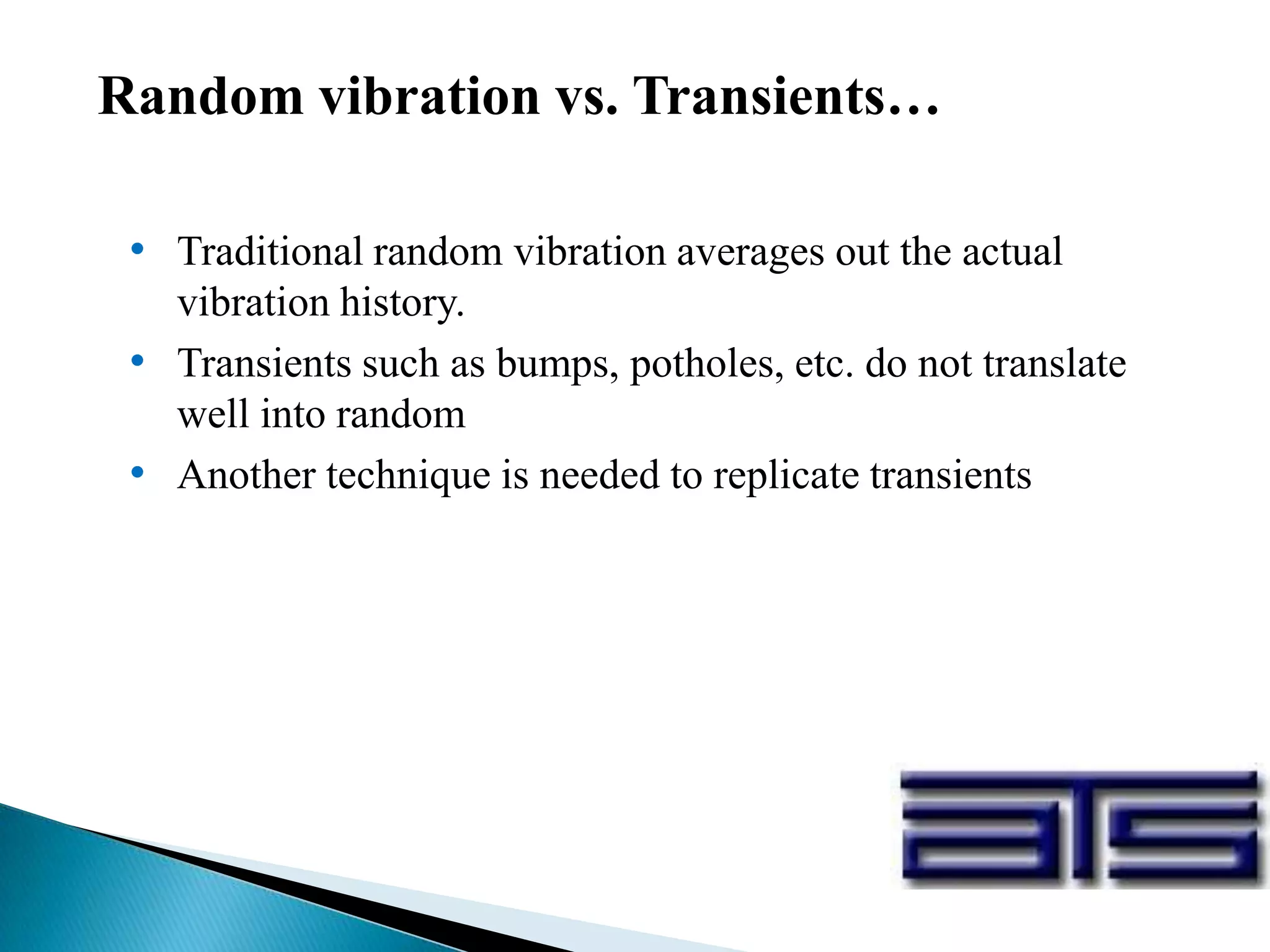
• Traditional random vibration averages out the actual
vibration history.
• Transients such as bumps, potholes, etc. do not translate
well into random
• Another technique is needed to replicate transients
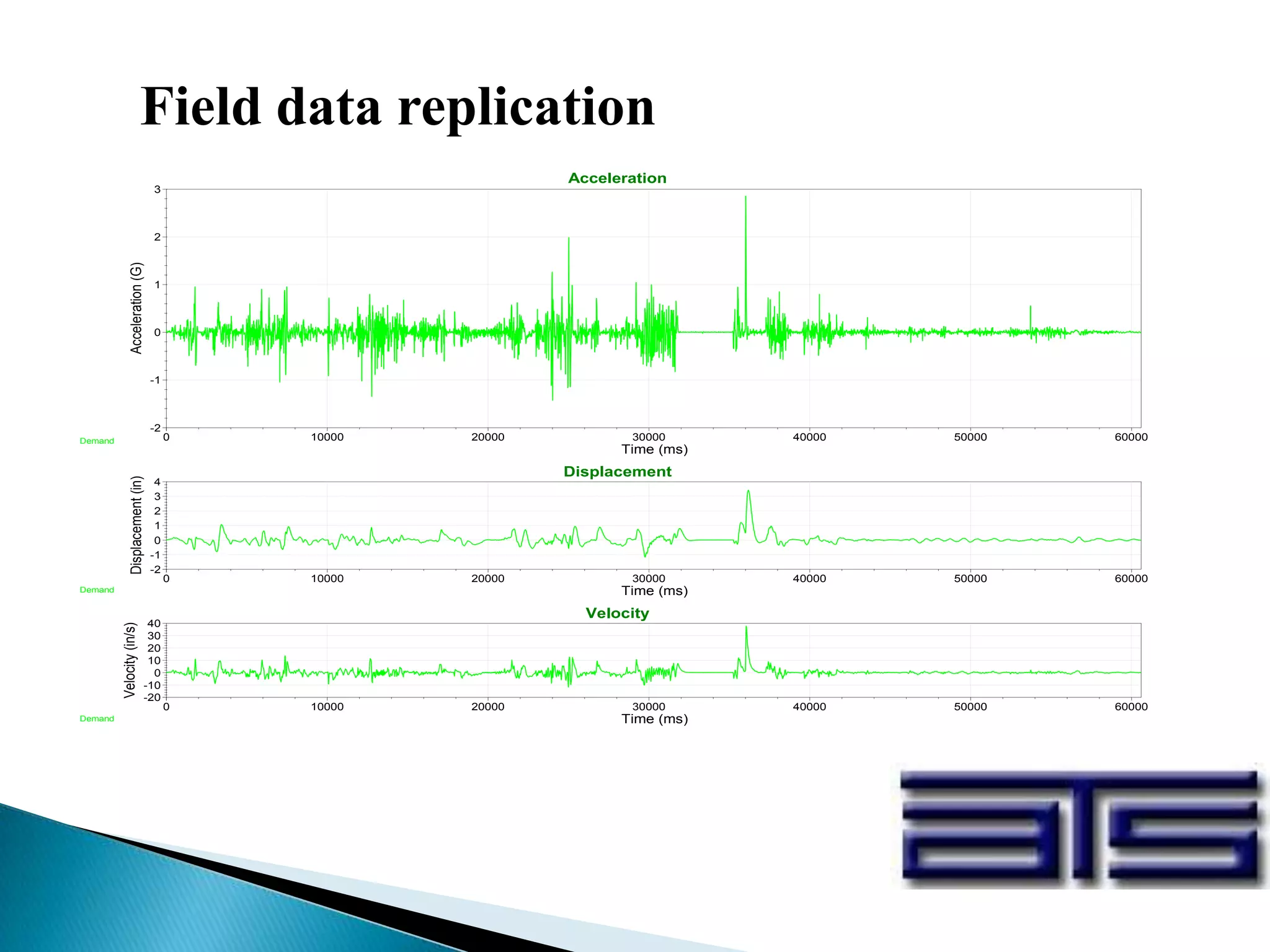
• Field data replication
• Data collected in the field (acceleration vs. time)
is directly played back and repeated in the lab
What are the different types of vibrations?
Field data replication
0 10000 20000 30000 40000 50000 60000
-2
-1
0
1
2
3
Time (ms)
Acceleration(G)
Acceleration
Demand
0 10000 20000 30000 40000 50000 60000
-2
-1
0
1
2
3
4
Time (ms)
Displacement(in)
Displacement
Demand
0 10000 20000 30000 40000 50000 60000
-20
-10
0
10
20
30
40
Time (ms)
Velocity(in/s)
Velocity
Demand
How are vibrations replicated in the lab?
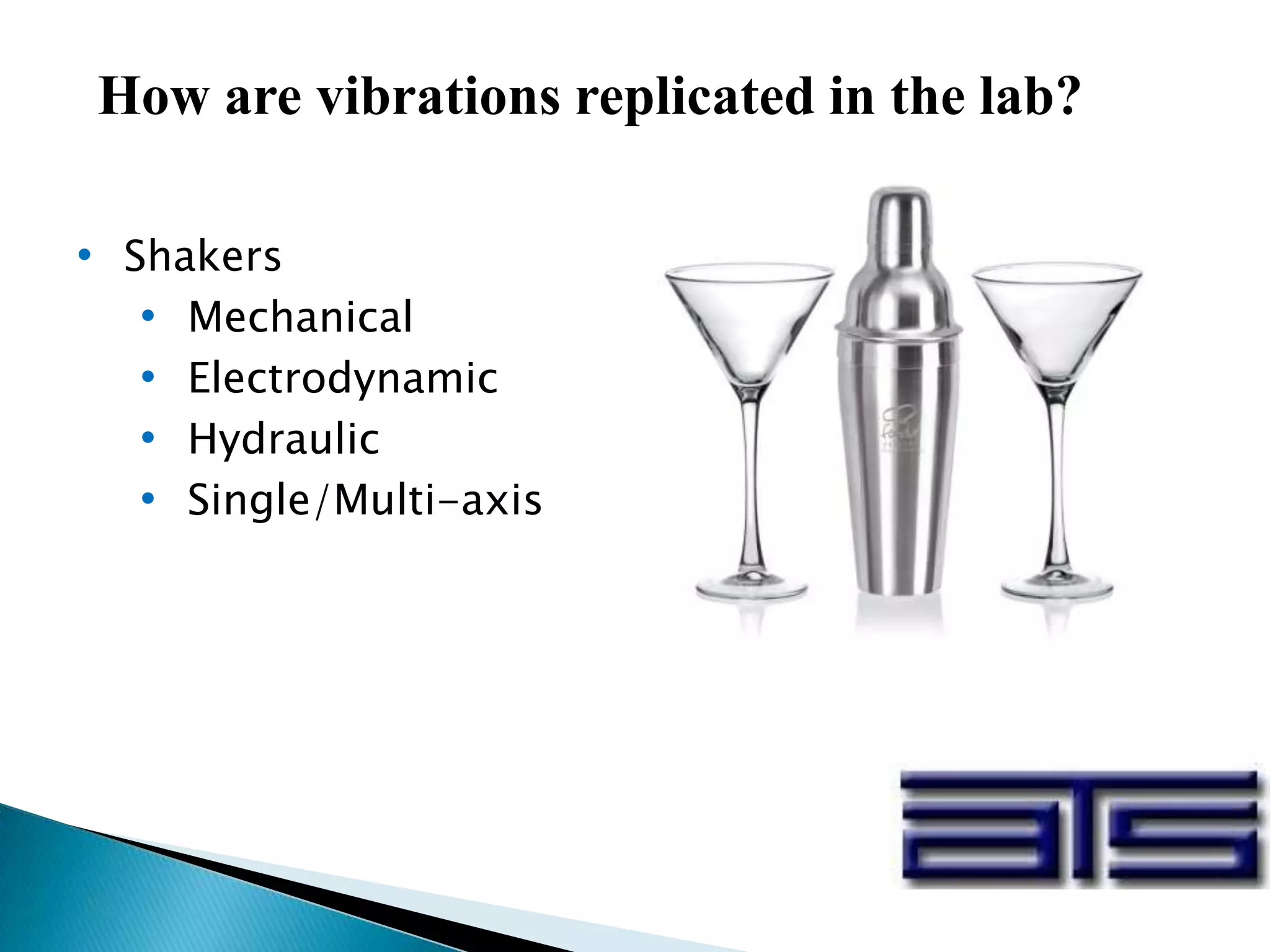
• Shakers
• Mechanical
• Electrodynamic
• Hydraulic
• Single/Multi-axis
How are vibrations replicated in the lab?
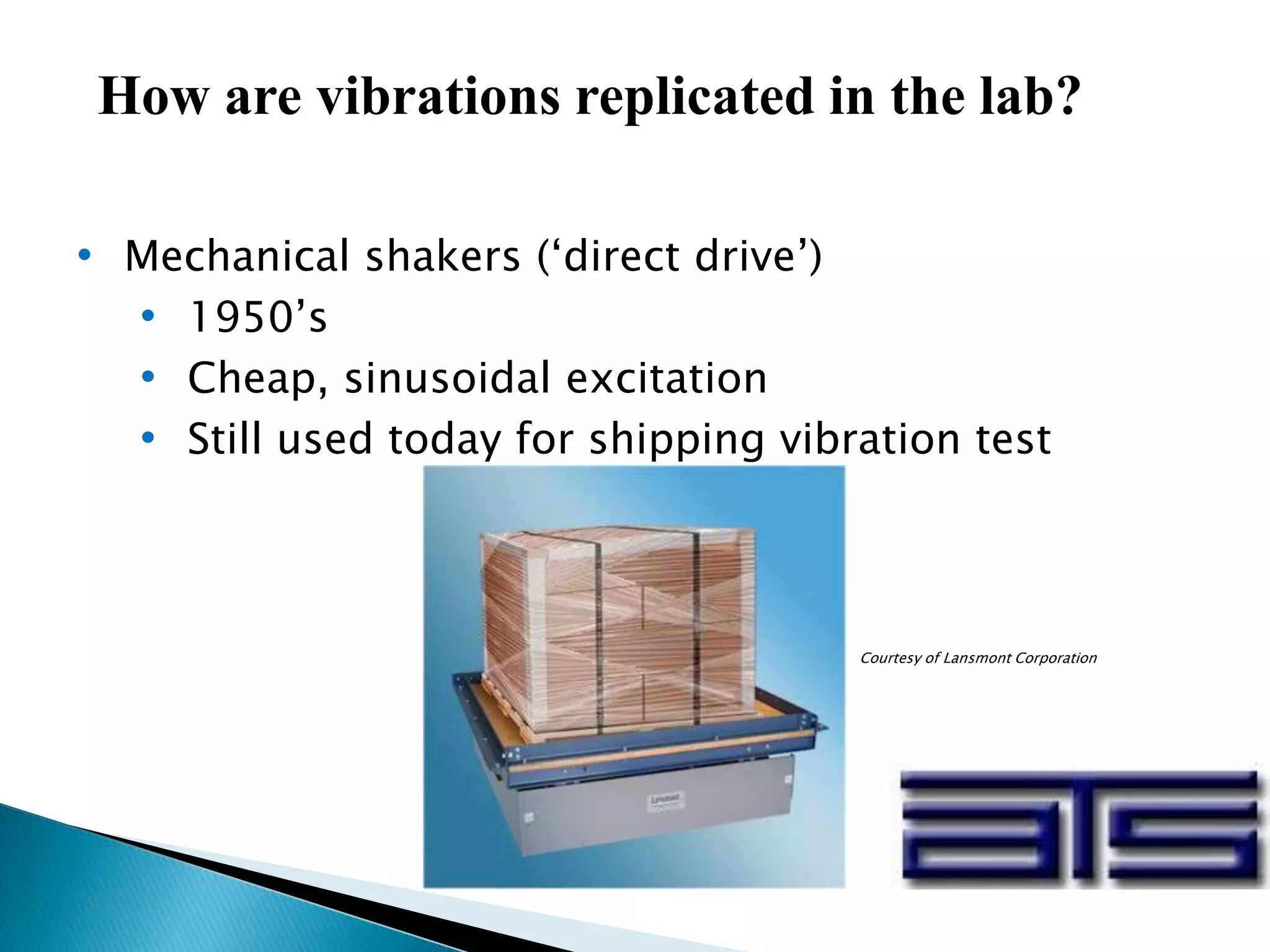
• Mechanical shakers (‘direct drive’)
• 1950’s
• Cheap, sinusoidal excitation
• Still used today for shipping vibration test
Courtesy of Lansmont Corporation
How are vibrations replicated in the lab?
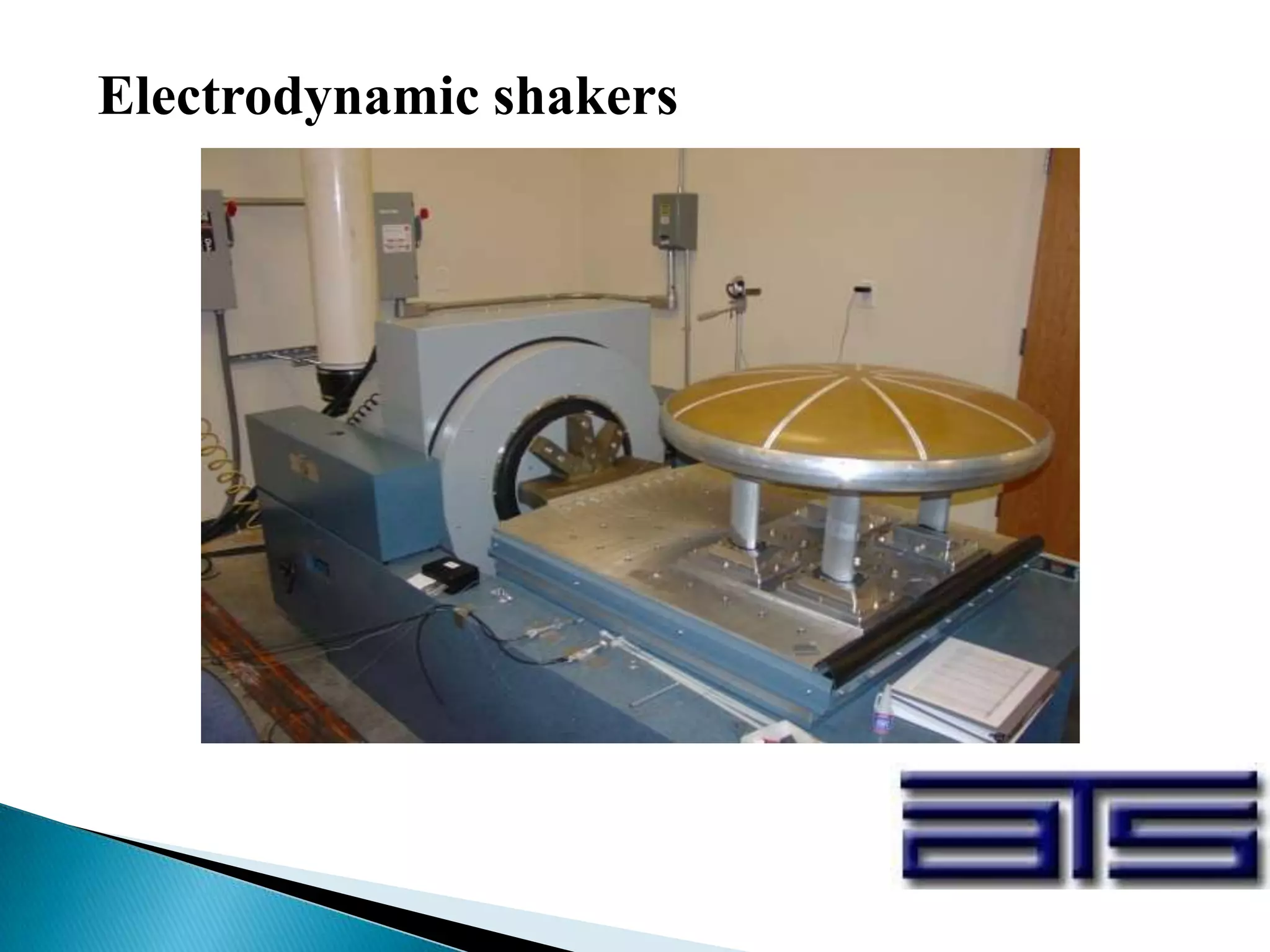
• Electrodynamic shakers
• Make most of the fleet of commercial test labs
• Sequential, single-axis excitation
• Big, highly-controlled ‘loudspeakers’
• Come in various sizes and shapes (sliptable)
• Rated in lbf
• Payload and severity counterbalance each
other
Electrodynamic shakers
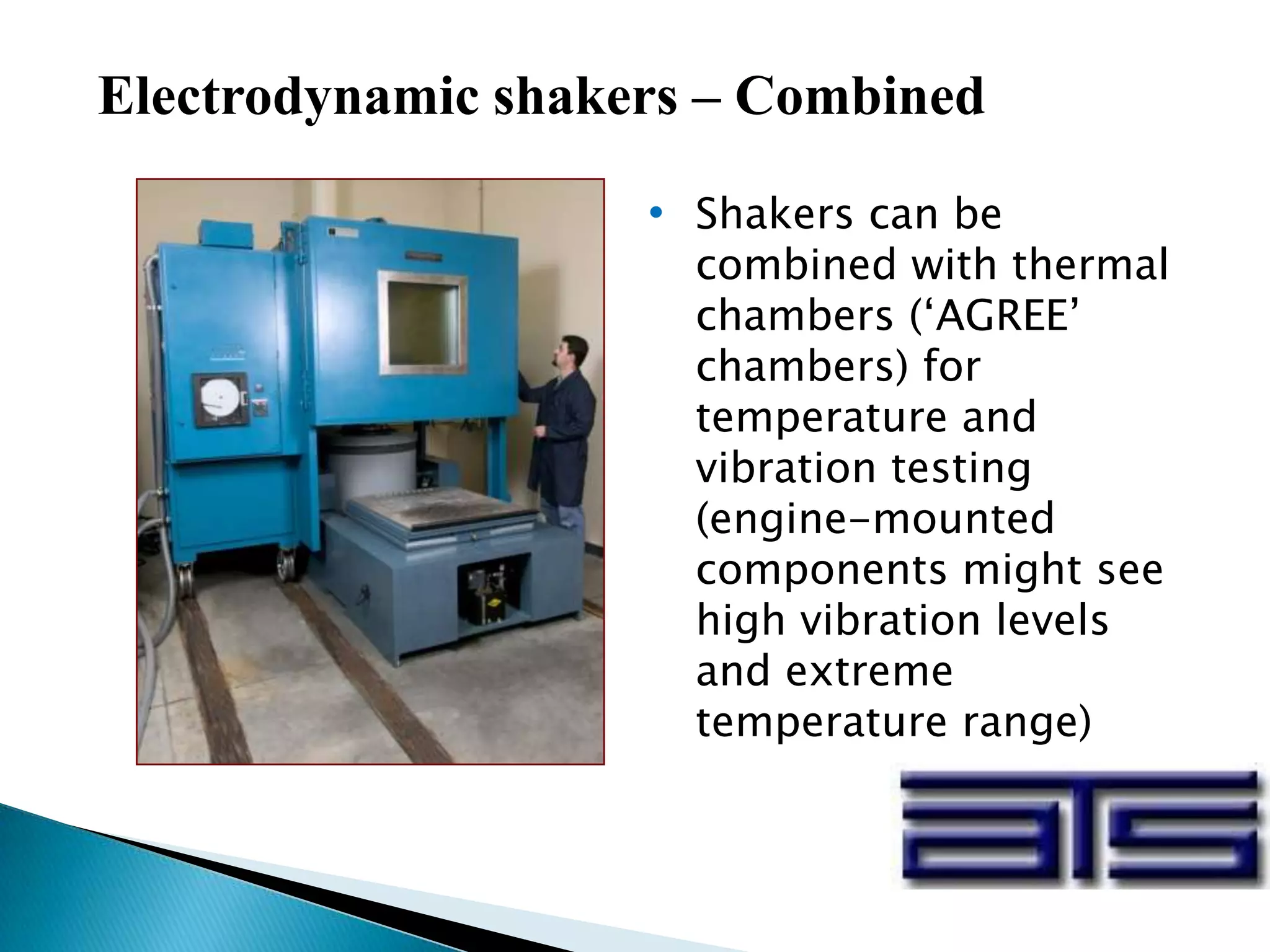
Electrodynamic shakers – Combined
• Shakers can be
combined with thermal
chambers (‘AGREE’
chambers) for
temperature and
vibration testing
(engine-mounted
components might see
high vibration levels
and extreme
temperature range)
Electrodynamic shakers
• Medium to high frequency range (typically from
5Hz to 2,000Hz)
• Low available displacement (2” peak-to-peak)
Electrodynamic shakers
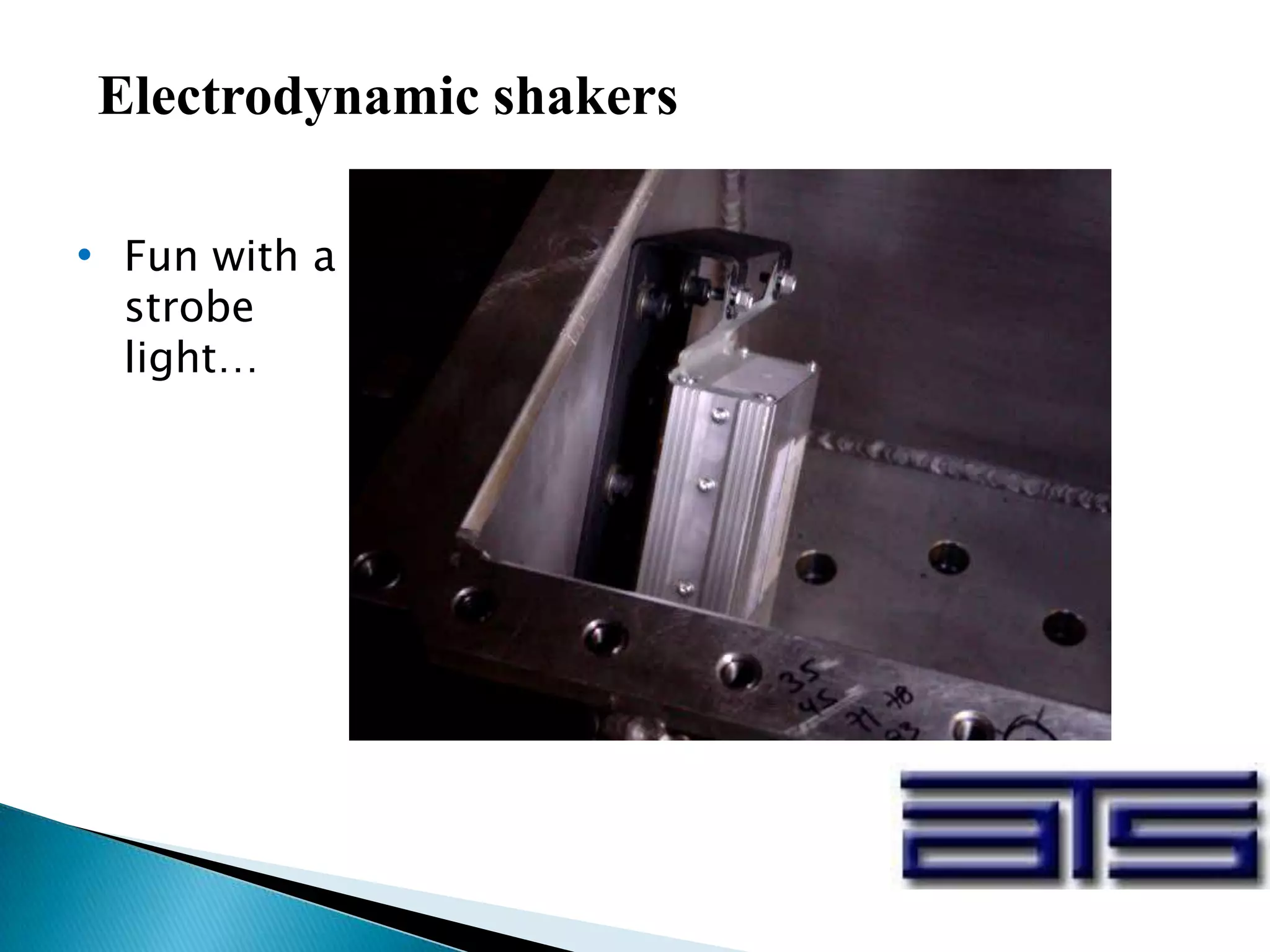
• Fun with a
strobe
light…
Hydraulic shakers
• Low frequency range (typically 1Hz to 100Hz)
• High available displacement (10” or 12” peak-to-
peak)
• Often offer the highest force rating for the buck
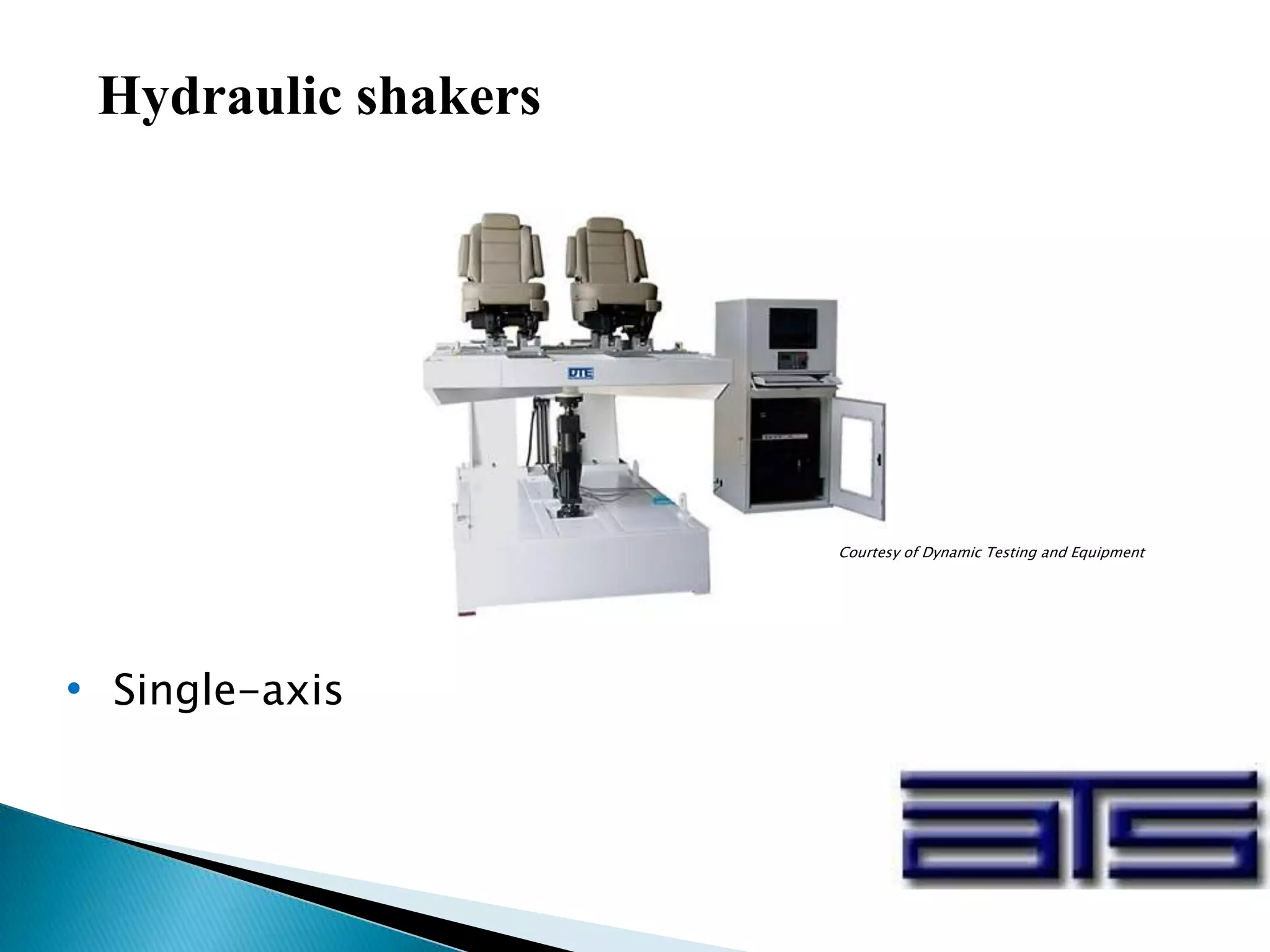
Hydraulic shakers
• Single-axis
Courtesy of Dynamic Testing and Equipment
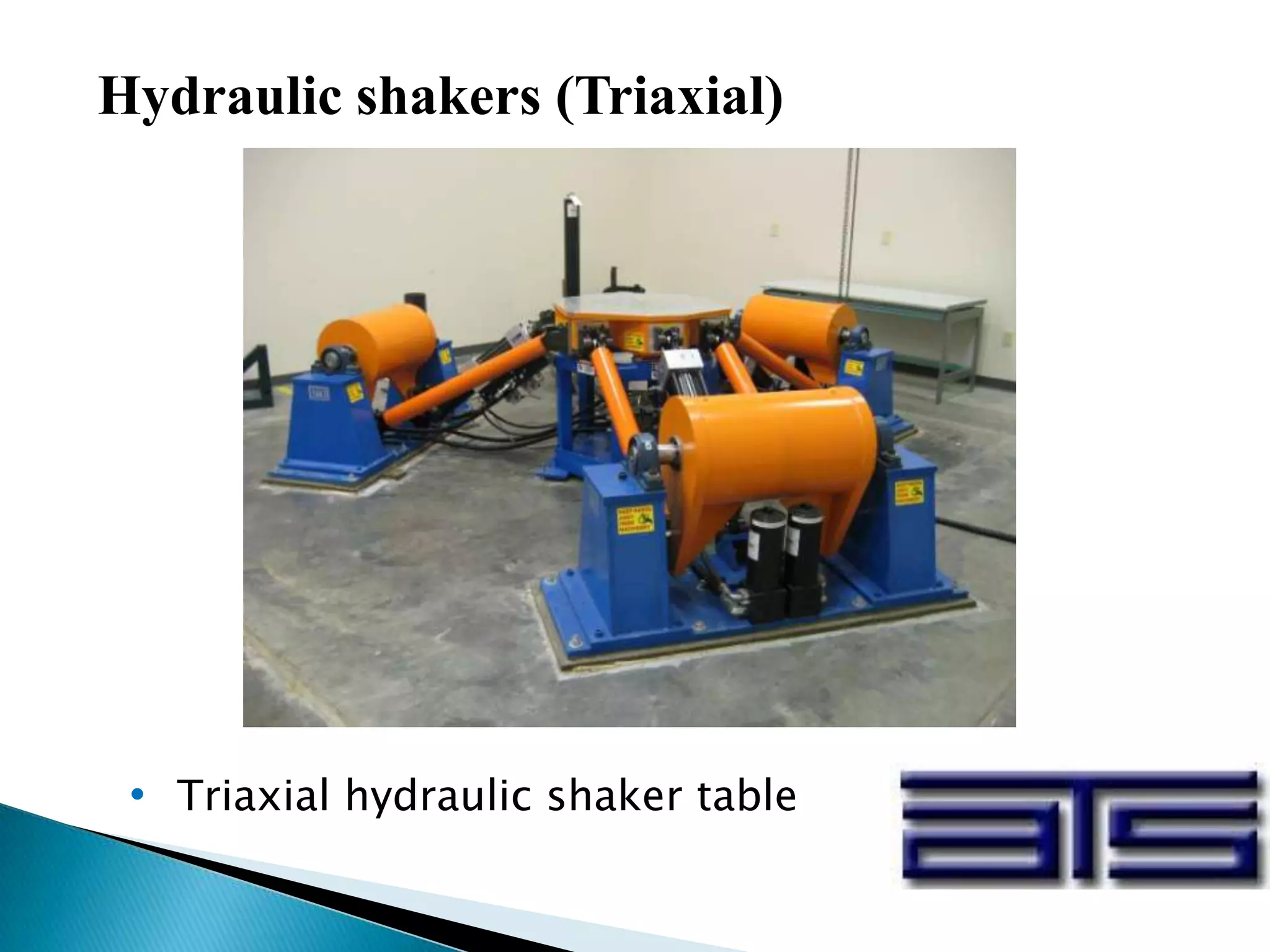
Hydraulic shakers (Triaxial)
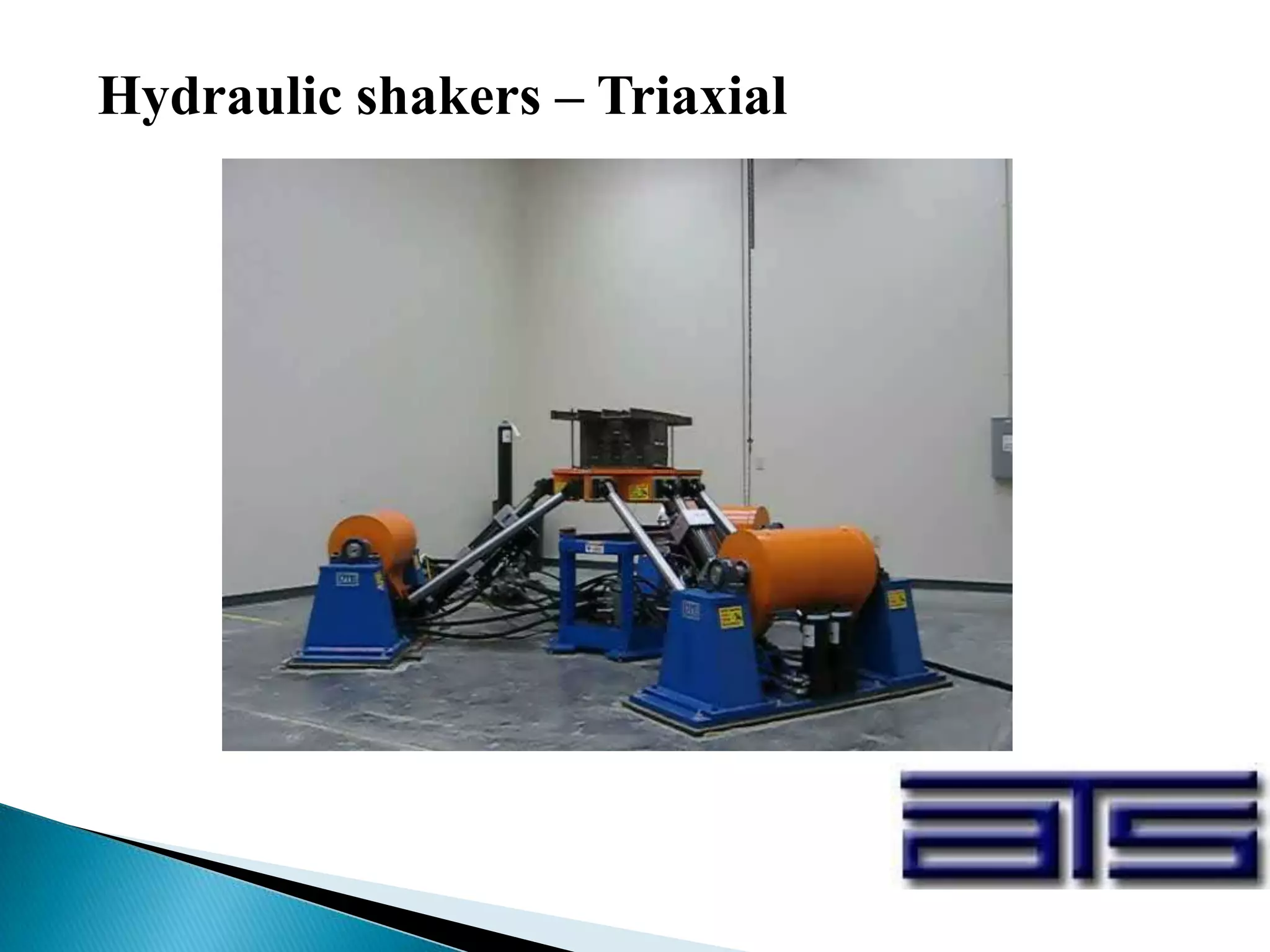
• Triaxial hydraulic shaker table
Hydraulic shakers – Triaxial
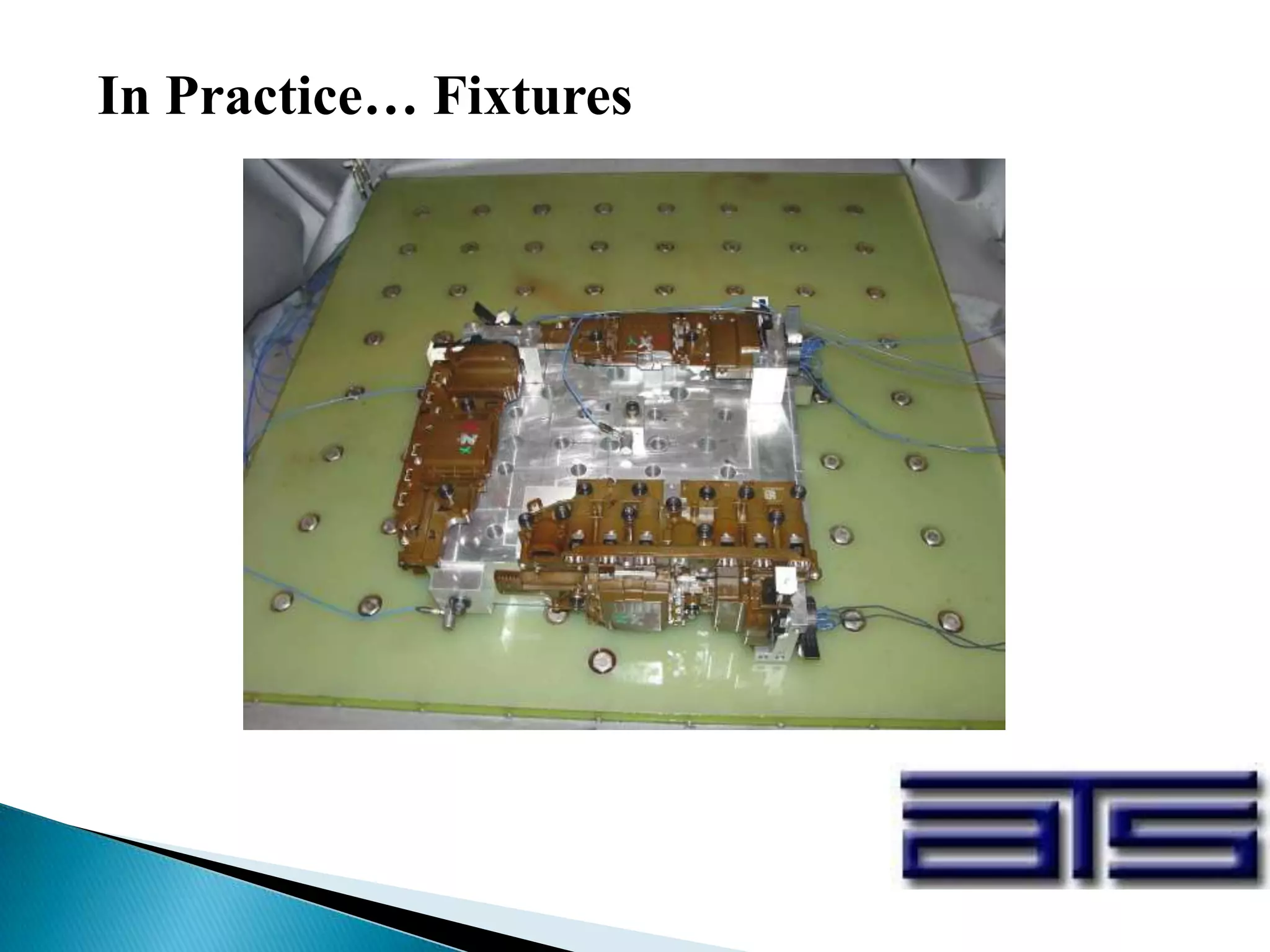
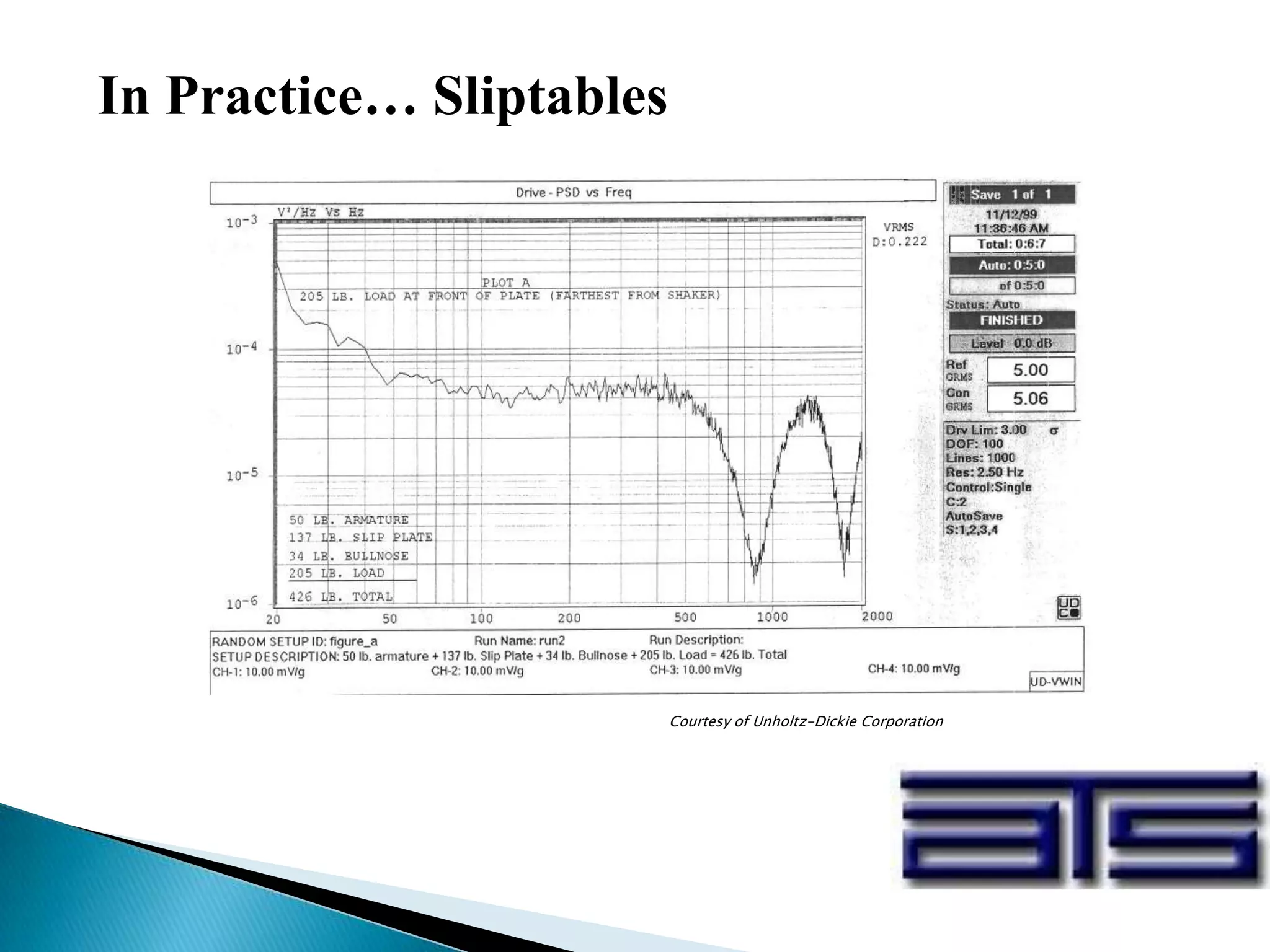
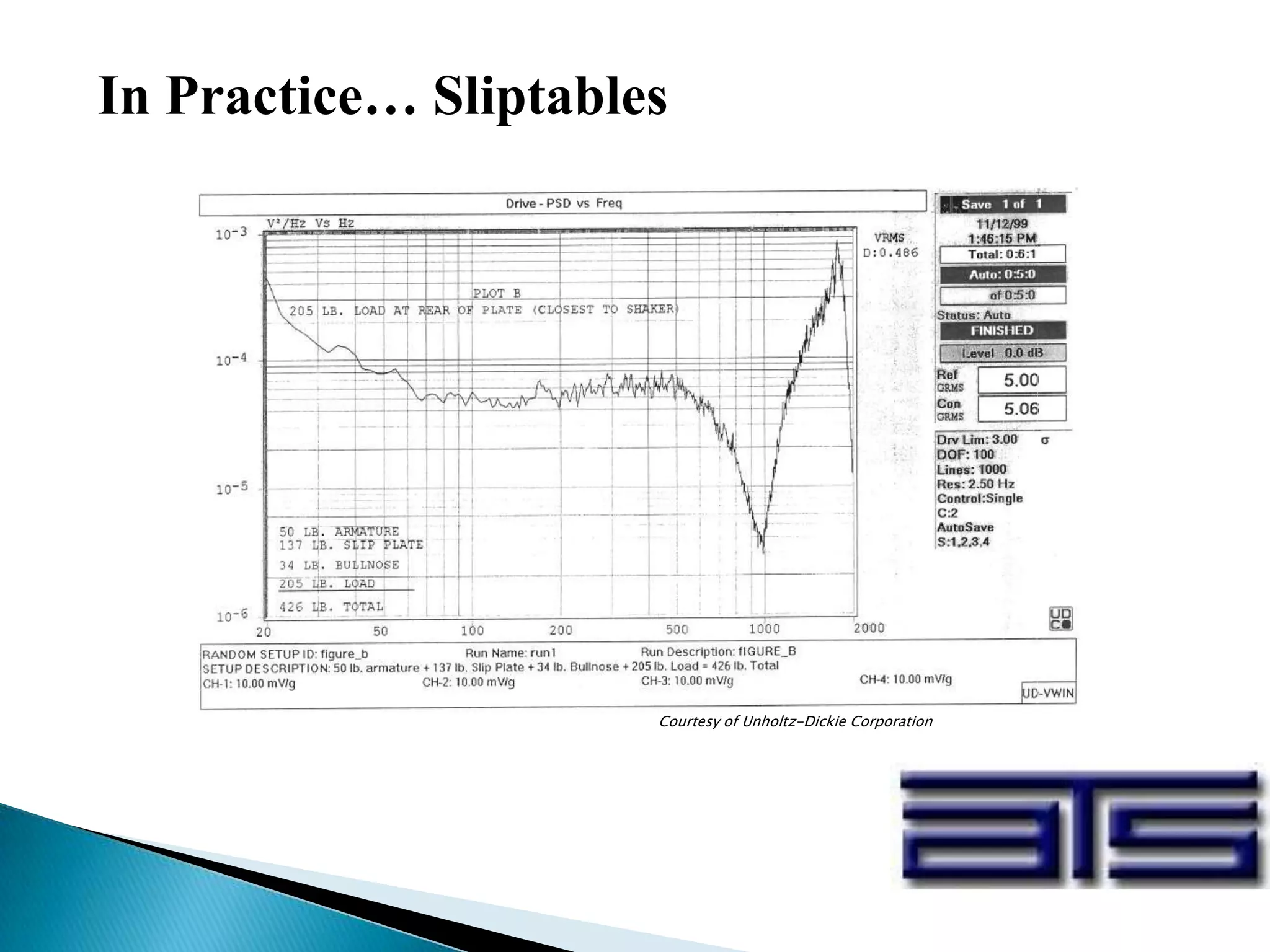
In Practice…
• Fixtures…
• Position of the control accelerometer…
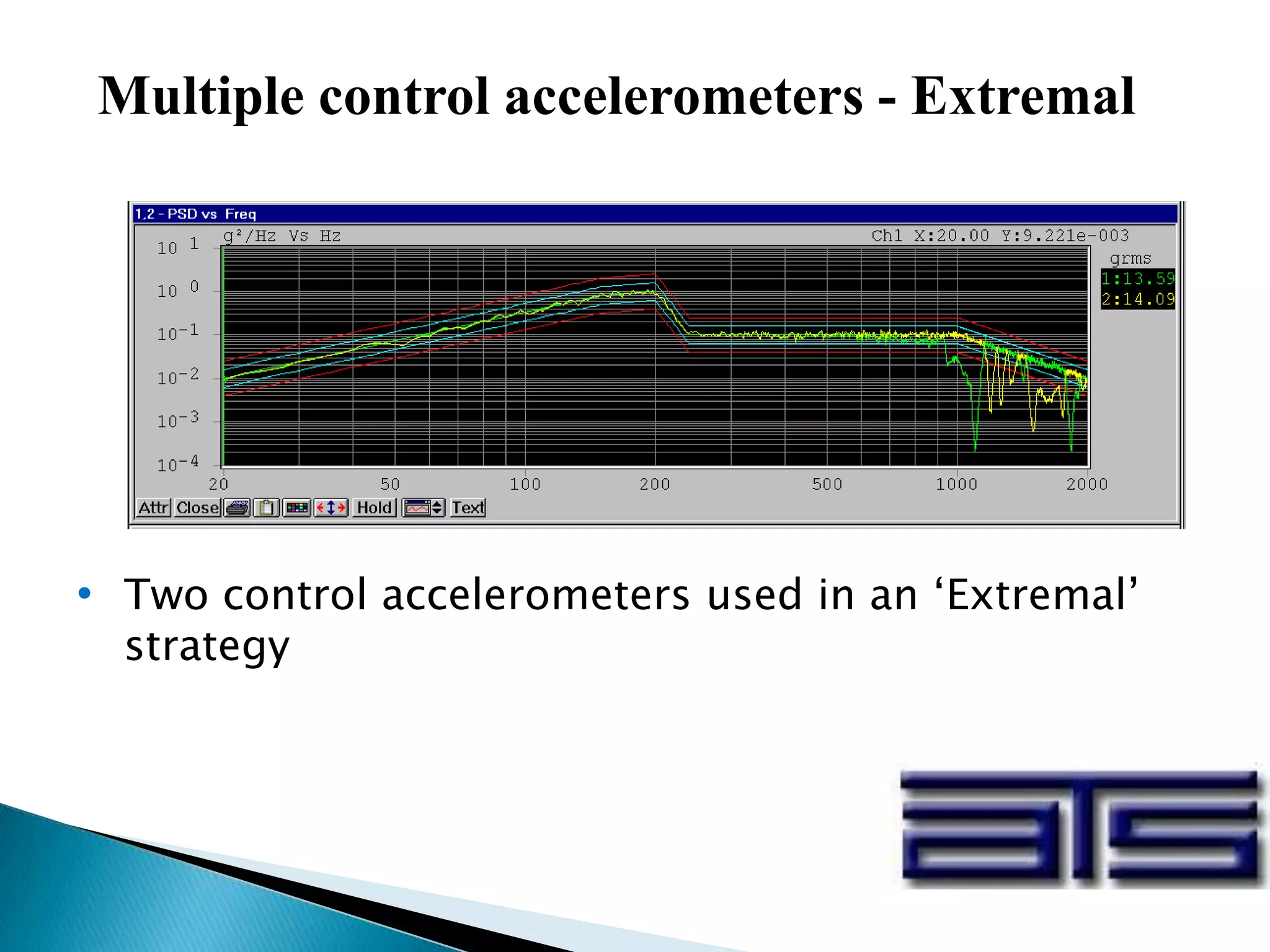
• How many control accels?
• Sliptable use…
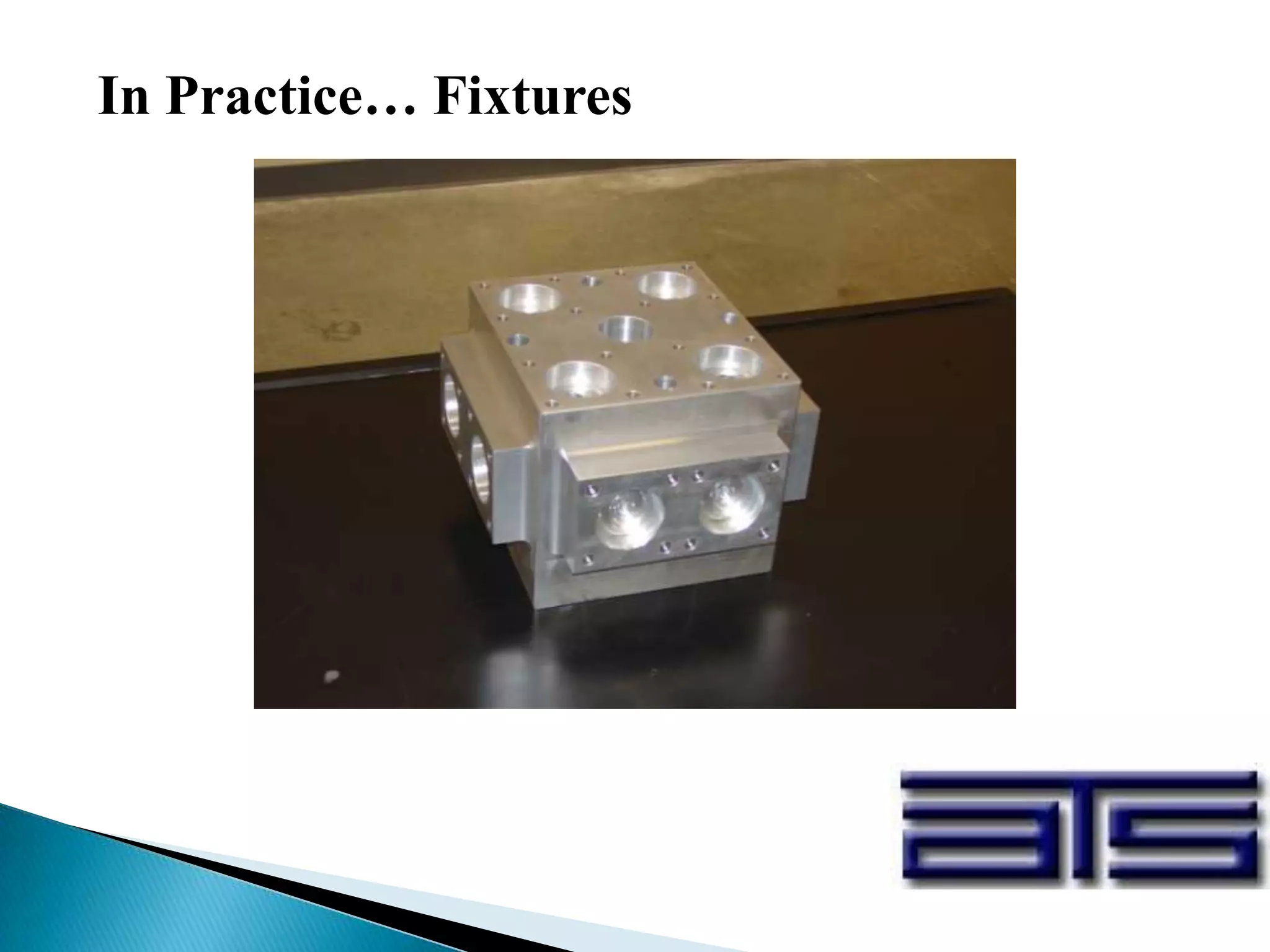
In Practice… Fixtures
In Practice… Sliptables
Courtesy of Unholtz-Dickie Corporation
In Practice… Sliptables
Courtesy of Unholtz-Dickie Corporation
Multiple control accelerometers - Extremal
• Two control accelerometers used in an ‘Extremal’
strategy
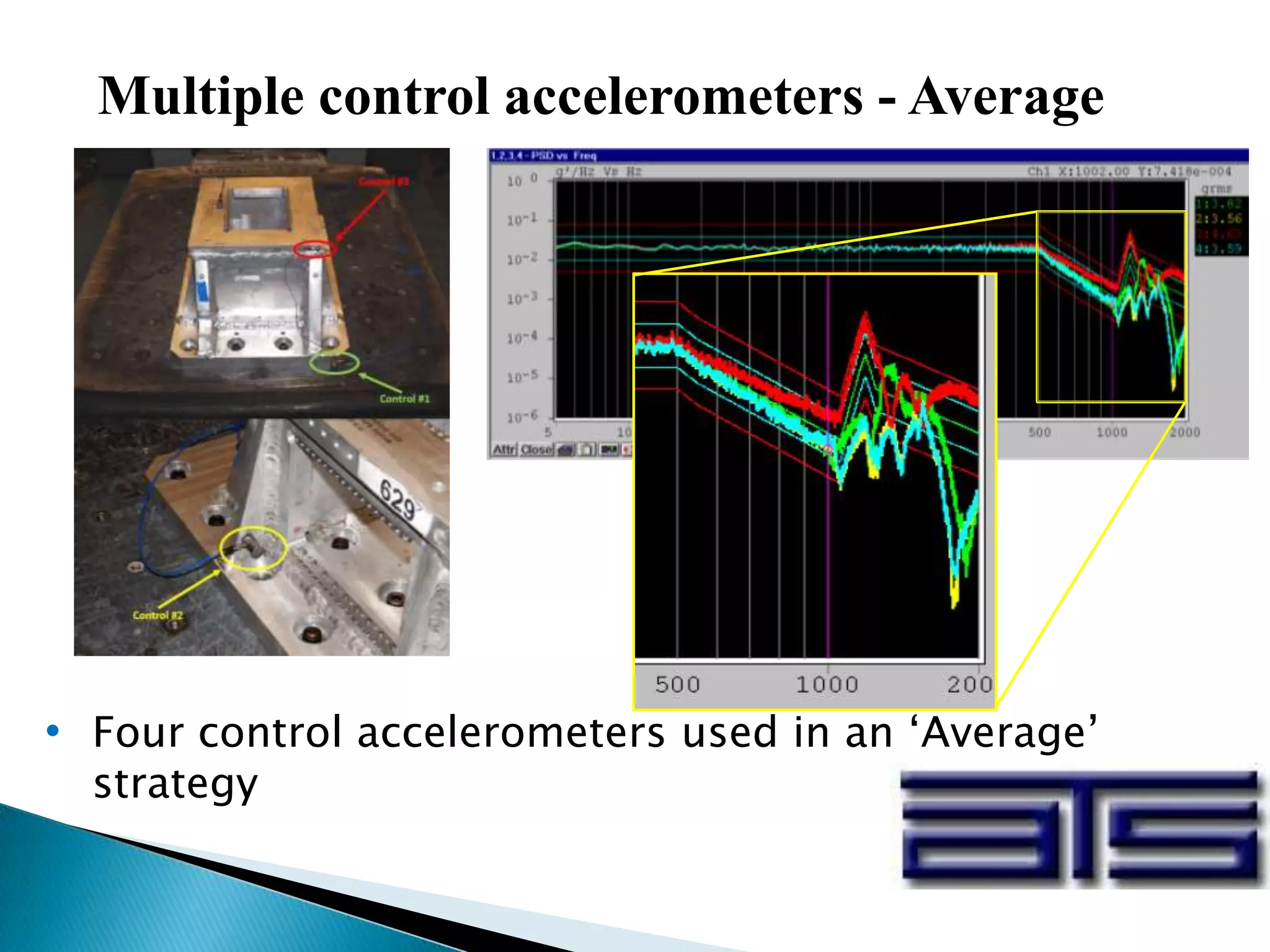
Multiple control accelerometers - Average
• Four control accelerometers used in an ‘Average’
strategy
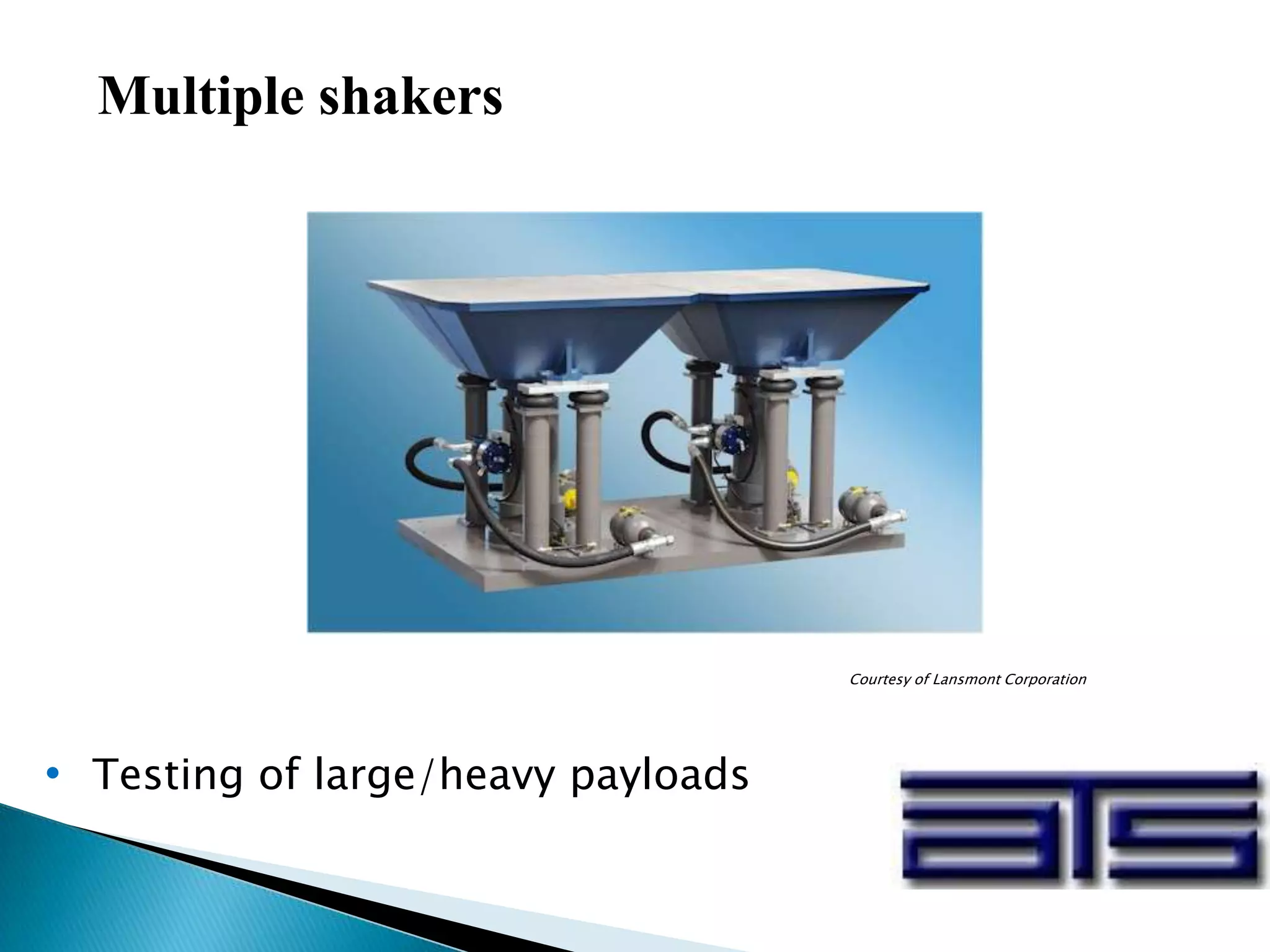
Multiple shakers
• Testing of large/heavy payloads
Courtesy of Lansmont Corporation
Questions?
• Contact info:
• David Common – dcommon@atslab.com
• (678) 444-2905

Introduction to Vibration Qualification Testing

  • 1.
    Introduction to Vibration Qualification Testing David Common ©2013ASQ & Presentation Common http://reliabilitycalendar.org/webina rs/
  • 2.
    ASQ Reliability Division EnglishWebinar Series One of the monthly webinars on topics of interest to reliability engineers. To view recorded webinar (available to ASQ Reliability Division members only) visit asq.org/reliability To sign up for the free and available to anyone live webinars visit reliabilitycalendar.org and select English Webinars to find links to register for upcoming events http://reliabilitycalendar.org/webina rs/
  • 3.
    Engineering, Testing, Consultingand Inspection Services David Common Dynamics Testing Manager Applied Technical Services, Inc. Marietta, GA dcommon@atslab.com (678) 444-2905 May 09, 2013 Introduction to Vibration Qualification Testing
  • 4.
    Agenda • Why shouldwe care about vibrations ? • Where do vibrations come from ? • What are the types of vibration and how are they analyzed from a test lab perspective ? • How are vibrations replicated in the lab ? • In Practice • Questions?
  • 5.
    Why should wecare about vibrations ? Although some specific applications aim at creating ‘good’ vibrations (loudspeakers), most vibration sources have the potential to create issues.
  • 6.
    Why should wecare about vibrations ? (cont.) Issues can be of different kinds: • Functional (CD skip) • Comfort (squeak, rattle) • Structural
  • 7.
    Where do vibrationscome from ? • Machinery • Road
  • 8.
    Where do vibrationscome from ? • Wind load (Tacoma bridge) • Ground motion
  • 9.
    What are thedifferent types of vibrations? • Sinusoidal vibration • Most basic • Simple motion • One (1) frequency present at any given time
  • 10.
    Sinusoidal Vibration 0 1020 30 40 50 60 -1.5 -1.0 -0.5 0 0.5 1.0 1.5 Time (ms) Acceleration(G) Acceleration Waveform Ch1 10 100 0.4 3.0 1.0 Frequency (Hz) Acceleration(Gpeak) Acceleration Profile Demand Control
  • 11.
    Sinusoidal Vibration 0 510 15 20 25 30 -0.8 -0.6 -0.4 -0.2 0 0.2 0.4 0.6 0.8 Time (sec) Acceleration(G) Acceleration Demand Ch1
  • 12.
  • 13.
    Sinusoidal Vibration -Quantification • Typically expressed as: • Acceleration vs. frequency • Velocity vs. frequency • Displacement vs. frequency • Any combination of the above vs. frequency
  • 14.
    • Random vibration •‘Random’ nature due to incapacity to predict precise vibration level at any given time • Quantified using statistical tools • Broadband, multi-frequency content • More closely match real-world excitations What are the different types of vibrations?
  • 15.
    Random Vibration 10 1001000 -6 1x10 -5 1x10 -4 1x10 -3 1x10 Frequency (Hz) AccelerationSpectralDensity(G²/Hz) Acceleration Spectral Density Demand Ch1 0 500 1000 1500 2000 2500 3000 3500 4000 -6 -4 -2 0 2 4 6 Time (ms) Acceleration(G) Acceleration Waveform Ch1
  • 16.
    Random Vibration –Really random? 10 100 1000 -6 1x10 Frequency(Hz) Ac Demand Ch1 0 500 1000 1500 2000 2500 3000 3500 4000 -6 -4 -2 0 2 4 6 Time(ms) Acceleration(G) AccelerationWaveform Ch1
  • 17.
    Random Vibration –Kurtosis adjustment50 100 -2 6x10 -1 1x10 Frequency(Hz) Accelerati Ch1 0 500 1000 1500 2000 2500 3000 3500 4000 4500 5000 -60 -40 -20 0 20 40 60 Time(ms) Acceleration(G) AccelerationWaveform Ch1
  • 18.
    Random Vibration –Quantification • Expressed as PSD (‘Power Spectral Density’) or ASD (‘Acceleration Spectral Density’) vs. frequency • Dimension is g2/Hz (or (m/s2)2xs) • PSD is the random vibration level, normalized with respect to the bandwidth of analysis (since dealing with a broadband excitation) • Tabulated values will sometimes have a ‘gRMS’ value added: • This is the overall energy introduced by the random vibration profile (integrates PSD vs. frequency)
  • 19.
    Random Vibration –Different shapes… 2001 10 100 -5 1x10 -4 1x10 -3 1x10 -2 1x10 Frequency (Hz) AccelerationSpectralDensity(G²/Hz) Acceleration Spectral Density Ch1 0 500 1000 1500 2000 2500 3000 3500 4000 4500 5000 -3 -2 -1 0 1 2 3 Time (ms) Acceleration(G) Acceleration Waveform Ch1 • Truck transportation simulation
  • 20.
    Random Vibration –Different shapes… • Engine compartment simulation 60 100 1000 -6 1x10 -5 1x10 -4 1x10 -3 1x10 -2 1x10 Frequency (Hz) AccelerationSpectralDensity(G²/Hz) Acceleration Spectral Density Ch1 0 100 200 300 400 500 600 700 -6 -4 -2 0 2 4 6 Time (ms) Acceleration(G) Acceleration Waveform Ch1
  • 21.
    Let’s mix thingsup – Sine on Random • Add discreet sinusoidal vibration tones to a broadband random vibration background • Typical of helicopter and propeller aircraft applications (known blade passing frequencies on a random background)
  • 22.
    Let’s mix thingsup – Sine on Random 20 2000100 1000 -4 1x10 -3 1x10 -2 1x10 -1 1x10 0 1x10 Frequency (Hz) AccelerationSpectralDensity(G²/Hz) Acceleration Spectral Density Ch1 0 500 1000 1500 2000 2500 3000 -10 -5 0 5 10 Time (ms) Acceleration(G) Acceleration Waveform Ch1
  • 23.
    Let’s mix thingsup – Random on Random • Add narrowband random content onto a broadband random background • Typical of tracked vehicles (military) • Narrowband content is swept across a frequency range to reflect speed changes
  • 24.
    Let’s mix thingsup – Random on Random 20 2000100 1000 -4 1x10 -3 1x10 -2 1x10 -1 1x10 0 1x10 Frequency (Hz) AccelerationSpectralDensity(G²/Hz) Acceleration Spectral Density Demand Ch1 0 500 1000 1500 2000 2500 3000 3500 4000 -20 -15 -10 -5 0 5 10 15 20 Time (ms) Acceleration(G) Acceleration Waveform Ch1
  • 25.
    Random vibration vs.Transients… • Traditional random vibration averages out the actual vibration history. • Transients such as bumps, potholes, etc. do not translate well into random • Another technique is needed to replicate transients
  • 26.
    • Field datareplication • Data collected in the field (acceleration vs. time) is directly played back and repeated in the lab What are the different types of vibrations?
  • 27.
    Field data replication 010000 20000 30000 40000 50000 60000 -2 -1 0 1 2 3 Time (ms) Acceleration(G) Acceleration Demand 0 10000 20000 30000 40000 50000 60000 -2 -1 0 1 2 3 4 Time (ms) Displacement(in) Displacement Demand 0 10000 20000 30000 40000 50000 60000 -20 -10 0 10 20 30 40 Time (ms) Velocity(in/s) Velocity Demand
  • 28.
    How are vibrationsreplicated in the lab? • Shakers • Mechanical • Electrodynamic • Hydraulic • Single/Multi-axis
  • 29.
    How are vibrationsreplicated in the lab? • Mechanical shakers (‘direct drive’) • 1950’s • Cheap, sinusoidal excitation • Still used today for shipping vibration test Courtesy of Lansmont Corporation
  • 30.
    How are vibrationsreplicated in the lab? • Electrodynamic shakers • Make most of the fleet of commercial test labs • Sequential, single-axis excitation • Big, highly-controlled ‘loudspeakers’ • Come in various sizes and shapes (sliptable) • Rated in lbf • Payload and severity counterbalance each other
  • 31.
  • 32.
    Electrodynamic shakers –Combined • Shakers can be combined with thermal chambers (‘AGREE’ chambers) for temperature and vibration testing (engine-mounted components might see high vibration levels and extreme temperature range)
  • 33.
    Electrodynamic shakers • Mediumto high frequency range (typically from 5Hz to 2,000Hz) • Low available displacement (2” peak-to-peak)
  • 34.
    Electrodynamic shakers • Funwith a strobe light…
  • 35.
    Hydraulic shakers • Lowfrequency range (typically 1Hz to 100Hz) • High available displacement (10” or 12” peak-to- peak) • Often offer the highest force rating for the buck
  • 36.
    Hydraulic shakers • Single-axis Courtesyof Dynamic Testing and Equipment
  • 37.
    Hydraulic shakers (Triaxial) •Triaxial hydraulic shaker table
  • 38.
  • 39.
    In Practice… • Fixtures… •Position of the control accelerometer… • How many control accels? • Sliptable use…
  • 40.
  • 41.
  • 42.
    In Practice… Sliptables Courtesyof Unholtz-Dickie Corporation
  • 43.
    In Practice… Sliptables Courtesyof Unholtz-Dickie Corporation
  • 44.
    Multiple control accelerometers- Extremal • Two control accelerometers used in an ‘Extremal’ strategy
  • 45.
    Multiple control accelerometers- Average • Four control accelerometers used in an ‘Average’ strategy
  • 46.
    Multiple shakers • Testingof large/heavy payloads Courtesy of Lansmont Corporation
  • 47.
    Questions? • Contact info: •David Common – dcommon@atslab.com • (678) 444-2905