
An Introduction to Weibull
Analysis (威布尔分析引论)
Rong Pan
©2014 ASQ
http://www.asqrd.org
RONG PA N
ASSOCIATE PROFESSOR
A RIZONA ST A T E U NIVERSIT Y
EM A IL: RONG.PA N@ A SU .EDU
An Introduction to Weibull
Analysis
Outlines
4/12/2014Webinar for ASQ Reliability Division
3
 Objectives
 To understand Weibull distribution
 To be able to use Weibull plot for failure time analysis and
diagnosis
 To be able to use software to do data analysis
 Organization
 Distribution model
 Parameter estimation
 Regression analysis
A Little Bit of History
4/12/2014Webinar for ASQ Reliability Division
4
 Waloddi Weibull (1887-1979)
 Invented Weibull distribution in 1937
 Publication in 1951
 A statistical distribution function of wide
applicability, Journal of Mechanics, ASME,
September 1951, pp. 293-297.
 Was professor at the Royal Institute of
Technology, Sweden
 Research funded by U.S. Air Force
Weibull Distribution
4/12/2014Webinar for ASQ Reliability Division
5
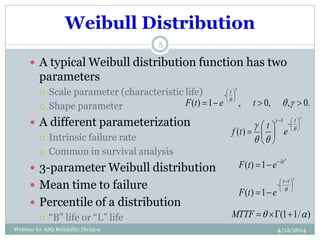
 A typical Weibull distribution function has two
parameters
 Scale parameter (characteristic life)
 Shape parameter
 A different parameterization
 Intrinsic failure rate
 Common in survival analysis
 3-parameter Weibull distribution
 Mean time to failure
 Percentile of a distribution
 “B” life or “L” life




 














t
e
t
tf
1
)(
.0,,0,1)( 










tetF
t

t
etF 
1)(








 


t
etF 1)(
)/11(  MTTF
Functions Related to Reliability
4/12/2014Webinar for ASQ Reliability Division
6
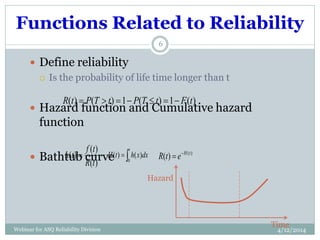
 Define reliability
 Is the probability of life time longer than t
 Hazard function and Cumulative hazard
function
 Bathtub curve
)(1)(1)()( tFtTPtTPtR 
)(
)(
)(
tR
tf
th  
t
dxxhtH
0
)()( )(
)( tH
etR 

Time
Hazard
Understanding Hazard Function
4/12/2014Webinar for ASQ Reliability Division
7
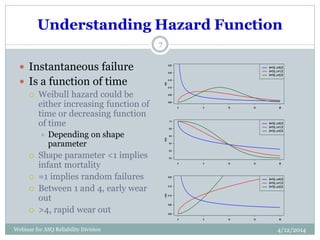
 Instantaneous failure
 Is a function of time
 Weibull hazard could be
either increasing function of
time or decreasing function
of time
 Depending on shape
parameter
 Shape parameter <1 implies
infant mortality
 =1 implies random failures
 Between 1 and 4, early wear
out
 >4, rapid wear out
Connection to Other Distributions
4/12/2014Webinar for ASQ Reliability Division
8
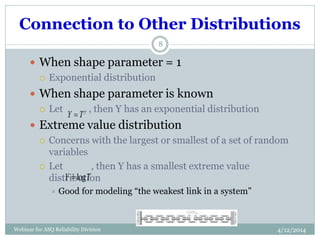
 When shape parameter = 1
 Exponential distribution
 When shape parameter is known
 Let , then Y has an exponential distribution
 Extreme value distribution
 Concerns with the largest or smallest of a set of random
variables
 Let , then Y has a smallest extreme value
distribution
 Good for modeling “the weakest link in a system”

TY 
TY log
Weibull Plot
4/12/2014Webinar for ASQ Reliability Division
9
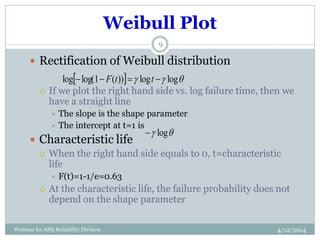
 Rectification of Weibull distribution
 If we plot the right hand side vs. log failure time, then we
have a straight line
 The slope is the shape parameter
 The intercept at t=1 is
 Characteristic life
 When the right hand side equals to 0, t=characteristic
life
 F(t)=1-1/e=0.63
 At the characteristic life, the failure probability does not
depend on the shape parameter
   loglog))(1log(log  ttF
 log
Weibull Plot Example
4/12/2014Webinar for ASQ Reliability Division
10
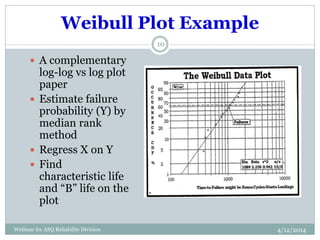
 A complementary
log-log vs log plot
paper
 Estimate failure
probability (Y) by
median rank
method
 Regress X on Y
 Find
characteristic life
and “B” life on the
plot
Complete Data
4/12/2014Webinar for ASQ Reliability Division
11
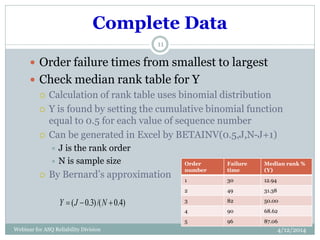
 Order failure times from smallest to largest
 Check median rank table for Y
 Calculation of rank table uses binomial distribution
 Y is found by setting the cumulative binomial function
equal to 0.5 for each value of sequence number
 Can be generated in Excel by BETAINV(0.5,J,N-J+1)
 J is the rank order
 N is sample size
 By Bernard’s approximation
Order
number
Failure
time
Median rank %
(Y)
1 30 12.94
2 49 31.38
3 82 50.00
4 90 68.62
5 96 87.06
)4.0/()3.0(  NJY
Censored Data
4/12/2014Webinar for ASQ Reliability Division
12
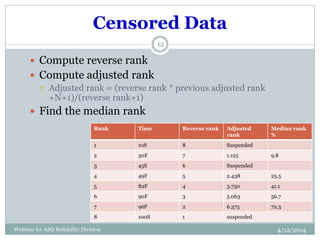
 Compute reverse rank
 Compute adjusted rank
 Adjusted rank = (reverse rank * previous adjusted rank
+N+1)/(reverse rank+1)
 Find the median rank
Rank Time Reverse rank Adjusted
rank
Median rank
%
1 10S 8 Suspended
2 30F 7 1.125 9.8
3 45S 6 Suspended
4 49F 5 2.438 25.5
5 82F 4 3.750 41.1
6 90F 3 5.063 56.7
7 96F 2 6.375 72.3
8 100S 1 suspended
Diagnosis using Weibull Plot
4/12/2014Webinar for ASQ Reliability Division
13
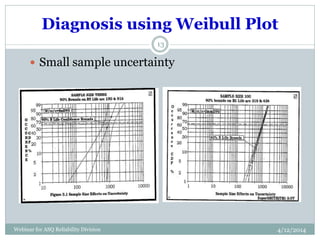
 Small sample uncertainty
Diagnosis using Weibull Plot
4/12/2014Webinar for ASQ Reliability Division
14
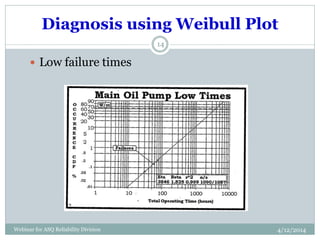
 Low failure times
Diagnosis using Weibull Plot
4/12/2014Webinar for ASQ Reliability Division
15
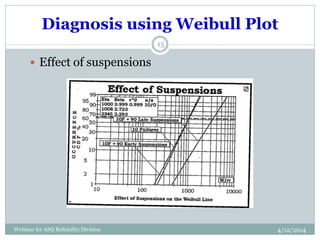
 Effect of suspensions
Diagnosis using Weibull Plot
4/12/2014Webinar for ASQ Reliability Division
16
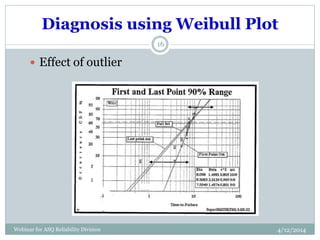
 Effect of outlier
Diagnosis using Weibull Plot
4/12/2014Webinar for ASQ Reliability Division
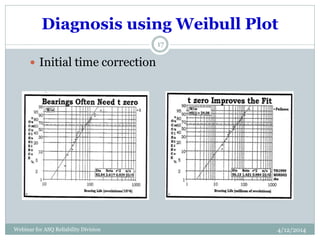
17
 Initial time correction
Diagnosis using Weibull Plot
4/12/2014Webinar for ASQ Reliability Division
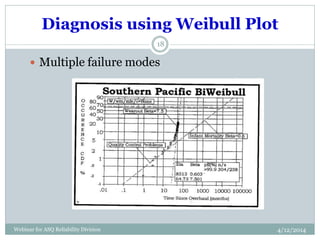
18
 Multiple failure modes
Maximum Likelihood Estimation
4/12/2014Webinar for ASQ Reliability Division
19
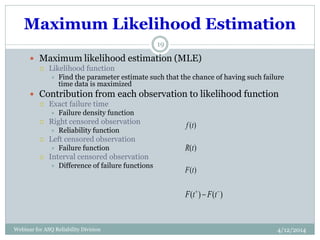
 Maximum likelihood estimation (MLE)
 Likelihood function
 Find the parameter estimate such that the chance of having such failure
time data is maximized
 Contribution from each observation to likelihood function
 Exact failure time
 Failure density function
 Right censored observation
 Reliability function
 Left censored observation
 Failure function
 Interval censored observation
 Difference of failure functions
)(tR
)(tF
)()( 
 tFtF
)(tf
Plot by Software
4/12/2014Webinar for ASQ Reliability Division
20
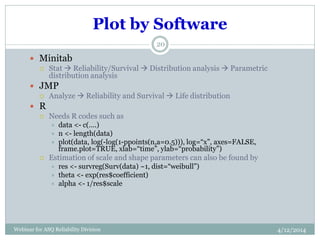
 Minitab
 Stat  Reliability/Survival  Distribution analysis  Parametric
distribution analysis
 JMP
 Analyze  Reliability and Survival  Life distribution
 R
 Needs R codes such as
 data <- c(….)
 n <- length(data)
 plot(data, log(-log(1-ppoints(n,a=0.5))), log=“x”, axes=FALSE,
frame.plot=TRUE, xlab=“time”, ylab=“probability”)
 Estimation of scale and shape parameters can also be found by
 res <- survreg(Surv(data) ~1, dist=“weibull”)
 theta <- exp(res$coefficient)
 alpha <- 1/res$scale
Compare to Other Distributions
4/12/2014Webinar for ASQ Reliability Division
21
 Choose a distribution model
 Fit multiple distribution models
 Criteria (smaller the better)
 Negative log-likelihood values
 AICc (corrected Akaike’s information criterion)
 BIC (Baysian information criterion)
Weibull Regression
4/12/2014Webinar for ASQ Reliability Division
22
 When there is an explanatory variable
(regressor)
 Stress variable in the accelerated life testing (ALT)
model
 Shape parameter of Weibull distribution is often
assumed fixed
 Scale parameter is changed by regressor
 Typically a log-linear function is assumed
 Implementation in Software
Final Remarks
4/12/2014Webinar for ASQ Reliability Division
23
 Weibull distribution
 2 parameters
 3 parameters
 Shape of hazard function
 Different stages of bathtub curve
 Weibull plot
 Find the parameter estimation
 Interpretation

An introduction to weibull analysis

  • 1.
    An Introduction toWeibull Analysis (威布尔分析引论) Rong Pan ©2014 ASQ http://www.asqrd.org
  • 2.
    RONG PA N ASSOCIATEPROFESSOR A RIZONA ST A T E U NIVERSIT Y EM A IL: RONG.PA N@ A SU .EDU An Introduction to Weibull Analysis
  • 3.
    Outlines 4/12/2014Webinar for ASQReliability Division 3  Objectives  To understand Weibull distribution  To be able to use Weibull plot for failure time analysis and diagnosis  To be able to use software to do data analysis  Organization  Distribution model  Parameter estimation  Regression analysis
  • 4.
    A Little Bitof History 4/12/2014Webinar for ASQ Reliability Division 4  Waloddi Weibull (1887-1979)  Invented Weibull distribution in 1937  Publication in 1951  A statistical distribution function of wide applicability, Journal of Mechanics, ASME, September 1951, pp. 293-297.  Was professor at the Royal Institute of Technology, Sweden  Research funded by U.S. Air Force
  • 5.
    Weibull Distribution 4/12/2014Webinar forASQ Reliability Division 5  A typical Weibull distribution function has two parameters  Scale parameter (characteristic life)  Shape parameter  A different parameterization  Intrinsic failure rate  Common in survival analysis  3-parameter Weibull distribution  Mean time to failure  Percentile of a distribution  “B” life or “L” life                     t e t tf 1 )( .0,,0,1)(            tetF t  t etF  1)(             t etF 1)( )/11(  MTTF
  • 6.
    Functions Related toReliability 4/12/2014Webinar for ASQ Reliability Division 6  Define reliability  Is the probability of life time longer than t  Hazard function and Cumulative hazard function  Bathtub curve )(1)(1)()( tFtTPtTPtR  )( )( )( tR tf th   t dxxhtH 0 )()( )( )( tH etR   Time Hazard
  • 7.
    Understanding Hazard Function 4/12/2014Webinarfor ASQ Reliability Division 7  Instantaneous failure  Is a function of time  Weibull hazard could be either increasing function of time or decreasing function of time  Depending on shape parameter  Shape parameter <1 implies infant mortality  =1 implies random failures  Between 1 and 4, early wear out  >4, rapid wear out
  • 8.
    Connection to OtherDistributions 4/12/2014Webinar for ASQ Reliability Division 8  When shape parameter = 1  Exponential distribution  When shape parameter is known  Let , then Y has an exponential distribution  Extreme value distribution  Concerns with the largest or smallest of a set of random variables  Let , then Y has a smallest extreme value distribution  Good for modeling “the weakest link in a system”  TY  TY log
  • 9.
    Weibull Plot 4/12/2014Webinar forASQ Reliability Division 9  Rectification of Weibull distribution  If we plot the right hand side vs. log failure time, then we have a straight line  The slope is the shape parameter  The intercept at t=1 is  Characteristic life  When the right hand side equals to 0, t=characteristic life  F(t)=1-1/e=0.63  At the characteristic life, the failure probability does not depend on the shape parameter    loglog))(1log(log  ttF  log
  • 10.
    Weibull Plot Example 4/12/2014Webinarfor ASQ Reliability Division 10  A complementary log-log vs log plot paper  Estimate failure probability (Y) by median rank method  Regress X on Y  Find characteristic life and “B” life on the plot
  • 11.
    Complete Data 4/12/2014Webinar forASQ Reliability Division 11  Order failure times from smallest to largest  Check median rank table for Y  Calculation of rank table uses binomial distribution  Y is found by setting the cumulative binomial function equal to 0.5 for each value of sequence number  Can be generated in Excel by BETAINV(0.5,J,N-J+1)  J is the rank order  N is sample size  By Bernard’s approximation Order number Failure time Median rank % (Y) 1 30 12.94 2 49 31.38 3 82 50.00 4 90 68.62 5 96 87.06 )4.0/()3.0(  NJY
  • 12.
    Censored Data 4/12/2014Webinar forASQ Reliability Division 12  Compute reverse rank  Compute adjusted rank  Adjusted rank = (reverse rank * previous adjusted rank +N+1)/(reverse rank+1)  Find the median rank Rank Time Reverse rank Adjusted rank Median rank % 1 10S 8 Suspended 2 30F 7 1.125 9.8 3 45S 6 Suspended 4 49F 5 2.438 25.5 5 82F 4 3.750 41.1 6 90F 3 5.063 56.7 7 96F 2 6.375 72.3 8 100S 1 suspended
  • 13.
    Diagnosis using WeibullPlot 4/12/2014Webinar for ASQ Reliability Division 13  Small sample uncertainty
  • 14.
    Diagnosis using WeibullPlot 4/12/2014Webinar for ASQ Reliability Division 14  Low failure times
  • 15.
    Diagnosis using WeibullPlot 4/12/2014Webinar for ASQ Reliability Division 15  Effect of suspensions
  • 16.
    Diagnosis using WeibullPlot 4/12/2014Webinar for ASQ Reliability Division 16  Effect of outlier
  • 17.
    Diagnosis using WeibullPlot 4/12/2014Webinar for ASQ Reliability Division 17  Initial time correction
  • 18.
    Diagnosis using WeibullPlot 4/12/2014Webinar for ASQ Reliability Division 18  Multiple failure modes
  • 19.
    Maximum Likelihood Estimation 4/12/2014Webinarfor ASQ Reliability Division 19  Maximum likelihood estimation (MLE)  Likelihood function  Find the parameter estimate such that the chance of having such failure time data is maximized  Contribution from each observation to likelihood function  Exact failure time  Failure density function  Right censored observation  Reliability function  Left censored observation  Failure function  Interval censored observation  Difference of failure functions )(tR )(tF )()(   tFtF )(tf
  • 20.
    Plot by Software 4/12/2014Webinarfor ASQ Reliability Division 20  Minitab  Stat  Reliability/Survival  Distribution analysis  Parametric distribution analysis  JMP  Analyze  Reliability and Survival  Life distribution  R  Needs R codes such as  data <- c(….)  n <- length(data)  plot(data, log(-log(1-ppoints(n,a=0.5))), log=“x”, axes=FALSE, frame.plot=TRUE, xlab=“time”, ylab=“probability”)  Estimation of scale and shape parameters can also be found by  res <- survreg(Surv(data) ~1, dist=“weibull”)  theta <- exp(res$coefficient)  alpha <- 1/res$scale
  • 21.
    Compare to OtherDistributions 4/12/2014Webinar for ASQ Reliability Division 21  Choose a distribution model  Fit multiple distribution models  Criteria (smaller the better)  Negative log-likelihood values  AICc (corrected Akaike’s information criterion)  BIC (Baysian information criterion)
  • 22.
    Weibull Regression 4/12/2014Webinar forASQ Reliability Division 22  When there is an explanatory variable (regressor)  Stress variable in the accelerated life testing (ALT) model  Shape parameter of Weibull distribution is often assumed fixed  Scale parameter is changed by regressor  Typically a log-linear function is assumed  Implementation in Software
  • 23.
    Final Remarks 4/12/2014Webinar forASQ Reliability Division 23  Weibull distribution  2 parameters  3 parameters  Shape of hazard function  Different stages of bathtub curve  Weibull plot  Find the parameter estimation  Interpretation