
Field	
  Data	
  Analysis	
  &	
  
Sta0s0cal	
  Warranty	
  
Forecas0ng	
  
Vasiliy	
  V.	
  Krivtsov,	
  Ph.D.	
  
©2013	
  ASQ	
  &	
  Presenta0on	
  Krivtsov	
  
hCp://reliabilitycalendar.org/
webinars/	
  
ASQ	
  Reliability	
  Division	
  
English	
  Webinar	
  Series	
  
One	
  of	
  the	
  monthly	
  webinars	
  
on	
  topics	
  of	
  interest	
  to	
  
reliability	
  engineers.	
  
To	
  view	
  recorded	
  webinar	
  (available	
  to	
  ASQ	
  Reliability	
  
Division	
  members	
  only)	
  visit	
  asq.org/reliability	


To	
  sign	
  up	
  for	
  the	
  free	
  and	
  available	
  to	
  anyone	
  live	
  
webinars	
  visit	
  reliabilitycalendar.org	
  and	
  select	
  English	
  
Webinars	
  to	
  find	
  links	
  to	
  register	
  for	
  upcoming	
  events	
  
hCp://reliabilitycalendar.org/
webinars/	
  
Field Data Analysis &
Statistical Warranty Forecasting
Vasiliy V. Krivtsov, Ph.D.
Ford Motor Company
ASQ Reliability Division Seminar
13 June 2013
V. Krivtsov: Field Data Analysis & Statistical Warranty Forecasting | 2013 © Ford Motor Co. 2
 Introduction
 Sources of field data
 Statistical engineering inferences from field data analysis
 Importance of managing warranty reserve
 Probabilistic models
 Non-repairable items/systems,
 Repairable systems
 Bivariate models (time & usage)
 Statistical estimation
 Non-repairable items/systems,
 Repairable systems
 Bivariate models
 Special Topics
 Calendarized warranty forecasting
 Field data maturity issues
 Survival regression in root-cause analysis of field failures
 Key References
Discussion Outline
V. Krivtsov: Field Data Analysis & Statistical Warranty Forecasting | 2013 © Ford Motor Co. 3
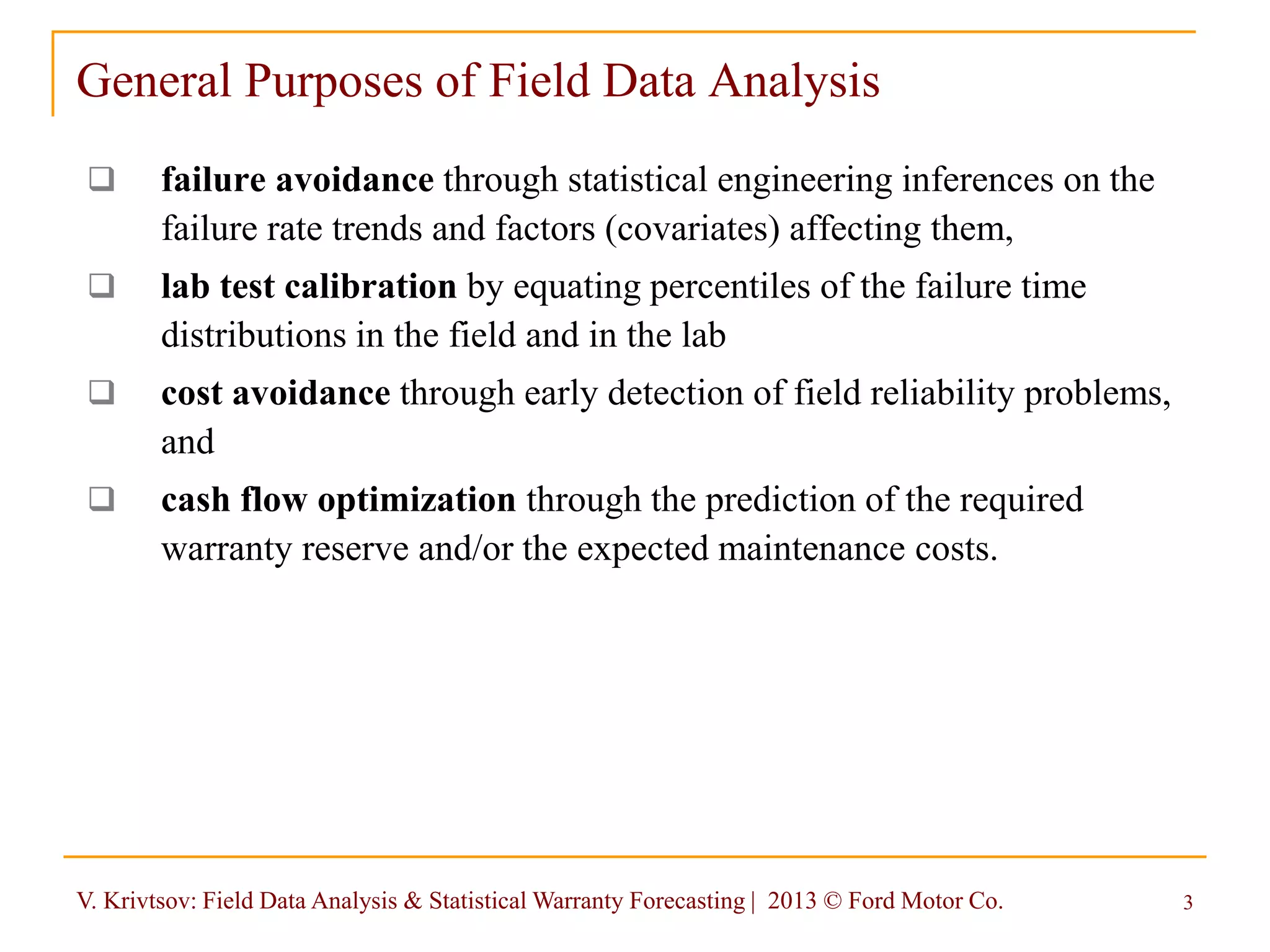
General Purposes of Field Data Analysis
 failure avoidance through statistical engineering inferences on the
failure rate trends and factors (covariates) affecting them,
 lab test calibration by equating percentiles of the failure time
distributions in the field and in the lab
 cost avoidance through early detection of field reliability problems,
and
 cash flow optimization through the prediction of the required
warranty reserve and/or the expected maintenance costs.
V. Krivtsov: Field Data Analysis & Statistical Warranty Forecasting | 2013 © Ford Motor Co. 4
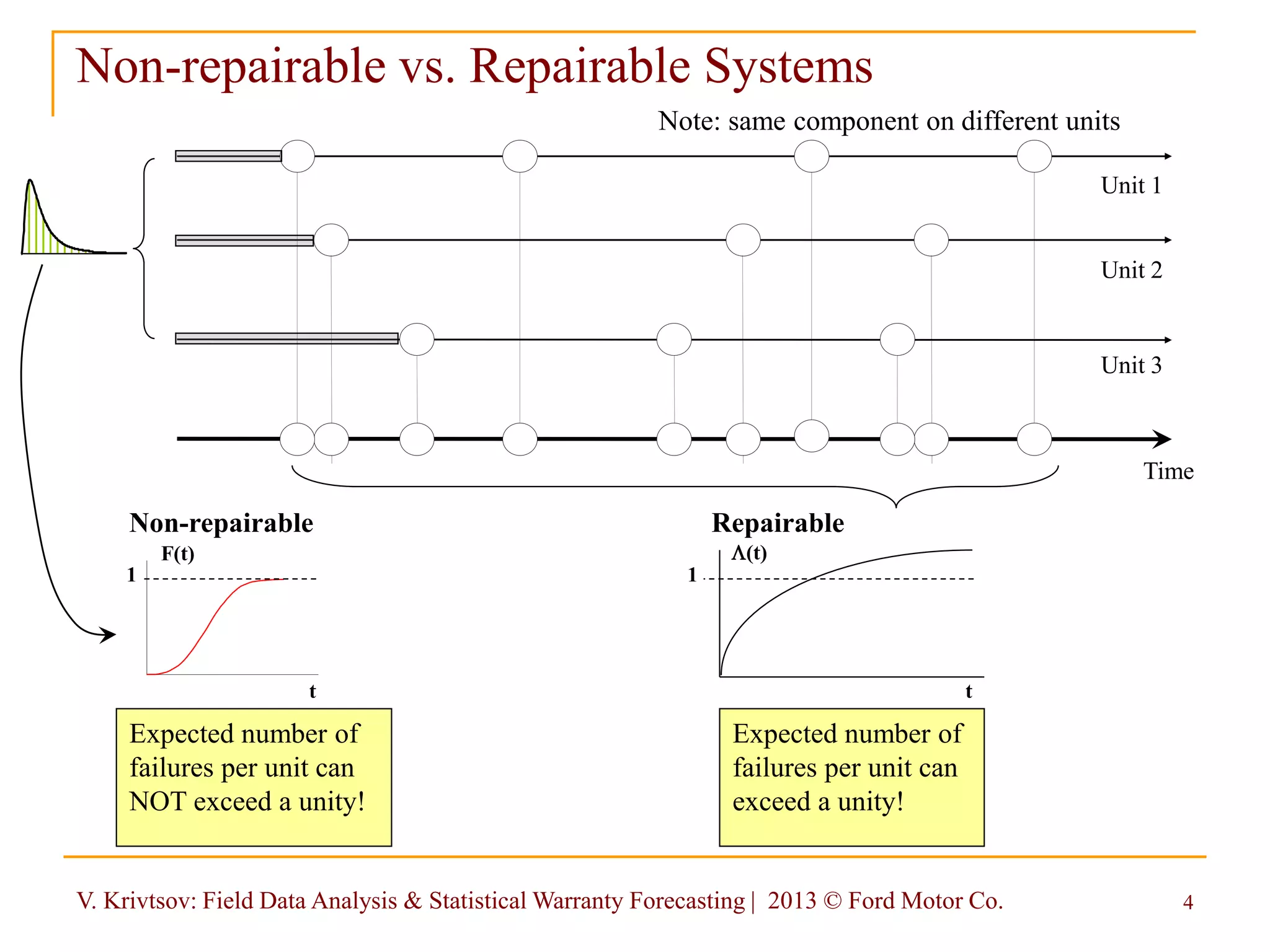
Non-repairable vs. Repairable Systems
Unit 1
1
Non-repairable Repairable
F(t)
t
1
L(t)
t
Expected number of
failures per unit can
NOT exceed a unity!
Expected number of
failures per unit can
exceed a unity!
Unit 2
Unit 3
Time
Note: same component on different units
Probabilistic Models for
Non-Repairable Systems
V. Krivtsov: Field Data Analysis & Statistical Warranty Forecasting | 2013 © Ford Motor Co. 6
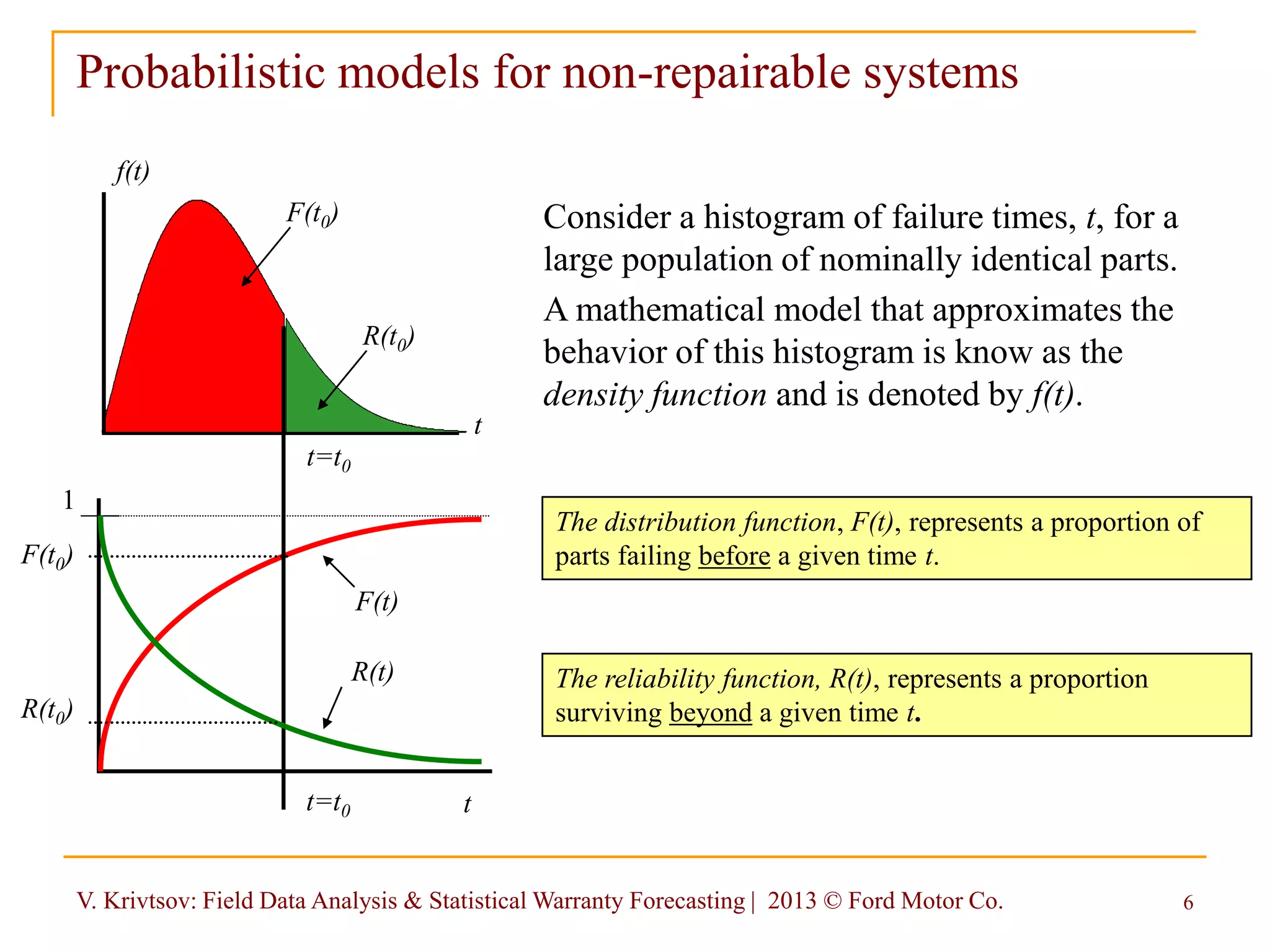
Consider a histogram of failure times, t, for a
large population of nominally identical parts.
t
f(t)
A mathematical model that approximates the
behavior of this histogram is know as the
density function and is denoted by f(t).
Probabilistic models for non-repairable systems
t=t0
t
F(t)
1
F(t0)
t=t0
The distribution function, F(t), represents a proportion of
parts failing before a given time t.
F(t0)
The reliability function, R(t), represents a proportion
surviving beyond a given time t.
R(t)
R(t0)
R(t0)
V. Krivtsov: Field Data Analysis & Statistical Warranty Forecasting | 2013 © Ford Motor Co. 7
Hazard Function (Instantaneous Failure Rate)
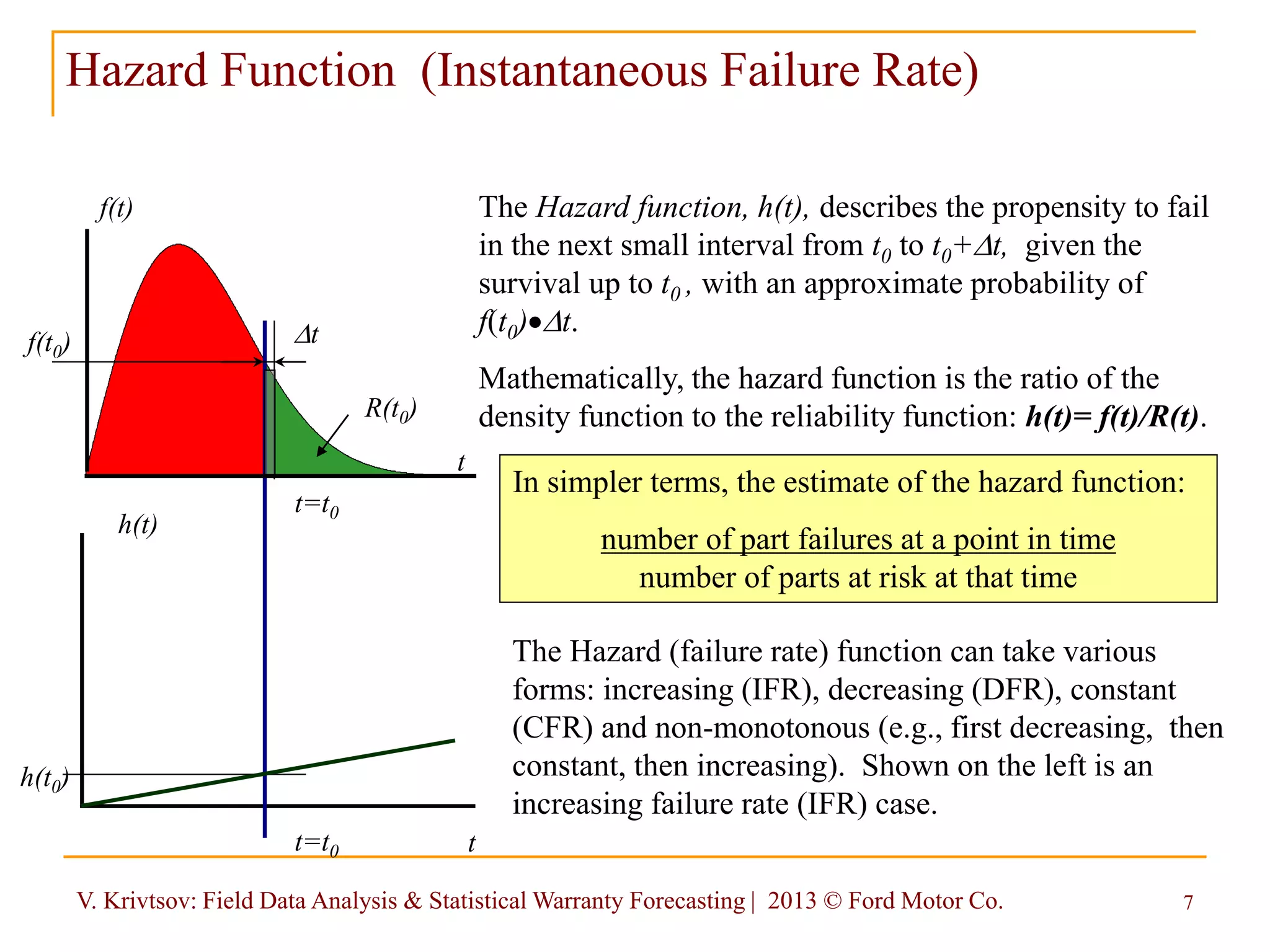
The Hazard function, h(t), describes the propensity to fail
in the next small interval from t0 to t0+Dt, given the
survival up to t0 , with an approximate probability of
f(t0)Dt.
Mathematically, the hazard function is the ratio of the
density function to the reliability function: h(t)= f(t)/R(t).
In simpler terms, the estimate of the hazard function:
number of part failures at a point in time
number of parts at risk at that time
f(t)
t
R(t0)
t=t0
t
h(t)
Dtf(t0)
t=t0
h(t0)
The Hazard (failure rate) function can take various
forms: increasing (IFR), decreasing (DFR), constant
(CFR) and non-monotonous (e.g., first decreasing, then
constant, then increasing). Shown on the left is an
increasing failure rate (IFR) case.
V. Krivtsov: Field Data Analysis & Statistical Warranty Forecasting | 2013 © Ford Motor Co. 8
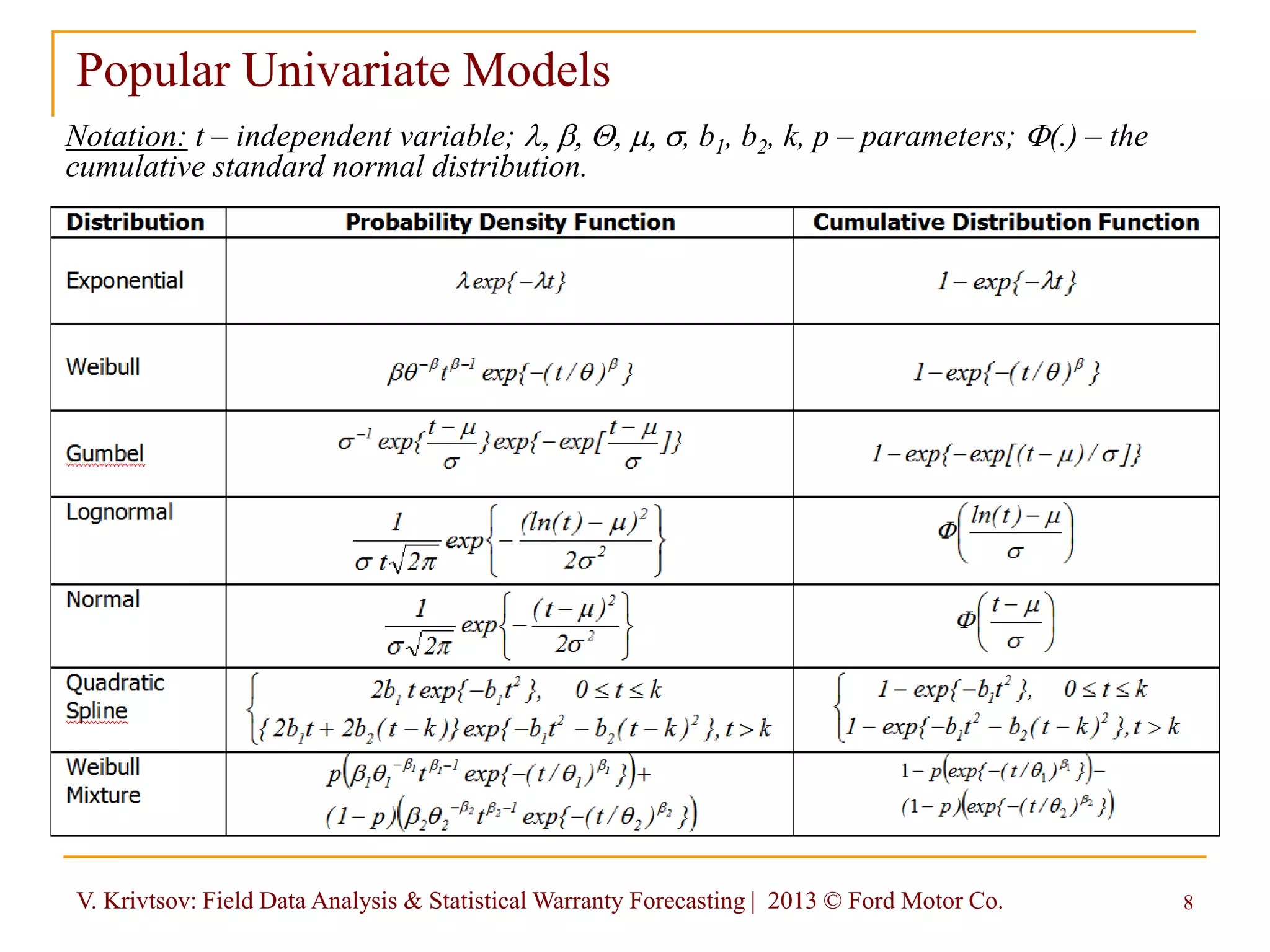
Popular Univariate Models
Notation: t – independent variable; l, b, Q, m, s, b1, b2, k, p – parameters; F(.) – the
cumulative standard normal distribution.
V. Krivtsov: Field Data Analysis & Statistical Warranty Forecasting | 2013 © Ford Motor Co. 9
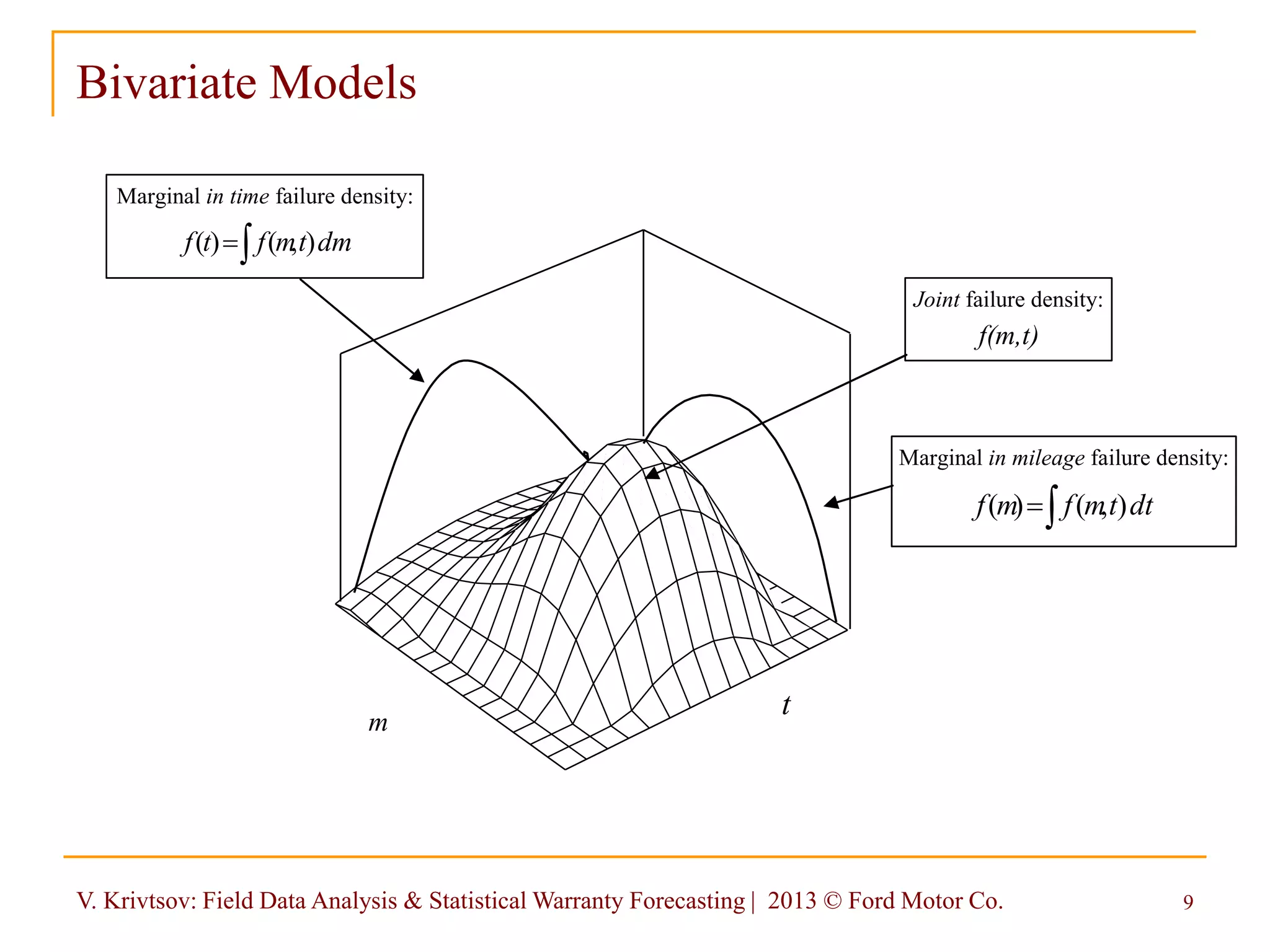
Bivariate Models
Joint failure density:
f(m,t)
Marginal in mileage failure density:
 dttmfmf ),()(
Marginal in time failure density:
 dmtmftf ),()(
t
m
Probabilistic Models for
Repairable Systems
V. Krivtsov: Field Data Analysis & Statistical Warranty Forecasting | 2013 © Ford Motor Co.
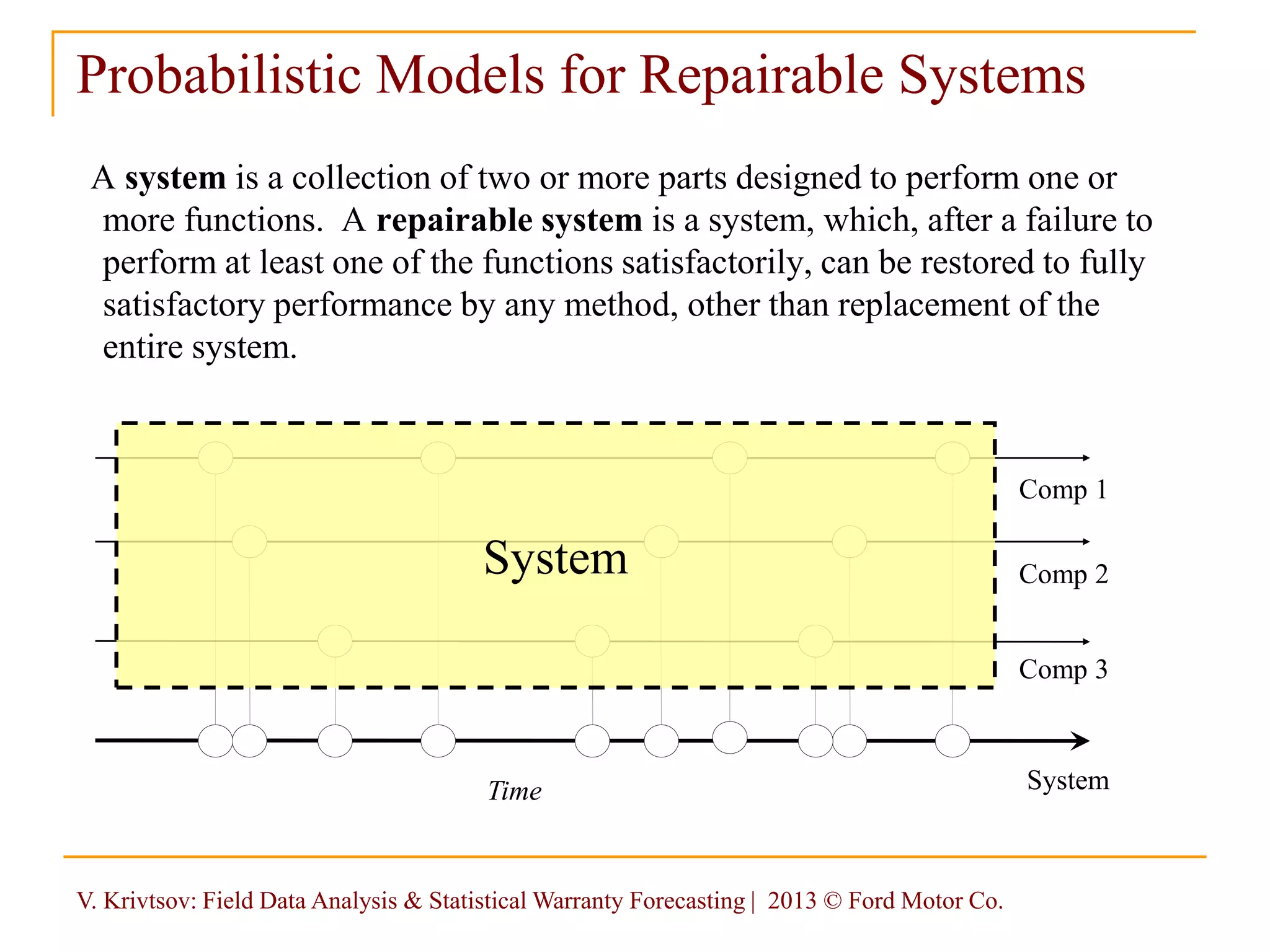
Probabilistic Models for Repairable Systems
A system is a collection of two or more parts designed to perform one or
more functions. A repairable system is a system, which, after a failure to
perform at least one of the functions satisfactorily, can be restored to fully
satisfactory performance by any method, other than replacement of the
entire system.
Comp 1
Comp 2
Comp 3
Time
System
System
V. Krivtsov: Field Data Analysis & Statistical Warranty Forecasting | 2013 © Ford Motor Co. 12
A connection between non-repairable & repairable systems
t
N(t)
E[N(t)]
0
1
2
3
4
5
repair
f(t) = dF(t)/dt – underlying (TTFF)
distribution of non-repairable components
X1 X2 X3 X5X4
])([)()()]([
0
 
t
NdEtFtFtNE 
Fundamental renewal equation:
CumulativeFailures
V. Krivtsov: Field Data Analysis & Statistical Warranty Forecasting | 2013 © Ford Motor Co. 13
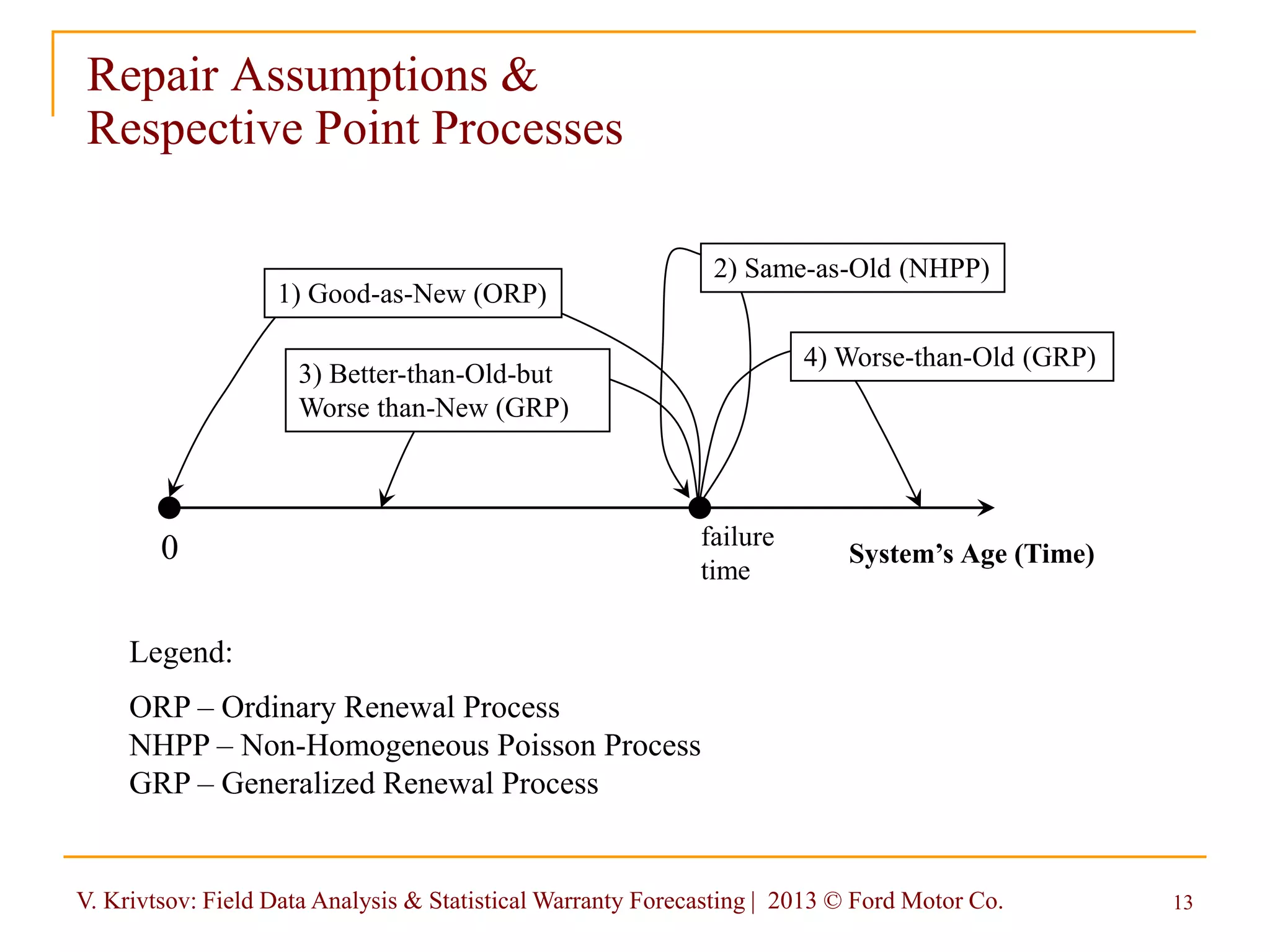
Repair Assumptions &
Respective Point Processes
System’s Age (Time)0 failure
time
1) Good-as-New (ORP)
2) Same-as-Old (NHPP)
3) Better-than-Old-but
Worse than-New (GRP)
4) Worse-than-Old (GRP)
Legend:
ORP – Ordinary Renewal Process
NHPP – Non-Homogeneous Poisson Process
GRP – Generalized Renewal Process
V. Krivtsov: Field Data Analysis & Statistical Warranty Forecasting | 2013 © Ford Motor Co. 14
Ordinary Renewal Process
 Repair Assumption: “good-as-new”
 Expected number of failures in [0, t]:
F(t) = CDF of the time to first failure (TTFF) distribution
 Iterative Model (Smith, Leadbetter - 1963)
TTFF distribution: Weibull
 Recursive Model (White - 1964)
TTFF distribution: Weibull
 Numerical Integration Approach (Baxter, Scheuer - 1982)
TTFF distributions: Weibull, Gamma, lognormal, truncated Gaussian
 Pade Approximation Model (Garg, Kalagnanam - 1998)
TTFF distribution: truncated Gaussian
 LL
t
dtFtFt
0
)()()()( 
V. Krivtsov: Field Data Analysis & Statistical Warranty Forecasting | 2013 © Ford Motor Co. 15
Nonhomogeneous Poisson Process (NHPP)
 Repair Assumption: “same-as-old”
 Expected number of failures in [0, t]:
l() = the rate of occurrence of failures (ROCOF)
 Common Models for l()
 Loglinear Model (Cox, Lewis - 1966)
 Power Law Model (Crow - 1974)
 Monte Carlo Simulation
X1 = time to first failure distributed according to F(t),
X2 = time to second failure distributed according to F(t2| X1), where
Failure Interarrival Time

t
0
d)()t( lL
)(
)(
1)|(
1
12
12
XR
XtR
XttF



L
n
i inn XStSnEt 1
)],|[max()(
  11
1
)](1[1 

 iii SStFFX 
V. Krivtsov: Field Data Analysis & Statistical Warranty Forecasting | 2013 © Ford Motor Co. 16
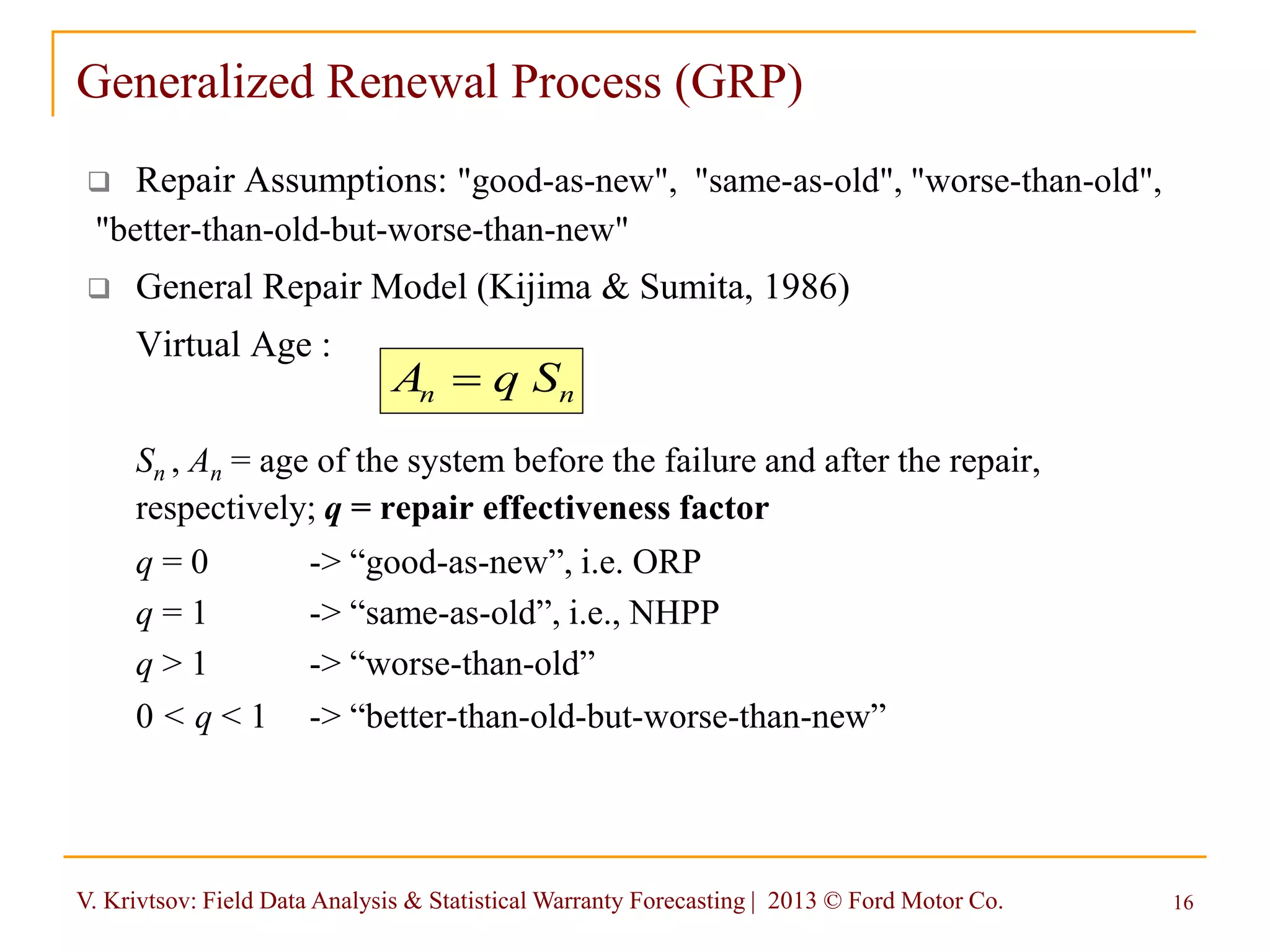
Generalized Renewal Process (GRP)
 Repair Assumptions: "good-as-new", "same-as-old", "worse-than-old",
"better-than-old-but-worse-than-new"
 General Repair Model (Kijima & Sumita, 1986)
Virtual Age :
Sn , An = age of the system before the failure and after the repair,
respectively; q = repair effectiveness factor
q = 0 -> “good-as-new”, i.e. ORP
q = 1 -> “same-as-old”, i.e., NHPP
q > 1 -> “worse-than-old”
0 < q < 1 -> “better-than-old-but-worse-than-new”
nn SqA 
V. Krivtsov: Field Data Analysis & Statistical Warranty Forecasting | 2013 © Ford Motor Co. 17
Fundamental G-Renewal Equation
 Expected number of failures in [0, t]:
where
 Closed solution is impossible and numerical solutions via Laplace transform or power series
expansion also fail (Kijima, 1988)
 Numerical integration approximations are difficult to apply, because of a recurrent infinite
system issue (Filkenstein, 1997)
 A Monte Carlo Solution is, however, possible (Kaminskiy & Krivtsov, 1998)
Failure Interarrival Time
,)|()()0|()(
0 0


ddxxxgxhgt
t
  







L
0,,
)(1
)(
)( 


 xt
qXF
qXtf
xtg

L
n
i inn XStSnEt 1
)],|[max()(
1-i
1-i
1-i1-
i Sq,
)SqF(t-1
)SqF(t-1
-1FX 









V. Krivtsov: Field Data Analysis & Statistical Warranty Forecasting | 2013 © Ford Motor Co. 18
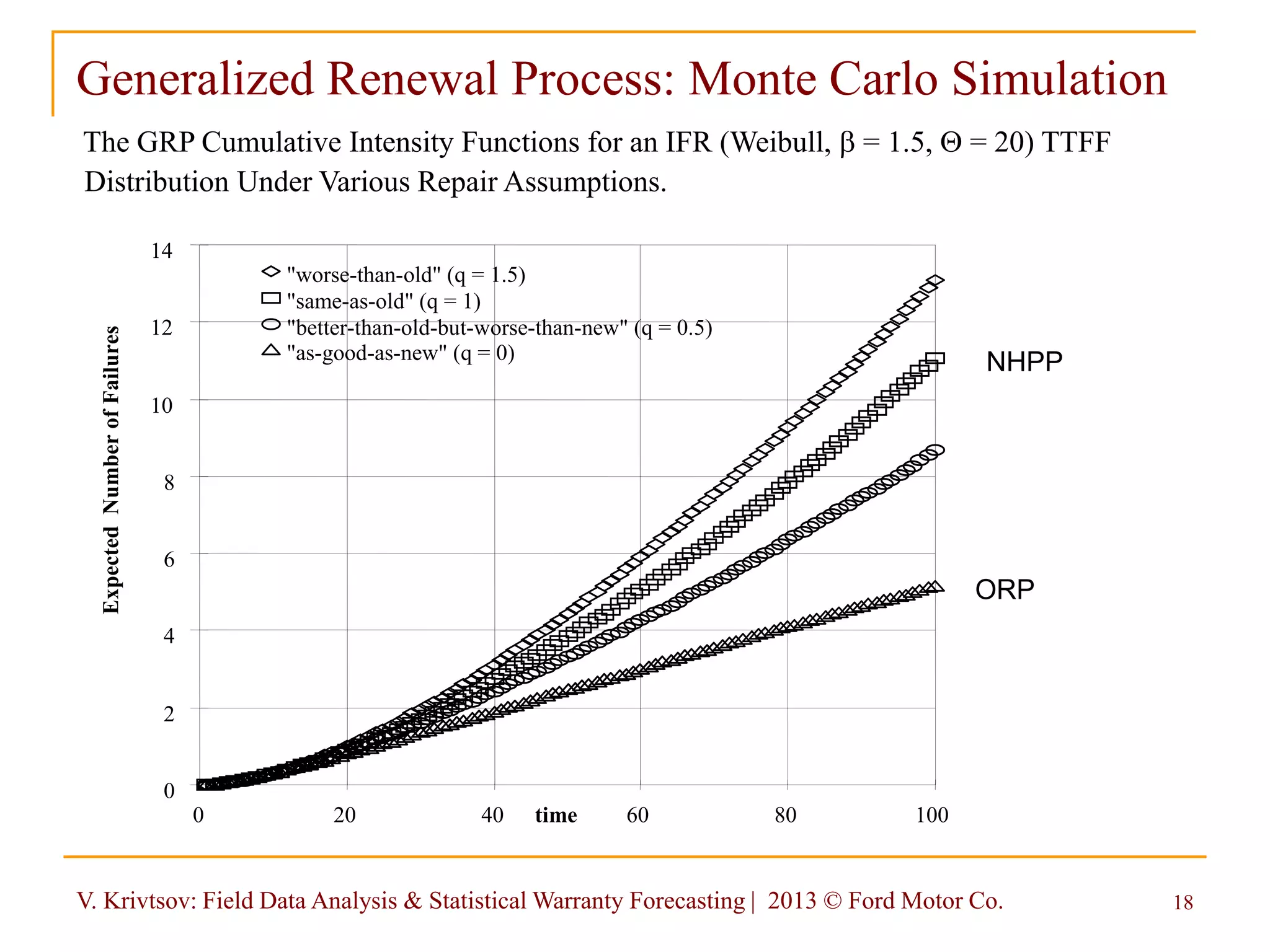
Generalized Renewal Process: Monte Carlo Simulation
0
2
4
6
8
10
12
14
0 20 40 60 80 100time
ExpectedNumberofFailures
"worse-than-old" (q = 1.5)
"same-as-old" (q = 1)
"better-than-old-but-worse-than-new" (q = 0.5)
"as-good-as-new" (q = 0)
NHPP
ORP
The GRP Cumulative Intensity Functions for an IFR (Weibull, b = 1.5, Q = 20) TTFF
Distribution Under Various Repair Assumptions.
Statistical Estimation of Probabilistic Models
for Non-Repairable Systems
V. Krivtsov: Field Data Analysis & Statistical Warranty Forecasting | 2013 © Ford Motor Co. 20
Censoring
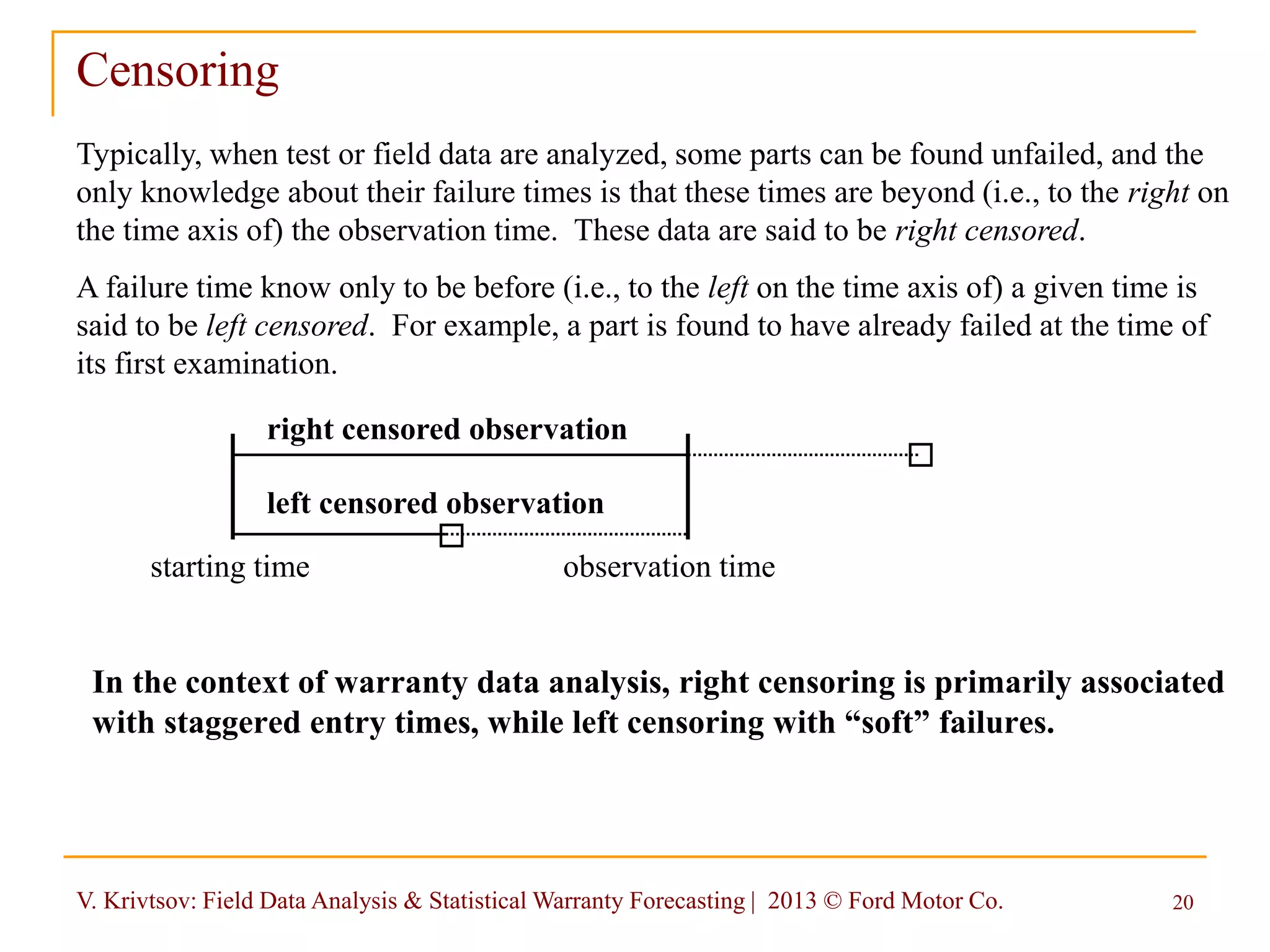
In the context of warranty data analysis, right censoring is primarily associated
with staggered entry times, while left censoring with “soft” failures.
Typically, when test or field data are analyzed, some parts can be found unfailed, and the
only knowledge about their failure times is that these times are beyond (i.e., to the right on
the time axis of) the observation time. These data are said to be right censored.
A failure time know only to be before (i.e., to the left on the time axis of) a given time is
said to be left censored. For example, a part is found to have already failed at the time of
its first examination.
observation time
right censored observation
left censored observation
starting time
V. Krivtsov: Field Data Analysis & Statistical Warranty Forecasting | 2013 © Ford Motor Co. 21
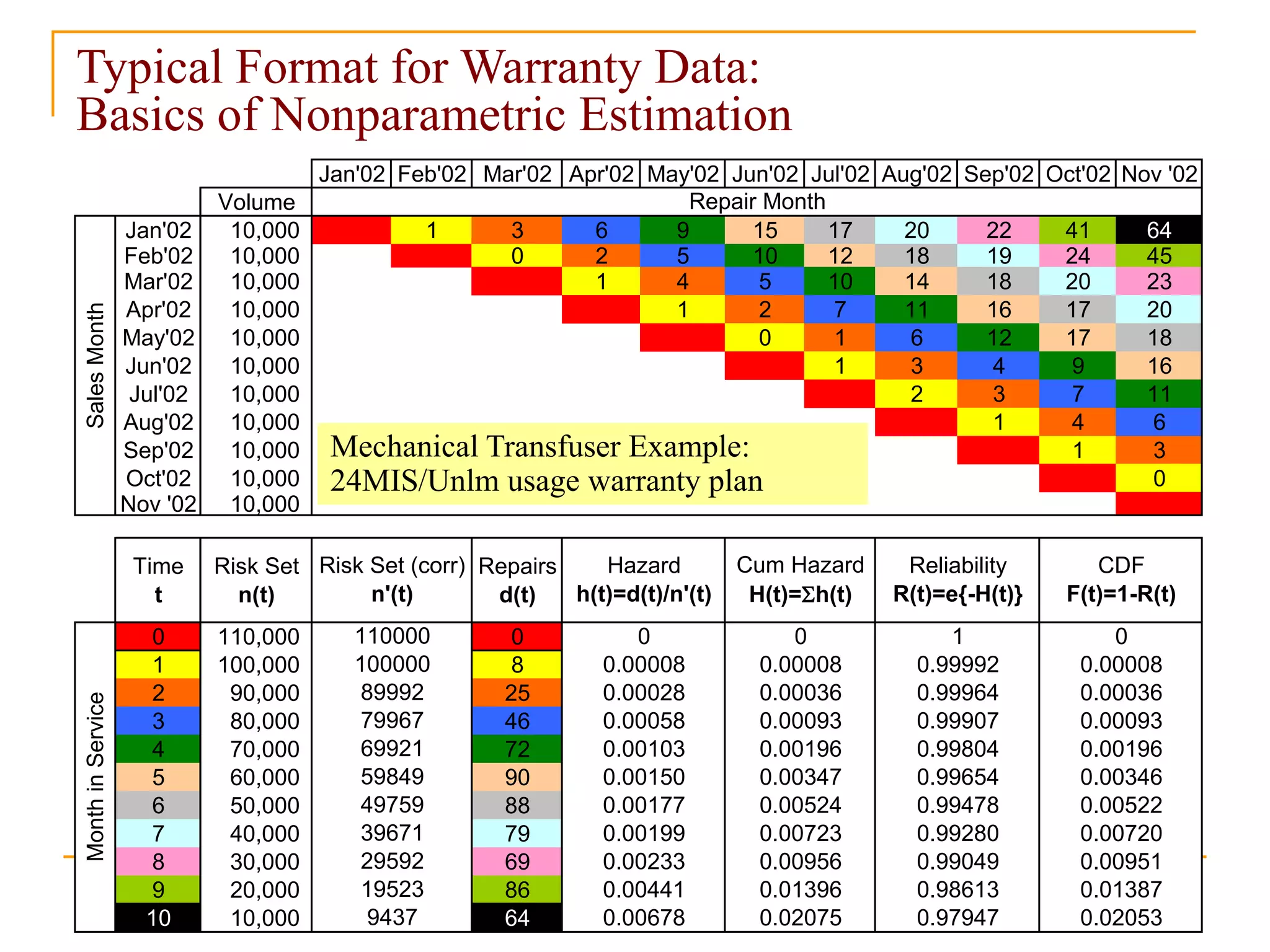
Typical Format for Warranty Data:
Basics of Nonparametric Estimation
Jan'02 Feb'02 Mar'02 Apr'02 May'02 Jun'02 Jul'02 Aug'02 Sep'02 Oct'02 Nov '02
Volume
Jan'02 10,000 1 3 6 9 15 17 20 22 41 64
Feb'02 10,000 0 2 5 10 12 18 19 24 45
Mar'02 10,000 1 4 5 10 14 18 20 23
Apr'02 10,000 1 2 7 11 16 17 20
May'02 10,000 0 1 6 12 17 18
Jun'02 10,000 1 3 4 9 16
Jul'02 10,000 2 3 7 11
Aug'02 10,000 1 4 6
Sep'02 10,000 1 3
Oct'02 10,000 0
Nov '02 10,000
Time
t
Risk Set
n(t)
Repairs
d(t)
0 110,000 0
1 100,000 8
2 90,000 25
3 80,000 46
4 70,000 72
5 60,000 90
6 50,000 88
7 40,000 79
8 30,000 69
9 20,000 86
10 10,000 64
29592
19523
9437
69921
59849
49759
39671
110000
100000
89992
79967
0.01396
0.00956
CDF
F(t)=1-R(t)
Cum Hazard
H(t)=Sh(t)
0.99907
0.99964
0.99992
01
0.00720
0.00951
0.01387
0.02053
Repair Month
0.99804
0.99654
0.99478
0.00008
0.00036
0.00093
0.00196
0.00346
0.00522
0.00036
0.00093
0.00196
0.00347
0.00524
0.007230.00199
0.00233
0.00441
0.00678
0.99280
0.99049
0.98613
0.979470.02075
Reliability
R(t)=e{-H(t)}
MonthinService
0
0.00008
0.00028
0.00058
0.00103
0.00150
0.00177
0
SalesMonth
Hazard
h(t)=d(t)/n'(t)
Risk Set (corr)
n'(t)
0.00008
Mechanical Transfuser Example:
24MIS/Unlm usage warranty plan
V. Krivtsov: Field Data Analysis & Statistical Warranty Forecasting | 2013 © Ford Motor Co. 22
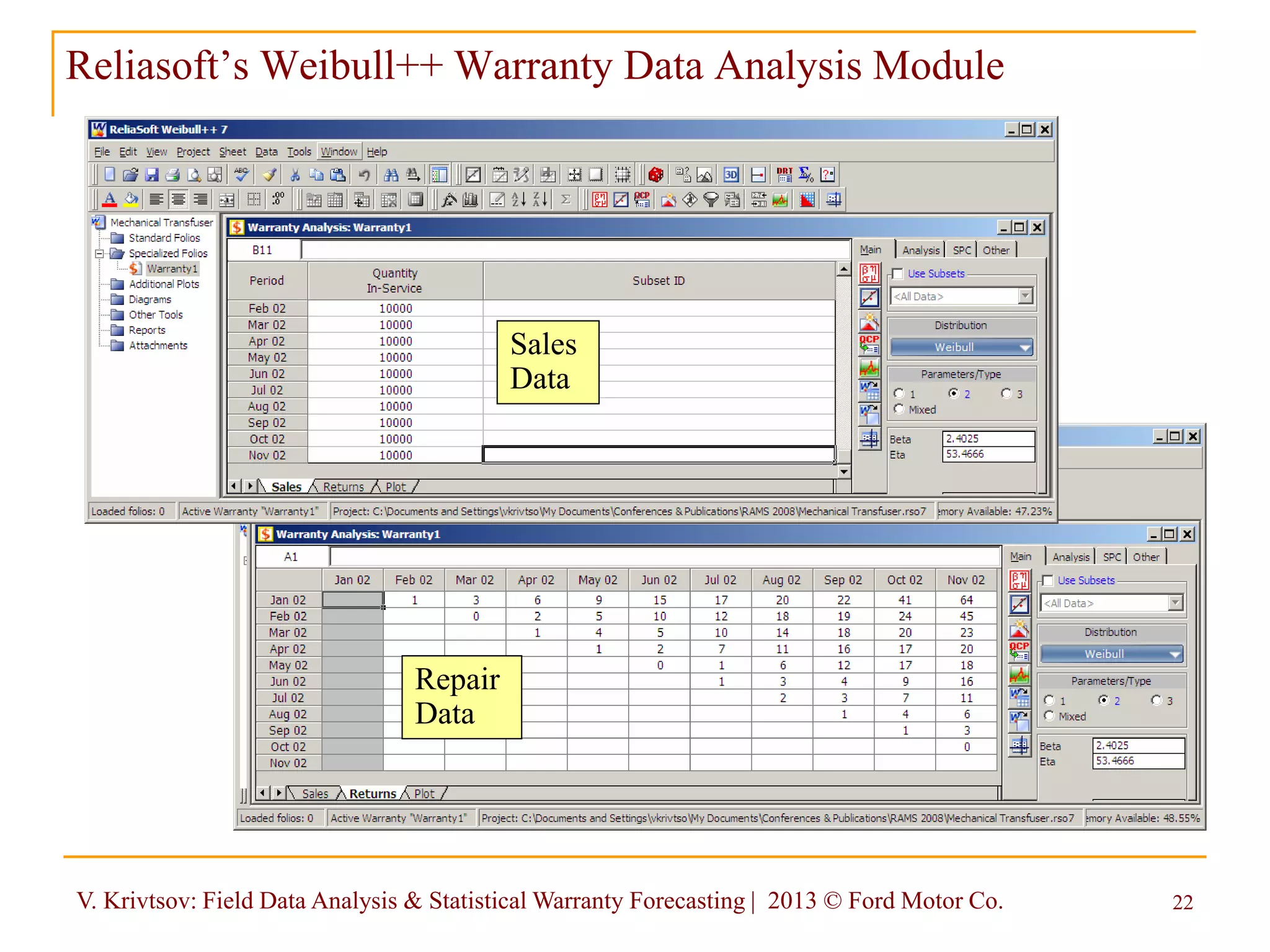
Reliasoft’s Weibull++ Warranty Data Analysis Module
Sales
Data
Repair
Data
V. Krivtsov: Field Data Analysis & Statistical Warranty Forecasting | 2013 © Ford Motor Co. 23
Time: t
CDF:F(t)
1.000E-4 12.0002.400 4.800 7.200 9.600
0.000
0.020
0.004
0.008
0.012
0.016
x 8
x 25
x 46
x 72
x 90
x 88
x 79
x 69
x 86
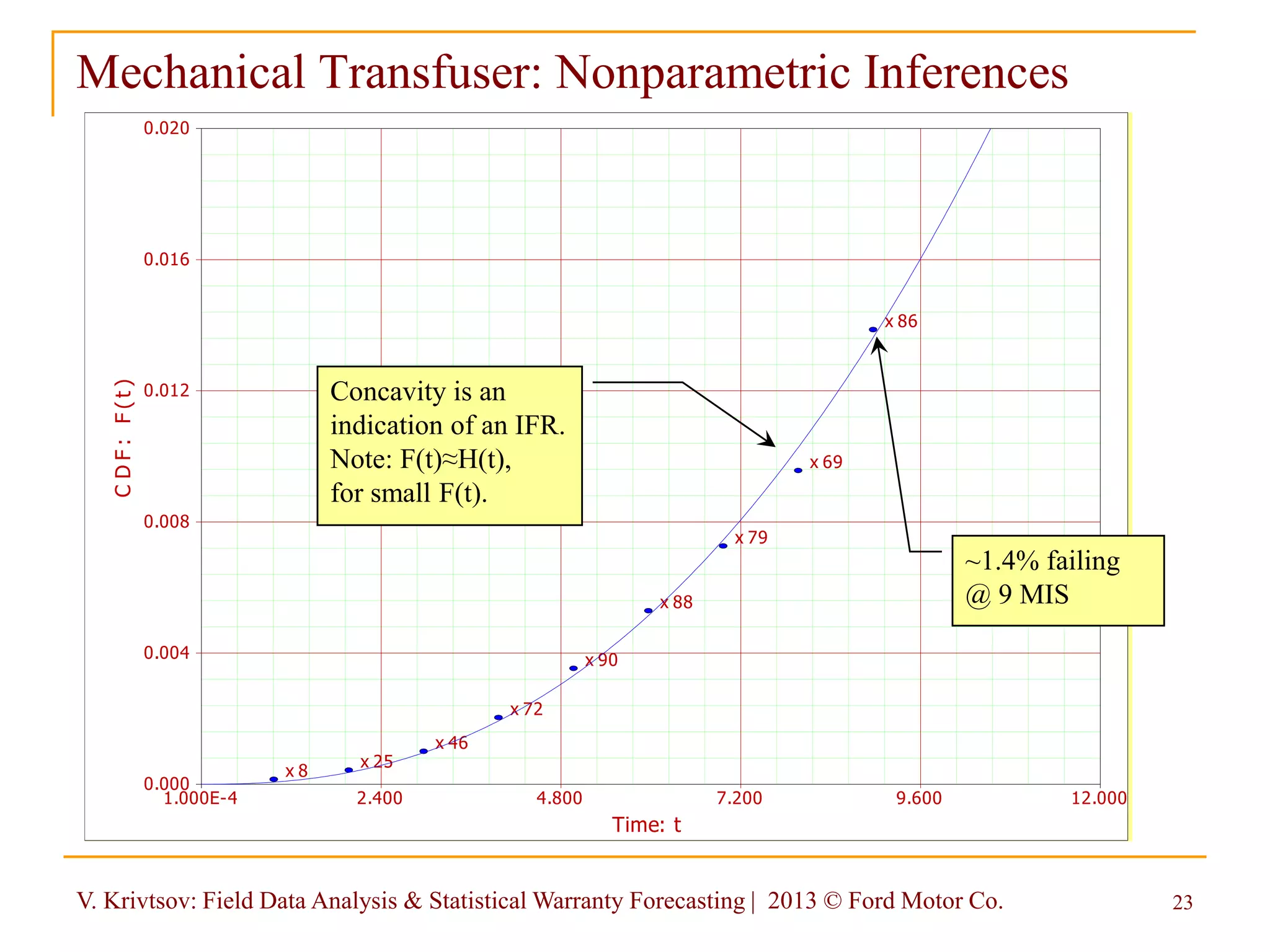
Mechanical Transfuser: Nonparametric Inferences
~1.4% failing
@ 9 MIS
Concavity is an
indication of an IFR.
Note: F(t)≈H(t),
for small F(t).
V. Krivtsov: Field Data Analysis & Statistical Warranty Forecasting | 2013 © Ford Motor Co. 24
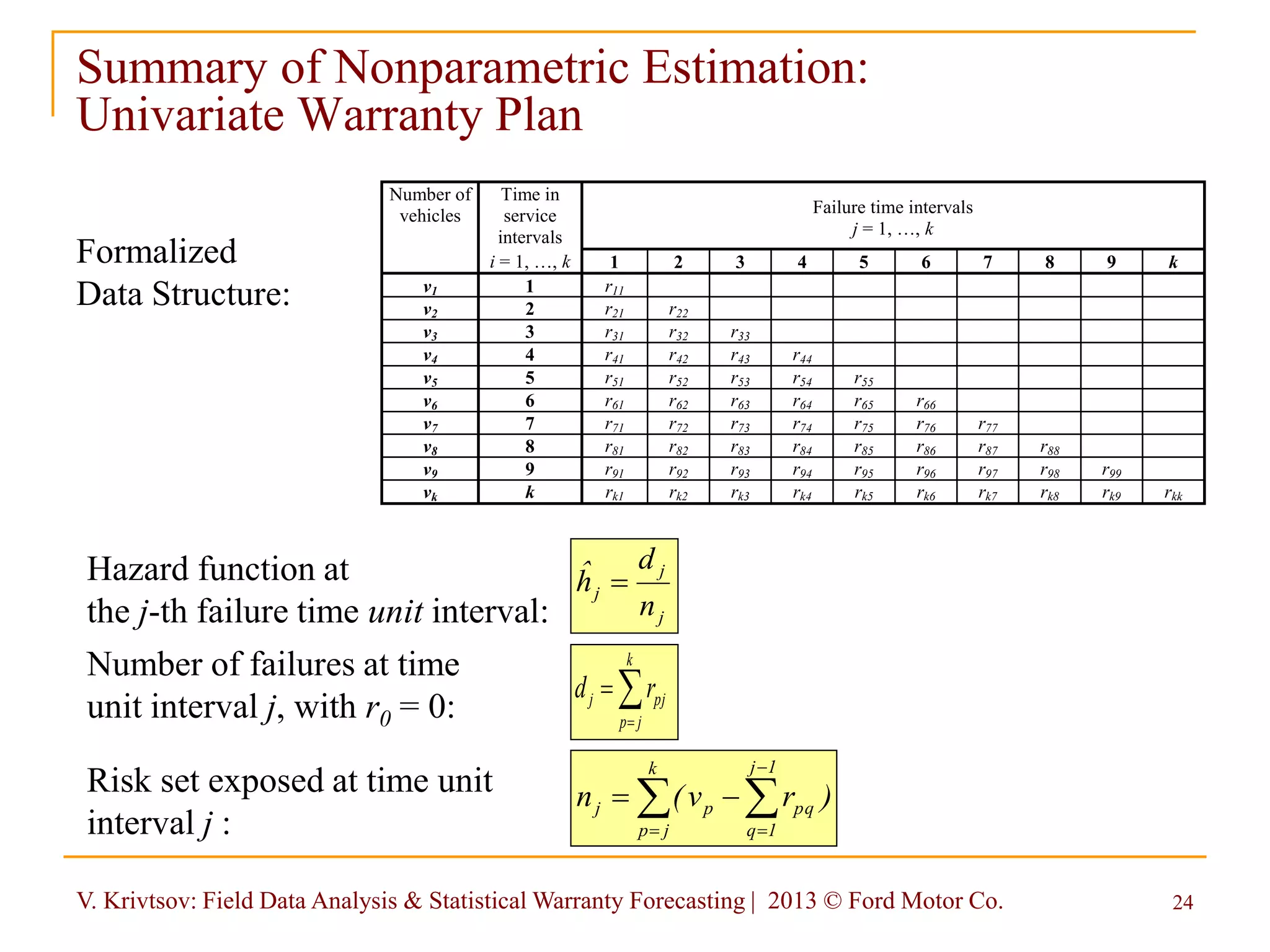
Number of failures at time
unit interval j, with r0 = 0: 

k
jp
pjj rd
 



k
jp
1j
1q
pqpj )rv(nRisk set exposed at time unit
interval j :
Number of
vehicles
Time in
service
intervals
Failure time intervals
j = 1, …, k
i = 1, …, k 1 2 3 4 5 6 7 8 9 k
v1 1 r11
v2 2 r21 r22
v3 3 r31 r32 r33
v4 4 r41 r42 r43 r44
v5 5 r51 r52 r53 r54 r55
v6 6 r61 r62 r63 r64 r65 r66
v7 7 r71 r72 r73 r74 r75 r76 r77
v8 8 r81 r82 r83 r84 r85 r86 r87 r88
v9 9 r91 r92 r93 r94 r95 r96 r97 r98 r99
vk k rk1 rk2 rk3 rk4 rk5 rk6 rk7 rk8 rk9 rkk
Summary of Nonparametric Estimation:
Univariate Warranty Plan
Formalized
Data Structure:
j
j
j
n
d
hˆ Hazard function at
the j-th failure time unit interval:
V. Krivtsov: Field Data Analysis & Statistical Warranty Forecasting | 2013 © Ford Motor Co. 25
 



k
jp
j
q
jpqpj rvn
1
1
))((
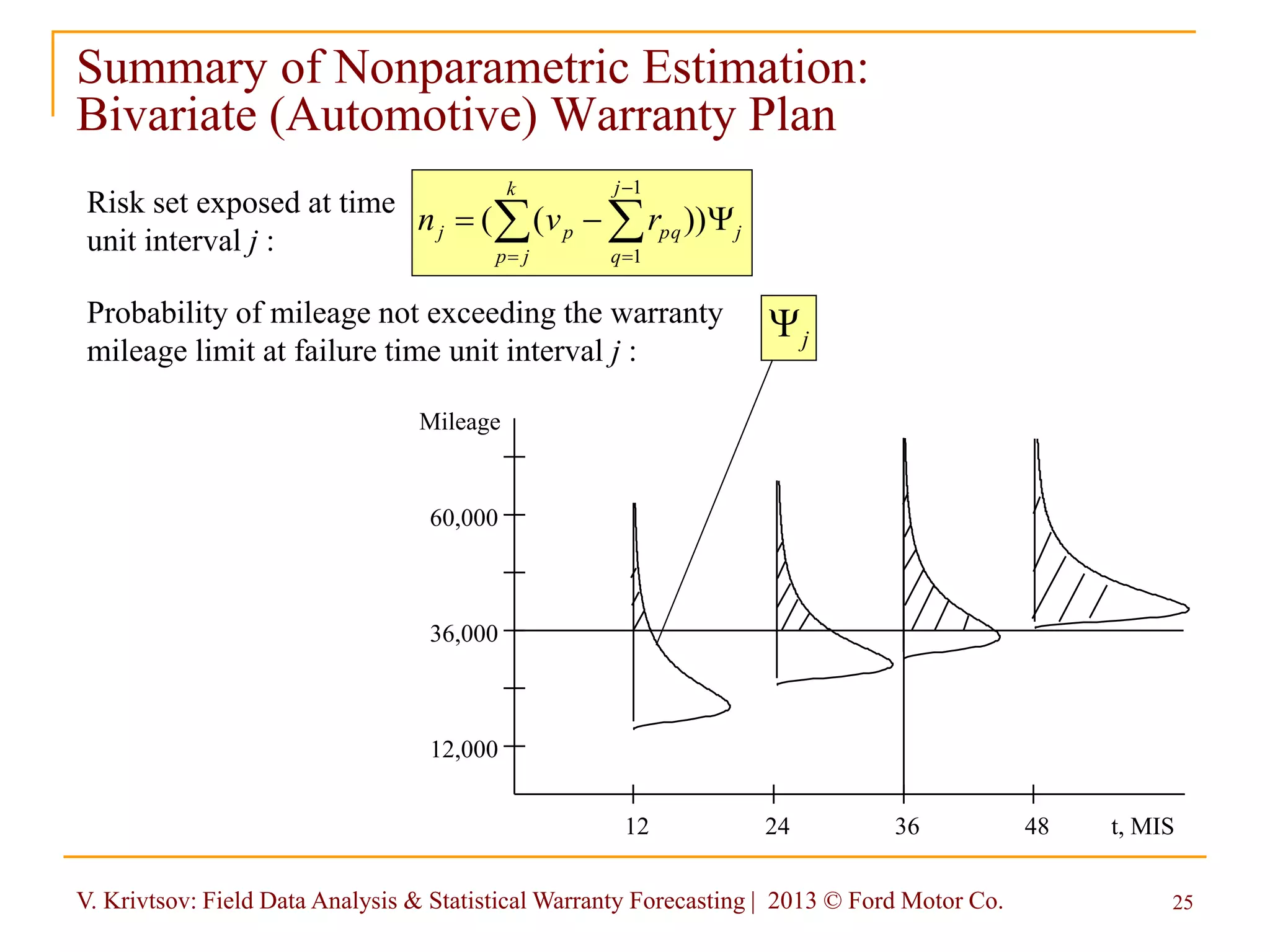
Risk set exposed at time
unit interval j :
Probability of mileage not exceeding the warranty
mileage limit at failure time unit interval j :
Summary of Nonparametric Estimation:
Bivariate (Automotive) Warranty Plan
12 24 36 48 t, MIS
12,000
36,000
60,000
Mileage
j
V. Krivtsov: Field Data Analysis & Statistical Warranty Forecasting | 2013 © Ford Motor Co. 26
Weibull Probability Plot: Mechanical Transfuser Data
ReliaSoft Weibull++ 7 - www.ReliaSoft.com
b,,
Time: t
CDF:F(t)
0.100 100.0001.000 10.000
0.001
0.005
0.010
0.050
0.100
0.500
1.000
5.000
10.000
50.000
90.000
99.000
0.001
x 8
x 25
x 46
x 72
x 90
x 88
x 79
x 69
x 86
x 64
0.5
0.6
0.7
0.8
0.9
1.0
1.2
1.4
1.6
2.0
3.0
4.0
6.0

b
Probability-W eibull
CB@ 95% 2-Sided [T]
All Data
W eibull-2P
RRX SRM MED FM
F=627/S=99373
Data Points
Probability Line
Top CB-I
Bottom CB-I
Vasiliy Krivtsov
VVK
9/22/2007
4:51:35 PM
Mechanical Transfuser –
Warranty Forecast Summary:
Failure probability @ 24MIS: 0.1364
Population Size: 110,000
Total Expected Repairs: 15,004
Cost per repair: $30
Total Expected Warranty Cost: $450,120
Year-to-date Cost: $18,810
Required Warranty Reserve: $431,310
13.64
24
V. Krivtsov: Field Data Analysis & Statistical Warranty Forecasting | 2013 © Ford Motor Co. 27
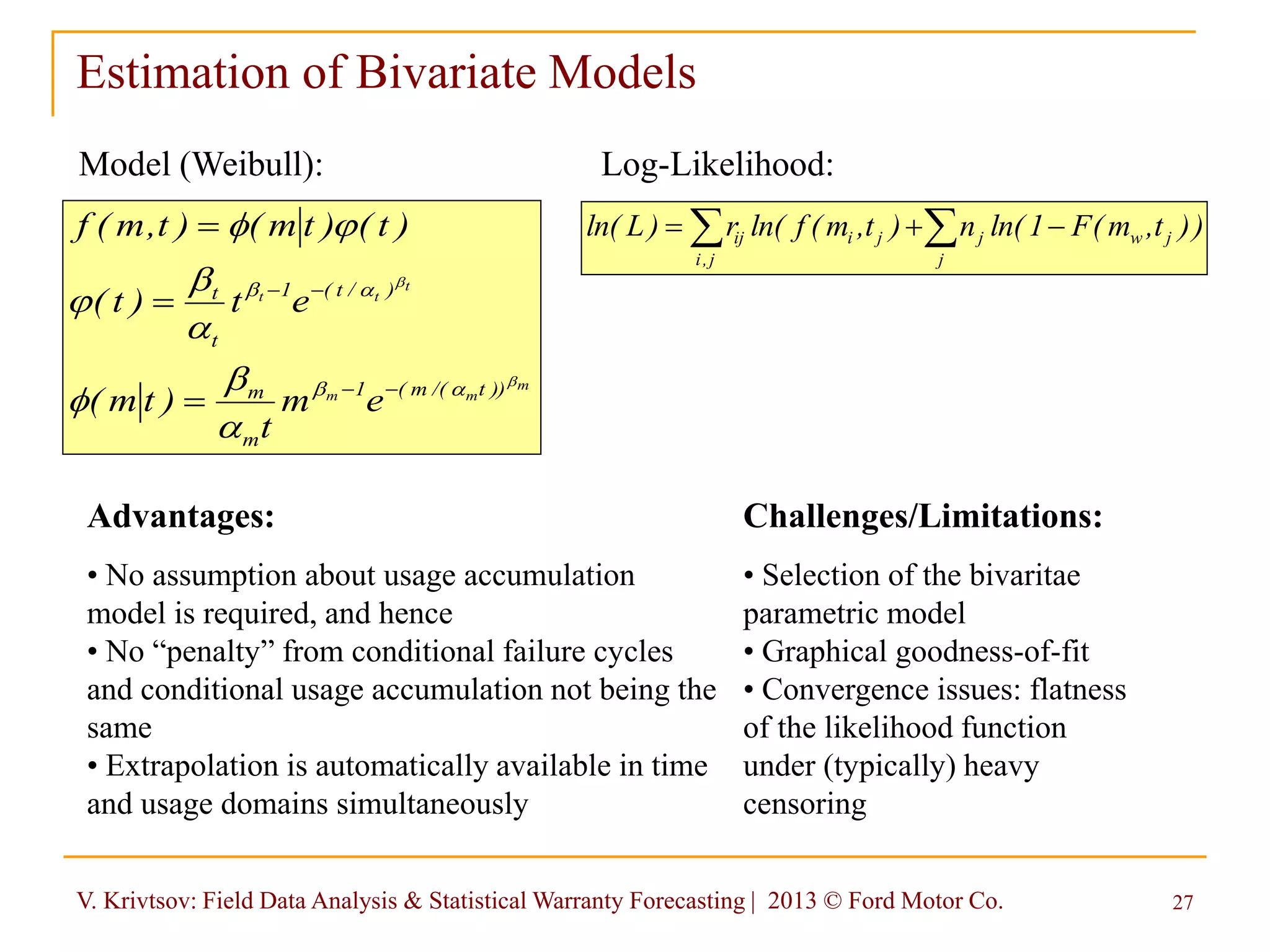
Estimation of Bivariate Models
Model (Weibull):
m
mm
t
tt
))t/(m(1
m
m
)/t(1
t
t
em
t
)tm(
et)t(
)t()tm()t,m(f
b
b
b
b

b


b







Advantages:
• No assumption about usage accumulation
model is required, and hence
• No “penalty” from conditional failure cycles
and conditional usage accumulation not being the
same
• Extrapolation is automatically available in time
and usage domains simultaneously
Log-Likelihood:
))t,m(F1ln(n)t,m(fln(r)Lln(
j
jwj
j,i
jiij  
Challenges/Limitations:
• Selection of the bivaritae
parametric model
• Graphical goodness-of-fit
• Convergence issues: flatness
of the likelihood function
under (typically) heavy
censoring
V. Krivtsov: Field Data Analysis & Statistical Warranty Forecasting | 2013 © Ford Motor Co. 28
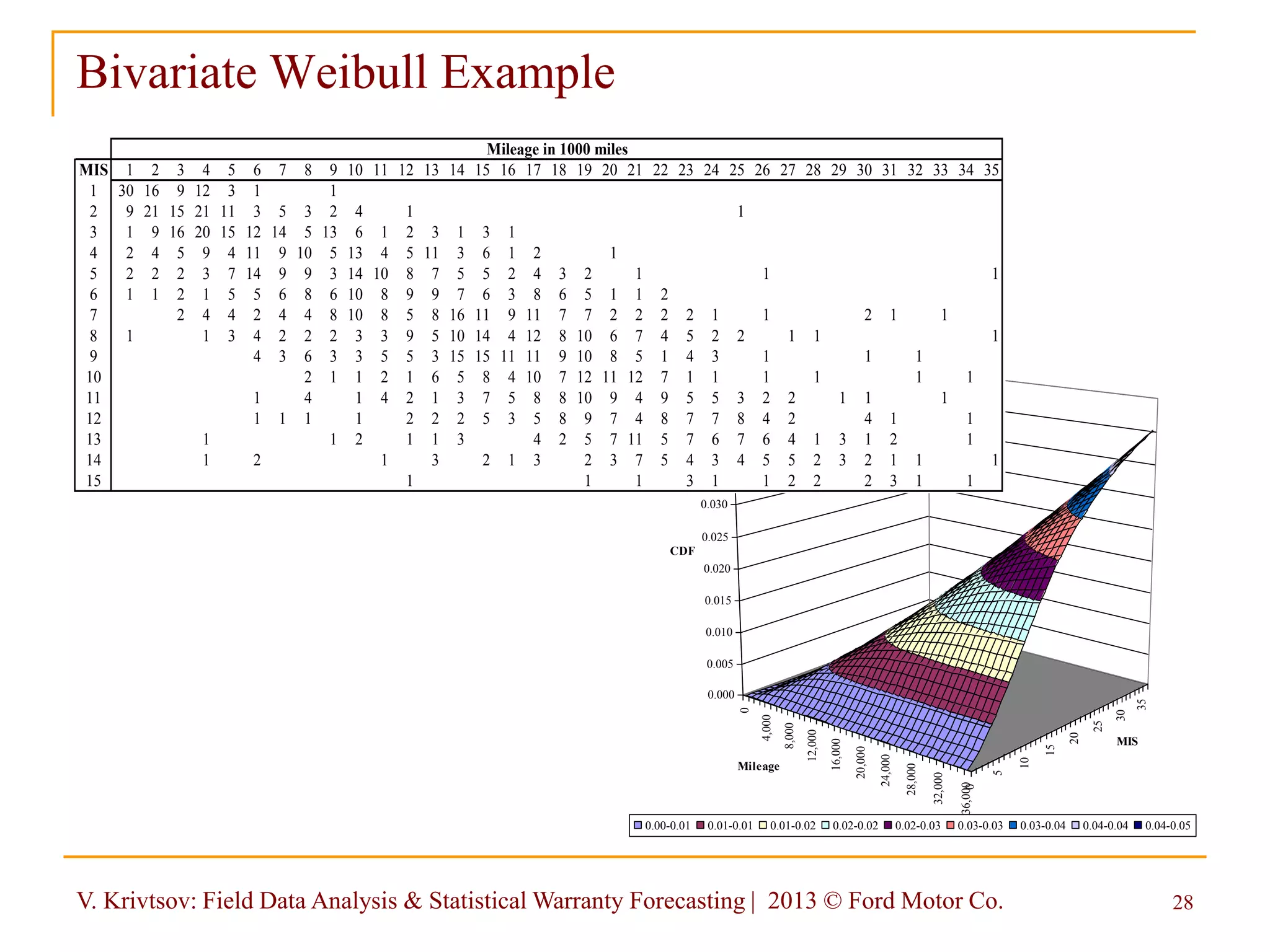
Bivariate Weibull Example
0
4,000
8,000
12,000
16,000
20,000
24,000
28,000
32,000
36,0000
5
10
15
20
25
30
35
0.000
0.005
0.010
0.015
0.020
0.025
0.030
0.035
0.040
0.045
CDF
Mileage
MIS
0.00-0.01 0.01-0.01 0.01-0.02 0.02-0.02 0.02-0.03 0.03-0.03 0.03-0.04 0.04-0.04 0.04-0.05
MIS 1 2 3 4 5 6 7 8 9 10 11 12 13 14 15 16 17 18 19 20 21 22 23 24 25 26 27 28 29 30 31 32 33 34 35
1 30 16 9 12 3 1 1
2 9 21 15 21 11 3 5 3 2 4 1 1
3 1 9 16 20 15 12 14 5 13 6 1 2 3 1 3 1
4 2 4 5 9 4 11 9 10 5 13 4 5 11 3 6 1 2 1
5 2 2 2 3 7 14 9 9 3 14 10 8 7 5 5 2 4 3 2 1 1 1
6 1 1 2 1 5 5 6 8 6 10 8 9 9 7 6 3 8 6 5 1 1 2
7 2 4 4 2 4 4 8 10 8 5 8 16 11 9 11 7 7 2 2 2 2 1 1 2 1 1
8 1 1 3 4 2 2 2 3 3 9 5 10 14 4 12 8 10 6 7 4 5 2 2 1 1 1
9 4 3 6 3 3 5 5 3 15 15 11 11 9 10 8 5 1 4 3 1 1 1
10 2 1 1 2 1 6 5 8 4 10 7 12 11 12 7 1 1 1 1 1 1
11 1 4 1 4 2 1 3 7 5 8 8 10 9 4 9 5 5 3 2 2 1 1 1
12 1 1 1 1 2 2 2 5 3 5 8 9 7 4 8 7 7 8 4 2 4 1 1
13 1 1 2 1 1 3 4 2 5 7 11 5 7 6 7 6 4 1 3 1 2 1
14 1 2 1 3 2 1 3 2 3 7 5 4 3 4 5 5 2 3 2 1 1 1
15 1 1 1 3 1 1 2 2 2 3 1 1
Mileage in 1000 miles
Statistical Estimation of Probabilistic Models
for Repairable Systems
V. Krivtsov: Field Data Analysis & Statistical Warranty Forecasting | 2013 © Ford Motor Co. 30
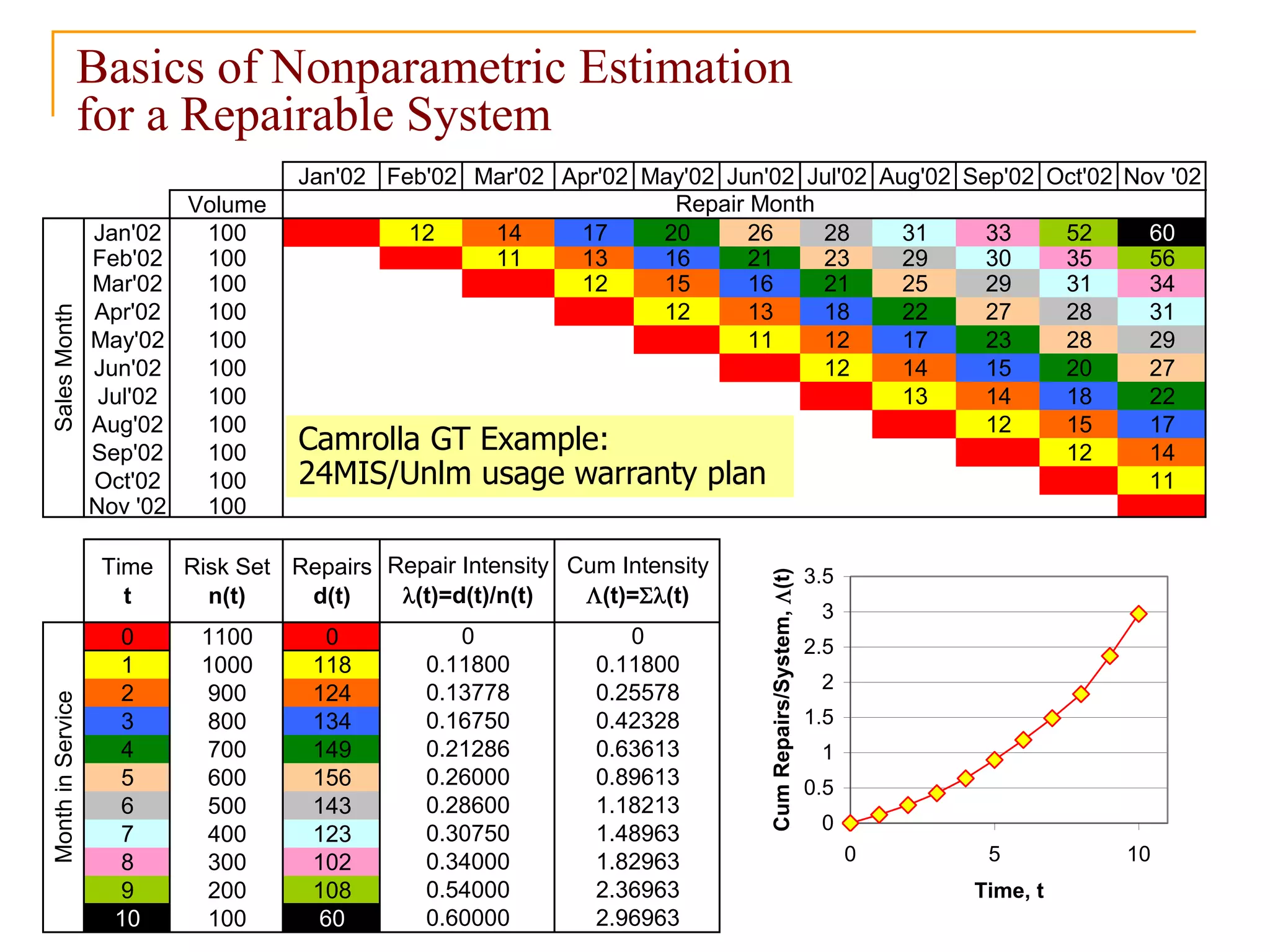
Jan'02 Feb'02 Mar'02 Apr'02 May'02 Jun'02 Jul'02 Aug'02 Sep'02 Oct'02 Nov '02
Volume
Jan'02 100 12 14 17 20 26 28 31 33 52 60
Feb'02 100 11 13 16 21 23 29 30 35 56
Mar'02 100 12 15 16 21 25 29 31 34
Apr'02 100 12 13 18 22 27 28 31
May'02 100 11 12 17 23 28 29
Jun'02 100 12 14 15 20 27
Jul'02 100 13 14 18 22
Aug'02 100 12 15 17
Sep'02 100 12 14
Oct'02 100 11
Nov '02 100
Time
t
Risk Set
n(t)
Repairs
d(t)
0 1100 0
1 1000 118
2 900 124
3 800 134
4 700 149
5 600 156
6 500 143
7 400 123
8 300 102
9 200 108
10 100 60
0.63613
0.89613
Repair Month
Cum Intensity
L(t)=Sl(t)
0.25578
0.42328
0.26000
0.28600 1.18213
0.30750 1.48963
2.96963
2.36963
1.82963
0.60000
0.34000
0.54000
SalesMonth
Repair Intensity
l(t)=d(t)/n(t)
0.11800
0
MonthinService
0
0.11800
0.13778
0.16750
0.21286
0
0.5
1
1.5
2
2.5
3
3.5
0 5 10
Time, t
CumRepairs/System,L(t)
Basics of Nonparametric Estimation
for a Repairable System
Camrolla GT Example:
24MIS/Unlm usage warranty plan
V. Krivtsov: Field Data Analysis & Statistical Warranty Forecasting | 2013 © Ford Motor Co. 31
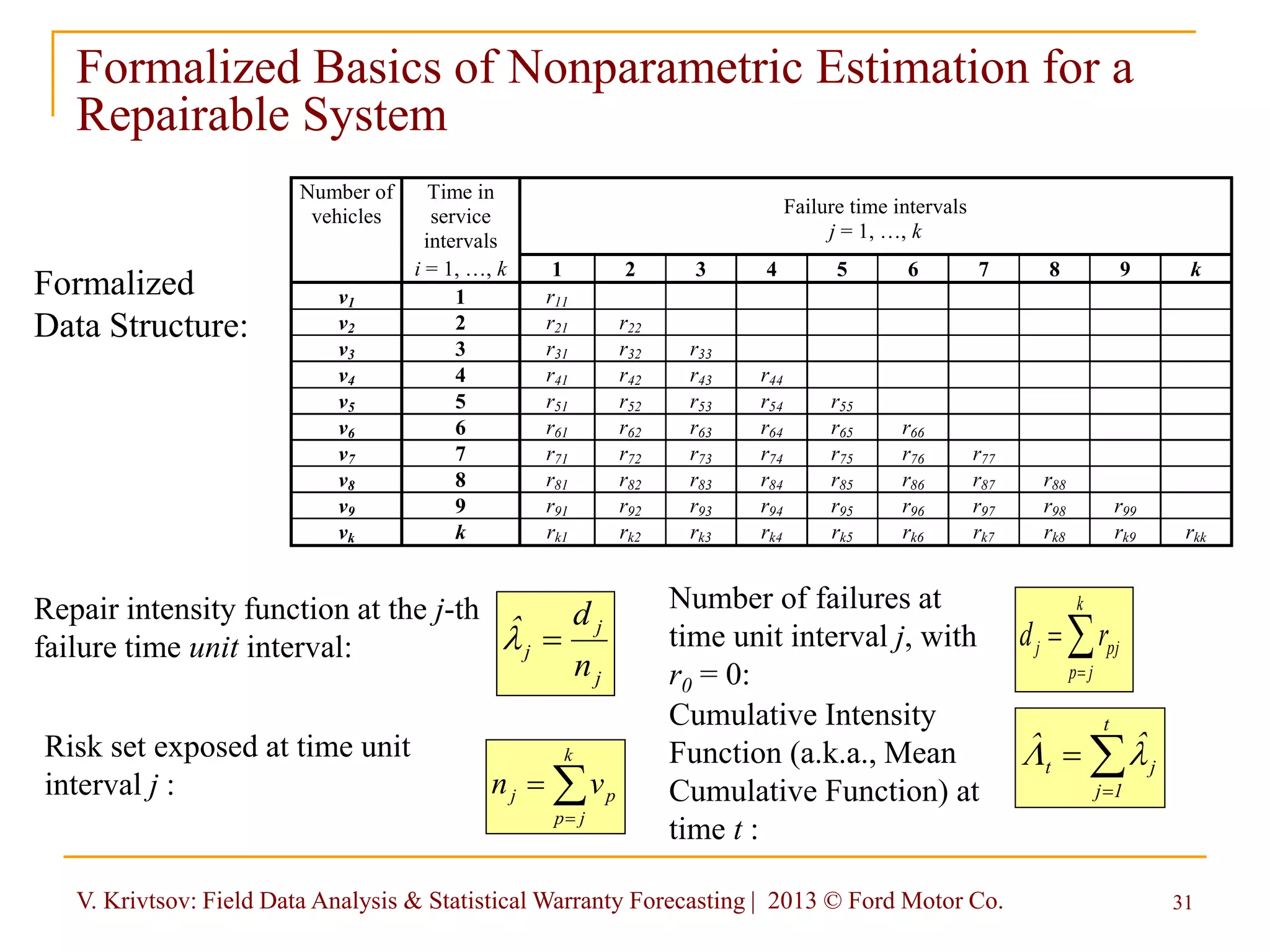
Number of
vehicles
Time in
service
intervals
Failure time intervals
j = 1, …, k
i = 1, …, k 1 2 3 4 5 6 7 8 9 k
v1 1 r11
v2 2 r21 r22
v3 3 r31 r32 r33
v4 4 r41 r42 r43 r44
v5 5 r51 r52 r53 r54 r55
v6 6 r61 r62 r63 r64 r65 r66
v7 7 r71 r72 r73 r74 r75 r76 r77
v8 8 r81 r82 r83 r84 r85 r86 r87 r88
v9 9 r91 r92 r93 r94 r95 r96 r97 r98 r99
vk k rk1 rk2 rk3 rk4 rk5 rk6 rk7 rk8 rk9 rkk
Number of failures at
time unit interval j, with
r0 = 0:


k
jp
pjj rd


k
jp
pj vn
Risk set exposed at time unit
interval j :
Formalized Basics of Nonparametric Estimation for a
Repairable System
Formalized
Data Structure:
j
j
j
n
dˆ l
Repair intensity function at the j-th
failure time unit interval:
Cumulative Intensity
Function (a.k.a., Mean
Cumulative Function) at
time t :


t
1j
jt
ˆˆ lL
V. Krivtsov: Field Data Analysis & Statistical Warranty Forecasting | 2013 © Ford Motor Co. 32
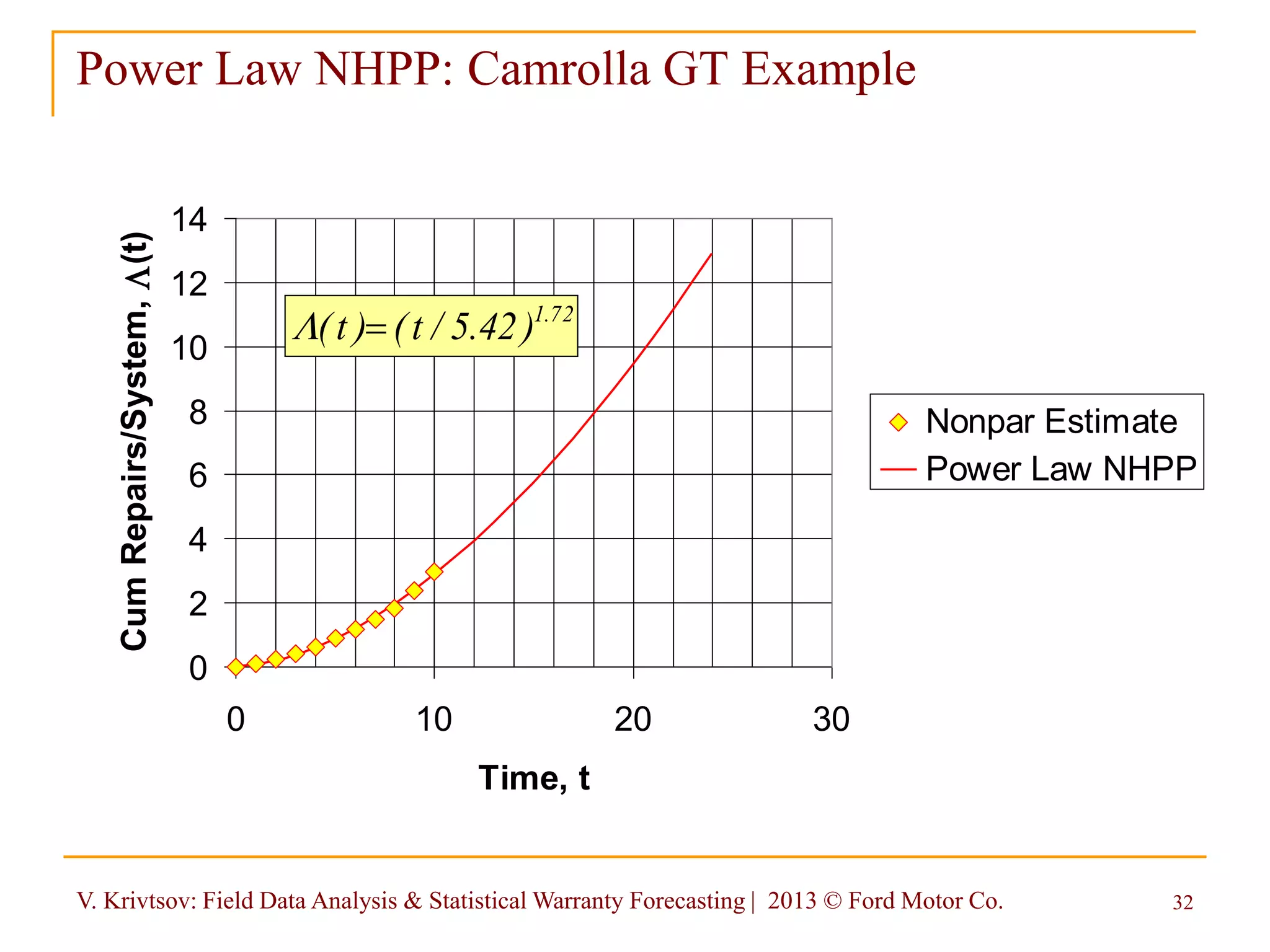
0
2
4
6
8
10
12
14
0 10 20 30
Time, t
CumRepairs/System,L(t)
Nonpar Estimate
Power Law NHPP
Power Law NHPP: Camrolla GT Example
72.1
)42.5/t()t( L
Special Topics
V. Krivtsov: Field Data Analysis & Statistical Warranty Forecasting | 2013 © Ford Motor Co. 34
Calendarized Forecasting
ReliaSoft Weibull++ 7 - www.ReliaSoft.com
b,,
Time: t
CDF:F(t)
0.100 100.0001.000 10.000
0.001
0.005
0.010
0.050
0.100
0.500
1.000
5.000
10.000
50.000
90.000
99.000
0.001
x 8
x 25
x 46
x 72
x 90
x 88
x 79
x 69
x 86
x 64
0.5
0.6
0.7
0.8
0.9
1.0
1.2
1.4
1.6
2.0
3.0
4.0
6.0 
b
Probability-W eibull
CB@ 95% 2-Sided [T]
All Data
W eibull-2P
RRX SRM MED FM
F=627/S=99373
Data Points
Probability Line
Top CB-I
Bottom CB-I
Vasiliy Krivtsov
VVK
9/22/2007
4:51:35 PM
13.64
24
Mechanical Transfuser –
Warranty Forecast Summary:
Failure probability @ 24MIS: 0.1364
Population Size: 110,000
Total Expected Repairs: 15,004
Cost per repair: $30
Total Expected Warranty Cost: $450,120
Year-to-date Cost: $18,810
Required Warranty Reserve: $431,310
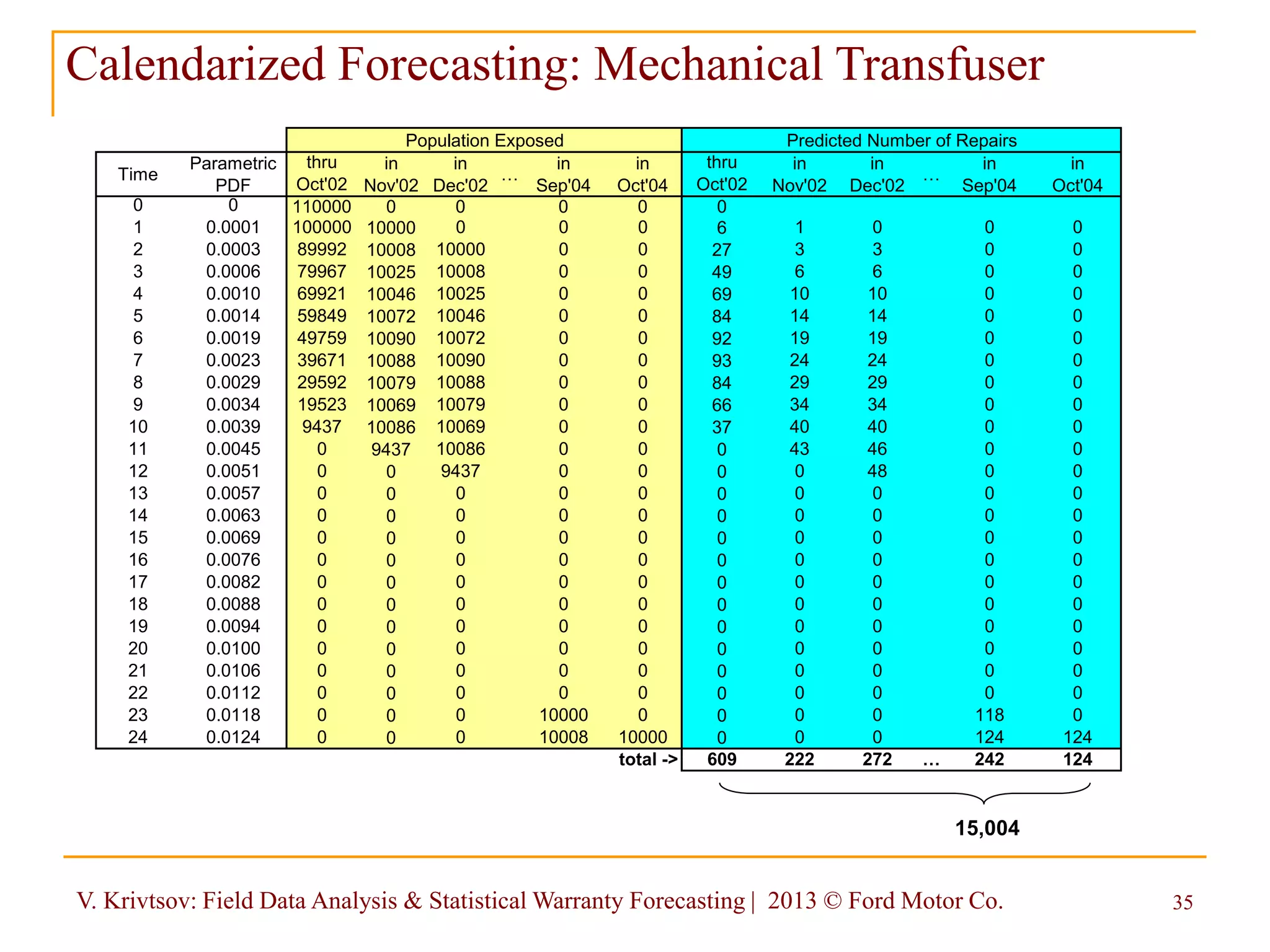
How will this total number of repairs be
distributed along the calendar time, i.e.
how many repairs to expect next month,
the following month, etc.?
V. Krivtsov: Field Data Analysis & Statistical Warranty Forecasting | 2013 © Ford Motor Co. 35
Time
Parametric
PDF
thru
Oct'02
in
Nov'02
in
Dec'02
…
in
Sep'04
in
Oct'04
thru
Oct'02
in
Nov'02
in
Dec'02
…
in
Sep'04
in
Oct'04
0 0 110000 0 0 0 0 0
1 0.0001 100000 10000 0 0 0 6 1 0 0 0
2 0.0003 89992 10008 10000 0 0 27 3 3 0 0
3 0.0006 79967 10025 10008 0 0 49 6 6 0 0
4 0.0010 69921 10046 10025 0 0 69 10 10 0 0
5 0.0014 59849 10072 10046 0 0 84 14 14 0 0
6 0.0019 49759 10090 10072 0 0 92 19 19 0 0
7 0.0023 39671 10088 10090 0 0 93 24 24 0 0
8 0.0029 29592 10079 10088 0 0 84 29 29 0 0
9 0.0034 19523 10069 10079 0 0 66 34 34 0 0
10 0.0039 9437 10086 10069 0 0 37 40 40 0 0
11 0.0045 0 9437 10086 0 0 0 43 46 0 0
12 0.0051 0 0 9437 0 0 0 0 48 0 0
13 0.0057 0 0 0 0 0 0 0 0 0 0
14 0.0063 0 0 0 0 0 0 0 0 0 0
15 0.0069 0 0 0 0 0 0 0 0 0 0
16 0.0076 0 0 0 0 0 0 0 0 0 0
17 0.0082 0 0 0 0 0 0 0 0 0 0
18 0.0088 0 0 0 0 0 0 0 0 0 0
19 0.0094 0 0 0 0 0 0 0 0 0 0
20 0.0100 0 0 0 0 0 0 0 0 0 0
21 0.0106 0 0 0 0 0 0 0 0 0 0
22 0.0112 0 0 0 0 0 0 0 0 0 0
23 0.0118 0 0 0 10000 0 0 0 0 118 0
24 0.0124 0 0 0 10008 10000 0 0 0 124 124
609 222 272 … 242 124
Population Exposed Predicted Number of Repairs
total ->
Calendarized Forecasting: Mechanical Transfuser
15,004
V. Krivtsov: Field Data Analysis & Statistical Warranty Forecasting | 2013 © Ford Motor Co. 36
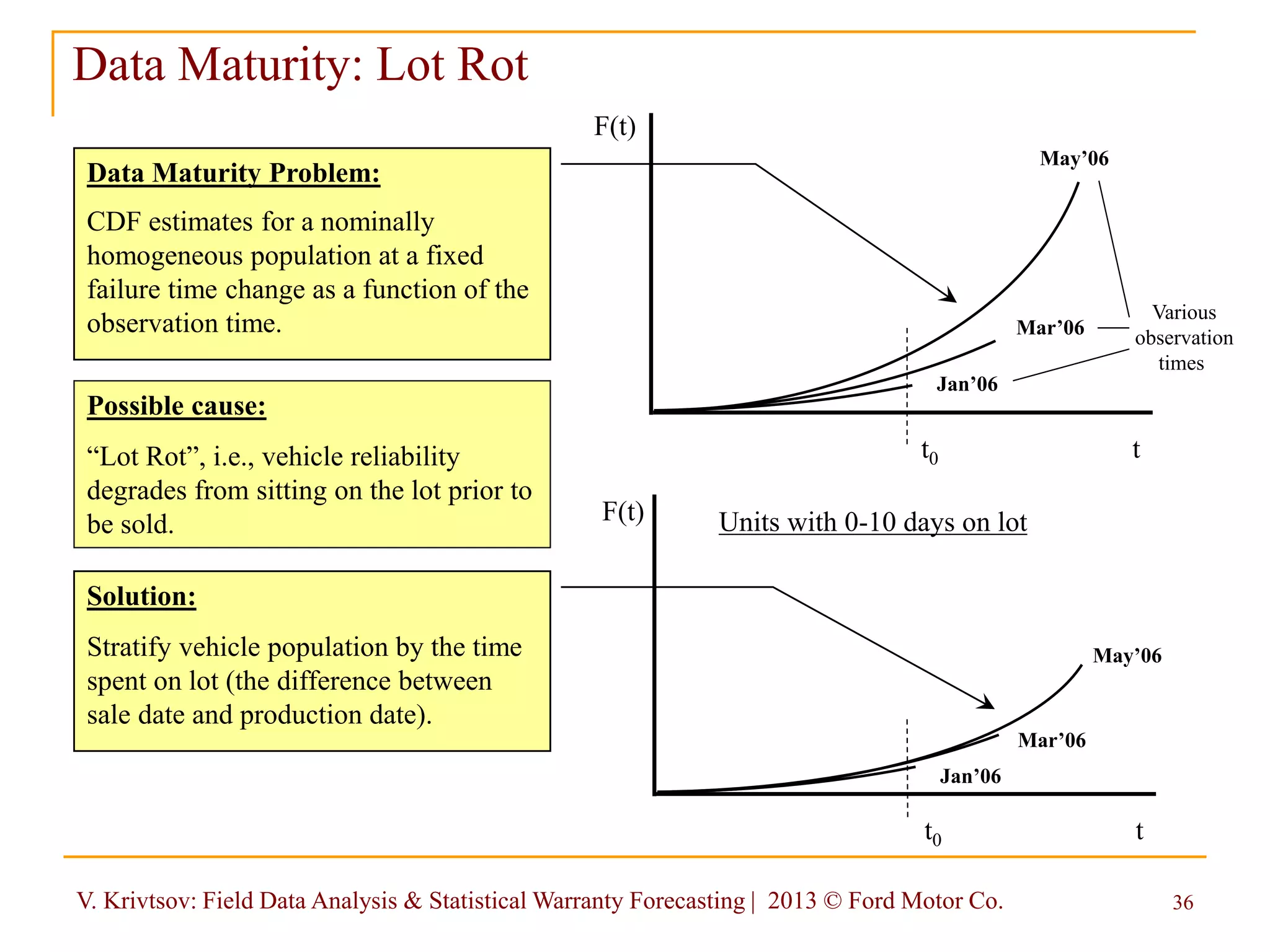
Data Maturity: Lot Rot
t
F(t)
Jan’06
Mar’06
May’06
t0
Data Maturity Problem:
CDF estimates for a nominally
homogeneous population at a fixed
failure time change as a function of the
observation time.
Possible cause:
“Lot Rot”, i.e., vehicle reliability
degrades from sitting on the lot prior to
be sold.
Various
observation
times
Solution:
Stratify vehicle population by the time
spent on lot (the difference between
sale date and production date).
t
F(t)
Jan’06
Mar’06
May’06
t0
Units with 0-10 days on lot
V. Krivtsov: Field Data Analysis & Statistical Warranty Forecasting | 2013 © Ford Motor Co. 37
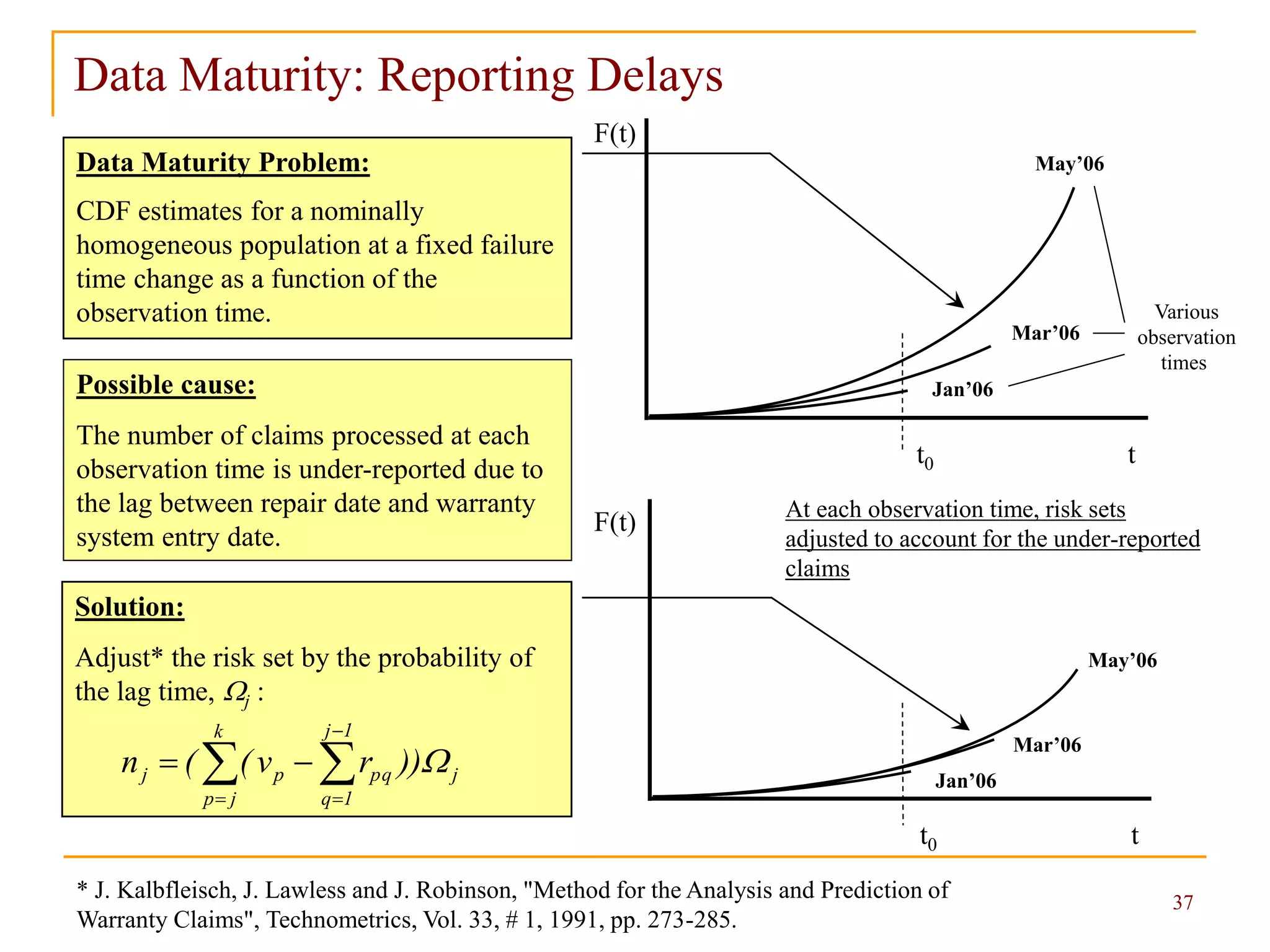
Data Maturity: Reporting Delays
t
F(t)
Jan’06
Mar’06
May’06
t0
Data Maturity Problem:
CDF estimates for a nominally
homogeneous population at a fixed failure
time change as a function of the
observation time.
Possible cause:
The number of claims processed at each
observation time is under-reported due to
the lag between repair date and warranty
system entry date.
Various
observation
times
Solution:
Adjust* the risk set by the probability of
the lag time, Wj :
t
F(t)
Jan’06
Mar’06
May’06
t0
At each observation time, risk sets
adjusted to account for the under-reported
claims
 



k
jp
1j
1q
jpqpj ))rv((n W
* J. Kalbfleisch, J. Lawless and J. Robinson, "Method for the Analysis and Prediction of
Warranty Claims", Technometrics, Vol. 33, # 1, 1991, pp. 273-285.
V. Krivtsov: Field Data Analysis & Statistical Warranty Forecasting | 2013 © Ford Motor Co. 38
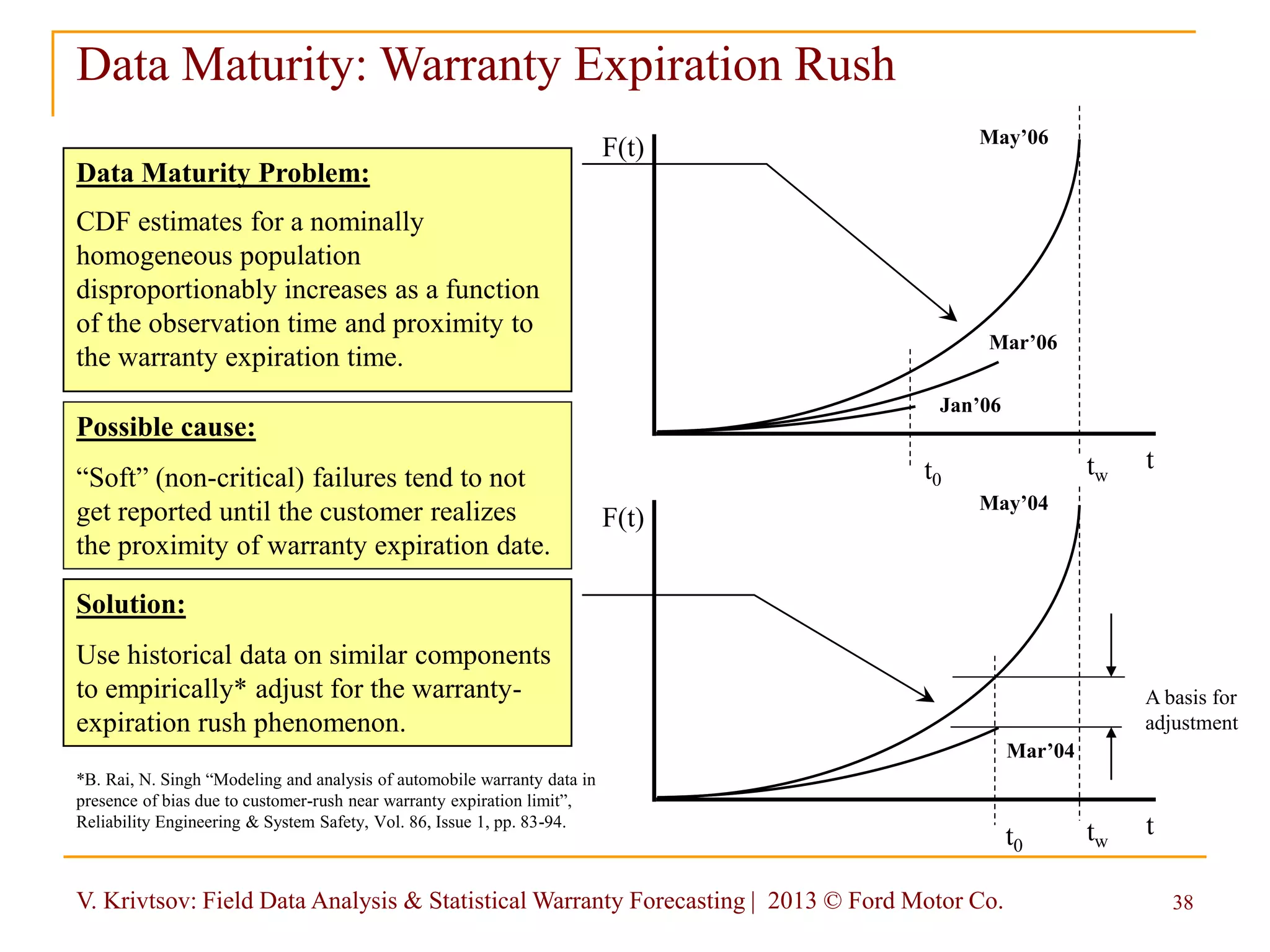
Data Maturity: Warranty Expiration Rush
t
F(t)
Jan’06
Mar’06
May’06
t0
Data Maturity Problem:
CDF estimates for a nominally
homogeneous population
disproportionably increases as a function
of the observation time and proximity to
the warranty expiration time.
Possible cause:
“Soft” (non-critical) failures tend to not
get reported until the customer realizes
the proximity of warranty expiration date.
Solution:
Use historical data on similar components
to empirically* adjust for the warranty-
expiration rush phenomenon.
*B. Rai, N. Singh “Modeling and analysis of automobile warranty data in
presence of bias due to customer-rush near warranty expiration limit”,
Reliability Engineering & System Safety, Vol. 86, Issue 1, pp. 83-94.
tw
t
F(t)
Mar’04
May’04
t0
tw
A basis for
adjustment
V. Krivtsov: Field Data Analysis & Statistical Warranty Forecasting | 2013 © Ford Motor Co. 39
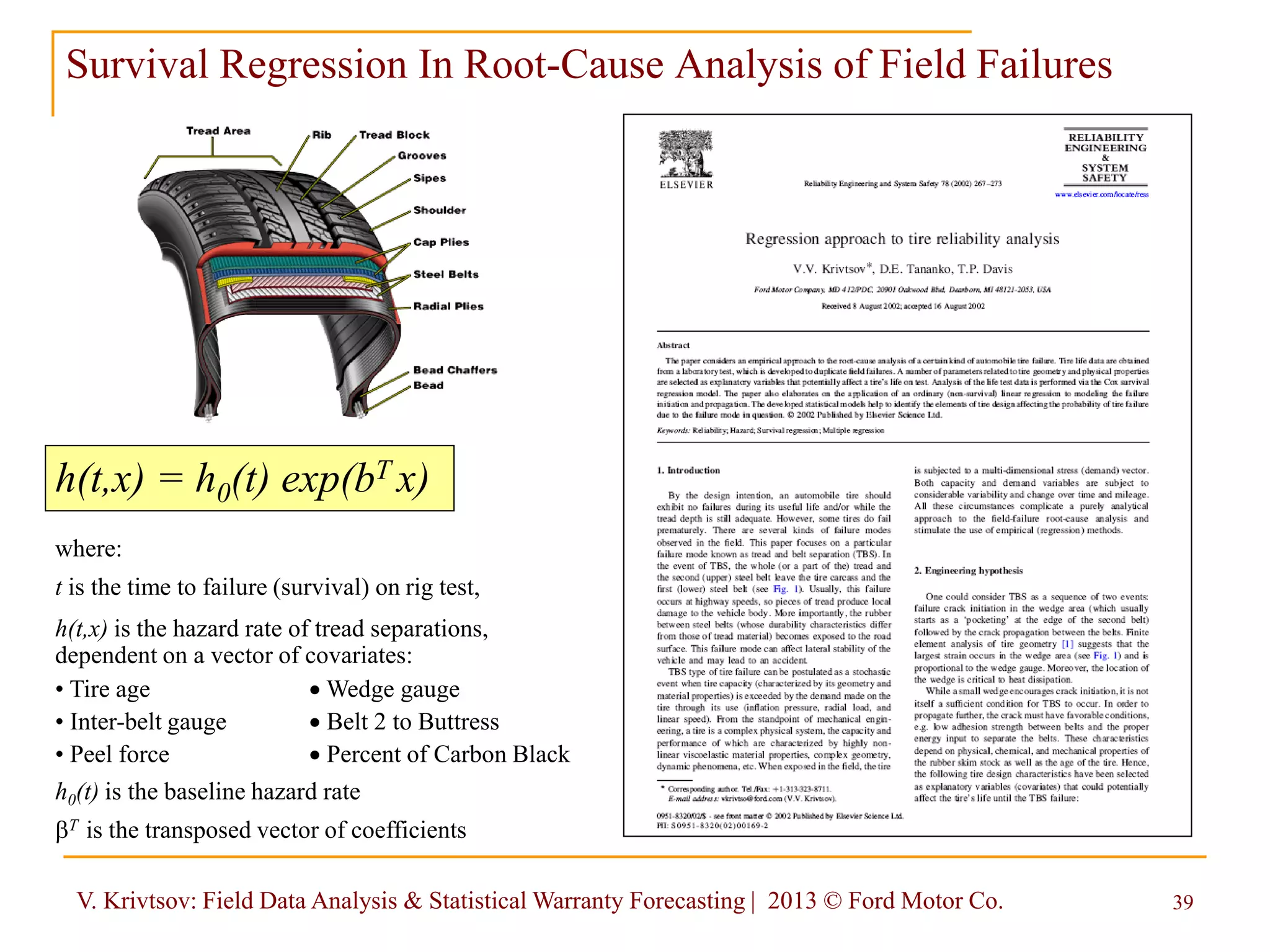
Survival Regression In Root-Cause Analysis of Field Failures
h(t,x) = h0(t) exp(bT x)
where:
t is the time to failure (survival) on rig test,
h(t,x) is the hazard rate of tread separations,
dependent on a vector of covariates:
• Tire age  Wedge gauge
• Inter-belt gauge  Belt 2 to Buttress
• Peel force  Percent of Carbon Black
h0(t) is the baseline hazard rate
bT is the transposed vector of coefficients
V. Krivtsov: Field Data Analysis & Statistical Warranty Forecasting | 2013 © Ford Motor Co. 40
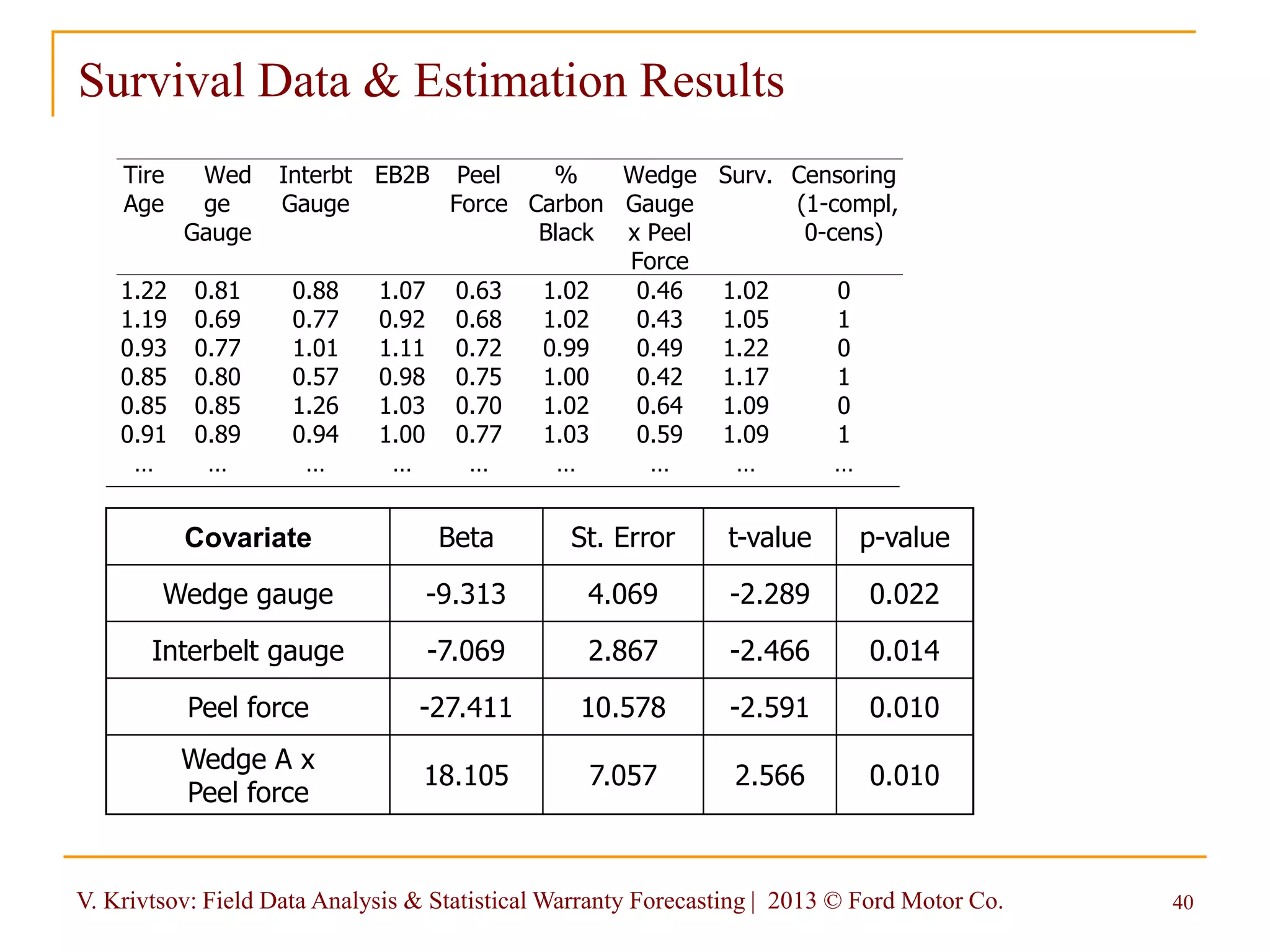
Survival Data & Estimation Results
Tire
Age
Wed
ge
Gauge
Interbt
Gauge
EB2B Peel
Force
%
Carbon
Black
Wedge
Gauge
x Peel
Force
Surv. Censoring
(1-compl,
0-cens)
1.22 0.81 0.88 1.07 0.63 1.02 0.46 1.02 0
1.19 0.69 0.77 0.92 0.68 1.02 0.43 1.05 1
0.93 0.77 1.01 1.11 0.72 0.99 0.49 1.22 0
0.85 0.80 0.57 0.98 0.75 1.00 0.42 1.17 1
0.85 0.85 1.26 1.03 0.70 1.02 0.64 1.09 0
0.91 0.89 0.94 1.00 0.77 1.03 0.59 1.09 1
… … … … … … … … …
Covariate Beta St. Error t-value p-value
Wedge gauge -9.313 4.069 -2.289 0.022
Interbelt gauge -7.069 2.867 -2.466 0.014
Peel force -27.411 10.578 -2.591 0.010
Wedge A x
Peel force
18.105 7.057 2.566 0.010
V. Krivtsov: Field Data Analysis & Statistical Warranty Forecasting | 2013 © Ford Motor Co. 41
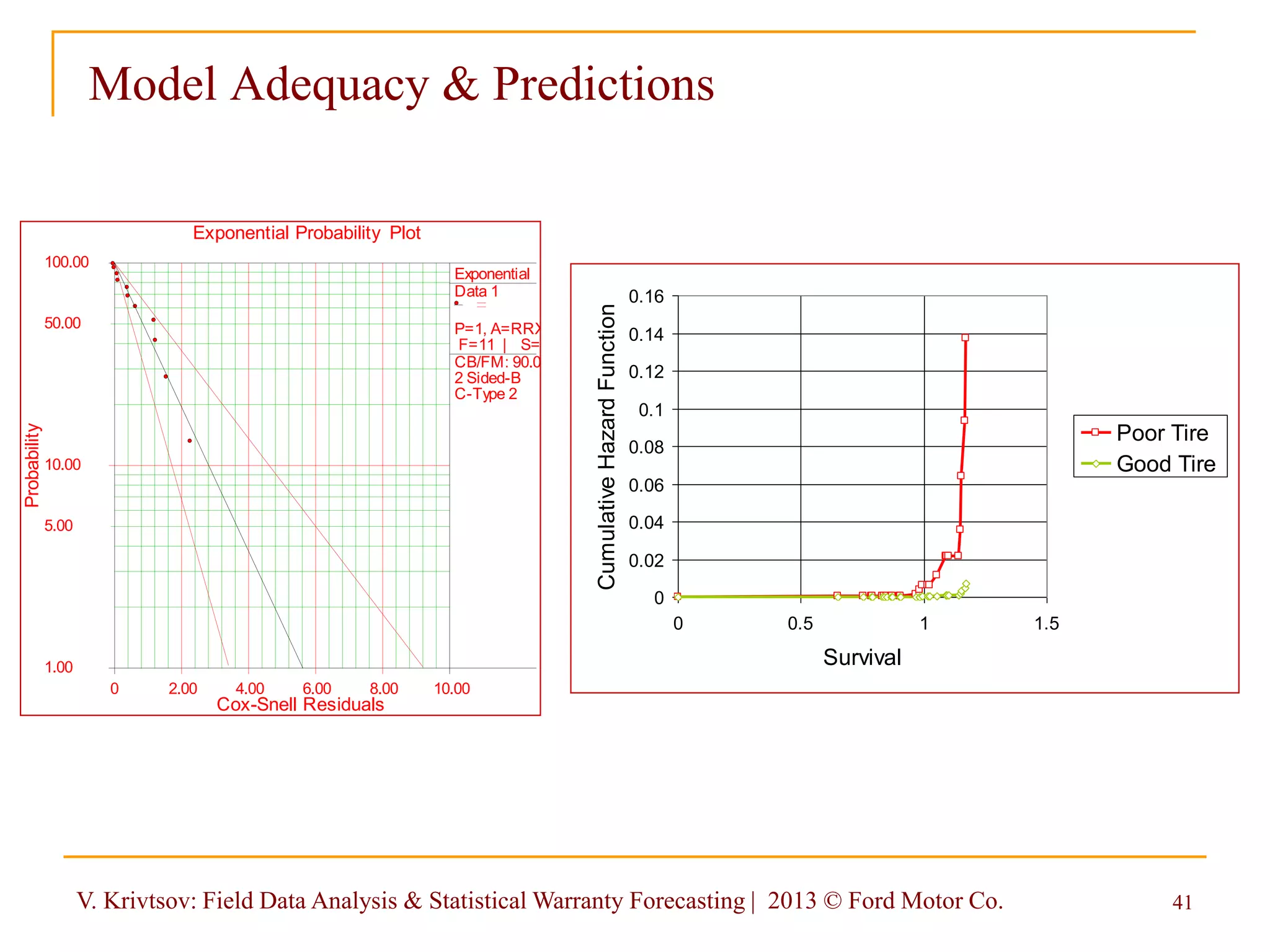
Model Adequacy & Predictions
1.00
5.00
10.00
50.00
100.00
0 10.002.00 4.00 6.00 8.00
Exponential Probability Plot
Cox-Snell Residuals
Probability
Exponential
Data 1
P=1, A=RRX-S
F=11 | S=23
CB/FM: 90.00%
2 Sided-B
C-Type 2
0
0.02
0.04
0.06
0.08
0.1
0.12
0.14
0.16
0 0.5 1 1.5
Survival
CumulativeHazardFunction
Poor Tire
Good Tire
V. Krivtsov: Field Data Analysis & Statistical Warranty Forecasting | 2013 © Ford Motor Co. 42
Key References
 W. Blischke and D. Murphy, Warranty Cost Analysis, 1994; Marcel Dekker, Inc., New York.
 J. Lawless, J. Hu and Cao, J., "Methods for Estimation of Failure Distributions and Rates from
Automobile Warranty Data", Lifetime Data Analysis, Vol. 1, 1995, pp. 227-240.
 V.V. Krivtsov, Field Data Analysis & Statistical Warranty Forecasting – RAMS Alan O. Plait Best
Paper, 2011, IEEE Catalog No CFP11RAM-CDR, ISBN: 978-1-4244-8855-1.
 J. Hu, J. Lawless and K. Suzuki, "Nonparametric Estimation of a Lifetime Distribution When
Censoring Times Are Missing", Technometrics, Vol. 40, # 1, 1998, pp. 3-13.
 J. Kalbfleisch, J. Lawless and J. Robinson, "Method for the Analysis and Prediction of Warranty
Claims", Technometrics, Vol. 33, # 1, 1991, pp. 273-285.
 M.P. Kaminskiy and V.V. Krivtsov, "A Statistical Estimation of the Cost Impact from Introducing a
Mileage Limit in Automobile Warranty Policy", Institute of Mathematical Statistics Bulletin, Vol.
28, # 2, 1999, p. 73-78.
 M.P. Kaminskiy and V.V. Krivtsov, "A Monte Carlo Approach to Warranty Repair Predictions" -
SAE Technical Paper Series, 1997, # 972582.
 J.F. Lawless, and J.D. Kalbleisch, "Some issues in the collection and analysis of field reliability
data", Survival Analysis: State of the Art. Editors J.P. Klein and P.K. Goel, Kluwer Academic
Publishers, 1992, pp. 141-152.
 M.W. Lu, "Automotive reliability prediction based on early field failure warranty data", Quality
and Reliability Engineering International, 1998, Vol. 14, 2, pp 103-108.
 K. Suzuki, "Estimation of lifetime parameters from incomplete field data", Technometrics, 1985,
27, pp.263-272.
 V.V. Krivtsov, D.E. Tananko and T.P. Davis, "A Regression Approach to Tire Reliability Analysis",
Reliability Engineering & System Safety, 2002,vol. 78, pp. 267-273.

2013 asq field data analysis & statistical warranty forecasting

  • 1.
    Field  Data  Analysis  &   Sta0s0cal  Warranty   Forecas0ng   Vasiliy  V.  Krivtsov,  Ph.D.   ©2013  ASQ  &  Presenta0on  Krivtsov   hCp://reliabilitycalendar.org/ webinars/  
  • 2.
    ASQ  Reliability  Division   English  Webinar  Series   One  of  the  monthly  webinars   on  topics  of  interest  to   reliability  engineers.   To  view  recorded  webinar  (available  to  ASQ  Reliability   Division  members  only)  visit  asq.org/reliability     To  sign  up  for  the  free  and  available  to  anyone  live   webinars  visit  reliabilitycalendar.org  and  select  English   Webinars  to  find  links  to  register  for  upcoming  events   hCp://reliabilitycalendar.org/ webinars/  
  • 3.
    Field Data Analysis& Statistical Warranty Forecasting Vasiliy V. Krivtsov, Ph.D. Ford Motor Company ASQ Reliability Division Seminar 13 June 2013
  • 4.
    V. Krivtsov: FieldData Analysis & Statistical Warranty Forecasting | 2013 © Ford Motor Co. 2  Introduction  Sources of field data  Statistical engineering inferences from field data analysis  Importance of managing warranty reserve  Probabilistic models  Non-repairable items/systems,  Repairable systems  Bivariate models (time & usage)  Statistical estimation  Non-repairable items/systems,  Repairable systems  Bivariate models  Special Topics  Calendarized warranty forecasting  Field data maturity issues  Survival regression in root-cause analysis of field failures  Key References Discussion Outline
  • 5.
    V. Krivtsov: FieldData Analysis & Statistical Warranty Forecasting | 2013 © Ford Motor Co. 3 General Purposes of Field Data Analysis  failure avoidance through statistical engineering inferences on the failure rate trends and factors (covariates) affecting them,  lab test calibration by equating percentiles of the failure time distributions in the field and in the lab  cost avoidance through early detection of field reliability problems, and  cash flow optimization through the prediction of the required warranty reserve and/or the expected maintenance costs.
  • 6.
    V. Krivtsov: FieldData Analysis & Statistical Warranty Forecasting | 2013 © Ford Motor Co. 4 Non-repairable vs. Repairable Systems Unit 1 1 Non-repairable Repairable F(t) t 1 L(t) t Expected number of failures per unit can NOT exceed a unity! Expected number of failures per unit can exceed a unity! Unit 2 Unit 3 Time Note: same component on different units
  • 7.
  • 8.
    V. Krivtsov: FieldData Analysis & Statistical Warranty Forecasting | 2013 © Ford Motor Co. 6 Consider a histogram of failure times, t, for a large population of nominally identical parts. t f(t) A mathematical model that approximates the behavior of this histogram is know as the density function and is denoted by f(t). Probabilistic models for non-repairable systems t=t0 t F(t) 1 F(t0) t=t0 The distribution function, F(t), represents a proportion of parts failing before a given time t. F(t0) The reliability function, R(t), represents a proportion surviving beyond a given time t. R(t) R(t0) R(t0)
  • 9.
    V. Krivtsov: FieldData Analysis & Statistical Warranty Forecasting | 2013 © Ford Motor Co. 7 Hazard Function (Instantaneous Failure Rate) The Hazard function, h(t), describes the propensity to fail in the next small interval from t0 to t0+Dt, given the survival up to t0 , with an approximate probability of f(t0)Dt. Mathematically, the hazard function is the ratio of the density function to the reliability function: h(t)= f(t)/R(t). In simpler terms, the estimate of the hazard function: number of part failures at a point in time number of parts at risk at that time f(t) t R(t0) t=t0 t h(t) Dtf(t0) t=t0 h(t0) The Hazard (failure rate) function can take various forms: increasing (IFR), decreasing (DFR), constant (CFR) and non-monotonous (e.g., first decreasing, then constant, then increasing). Shown on the left is an increasing failure rate (IFR) case.
  • 10.
    V. Krivtsov: FieldData Analysis & Statistical Warranty Forecasting | 2013 © Ford Motor Co. 8 Popular Univariate Models Notation: t – independent variable; l, b, Q, m, s, b1, b2, k, p – parameters; F(.) – the cumulative standard normal distribution.
  • 11.
    V. Krivtsov: FieldData Analysis & Statistical Warranty Forecasting | 2013 © Ford Motor Co. 9 Bivariate Models Joint failure density: f(m,t) Marginal in mileage failure density:  dttmfmf ),()( Marginal in time failure density:  dmtmftf ),()( t m
  • 12.
  • 13.
    V. Krivtsov: FieldData Analysis & Statistical Warranty Forecasting | 2013 © Ford Motor Co. Probabilistic Models for Repairable Systems A system is a collection of two or more parts designed to perform one or more functions. A repairable system is a system, which, after a failure to perform at least one of the functions satisfactorily, can be restored to fully satisfactory performance by any method, other than replacement of the entire system. Comp 1 Comp 2 Comp 3 Time System System
  • 14.
    V. Krivtsov: FieldData Analysis & Statistical Warranty Forecasting | 2013 © Ford Motor Co. 12 A connection between non-repairable & repairable systems t N(t) E[N(t)] 0 1 2 3 4 5 repair f(t) = dF(t)/dt – underlying (TTFF) distribution of non-repairable components X1 X2 X3 X5X4 ])([)()()]([ 0   t NdEtFtFtNE  Fundamental renewal equation: CumulativeFailures
  • 15.
    V. Krivtsov: FieldData Analysis & Statistical Warranty Forecasting | 2013 © Ford Motor Co. 13 Repair Assumptions & Respective Point Processes System’s Age (Time)0 failure time 1) Good-as-New (ORP) 2) Same-as-Old (NHPP) 3) Better-than-Old-but Worse than-New (GRP) 4) Worse-than-Old (GRP) Legend: ORP – Ordinary Renewal Process NHPP – Non-Homogeneous Poisson Process GRP – Generalized Renewal Process
  • 16.
    V. Krivtsov: FieldData Analysis & Statistical Warranty Forecasting | 2013 © Ford Motor Co. 14 Ordinary Renewal Process  Repair Assumption: “good-as-new”  Expected number of failures in [0, t]: F(t) = CDF of the time to first failure (TTFF) distribution  Iterative Model (Smith, Leadbetter - 1963) TTFF distribution: Weibull  Recursive Model (White - 1964) TTFF distribution: Weibull  Numerical Integration Approach (Baxter, Scheuer - 1982) TTFF distributions: Weibull, Gamma, lognormal, truncated Gaussian  Pade Approximation Model (Garg, Kalagnanam - 1998) TTFF distribution: truncated Gaussian  LL t dtFtFt 0 )()()()( 
  • 17.
    V. Krivtsov: FieldData Analysis & Statistical Warranty Forecasting | 2013 © Ford Motor Co. 15 Nonhomogeneous Poisson Process (NHPP)  Repair Assumption: “same-as-old”  Expected number of failures in [0, t]: l() = the rate of occurrence of failures (ROCOF)  Common Models for l()  Loglinear Model (Cox, Lewis - 1966)  Power Law Model (Crow - 1974)  Monte Carlo Simulation X1 = time to first failure distributed according to F(t), X2 = time to second failure distributed according to F(t2| X1), where Failure Interarrival Time  t 0 d)()t( lL )( )( 1)|( 1 12 12 XR XtR XttF    L n i inn XStSnEt 1 )],|[max()(   11 1 )](1[1    iii SStFFX 
  • 18.
    V. Krivtsov: FieldData Analysis & Statistical Warranty Forecasting | 2013 © Ford Motor Co. 16 Generalized Renewal Process (GRP)  Repair Assumptions: "good-as-new", "same-as-old", "worse-than-old", "better-than-old-but-worse-than-new"  General Repair Model (Kijima & Sumita, 1986) Virtual Age : Sn , An = age of the system before the failure and after the repair, respectively; q = repair effectiveness factor q = 0 -> “good-as-new”, i.e. ORP q = 1 -> “same-as-old”, i.e., NHPP q > 1 -> “worse-than-old” 0 < q < 1 -> “better-than-old-but-worse-than-new” nn SqA 
  • 19.
    V. Krivtsov: FieldData Analysis & Statistical Warranty Forecasting | 2013 © Ford Motor Co. 17 Fundamental G-Renewal Equation  Expected number of failures in [0, t]: where  Closed solution is impossible and numerical solutions via Laplace transform or power series expansion also fail (Kijima, 1988)  Numerical integration approximations are difficult to apply, because of a recurrent infinite system issue (Filkenstein, 1997)  A Monte Carlo Solution is, however, possible (Kaminskiy & Krivtsov, 1998) Failure Interarrival Time ,)|()()0|()( 0 0   ddxxxgxhgt t           L 0,, )(1 )( )(     xt qXF qXtf xtg  L n i inn XStSnEt 1 )],|[max()( 1-i 1-i 1-i1- i Sq, )SqF(t-1 )SqF(t-1 -1FX          
  • 20.
    V. Krivtsov: FieldData Analysis & Statistical Warranty Forecasting | 2013 © Ford Motor Co. 18 Generalized Renewal Process: Monte Carlo Simulation 0 2 4 6 8 10 12 14 0 20 40 60 80 100time ExpectedNumberofFailures "worse-than-old" (q = 1.5) "same-as-old" (q = 1) "better-than-old-but-worse-than-new" (q = 0.5) "as-good-as-new" (q = 0) NHPP ORP The GRP Cumulative Intensity Functions for an IFR (Weibull, b = 1.5, Q = 20) TTFF Distribution Under Various Repair Assumptions.
  • 21.
    Statistical Estimation ofProbabilistic Models for Non-Repairable Systems
  • 22.
    V. Krivtsov: FieldData Analysis & Statistical Warranty Forecasting | 2013 © Ford Motor Co. 20 Censoring In the context of warranty data analysis, right censoring is primarily associated with staggered entry times, while left censoring with “soft” failures. Typically, when test or field data are analyzed, some parts can be found unfailed, and the only knowledge about their failure times is that these times are beyond (i.e., to the right on the time axis of) the observation time. These data are said to be right censored. A failure time know only to be before (i.e., to the left on the time axis of) a given time is said to be left censored. For example, a part is found to have already failed at the time of its first examination. observation time right censored observation left censored observation starting time
  • 23.
    V. Krivtsov: FieldData Analysis & Statistical Warranty Forecasting | 2013 © Ford Motor Co. 21 Typical Format for Warranty Data: Basics of Nonparametric Estimation Jan'02 Feb'02 Mar'02 Apr'02 May'02 Jun'02 Jul'02 Aug'02 Sep'02 Oct'02 Nov '02 Volume Jan'02 10,000 1 3 6 9 15 17 20 22 41 64 Feb'02 10,000 0 2 5 10 12 18 19 24 45 Mar'02 10,000 1 4 5 10 14 18 20 23 Apr'02 10,000 1 2 7 11 16 17 20 May'02 10,000 0 1 6 12 17 18 Jun'02 10,000 1 3 4 9 16 Jul'02 10,000 2 3 7 11 Aug'02 10,000 1 4 6 Sep'02 10,000 1 3 Oct'02 10,000 0 Nov '02 10,000 Time t Risk Set n(t) Repairs d(t) 0 110,000 0 1 100,000 8 2 90,000 25 3 80,000 46 4 70,000 72 5 60,000 90 6 50,000 88 7 40,000 79 8 30,000 69 9 20,000 86 10 10,000 64 29592 19523 9437 69921 59849 49759 39671 110000 100000 89992 79967 0.01396 0.00956 CDF F(t)=1-R(t) Cum Hazard H(t)=Sh(t) 0.99907 0.99964 0.99992 01 0.00720 0.00951 0.01387 0.02053 Repair Month 0.99804 0.99654 0.99478 0.00008 0.00036 0.00093 0.00196 0.00346 0.00522 0.00036 0.00093 0.00196 0.00347 0.00524 0.007230.00199 0.00233 0.00441 0.00678 0.99280 0.99049 0.98613 0.979470.02075 Reliability R(t)=e{-H(t)} MonthinService 0 0.00008 0.00028 0.00058 0.00103 0.00150 0.00177 0 SalesMonth Hazard h(t)=d(t)/n'(t) Risk Set (corr) n'(t) 0.00008 Mechanical Transfuser Example: 24MIS/Unlm usage warranty plan
  • 24.
    V. Krivtsov: FieldData Analysis & Statistical Warranty Forecasting | 2013 © Ford Motor Co. 22 Reliasoft’s Weibull++ Warranty Data Analysis Module Sales Data Repair Data
  • 25.
    V. Krivtsov: FieldData Analysis & Statistical Warranty Forecasting | 2013 © Ford Motor Co. 23 Time: t CDF:F(t) 1.000E-4 12.0002.400 4.800 7.200 9.600 0.000 0.020 0.004 0.008 0.012 0.016 x 8 x 25 x 46 x 72 x 90 x 88 x 79 x 69 x 86 Mechanical Transfuser: Nonparametric Inferences ~1.4% failing @ 9 MIS Concavity is an indication of an IFR. Note: F(t)≈H(t), for small F(t).
  • 26.
    V. Krivtsov: FieldData Analysis & Statistical Warranty Forecasting | 2013 © Ford Motor Co. 24 Number of failures at time unit interval j, with r0 = 0:   k jp pjj rd      k jp 1j 1q pqpj )rv(nRisk set exposed at time unit interval j : Number of vehicles Time in service intervals Failure time intervals j = 1, …, k i = 1, …, k 1 2 3 4 5 6 7 8 9 k v1 1 r11 v2 2 r21 r22 v3 3 r31 r32 r33 v4 4 r41 r42 r43 r44 v5 5 r51 r52 r53 r54 r55 v6 6 r61 r62 r63 r64 r65 r66 v7 7 r71 r72 r73 r74 r75 r76 r77 v8 8 r81 r82 r83 r84 r85 r86 r87 r88 v9 9 r91 r92 r93 r94 r95 r96 r97 r98 r99 vk k rk1 rk2 rk3 rk4 rk5 rk6 rk7 rk8 rk9 rkk Summary of Nonparametric Estimation: Univariate Warranty Plan Formalized Data Structure: j j j n d hˆ Hazard function at the j-th failure time unit interval:
  • 27.
    V. Krivtsov: FieldData Analysis & Statistical Warranty Forecasting | 2013 © Ford Motor Co. 25      k jp j q jpqpj rvn 1 1 ))(( Risk set exposed at time unit interval j : Probability of mileage not exceeding the warranty mileage limit at failure time unit interval j : Summary of Nonparametric Estimation: Bivariate (Automotive) Warranty Plan 12 24 36 48 t, MIS 12,000 36,000 60,000 Mileage j
  • 28.
    V. Krivtsov: FieldData Analysis & Statistical Warranty Forecasting | 2013 © Ford Motor Co. 26 Weibull Probability Plot: Mechanical Transfuser Data ReliaSoft Weibull++ 7 - www.ReliaSoft.com b,, Time: t CDF:F(t) 0.100 100.0001.000 10.000 0.001 0.005 0.010 0.050 0.100 0.500 1.000 5.000 10.000 50.000 90.000 99.000 0.001 x 8 x 25 x 46 x 72 x 90 x 88 x 79 x 69 x 86 x 64 0.5 0.6 0.7 0.8 0.9 1.0 1.2 1.4 1.6 2.0 3.0 4.0 6.0  b Probability-W eibull CB@ 95% 2-Sided [T] All Data W eibull-2P RRX SRM MED FM F=627/S=99373 Data Points Probability Line Top CB-I Bottom CB-I Vasiliy Krivtsov VVK 9/22/2007 4:51:35 PM Mechanical Transfuser – Warranty Forecast Summary: Failure probability @ 24MIS: 0.1364 Population Size: 110,000 Total Expected Repairs: 15,004 Cost per repair: $30 Total Expected Warranty Cost: $450,120 Year-to-date Cost: $18,810 Required Warranty Reserve: $431,310 13.64 24
  • 29.
    V. Krivtsov: FieldData Analysis & Statistical Warranty Forecasting | 2013 © Ford Motor Co. 27 Estimation of Bivariate Models Model (Weibull): m mm t tt ))t/(m(1 m m )/t(1 t t em t )tm( et)t( )t()tm()t,m(f b b b b  b   b        Advantages: • No assumption about usage accumulation model is required, and hence • No “penalty” from conditional failure cycles and conditional usage accumulation not being the same • Extrapolation is automatically available in time and usage domains simultaneously Log-Likelihood: ))t,m(F1ln(n)t,m(fln(r)Lln( j jwj j,i jiij   Challenges/Limitations: • Selection of the bivaritae parametric model • Graphical goodness-of-fit • Convergence issues: flatness of the likelihood function under (typically) heavy censoring
  • 30.
    V. Krivtsov: FieldData Analysis & Statistical Warranty Forecasting | 2013 © Ford Motor Co. 28 Bivariate Weibull Example 0 4,000 8,000 12,000 16,000 20,000 24,000 28,000 32,000 36,0000 5 10 15 20 25 30 35 0.000 0.005 0.010 0.015 0.020 0.025 0.030 0.035 0.040 0.045 CDF Mileage MIS 0.00-0.01 0.01-0.01 0.01-0.02 0.02-0.02 0.02-0.03 0.03-0.03 0.03-0.04 0.04-0.04 0.04-0.05 MIS 1 2 3 4 5 6 7 8 9 10 11 12 13 14 15 16 17 18 19 20 21 22 23 24 25 26 27 28 29 30 31 32 33 34 35 1 30 16 9 12 3 1 1 2 9 21 15 21 11 3 5 3 2 4 1 1 3 1 9 16 20 15 12 14 5 13 6 1 2 3 1 3 1 4 2 4 5 9 4 11 9 10 5 13 4 5 11 3 6 1 2 1 5 2 2 2 3 7 14 9 9 3 14 10 8 7 5 5 2 4 3 2 1 1 1 6 1 1 2 1 5 5 6 8 6 10 8 9 9 7 6 3 8 6 5 1 1 2 7 2 4 4 2 4 4 8 10 8 5 8 16 11 9 11 7 7 2 2 2 2 1 1 2 1 1 8 1 1 3 4 2 2 2 3 3 9 5 10 14 4 12 8 10 6 7 4 5 2 2 1 1 1 9 4 3 6 3 3 5 5 3 15 15 11 11 9 10 8 5 1 4 3 1 1 1 10 2 1 1 2 1 6 5 8 4 10 7 12 11 12 7 1 1 1 1 1 1 11 1 4 1 4 2 1 3 7 5 8 8 10 9 4 9 5 5 3 2 2 1 1 1 12 1 1 1 1 2 2 2 5 3 5 8 9 7 4 8 7 7 8 4 2 4 1 1 13 1 1 2 1 1 3 4 2 5 7 11 5 7 6 7 6 4 1 3 1 2 1 14 1 2 1 3 2 1 3 2 3 7 5 4 3 4 5 5 2 3 2 1 1 1 15 1 1 1 3 1 1 2 2 2 3 1 1 Mileage in 1000 miles
  • 31.
    Statistical Estimation ofProbabilistic Models for Repairable Systems
  • 32.
    V. Krivtsov: FieldData Analysis & Statistical Warranty Forecasting | 2013 © Ford Motor Co. 30 Jan'02 Feb'02 Mar'02 Apr'02 May'02 Jun'02 Jul'02 Aug'02 Sep'02 Oct'02 Nov '02 Volume Jan'02 100 12 14 17 20 26 28 31 33 52 60 Feb'02 100 11 13 16 21 23 29 30 35 56 Mar'02 100 12 15 16 21 25 29 31 34 Apr'02 100 12 13 18 22 27 28 31 May'02 100 11 12 17 23 28 29 Jun'02 100 12 14 15 20 27 Jul'02 100 13 14 18 22 Aug'02 100 12 15 17 Sep'02 100 12 14 Oct'02 100 11 Nov '02 100 Time t Risk Set n(t) Repairs d(t) 0 1100 0 1 1000 118 2 900 124 3 800 134 4 700 149 5 600 156 6 500 143 7 400 123 8 300 102 9 200 108 10 100 60 0.63613 0.89613 Repair Month Cum Intensity L(t)=Sl(t) 0.25578 0.42328 0.26000 0.28600 1.18213 0.30750 1.48963 2.96963 2.36963 1.82963 0.60000 0.34000 0.54000 SalesMonth Repair Intensity l(t)=d(t)/n(t) 0.11800 0 MonthinService 0 0.11800 0.13778 0.16750 0.21286 0 0.5 1 1.5 2 2.5 3 3.5 0 5 10 Time, t CumRepairs/System,L(t) Basics of Nonparametric Estimation for a Repairable System Camrolla GT Example: 24MIS/Unlm usage warranty plan
  • 33.
    V. Krivtsov: FieldData Analysis & Statistical Warranty Forecasting | 2013 © Ford Motor Co. 31 Number of vehicles Time in service intervals Failure time intervals j = 1, …, k i = 1, …, k 1 2 3 4 5 6 7 8 9 k v1 1 r11 v2 2 r21 r22 v3 3 r31 r32 r33 v4 4 r41 r42 r43 r44 v5 5 r51 r52 r53 r54 r55 v6 6 r61 r62 r63 r64 r65 r66 v7 7 r71 r72 r73 r74 r75 r76 r77 v8 8 r81 r82 r83 r84 r85 r86 r87 r88 v9 9 r91 r92 r93 r94 r95 r96 r97 r98 r99 vk k rk1 rk2 rk3 rk4 rk5 rk6 rk7 rk8 rk9 rkk Number of failures at time unit interval j, with r0 = 0:   k jp pjj rd   k jp pj vn Risk set exposed at time unit interval j : Formalized Basics of Nonparametric Estimation for a Repairable System Formalized Data Structure: j j j n dˆ l Repair intensity function at the j-th failure time unit interval: Cumulative Intensity Function (a.k.a., Mean Cumulative Function) at time t :   t 1j jt ˆˆ lL
  • 34.
    V. Krivtsov: FieldData Analysis & Statistical Warranty Forecasting | 2013 © Ford Motor Co. 32 0 2 4 6 8 10 12 14 0 10 20 30 Time, t CumRepairs/System,L(t) Nonpar Estimate Power Law NHPP Power Law NHPP: Camrolla GT Example 72.1 )42.5/t()t( L
  • 35.
  • 36.
    V. Krivtsov: FieldData Analysis & Statistical Warranty Forecasting | 2013 © Ford Motor Co. 34 Calendarized Forecasting ReliaSoft Weibull++ 7 - www.ReliaSoft.com b,, Time: t CDF:F(t) 0.100 100.0001.000 10.000 0.001 0.005 0.010 0.050 0.100 0.500 1.000 5.000 10.000 50.000 90.000 99.000 0.001 x 8 x 25 x 46 x 72 x 90 x 88 x 79 x 69 x 86 x 64 0.5 0.6 0.7 0.8 0.9 1.0 1.2 1.4 1.6 2.0 3.0 4.0 6.0  b Probability-W eibull CB@ 95% 2-Sided [T] All Data W eibull-2P RRX SRM MED FM F=627/S=99373 Data Points Probability Line Top CB-I Bottom CB-I Vasiliy Krivtsov VVK 9/22/2007 4:51:35 PM 13.64 24 Mechanical Transfuser – Warranty Forecast Summary: Failure probability @ 24MIS: 0.1364 Population Size: 110,000 Total Expected Repairs: 15,004 Cost per repair: $30 Total Expected Warranty Cost: $450,120 Year-to-date Cost: $18,810 Required Warranty Reserve: $431,310 How will this total number of repairs be distributed along the calendar time, i.e. how many repairs to expect next month, the following month, etc.?
  • 37.
    V. Krivtsov: FieldData Analysis & Statistical Warranty Forecasting | 2013 © Ford Motor Co. 35 Time Parametric PDF thru Oct'02 in Nov'02 in Dec'02 … in Sep'04 in Oct'04 thru Oct'02 in Nov'02 in Dec'02 … in Sep'04 in Oct'04 0 0 110000 0 0 0 0 0 1 0.0001 100000 10000 0 0 0 6 1 0 0 0 2 0.0003 89992 10008 10000 0 0 27 3 3 0 0 3 0.0006 79967 10025 10008 0 0 49 6 6 0 0 4 0.0010 69921 10046 10025 0 0 69 10 10 0 0 5 0.0014 59849 10072 10046 0 0 84 14 14 0 0 6 0.0019 49759 10090 10072 0 0 92 19 19 0 0 7 0.0023 39671 10088 10090 0 0 93 24 24 0 0 8 0.0029 29592 10079 10088 0 0 84 29 29 0 0 9 0.0034 19523 10069 10079 0 0 66 34 34 0 0 10 0.0039 9437 10086 10069 0 0 37 40 40 0 0 11 0.0045 0 9437 10086 0 0 0 43 46 0 0 12 0.0051 0 0 9437 0 0 0 0 48 0 0 13 0.0057 0 0 0 0 0 0 0 0 0 0 14 0.0063 0 0 0 0 0 0 0 0 0 0 15 0.0069 0 0 0 0 0 0 0 0 0 0 16 0.0076 0 0 0 0 0 0 0 0 0 0 17 0.0082 0 0 0 0 0 0 0 0 0 0 18 0.0088 0 0 0 0 0 0 0 0 0 0 19 0.0094 0 0 0 0 0 0 0 0 0 0 20 0.0100 0 0 0 0 0 0 0 0 0 0 21 0.0106 0 0 0 0 0 0 0 0 0 0 22 0.0112 0 0 0 0 0 0 0 0 0 0 23 0.0118 0 0 0 10000 0 0 0 0 118 0 24 0.0124 0 0 0 10008 10000 0 0 0 124 124 609 222 272 … 242 124 Population Exposed Predicted Number of Repairs total -> Calendarized Forecasting: Mechanical Transfuser 15,004
  • 38.
    V. Krivtsov: FieldData Analysis & Statistical Warranty Forecasting | 2013 © Ford Motor Co. 36 Data Maturity: Lot Rot t F(t) Jan’06 Mar’06 May’06 t0 Data Maturity Problem: CDF estimates for a nominally homogeneous population at a fixed failure time change as a function of the observation time. Possible cause: “Lot Rot”, i.e., vehicle reliability degrades from sitting on the lot prior to be sold. Various observation times Solution: Stratify vehicle population by the time spent on lot (the difference between sale date and production date). t F(t) Jan’06 Mar’06 May’06 t0 Units with 0-10 days on lot
  • 39.
    V. Krivtsov: FieldData Analysis & Statistical Warranty Forecasting | 2013 © Ford Motor Co. 37 Data Maturity: Reporting Delays t F(t) Jan’06 Mar’06 May’06 t0 Data Maturity Problem: CDF estimates for a nominally homogeneous population at a fixed failure time change as a function of the observation time. Possible cause: The number of claims processed at each observation time is under-reported due to the lag between repair date and warranty system entry date. Various observation times Solution: Adjust* the risk set by the probability of the lag time, Wj : t F(t) Jan’06 Mar’06 May’06 t0 At each observation time, risk sets adjusted to account for the under-reported claims      k jp 1j 1q jpqpj ))rv((n W * J. Kalbfleisch, J. Lawless and J. Robinson, "Method for the Analysis and Prediction of Warranty Claims", Technometrics, Vol. 33, # 1, 1991, pp. 273-285.
  • 40.
    V. Krivtsov: FieldData Analysis & Statistical Warranty Forecasting | 2013 © Ford Motor Co. 38 Data Maturity: Warranty Expiration Rush t F(t) Jan’06 Mar’06 May’06 t0 Data Maturity Problem: CDF estimates for a nominally homogeneous population disproportionably increases as a function of the observation time and proximity to the warranty expiration time. Possible cause: “Soft” (non-critical) failures tend to not get reported until the customer realizes the proximity of warranty expiration date. Solution: Use historical data on similar components to empirically* adjust for the warranty- expiration rush phenomenon. *B. Rai, N. Singh “Modeling and analysis of automobile warranty data in presence of bias due to customer-rush near warranty expiration limit”, Reliability Engineering & System Safety, Vol. 86, Issue 1, pp. 83-94. tw t F(t) Mar’04 May’04 t0 tw A basis for adjustment
  • 41.
    V. Krivtsov: FieldData Analysis & Statistical Warranty Forecasting | 2013 © Ford Motor Co. 39 Survival Regression In Root-Cause Analysis of Field Failures h(t,x) = h0(t) exp(bT x) where: t is the time to failure (survival) on rig test, h(t,x) is the hazard rate of tread separations, dependent on a vector of covariates: • Tire age  Wedge gauge • Inter-belt gauge  Belt 2 to Buttress • Peel force  Percent of Carbon Black h0(t) is the baseline hazard rate bT is the transposed vector of coefficients
  • 42.
    V. Krivtsov: FieldData Analysis & Statistical Warranty Forecasting | 2013 © Ford Motor Co. 40 Survival Data & Estimation Results Tire Age Wed ge Gauge Interbt Gauge EB2B Peel Force % Carbon Black Wedge Gauge x Peel Force Surv. Censoring (1-compl, 0-cens) 1.22 0.81 0.88 1.07 0.63 1.02 0.46 1.02 0 1.19 0.69 0.77 0.92 0.68 1.02 0.43 1.05 1 0.93 0.77 1.01 1.11 0.72 0.99 0.49 1.22 0 0.85 0.80 0.57 0.98 0.75 1.00 0.42 1.17 1 0.85 0.85 1.26 1.03 0.70 1.02 0.64 1.09 0 0.91 0.89 0.94 1.00 0.77 1.03 0.59 1.09 1 … … … … … … … … … Covariate Beta St. Error t-value p-value Wedge gauge -9.313 4.069 -2.289 0.022 Interbelt gauge -7.069 2.867 -2.466 0.014 Peel force -27.411 10.578 -2.591 0.010 Wedge A x Peel force 18.105 7.057 2.566 0.010
  • 43.
    V. Krivtsov: FieldData Analysis & Statistical Warranty Forecasting | 2013 © Ford Motor Co. 41 Model Adequacy & Predictions 1.00 5.00 10.00 50.00 100.00 0 10.002.00 4.00 6.00 8.00 Exponential Probability Plot Cox-Snell Residuals Probability Exponential Data 1 P=1, A=RRX-S F=11 | S=23 CB/FM: 90.00% 2 Sided-B C-Type 2 0 0.02 0.04 0.06 0.08 0.1 0.12 0.14 0.16 0 0.5 1 1.5 Survival CumulativeHazardFunction Poor Tire Good Tire
  • 44.
    V. Krivtsov: FieldData Analysis & Statistical Warranty Forecasting | 2013 © Ford Motor Co. 42 Key References  W. Blischke and D. Murphy, Warranty Cost Analysis, 1994; Marcel Dekker, Inc., New York.  J. Lawless, J. Hu and Cao, J., "Methods for Estimation of Failure Distributions and Rates from Automobile Warranty Data", Lifetime Data Analysis, Vol. 1, 1995, pp. 227-240.  V.V. Krivtsov, Field Data Analysis & Statistical Warranty Forecasting – RAMS Alan O. Plait Best Paper, 2011, IEEE Catalog No CFP11RAM-CDR, ISBN: 978-1-4244-8855-1.  J. Hu, J. Lawless and K. Suzuki, "Nonparametric Estimation of a Lifetime Distribution When Censoring Times Are Missing", Technometrics, Vol. 40, # 1, 1998, pp. 3-13.  J. Kalbfleisch, J. Lawless and J. Robinson, "Method for the Analysis and Prediction of Warranty Claims", Technometrics, Vol. 33, # 1, 1991, pp. 273-285.  M.P. Kaminskiy and V.V. Krivtsov, "A Statistical Estimation of the Cost Impact from Introducing a Mileage Limit in Automobile Warranty Policy", Institute of Mathematical Statistics Bulletin, Vol. 28, # 2, 1999, p. 73-78.  M.P. Kaminskiy and V.V. Krivtsov, "A Monte Carlo Approach to Warranty Repair Predictions" - SAE Technical Paper Series, 1997, # 972582.  J.F. Lawless, and J.D. Kalbleisch, "Some issues in the collection and analysis of field reliability data", Survival Analysis: State of the Art. Editors J.P. Klein and P.K. Goel, Kluwer Academic Publishers, 1992, pp. 141-152.  M.W. Lu, "Automotive reliability prediction based on early field failure warranty data", Quality and Reliability Engineering International, 1998, Vol. 14, 2, pp 103-108.  K. Suzuki, "Estimation of lifetime parameters from incomplete field data", Technometrics, 1985, 27, pp.263-272.  V.V. Krivtsov, D.E. Tananko and T.P. Davis, "A Regression Approach to Tire Reliability Analysis", Reliability Engineering & System Safety, 2002,vol. 78, pp. 267-273.