“
Basics of Rotating Machinery
Vibrations
CHAPTER 1
”
Introduction
 The vibration of the rotating machinery contains huge
amount of information that can be utilized to determine
the machine condition, the fault producing the dynamic
forces that causes these vibrations and the severity of
these faults.
2
Why studying Vibration?
 Assess the condition of a machine.
 Diagnose the root causes of any excessive vibration
if any.
3
What is Vibration?
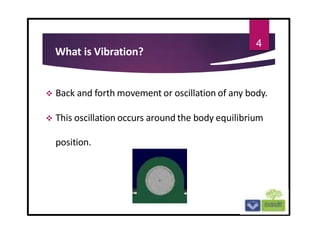
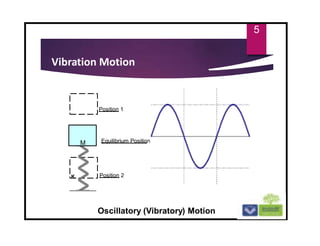
 Back and forth movement or oscillation of any body.
 This oscillation occurs around the body equilibrium
position.
4
5
Vibration Motion
Position 1
M Equilibrium Position
K Position 2
Oscillatory (Vibratory) Motion
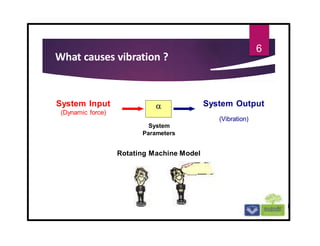
What causes vibration ?
6
System
Parameters
Rotating Machine Model

System Input
(Dynamic force)
System Output
(Vibration)
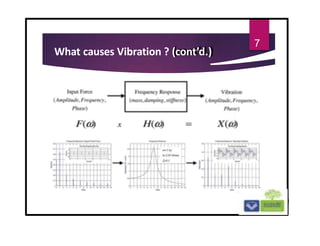
What causes Vibration ? (cont’d.)
7
Sources of Exciting Forces
 Inadequate design:
• Flexibility
• Flow pulsations
 Manufacturing defects:
• Casting cavities lead to unbalance
• Bent shaft and eccentricity
 Poor installation:
• Misalignment
• Distortion (soft foot)
• Piping strain
8
Sources of Exciting Forces (cont’d.)
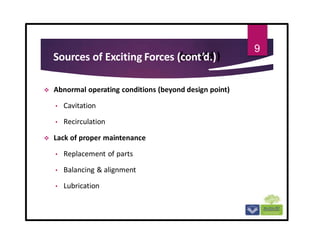
 Abnormal operating conditions (beyond design point)
• Cavitation
• Recirculation
 Lack of proper maintenance
• Replacement of parts
• Balancing & alignment
• Lubrication
9
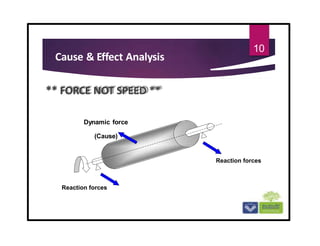
Cause & Effect Analysis
** FORCE NOT SPEED **
10
Dynamic force
(Cause)
Reaction forces
Reaction forces
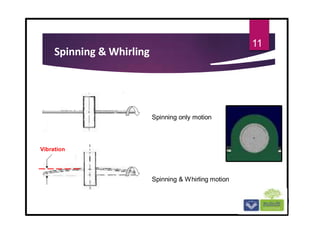
Spinning & Whirling
11
Spinning only motion
Spinning & Whirling motion
Vibration
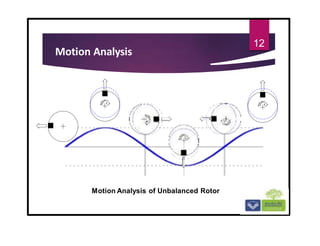
Motion Analysis
12
Motion Analysis of Unbalanced Rotor
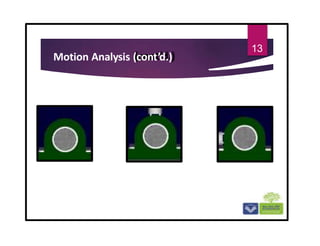
Motion Analysis (cont’d.)
13
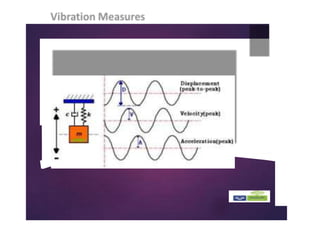
Vibration Measures
 Three measures; displacement,
velocity and acceleration.
 Displacement is related to the
motion.
 The velocity is related to fatigue.
 The acceleration is directly
proportional to the force.
15
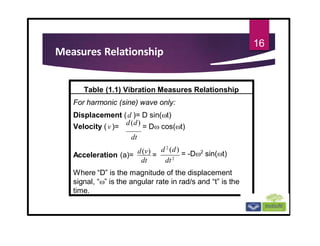
Measures Relationship
16
Table (1.1) Vibration Measures Relationship
For harmonic (sine) wave only:
Displacement (d )= D sin(t)
Velocity (v )=
d(d)
= D cos(t)
dt
Acceleration (a)=
d(v)
=
dt dt2
d 2
(d)
= -D2
sin(t)
Where “D” is the magnitude of the displacement
signal, “” is the angular rate in rad/s and “t” is the
time.
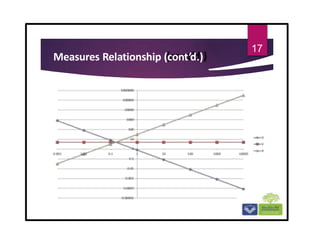
Measures Relationship (cont’d.)
17
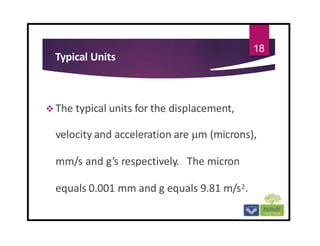
Typical Units
 The typical units for the displacement,
velocity and acceleration are m (microns),
mm/s and g’s respectively. The micron
equals 0.001 mm and g equals 9.81 m/s2.
18
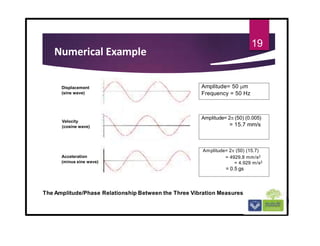
Numerical Example
19
The Amplitude/Phase Relationship Between the Three Vibration Measures
Displacement
(sine wave)
Velocity
(cosine wave)
Acceleration
(minus sine wave)
Amplitude= 50 m
Frequency = 50 Hz
Amplitude= 2 (50) (0.005)
= 15.7 mm/s
Amplitude= 2 (50) (15.7)
= 4929.8 mm/s2
= 4.929 m/s2
= 0.5 gs
20
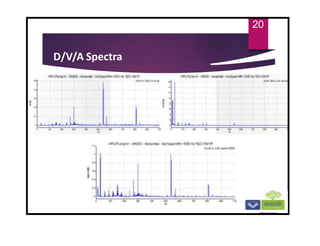
D/V/A Spectra
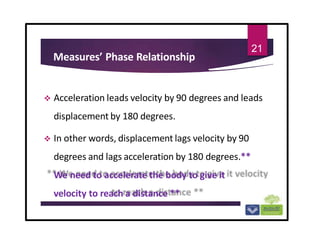
Measures’ Phase Relationship
 Acceleration leads velocity by 90 degrees and leads
displacement by 180 degrees.
 In other words, displacement lags velocity by 90
degrees and lags acceleration by 180 degrees.**
We need to accelerate the body to give it
velocity to reach a distance **
21
Measures Conversion
 Integration and differentiation is theoretically
available.
 Practically integration only is allowed.
 Noise is a consideration.
22
Waves type
- Impulsive wave
- Harmonic wave
- Periodic wave
- Impact wave
- Random wave
24
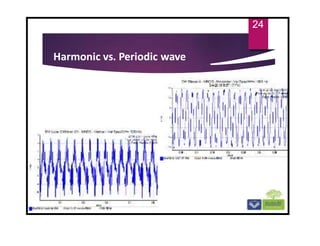
Harmonic vs. Periodic wave
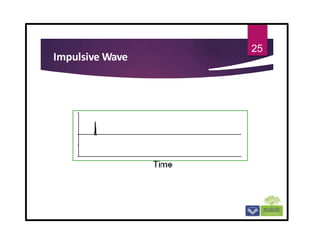
Impulsive Wave
25
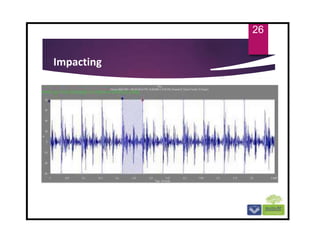
26
Impacting
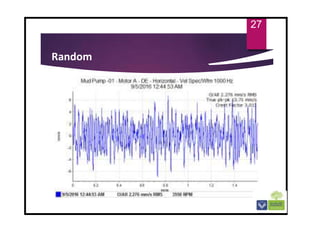
27
Random
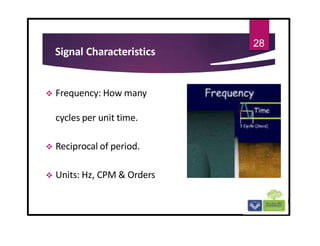
Signal Characteristics
 Frequency: How many
cycles per unit time.
 Reciprocal of period.
 Units: Hz, CPM & Orders
28
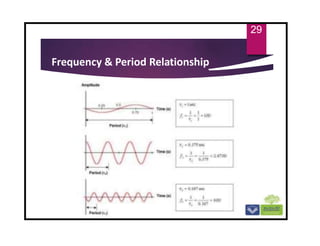
29
Frequency & Period Relationship
30
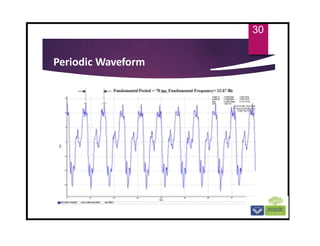
Periodic Waveform
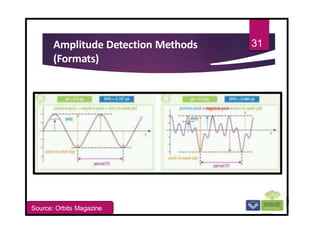
Amplitude Detection Methods
(Formats)
31
Source: Orbits Magazine
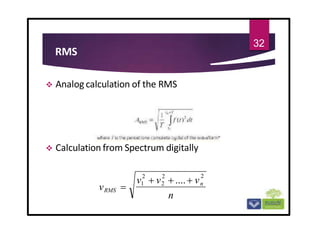
RMS
 Analog calculation of the RMS
 Calculation from Spectrum digitally
32
n
v  v .... v
v 
2
n
RMS
2
1 2
2
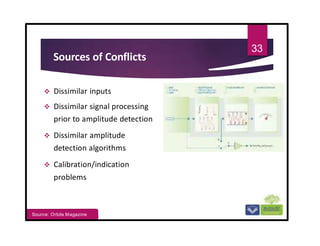
Sources of Conflicts
 Dissimilar inputs
 Dissimilar signal processing
prior to amplitude detection
 Dissimilar amplitude
detection algorithms
 Calibration/indication
problems
33
Source: Orbits Magazine
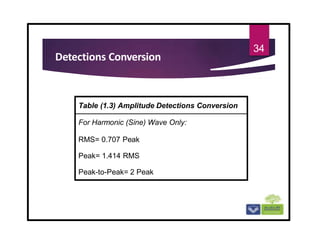
Detections Conversion
34
Table (1.3) Amplitude Detections Conversion
For Harmonic (Sine) Wave Only:
RMS= 0.707 Peak
Peak= 1.414 RMS
Peak-to-Peak= 2 Peak
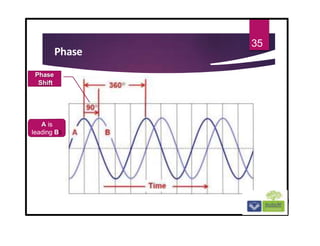
Phase
35
Phase
Shift
A is
leading B
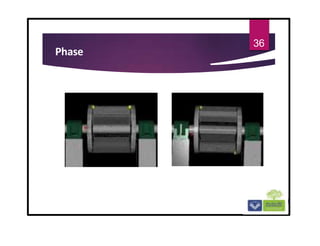
Phase
36
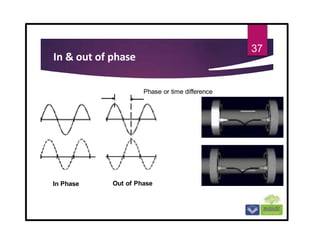
In & out of phase
37
In Phase
Phase or time difference
Out of Phase
Phase measurements methods
 Photoelectric or laser probes. [Absolute Phase]
 Strobe light. [Obsolete]
 Dual channel analyzer. [Relative Phase]
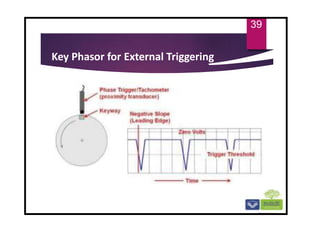
 Key phasor. [Absolute Phase for Turbomachinery]
38
39
Key Phasor for External Triggering
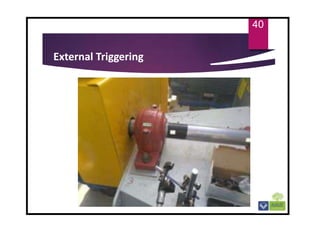
Laser of Photoelectric Probes for 40
External Triggering
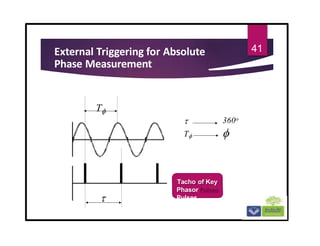
External Triggering for Absolute
Phase Measurement
T
41

T
360o


Tacho of Key
Phasor
Pulses
42
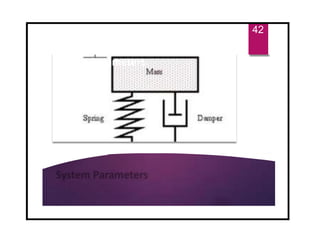
System Parameters
System Parameters
 Mass
 Stiffness
 Damping
43
Mass
 Mass is the volume of the system multiplied by the
density of its material and the typical unit of the
mass is kilograms (kg).
 The higher the mass the lower the vibration for the
same force amplitude applied.
Stiffness
 Stiffness is a measure of the system elasticity and is
defined as the deflection caused by applying unit
force to the system.
 Stiffness is typically expressed in Newton per meter
(N/m).
 The higher the stiffness, the lower the vibration
amplitudes resulted from same force applied.
Damping
 Damping is defined as the ability of the system to
dissipate energy into heat (i.e. converts the kinetic
energy of motion or vibration into heat energy).
 The damping is expressed in Newton per millimeter
per second (N/mm/s).
 The highest the damping in the system, the lower
the vibration amplitude for the same force.
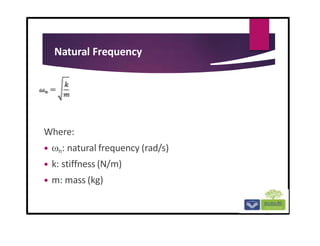
Natural Frequency
Where:
 n: natural frequency (rad/s)
 k: stiffness (N/m)
 m: mass (kg)
Resonance
 Resonance is a condition at which the frequency of
one of the exciting forces is close or equal to one of
the natural frequencies of the system.
 In this case, the system will vibrate severely since the
system will work as an amplifier that converts all
energy into vibratory motion.
 The term "resonance" is typically used with
structures; when discussing the natural frequencies
of a rotor, the term "Critical “peed" is typically used.
Resonance
Related to structures.
Depends on mass and stiffness.
System acts as amplifier.
49
100 Hz by 50 Hz 100 Hz by 100 Hz 100 Hz by 200 Hz
Video: Ground Test
Video: Bridge
Critical Speeds
 The critical speeds are the speeds at which an
exciting force frequency is very close or equals to
one of the rotor natural frequencies.
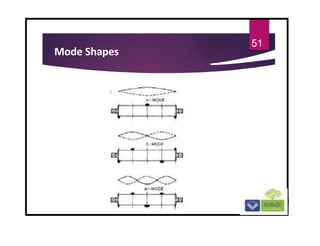
 In other words, the critical speed is the speed at
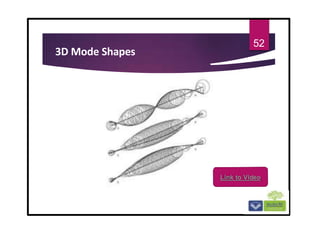
which the resonance occurs in the rotor. For each
critical speed, there is a unique deflection shape of
the rotor known as "Mode “hape".
Mode Shapes
51
3D Mode Shapes
52
Link to Video
53
Questions??

chapter 1basic of rotating machinery vibration .pptx

  • 1.
    “ Basics of RotatingMachinery Vibrations CHAPTER 1 ”
  • 2.
    Introduction  The vibrationof the rotating machinery contains huge amount of information that can be utilized to determine the machine condition, the fault producing the dynamic forces that causes these vibrations and the severity of these faults. 2
  • 3.
    Why studying Vibration? Assess the condition of a machine.  Diagnose the root causes of any excessive vibration if any. 3
  • 4.
    What is Vibration? Back and forth movement or oscillation of any body.  This oscillation occurs around the body equilibrium position. 4
  • 5.
    5 Vibration Motion Position 1 MEquilibrium Position K Position 2 Oscillatory (Vibratory) Motion
  • 6.
    What causes vibration? 6 System Parameters Rotating Machine Model  System Input (Dynamic force) System Output (Vibration)
  • 7.
    What causes Vibration? (cont’d.) 7
  • 8.
    Sources of ExcitingForces  Inadequate design: • Flexibility • Flow pulsations  Manufacturing defects: • Casting cavities lead to unbalance • Bent shaft and eccentricity  Poor installation: • Misalignment • Distortion (soft foot) • Piping strain 8
  • 9.
    Sources of ExcitingForces (cont’d.)  Abnormal operating conditions (beyond design point) • Cavitation • Recirculation  Lack of proper maintenance • Replacement of parts • Balancing & alignment • Lubrication 9
  • 10.
    Cause & EffectAnalysis ** FORCE NOT SPEED ** 10 Dynamic force (Cause) Reaction forces Reaction forces
  • 11.
    Spinning & Whirling 11 Spinningonly motion Spinning & Whirling motion Vibration
  • 12.
  • 13.
  • 15.
    Vibration Measures  Threemeasures; displacement, velocity and acceleration.  Displacement is related to the motion.  The velocity is related to fatigue.  The acceleration is directly proportional to the force. 15
  • 16.
    Measures Relationship 16 Table (1.1)Vibration Measures Relationship For harmonic (sine) wave only: Displacement (d )= D sin(t) Velocity (v )= d(d) = D cos(t) dt Acceleration (a)= d(v) = dt dt2 d 2 (d) = -D2 sin(t) Where “D” is the magnitude of the displacement signal, “” is the angular rate in rad/s and “t” is the time.
  • 17.
  • 18.
    Typical Units  Thetypical units for the displacement, velocity and acceleration are m (microns), mm/s and g’s respectively. The micron equals 0.001 mm and g equals 9.81 m/s2. 18
  • 19.
    Numerical Example 19 The Amplitude/PhaseRelationship Between the Three Vibration Measures Displacement (sine wave) Velocity (cosine wave) Acceleration (minus sine wave) Amplitude= 50 m Frequency = 50 Hz Amplitude= 2 (50) (0.005) = 15.7 mm/s Amplitude= 2 (50) (15.7) = 4929.8 mm/s2 = 4.929 m/s2 = 0.5 gs
  • 20.
  • 21.
    Measures’ Phase Relationship Acceleration leads velocity by 90 degrees and leads displacement by 180 degrees.  In other words, displacement lags velocity by 90 degrees and lags acceleration by 180 degrees.** We need to accelerate the body to give it velocity to reach a distance ** 21
  • 22.
    Measures Conversion  Integrationand differentiation is theoretically available.  Practically integration only is allowed.  Noise is a consideration. 22
  • 23.
    Waves type - Impulsivewave - Harmonic wave - Periodic wave - Impact wave - Random wave
  • 24.
  • 25.
  • 26.
  • 27.
  • 28.
    Signal Characteristics  Frequency:How many cycles per unit time.  Reciprocal of period.  Units: Hz, CPM & Orders 28
  • 29.
  • 30.
  • 31.
  • 32.
    RMS  Analog calculationof the RMS  Calculation from Spectrum digitally 32 n v  v .... v v  2 n RMS 2 1 2 2
  • 33.
    Sources of Conflicts Dissimilar inputs  Dissimilar signal processing prior to amplitude detection  Dissimilar amplitude detection algorithms  Calibration/indication problems 33 Source: Orbits Magazine
  • 34.
    Detections Conversion 34 Table (1.3)Amplitude Detections Conversion For Harmonic (Sine) Wave Only: RMS= 0.707 Peak Peak= 1.414 RMS Peak-to-Peak= 2 Peak
  • 35.
  • 36.
  • 37.
    In & outof phase 37 In Phase Phase or time difference Out of Phase
  • 38.
    Phase measurements methods Photoelectric or laser probes. [Absolute Phase]  Strobe light. [Obsolete]  Dual channel analyzer. [Relative Phase]  Key phasor. [Absolute Phase for Turbomachinery] 38
  • 39.
    39 Key Phasor forExternal Triggering
  • 40.
    Laser of PhotoelectricProbes for 40 External Triggering
  • 41.
    External Triggering forAbsolute Phase Measurement T 41  T 360o   Tacho of Key Phasor Pulses
  • 42.
  • 43.
    System Parameters  Mass Stiffness  Damping 43
  • 44.
    Mass  Mass isthe volume of the system multiplied by the density of its material and the typical unit of the mass is kilograms (kg).  The higher the mass the lower the vibration for the same force amplitude applied.
  • 45.
    Stiffness  Stiffness isa measure of the system elasticity and is defined as the deflection caused by applying unit force to the system.  Stiffness is typically expressed in Newton per meter (N/m).  The higher the stiffness, the lower the vibration amplitudes resulted from same force applied.
  • 46.
    Damping  Damping isdefined as the ability of the system to dissipate energy into heat (i.e. converts the kinetic energy of motion or vibration into heat energy).  The damping is expressed in Newton per millimeter per second (N/mm/s).  The highest the damping in the system, the lower the vibration amplitude for the same force.
  • 47.
    Natural Frequency Where:  n:natural frequency (rad/s)  k: stiffness (N/m)  m: mass (kg)
  • 48.
    Resonance  Resonance isa condition at which the frequency of one of the exciting forces is close or equal to one of the natural frequencies of the system.  In this case, the system will vibrate severely since the system will work as an amplifier that converts all energy into vibratory motion.  The term "resonance" is typically used with structures; when discussing the natural frequencies of a rotor, the term "Critical “peed" is typically used.
  • 49.
    Resonance Related to structures. Dependson mass and stiffness. System acts as amplifier. 49 100 Hz by 50 Hz 100 Hz by 100 Hz 100 Hz by 200 Hz Video: Ground Test Video: Bridge
  • 50.
    Critical Speeds  Thecritical speeds are the speeds at which an exciting force frequency is very close or equals to one of the rotor natural frequencies.  In other words, the critical speed is the speed at which the resonance occurs in the rotor. For each critical speed, there is a unique deflection shape of the rotor known as "Mode “hape".
  • 51.
  • 52.
  • 53.