Analysis of Mechanical Vibration in 
spring mass damper model and 
Machining Processes 
for the partial fulfillment to the degree of Bachelor of Technology 
in 
Mechanical Engineering 
by 
Ankur Shukla (2K12/ME/044) 
Ankur Gupta (2K12/ME/043) 
Aman Handa (2K12/ME/028) 
Under the supervision of 
Dr. R.C. Singh Shri Rooplal 
Mechanical Engineering Department 
Delhi Technological University,Delhi-110042
INTRODUCTION
• Vibration is a mechanical phenomenon 
whereby oscillations occur about an 
equilibrium point. 
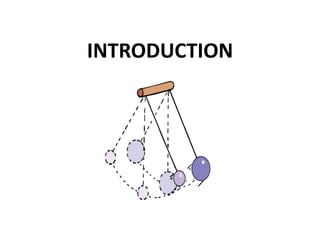
• The oscillations may be periodic such as the 
motion of a pendulum or random such as the 
movement of a tire on a gravel road. 
• Vibration is undesirable, wasting energy and 
creating unwanted sound – noise.
Types of Vibrations 
• FREE VIBRATION occurs when a mechanical system is set 
off with an initial input and then allowed to vibrate 
freely. 
• FORCED VIBRATION is when a time-varying disturbance 
(load, displacement or velocity) is applied to a 
mechanical system. The disturbance can be a periodic, 
steady-state input, a transient input, or a random input.
DAMPING 
• Damping is an influence within or upon an oscillatory system that 
has the effect of reducing, restricting or preventing its oscillations. 
• OVERDAMPED: The system returns (exponentially decays) to 
equilibrium without oscillating. 
• CRITICALLY DAMPED: The system returns to equilibrium as quickly 
as possible without oscillating. 
• UNDERDAMPED: The system oscillates (at reduced frequency 
compared to the undamped case) with the amplitude gradually 
decreasing to zero. 
• UNDAMPED: The system oscillates at its natural resonant frequency 
(ωo).
SCOPE AND DESCRIPTION OF WORK
• In this study we analyzed very basic form of vibrations 
such as free, forced vibration with and without damping. 
• We have included our experimentation results and these 
results are compared with results obtained via MATLAB, to 
plot the model natural frequency curve. 
• In this study we have represented a vibration analyser, 
which is able to analyse the chatter vibration in machining 
processes and machine parts and represent it in an easy 
and understandable form. 
• The objective to conduct this study is to analyse the 
different type of vibration in machining processes by 
presented vibration analyser.
LITERATURE REVIEW
• Vibration can be regarded as a branch of dynamics that deals with periodic 
and oscillatory motion. Common example of vibration problems are the 
response of civil engineering structures to dynamic loading, ambient 
condition and earthquakes, vibration of the unbalanced rotating machines 
and vibration of power line due to wind excitations, and aircraft wings 
[11]. 
• Vibrations are produced in machine having unbalanced masses. These 
vibrations will be transmitted to the foundation upon which the machine 
is installed. This is usually undesirable. To diminish the transmitted 
vibration, machines are usually mounted on spring or dampers, or on 
some other vibration isolating material [12]. 
• Phani Srikantha A., Woodhouse J. [9] studied parametric identification of 
viscous damping models in the context of linear vibration theory. 
Frequency domain identification methods based on measured frequency 
response functions (FRFs) are considered.
•Jiao Chunwang, Liu Jie, Guo Dameng and Wang Qianqian [10] studied that 
It is of paramount importance to acquire the response of many nonlinear 
forced vibration system. They developed a new method to explore the 
approximate analytical solution of forced vibration system which is named 
harmonic iteration method (HIM). 
•Hao Jiang, Xinhua Long, and Guang Meng [13] said Cutting vibration is 
unavoidable during a machining process and has great impact on the 
machined surface. With the increase of the demand on the highquality of 
surface finish, the effects of cutting vibrationon surface generationattract a 
lot of attentions. 
•A great deal of research has been carried out on the chatter problem since 
the late 1950s, when Tobias and Fishwick [3], Tlusty and Polacek [6] and 
Merrit [7] presented the first research results focused on this phenomenon. 
Lots of significant advances have been made over the years. Advances in 
computers, sensors and actuators have increased understanding of the 
phenomena, and developed and improved strategies to solve the problem 
[2].
NUMERICAL FORMULATION
Natural frequency for free vibration without damping 
k 
m 
1 
2 
푑2푥 
푑푡2
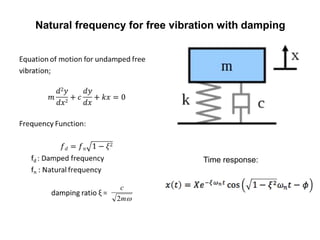
Natural frequency for free vibration with damping 
c 
2 
m 
Time response:
FORCED VIBRATION WITHOUT DAMPING
Forced Vibration with damping
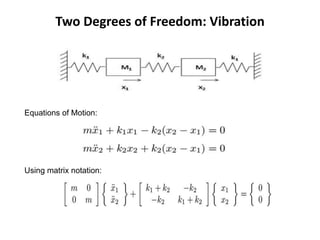
Two Degrees of Freedom: Vibration 
Equations of Motion: 
Using matrix notation:
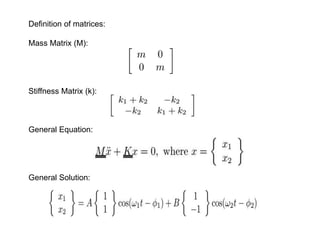
Definition of matrices: 
Mass Matrix (M): 
Stiffness Matrix (k): 
General Equation: 
General Solution:
Two Degree of Freedom: Vibration 
with damping 
Equations of motion: 
This can be rewritten in matrix format:
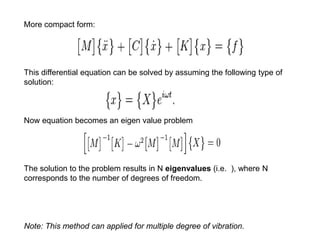
More compact form: 
This differential equation can be solved by assuming the following type of 
solution: 
Now equation becomes an eigen value problem 
The solution to the problem results in N eigenvalues (i.e. ), where N 
corresponds to the number of degrees of freedom. 
Note: This method can applied for multiple degree of vibration.
MODELLING
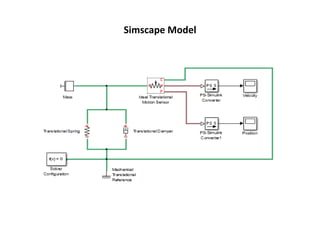
Simscape Model
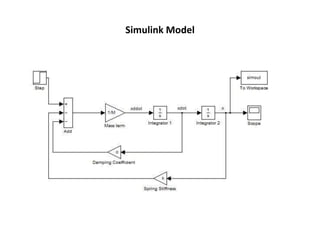
Simulink Model
MATLAB : Time Response For 
Different Types of Vibration
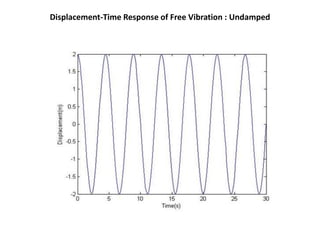
Displacement-Time Response of Free Vibration : Undamped
Velocity-Time Responce of Free Vibration: Undamped
Displacement-Time Responce of damped Free Vibration: Critically Damped
Velocity-Time Responce of damped Free Vibration: Critically Damped
Displacement-Time Responce of damped Free Vibration: Under Damped
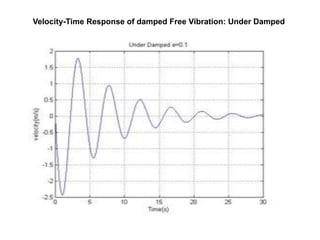
Velocity-Time Response of damped Free Vibration: Under Damped
Displacement-Time Response of damped Free Vibration: Over Damped
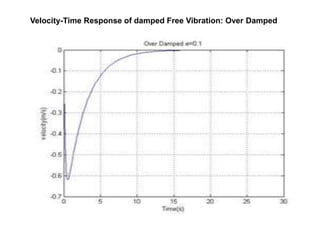
Velocity-Time Response of damped Free Vibration: Over Damped
Displacement-Time Response of Forced Vibration: Undamped
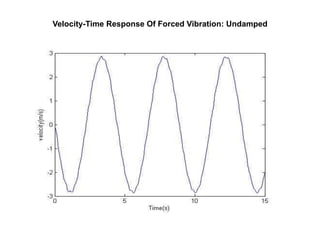
Velocity-Time Response Of Forced Vibration: Undamped
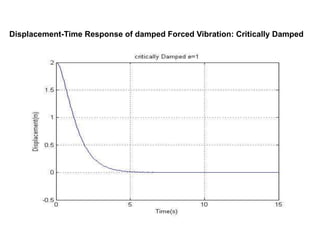
Displacement-Time Response of damped Forced Vibration: Critically Damped
Velocity-Time Response of damped Forced Vibration: Critically Damped
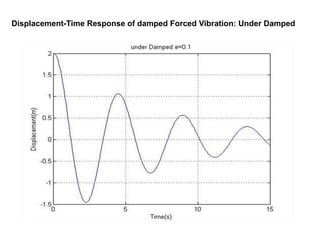
Displacement-Time Response of damped Forced Vibration: Under Damped
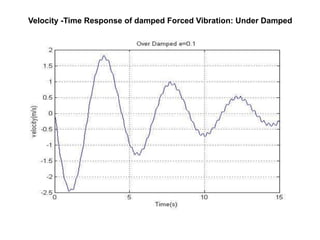
Velocity -Time Response of damped Forced Vibration: Under Damped
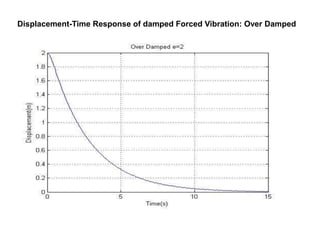
Displacement-Time Response of damped Forced Vibration: Over Damped
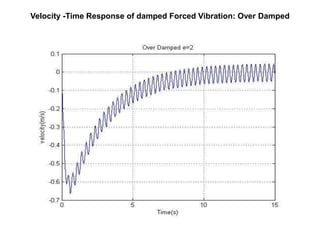
Velocity -Time Response of damped Forced Vibration: Over Damped
VIBRATION ANALYSIS
• The frequency analysis involves a frequency spectrum which 
provides us with the detailed information of the signal sources not able 
to be obtained from the time signal. 
• It provides information on the vibrations caused due to rotating 
parts and tooth meshing. 
• Process involves sending a signal through a filter and at the same 
time sweeping the filter over the frequency range of filters, it gives us 
the frequency spectrum. 
• Monitoring of a fan: The most likely fault to occur is unbalance, This 
will normally also be the highest level in the spectrum. To see if 
unbalance is developing, it is therefore sufficient to measure the 
overall level at regular intervals
• The overall level will reflect the increase just as well as the 
spectrum. 
• Monitoring of a gearbox: Damaged or worn gears will show up as 
an increase in the vibration level at the tooth meshing frequencies 
(shaft RPM number of teeth) and their harmonics. 
• The levels at these frequencies are normally much lower than the 
highest level in the frequency spectrum, so it is necessary to use a 
full spectrum comparison to reveal a developing fault. 
• Presenting the data: The data is presented in the form of linear 
scales with ranges dictated by the range of data but it does not 
allow to see some important data ,Hence logarithmic scales are 
used.
VIBXPERT 
• VIBXPERT is a device that helps in vibrations analysis. It provides us 
with many key functions. 
• Route based data collection ,Vibration diagnosis ,Field balancing , 
Multimeter ,Data logging ,Visual inspection ,Print reports on USB 
stick ,Time waveform ,Amplitude spectrum , Static shaft position 
(for balancing) ,Long term recording ,Printing of measurement 
reports are the functions it performs
Refrences
Bibliography 
[1]. Tobias, S.A. Machine Tool Vibration. Spain : UMRO, 1961. 
[2]. Chatter in machining process: A review. Guillem Quintana, Joquim Ciurana. 2011, International Journal of 
Machine tools and Manufacture, pp. 363-376. 
[3]. S.A. Tobais, W. Fishwick. Theory of regenerative machine tool chatter. s.l. : The Engineer, 1958. 
[4]. A review of chatter vibration research in turning. M. Siddhpura, R. Paurobally. 1, s.l. : ELSEVIER, 2012, 
International Journal of machine tools and manufacture, Vol. 61, pp. 27-47. 
[5]. On the art of cutting metals. F.Taylor. 1907, Transactions of ASME , Vol. 28. 
[6]. The stability of machine tools against self-excited vibrations in machining. J. Tlusty, M. Polacek. 1963, 
International Research in Production Engineering, pp. 465–474. 
[7]. Theory of self-excited machine-tool chatter-contribution to machine tool chatter research—1. Merrit, H.E. 
1965, ASME Journal of Engineering for Industry, pp. 447-454. 
[8]. Robust Analysis of Stability in Internal Turning. Giovanni Totis, Marco Sortino. Udine, Italy : ELSEVIER, 2014. 
24th DAAAM International Symposium on Intelligent Manufacturing and Automation. Vol. 69, pp. 1306-1315. 
[9]. Viscous damping identification in linear vibration. S. Adhikari, J. Woodhouse. 2007, Journal of Sound and 
Vibration , Vol. 303, pp. 475-500. 
[10]. Jiao Chunwang, Liu Jie, Guo Dameng and Wang Qianqian. A New Method for Solving Nonlinear Forced 
Vibration System Response. 2010. 
[11]. Wahab, M. A. Dynamics and Vibration: An Introduction. s.l. : John Wiley & Sons Ltd., 2008. 
[12]. Rattan, S.S. Theory of Machines. 3. New Delhi : McGraw Hill Education (India) Private Ltd., 2009. 
[13]. Study of the correlation between surface generation and cutting vibrations in peripheral milling. Hao 
Jiang, Xinhua Long, Guang Meng. Shanghai, China : s.n., 2008, journal of materials processing technology, Vol. 
208, pp. 229-238.

Mechanical Vibration

  • 1.
    Analysis of MechanicalVibration in spring mass damper model and Machining Processes for the partial fulfillment to the degree of Bachelor of Technology in Mechanical Engineering by Ankur Shukla (2K12/ME/044) Ankur Gupta (2K12/ME/043) Aman Handa (2K12/ME/028) Under the supervision of Dr. R.C. Singh Shri Rooplal Mechanical Engineering Department Delhi Technological University,Delhi-110042
  • 2.
  • 3.
    • Vibration isa mechanical phenomenon whereby oscillations occur about an equilibrium point. • The oscillations may be periodic such as the motion of a pendulum or random such as the movement of a tire on a gravel road. • Vibration is undesirable, wasting energy and creating unwanted sound – noise.
  • 4.
    Types of Vibrations • FREE VIBRATION occurs when a mechanical system is set off with an initial input and then allowed to vibrate freely. • FORCED VIBRATION is when a time-varying disturbance (load, displacement or velocity) is applied to a mechanical system. The disturbance can be a periodic, steady-state input, a transient input, or a random input.
  • 5.
    DAMPING • Dampingis an influence within or upon an oscillatory system that has the effect of reducing, restricting or preventing its oscillations. • OVERDAMPED: The system returns (exponentially decays) to equilibrium without oscillating. • CRITICALLY DAMPED: The system returns to equilibrium as quickly as possible without oscillating. • UNDERDAMPED: The system oscillates (at reduced frequency compared to the undamped case) with the amplitude gradually decreasing to zero. • UNDAMPED: The system oscillates at its natural resonant frequency (ωo).
  • 6.
  • 7.
    • In thisstudy we analyzed very basic form of vibrations such as free, forced vibration with and without damping. • We have included our experimentation results and these results are compared with results obtained via MATLAB, to plot the model natural frequency curve. • In this study we have represented a vibration analyser, which is able to analyse the chatter vibration in machining processes and machine parts and represent it in an easy and understandable form. • The objective to conduct this study is to analyse the different type of vibration in machining processes by presented vibration analyser.
  • 8.
  • 9.
    • Vibration canbe regarded as a branch of dynamics that deals with periodic and oscillatory motion. Common example of vibration problems are the response of civil engineering structures to dynamic loading, ambient condition and earthquakes, vibration of the unbalanced rotating machines and vibration of power line due to wind excitations, and aircraft wings [11]. • Vibrations are produced in machine having unbalanced masses. These vibrations will be transmitted to the foundation upon which the machine is installed. This is usually undesirable. To diminish the transmitted vibration, machines are usually mounted on spring or dampers, or on some other vibration isolating material [12]. • Phani Srikantha A., Woodhouse J. [9] studied parametric identification of viscous damping models in the context of linear vibration theory. Frequency domain identification methods based on measured frequency response functions (FRFs) are considered.
  • 10.
    •Jiao Chunwang, LiuJie, Guo Dameng and Wang Qianqian [10] studied that It is of paramount importance to acquire the response of many nonlinear forced vibration system. They developed a new method to explore the approximate analytical solution of forced vibration system which is named harmonic iteration method (HIM). •Hao Jiang, Xinhua Long, and Guang Meng [13] said Cutting vibration is unavoidable during a machining process and has great impact on the machined surface. With the increase of the demand on the highquality of surface finish, the effects of cutting vibrationon surface generationattract a lot of attentions. •A great deal of research has been carried out on the chatter problem since the late 1950s, when Tobias and Fishwick [3], Tlusty and Polacek [6] and Merrit [7] presented the first research results focused on this phenomenon. Lots of significant advances have been made over the years. Advances in computers, sensors and actuators have increased understanding of the phenomena, and developed and improved strategies to solve the problem [2].
  • 11.
  • 12.
    Natural frequency forfree vibration without damping k m 1 2 푑2푥 푑푡2
  • 13.
    Natural frequency forfree vibration with damping c 2 m Time response:
  • 14.
  • 15.
  • 16.
    Two Degrees ofFreedom: Vibration Equations of Motion: Using matrix notation:
  • 17.
    Definition of matrices: Mass Matrix (M): Stiffness Matrix (k): General Equation: General Solution:
  • 18.
    Two Degree ofFreedom: Vibration with damping Equations of motion: This can be rewritten in matrix format:
  • 19.
    More compact form: This differential equation can be solved by assuming the following type of solution: Now equation becomes an eigen value problem The solution to the problem results in N eigenvalues (i.e. ), where N corresponds to the number of degrees of freedom. Note: This method can applied for multiple degree of vibration.
  • 20.
  • 21.
  • 22.
  • 23.
    MATLAB : TimeResponse For Different Types of Vibration
  • 24.
    Displacement-Time Response ofFree Vibration : Undamped
  • 25.
    Velocity-Time Responce ofFree Vibration: Undamped
  • 26.
    Displacement-Time Responce ofdamped Free Vibration: Critically Damped
  • 27.
    Velocity-Time Responce ofdamped Free Vibration: Critically Damped
  • 28.
    Displacement-Time Responce ofdamped Free Vibration: Under Damped
  • 29.
    Velocity-Time Response ofdamped Free Vibration: Under Damped
  • 30.
    Displacement-Time Response ofdamped Free Vibration: Over Damped
  • 31.
    Velocity-Time Response ofdamped Free Vibration: Over Damped
  • 32.
    Displacement-Time Response ofForced Vibration: Undamped
  • 33.
    Velocity-Time Response OfForced Vibration: Undamped
  • 34.
    Displacement-Time Response ofdamped Forced Vibration: Critically Damped
  • 35.
    Velocity-Time Response ofdamped Forced Vibration: Critically Damped
  • 36.
    Displacement-Time Response ofdamped Forced Vibration: Under Damped
  • 37.
    Velocity -Time Responseof damped Forced Vibration: Under Damped
  • 38.
    Displacement-Time Response ofdamped Forced Vibration: Over Damped
  • 39.
    Velocity -Time Responseof damped Forced Vibration: Over Damped
  • 40.
  • 41.
    • The frequencyanalysis involves a frequency spectrum which provides us with the detailed information of the signal sources not able to be obtained from the time signal. • It provides information on the vibrations caused due to rotating parts and tooth meshing. • Process involves sending a signal through a filter and at the same time sweeping the filter over the frequency range of filters, it gives us the frequency spectrum. • Monitoring of a fan: The most likely fault to occur is unbalance, This will normally also be the highest level in the spectrum. To see if unbalance is developing, it is therefore sufficient to measure the overall level at regular intervals
  • 42.
    • The overalllevel will reflect the increase just as well as the spectrum. • Monitoring of a gearbox: Damaged or worn gears will show up as an increase in the vibration level at the tooth meshing frequencies (shaft RPM number of teeth) and their harmonics. • The levels at these frequencies are normally much lower than the highest level in the frequency spectrum, so it is necessary to use a full spectrum comparison to reveal a developing fault. • Presenting the data: The data is presented in the form of linear scales with ranges dictated by the range of data but it does not allow to see some important data ,Hence logarithmic scales are used.
  • 43.
    VIBXPERT • VIBXPERTis a device that helps in vibrations analysis. It provides us with many key functions. • Route based data collection ,Vibration diagnosis ,Field balancing , Multimeter ,Data logging ,Visual inspection ,Print reports on USB stick ,Time waveform ,Amplitude spectrum , Static shaft position (for balancing) ,Long term recording ,Printing of measurement reports are the functions it performs
  • 44.
  • 45.
    Bibliography [1]. Tobias,S.A. Machine Tool Vibration. Spain : UMRO, 1961. [2]. Chatter in machining process: A review. Guillem Quintana, Joquim Ciurana. 2011, International Journal of Machine tools and Manufacture, pp. 363-376. [3]. S.A. Tobais, W. Fishwick. Theory of regenerative machine tool chatter. s.l. : The Engineer, 1958. [4]. A review of chatter vibration research in turning. M. Siddhpura, R. Paurobally. 1, s.l. : ELSEVIER, 2012, International Journal of machine tools and manufacture, Vol. 61, pp. 27-47. [5]. On the art of cutting metals. F.Taylor. 1907, Transactions of ASME , Vol. 28. [6]. The stability of machine tools against self-excited vibrations in machining. J. Tlusty, M. Polacek. 1963, International Research in Production Engineering, pp. 465–474. [7]. Theory of self-excited machine-tool chatter-contribution to machine tool chatter research—1. Merrit, H.E. 1965, ASME Journal of Engineering for Industry, pp. 447-454. [8]. Robust Analysis of Stability in Internal Turning. Giovanni Totis, Marco Sortino. Udine, Italy : ELSEVIER, 2014. 24th DAAAM International Symposium on Intelligent Manufacturing and Automation. Vol. 69, pp. 1306-1315. [9]. Viscous damping identification in linear vibration. S. Adhikari, J. Woodhouse. 2007, Journal of Sound and Vibration , Vol. 303, pp. 475-500. [10]. Jiao Chunwang, Liu Jie, Guo Dameng and Wang Qianqian. A New Method for Solving Nonlinear Forced Vibration System Response. 2010. [11]. Wahab, M. A. Dynamics and Vibration: An Introduction. s.l. : John Wiley & Sons Ltd., 2008. [12]. Rattan, S.S. Theory of Machines. 3. New Delhi : McGraw Hill Education (India) Private Ltd., 2009. [13]. Study of the correlation between surface generation and cutting vibrations in peripheral milling. Hao Jiang, Xinhua Long, Guang Meng. Shanghai, China : s.n., 2008, journal of materials processing technology, Vol. 208, pp. 229-238.